

Note: This article contains affiliate links. If you click on these links and make a purchase, I may earn a small commission at no extra cost to you. This helps support my research and content. Read my full affiliate disclosure here.
Tropical plants have high nutrient and humidity demands that affect foliage color, flower production, and root health. Choosing the right fertilizer for tropical plants matters because incorrect ratios or application methods can cause tip burn, leggy growth, or reduced bloom. This guide shortlists seven top options suited to indoor and outdoor tropicals and explains the practical tradeoffs you need to weigh. We evaluated products across feeding schedule, nutrient balance, and ease of use so you can pick a fertilizer that fits your watering habits and the kinds of tropicals you grow. Below are the top picks followed by clear buying guidance and the criteria used to select them.
Top Picks at a Glance
| Best Overall The best all-around choice for most situations | Miracle-Gro Indoor Plant Food for Tropicals, Liquid, 8 fl. oz. (2-Pack) |  |
| Best Quality Built to a higher standard if you want something more solid | BLESS YOUR SOIL Big Green Leaves Indoor Plant Food, 1 lb Concentrated Powder |  |
| Best Value The sweet spot between price and what you get | Purived All-Purpose Liquid Plant Fertilizer, 16 oz (makes 50 gal) |  |
| Best Budget The cheapest option that still gets the job done reliably | Miracle-Gro Indoor Plant Food Spikes for All Plants, 48 Spikes |  |
| Highest Rated A top-rated pick with lots of positive feedback | Miracle-Gro Water Soluble All Purpose Plant Food, 12.5 lb |  |
| Most Popular A crowd favorite that many people choose with confidence | TPS NUTRIENTS Indoor Plant Food Liquid Fertilizer, 8 oz |  |
| Best Seller A high-volume bestseller chosen again and again | Miracle-Gro Indoor Plant Food, Liquid, 8 oz. (2-Pack) |  |
Miracle-Gro Indoor Plant Food for Tropicals, Liquid, 8 fl. oz. (2-Pack)

| Item Form | Liquid |
|---|---|
| Application Method | Directly to soil or mixed with water |
| Target Species | Tropical Plants |
| Mixing Ratio | 4 pumps:1 quart of water |
| Unit Count | 16 Fluid Ounces |
This Miracle-Gro indoor plant food is a ready-to-use liquid fertilizer made specifically for tropical houseplants like monsteras, palms, crotons and pothos. You can apply it directly to potting soil or dilute the formula (4 pumps per quart) and feed when you water, with reapplication every two weeks. The potassium-focused formula is designed to encourage lush green foliage, and the pump dosing makes it easy to give small or larger pots the right amount without measuring. Practical benefits include simple, regular feeding that integrates into a normal watering routine and the convenience of two small bottles that are easy to store. Limitations are that coverage is listed as low so a single bottle will only treat a modest collection and you will need to follow the pump/dilution guidance carefully to avoid overfeeding. This product works best as part of routine indoor plant care alongside fresh potting mix and occasional repotting rather than as a one-time fix for severely nutrient-deficient plants.
Best for: Houseplant owners who want a simple, twice-monthly liquid fertilizer to maintain healthy tropical foliage and prefer an easy pump dosing system that fits into regular watering.
Less Ideal for: People managing large plant collections, nursery growers, or those needing a high-coverage or slow-release solution should consider higher-capacity or different-format fertilizers.
- Formulated for tropical houseplants with added potassium to support lush foliage
- Easy pump dosing for direct soil application or mixing with water
- Liquid form feeds plants immediately and integrates with regular watering
- Comes as a two-pack so you have a spare bottle for ongoing care
- Coverage rated low, so bottles will not feed large collections for long
Verdict: A convenient, potassium-focused liquid feed for tropical houseplants that makes twice-monthly dosing quick and fuss-free.
BLESS YOUR SOIL Big Green Leaves Indoor Plant Food, 1 lb Concentrated Powder

| NPK Ratio | 12-4-8 |
|---|---|
| Form | Powder, water-soluble concentrate |
| Yield | Makes ~90 gallons of solution |
| Application Methods | Soil drench, foliar feed, hydroponic/LECA compatible |
| Includes | Pre-measured teaspoon scoop |
Big Green Leaves is a dry, water-soluble houseplant fertilizer designed to drive leafy growth in tropical indoor plants. It mixes quickly with a pre-measured scoop and yields roughly 90 gallons of feed solution from a 1 lb pouch, so it is typically used as a routine soil drench or foliar spray every 2–4 weeks during active growth. The 12-4-8 NPK leans high on nitrogen for bigger leaves and stems while included sea kelp and a chelated micronutrient blend support root development and consistent uptake across variable pH levels. Practical benefits include compatibility with potting mixes, soilless media, and hydro/LECA systems, a resealable pouch for tidy storage, and no fillers or urea that can cause salt buildup. Important limitations are that its formulation is aimed at foliage-driven tropicals rather than cacti, succulents, or high-phosphorus flowering plants, and the concentrated powder requires careful measuring and dilution to avoid overfeeding sensitive specimens. For growers focused on vigorous leaf production, it delivers a clear, concentrated option with broad application modes.
Best for: Buyers who prioritize rapid, healthy leaf growth on tropical and foliage houseplants and want a concentrated, value-oriented fertilizer they can use across soil and soilless systems.
Less Ideal for: Gardeners who mainly grow succulents, cacti, or flowering houseplants that require higher phosphorus or very low-nitrogen fertilizers should choose a product tailored to those needs.
- High 12-4-8 NPK tailored for leafy tropical houseplants to promote rapid foliage growth.
- Contains sea kelp and chelated micronutrients to support root health and improve nutrient uptake.
- Very concentrated yield (about 90 gallons per pound) for lower cost and less packaging than liquid fertilizers.
- Versatile application: soil drench, foliar feed, hydroponic and LECA compatibility.
- Resealable pouch with a pre-measured scoop for consistent mixing and tidy storage.
- Not formulated for cacti, succulents, or flowering plants that need higher phosphorus levels.
- Requires accurate measuring and dilution because of its concentration, which can risk overfeeding if misused.
Verdict: If you want fast, fuller foliage on tropical houseplants, this concentrated 12-4-8 powder gives strong, versatile feeding and excellent value per gallon.
Purived All-Purpose Liquid Plant Fertilizer, 16 oz (makes 50 gal)

| Item Form | Liquid |
|---|---|
| Specific Uses For Product | Houseplant Fertilizer |
| Application Method | soil drench, foliar feed, full & semi hydroponics |
| Liquid Volume | 16 fluid ounces |
| Mixing Ratio | 320:1 |
Purived All-Purpose Liquid Plant Fertilizer is a concentrated, versatile feed for indoor and potted tropical plants. One 16 oz bottle mixes to about 50 gallons using the supplied mixing ratio and supplies a full-spectrum mix of NPK plus micronutrients like iron, magnesium, zinc, and boron. It is used as a soil drench, foliar spray, or in full and semi-hydroponic systems, so you can switch feeding methods without changing products. The formula is odorless and designed for frequent, routine feeding; the product guidance of one cap per gallon simplifies dosing for regular maintenance. Practical advantages include a long shelf life and straightforward dilution, but buyers should measure carefully to avoid overfeeding and follow safety directions since the concentrate contains a wide range of minerals. This works well as a general maintenance feed to keep foliage glossy and promote steady growth, though growers wanting tailored macronutrient ratios for specific tropical species may prefer a specialty fertilizer formulated for high-nitrogen or bloom-focused cycles.
Best for: Buyers who want a single, easy-to-mix liquid fertilizer for routine feeding of mixed tropical houseplants and who value convenience and broad nutrient coverage.
Less Ideal for: Specialist growers who need tailored macronutrient schedules for flowering or nutrient-sensitive exotic species should consider dedicated formulations instead.
- Highly concentrated so one bottle makes about 50 gallons, reducing refill frequency
- Versatile application: soil drench, foliar feed, and compatible with full and semi-hydroponics
- Contains a broad spectrum of micronutrients in addition to NPK for balanced feeding
- Odorless formula with a clear mixing ratio makes regular dosing simple
- Not formulated for specific tropical species needs or bloom stimulation programs
- Concentrate requires careful measuring to avoid over-application
Verdict: A convenient, concentrated all-purpose liquid feed that simplifies regular nutrition for a wide range of tropical houseplants.
Miracle-Gro Indoor Plant Food Spikes for All Plants, 48 Spikes

| Item Form | Sticks |
|---|---|
| Application Method | Insert spike into soil |
| Coverage | Full |
| Target Species | Houseplants |
| Unit Count | 48 Count |
Miracle-Gro Indoor Plant Food Spikes are preformed fertilizer sticks designed to simplify feeding for houseplants, including tropical varieties. You use the included aerator to make a small hole, press a spike into the soil, cover it, and water as usual. Each spike releases nutrients over about two months, so a single application reduces the need for frequent liquid feeding. The pack of 48 gives broad coverage across several pots and the stick form keeps the process tidy and low-maintenance. For tropical plants the steady slow-release feeding can support steady growth and leaf development without the risk of overwatering with liquid concentrates. The product is intentionally basic: it lists N, P, K as ingredients but does not provide a detailed NPK ratio on the product page, so users who want precise nutrient balance or specialized formulas for specific tropical needs may prefer liquid or granular feeds with labeled ratios. Coverage recommendations vary by pot size, so expect to use more spikes for larger tropical specimens. These spikes are best used as a convenient baseline feeding between more targeted fertilizer treatments.
Best for: Buyers who want an inexpensive, no-fuss way to keep indoor tropical plants fed between more targeted treatments and prefer set-and-forget maintenance over frequent mixing and measuring.
Less Ideal for: Growers who need precise, adjustable nutrient ratios for flowering, boosting or recovery of specific tropical species should choose a labeled liquid or granular fertilizer instead.
- Pre-measured sticks give up to two months of continuous feeding per application
- Very low maintenance and tidy to apply with the Miracle-Aerator hole method
- Large 48-count pack covers multiple plants and reduces trip frequency
- Suitable for a wide range of indoor plants including tropicals
- No specific NPK ratio shown on the product information for precise nutrient planning
- May require many spikes for large pots or big tropical specimens
Verdict: A budget-friendly, low-maintenance way to provide steady two-month feeding for indoor tropical plants without daily fuss.
Miracle-Gro Water Soluble All Purpose Plant Food, 12.5 lb

| Item Form | Powder |
|---|---|
| Specific Uses For Product | Plant Food |
| Coverage | general purpose, suitable for various plants |
| Mixing Ratio | 1 tablespoon per gallon of water |
Miracle‑Gro Water Soluble All Purpose Plant Food is a powdered, water‑soluble fertilizer designed to feed flowers, vegetables, houseplants, shrubs and trees by dissolving into a watering can or garden feeder. You mix the powder at the recommended ratio (1 tablespoon per gallon for general use) and apply every 1 to 2 weeks; smaller doses are specified for indoor plants. Its NPK profile is formulated to encourage growth and quick results compared with unfed plants, and a single 12.5 lb container claims to cover roughly 5,000 sq ft when used as directed. The product is flexible for container and in‑ground use and is safe to use across many plant types when directions are followed. Limitations include the generic formulation: tropical plants that need specialized nutrient balances or lower salt tolerance may benefit from a product tailored to tropicals, and reliance on a water‑soluble program requires consistent feeding and proper dilution to avoid overfertilizing. The included scoop and clear mixing directions make regular application straightforward for steady results.
Best for: Buyers who prioritize a reliable, easy‑to‑use fertilizer program and want a single product that feeds a wide range of plants with predictable results.
Less Ideal for: Growers seeking a fertilizer formulated specifically for tropical species with custom nutrient ratios or lower salt formulations should consider specialty tropical fertilizers instead.
- Water‑soluble formula feeds plants quickly when watered in
- Clear mixing ratios and included scoop simplify regular application
- Versatile for indoor and outdoor use, including containers and in‑ground beds
- Large 12.5 lb container covers a lot of garden area for routine feeding
- All‑purpose NPK may not match specific micronutrient needs of tropical plants
- Requires regular, correct mixing and application to avoid fertilizer burn
Verdict: A dependable, easy‑to‑apply water‑soluble fertilizer for growers who want a single, regular‑use product to keep diverse plants fed.
TPS NUTRIENTS Indoor Plant Food Liquid Fertilizer, 8 oz

| Item Form | Liquid |
|---|---|
| Application Method | Watering can |
| Specific Uses For Product | Plant Food |
| Unit Count | 8 Fluid Ounces |
| Mixing Ratio | 2:1 (oz/gallon) or 1:64 (tbsp/gallon) |
This 8 oz liquid indoor plant fertilizer is designed to be mixed with water and applied with your normal watering routine to support foliage color, new leaf production, and root strength. It is a liquid concentrate with a kelp-enriched formula intended for weekly or regular feeding of common tropical houseplants such as monstera, pothos, philodendron, and fiddle leaf fig. The product highlights easy mixing (manufacturer suggests roughly 1 tablespoon per 32 oz of water) and compatibility with a watering-can application, which makes dosing straightforward for growers who already water by hand. Practical benefits include quicker visible leaf vigor, steadier new growth, and healthier root development when used consistently. Limitations are the small 8 oz bottle size relative to repeat feedings for multiple or large plants and the absence of an NPK breakdown on the provided information, which means growers wanting precise macronutrient control may need to look elsewhere or rotate products for specific needs.
Best for: Houseplant owners who want an easy, kelp-boosted liquid feed to promote greener leaves and steady new growth in tropical indoor plants and prefer a simple watering-can application.
Less Ideal for: Growers who need exact macronutrient ratios for specialized feeding schedules or those managing large plant collections where a larger-volume product would be more economical.
- Liquid concentrate that mixes easily with water for straightforward weekly feeding
- Kelp-enriched formula intended to support leaf vibrancy and new growth
- Suitable for a wide range of indoor tropical houseplants
- Applied via watering can so it fits into normal watering routines
- Small 8 oz bottle can require frequent repurchase for collections of multiple plants
- No NPK or full nutrient breakdown provided in the listed details
Verdict: A convenient kelp-enriched liquid feed that makes weekly fertilizing of tropical houseplants simple and delivers noticeable leaf and root improvement.
Miracle-Gro Indoor Plant Food, Liquid, 8 oz. (2-Pack)
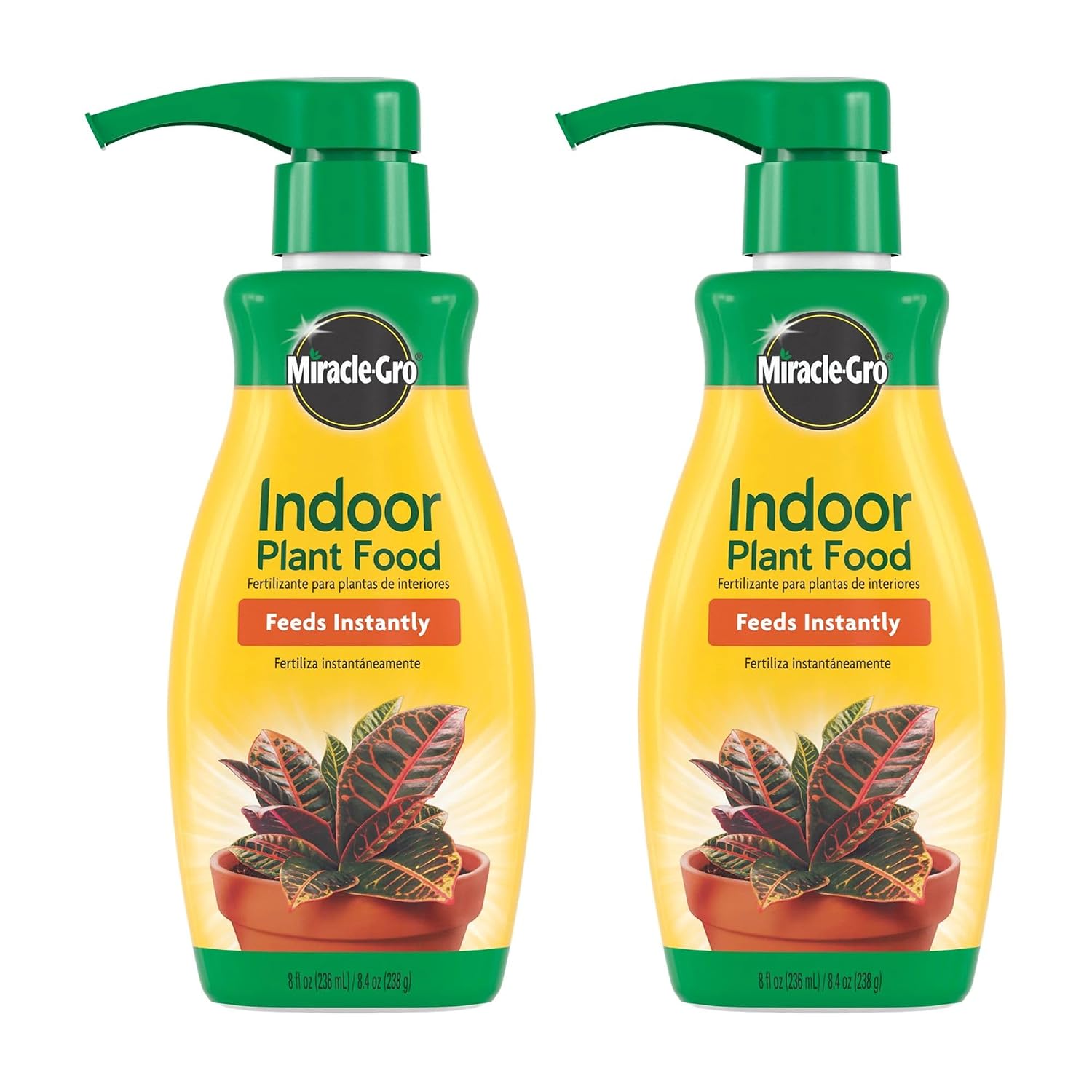
| Item Form | Liquid |
|---|---|
| Application Method | Apply directly to the soil or mix with water |
| Coverage | Pot size |
| Number of Packs | 2 |
| Target Species | Peace Lily, Snake Plant, Croton, Succulents, Herbs |
Miracle-Gro Indoor Plant Food is a liquid fertilizer intended for routine weekly feeding of indoor container plants, including many tropical houseplants. It is typically applied directly to the potting soil with the built-in pump or diluted in water for larger containers, which makes dosing quick and repeatable. The formula feeds plants instantly so you can see greener foliage and steadier growth when used consistently. Practical benefits include easy application without measuring tools, compatibility with a wide range of species from snake plants to peace lilies and herbs, and the convenience of two small bottles that fit in a cupboard. Important limitations are that it is a general-purpose, water-soluble feed rather than a specialty formula for flowering or high-nitrogen needs, and weekly application means ongoing maintenance rather than a slow-release set-and-forget option. For risk-averse gardeners this product is straightforward to use, but those seeking custom nutrient balances for heavy-feeding tropical specimens may prefer a targeted fertilizer instead.
Best for: Home growers who want a simple, reliable weekly fertilizer to keep common indoor tropical plants healthy without complicated mixing or measuring.
Less Ideal for: Collectors growing demanding or fast-growing tropical specimens that need tailored N-P-K ratios or programmable fertigation should look for specialty or concentrated fertilizers.
- Ready-to-use liquid with a pump for easy, repeatable dosing
- Suitable for a wide range of common indoor and tropical houseplants
- Feeds plants instantly for noticeable foliage improvement
- Comes as a two-bottle pack for extended supply
- General-purpose formula may not meet specific nutrient needs of heavy-feeding tropical species
- Requires weekly application rather than providing slow-release convenience
Verdict: A no-fuss, pump-dosed liquid fertilizer that makes weekly feeding easy for everyday tropical houseplants.
Choosing the Right Fertilizer for Tropical Plants: Key Factors to Consider
Nutrient Ratio and Balance
Tropical plants vary in their nitrogen, phosphorus, and potassium needs depending on whether they are grown for foliage or blooms. A balanced NPK suited to foliage development will encourage lush leaves, while a higher phosphorus approach can support flowering species. Look at the numbers and match the ratio to your plant goals.
Beyond NPK, the presence and form of micronutrients like iron, magnesium, manganese, and trace elements affect long-term leaf color and vigor. Chelated or plant-available forms are more reliable, especially in potting mixes with variable pH.
Application Method and Flexibility
Tropical gardeners use several feeding methods: regular liquid feeds, periodic slow-release granules, or foliar sprays for quick correction. A fertilizer that performs well across more than one method gives you flexibility when humidity or potting mix moisture makes a particular approach impractical.
Foliar feeding can correct deficiencies quickly, but it is temporary and best paired with root feeding. Slow-release options reduce the risk of overfeeding but may not supply micronutrients evenly over time.
Salt Index and Root Safety
Many tropical species are sensitive to excess soluble salts, which cause brown leaf tips and stunted roots. A fertilizer with a lower salt index or clear dilution guidance reduces that risk. Also consider how easily a product can be flushed from the medium when salt buildup occurs.
If you water frequently or use concentrated feeds, choose products with explicit instructions for dosing and periodic leaching to protect delicate root systems.
Micronutrient Completeness
Tropical plants frequently show subtle deficiencies that reduce leaf intensity and growth rate. Fertilizers that include chelated iron, magnesium, and trace elements help maintain rich green tones and natural pigmentation in leaves.
If your water or potting mix tends to lock up micronutrients, prioritize formulas that list these elements and their chemical form so you can predict availability.
Feed Frequency and Maintenance
Consider how often you want to feed. Liquid feeds typically require weekly or biweekly application during active growth, while slow-release granules or spikes can last months. Frequent feeding allows precise control but requires consistent effort.
Maintenance also includes flushing pots to prevent salt accumulation and adjusting rates seasonally. Choose a regimen that matches the time you can commit to routine care.
Matching Fertilizer To Tropical Plant Types
Different tropical plants have distinct needs. Broad-leaved foliage plants often need steady nitrogen to maintain large leaves, while flowering tropicals benefit from slightly higher phosphorus during bloom cycles. Succulent tropicals and epiphytic types prefer lighter, more frequent feeds with low salt loads.
- Foliage first: steady, balanced nutrient supply
- Flowering species: boost phosphorus during buds and bloom
- Epiphytes/air plants: dilute feeds and focus on micronutrients
Application Timing and Seasonal Adjustments
Tropical plants have active growth periods and slower dormancy phases. Increase feeding frequency and slightly richer ratios during warm, actively growing months. Reduce or pause feeding in cooler, lower-light periods to prevent salt buildup and unnecessary growth spurts that stress the plant.
- Active growth: feed more often with balanced liquid fertilizer
- Dormant season: reduce or stop fertilizing
- After repotting: wait a few weeks before resuming regular feeds
Using Foliar Feeding Effectively
Foliar sprays can quickly correct deficiencies and give a fast visual boost to leaf color. Apply in the morning so leaves dry during the day and avoid foliar feeding when temperatures are very hot or when plants are under drought stress. Use dilute solutions and follow concentration guidance to prevent leaf burn.
- Use foliar feeds for quick correction, not as sole nutrition
- Spray during cooler parts of the day to improve uptake
- Always dilute and test on a small area first
Soil Media and pH Considerations
Potting mixes and pH influence nutrient availability. Many tropicals prefer slightly acidic conditions where iron and manganese remain available. If your media is neutral to alkaline, choose fertilizers with chelated micronutrients or correct the pH to improve uptake. Well-draining mixes reduce root rot and limit salt accumulation.
- Check and adjust pH when deficiencies persist
- Use mixes that retain moisture but drain well to protect roots
- Micronutrient chelates help in higher pH substrates
Safety and Storage for Garden Supplies
Store fertilizers in a cool, dry place away from direct sunlight and moisture. Keep products sealed to prevent caking and degradation of micronutrients. Handle concentrated liquids and powders with gloves to avoid skin irritation and follow label instructions for storage life.
- Seal containers after use to maintain stability
- Keep out of reach of pets and children
- Record purchase or open dates for inventory control
How We Chose the Best Fertilizer for Tropical Plants
We focused on formulas and application styles that match how tropical plants behave in real growing conditions. Criteria included nutrient ratio and bioavailability, which determines how readily leaves and roots take up essential NPK and micronutrients; application flexibility, evaluating whether a product works for foliar feeding, soil drench, or slow release; salt management, looking at fertilizer salt index and guidance to avoid tip burn in sensitive tropical foliage; and compatibility with typical tropical media, including peat, coco coir, and loam-based potting mixes. We also considered formulation stability in humid environments and whether the product supplies micronutrients like magnesium and iron that tropicals often need. Exclusions applied to any fertilizer primarily designed for lawns, heavy-feeding vegetables, or products lacking clear nutrient analysis and application instructions. The final shortlist highlights options that balance nutrient completeness, ease of use, and lower risk of fertilizer salt damage for a range of tropical houseplants and patio specimens.
FAQ
How often should I feed tropical houseplants?
It often depends on growth and season. During active spring and summer growth, many tropicals do well with a diluted liquid feed every one to two weeks or a balanced slow-release every three months. Reduce feeding in fall and winter when growth slows.
Can I use a general houseplant fertilizer on tropicals?
Often yes if the general fertilizer supplies a balanced NPK and micronutrients appropriate for foliage. Check the ratio and ensure it does not have a high salt index. For specialized flowering tropicals, adjust phosphorus during bloom.
Is foliar feeding necessary for tropical plants?
Foliar feeding is useful for quick correction of deficiencies and for delivering micronutrients directly to leaves. It is usually supplemental and works best combined with regular root feeding rather than as the sole nutrient source.
How do I avoid fertilizer burn on sensitive tropicals?
Use lower concentrations than label maximums when first applying and water thoroughly after feeding to distribute salts. Choose lower salt-index formulas and flush pots periodically if you notice browning leaf tips or slowed growth.
Should I change fertilizer when repotting tropical plants?
Wait a few weeks after repotting to let roots recover before resuming regular feeding. If you use a potting mix with incorporated slow-release nutrients, reduce or skip added fertilizer until those have declined.
Do tropical plants need micronutrients beyond NPK?
Usually yes. Micronutrients like iron, magnesium, and manganese influence leaf color and health, and deficiencies are common in pot cultures. Select fertilizers that list these elements in available forms when possible.
Final Verdict
Prioritize the feeding approach that matches how you grow tropicals: choose balanced, plant-available nutrients for foliage-focused specimens and adjust phosphorus for flowering types. Match the application method to your routine so you can maintain regular, measured feeding without creating salt buildup. Pay attention to micronutrients and salt control to keep leaves vibrant and roots healthy. When you align nutrient ratio, application flexibility, and salt management with the plant types you keep, selecting among the top fertilizer options becomes a matter of convenience and compatibility rather than guesswork.
