

Note: This article contains affiliate links. If you click on these links and make a purchase, I may earn a small commission at no extra cost to you. This helps support my research and content. Read my full affiliate disclosure here.
If you manage several acres of turf, pasture, or a broad landscape, small-scale baits and spot treatments are inefficient and time consuming. Choosing a product formulated for large areas matters because coverage rate, residual activity, and application method determine how quickly mounds are reduced and how long reinfestation is delayed. This guide covers the top shortlisted fire ant control options designed for extensive grounds and explains the practical tradeoffs between fast knockdown and long-term suppression. You will see the evaluation criteria used to narrow the list and what to expect from the treatments in a working garden or property. Read on to learn which product types and application approaches work best across lawns, fields, and acreage and why we rated each option against the same practical standards.
Top Picks at a Glance
| Best Overall The best all-around choice for most situations | Extinguish Plus Fire Ant Killer, 25 lb Bag |  |
| Best Value The sweet spot between price and what you get | Spectracide One-Shot Fire Ant Killer Granules, 5 lb |  |
| Best Budget The cheapest option that still gets the job done reliably | Ortho Orthene Fire Ant Killer Broadcast Granules, 11.5 lb |  |
| Highest Rated A top-rated pick with lots of positive feedback | Ortho Fire Ant Killer Broadcast Granules, 13 lb. |  |
| Most Popular A crowd favorite that many people choose with confidence | Ortho Fire Ant Killer Broadcast Granules, 11.5 lb |  |
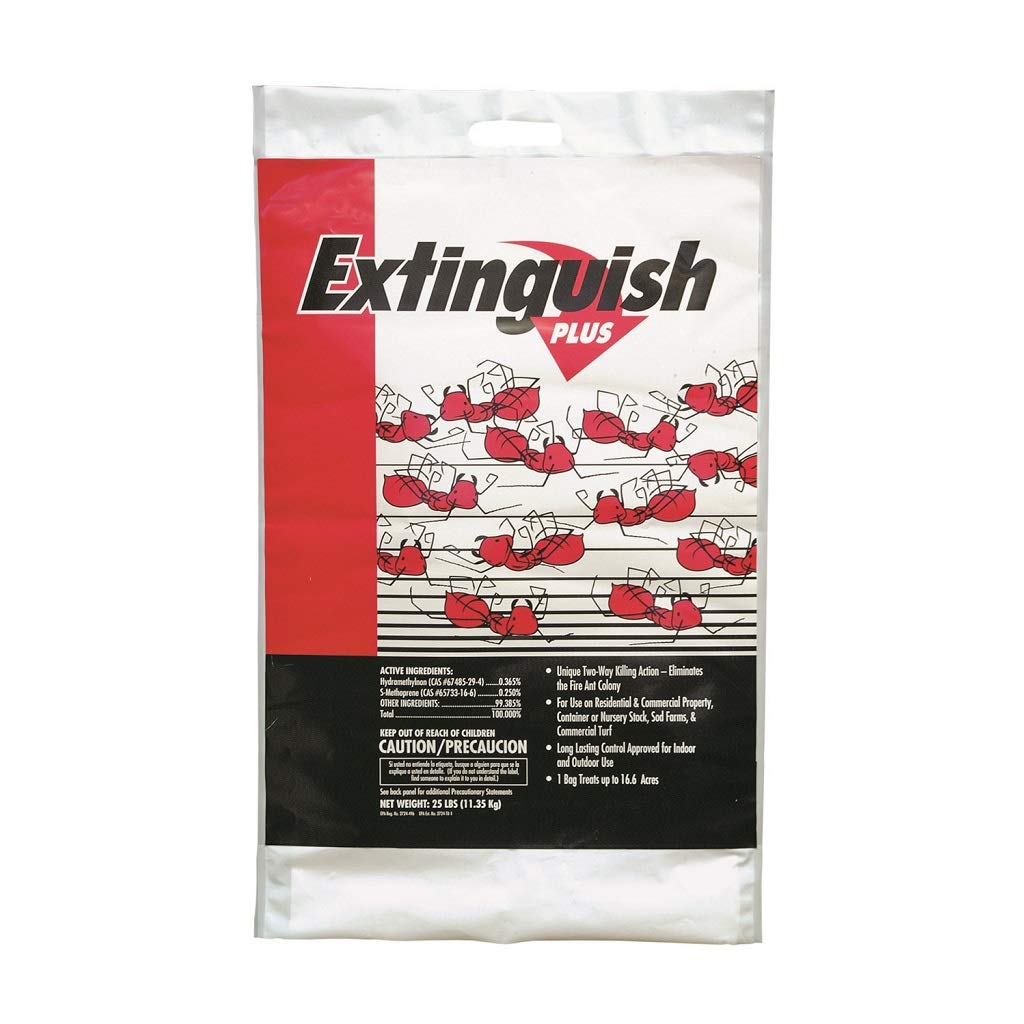
Extinguish Plus Fire Ant Killer, 25 lb Bag
| Item Form | Granules |
|---|---|
| Target Species | Insects |
| Active Ingredients | Hydramethylnon 0.365%, S‑Methoprene 0.250% |
Extinguish Plus is a granular fire ant bait formulated to attract and eliminate entire colonies by combining a fast-acting adulticide (hydramethylnon) with an insect growth regulator (s‑methoprene) that prevents queen reproduction. It is applied as a broadcast treatment or to individual mounds when ants are actively foraging, making it practical for treating large yards, pastures, or other broad outdoor spaces. Notable features include a dual-action formula that provides both quick knockdown and longer-term suppression and a 25 lb bag size that covers substantial area between applications. Practical benefits are straightforward application, suitability for use around grazing livestock when used as directed, and instructions that help time treatments for best uptake. Important limitations are that it should only be used outdoors, it is toxic to fish and aquatic environments, and effectiveness depends on correct timing when ants are feeding, which may require multiple observations and repeat applications for complete control across very large or heavily infested properties.
Best for: Buyers who need a broadly effective, easy-to-apply solution for controlling fire ants across large lawns, pastures, or acreage and who prioritize both immediate knockdown and longer-term suppression.
Less Ideal for: People needing a non-toxic or water-safe option or those managing small indoor infestations should consider different products or targeted treatments.
- Dual-action formula gives rapid worker kill plus long-term colony suppression
- Large 25 lb bag suitable for treating extensive areas or multiple applications
- Granular form can be used as broadcast treatment or applied to individual mounds
- Approved for use in areas with grazing cattle and horses when directions are followed
- Toxic to fish and aquatic environments so cannot be used near water
- Needs ants to be actively foraging for bait uptake which may require timing checks and repeat visits
Verdict: A large 25 lb granular bait that combines fast worker kill with an IGR for practical, long-lasting fire ant control over large outdoor areas.
Spectracide One-Shot Fire Ant Killer Granules, 5 lb

| Item Form | Granules |
|---|---|
| Target Species | Insects |
| Included Components | Spectracide HG-96848 One Shot Fire Ant Killer, 5 lbs |
Spectracide One-Shot is a granular bait you scatter around mounds or apply across turf with a spreader for broad coverage. It relies on foraging worker ants to pick up the granules and carry the active ingredient back to the queen and colony, so you may see increased ant activity briefly before the colony declines. A single 5 lb bag treats up to 10,000 square feet for broadcast applications and is intended for use in early spring through summer, applied in morning or evening when ants are actively foraging. No watering is required after application, and control can begin within 24 to 48 hours with colony reduction lasting up to three months. The formulation is easy to apply and useful for large lawns or multiple mounds, but it is a bait so timing and application conditions matter; wet or recently mowed turf can reduce effectiveness and multiple seasonal applications may be needed for long-term suppression. Follow label directions for safe outdoor use and to get the best results.
Best for: Homeowners or property managers who need a practical, easy-to-apply solution for treating multiple mounds or large lawns and prefer a product that reduces colony numbers rather than just killing surface workers.
Less Ideal for: People who need an immediate visible knockdown of foraging ants or who cannot control application timing relative to weather and mowing should consider a different fast-acting surface treatment.
- Granular bait taken to the colony for systemic control of queen and workers
- Covers large areas—5 lb treats up to 10,000 sq ft for broadcast use
- No watering required after application which simplifies use
- Works as both mound and broadcast treatment for flexible application
- Effectiveness depends on ants actively foraging so timing and weather affect results
- Initial increase in visible ants as workers carry bait back to the colony
Verdict: A single 5 lb bag delivers straightforward, long-lasting bait control over large lawns when applied at the right time.
Ortho Orthene Fire Ant Killer Broadcast Granules, 11.5 lb

| Item Form | Granules |
|---|---|
| Unit Count | 1 Count |
| Manufacturer | The Scotts Company LLC |
| Coverage | Up to 5,000 sq. ft. |
| Protection Duration | Up to 6 months |
Ortho Orthene Fire Ant Killer Broadcast Granules is a lawn-directed granular treatment designed as the second step in a two-step fire ant control system. You apply it with a broadcast or rotary spreader over the entire lawn when ants are active in the morning or evening, water the granules in, and keep people and pets off the area until it dries. The product is formulated to prevent new mounds from forming and offers up to six months of residual protection across a treated area. A single 11.5 lb bag covers up to 5,000 sq ft, which makes it practical for treating large yards without repeated trips to reapply. Important limitations are that it is for outdoor broadcast use only and works best when paired with a mound treatment to eliminate established colonies. Timing the application to the recommended temperature range and watering after spreading are necessary for best performance.
Best for: Homeowners managing large lawns who prioritize an affordable, single broadcast treatment to prevent future fire ant mounds and reduce repeat applications.
Less Ideal for: People who need an immediate single-step solution to kill active mounds without additional mound treatments or those who cannot follow post-application watering and access restrictions.
- Up to 6 months of residual protection against new fire ant mounds
- Covers up to 5,000 sq ft per 11.5 lb bag, suitable for large lawns
- Designed for broadcast spreader application for even, whole-lawn treatment
- Helps prevent reinfestation from neighboring areas when applied lawn-wide
- Does not kill existing mounds on its own and should be paired with a mound treatment
- Requires watering in after application and restricted access until dry
Verdict: A cost-effective broadcast granular treatment that gives large lawns up to six months of protection from new fire ant mounds when used as part of a two-step control plan.
Ortho Fire Ant Killer Broadcast Granules, 13 lb.

| Item Form | Granules |
|---|---|
| Target Species | Insects |
| Item Weight | 13 pounds |
Ortho Fire Ant Killer Broadcast Granules is a lawn-scale granular product intended as the second step in a two-step fire ant control system. You apply it with a broadcast or drop spreader over the entire lawn and then water the granules in; a 13 lb. bag covers up to about 5,650 sq ft. The formula is fast acting against mounds, advertised to kill mounds in roughly 15 minutes, and provides residual protection for up to six months to help prevent new mounds from fly-in queens or neighboring infestations. Practical benefits include broad-area coverage for large yards and compatibility with standard spreaders, which makes routine seasonal treatment straightforward. Important limitations are that it is designed for outdoor use only and is Step 2 of the system, so existing mounds are best addressed first with a mound-specific product; follow label directions for pet and reentry safety and to achieve the stated performance. For gardeners who need reliable, follow-up protection across a large lawn this product simplifies maintenance, but expect to pair it with an immediate mound treatment when active colonies are present.
Best for: Homeowners maintaining large lawns who prioritize dependable, long-lasting prevention and routine seasonal treatment over spot-only fixes.
Less Ideal for: People who need a single-product instant colony elimination for visible mounds or those who want an indoor-safe solution should consider mound treatments or alternative products.
- Covers up to 5,650 sq ft from a single 13 lb. bag, suitable for large residential lawns
- Fast acting formula that claims to kill mounds in about 15 minutes
- Provides residual protection for up to six months to reduce reinfestation
- Designed for broadcast application with standard spreaders for even coverage
- Not intended to eliminate existing mounds on its own and is marketed as Step 2 of a two-step system
- Contains active ingredients that require watering in and temporary exclusion of people and pets until area dries
Verdict: Use this broadcast granular as the reliable follow-up treatment to protect a large lawn for months after you eliminate active mounds.
Ortho Fire Ant Killer Broadcast Granules, 11.5 lb

| Unit Count | 184 Ounce |
|---|---|
| Item Form | Granules |
| Target Species | Insects |
| Active Ingredients | Bifenthrin |
Ortho Fire Ant Killer Broadcast Granules are a lawn-scale granular treatment formulated to control fire ants across broad turf areas. You apply it with a drop or broadcast spreader over your lawn in spring and late summer, then water it in; an 11.5 lb bag is sized to treat up to 5,000 sq. ft. The product contains bifenthrin and is advertised to kill mounds in about 15 minutes and to prevent new mounds from forming for up to six months, making it useful as the second step in a two-step program that first targets existing mounds. For homeowners managing large yards this lets you treat the whole lawn to reduce reinfestation from neighboring areas. Important limitations: it is a chemical pesticide so you must follow PPE and safety directions carefully and avoid non-target exposure, and the manufacturer recommends pairing it with a mound-specific product to destroy established colonies. It works best when applied during cooler parts of the day and watered in as instructed.
Best for: Homeowners responsible for large lawns who want a whole-yard preventive treatment and value quick knockdown plus months-long residual control.
Less Ideal for: People looking for an organic or non-chemical option or those who only need a targeted mound-by-mound solution.
- Formulated to kill fire ant mounds rapidly, with manufacturer claim of 15-minute action
- Provides residual control for up to six months to help prevent new mounds
- Covers up to 5,000 sq. ft. per 11.5 lb bag, suitable for large lawns
- Designed for broadcast application with a spreader for even, whole-lawn protection
- Contains a synthetic pyrethroid (bifenthrin) so requires PPE and careful handling to limit exposure
- Not intended as a standalone mound killer; manufacturer recommends a separate mound treatment for existing colonies
Verdict: A practical broadcast treatment for homeowners who need fast mound control and long residual protection across large lawns.
Choosing the Right Fire Ant Killer for Large Areas: Key Factors to Consider
Coverage Rate and Pack Size
Coverage rate determines how quickly you can treat a large property. Products formulated for large areas include clear spreader or spray rates per acre; these rates let you estimate how many bags or gallons you need and how many passes with a spreader or sprayer are required.
Pack size matters because small consumer packages mean frequent reloads and wasted time. For acreage, look for formulations sold in larger sacks or concentrates that dilute to cover many acres. Confirm label guidance for the application rate so you avoid under- or over-application, both of which reduce effectiveness or increase risk.
Residual Control Versus Knockdown Speed
Some treatments deliver rapid knockdown of active mounds but wear off quickly, requiring follow-up applications. Others provide slower initial control but leave a longer residual that suppresses new colonies for weeks or months.
Decide whether you need immediate relief from aggressive mounding or a longer maintenance window. Often the most efficient strategy for large areas is an initial treatment with a product that gives reasonable knockdown followed by a residual product that limits reinfestation.
Application Method and Equipment Compatibility
Large-area control needs application methods that scale: broadcast spreaders, ATV-mounted spreaders, tractor-mounted boom sprayers, or hydraulic sprayers for liquid treatments. Check label compatibility with common equipment and whether the formulation clogs nozzles or requires special calibration.
Ease of calibrating the equipment, consistency of granule size for even spread, and whether the product mixes cleanly in sprayer tanks will affect how uniformly the area is treated and how much labor the job requires.
Safety for People, Pets, and Livestock
When treating acreage you are more likely to expose people, pets, or farm animals to treated areas. Review reentry intervals, grazing restrictions, and any specific precautions for children or companion animals.
Products with lower acute toxicity and clear reentry guidance reduce downtime and make it easier to incorporate treatment into routine land management. Always follow label directions to protect non-targets.
Environmental Persistence and Runoff Risk
Active ingredients vary in how long they persist in soil and their potential to move with runoff. On sloped ground or near water features, choose options with lower runoff potential and clear buffer zone guidance on the label.
Long environmental persistence can aid suppression but may also increase risk to beneficial insects and aquatic life. Account for proximity to pollinator habitat and watercourses when choosing a control product for large-area use.
Timing and Seasonal Considerations
Effectiveness of fire ant treatments often depends on timing. Many products perform best when ants are actively foraging or during certain temperature ranges when bait uptake is highest.
Plan applications during peak activity windows and consider follow-up timing for residual products. Seasonal management reduces the number of treatments needed across the year and helps protect vulnerable turf or crops during establishment.
Choosing Between Granular Baits and Liquid Treatments
Granular baits distribute active ingredients across the soil surface where foraging workers pick up and carry particles into the nest. They are generally easier to spread across large lawns and pastures using broadcast or vehicle-mounted spreaders and often require less immediate mixing and cleanup.
Liquid treatments can provide faster contact knockdown when applied as a drench or broadcast spray, and they allow for precise calibration of active ingredient per acre. However, liquids require suitable sprayer equipment and attention to nozzle selection and agitation to keep material evenly suspended.
- Granules: simpler spreader calibration, less risk of nozzle clogging.
- Liquids: faster contact control, adjustable rate per acre, may require buffer zones near water.
Preparing the Site and Timing Applications
Before treating, mow or graze the area to reduce vegetation height so granules reach the soil and sprays contact active ants. Timing applications for warm, dry days when ants are actively foraging improves bait uptake and contact efficacy.
Avoid treating before heavy rain unless the label specifies rainfast times. On slopes or near drains, follow buffer recommendations and consider using products with lower mobility to limit off-target movement.
- Mow first to increase bait visibility to ants.
- Apply on calm, dry days when ants are active.
- Check weather forecasts to avoid wash-off from rain.
Safety Planning for Large-Area Treatments
Treating acreage introduces logistical safety concerns. Create a reentry plan with clear timelines for when people, pets, and livestock can return to treated zones. Post-treatment signage or temporary fencing helps manage access for several hours or days depending on label instructions.
Store and handle concentrates and larger-pack formulations safely. Use appropriate personal protective equipment for mixing and loading, and keep an eye on wind direction during spray operations to avoid drift onto sensitive areas.
- Plan reentry intervals for grazing and human access.
- Use PPE for mixing and loading concentrates.
- Mark treated areas until they meet label reentry guidance.
Monitoring Effectiveness and Scheduling Follow-Ups
After an initial treatment, inspect previously active mounds and forage trails to assess knockdown. For large areas, set up a sampling approach-check a representative number of plots rather than every mound to monitor results efficiently.
Schedule follow-up treatments based on observed activity and the labeled residual window. Integrating cultural controls such as reducing thatch and improving drainage can reduce reestablishment pressure and extend the interval between chemical treatments.
- Use representative sampling to check control across acreage.
- Plan follow-ups based on activity and residual duration.
- Combine chemical control with cultural practices to reduce reinfestation.
Integrating Fire Ant Control Into Landscape Management
Treating fire ants on large properties is most effective when part of a broader management plan. Coordinate control with pasture rotations, turf renovation, or seeding schedules to avoid disturbing treated zones and to protect newly established plants.
Consider habitat modifications that make the landscape less attractive to ants, such as reducing debris piles and addressing irrigation issues that create overly moist zones where colonies often thrive.
- Coordinate treatments with other landscape operations.
- Remove debris and correct irrigation issues to reduce nesting sites.
- Document application dates and location to inform future management.
How We Chose the Best Fire Ant Killer for Large Areas
To compile this list we focused on products and formulations intended for treating broad turf, pasture, or landscape areas rather than single-mound spot fixes. We used six concrete evaluation dimensions relevant to large-area control: coverage rate per application, residual activity duration, mode of application and ease of treating acreage, safety profile for people and non-target animals, and environmental persistence or runoff risk. We also considered label directions for maximum treated acreage to ensure realistic application rates. Products were excluded if they are strictly for spot treatment only, lack clear application rates for large areas, or rely on methods impractical for acreage (for example, handheld granular volumes designed only for yard-scale use). We did not include specialty baits intended exclusively for indoor or ornamental potted-plant use. The final shortlist emphasizes formulations and application options that let gardeners and land managers treat wide areas effectively while balancing speed of control and long-term suppression.
FAQ
How much area does a typical large-area formulation cover per application?
Coverage varies by formulation and label rate. Many products provide clear per-acre application rates on the label so you can calculate how many bags or gallons are needed. Always follow the label to avoid under-application.
Can I treat fields used for grazing or hay production?
Some products are labeled for use on pasture or rangeland but often include specific grazing or harvest restrictions. Check reentry intervals and grazing or cutting-for-hay timelines before treating to ensure animal and forage safety.
Is it better to broadcast bait or target active mounds on large properties?
For acreage, broadcast baiting is usually more efficient because it treats foraging workers across a wide area, helping deliver bait into multiple colonies. Targeting active mounds can be labor intensive and less practical across large tracts.
How soon will I see results after an application?
Response time depends on product type. Contact sprays can show quick knockdown within hours to days, while baits may take several days to weeks as workers carry bait into the nest and the active ingredient spreads. Expect different timelines and plan follow-ups accordingly.
Will treatments harm pollinators or beneficial insects on my property?
Risk to pollinators depends on the active ingredient and application timing. Avoid spraying flowering plants and follow buffer recommendations. Baits with targeted attractants can reduce non-target exposure compared with broad-spectrum sprays.
What should I do if rain is forecast after treatment?
Rain can wash off some treatments or reduce bait availability. Check the product label for rainfast times and apply when a dry window is forecast. If heavy rain occurs soon after application, a follow-up treatment may be necessary per label directions.
Final Verdict
For large-area fire ant control prioritize products and application methods that let you treat acres efficiently while balancing immediate knockdown and lasting suppression. Focus on coverage per acre, compatibility with your spreader or sprayer, and safety instructions that match how the land is used. Account for environmental risks and seasonal timing when scheduling treatments. With a plan that combines appropriate product choice, correct application rates, and monitoring, you can reduce mounding across wide properties while minimizing non-target impacts.
