

Note: This article contains affiliate links. If you click on these links and make a purchase, I may earn a small commission at no extra cost to you. This helps support my research and content. Read my full affiliate disclosure here.
Growing healthy, productive pumpkins depends heavily on choosing the right fertilizer for pumpkin plants. Too much nitrogen early on and you get lots of leaves but few blooms. Too little phosphorus or potassium and fruit set and size suffer. This guide shortlists seven top options tailored to the needs of pumpkin growers and explains how each was evaluated. You will find practical guidance on nutrient balance, timing, and application methods that suit garden beds, raised beds, and containers. The picks below are the top-rated choices for pumpkin production, followed by clear buying factors and care tips to help you pick the best fit for your patch.
Top Picks at a Glance
| Best Overall The best all-around choice for most situations | Pendelton Pumpkin Juice 11-8-5 Foliar Liquid Fertilizer (1 qt) |  |
| Best Quality Built to a higher standard if you want something more solid | FoxFarm Big Bloom Liquid Plant Food, 16 fl oz |  |
| Best Value The sweet spot between price and what you get | Scotts All Purpose Flower & Vegetable Continuous Release Plant Food, 3 lb |  |
| Best Budget The cheapest option that still gets the job done reliably | Miracle-Gro Water Soluble Tomato Plant Food, 1.5 lb |  |
| Highest Rated A top-rated pick with lots of positive feedback | Miracle-Gro Water Soluble All Purpose Plant Food, 12.5 lb |  |
| Most Popular A crowd favorite that many people choose with confidence | Farmer's Secret Fruit & Bloom Booster Liquid Fertilizer (8 oz) |  |
| Best Seller A high-volume bestseller chosen again and again | Miracle-Gro Liquid All Purpose Plant Food Concentrate, 32 oz. |  |
Pendelton Pumpkin Juice 11-8-5 Foliar Liquid Fertilizer (1 qt)
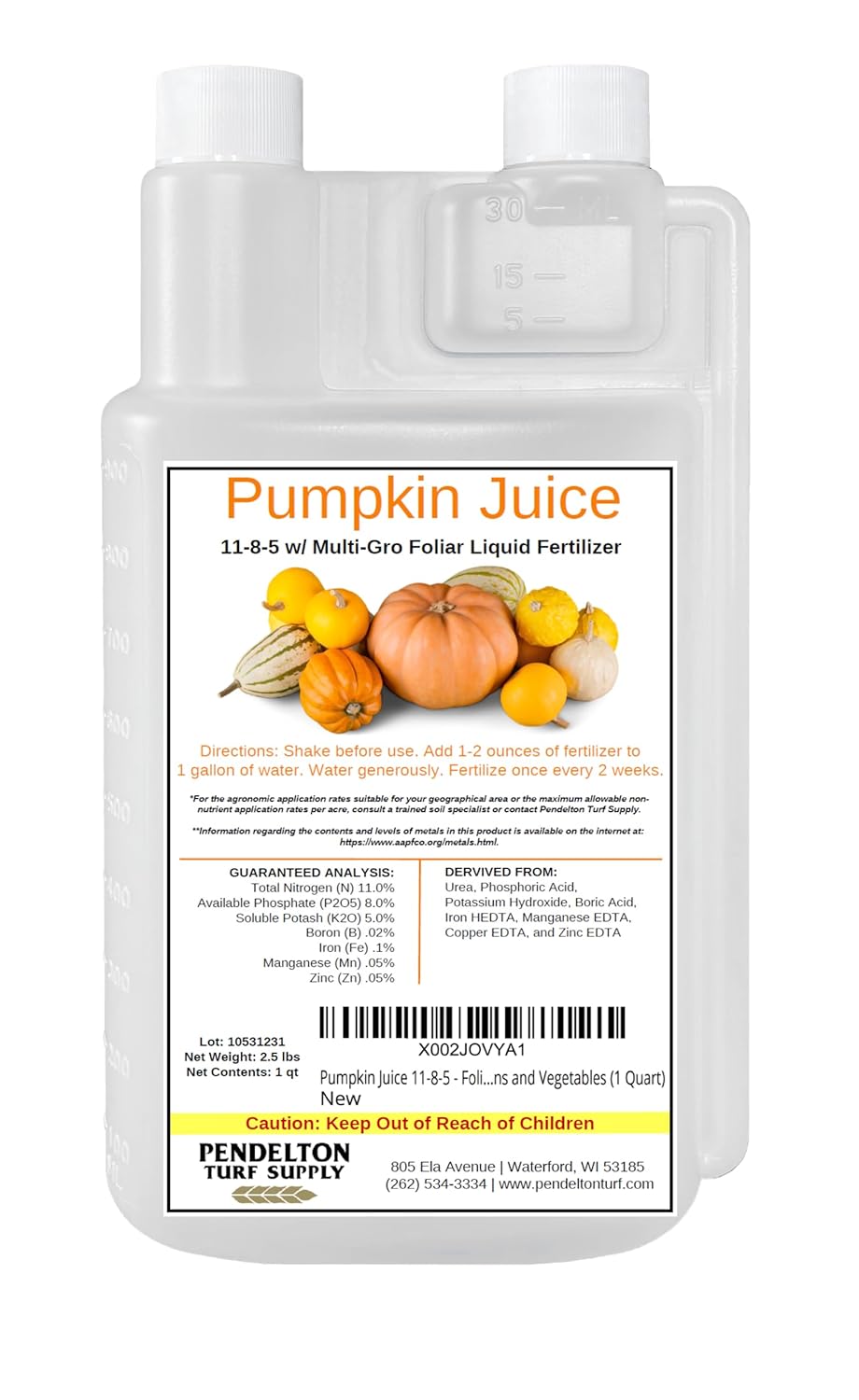
| Item Form | Liquid |
|---|---|
| Application Method | foliar |
| Target Species | pumpkins and vegetables |
| Mixing Ratio | 128:1 |
| Liquid Volume | 1 quarts |
Pumpkin Juice is a concentrated foliar and root-feed liquid fertilizer designed to speed vegetative growth and support fruit development in pumpkins and other vegetables. You dilute the product at the recommended mixing ratio (about 128:1) and apply it as a foliar spray or soil drench, which makes it useful for both quick nutrient boosts and routine feeding. The 11-8-5 NPK blend plus trace boron, iron, manganese, and zinc delivers nitrogen for leafy growth, phosphorus for root and bloom development, and potassium for overall plant vigor. The bottle includes a squeeze-measure cap for straightforward dosing and produces a large amount of usable solution from one quart. Important limitations are that this is a supplement rather than a complete soil fertility program and its acidic foliar formulation requires following label rates to avoid leaf burn. For growers wanting faster growth and improved yields on pumpkins, it is a practical, easy-to-use concentrate when combined with good soil management.
Best for: Gardeners growing pumpkins or similar vining vegetables who want a straightforward, concentrated feed to boost growth and yields and who already manage basic soil fertility.
Less Ideal for: Growers seeking a complete granular soil amendment or those who prefer only slow-release, soil-only fertilizers should look elsewhere.
- Concentrated formula yields many gallons from one quart for repeated feedings
- Combined foliar and root application offers flexible use during the season
- Balanced 11-8-5 NPK targets foliage, bloom, and fruit development
- Includes micronutrients (B, Fe, Mn, Zn) that support flowering and fruit set
- Squeeze-measure bottle simplifies accurate mixing and application
- Product is a supplement and should not replace a comprehensive soil fertility plan
- Acidic foliar formulation requires careful dilution to avoid foliar burn
Verdict: A concentrated, easy-to-dilute foliar and root-feed fertilizer that quickly boosts pumpkin growth and supports better yields.
FoxFarm Big Bloom Liquid Plant Food, 16 fl oz

| Item Form | Liquid |
|---|---|
| Specific Uses For Product | Organic |
| Application Method | watering can, sprayer, or drip system |
| Liquid Volume | 16 fluid ounces |
FoxFarm Big Bloom is a concentrated liquid bloom food intended to boost flowers and fruit by delivering readily available organic nutrients. You mix a small dose into watering cans, sprayers, hose-end applicators, or drip systems and apply it with regular watering; the product is OMRI listed for organic gardening and emphasizes bat guano and earthworm castings for quick uptake. For pumpkin growers it can help extend flowering and support fruit set when used through the bloom and fruiting period, and the liquid form makes it easy to feed container or in-ground plants without disturbing roots. Notable features include organic certification, compatibility with multiple application methods, and a user guide dosing of about 4 tablespoons per gallon. Important limits are that it contains phosphorus so local runoff rules may apply and liquid concentrates require careful measuring to avoid overapplication; it is not a one-time slow-release solution so regular feedings are needed during the growing season.
Best for: Pumpkin growers focused on maximizing flowering and fruit set who prioritize fast-acting, organic nutrient boosts applied during bloom and fruiting stages.
Less Ideal for: Gardeners who want a single slow-release fertilizer or who must strictly avoid phosphorus in their area should consider alternative products.
- OMRI listed and certified for organic gardening
- Formulated with bat guano and earthworm castings for bloom and fruit support
- Works with watering cans, sprayers, hose-end applicators, or drip systems
- Concentrated liquid for quick nutrient uptake and easy foliar or root feeding
- Contains phosphorus which may be restricted in some areas due to runoff rules
- Requires repeated applications rather than providing long-term slow release
Verdict: A compact, OMRI-listed liquid bloom fertilizer that delivers quick organic nutrients to support stronger flowering and bigger pumpkins when fed during bloom and fruiting.
Scotts All Purpose Flower & Vegetable Continuous Release Plant Food, 3 lb

| Item Form | Granules |
|---|---|
| Application Method | Sprinkle on soil and rake into top 1-3 inches |
| Target Species | All Purpose Flower & Vegetable Continuous Release Plant Food |
| Unit Count | 48 Ounce |
This Scotts continuous-release plant food is a simple, no-frills granular fertilizer made for in-ground flowers and vegetables. You apply it by sprinkling around plants, raking it into the top 1–3 inches of soil, and watering to activate; one 3 lb bag covers roughly 150 sq ft and feeds for about two months per application. The high-phosphorus formula is designed to encourage blooms and strong root development while providing steady nitrogen to support foliage and fruiting. For pumpkin growers the slow-release action reduces the need for frequent feeding during the growing season and the spreadable granules make it easy to treat beds or rows. Limitations: the bag is small for large pumpkin patches so expect to reapply or buy multiple bags, and continuous-release granules release nutrients more slowly than soluble feeds if you need an immediate boost. Follow label rates to avoid overapplication near crowns and trunks.
Best for: Gardeners who want a low-effort, steady feeding plan for in-ground vegetables and flowering plants and prefer scheduled, hands-off fertilizing during the growing season.
Less Ideal for: Growers who need quick corrective feeding, those managing very large pumpkin plots, or gardeners exclusively using containers where a water-soluble formula is preferred.
- Continuous-release granules feed plants for up to two months reducing application frequency
- Easy application: sprinkle, rake into topsoil and water
- Formulated for flowers and vegetables so it supports blooms and harvests
- Covers a typical garden area effectively from a small bag (approx. 150 sq ft)
- 3 lb bag is small for large or multiple pumpkin plants requiring repeated purchases
- Not water-soluble so it does not provide an immediate nutrient spike when plants are deficient
Verdict: Choose this product if you want an easy, steady two-month feeding that reduces how often you need to fertilize pumpkin beds.
Miracle-Gro Water Soluble Tomato Plant Food, 1.5 lb

| Item Form | Liquid |
|---|---|
| Application Method | Water Soluble |
| Specific Uses For Product | Plant Food |
| Target Species | Tomatoes and vegetables |
| Mixing Ratio | 18-18-21 |
Miracle-Gro Water Soluble Tomato Plant Food is a concentrated, water‑soluble fertilizer intended to give vegetables faster nourishment when mixed into a watering can or used with a garden feeder. The label formula (18-18-21) supplies balanced nitrogen, phosphorus and potassium for leafy growth and fruit development, and instructions call for feeding outdoor vegetables every 7 to 14 days. In practice this makes it easy to boost pumpkins and other vining vegetables during the growing season for larger fruits and fuller plants. The product dissolves quickly, works with standard hose feeders or watering cans, and is safe when used as directed so gardeners do not need specialized equipment. For budget-minded gardeners a single 1.5 lb container treats a moderate area and gives repeat feedings across the season, though frequent applications mean you will go through supply faster than with slow‑release granular options. Also it is a general vegetable formula rather than a pumpkin‑specific mix, so growers wanting specialty nutrient ratios may prefer a targeted product.
Best for: Gardeners who want a simple, fast-acting liquid fertilizer to boost pumpkin growth and fruit set without special equipment and who prioritize straightforward, repeatable feeding.
Less Ideal for: Growers looking for a low-maintenance, once‑per‑season granular solution or those who require a fertilizer formulated specifically for pumpkins and vine micronutrient needs.
- Balanced N-P-K (18-18-21) suitable for both foliage and fruit development
- Water‑soluble formula mixes quickly for use in a watering can or Miracle‑Gro Garden Feeder
- Feeds every 7–14 days for visible, relatively fast results
- Safe for use on vegetables when used as directed
- Requires frequent applications so you may need more product over a season compared with slow‑release fertilizers
- Not formulated specifically for pumpkins so it lacks pumpkin-optimized micronutrient ratios
Verdict: A fast‑acting, easy‑to‑mix liquid fertilizer that reliably boosts vegetable and pumpkin growth when fed every 1–2 weeks.
Miracle-Gro Water Soluble All Purpose Plant Food, 12.5 lb

| Item Form | Powder |
|---|---|
| Specific Uses For Product | Plant Food |
| Coverage | general purpose, suitable for various plants |
| Mixing Ratio | 1 tablespoon per gallon of water |
Miracle-Gro Water Soluble All Purpose Plant Food is a granular powder you dissolve in water to deliver fast-acting nutrition to plants. It is used by mixing the scoop with a watering can or a garden feeder and applying to the soil at the base of plants every 1 to 2 weeks. The formula provides a high nitrogen ratio that encourages leafy growth and general vigor, making it useful during the vegetative stage of fruiting plants. Practical benefits include clear mixing instructions and a large 12.5 pound container that covers substantial garden area. It is versatile enough for containers, in-ground beds, and garden feeders. Important limitations are that the product is a general-purpose feed rather than a specialty pumpkin or bloom-booster formula, so growers seeking high phosphorus for flower and fruit set may want to supplement with a bloom-focused fertilizer at key stages. Also it requires regular reapplication every 7 to 14 days for best results rather than a slow-release approach.
Best for: Gardeners who prioritize a dependable, easy-to-mix fertilizer to maintain vigorous vegetative growth across a mixed vegetable patch or pumpkin seedlings and who prefer predictable, repeatable feeding routines.
Less Ideal for: Growers looking for a single-product solution to maximize pumpkin flowering and fruit set or those who want a slow-release fertilizer that needs less frequent attention.
- Fast-acting water-soluble formula that feeds plants immediately when applied
- Clear mixing ratios and application instructions for indoor and outdoor use
- Large 12.5 lb container provides broad coverage for many plants and garden beds
- Versatile for use in containers, in-ground gardens, or with a garden feeder
- General all-purpose NPK may not provide the higher phosphorus levels some fruiting crops need during bloom and fruit set
- Requires frequent applications rather than offering long-term slow-release feeding
Verdict: A reliable, easy-to-use water-soluble fertilizer for gardeners who want predictable, fast feeding to support vegetative growth in pumpkin beds and mixed vegetable gardens.
Farmer's Secret Fruit & Bloom Booster Liquid Fertilizer (8 oz)

| Item Form | Liquid |
|---|---|
| Application Method | dilute with water and pour or spray |
| Mixing Ratio | 1 teaspoon : 2 gallons |
| Specific Uses For Product | Plant Food |
| Coverage | general garden use |
This concentrated liquid fertilizer is designed to encourage stronger roots, more blooms and higher fruit yields by supplying phosphorus, potassium and trace minerals in an immediately available form. You dilute 1 teaspoon per 2 gallons of water and apply as a soil drench or foliar spray every 1 to 2 weeks once plants begin to bud. The formula is aimed at mid-to-late growth stages and is marketed as compatible with watering cans, sprayers and irrigation systems for easy integration into regular watering. Practical benefits include fast nutrient uptake compared with granulars and a small bottle that treats a lot of plants because the concentrate is potent. Important limitations are that dosing must be measured carefully to avoid overfeeding and an 8 ounce bottle is small if you have a large patch of heavy feeders like pumpkins. The product documentation notes wide compatibility with many fruits and flowers and a long shelf life, which helps reduce risk for cautious buyers relying on community feedback and repeated use.
Best for: Gardeners who want a proven, concentrated bloom and fruit booster they can add to regular watering routines and who prefer products with strong user feedback and clear application guidance.
Less Ideal for: Growers managing very large or commercial pumpkin plantings who need bulk fertilizer solutions or slow-release granulars for low-maintenance feeding.
- High phosphorus and potassium formulation to encourage flowering and fruit set
- Concentrated liquid formula provides fast nutrient availability and long effective coverage from a small bottle
- Can be applied as a soil drench or foliar spray and is compatible with watering cans, sprayers and irrigation systems
- Includes trace minerals (iron, zinc, calcium) that support overall plant health and disease resistance
- 8 oz bottle may be insufficient for large gardens or extensive pumpkin patches
- Requires careful dilution and application frequency to avoid overfeeding
Verdict: A small, highly concentrated liquid formula to quickly boost blooms and fruit for backyard pumpkin growers who value proven results and easy application.
Miracle-Gro Liquid All Purpose Plant Food Concentrate, 32 oz.

| Item Form | Liquid |
|---|---|
| Specific Uses For Product | Plant Growth, Root Development |
| Application Method | Mix with water in a watering can |
| Unit Count | 32 Fluid Ounces |
| Mixing Ratio | 1:10 (concentrate to water, estimate) |
Miracle-Gro Liquid All Purpose Plant Food is a ready-to-mix concentrate designed to provide quick nutrients for flowers, vegetables, shrubs and houseplants. You dilute the concentrate in a watering can and apply it to the soil every 1 to 2 weeks; the label gives simple dosing for garden beds and containers, and a cap/teaspoon measure to avoid guesswork. Its liquid form delivers nutrients immediately to roots, which is useful for feeding pumpkins during active growth and fruit set when you want faster uptake than granular fertilizers. The product covers many plant types, so it removes the hassle of buying fertilizer for each crop. Limitations are its general-purpose formula rather than a pumpkin-specific NPK ratio and the need to remember frequent reapplication compared with slow-release options. Also you must follow the mixing directions to avoid overfeeding sensitive seedlings and young transplants.
Best for: Gardeners who want a simple, reliable liquid fertilizer to feed pumpkins and other garden plants on a regular schedule and who prefer clear, easy dosing instructions.
Less Ideal for: Growers seeking a specialty pumpkin formula or a low-maintenance slow‑release feed that requires fewer applications should consider targeted or granular alternatives.
- Concentrated liquid so nutrients are delivered quickly to roots
- Clear mixing instructions for garden and container use reduce dosing guesswork
- Works on a wide range of plants so one product covers multiple garden needs
- Not formulated specifically for pumpkins so it may lack an optimal NPK balance for maximum fruit size
Verdict: A straightforward liquid concentrate that gives pumpkins fast, easy-to-apply nutrition for gardeners who want predictable, frequent feeding.
Choosing the Right Fertilizer for Pumpkin Plants: Key Factors to Consider
Nutrient Ratio and Timing
Pumpkin plants need different nutrients at distinct stages. Early in the season, a slightly higher nitrogen level supports vigorous vine and leaf growth which helps plants capture light and build biomass. As plants begin to set flowers, the balance should shift toward phosphorus and potassium to encourage bloom production and fruit development. Choosing a fertilizer with a clear N-P-K ratio and understanding when to switch or supplement will directly affect how many flowers set and how large the fruits grow.
Timing matters because applying high nitrogen during flowering delays fruit set and can reduce final yield. Look for feeds that either change release rates over time or plan a two-stage feeding approach: a growth-phase formula followed by a bloom/fruiting-phase formula.
Release Type and Longevity
Granular slow-release products provide steady nutrition for weeks to months, lowering the chance of nutrient spikes that burn roots or favor leafy growth over fruiting. Water-soluble feeds give quick correction when plants show a deficiency or during heavy fruit development, but they require more frequent applications and monitoring.
Consider how often you want to feed and how consistent your watering schedule is. Inconsistent moisture can make soluble fertilizers less predictable, while many slow-release formulations are more forgiving for weekend gardeners or those with larger patches.
Micronutrients and Secondary Elements
Pumpkins benefit from elements beyond N-P-K. Magnesium supports photosynthesis, calcium helps prevent blossom end rot, and trace elements like boron and zinc play subtle roles in flower development and pollination success. A fertilizer that includes balanced secondary nutrients or that is compatible with common supplemental applications can prevent hidden deficiencies that reduce yields.
If your soil test shows specific shortfalls, choose a product that supplies those micronutrients or plan targeted foliar or soil amendments. Avoid over-application of micronutrient concentrates without testing, since excesses can be harmful.
Application Method and Labor
Different formulations suit different application workflows. Granules are easy to broadcast or band at planting and require minimal upkeep. Water-soluble powders or liquids let you feed at bloom and fruit set with a hose-end or watering-can drench. Foliar sprays can quickly correct early deficiencies but are not a standalone long-term strategy for pumpkins.
Think about how large your patch is and how much time you can commit. If you manage a few vines in containers, concentrated liquid or soluble feeds make sense. For in-ground or larger pumpkin areas, a granular slow-release applied at planting and a side-dressing at early fruit set might be less labor-intensive.
Soil Interaction and pH Effects
Fertilizer performance depends on soil texture and pH. Sandy soils leach nutrients more quickly and often need more frequent feeding or slow-release formulas to hold nutrients. Heavy clay soils retain nutrients but can tie up certain elements if pH is off. Some fertilizers also affect soil acidity; for example, ammonium-based nitrogen tends to acidify soil over time.
A baseline soil test informs choices. Matching fertilizer type and application rate to your soil reduces waste and avoids nutritional imbalances that can limit pumpkin size and fruit quality.
Environmental Impact and Runoff Risk
Pumpkin patches are often in gardens near lawns, water features, or storm drains. Fast-release, highly soluble nitrogen can run off during heavy rains and contribute to nutrient pollution. Slow-release formulations and correct application timing reduce runoff risk. Organic options release nutrients more slowly and can improve soil structure and microbial life but may require larger initial application rates.
Consider local weather patterns and landscape layout. Use targeted banding or side-dressing to keep nutrients where roots can access them and minimize movement off-site.
Feeding Schedule for Strong Vines and Big Fruits
Pumpkin feeding is a seasonal rhythm. Start with a balanced or slightly nitrogen-weighted feed during early vegetative growth, switch to a higher phosphorus and potassium focus when first true flowers appear, and continue light maintenance feedings through early fruit expansion. A common practical approach is an initial granular application at planting, a water-soluble boost at first bloom, and a side-dress when fruits are about the size of a fist.
Record feeding dates and plant responses. That simple log helps you refine timing the next season and avoid overfertilizing late in the cycle, which can stall ripening or promote excess vegetative growth at the expense of fruit finish.
- Apply starter granular feed at planting to support root establishment
- Use soluble phosphorus-rich boost at bloom to improve flower set
- Side-dress with potassium-focused feed during early fruit growth
Soil Testing and Adjusting Your Plan
A basic soil test before planting tells you pH, organic matter, and primary nutrient levels. That information guides whether to add lime, sulfur, or specific nutrient amendments. Adjust application rates to your soil's existing fertility rather than following generic packet directions.
Retest every two to three years if you regularly amend beds. For container-grown pumpkins, test potting mixes more often because they deplete faster and can shift pH with repeated feedings.
- Test pH and primary nutrients before the season
- Scale application rates to existing soil fertility
- Monitor containers monthly for nutrient depletion
Organic Vs Synthetic Options
Organic fertilizers release nutrients more slowly and can improve soil structure and microbial activity, which benefits long-term patch health. They are often less concentrated, so gardeners may need to apply larger volumes or combine organics with targeted soluble feeds during high-demand periods.
Synthetic fertilizers deliver nutrients predictably and are useful when you need fast correction. However, they require careful timing and correct rates to avoid encouraging too much leafy growth or causing burn in dry conditions.
- Organics build soil health but release nutrients slowly
- Synthetics act fast and are easier to target by stage
- Consider a hybrid approach for steady nutrition and timely boosts
Preventing Common Nutrient Disorders
Blossom end rot, yellowing leaves, and poor flowering are often signs of nutrient or pH problems rather than disease. Blossom end rot usually relates to calcium availability and irregular water supply. Yellowing or interveinal chlorosis can indicate magnesium or iron deficiencies depending on the pattern.
Manage disorders by correcting underlying soil conditions, applying appropriate targeted nutrients, and maintaining consistent soil moisture. Avoid blanket increases in nitrogen to fix foliage issues, as that can mask other deficiencies and reduce fruiting.
- Maintain even moisture to reduce blossom end rot
- Look at leaf patterns to distinguish magnesium from iron issues
- Use targeted mineral supplements only after diagnosis
Practical Tips for Containers and Small Plots
Containers need closer attention because nutrients are used up quickly and leach with frequent watering. Use higher-frequency, lower-dose soluble feeds or a combination of a long-release granular in the mix plus fortnightly soluble feedings during peak growth. Choose potting mixes with good organic matter to help buffer nutrient swings.
For small plots, broadcast less and band more. Placing fertilizer where roots will grow reduces waste and limits unwanted vegetation growth outside the vines' root zone.
- Combine a slow-release base with regular soluble boosts in containers
- Band fertilizer in small plots to concentrate nutrients
- Monitor leaf color and fruit development closely in small systems
How We Chose the Best Fertilizer for Pumpkin Plants
We shortlisted fertilizers that match the typical life cycle and nutrient needs of pumpkin plants. Evaluation emphasized nutrient balance and formulation because pumpkins need a predictable shift from vegetative growth to flowering and fruiting. Delivery and ease of application were scored to reflect how quickly gardeners can feed vines in beds, raised rows, or containers. Release profile and longevity were assessed since slow-release and timed-release products reduce labor and the risk of nutrient swings. Soil compatibility and pH impact were included because many gardeners amend soil or work with raised beds and need products that perform across common conditions. Packaging size and concentration were considered to ensure options suit single-season growers and larger patches alike. We excluded blends focused solely on lawns or general-purpose houseplant feeds that do not provide high-phosphorus or potassium options needed for pumpkin fruiting. Products were filtered for clear N-P-K labeling and for formulations appropriate to outdoor vegetable production. The result is a set of choices that balance vine growth, bloom production, and fruit development while offering straightforward application methods.
FAQ
When should I switch fertilizer focus from vine growth to fruiting?
Switch when you see the first true flowers and especially when male and female flowers start opening. Move from higher nitrogen to higher phosphorus and potassium at first bloom to encourage pollination and fruit set.
Can I use a general vegetable fertilizer for pumpkins?
Often yes, but check the N-P-K ratio. A general vegetable feed can work during early growth, but pumpkins benefit from a bloom or fruiting formula later in the season with more phosphorus and potassium.
How often should I feed pumpkins in containers versus in-ground beds?
Containers usually need feeding every one to two weeks during active growth because nutrients leach faster. In-ground beds may only need a slow-release application at planting plus one or two side-dressings during the season.
Will too much nitrogen ruin my pumpkin harvest?
Excessive nitrogen often promotes leaf and vine growth at the expense of flowers and fruit set. It can delay ripening and reduce the number and size of pumpkins if not corrected before bloom.
How can I prevent blossom end rot on pumpkins?
Blossom end rot is typically a calcium uptake issue made worse by irregular watering. Maintain consistent soil moisture, ensure adequate soil calcium from amendments or lime if needed, and avoid over-fertilizing with high-nitrogen feeds.
Do organic fertilizers provide enough phosphorus for big pumpkins?
Organic sources can supply phosphorus, but they release it more slowly and may require larger application rates or supplemental soluble phosphorus at bloom for peak fruit development.
Final Verdict
Choosing the right fertilizer for pumpkin plants means matching nutrient balance and release style to the crop stage and your garden system. Prioritize an early season plan that supports vine growth, then shift to phosphorus and potassium support at bloom and early fruit expansion. Decide whether you need fast-acting soluble feeds for quick correction or slow-release formulas for low-maintenance patches. Tradeoffs include labor versus control and short-term correction versus long-term soil improvement. Focus on N-P-K balance, release profile, and soil compatibility to pick the approach that best fits your patch and schedule, and you will be positioned to grow healthier vines and larger pumpkins.
