

Note: This article contains affiliate links. If you click on these links and make a purchase, I may earn a small commission at no extra cost to you. This helps support my research and content. Read my full affiliate disclosure here.
Picking the right broadcast fertilizer spreader matters because uneven application can damage turf, waste product, and leave bare patches in vegetable and ornamental beds. Whether you maintain a small lawn, a mixed garden, or larger turf areas, the right spreader makes dosing predictable and saves time during busy seasons. This guide presents six shortlisted broadcast spreaders that suit common garden and yard situations and explains the evaluation points gardeners should weigh. Below the product list you will find practical buying factors and detailed guidance on setup, calibration, and maintenance to help you get consistent results from your fertilizer applications.
Top Picks at a Glance
| Best Overall The best all-around choice for most situations | Scotts Turf Builder EdgeGuard DLX Broadcast Spreader |  |
| Best Quality Built to a higher standard if you want something more solid | CHAPIN 8400C Professional 100‑Pound Turf Broadcast Spreader |  |
| Best Value The sweet spot between price and what you get | VEVOR 15 lb Walk-Behind Broadcast Spreader — 9.8 ft Spread Width |  |
| Highest Rated A top-rated pick with lots of positive feedback | The Andersons Pacer Pro Walk-Behind Broadcast Spreader (80 lb Hopper) |  |
| Most Popular A crowd favorite that many people choose with confidence | Scotts Turf Builder EdgeGuard Mini Broadcast Spreader |  |
| Best Seller A high-volume bestseller chosen again and again | Scotts Whirl Hand-Powered Spreader |  |
Scotts Turf Builder EdgeGuard DLX Broadcast Spreader

| Capacity coverage | Up to 15,000 sq. ft. |
|---|---|
| Additional features | EdgeGuard Technology, Pre-calibrated |
| Suitable materials | Fertilizer, grass seed, salt, ice melt |
| Brand | Scotts |
The Scotts Turf Builder EdgeGuard DLX is a straightforward broadcast spreader built for homeowners who want consistent granular coverage without fuss. It arrives pre-calibrated and ready to use: set the dial to the recommended setting printed on Scotts products, pour the material into the curved hopper, and walk. A dual-bladed agitator helps keep seed and fertilizer moving evenly so you get uniform application across the lawn, and the large capacity covers up to 15,000 square feet between refills. The standout feature is EdgeGuard technology, which blocks the right side of the spread pattern to protect driveways, garden beds, and walkways from overspray. Practical extras like a sturdy hopper design and the ability to handle salt or ice melt make it a year-round tool. It is mainly a manual, walk-behind unit so heavy commercial use or very large properties may need a tow-behind or larger spreader, and some buyers who prefer fully adjustable factory calibration may find the pre-calibrated setup less flexible.
Best for: Homeowners who want a reliable, easy-to-use spreader that delivers even coverage for typical yard sizes and who value simple setup and a built-in overspray guard.
Less Ideal for: Landscape professionals or owners of very large lawns looking for high-capacity tow-behind equipment or finely tunable commercial spreaders.
- Pre-calibrated and ready to use for quick setup
- EdgeGuard side shield prevents product from reaching non-lawn areas
- Curved hopper and dual-bladed agitator promote consistent, even distribution
- Large capacity covers up to 15,000 sq. ft. between fills
- Can spread fertilizer, grass seed, salt, and ice melt for year-round use
- Not ideal for commercial-scale spreading or very large properties that need a tow-behind unit
- Limited manual calibration options compared with some fully adjustable models
Verdict: Buy this if you want a homeowner-friendly broadcast spreader that delivers consistent coverage with an overspray shield and minimal setup.
CHAPIN 8400C Professional 100‑Pound Turf Broadcast Spreader

| Load Capacity | 100 pounds |
|---|---|
| Wheel Type | Rubber |
| Number of Wheels | 2 |
| Material Type | Polyethylene, Stainless Steel |
The CHAPIN 8400C is a workhorse broadcast spreader aimed at serious homeowners and pros who need consistent coverage across lawns or larger properties. It pushes like a traditional walk‑behind spreader and uses a 100‑pound poly hopper on a stainless steel frame, an enclosed gearbox and cast agitator to keep material flowing without frequent clogging. The adjustable rotary gate and steel linkage let you control application pattern and rate for fertilizers, seed, and weed control products, while the 14‑inch pneumatic tires provide stability on uneven turf and moderate slopes. Practical touches include a rain cover, hopper grate to stop clumping, molded grips and a T‑handle for easier pushing. The unit requires assembly and is not recommended for salt, sand, or lime powders, so it is best for granular lawn products. Size and 38‑pound weight make it substantial to maneuver in tight beds, but that robustness is exactly what delivers steady, professional spread performance over larger areas.
Best for: Buyers who prioritize reliable, even application and durability for frequent use across lawns, acreage, or professional jobs where uptime and consistent coverage matter.
Less Ideal for: If you only need an occasional small‑yard spreader or must regularly apply salt, sand, or fine lime powders, a lighter-duty or specialty spreader would be a better fit.
- Large 100‑pound hopper reduces refill frequency for big yards
- Stainless steel frame and enclosed gearbox improve durability and reduce weather exposure
- Adjustable rotary gate and directional control for accurate application with different granular products
- 14‑inch pneumatic tires provide traction and stability on uneven terrain
- Included rain cover and hopper grate help prevent clumping in damp conditions
- Not recommended for salt, sand, lime or powderized materials
- Relatively heavy and sizeable which can make storage and maneuvering in tight spaces harder
Verdict: Choose the CHAPIN 8400C when you need a durable, high‑capacity broadcast spreader that delivers consistent professional‑grade coverage across larger lawns and properties.
VEVOR 15 lb Walk-Behind Broadcast Spreader — 9.8 ft Spread Width

| Spread width | 9.8 ft |
|---|---|
| Hopper capacity | 15 lbs |
| Adjustment settings | 30 settings |
| Tire size | 10 in |
This VEVOR push broadcast spreader is designed for homeowners who want a simple, no-frills tool to handle seeding, fertilizing, and seasonal lawn treatments. The 15 lb hopper and 9.8 ft spread width make it well suited to small to medium yards; the 30 adjustment settings let you fine-tune coverage for different materials. Construction mixes a powder-coated steel frame with a UV-resistant, impact-tough plastic hopper to resist rust and weathering, and the large 10-inch tires roll smoothly over turf, gravel, or light snow. Key parts come preassembled so setup is quick and requires minimal tools. It stores compactly thanks to a detachable handle and hopper. Limitations are that the capacity is modest for large properties and this is a manual push unit so it requires physical effort and steady pace for uniform coverage. Expect good value if you need a durable, easy-to-use spreader for routine lawn care rather than heavy commercial use.
Best for: A practical homeowner who wants a reliable, low-maintenance spreader to handle routine seeding and fertilizing on small to mid-size lawns without complex controls or heavy-duty capacity.
Less Ideal for: Not a good fit for contractors or users with large acreage who need high-capacity or tow-behind commercial spreaders.
- 15 lb hopper sized for typical small-to-medium home lawns
- Adjustable 30-setting drop control for precise coverage with seed or fertilizer
- Powder-coated steel frame and UV-resistant hopper for weather resistance
- Large 10 in tires that roll well over grass, gravel, and light snow
- Parts arrive partly preassembled for fast, tool-light setup
- Manual push design requires physical effort and steady walking speed for even spreading
- Modest hopper capacity makes repeated refills necessary on larger properties
Verdict: A durable, easy-to-use push spreader that delivers precise coverage for practical homeowners maintaining small to mid-size lawns.
The Andersons Pacer Pro Walk-Behind Broadcast Spreader (80 lb Hopper)

| Hopper capacity | 80 lb |
|---|---|
| Tires | 12-inch pneumatic |
| Agitator | Spider agitator |
| Application control | Adjustable drop rate with 3-hole shut-off |
| Frame finish | Powder-coated frame |
The Andersons Pacer Pro is a heavy-duty broadcast spreader built to deliver consistent, reliable coverage for lawn care and winter tasks. It uses a spider agitator and dual material plates to keep fertilizer, seed, and salt flowing evenly, while the three-hole drop shut-off and adjustable drop rate let you dial in application without constant tweaks. The 80-pound hopper and included cover reduce refill frequency and protect materials from moisture, and the 12-inch knobby pneumatic tires give good traction and weight distribution across uneven terrain. The frame is powder-coated for corrosion resistance and the unit ships partially assembled, though you will need to finish setup and calibrate it before first use. If you expect pro-level consistency and year-round versatility, this spreader performs well, but it is a large, purpose-built tool better suited to medium to large lawns than tight, highly landscaped yards.
Best for: Buyers who prioritize dependable, pro-level spreading performance for medium to large lawns and need a durable, year-round tool for fertilizer, seed, and salt applications.
Less Ideal for: Not the best choice for owners of small, tightly planted yards or those who need a compact, lightweight spreader for occasional use.
- Large 80 lb hopper reduces refill frequency and includes a cover to protect materials
- Spider agitator and dual material plates promote consistent, even flow of fertilizer, seed, and salt
- Adjustable drop rate and three-hole shut-off allow precise application control
- 12-inch knobby pneumatic tires provide traction and smoother handling on uneven ground
- Arrives only partially assembled and requires calibration before first use
- Size and capacity make it less convenient for very small or highly detailed lawns
Verdict: Choose the Pacer Pro if you want a rugged, professional-grade spreader that delivers consistent, reliable applications across medium to large lawns.
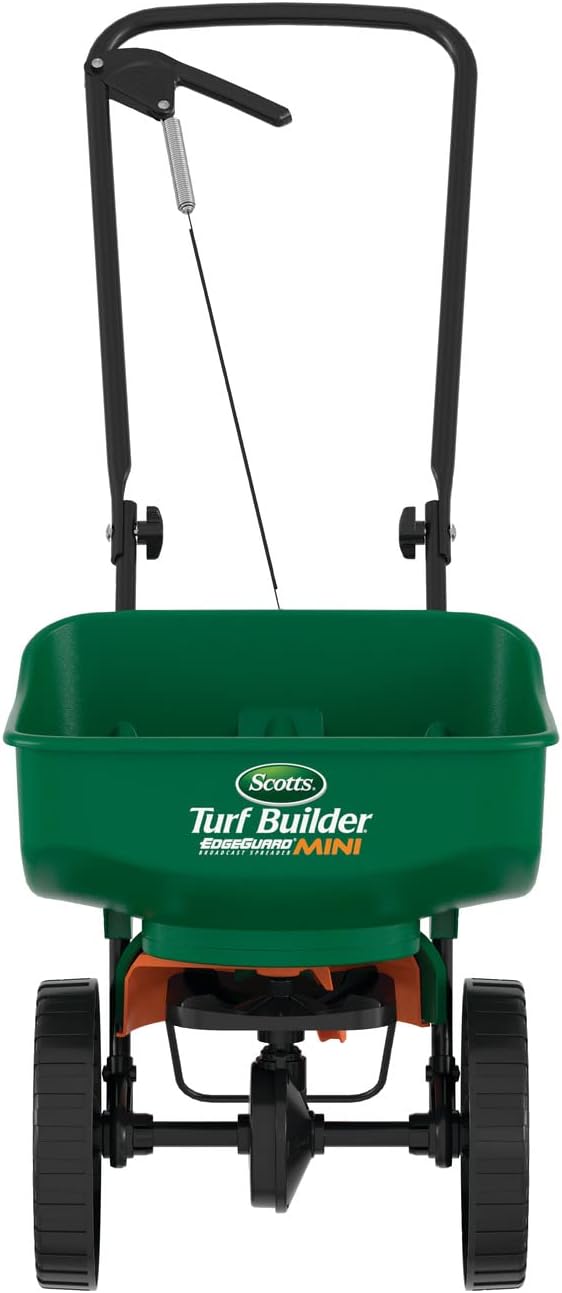
Scotts Turf Builder EdgeGuard Mini Broadcast Spreader
| Manufacturer | The Scotts Company LLC |
|---|---|
| Capacity | Up to 5,000 sq. ft. |
| Usage | Fertilizer, seed, granular weed control, salt and ice melt |
The Scotts Turf Builder EdgeGuard Mini is a pre-calibrated broadcast spreader built for homeowners with smaller yards. It holds up to 5,000 sq. ft. of product and is used to apply fertilizer, grass seed, granular weed control and even ice melt. Notable features include Scotts EdgeGuard technology that blocks the right-side spread pattern to keep product off sidewalks and driveways, a redesigned curved hopper and dual-blade agitator for smoother product flow, and fold-down handle and open-spoke wheels for easy storage and durable rolling. In real-world use it simplifies accurate coverage for routine feeding or spot treatments on compact lawns and reduces the common problem of drifting product onto hardscapes. The main compromises are capacity and scale: it is intended for small areas rather than large properties, and broadcast spreaders can still require a steady walking pace and correct setting to avoid streaking. For routine seasonal applications on small to mid-size yards this model is a practical, low-fuss choice.
Best for: Homeowners with small to medium yards who want a straightforward, ready-to-use spreader that limits product on hardscapes and delivers consistent results without fiddly setup.
Less Ideal for: Owners of large properties or professional landscapers who need higher capacity and faster coverage should choose a larger, commercial-grade spreader.
- EdgeGuard technology reduces overspray onto sidewalks and driveways
- Pre-calibrated and simple rate dial makes setup quick for common Scotts products
- Curved hopper and dual-blade agitator promote consistent product flow
- Fold-down handle and compact size for easy storage
- 5,000 sq. ft. capacity is small for larger lawns
- Broadcast spread pattern still requires consistent walking speed and correct setting to avoid uneven coverage
Verdict: A compact, easy-to-use spreader with EdgeGuard that makes accurate fertilizing and spot treatments simple for small lawns.
Scotts Whirl Hand-Powered Spreader

| Capacity | Up to 1,500 sq. ft. |
|---|---|
| Material Type | Metal, Plastic |
| Handle Material | Rubber |
| Additional Features | Adjustable Arm Support, Smooth Even Coverage |
The Scotts Whirl is a simple hand-powered spreader made for small yards and targeted jobs like overseeding patches, applying fertilizer to a front lawn, or spreading ice melt on walkways. It ships ready to use and has an adjustable arm support and rubber handle to make short jobs more comfortable. The hopper and agitator are engineered to produce smooth, even coverage with common granular products, and the unit is light and easy to maneuver for spot treatments or full passes on lawns under 1,500 sq. ft. Because it is hand-powered there are no batteries or complex parts to maintain, which reduces worry for buyers who prefer straightforward tools. Limitations include a small capacity and manual operation, so it is not efficient for large properties or long continuous runs, and fine calibration options are more basic than larger broadcast models. For routine small-lawn tasks it reliably delivers consistent spreads without much setup.
Best for: Homeowners with small yards or anyone who needs a low-maintenance, easy-to-use spreader for spot seeding, fertilizing, or winter ice melt.
Less Ideal for: People with medium to large lawns or professional users who need high-capacity, fast coverage should consider larger wheeled broadcast spreaders instead.
- Ready-to-use out of the box for immediate application
- Adjustable arm support and rubber handle improve comfort during use
- Engineered hopper and agitator for smooth, even granular coverage
- Lightweight and easy to maneuver for small lawns and spot treatments
- Small capacity limits coverage to about 1,500 sq. ft. per fill
- Manual operation is slower than wheeled or motorized broadcast spreaders
Verdict: A no-fuss, hand-held spreader that gives reliable, even application for small lawns and spot treatments.
Choosing the Right Broadcast Fertilizer Spreader: Key Factors to Consider
Spread Pattern Consistency
How uniformly a spreader distributes granules determines the health of turf and garden beds. Uneven spread often shows as streaks or concentrated bands of fertilizer that can scorch grass or overfeed plants. Look for spreaders with adjustable deflectors or well-designed vanes that produce an even arc and minimize overlap. In real use you will walk at varying speeds and over slightly uneven terrain, so a spreader that maintains a steady throw despite small variations in load or pace reduces the need for rework.
Materials and vane design influence how different granule sizes behave. Some units are tuned for standard lawn fertilizers, while others handle a wider range of seeds, lime, or soil amendments. Expect a calibration step to match the product you load and test passes in a small area before doing a whole-lawn application.
Calibration Accuracy
Accurate calibration ensures you apply the correct amount of product per area, preventing waste and plant damage. A good broadcast spreader offers clear, repeatable settings and a simple way to measure and adjust output. Calibration usually involves matching a recommended setting to the spreader, then doing a catch test over a measured strip to confirm grams or ounces per square foot.
Gardeners should favor models with clearly marked gates and smooth control mechanisms rather than vague or finicky dials. The ability to fine-tune the flow rate and to lock a setting in place while you walk will improve consistency across long passes.
Build Durability
The construction of the hopper, frame, and moving parts dictates how long a spreader will last under typical outdoor conditions. UV-stabilized plastics resist cracking in sun exposure, while powder-coated steel frames limit rust in wet environments. Bolted connections are easier to service than rivets, and replaceable parts extend service life.
Durability also affects performance: warped hoppers and corroded gates change how product flows. For seasonal use, choose a spreader that tolerates moisture and abrasive materials without rapid wear. Consider whether common wear parts are user-replaceable and how straightforward routine maintenance is.
Hopper Capacity
Hopper capacity affects how frequently you refill during a job and how heavy the unit becomes when full. Larger hoppers reduce trips back to the bag for mid-size lawns, but they add weight and can be harder to maneuver or transport. Smaller hoppers are lighter and easier to handle for tight yards, patios, or small beds.
Think about the scale of your property and whether you prefer fewer refills or lighter loads. Also consider how the hopper shape channels product to the outlet; poor geometry can leave clumps in corners or cause bridging that interrupts flow.
Ease of Use
A practical spreader should be easy to load, adjust, and push or tow across the terrain you manage. Ergonomic handles, smooth wheels, and straightforward gate controls reduce fatigue and help maintain a consistent walk speed. Features like quick-release hoppers, simple attachment points for towing, and intuitive maintenance access save time.
Also consider storage and winter care. A spreader that disassembles or nests neatly takes up less space and is easier to protect from weather between seasons.
When to Choose a Broadcast Spreader
Broadcast spreaders are ideal for covering broad, open areas quickly. They work well on lawns, newly seeded patches, or when you need to distribute lime, granular herbicide, or grass seed over a wide swath without close precision.
If you need narrow-strip precision near beds, borders, or around delicate plantings, consider using a sidewalk or drop-style approach for those edges and reserve the broadcast spreader for the main turf areas.
- Best for treating large lawns and open garden areas
- Faster coverage than hand spreading or drop spreaders
- Less precise at edges, so plan passes accordingly
Calibration and Test Passes
Before applying fertilizer to your entire lawn, always perform a calibration test. Measure a fixed test area, set the spreader to the recommended manufacturer number for the material, walk a test pass collecting the output, and adjust until the measured rate matches the target pounds or kilograms per area.
Test passes reveal how walking speed, overlap, and granule size affect real application rate. Adjust your walking pace if needed and mark transects so you can overlap consistently on subsequent passes.
- Use a measured strip and catch tray or cardboard to collect a test sample
- Convert grams collected to coverage rate before full application
Terrain and Wheel Selection
Wheel size and tread make a big difference on uneven turf, slopes, or soft ground. Larger, wider wheels reduce sinking on wet lawns and keep the spreader tracking straight. Narrow or hard plastic wheels are lighter but can struggle in ruts and soft soil.
If your yard has hills or rough areas, choose a spreader with robust wheels and a stable axle to prevent tipping and maintain a consistent throw.
- Larger pneumatic or semi-pneumatic wheels for soft or uneven ground
- Hard plastic wheels for paved areas and storage longevity
Material Compatibility
Not every broadcast spreader handles every material equally. Fine seeds, pelletized fertilizers, gypsum, and lime each flow differently. Check that the spreader you consider can be adjusted to deliver the particle sizes you plan to use without clogging or bridging.
Some spreaders include liners or anti-clog features to help with damp or sticky products. For heavy, abrasive materials choose a model with tougher gate hardware and smooth internal surfaces.
- Confirm flow control suits your primary materials
- Look for anti-bridging hopper design if you use damp or clumping products
Maintenance and Winter Storage
Routine maintenance keeps calibration steady and parts working season to season. After each use, remove remaining product, rinse nonmetal components if compatible, and let everything dry before storage. Lubricate moving parts sparingly and check for corroded hardware in spring.
During winter store the spreader in a dry, sheltered spot and remove batteries or electrical components if present. Label and store spare parts in a small kit so repairs are simple when needed.
- Rinse and dry to prevent corrosion and clumping
- Keep spare gate hardware and fasteners on hand
How We Chose the Best Broadcast Fertilizer Spreader
We selected spreaders that deliver consistent material distribution, are straightforward to calibrate, and hold up to outdoor use. Our editorial filters prioritized construction and durability, the precision of the flow-control system and spread pattern, ease of calibration and adjustment, hopper capacity matched to typical residential tasks, and ergonomic handling for the type of spreader. Practical reliability in wet or dusty conditions and availability of replacement parts or simple repairability were also considered. We excluded specialty mineral-only applicators, heavy commercial-only equipment, and products that require professional installation. The goal was to keep this roundup relevant to gardeners and homeowners who need broadcast-style spreading for lawns, garden beds, seed distribution, or mulch application. The criteria below match the scoring metrics used for each spreader so readers can compare durability, calibration, spread coverage, hopper size, and handling at a glance.
FAQ
Can I use a broadcast spreader for seed and fertilizer at the same time?
Often you can, but it depends on particle sizes and the spreader design. Mixes with similar granule size spread more evenly together. For best results, test a small area first to confirm even distribution.
How do I avoid streaking when using a broadcast spreader?
Maintain a steady walking speed and consistent overlap between passes. Calibrate your output and use wider swaths or multiple overlapping passes rather than trying to cover with a single pass near the edges.
How frequently should I calibrate the spreader?
Calibrate whenever you change products, after cleaning, or if you notice uneven application. For seasonal users, a calibration check at the start of each season is a good practice.
Is it better to walk faster or slower with a broadcast spreader?
Walking speed affects application rate. Faster walking reduces material laid per area. Use the walking speed recommended during calibration and mark a stable pace. Adjust the spreader setting if you must change your normal speed.
What maintenance extends the life of a broadcast spreader?
Empty and clean the hopper after each use, dry thoroughly, and inspect gates and axles for wear. Replace worn fasteners or seals promptly and lubricate moving parts as specified by the manufacturer.
Final Verdict
Prioritize even spread pattern and reliable calibration when choosing a broadcast fertilizer spreader. Those two factors have the biggest impact on plant health and product efficiency, while build durability and hopper size determine long-term convenience and how you handle larger jobs. Balance capacity and weight for the scale of your lawn or garden, and favor units that are easy to adjust and maintain. With proper calibration and routine care you can achieve uniform applications and avoid common problems like streaking or material bridging.
