

Note: This article contains affiliate links. If you click on these links and make a purchase, I may earn a small commission at no extra cost to you. This helps support my research and content. Read my full affiliate disclosure here.
Growing garlic and onions successfully depends as much on feeding as on soil and water. The right fertilizer helps bulbs swell properly, builds neck strength for harvest, and improves how long cured bulbs store. This guide covers seven shortlisted fertilizers suited for garlic and onions, explaining how each type behaves in the garden and why it made the list. We evaluate nutrient ratios, how easy products are to apply, and how they affect bulb development so you can choose the best feed for your planting style. Below you'll find focused buying guidance and practical tips to match feeding strategy to your soil, bed type, and harvest goals.
Top Picks at a Glance
| Best Overall The best all-around choice for most situations | Espoma Bulb-Tone Organic Fertilizer (4 lb) |  |
| Best Quality Built to a higher standard if you want something more solid | Old Cobblers Farm Wicked Growth Garlic & Onion Fertilizer (5 lb) |  |
| Best Value The sweet spot between price and what you get | Down To Earth Organic Bone Meal Fertilizer 3-15-0, 25 lb |  |
| Best Budget The cheapest option that still gets the job done reliably | TPS NUTRIENTS Onion Fertilizer Liquid Plant Food, 8 oz |  |
| Highest Rated A top-rated pick with lots of positive feedback | Gardenera Liquid Power Garlic Fertilizer Concentrate, 8 oz |  |
| Most Popular A crowd favorite that many people choose with confidence | TPS NUTRIENTS Garlic Fertilizer Liquid Plant Food, 8 fl oz |  |
| Best Seller A high-volume bestseller chosen again and again | Prevegenics Onion Liquid Fertilizer (32 fl. oz.) |  |
Espoma Bulb-Tone Organic Fertilizer (4 lb)

| Item Form | Granules |
|---|---|
| Specific Uses For Product | Gardening,Organic,Plant Food |
| Coverage | Medium |
| Target Species | bulbs |
| Mixing Ratio | 3:5:3 |
Espoma Bulb-Tone is an organic granular fertilizer intended for planting and feeding flower bulbs; it contains a 3-5-3 analysis with added calcium and Espoma’s Bio-tone formula. It is typically applied at planting by placing granules in the planting hole for new bulbs or sprinkled on the soil surface and watered in for established bulbs. The product is ready to use with no mixing required and is approved for organic gardening, so it fits naturally into organic beds. Practical benefits include gentle, phosphorus-forward nutrition to encourage root development and blooms, and the granular form makes application simple and tidy. Because it is formulated for bulbs, it supplies moderate coverage suitable for small to medium planting areas. Important limitations are that its nutrient ratio and formulation target flowering bulbs rather than heavy-feeding vegetables, so it is not optimized for crops that need higher nitrogen for leaf and bulb mass. Coverage is described as medium so multiple bags are likely needed for larger beds.
Best for: Gardeners who prioritize organic inputs and want a gentle, bloom-focused fertilizer for planting or maintaining bulbs in small to medium beds.
Less Ideal for: Growers seeking a high-nitrogen fertilizer specifically to increase bulb size and leaf mass in heavy-feeding vegetables should choose a product formulated for vegetables instead.
- Organic certified formula suitable for organic gardens
- Granular, ready-to-use form that is easy to apply at planting or as a top-dress
- Phosphorus-forward 3-5-3 N-P-K with added calcium supports root establishment and flowering
- Made by a long-established brand with a specific bulb-focused formulation
- Designed for flowering bulbs and formulated for bloom support rather than boosting leafy growth or large vegetable bulbs like garlic and onions
Verdict: Pick this if you want an easy, certified-organic granular fertilizer that supports root development and flowering in bulb plantings.
Old Cobblers Farm Wicked Growth Garlic & Onion Fertilizer (5 lb)

| Item Form | Granules |
|---|---|
| Application Method | Granular |
| Target Species | Garlic and Onion |
| Unit Count | 16 Ounce |
This granular fertilizer is built specifically for alliums and is used as both a pre-plant soil amendment and a repeating side-dress during the growing season. It supplies a balanced 10-10-10 NPK, plus 3% sulfur from gypsum and elemental sulfur to support the flavor compounds in garlic and onions, and added calcium, boron, and zinc aimed at firmer bulbs and even formation. Typical use is to mix 1/2 to 1 cup per 10 sq ft into the soil before planting, then side-dress 1/2 cup per 10 linear feet once tops reach 4 to 6 inches and repeat every 4 to 6 weeks, stopping a few weeks before harvest. The granular form is easy to measure and applies cleanly to beds and rows, and the package includes clear safety and storage advice. Limitations are that it is a conventional fertilizer so you should follow soil test results to avoid overapplication, and the product does not list a full elemental analysis by micronutrient amounts beyond guaranteed boron and zinc percentages, which may matter for finely tuned fertility plans.
Best for: Gardeners focused on maximizing bulb size, storage quality, and flavor in garlic and onions who follow a scheduled feeding plan and want a product tailored to alliums.
Less Ideal for: Growers who rely solely on organic certified inputs or who prefer complete custom nutrient blends based on detailed soil test results should consider other options.
- Balanced 10-10-10 NPK tailored for bulb development
- Includes 3% sulfur to support allium flavor and pungency
- Granular formula with clear pre-plant and side-dress directions
- Adds calcium plus guaranteed boron and zinc for firmer, even bulbs
- Micronutrient amounts are not fully itemized on the label beyond guarantees
- Conventional fertilizer so unnecessary if soil test shows no need
Verdict: Choose this granular allium fertilizer when you want a balanced NPK plus sulfur and micronutrients formulated to boost bulb development, flavor, and storage quality.
Down To Earth Organic Bone Meal Fertilizer 3-15-0, 25 lb

| Item Form | Granules |
|---|---|
| Specific Uses For Product | Organic,Potting,Root |
| Coverage | Medium |
| Target Species | flowering plants, trees, ornamentals, bulbs |
| Mixing Ratio | 3:15:0 |
This 25 lb bag of Down To Earth organic bone meal is a straightforward, single-ingredient source of phosphorus and calcium for planting bulbs and strengthening early root growth. Gardeners typically sprinkle or mix the granules into planting holes or around established bulbs, garlic, and onions to encourage strong root establishment and better bloom and bulb formation. The 3-15-0 analysis means it delivers a strong phosphorus boost with negligible nitrogen, so it is best used at planting or when you want to promote roots and flowers rather than leafy growth. Being OMRI-listed makes it suitable for organic gardens, and the granular form is easy to handle and apply with a scoop. Important limitations are that it does not feed for nitrogen or potassium needs, so you will need a complementary fertilizer for balanced nutrition, and phosphorus-containing fertilizers are restricted in some areas because of runoff concerns, so check local guidance before use.
Best for: Gardeners focused on establishing strong roots and improving bulb and bloom set for crops like garlic and onions who prioritize organic, single-ingredient amendments.
Less Ideal for: Gardeners seeking an all-in-one fertilizer or those who need to correct nitrogen or potassium deficiencies without combining products.
- High phosphorus to promote root development and bulb formation
- OMRI-listed for organic production
- Granular form is easy to apply at planting or around established plants
- Includes calcium which supports bulb and flower quality
- Provides little to no nitrogen so it does not support leafy growth
- Not a complete fertilizer so another product is needed for balanced feeding
Verdict: A reliable organic phosphorus and calcium boost to establish strong roots and improve bulb and bloom development for garlic, onions, and other bulbs.
TPS NUTRIENTS Onion Fertilizer Liquid Plant Food, 8 oz

| Item Form | Liquid |
|---|---|
| Application Method | Mix with water and spray or pour onto plants |
| Target Species | Onions |
| Liquid Volume | 8 fluid ounces |
| Mixing Ratio | 1 tablespoon per gallon of water |
This 8 oz liquid onion fertilizer is designed specifically for bulb-forming crops and is mixed with water for foliar or soil application. You use it at the stated mixing rate (1 tablespoon per gallon) and apply by spraying or pouring during the key growth phases to promote stronger roots, balanced foliage, and fuller bulbs. The liquid form delivers nutrients quickly compared with granular feeds, which is helpful when plants need a timely boost. It is labeled for garden beds, raised planters, and containers so it suits small plots and urban gardens. The small unit size keeps upfront cost low but means you'll need multiple bottles for larger beds or repeated applications over a full season. Coverage is described as low, so this is best for targeted feeding rather than whole-field fertilization. For gardeners on a budget growing garlic and onions in modest spaces, this offers a straightforward, crop-specific option; larger operations will want higher-volume or granular products to reduce application frequency and cost per use.
Best for: Home gardeners growing garlic or onions in beds, raised planters, or containers who want a targeted, easy-to-use liquid feed and are managing costs with small purchases.
Less Ideal for: Large vegetable growers or those needing to fertilize many beds regularly because the small bottle and low coverage increase cost and labor for repeated applications.
- Formulated specifically for onions and other alliums to encourage bulb development
- Liquid concentrate allows quick nutrient uptake when mixed and applied
- Suitable for garden beds, raised planters, and containers
- Simple mixing ratio (1 tablespoon per gallon) makes application easy for beginners
- Small 8 oz volume provides limited coverage and may require multiple purchases for medium to large gardens
- Coverage listed as low so not optimal for large-scale feeding
Verdict: A practical, crop-specific liquid feed that gives small-scale garlic and onion growers an easy and affordable way to support bulb development.
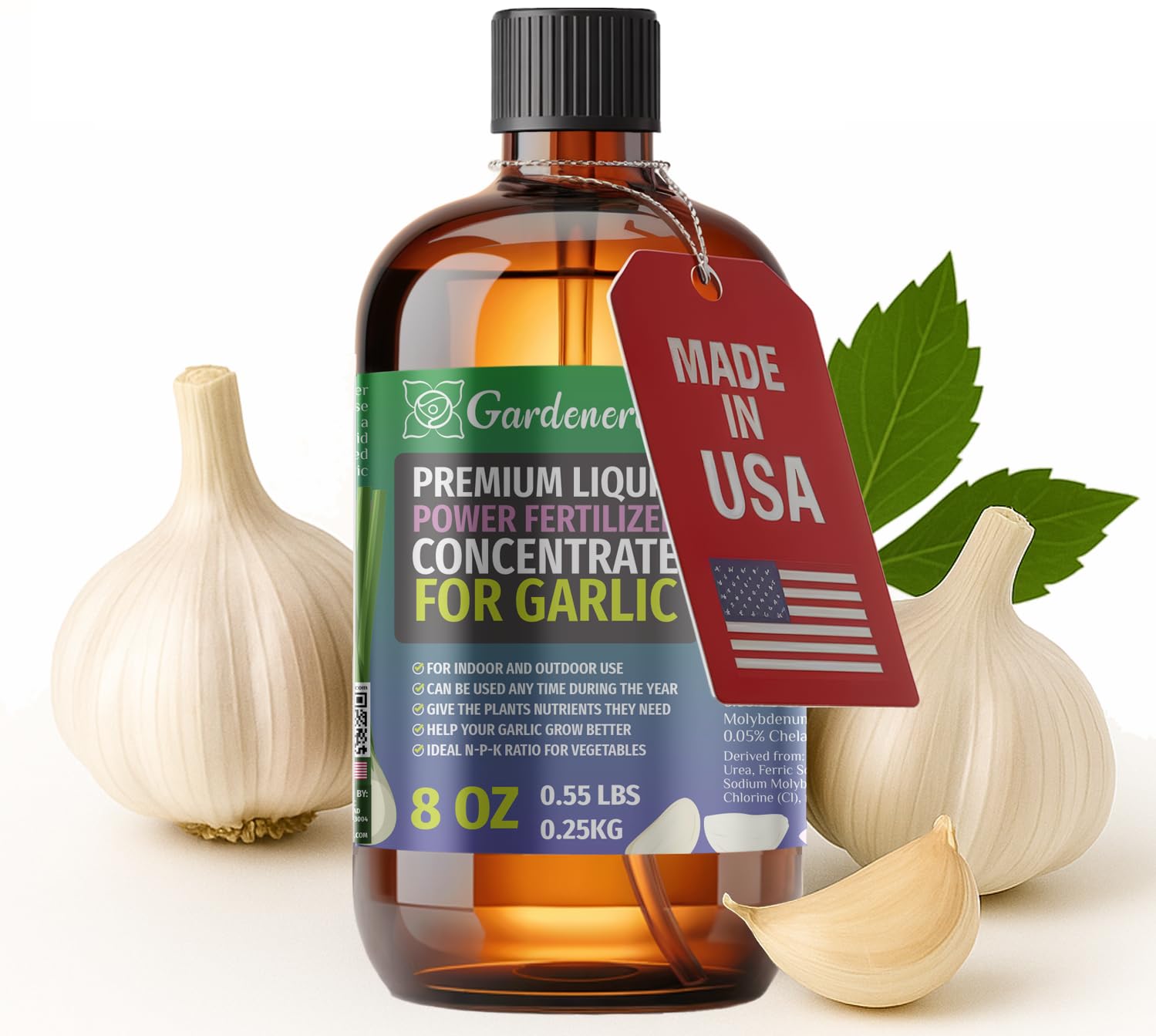
Gardenera Liquid Power Garlic Fertilizer Concentrate, 8 oz
| Item Form | Liquid |
|---|---|
| Application Method | root drench, hose sprayer, or foliar mist |
| Target Species | Garlic |
| Liquid Volume | 8 fluid ounces |
Gardenera Liquid Power is a concentrated liquid fertilizer made specifically for garlic that you apply as a root drench, through a hose sprayer, or as a foliar mist. In practice it is used throughout the growing cycle to encourage leafy growth early, deepen root systems, and support clove expansion before bulbing. Notable features include a balanced NPK blend with chelated micronutrients and a low pH profile that can free up locked nutrients in alkaline soils, which helps address common garlic deficiencies. The 8 ounce concentrate treats small beds or container plantings without bulky packaging and is easy to measure and mix. Expect stronger tops for better curing and potentially larger, more flavorful bulbs when used as directed. Important limitations are that coverage is listed as low so it is best for home gardens rather than large-scale plantings, and the product description emphasizes an acidic formulation so users with very sensitive soils should follow dilution instructions carefully.
Best for: Home gardeners who grow garlic in small beds or containers and want a reliable, garlic-tailored feed to improve bulb size and flavor without complicated application.
Less Ideal for: Growers managing large allotments, market-scale plantings, or those seeking an all-purpose fertilizer for many crop types should look for higher-coverage or broader-purpose products.
- Formulated specifically for garlic with a balanced NPK and chelated micronutrients
- Low pH concentrate that improves micronutrient availability in alkaline soils
- Multiple application methods: root drench, hose sprayer, or foliar mist
- Compact 8 oz concentrate is easy to store and measure for small gardens
- Coverage rated low, so one bottle is not suited to large beds or commercial use
- Acidic formula requires careful dilution to avoid harming sensitive seedlings or soil biology
Verdict: Choose this concentrated garlic-specific feed when you want a targeted, easy-to-apply product to boost root development and bulb quality in home garlic plantings.
TPS NUTRIENTS Garlic Fertilizer Liquid Plant Food, 8 fl oz

| Item Form | Liquid |
|---|---|
| Specific Uses For Product | Plant Growth |
| Coverage | garlic and allium varieties |
| Target Species | garlic and allium varieties |
This liquid garlic fertilizer is formulated to support tight bulb formation and healthy tops without encouraging excessive leafy growth. It is intended for use on garlic and other allium varieties in garden beds and raised rows; you dilute and apply according to the included directions during the growing season. Notable features include added calcium and magnesium for stronger plant tissue, kelp for natural growth support, and a gentle nitrate formula that aims to feed bulbs rather than overstimulate foliage. The 8 ounce bottle is easy to store and handle and works well for small to medium plantings. Important limitations are the small unit size, which means frequent repurchasing for larger plots, and the need to follow safety guidance since it requires handling precautions. For gardeners who want a purpose-built, kelp-enriched liquid feed to encourage consistent garlic bulbs, this product is a straightforward option that pairs well with good soil preparation and standard cultural practices.
Best for: Gardeners growing garlic or other alliums in backyard beds or raised rows who prefer a targeted liquid feed that supports bulb formation and plant strength.
Less Ideal for: Large-scale growers or those managing extensive beds who need concentrated or bulk fertilizer solutions for many plants.
- Formulated specifically for garlic and allium varieties to encourage bulb development
- Contains calcium and magnesium to support plant strength and tissue health
- Kelp-enriched for natural growth stimulation and improved vigor
- Liquid form is easy to dilute and apply to garden beds and raised rows
- Small 8 fl oz bottle may be insufficient for larger plantings or multiple seasons
- Requires careful handling and protective gear as noted in safety instructions
Verdict: A focused, kelp-enriched liquid feed designed to promote consistent garlic bulb development for small to medium home gardens.
Prevegenics Onion Liquid Fertilizer (32 fl. oz.)

| Item Form | Liquid |
|---|---|
| Specific Uses For Product | Plant Growth |
| Target Species | Allium cepa |
| Liquid Volume | 32 fluid ounces |
| Mixing Ratio | 1 part fertilizer in 3 parts water |
Prevegenics Onion Liquid Fertilizer is a 32 fl. oz. ready-to-dilute liquid designed for soil or foliar application to onion plants. It supplies a blend of macronutrients and micronutrients including nitrogen, phosphorus, potassium, calcium, magnesium, sulfur, boron, copper, manganese, and zinc, and is mixed at a 1:3 ratio with water for routine feeding. In practice you dilute and apply to the base of plants or as a foliar feed to support vegetative growth and bulb development, which can help increase yield and improve quality. The product is simple to use, covers a full application area for small to medium garden beds, and the liquid format makes it easy to measure and apply with a watering can or sprayer. Limitations are that precise N-P-K values are not listed on the label here and heavy feeders may need additional nitrogen at certain growth stages, so monitoring plant response is still recommended. Follow the included directions and safety guidance to avoid overapplication.
Best for: Gardeners who want a straightforward, plant-focused fertilizer for bulbs and who prefer an easy-to-mix liquid solution with clear application directions.
Less Ideal for: Large-scale growers or those who require exact N-P-K formulations and tailored nutrient programs should consider commercial-grade concentrates or lab-analyzed fertilizers.
- Formulated specifically for onions to support bulb quality and plant health
- Contains both macro and multiple micronutrients useful for balanced feeding
- Liquid form is easy to dilute and apply with standard garden watering tools
- Simple mixing ratio (1 part fertilizer to 3 parts water) reduces guesswork during application
- Label information in this listing does not show specific N-P-K numbers which may make precise feeding schedules harder to plan
- 32 fl. oz. may require repurchasing for larger plots or repeated seasonal use
Verdict: A simple, onion-focused liquid fertilizer that delivers a broad mix of macro and micronutrients in an easy-to-dilute format for gardeners who want low-risk, straightforward feeding.
Choosing the Right Fertilizer for Garlic and Onions: Key Factors to Consider
Nutrient Ratio and Timing
Garlic and onions need different nutrient emphasis at stages: higher nitrogen early to build healthy tops and roots, then reduced nitrogen with adequate phosphorus and potassium during bulb fill. Choosing a fertilizer with clear N-P-K ratios lets you match application to growth stages. Apply higher-nitrogen feeds during green-up and switch to low-nitrogen, higher-potassium options a few weeks before harvest to encourage firm bulbs and better storage life.
Timing matters as much as ratio. Fast-release nitrogen can push too much top growth late in the season and reduce bulb size, while slow-release or granular formulations provide steadier supply that supports steady bulbing without late-season softness.
Release Profile and Longevity
Fertilizers come as quick-release soluble feeds, granular slow-release, and organic amendments that release nutrients as they break down. Quick feeds give a rapid visible response but may require more frequent application and risk leaching in light soils. Slow-release granules or coated fertilizers supply nutrients over weeks to months, reducing the need for repeated feeding and lowering burn risk.
Consider how long you want one application to last. For beds where you plant multiple crops, a longer-lasting amendment can improve soil structure and nutrient retention. For containers or short rotations, soluble feeds let you fine-tune levels more precisely.
Application Method and Practicality
How you apply fertilizer affects labor and effectiveness. Options include banding at planting, side-dressing during the season, foliar feeding for quick micronutrient fixes, and broadcast incorporation prior to planting. Choose a product that fits your workflow: granular blends are easy to broadcast or band, water-soluble powders work with irrigation or hose-end feeders, and organic amendments often need incorporation and time to break down.
Practical labels and clear measurement guidance matter. Inconsistent dosing leads to uneven bulbs or nutrient burn, so pick fertilizers that provide straightforward application rates for the bed sizes you tend.
Soil Health and Organic Matter
Long-term productivity of garlic and onions depends on soil structure and biology. Fertilizers that contribute to soil organic matter, such as composted amendments or blends with humates, help with moisture retention and nutrient holding capacity. These improvements reduce the need for frequent feeding and produce more consistent bulb development season to season.
If you are transitioning to organic practices, select products compliant with your system. For conventional gardens, pairing mineral fertilizers with organic matter applications is often the best approach for both immediate nutrition and future soil resilience.
Salt Content and Crop Safety
Bulb crops can be sensitive to high soluble salt levels, which cause tip burn, stunted growth, or difficulty establishing transplants. Fertilizers low in soluble salts or with controlled-release profiles reduce the risk of salt damage, especially in container-grown bulbs and light sandy soils. Check product guidelines for recommendations on dilution and placement to avoid root-zone concentration.
When using manures or concentrated amendments, allow time for salts to equilibrate in the soil and consider rinsing or irrigating lightly after application if salt buildup is a concern.
Compatibility with Soil Tests and Amendments
Soil testing should guide fertilizer choice. A test reveals pH, phosphorus, potassium, and secondary nutrient levels so you can pick a product that corrects actual deficiencies rather than guessing. Some fertilizers are designed as top-up options while others correct specific deficiencies like low phosphorus for root development.
Compatibility matters if you plan to use lime, sulfur, or other major soil amendments. Certain fertilizers interact with pH adjustments and micronutrient availability. Match products to your soil plan to avoid over-application and to get predictable bulb responses.
Feeding Schedule for Garlic and Onions
Successful feeding follows the crop calendar. For planted cloves or sets, apply a starter fertilizer or incorporate a balanced granular amendment at planting to support early root growth. During the active leaf growth phase, a moderate nitrogen feed encourages canopy development that drives bulb initiation.
As bulbs begin to swell, reduce nitrogen and maintain phosphorus and potassium to support dry matter accumulation. Plan a final feed several weeks before harvest that favors potassium to improve bulb firmness and storability. Adjust timing for your climate and whether you grow spring-planted or autumn-planted garlic.
- Pre-plant: incorporate balanced granular or compost
- Green-up: apply moderate nitrogen feed
- Bulb fill: reduce nitrogen, maintain potassium
- Late season: stop high-nitrogen applications 3-4 weeks before harvest
Organic Versus Synthetic Options
Organic fertilizers increase soil biology and long-term fertility but often release nutrients more slowly and in less predictable ratios. They are excellent for building soil organic matter and reducing reliance on frequent synthetic feeds.
Synthetic fertilizers give precise N-P-K ratios and predictable soluble nutrient availability, which can be useful when correcting specific deficiencies or when rapid response is needed. Many gardeners combine both approaches: using organic matter as a baseline soil conditioner and targeted synthetic feeds when quick correction is required.
- Organic: slower release, improves soil ecology
- Synthetic: precise ratios, faster plant response
- Combination: balance immediate needs with long-term soil health
Using Fertilizer in Containers and Raised Beds
Containers and raised beds dry out and lose nutrients faster than in-ground beds, so choose low-salt fertilizers and monitor moisture closely. Water-soluble feeds applied at lower doses more frequently are often the safest approach in containers to avoid nutrient shock and salt accumulation.
For raised beds, incorporate organic amendments at the start of the season to increase water-holding capacity. Side-dress with granular feeds sparingly, and consider frequent light applications rather than a single heavy dose to prevent uneven bulbing.
- Use low-salt formulas for containers
- Prefer frequent light feedings in pots
- Incorporate compost into raised beds annually
Common Nutrient Deficiencies to Watch
Yellowing leaves early in the season often indicate nitrogen shortage, while stunted growth and weak roots can signal low phosphorus. Potassium deficiency typically shows as tip scorch, weak necks, and poor storage life. Correctly identifying symptoms helps you choose the right corrective feed rather than over-applying general fertilizer.
Micronutrients like boron and manganese are sometimes limiting in shallow soils and can affect bulb set and quality. A soil test is the best way to detect these shortages; foliar sprays can correct some micronutrient issues quickly when needed.
- Nitrogen: uniform yellowing and slow growth
- Phosphorus: poor root and early-season vigor
- Potassium: tip scorch, weak bulbs, poor storage
Storage and Curing Considerations Linked to Feeding
Feeding choices influence how well bulbs cure and store. Excessive late-season nitrogen produces softer bulbs with higher moisture and shorter shelf life. Switching to low-nitrogen, higher-potassium feeding during bulb fill helps tissues desiccate properly during curing.
After harvest, bulb storage is more about drying and disease management than fertilizer, but balanced feeding during the season reduces the risk of storage rot and shriveling. Avoid heavy nitrogen in the final weeks before harvest to improve long-term storage outcomes.
- Stop high-nitrogen feeds weeks before harvest
- Favor potassium during bulb fill for firmer bulbs
- Curing practices complement proper feeding for storage life
How We Chose the Best Fertilizer for Garlic and Onions
We selected fertilizers that address the specific growth cycle and nutrient needs of allium crops. Evaluation focused on nutrient composition and balance, looking for formulations that support root development early and bulb filling later. Application method and timing were assessed to favor products gardeners can use with common planting systems such as raised beds, in-ground rows, and containers. We considered nutrient availability and release profile to ensure options suit both quick feed needs and longer-release soil conditioning. We also evaluated ease of use in real garden situations, including how straightforward instructions are, compatibility with side-dressing or pre-plant incorporation, and safety for edible crops. Product longevity and storage handling were reviewed to favor stable formulations that keep well between seasons. Exclusions: we did not consider products designed only for turf or ornamental displays, or fertilizers intended exclusively for hydroponics. The final list emphasizes practical performance for garlic and onion production across small-scale and backyard situations.
FAQ
When should I stop fertilizing before harvest?
Usually stop high-nitrogen applications about three to four weeks before harvest to allow bulbs to mature and dry down. Continue low-nitrogen potassium-rich dressing if needed early in the bulb-fill phase but avoid feeds that promote late leaf growth.
Can I use compost alone to grow garlic and onions?
Compost provides slow-release nutrients and improves soil structure, and it can serve as the primary fertility source if it is well-matured and regularly applied. However, a soil test may show specific nutrient gaps that benefit from targeted fertilizer applications for optimal bulb size.
How often should I side-dress in raised beds?
In raised beds, side-dress lightly every four to six weeks during active growth if using granular or low-release fertilizers. If you use water-soluble feeds, apply lower doses every two to three weeks to maintain steady nutrient availability without salt buildup.
Are foliar feeds useful for bulb crops?
Foliar feeds can quickly correct micronutrient deficiencies and provide a short-term boost during stress, but they do not replace soil fertility for bulb development. Use foliar sprays as a supplement when symptoms indicate a deficiency or when rapid correction is needed.
What soil pH is best for garlic and onions?
Garlic and onions prefer slightly acidic to neutral soil, roughly pH 6.0 to 7.0. Within this range nutrient availability is good for most required elements. Adjust pH based on soil test results before heavy fertilization to ensure nutrients behave predictably.
Will too much fertilizer make bulbs split?
Excessive nitrogen, especially late in the season, can cause rapid growth and increase the chance of splitting or soft necks. Balanced feeding that reduces nitrogen during bulb fill minimizes this risk and promotes tighter, firmer bulbs.
Final Verdict
Prioritize nutrient balance and timing when selecting a fertilizer for garlic and onions. Early-season nitrogen supports canopy and root development, while reduced nitrogen and steady potassium during bulbing improve firmness and storage life. Consider release profile, salt content, and how the product fits your planting system when making a choice. Match the fertilizer to your soil test and feeding rhythm. Choosing the right combination of baseline soil improvement and targeted feeding helps you produce larger, dryer, and longer-storing bulbs with predictable results.
