

Note: This article contains affiliate links. If you click on these links and make a purchase, I may earn a small commission at no extra cost to you. This helps support my research and content. Read my full affiliate disclosure here.
Fleas in turf can quickly become a household nuisance and a pet-health concern. Choosing the right lawn insecticide for fleas matters because treatment behavior in grass is different from indoor sprays: you need a product that contacts or is taken up by insects, covers the area you actually use, and leaves a residual that reduces reinfestation without harming desirable lawn life. This guide summarizes our top shortlisted options for lawns, explaining how we evaluated coverage, persistence, application method, and safety. Read on to understand what each insecticide type does in a real yard and which features matter most for your situation.
Top Picks at a Glance
| Best Overall The best all-around choice for most situations | Ortho BugClear Lawn Insect Killer, 20 lb. granules |  |
| Best Quality Built to a higher standard if you want something more solid | Talstar One Insecticide 1 Gallon Concentrate (Bifenthrin) |  |
| Best Value The sweet spot between price and what you get | Ortho BugClear Lawn Insect Killer, 10 lb. |  |
| Best Budget The cheapest option that still gets the job done reliably | Spectracide Triazicide Insect Killer for Lawns & Landscapes, 32 oz |  |
| Highest Rated A top-rated pick with lots of positive feedback | Atticus Talak 7.9% Bifenthrin Indoor/Outdoor Insecticide Concentrate (1 gal) |  |
| Most Popular A crowd favorite that many people choose with confidence | Atticus Talak 7.9% Bifenthrin Indoor/Outdoor Insecticide Concentrate (32 oz) |  |
Ortho BugClear Lawn Insect Killer, 20 lb. granules

| Item Form | Granules |
|---|---|
| Target Species | Insects |
| Unit Count | 1 Count |
| Coverage | Up to 33,000 sq. ft. |
Ortho BugClear Lawn Insect Killer is a granular treatment designed to protect lawns, ornamental beds and perimeter areas from common lawn pests. You broadcast the granules with a compatible spreader, then water the treated area to activate the product. It kills insects by contact and starts working quickly for most listed pests, while providing up to six months of control against many ants and up to three months of residual control for other insects. The product covers large lawns — the 20 lb. size is aimed at extensive yards — and can be used around listed vegetables and ornamental plants when applied according to label directions. Practical benefits include simple application with a spreader, fast knockdown of active pests, and extended protection that reduces how often you need to retreat. Important limitations are that some ant species are excluded from the long-term claim, very fast results are not promised for fire ants, and you must water in after application and follow label restrictions for vegetable beds and re-entry timing.
Best for: Homeowners who want a single, easy-to-apply granular product to reduce fleas and other lawn pests across a medium to large yard and prefer low-frequency reapplications.
Less Ideal for: Gardeners seeking organic or OMRI-listed solutions, or those needing a specialist fire ant or targeted ant-colony treatment should consider alternative products.
- Broad spectrum control for common lawn pests including ants, ticks, fleas and grubs
- Fast-acting contact activity for quick reduction in visible insect activity
- Long residual protection up to 6 months against many ant species and 3 months for other listed pests
- Large 20 lb. bag treats extensive lawns up to the stated coverage when applied correctly
- Not effective as a long-term solution against certain ant species named on the label and less effective on fire ants compared with specialized products
- Requires watering-in after application and careful adherence to label directions for use on vegetables and ornamentals
Verdict: Buy this if you want a simple, fast-acting granular treatment that reduces fleas and many other lawn pests while giving months of residual protection.
Talstar One Insecticide 1 Gallon Concentrate (Bifenthrin)

| Active ingredient | Bifenthrin 7.9% |
|---|---|
| Formulation | Concentrate, water-based |
| Coverage | Designed for perimeter, structural, and lawn applications |
Talstar One is a professional-strength bifenthrin concentrate designed for perimeter, structural, and lawn spot treatments. Mixed with water and applied with a pump sprayer, it creates a residual barrier against ants, spiders, fleas, ticks, mosquitoes, and many other lawn and home pests. Notable features include a water-based, low-odor formula that dries clear and claims long-lasting residual control, which reduces how often you need to reapply. Because it is a concentrate, one gallon covers large properties or multiple treatments when diluted correctly, making it cost-effective for ongoing seasonal maintenance. Important limitations are that it is a potent synthetic insecticide requiring careful adherence to label directions and protective equipment, and it is not a ready-to-use spray so a separate sprayer and correct mixing rates are required. For flea control on lawns it works as part of an integrated approach but should be applied following label restrictions for turf and around ornamentals.
Best for: Buyers who prioritize strong, long-lasting pest control for lawns and perimeters and are comfortable mixing concentrates and following label safety directions.
Less Ideal for: Casual users who want a ready-to-use product or those unwilling to follow pesticide safety procedures should consider simpler, lower-strength alternatives.
- Broad-spectrum control listed for 75+ pests including fleas and ticks
- Concentrated formula stretches to treat large areas or multiple structures
- Water-based, low-odor formula that dries clear for minimal residue visibility
- Effective residual activity reduces application frequency when used correctly
- Requires dilution and a separate sprayer so not ready-to-use
- Contains bifenthrin so proper PPE and label compliance are necessary
Verdict: Choose Talstar One when you need a concentrated, long‑lasting bifenthrin treatment for professional-grade flea and perimeter pest control.
Ortho BugClear Lawn Insect Killer, 10 lb.

| Unit Count | 160 Ounce |
|---|---|
| Item Form | Granules |
| Target Species | Insects |
Ortho BugClear Lawn Insect Killer is a 10 lb. bag of granules formulated to control ants, ticks, fleas, grubs, armyworms and other listed lawn pests. You apply it across turf and landscaped areas with a compatible broadcast spreader, then water it in to activate the product. The formula begins killing pests quickly by contact and provides extended residual control up to six months for many ant species and about three months for other listed insects. Its granular form makes it easy to treat medium to large yards (the label cites coverage up to 16,500 sq ft) and it can be used around home perimeters, flower beds and on certain listed vegetables. Practical benefits include straightforward application with a spreader, quick knockdown of visible activity, and season-long suppression that reduces repeat treatments. Important limitations are that it excludes some ant types from full control, it is not labeled for fire ant immediate mound control, and any granular insecticide requires careful spreading and follow-up watering to avoid uneven coverage.
Best for: Homeowners who prioritize a practical, low-effort solution for reducing fleas and other lawn pests across medium to large yards and want season-long suppression with routine lawn care steps.
Less Ideal for: People who need an instant mound-by-mound fire ant solution or who prefer non-chemical or spot-only treatments for small patios and container gardens.
- Granular formula applied with a spreader for even coverage across lawns
- Starts working quickly by contact against listed pests
- Provides long residual control—up to 6 months for many ants and 3 months for other pests
- Suitable for lawns, ornamental beds, home perimeters and some vegetables
- Does not provide immediate control of fire ants and excludes certain ant species from full protection
- Requires watering-in after application to activate and achieve best performance
- Coverage and effectiveness depend on correct spreader settings and application technique
Verdict: A straightforward granular lawn insecticide that delivers quick knockdown and multi-month residual control for homeowners wanting practical, season-long flea and pest suppression.
Spectracide Triazicide Insect Killer for Lawns & Landscapes, 32 oz
| Unit Count | 32 Ounce |
|---|---|
| Item Form | Spray (concentrate) |
| Target Species | Insects |
| Active Ingredients | Gamma-Cyhalothrin (0.08%) |
| Liquid Volume | 32 fluid ounces |
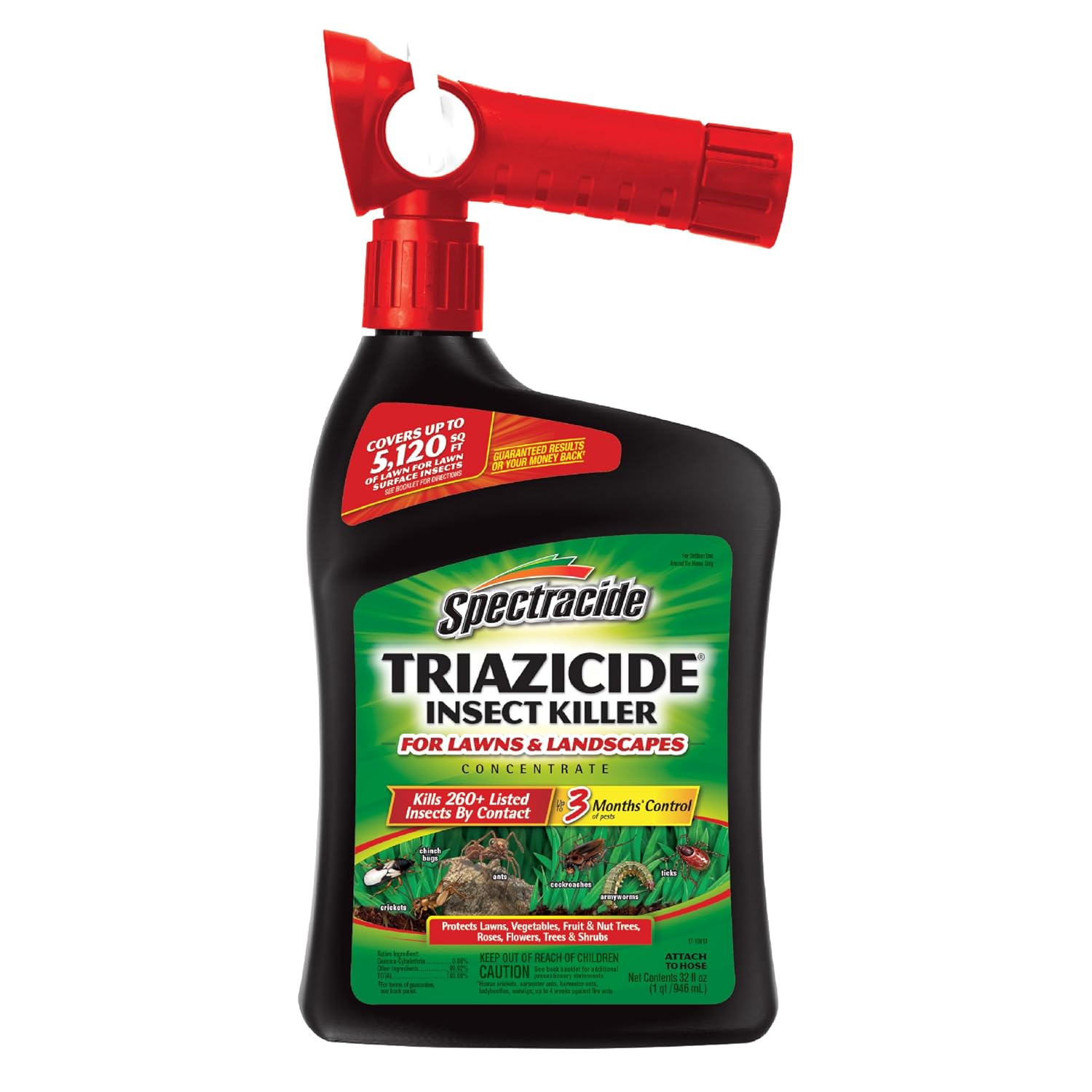
Spectracide Triazicide is a concentrate designed to be mixed with water and applied with a tank or hose-end sprayer to control surface and soil insects across lawns and landscape beds. It targets more than 260 pests by contact, including fleas and ticks, grubs and common lawn ants, and manufacturer directions show it can treat large areas when mixed at label rates. The formula is non-staining when used as directed and claims residual control for up to three months, which reduces how often you need to reapply. Practical benefits include flexible use around lawns, flower beds, trees and shrubs and specific directions for mound treatments like fire ants. Important limitations are its toxicity to fish and bees and the need to follow safety and exclusion zones near water and blooming plants; it is a pesticide that requires careful handling, timing, and proper mixing to avoid off-target damage. Also some buyers may prefer ready-to-use products rather than handling a concentrate and sprayer setup.
Best for: Buyers who want a cost-effective, broad-spectrum lawn treatment and are comfortable mixing a concentrate and using a sprayer to protect lawns and surrounding landscape from fleas and other pests.
Less Ideal for: Gardeners who need an immediate ready-to-use solution without mixing or who maintain pollinator-friendly landscapes with frequent blooms near treatment areas.
- Concentrate covers large areas when mixed so one bottle treats many square feet
- Broad-spectrum label lists 260+ insects including fleas and deer ticks
- Non-staining when used according to the label
- Residual control up to three months reduces application frequency
- Highly toxic to aquatic life and harmful to bees if applied to blooming plants or allowed to drift
- Requires mixing and a separate sprayer or hose attachment which adds setup and handling steps
Verdict: A budget-friendly concentrate that delivers broad, long-lasting flea and turf insect control when you are willing to mix and apply it properly.
Atticus Talak 7.9% Bifenthrin Indoor/Outdoor Insecticide Concentrate (1 gal)

| Unit Count | 128 Fluid Ounces |
|---|---|
| Active Ingredients | Bifenthrin |
| Formulation | Suspension Concentrate |
| Length of Control | Up to three months |
Atticus Talak 7.9% is a water-based bifenthrin concentrate designed for flexible use across lawns, landscapes, and indoor perimeter treatments. You dilute the concentrate with water to make ready-to-spray mixes for turf, plants, hardscape cracks, or indoor baseboards, and the label lists specific mix rates for different applications. It kills on contact and is labeled to control more than 75 pests, including fleas, ticks, ants, and mosquitoes, with residual activity that can last up to three months per application. The formula dries clear, leaves no odor or residue, and the bottle includes pre-marked pour sections to make small mixes easier. Important limitations are that mixed solutions should be used the same day and it is not approved for fogger use, so you need a sprayer and willingness to follow label safety precautions around people, pets, and certain states where restrictions apply. For someone who wants a single, long-lasting concentrate to treat both lawns and nearby living areas, Talak offers dependable, professional-style performance when applied as directed.
Best for: Buyers who prioritize a reliable, long-lasting insect control product for both turf and perimeter treatments and who will follow labeled application rates and safety guidance.
Less Ideal for: People seeking an immediate ready-to-use aerosol or fogger solution or those unwilling to mix and apply concentrated pesticides themselves.
- Broad-spectrum control listed for 75+ pests including fleas and ticks
- Residual activity up to three months per application
- Water-based formula dries clear with no odor or visible residue
- Dilutable concentrate with labeled mix rates for lawns, landscapes, and indoor perimeters
- Mixed spray solutions cannot be stored and must be used the same day
- Not approved for fogger application so a sprayer is required
- Contains bifenthrin which requires careful adherence to label safety and regional restrictions
Verdict: A dependable, long‑lasting bifenthrin concentrate for homeowners who want one product to treat lawns and living‑area perimeters against fleas and many other pests.
Atticus Talak 7.9% Bifenthrin Indoor/Outdoor Insecticide Concentrate (32 oz)

| Item Form | Liquid |
|---|---|
| Target Species | Insects |
| Liquid Volume | 32 fluid ounces |
| Active Ingredients | Bifenthrin |
| Specification Met | EPA |
Talak 7.9% is a water-based bifenthrin concentrate intended as a multipurpose indoor and outdoor insecticide. You dilute the concentrate with water and spray treated lawns, landscape plants, patio perimeters, foundations, and interior baseboards to create a residual barrier that kills on contact and can last up to three months. The label lists control for more than 75 pests including fleas and mites, and it can be used as a mound drench for fire ant control. The formula dries clear, is odor-free, and is designed not to cause phytotoxicity so it is safe for use on many ornamentals when applied per directions. Practical advantages include flexible dilution rates for turf, landscapes, and perimeter treatments and a bottle with a convenient pour feature for measured mixing. Important limitations are that concentrate solutions cannot be stored for later use so you must mix only what you need and it is not approved for fogger application; also it is restricted from sale in a few states, so check local availability and labeling before purchase.
Best for: Buyers who want a proven, multipurpose turf and perimeter insecticide with documented effectiveness against fleas and other common lawn pests and who value products backed by many user reviews.
Less Ideal for: People who need ready-to-use products or want to store premixed solution for repeated applications or those who require fogger-compatible formulations.
- High 7.9% bifenthrin concentration for broad, long-lasting residual control
- Formulated to dilute with water and treat lawns, landscapes, hardscape perimeters, and indoor baseboards
- Dries clear and is odor-free to avoid staining and strong smells on treated surfaces
- Label lists control of fleas and other turf pests and allows mound drench for fire ants
- Mixed spray solutions should be used same day and cannot be stored
- Not approved for fogger use, limiting some application methods
- Not available for sale in certain states
Verdict: A concentrated, water-dilutable bifenthrin formula that offers broad, long-lasting flea and general pest control for lawns and perimeter treatments.
Choosing the Right Lawn Insecticide for Fleas: Key Factors to Consider
Active Ingredient and Mode of Action
Active ingredient class determines how the product affects flea biology and whether it targets adults, larvae, or eggs. Some chemistries act on the nervous system to knock down adults quickly, while insect growth regulators or chitin synthesis inhibitors disrupt immature stages and reduce future generations.
Choosing products with different modes of action matters if fleas have been treated repeatedly in an area, because rotating chemistries helps reduce the chance of resistance developing. Also consider labeled restrictions; some active ingredients are not approved for certain turf types or near water features, and label directions control safe use around kids and pets.
Residual Duration in Turf
Residual duration describes how long the product remains active on grass blades and in thatch and therefore continues to control fleas after application. A longer residual can reduce the need for repeat treatments, but persistence depends on weather, mowing, irrigation, and UV exposure.
If your yard is frequently watered or mowed, a product with longer label-proven residual or with a controlled-release granular formulation will maintain control better. For spot treatments or high-traffic play areas, shorter-residual products that break down faster may be preferred to reduce exposure risk.
Application Method and Equipment Compatibility
How you apply the insecticide affects coverage, ease, and the chance of missed patches where fleas can survive. Granules are straightforward for even broadcast coverage with a spreader, while hose-end or pump sprayers let you treat larger areas more quickly and can reach into thatch and turf blades.
Match the application method to your yard size and the equipment you own. Consider whether you need tank-mixing flexibility, whether labeled rates fit common spreader settings, and whether the product requires special calibration to avoid over- or under-application.
Treated Coverage and Mix Rates
Coverage per container and the product's mix rates determine how much area a purchase will treat at labeled rates. Some concentrated liquids cover more square footage per gallon than a comparable ready-to-use spray, while some granulars advertise coverage for several thousand square feet.
Calculate realistic coverage using the labeled rate for flea control, not the maximum lawn rate for other pests. This helps avoid unexpectedly needing multiple containers for a single season. Also account for reapplication intervals stated on the label when planning inventory.
Timing and Seasonal Considerations
Flea activity on lawns often rises in warm months and when hosts pass through treated areas. Timing applications to coincide with peak adult activity and before heavy host exposure can substantially reduce biting incidents and egg deposition into turf.
For long-term suppression include at least one treatment timed to interrupt immature stages, often spaced on the label interval. In cooler climates or shaded lawns where flea life cycles are slower, you may need fewer treatments; in warm, humid regions, plan for more frequent intervention.
Pet and Family Safety Instructions
Label guidance on re-entry intervals, pet-safe drying times, and whether pets need to be kept off treated turf is critical. Different formulations require different wait times before allowing pets back on the lawn, and some list precautions for areas where pets groom or rest.
Consider how soon children and pets use the yard after treatment, and choose formulations and application methods that align with that schedule. Also check instructions on washing pets or contacting a veterinarian if accidental exposure occurs.
Understanding How Lawn Treatments Reach Fleas
Fleas on turf live in thatch, soil surface, and in shaded microhabitats where pets and wildlife rest. Contact adulticides work when fleas crawl over treated grass blades or surface residues, while growth regulators reduce egg viability and prevent larvae from maturing. Knowing where fleas spend time helps you direct treatments to hot spots such as under shrubs, along fence lines, and near pet paths.
For thorough control combine a product that provides rapid adult knockdown with one that interrupts immature stages. Application placement and timing are often as important as active ingredient; even a highly effective chemistry will fail if applied only to a few square feet while fleas thrive elsewhere in the yard.
- Spot-treat shady, moist areas where fleas concentrate
- Treat pet resting and denning sites with care and label guidance
- Address edges and shadowed turf along structures where flea eggs collect
Granular Versus Spray Formulations
Granular products are easy to spread evenly and often contain controlled-release carriers that extend residual. They are ideal for broad, uniform lawns and for homeowners who prefer not to handle concentrated liquids. Granules can be broadcast with a spreader and then watered in lightly to move the active ingredient into thatch.
Sprays allow finer placement and quicker coverage for irregular lawns, edges, and around landscape features. Hose-end and pump sprayers give flexibility to treat along fence lines and into dense turf where fleas hide. Follow label directions for calibration to avoid drift and achieve the intended application rate.
- Granules: good for large, open lawns and longer residual
- Sprays: better for precision, spot treatment, and treating thatch
- Consider mixing needs and equipment cleaning after using concentrated liquids
Integrated Yard Practices to Reduce Flea Pressure
Cultural steps can reduce flea habitat and lower reliance on chemical controls. Regular mowing, removing leaf litter, and limiting dense groundcover near pet resting spots reduce humid pockets that favor flea development. Controlling wildlife access to yards and promptly treating pets for fleas also interrupts the life cycle.
Irrigation timing matters. Overwatering can prolong favorable conditions for larvae, while a short, deep watering after applying a product that requires watering in can help move active ingredients into target zones. Use insecticides as one part of a broader plan to reduce re-infestation pressure.
- Mow regularly and remove excess thatch where possible
- Keep pet resting areas clean and launder pet bedding frequently
- Repair bare spots where animals congregate to prevent hotspots
When to Consider Professional Application
Large properties, heavily infested yards, or situations with complex water features may warrant a professional applicator who can apply labeled rates with commercial equipment and follow local regulations. Pros can also integrate soil treatments around foundations where fleas persist and recommend a multi-treatment schedule when infestations are severe.
If children or pets have allergies, or if there are sensitive nearby habitats, a professional can advise on product choices and buffer zones. Still, many homeowners can achieve effective control with labeled consumer products if they follow directions closely and address reinfestation sources.
- Consider pros for acreage, persistent infestations, or regulatory constraints
- Professionals can handle treatments requiring special licenses
- Ask about integrated plans that include follow-up visits and monitoring
Interpreting Labels and Safe Use Directions
Product labels are legal documents that specify target pests, application rates, water volumes, re-entry intervals, and restrictions near water or edible areas. For flea control read the label to confirm turf use, the flea life stages listed, and any specific instructions for pet re-entry. Do not apply above the labeled turf rate expecting better control; this can increase exposure without added benefit.
Keep product containers and application records in case you need to follow up with a veterinarian or extension service. Use recommended personal protective equipment during mixing and application and follow disposal instructions for leftover concentrate or empty containers.
- Confirm fleas are listed on the label and note the required re-entry interval
- Follow spreader or sprayer calibration instructions to achieve labeled rates
- Store products out of reach of children and pets and dispose as instructed
How We Chose the Best Lawn Insecticide for Fleas
We selected options that are formulated specifically for turf use and that list fleas or flea life stages on the product label. Our filters prioritized application methods suited to home lawns, including granular spreads and hose-end or pump-sprays, plus products with verifiable residual activity against adult fleas or immature stages. We also considered active ingredient classes to avoid grouping redundant formulations and to offer different modes of action for resistance management. Evaluation focused on measurable, garden-relevant criteria: treated coverage per application, residual duration in turf, effectiveness against flea life stages, and user safety instructions and restrictions for pets and children. We excluded products labeled only for indoor use, for ornamental beds without turf directions, or formulations unsuitable for typical lawn equipment. We also excluded materials that require specialized commercial licenses to apply. The resulting list balances efficacy, practical application, and safer handling for residential settings.
FAQ
How long after treating the lawn can pets go back outside?
Wait times vary by formulation. Many products allow pets back on treated turf after the spray or granule has dried or after a specified re-entry interval listed on the label. Check the product label for the exact guidance and keep pets off treated areas for the recommended time.
Will a single treatment eliminate fleas from my yard?
A single treatment may reduce adult flea numbers quickly but usually will not eliminate all life stages. Eggs and larvae in protected microhabitats can persist, so follow-up treatments timed according to the label and combined cultural controls are often necessary to interrupt the life cycle.
Can I use a lawn insecticide for fleas if I have a vegetable garden nearby?
Many turf products have restrictions for use near edible gardens or require buffer distances. Read the label for setbacks and avoid drift onto vegetables. If the edible area is close, consider spot treatments or physical barriers and follow label safety instructions carefully.
Are organic or botanical options effective for flea control on lawns?
Some botanical or softer chemistries can provide temporary knockdown but tend to have shorter residual activity compared with conventional active ingredients. They can be part of an integrated plan, especially where reduced persistence is desired, but may require more frequent applications.
How should I time treatments relative to my pet flea treatments?
Coordinate yard treatments with pet flea prevention so both the animal and the environment are protected. Apply lawn treatments when pet topical or oral products are active to reduce re-exposure. Avoid bathing or applying pet products immediately after lawn treatments unless label directions indicate it is safe.
Final Verdict
Choose a lawn insecticide strategy based on where fleas live in your yard, how often the area is used by pets and people, and the balance you want between rapid knockdown and longer residual control. Prioritize products whose labels list fleas and that offer an appropriate mode of action for the life stages you need to target. Plan treatment timing, follow label safety instructions closely, and combine chemical control with cultural measures like mowing, cleaning pet areas, and limiting wildlife access. That approach gives the best chance of reducing flea pressure while keeping your lawn safe for family and pets.
