

Note: This article contains affiliate links. If you click on these links and make a purchase, I may earn a small commission at no extra cost to you. This helps support my research and content. Read my full affiliate disclosure here.
If you grow apples, managing insect pests is one of the most direct ways to protect yield and fruit quality. Choosing the right insecticide for apple trees matters because timing, residual activity, and safety around pollinators and fruit all affect harvest success. This guide covers the top shortlisted insecticide options for apple trees and explains how each was evaluated for effectiveness, application method, and orchard safety. Read on to understand which product characteristics matter for your situation and how they perform in typical home or small-scale orchard conditions.
Top Picks at a Glance
| Best Overall The best all-around choice for most situations | BioAdvanced 3-in-1 Fruit, Citrus & Nut Tree Spray, 32 oz |  |
| Best Quality Built to a higher standard if you want something more solid | Bonide Captain Jack's Citrus, Fruit & Nut Orchard Spray Concentrate, 32 oz |  |
| Best Value The sweet spot between price and what you get | BioAdvanced 3-in-1 Insect, Disease & Mite Control Spray, 24 fl oz |  |
| Best Budget The cheapest option that still gets the job done reliably | Bonide Insecticidal Soap Ready-to-Use Spray, 32 oz |  |
| Most Popular A crowd favorite that many people choose with confidence | BioAdvanced Fruit, Citrus & Vegetable Insect Control Concentrate, 32 oz |  |
BioAdvanced 3-in-1 Fruit, Citrus & Nut Tree Spray, 32 oz

| Item Form | Liquid |
|---|---|
| Target Species | Insects |
| Included Components | 32 Oz Fruit & Nut Tree Care |
| Manufacturer | SBM Life Science |
The BioAdvanced 3-in-1 Fruit, Citrus & Nut Tree Spray is a hose-end, ready-to-spray concentrate designed for orchard and backyard fruit-tree care. It attaches to a garden hose so you can evenly coat branches and foliage without mixing or measuring, and the formula provides contact control of common pests such as aphids, caterpillars, and mites while also helping manage fungal diseases like black spot and powdery mildew. Because it is labeled for use up to the day before harvest, it is practical for apple growers who need quick protection late in the season. Notable features include the hose-end application for fast coverage and the triple-action label that reduces the need to buy separate insecticide and fungicide products. Limitations are that control is by contact so thorough coverage is required and it targets listed pests and diseases only, so you must confirm the product lists the specific pests or diseases you face and follow label directions closely for timing and safety.
Best for: Home orchardists who want a straightforward, time-saving treatment to protect apple trees from common pests and fungal diseases without juggling multiple products.
Less Ideal for: Commercial growers with large acreage or those needing systemic, long‑lasting control should consider professional or systemic alternatives tailored for heavy infestations.
- Hose-end ready-to-spray design for fast, even coverage without mixing
- Triple-action formulation that addresses insects, mites, and fungal diseases in one product
- Labeled safe for use up to the day before harvest for edibles when used as directed
- Effectiveness depends on thorough contact coverage since it kills by contact rather than systemic action
- Only controls pests and diseases explicitly listed on the label, so not universal for all orchard issues
Verdict: A convenient hose‑end 3‑in‑1 spray that delivers quick, one‑step protection for home apple trees against common insects, mites, and fungal diseases.
Bonide Captain Jack's Citrus, Fruit & Nut Orchard Spray Concentrate, 32 oz

| Unit Count | 32 Ounce |
|---|---|
| Item Form | Spray |
| Target Species | Fungicide, Insecticide and Miticide |
| Liquid Volume | 32 fluid ounces |
| Active Ingredients | lemon |
Bonide Captain Jack's Orchard Spray is a 32 oz concentrate designed to protect apple trees and other fruiting plants from a wide range of insects and fungal diseases. Mixable with water, one pint makes several gallons of finished spray so it is intended for gardeners who treat multiple trees or cover larger canopies. It targets beetles, caterpillars, fruit flies, scale and mites while also helping control powdery mildew, rust, blight and common leaf spots. You can apply it with a hose-end or tank sprayer and the label allows use up to the day before harvest, which is useful when fruit protection is time-sensitive. Practical benefits include broad-spectrum control in one product and economical dilution rates that reduce per-application cost. Limitations are that this is a conventional spray concentrate so you must follow label directions for mixing, timing, and safety gear, and it is not an organic-certified formulation if you need organic inputs for certified orchards.
Best for: Gardeners and small orchard owners who prioritize reliable, broad-spectrum protection for apple trees and value economical concentrates for treating multiple trees.
Less Ideal for: Growers looking for an organic-certified or completely non-chemical program or those who need a ready-to-use spray for a single small tree.
- Broad-spectrum action against insects, mites and common fungal diseases relevant to apple trees
- Concentrated formula that dilutes to multiple gallons for economical coverage
- Can be used up to the day before harvest for late-season protection
- Works with common application methods such as hose-end and tank sprayers
- Not labeled as an organic-certified product
- Requires careful mixing and personal protective equipment during application
Verdict: Choose this concentrate when you need a cost-effective, broad-spectrum insect and disease spray to protect apple trees across a small orchard.
BioAdvanced 3-in-1 Insect, Disease & Mite Control Spray, 24 fl oz

| Unit Count | 24 Fluid Ounces |
|---|---|
| Item Form | Spray |
| Liquid Volume | 24 fluid ounces |
| Active Ingredients | 0.012% Imidacloprid, 0.014% Tau-fluvalinate, 0.015% Tebuconazole |
| Specification Met | EPA |
This ready-to-use BioAdvanced 3-in-1 spray combines an insecticide, miticide, and fungicide for broad protection on ornamental plants, including orchids listed among similar use sites. It is applied with a trigger sprayer to foliage and blooms, killing aphids, caterpillars, Japanese beetles and controlling spider mites on contact while the systemic components provide rainproof protection for up to 30 days. The inclusion of a fungicide helps manage common diseases such as powdery mildew and black spot, which can benefit orchids prone to fungal problems in humid conditions. Practical benefits are ease of use, multi-target control in one bottle, and coverage for dozens of plants per container. Important limitations are that the formula contains systemic insecticides so it must be used according to label directions and is not allowed for sale in several states, and specific orchid suitability is not detailed on the label so spot-testing on a few plants is prudent before wide application. Expect good short-term control but follow safety and timing guidance for flowering plants.
Best for: Home gardeners who want a single, easy-to-use product to manage common insect pests, mites, and fungal issues on ornamental plants and potted specimens while minimizing application time.
Less Ideal for: Specialist growers who require orchid-specific products or organic/chemical-free controls should consider targeted or softer alternatives tailored to sensitive species.
- Combines insect, mite, and fungal control in one ready-to-use spray for simplified treatment.
- Trigger-spray applicator makes spot and foliar application easy for container and potted plants.
- Systemic, rainproof protection that can last up to 30 days reduces reapplication frequency.
- Covers many common pests on ornamentals including aphids, caterpillars, Japanese beetles, and spider mites.
- Label does not list detailed directions specific to orchids so compatibility with sensitive species is not guaranteed.
- Not available for sale in several states which limits access depending on location.
- Contains multiple active ingredients so users must follow safety precautions and withholding periods for bloom treatments.
Verdict: A convenient all-in-one ready-to-use spray for casual orchid and ornamental growers who want combined insect, mite, and disease control with minimal fuss.
Bonide Insecticidal Soap Ready-to-Use Spray, 32 oz

| Unit Count | 32 Ounce |
|---|---|
| Item Form | Spray |
| Target Species | Insects |
| Active Ingredients | Potassium salt of fatty acids |
This ready-to-use insecticidal soap spray kills soft-bodied insects on contact using potassium salts of fatty acids derived from plants, making it suitable for organic vegetable beds and container vegetables. It is applied with the built-in spray nozzle directly to affected foliage to control aphids, mites, caterpillars, whiteflies and other listed pests; the label allows use up to the day of harvest on many food crops. Practical benefits include an easy spray application with no mixing, low residual toxicity compared with conventional insecticides, and a broad list of target species for small-scale home gardens and greenhouses. Important limitations are that it works by contact so complete coverage is required and it will not control pests hidden inside fruit or stems; repeated applications may be necessary for heavy infestations. Users should follow label safety directions and test on a few plants first since some sensitive foliage can show damage under hot conditions.
Best for: Gardeners who prioritize simple, low-residue organic solutions for vegetables and want a no-mix spray they can use quickly on affected plants.
Less Ideal for: Large-scale growers who need systemic or long‑residual control or anyone needing a product to reach pests hidden inside fruit or stems.
- Ready-to-use spray with an easy nozzle for immediate application
- Active ingredient is a plant-derived potassium salt suitable for organic gardening
- Labeled for use on a wide range of vegetables, herbs, ornamentals and houseplants
- Low residual toxicity compared with synthetic insecticides
- Kills only on contact so full coverage and repeat treatments are often required
- May cause phytotoxicity on some sensitive plants or under high heat if not spot-tested
Verdict: A convenient, ready-to-use organic spray that gives practical contact control of common vegetable garden pests with minimal residual impact.
BioAdvanced Fruit, Citrus & Vegetable Insect Control Concentrate, 32 oz
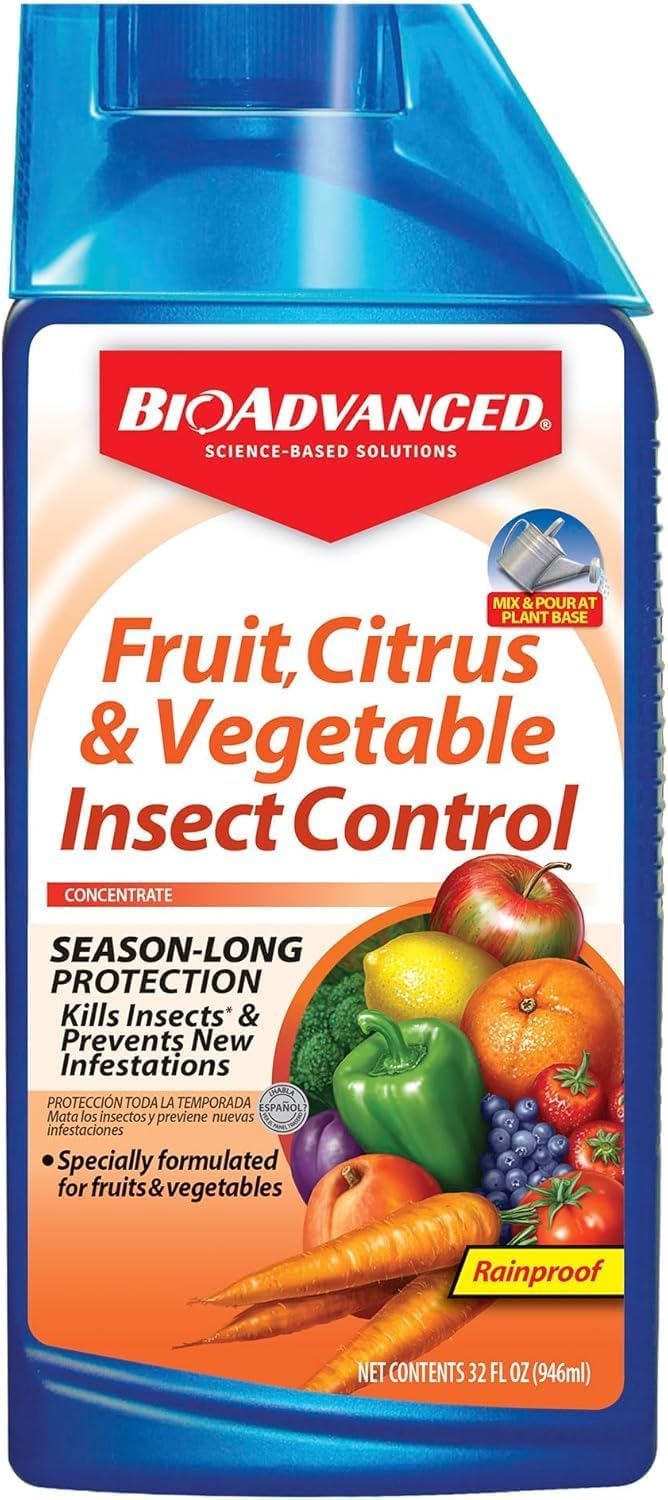
| Item Form | Concentrate |
|---|---|
| Target Species | Aphid, Whiteflies, Japanese Beetles, Mealybugs, Asian Citrus Psyllid |
| Liquid Volume | 32 fluid ounces |
| Specification Met | EPA |
| Active Ingredients | avocado |
This BioAdvanced concentrate is designed as a season-long, systemic insect control for edible gardens. You mix the concentrate with water and pour it around the root zone, so no foliar spraying is required; after uptake the product protects plants from feeding pests such as aphids, whiteflies, leafhoppers, scale and Japanese beetles and is rainproof after one hour. A single application covers large areas and the label states protection for up to two months, which makes it useful for producers who want durable control without repeated sprays. Because it is systemic the active ingredient is taken up by the plant, protecting new growth as well as existing foliage. Important limitations are regulatory restrictions in several U.S. states and the fact that systemic chemistry can affect nontarget insects, so follow label directions and harvest intervals carefully. For gardeners focused on strong, low-effort insect control for edible crops, this product delivers predictable season-long protection when used as directed.
Best for: Gardeners and small-scale growers who prioritize reliable, low-effort, season-long protection for edible vegetables and fruit and who want a pour-in-root treatment instead of repeated foliar sprays.
Less Ideal for: People who prefer organic contact-only treatments or who manage pollinator-heavy plantings where nontarget exposure must be minimized should consider alternative products.
- Systemic mode of action protects new growth and does not require foliar spraying
- Provides rainproof protection one hour after application
- Single application gives season-long control for up to two months
- Covers a wide range of listed pests relevant to vegetables and fruit
- Not permitted for sale or use in several U.S. states and some New York counties
- Contains systemic insecticide chemistry that can impact nontarget insects if misused
Verdict: Choose this concentrate if you want dependable, season-long systemic protection for vegetables and fruit with a single pour-in application.
Choosing the Right Insecticide for Apple Trees: Key Factors to Consider
Target Pest Spectrum
Different insecticides control different groups of pests. Some are broad-spectrum and will quickly knock down aphids, caterpillars, leafminers, and scale, while others are selective for chewing or sap-sucking insects. Knowing the specific pests you commonly see on your apple trees helps you choose a product with the right mode of action.
Choosing a product with activity against the pests present reduces unnecessary sprays and slows resistance development. If you rotate chemistries or alternate modes of action, you can maintain control effectiveness season after season.
Timing and Pre-Harvest Interval
When you apply an insecticide relative to bloom and harvest is critical. Some chemistries must not be used during bloom because of high risk to pollinators; others have long pre-harvest intervals that limit how close to picking you can spray. Understand label timing so you do not compromise fruit safety or pollination.
Plan treatments around phenology. Early-season sprays aimed at overwintering pests or first-generation larvae often have different options than late-season treatments targeting fruit-feeding insects. Always follow label instructions for intervals before harvest.
Residual Control Versus Short-Contact Action
Residual activity describes how long an insecticide continues to kill or repel insects after application. Longer residuals reduce reapplication frequency but can increase exposure risk to beneficial insects and may leave higher residues on fruit. Short-contact or quick knockdown products reduce immediate populations but may require more frequent applications.
Evaluate residual length in the context of your pest pressure, weather patterns, and pollinator activity. Heavy rain will shorten residuals and may necessitate reapplication sooner than label intervals suggest.
Impact on Pollinators and Beneficial Insects
Apple trees depend on pollinators for fruit set and benefit from predatory and parasitic insects that suppress pests. Some insecticides are highly toxic to bees or beneficial predators, especially during bloom. Others have lower toxicity or label directions that limit exposure windows.
Choose options and timings that avoid open bloom, use targeted spot treatments where practical, and prefer products or formulations labeled as less harmful to pollinators when pollination or beneficial insect activity is likely.
Application Method and Equipment Compatibility
Different formulations-sprays, concentrates, or trunk treatments-require different applicators and techniques. Home orchardists typically use a hand-pump sprayer, backpack sprayer, or hose-end applicator. Make sure the product you select mixes well, is compatible with your sprayer, and can reach the canopy and undersides of leaves where pests hide.
Consider droplet size, pressure, and coverage needs. Proper calibration and coverage are often more important than product choice; a poorly applied treatment will not control pests effectively.
Fruit Residue and Safety for Consumption
Residues on harvested apples are a concern for edible crops. Labels specify maximum residue intervals and required waiting periods before harvesting. Some insecticides break down quickly and leave minimal residues when used as directed, while others persist longer and demand longer pre-harvest intervals.
If you harvest for family consumption, prioritize products with clear, short pre-harvest intervals and follow washing and storage recommendations to minimize dietary exposure.
Common Apple Tree Pests and When to Treat
Identify the timing and life stage of the pest before applying any treatment. Early-spring treatments target overwintering eggs and newly hatched larvae, while midseason sprays focus on caterpillars, aphids, and codling moth activity. Monitoring with visual checks or traps helps determine the right moment to act.
Treating at the most vulnerable life stage yields more control with less product. For example, targeting caterpillars as young larvae is more effective than trying to control large, established caterpillars later in the season.
- Scout regularly for egg clusters, leaf damage, frass, and sticky honeydew.
- Use timing tools such as degree-day models or local extension advisories for pests like codling moth.
- Apply preventative sprays when pest pressure is predictable and early treatment reduces population growth.
Integrated Pest Management Strategies
Integrate cultural, mechanical, and biological tactics with judicious insecticide use. Pruning to improve airflow, removing infested fruit, and encouraging natural enemies all lower pest pressure and reduce reliance on chemical controls.
Use insecticides as one component of an IPM plan. Combine sanitation, monitoring, and selective treatments to maintain long-term control and minimize disruptions to beneficial insect populations.
- Promote habitat for predators by maintaining cover crops or flowering strips away from bloom period.
- Use pheromone traps for monitoring rather than as the sole control method.
- Rotate modes of action to delay resistance development.
Safe Application Practices Around Bloom
Avoid spraying during open bloom when bees and other pollinators are active. If treatment is necessary, choose options and timings that minimize exposure and follow label restrictions about pollinator protection windows.
When applying, target foliage and avoid broadcast drift. Work early in the morning or late in the day when pollinator activity is lower, and communicate with neighbors if hives are nearby.
- Read label warnings for pollinator contact periods and adhere strictly to them.
- Use calibrated nozzles and lower pressure to reduce drift.
- Consider physical barriers or spot treatments for localized infestations near bloom.
Mixing, Calibration, and Coverage Tips
Proper mixing and sprayer calibration ensure the product reaches pest hiding spots and performs as expected. Measure concentrates carefully, pre-mix as instructed, and test spray patterns before full-coverage applications.
Pay attention to canopy density. Dense trees need higher volume or finer droplets to penetrate foliage, whereas open trees require less volume for good coverage.
- Always wear recommended protective equipment when mixing and spraying.
- Clean equipment thoroughly after use to prevent cross-contamination of other garden treatments.
- Record application dates, rates, and weather to track efficacy and comply with pre-harvest intervals.
Handling Resistance and When to Rotate Modes of Action
Repeated use of the same active ingredient or mode of action selects for resistant pest populations. If you notice reduced efficacy over time, switch to a product with a different mode of action and rely more on cultural controls for a season.
Rotate treatments on a seasonal schedule and base rotations on label guidance for action groups to maintain long-term effectiveness.
- Limit applications of any one mode of action according to resistance-management recommendations.
- Combine chemical rotation with scouting and threshold-based applications to reduce selection pressure.
How We Chose the Best Insecticide for Apple Trees
We shortlisted products based on practical orchard needs and realistic home-gardening use. Evaluation emphasized four to six concrete, category-specific criteria: speed and breadth of pest control (which insects are targeted and how quickly populations are reduced), residual activity and reapplication interval (how long sprays remain effective and safe relative to harvest), pollinator and beneficial insect risk (toxicity window and required precautions around bloom), and application practicality (spray equipment compatibility, mixing ease, and coverage). We also considered fruit-residue potential and pre-harvest interval where relevant because that influences when apples are safe to harvest after treatment. We excluded products with unclear label directions for apples, formulations not intended for tree fruit, or those requiring specialized commercial equipment. The surviving options are those with explicit apple-tree labeling, manageable safety precautions for home orchardists, and documented activity on common apple pests. The scoring aligns with the dimensions above so gardeners can weigh tradeoffs between knockdown speed, longevity, pollinator safety, and ease of use.
FAQ
When is the safest time to apply insecticide to apple trees to avoid harming pollinators?
The safest time is outside of open bloom, typically early morning or late evening when pollinator activity is low. Follow label restrictions about spray timing and avoid any treatments labeled as highly toxic to bees during bloom.
How often should I reapply an insecticide after rain?
It depends on the product's residual activity and how heavy the rain was. Heavy rain can wash off contact insecticides and may require reapplication once foliage is dry and label intervals allow. Systemic products are less affected by rain.
Can I use the same insecticide all season on my apple trees?
Using the same mode of action all season can lead to resistance. Rotate products with different modes of action and combine nonchemical tactics to reduce selection pressure and maintain long-term control.
How close to harvest can I spray apples?
Pre-harvest intervals vary by product. Choose insecticides with clear, short pre-harvest intervals if you need late-season control, and always follow label directions to ensure fruit safety.
Are there options that are safer for beneficial insects?
Yes. Some chemistries and formulations are less toxic to predatory insects and pollinators, especially when applied outside bloom and with targeted techniques. Review label guidance for pollinator protection and choose products formulated for selectivity.
Final Verdict
Pick an insecticide for apple trees based on the pests you face, the timing relative to bloom and harvest, and how you balance residual control with pollinator safety. Prioritize accurate timing, proper application technique, and rotating modes of action to maintain long-term effectiveness. A practical approach that combines monitoring, cultural controls, and targeted insecticide use will protect yield while minimizing risks to pollinators and fruit safety. Use the evaluation criteria above to match a product to your orchard needs and management style.
