

Note: This article contains affiliate links. If you click on these links and make a purchase, I may earn a small commission at no extra cost to you. This helps support my research and content. Read my full affiliate disclosure here.
If you manage roughly three acres, the wrong mower turns weekend work into a full-day chore. For that size of property, cutting width, fuel or battery runtime, and the machine's durability determine how much time you spend mowing and how the lawn looks afterward. This guide focuses on top mower options suited for three-acre lots and explains the practical tradeoffs of width, power source, and storage. We shortlisted five strong choices and evaluated each against the real-world needs of acreage mowing so you can pick the type of mower that fits your schedule and terrain.
Top Picks at a Glance
| Best Overall The best all-around choice for most situations | Husqvarna TS 375XD Riding Lawn Mower, 24 HP, 54-inch Deck |  |
| Best Quality Built to a higher standard if you want something more solid | EGO Power+ ZT4204L 42" Z6 Zero Turn Riding Mower with Peak Power Technology and Batteries |  |
| Highest Rated A top-rated pick with lots of positive feedback | YARBO Y40 Core Robot Lawn Mower Pro (20" Cutting Width, Wire-Free, AI Vision + NetRTK) |  |
| Most Popular A crowd favorite that many people choose with confidence | Husqvarna Z254F 54 in. Zero-Turn Riding Mower, 23 HP Kawasaki |  |
| Best Seller A high-volume bestseller chosen again and again | Husqvarna Z242F Special Edition 42" Zero Turn Mower |  |
Husqvarna TS 375XD Riding Lawn Mower, 24 HP, 54-inch Deck

| Power Source | Gas Powered |
|---|---|
| Cutting width | 54 |
| Operation Mode | Manual |
| Item Weight | 680 pounds |
The Husqvarna TS 375XD is a purpose-built riding mower for sizeable lawns and demanding conditions. It pairs a 24 hp FR series Kawasaki V-twin engine with a 54-inch three-blade fabricated deck to cover ground quickly while delivering a clean cut. Built-in features like dial-adjustable seat suspension and a push-button locking differential make it easier to maintain comfort and traction when mowing uneven or hilly turf. Expect straightforward manual operation and rugged construction aimed at long seasons of heavy use. The machine’s weight and power suit continuous mowing on multi-acre properties, but they also mean it requires regular maintenance, fuel, and a sheltered storage space. Maneuvering in very tight beds or around many small obstacles will be slower than with a compact zero-turn, and transport needs a trailer rated for the mower’s mass. For someone managing roughly three acres who wants durability and fewer passes per session, this model is a strong contender.
Best for: Buyers who need a durable, no-nonsense mower to cover several acres efficiently and value comfort and traction for mixed terrain mowing.
Less Ideal for: Not a good choice for owners with very small yards, many tight obstacles, or those who need the extreme maneuverability of a zero-turn mower.
- Powerful 24 hp Kawasaki V-twin engine suited for sustained, high-load mowing
- Wide 54-inch fabricated three-blade deck reduces passes on large lawns
- Dial-adjustable seat suspension improves operator comfort during long jobs
- Push-button locking differential helps maintain traction on uneven or slippery terrain
- Heavy and large footprint makes transport and storage more demanding
- Manual operation lacks the tight turning agility of dedicated zero-turn mowers
Verdict: If you want a robust, comfortable mower that cuts large acreage quickly and handles rough terrain, the Husqvarna TS 375XD delivers the power and deck width to get the job done.
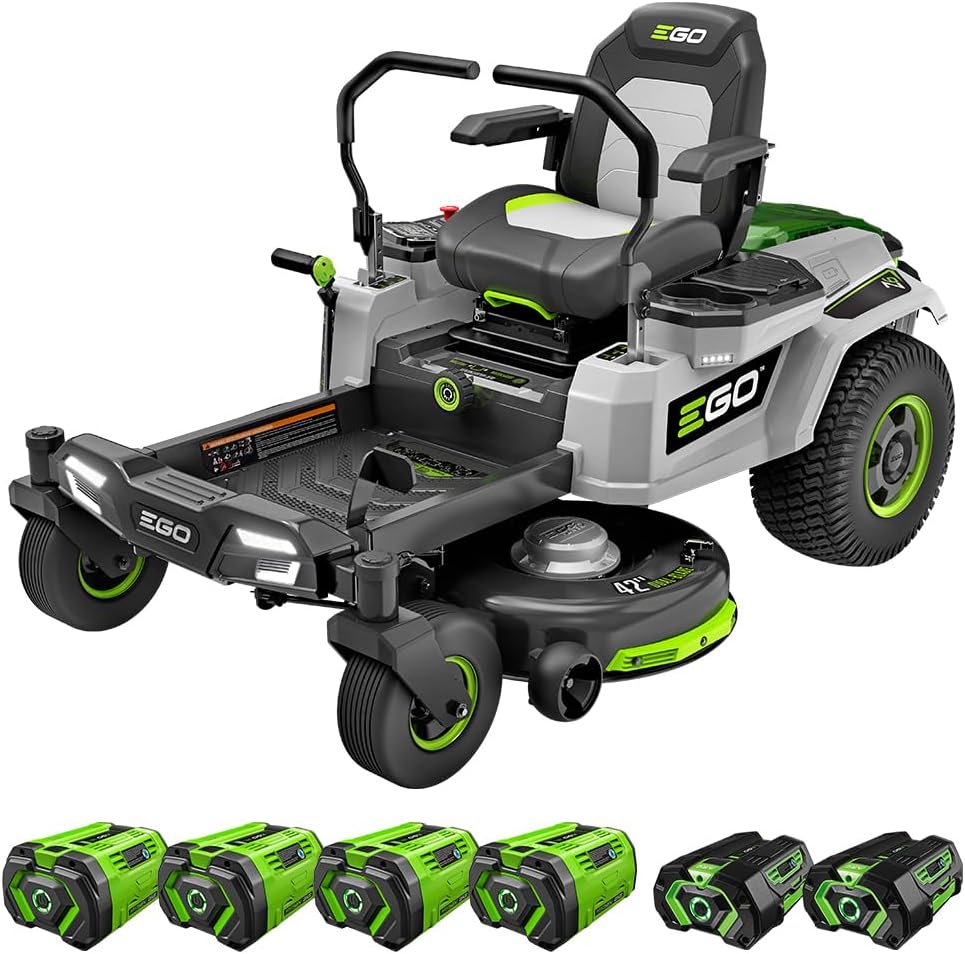
EGO Power+ ZT4204L 42" Z6 Zero Turn Riding Mower with Peak Power Technology and Batteries
| Cutting width | 42 inches |
|---|---|
| Operation Mode | Automatic |
| Maximum Adjustable Cutting Height | 4.5 inches |
| Minimum Adjustable Cutting Height | 1.5 inches |
| Number of Positions | 10 |
The EGO ZT4204L Z6 is a high-performance 42-inch zero-turn riding mower designed to replace a gas ZTR for medium-to-large properties. It uses up to six 56V ARC Lithium batteries and ships with four 10.0Ah and two 5.0Ah batteries to provide the power and runtime needed for about two acres on the included battery set, with the option to add more batteries for longer runs. Four independent brushless motors and Peak Power technology aim to match 22 horsepower, and the mower reaches travel speeds up to 8 MPH with three selectable driving modes for fine control of speed and responsiveness. Practical touches like an adjustable seat suspension, LCD interface, USB port, LED lights, and 10-position cutting height (1.5 to 4.5 inches) make it comfortable and versatile for different turf conditions. The mower supports mulching, bagging, and side discharge. Main limitations are dependency on battery capacity for runtime and the initial complexity and cost of expanding battery count for larger properties, but for someone focused on performance and clean power, it delivers near-gas performance with modern controls.
Best for: Buyers who prioritize near-gas performance, responsive handling, and modern electric controls for mowing medium to larger yards and want the option to expand runtime with additional batteries.
Less Ideal for: Shoppers who need the simplest lowest-cost mower setup or who lack easy access to charge and store multiple high-capacity batteries.
- Battery platform scalable to up to six 56V ARC Lithium batteries for extended runtime
- Four independent brushless motors delivering gas-equivalent power and strong torque
- Zero-turn 42-inch deck balances cutting width and maneuverability for acreage
- Multiple driving modes and LCD interface allow fine-tuning of performance
- Comfort features like adjustable seat suspension, USB port, and LED lights
- Runtime depends heavily on battery count so larger properties require buying extra batteries
- Higher upfront system cost and complexity compared with a single-engine gas mower
Verdict: If you want gas-level performance with the flexibility to scale electric runtime, this 42-inch Z6 zero-turn mower is built for performance-minded owners of multi-acre lawns.
YARBO Y40 Core Robot Lawn Mower Pro (20" Cutting Width, Wire-Free, AI Vision + NetRTK)

| Cutting width | 20 inches |
|---|---|
| Battery Average Life | 120 minutes |
| Cutting height range | 0.8-4.0 inches |
| Maximum climbing ability | 70% (35°) |
| Power Source | Battery Powered |
The YARBO Y40 Core Robot Lawn Mower Pro is built to keep large lawns maintained with minimal supervision. It uses NetRTK/RTK GPS plus binocular vision and multiple sensors to map and navigate complex yards without boundary wire, and its dual 300W motors power a 20-inch cutting deck with selectable straight or razor blades for different grass types. Typical use is set-and-forget: install the system, map zones, and let the mower run on schedule with automatic return-to-charge. Notable features include a long 120-minute battery runtime, a wide 0.8 to 4.0 inch cutting range, and high-climb capability up to 70 percent for steep terrain. Practical benefits are consistent, precise coverage across up to several acres, strong performance on thick or wet grass, and reduced manual trimming thanks to efficient grass ejection. Important limitations are its heavy weight and multi-box shipment that require two people for assembly, the need for a clear sky view for optimal RTK positioning, and the implied complexity of initial setup and site mapping compared with simpler boundary-wire robots.
Best for: Homeowners with a multi-acre property who prioritize dependable, precision mowing and are willing to invest time in a one-time setup for largely hands-off lawn care.
Less Ideal for: Small-lot owners, renters, or anyone seeking a lightweight, out-of-the-box mower with minimal setup and no advanced positioning requirements.
- High-precision navigation with NetRTK, RTK and binocular vision for reliable mapping and coverage
- Dual 300W motors and optimized cutting disc handle thick, wet, or overgrown grass effectively
- Long battery life (approximately 120 minutes) and auto-charge for extended, unattended operation
- Supports steep slopes up to 70 percent, suitable for uneven or hilly yards
- Very heavy and delivered in multiple boxes, requiring two people for assembly and installation
- Initial setup requires good sky visibility for RTK positioning and is more complex than boundary-wire models
Verdict: Choose the YARBO Y40 Core if you need a robust, RTK-guided robotic mower that reliably maintains multiple acres with minimal ongoing attention.
Husqvarna Z254F 54 in. Zero-Turn Riding Mower, 23 HP Kawasaki

| Power Source | gasoline |
|---|---|
| Cutting width | 54 inches |
| Maximum Adjustable Cutting Height | 4.5 inches |
| Number of Positions | 6 |
The Husqvarna Z254F is a heavy-duty zero-turn riding mower aimed at owners who need to cover several acres efficiently. It uses a 23 HP Kawasaki gas engine and a 54-inch ClearCut deck to cut wide swaths quickly, while a hydrostatic transmission removes the need for regular clutch adjustments. Typical use is mowing large lawns where speed and maneuverability matter: the zero-turn steering lets you cut around obstacles and finish a 3-acre property far faster than a walk-behind or small lawn tractor. Notable features include a deep deck profile for better lift and bagging performance, an ergonomic control panel and anti-slip foot area for operator comfort, and a simple deck lift for setting cutting height. Practical benefits are faster job completion, cleaner cuts at wider widths, and lower routine drive-train maintenance thanks to the hydrostatic system. Important limitations are that attachments like a mulching kit or bagger are sold separately and the machine is large and heavy, so it requires secure storage and occasional professional servicing for major work.
Best for: Owners of multi-acre lawns who prioritize fast, professional-quality mowing and want a durable zero-turn that reduces time spent on regular mowing.
Less Ideal for: People with very small lawns, limited storage, or who prefer lighter electric or push-mower options for tight urban yards.
- 54-inch ClearCut deck covers ground quickly for large properties
- 23 HP Kawasaki engine delivers reliable power and strong startup performance
- Hydrostatic transmission reduces routine drivetrain maintenance
- Ergonomic controls and anti-slip foot area improve operator comfort and safety
- Mulching kit and bagger are not included and must be purchased separately
- Heavy and large footprint requires ample storage space and may be difficult to trailer
Verdict: A workhorse zero-turn that lets you mow large lawns quickly with a powerful Kawasaki engine and a wide 54-inch deck.
Husqvarna Z242F Special Edition 42" Zero Turn Mower

| Power Source | Gas Powered |
|---|---|
| Cutting width | 42 |
| Maximum Adjustable Cutting Height | 4 inches |
| Number of Positions | 9 |
The Husqvarna Z242F Special Edition is a heavy-duty zero-turn mower built around a 21.5 HP Kawasaki V-twin and a 42-inch fabricated cutting deck. It is used for medium-to-large lawns where fast, precise mowing is desired; typical use is regular property maintenance on several acres, using the zero-turn steering to cut around obstacles and finish quickly. Notable features include a welded steel deck for durability, a Hydro-Gear EZT transmission for smooth drive control, a roomy seat for operator comfort, and a 3.5 gallon fuel tank that reduces refill frequency. In practice this mower delivers strong cutting performance and good traction on varied terrain, and the robust engine handles dense grass without bogging. Trade-offs are its substantial weight and size, which make transport and storage more demanding and require a trailer or large garage, and the gas powertrain needs routine maintenance and storage care. For buyers who prioritize reliable, time-saving mowing on multiple acres, this model offers a solid, well-supported package.
Best for: A cautious buyer who wants a reliable, time-saving mower for maintaining multiple acres with minimal oversight and predictable performance.
Less Ideal for: Those with very small yards, limited storage or who prefer electric or low-maintenance battery mowers.
- Powerful 21.5 HP Kawasaki V-twin engine handles thick grass and prolonged use
- 42-inch fabricated welded deck provides durable, consistent cutting performance
- Hydro-Gear EZT transmission offers smooth, responsive zero-turn control
- Large fuel tank reduces stops for refueling during extended mowing sessions
- Heavy and bulky, which complicates transport and storage
- Requires regular gas-engine maintenance and winter storage care
Verdict: A robust, comfortable zero-turn mower built to cut large lawns quickly and reliably for owners who want proven gas-powered performance.
Choosing the Right Lawn Mower for 3 Acres: Key Factors to Consider
Cutting Width and Deck Construction
Cutting width directly affects how quickly you can cover three acres. Wider decks cut more ground per pass, reducing total runtime, but very wide decks can be harder to maneuver around trees, gates, and narrow areas. Deck construction influences cut quality and longevity; stamped steel decks are common and economical, while fabricated decks are thicker and resist warping over time.
Also consider deck shape and blade configuration because they determine clipping circulation and the evenness of the cut. A well-designed deck lifts and channels grass uniformly into the discharge or collection system, which matters when you are making many passes across an acreage.
Runtime, Fuel Capacity, and Recharge Rates
For gas mowers, larger fuel tanks and efficient engines reduce the number of fuel stops needed during a mowing session. For battery-electric systems, cumulative runtime and the availability of quick-swap battery packs determine whether a single charge will handle three acres or if you need extra batteries. Pay attention to real-world runtime specs under load rather than idealized numbers because mowing thick or tall turf shortens runtime.
Recharge rates and the logistics of swapping batteries matter when planning work sessions. If you need to recharge between swaths, a fast charger or an extra battery pack will make a battery system more practical for acreage use.
Power and Engine or Motor Durability
Sufficient power keeps the mower cutting cleanly through dense growth and prevents bogging on slopes or thick grass. Look at engine displacement or motor continuous power ratings rather than marketing slogans. Durability indicators include the cooling system, materials around the engine or motor, and serviceability features such as accessible oil and air filters.
Durable drivetrains and transmissions are important too, especially for heavier units and frequent use. A robust powertrain reduces downtime and maintenance frequency when you are routinely mowing multiple acres.
Maneuverability, Steering, and Operator Comfort
Comfortable, predictable handling reduces fatigue during long mowing sessions. Consider steering type, turning radius, seat suspension, and platform ergonomics. Tractors or zero-turn mowers that turn tightly can significantly cut work time on open stretches but require skill around obstacles.
Controls that are easy to reach and intuitive reduce operator error and speed up routine tasks like adjusting cut height or engaging the blades. Vibration damping and good visibility over the deck contribute to safer and more accurate mowing on varied terrain.
Clip Handling, Mulching, and Discharge Options
How a mower deals with grass clippings affects cleanup time and lawn appearance. Rear collection systems reduce the need to rake or bag afterward but add weight and require emptying. Mulching blades and specific deck designs finely chop clippings and return nutrients to the lawn, which may be desirable on well-maintained turf.
Side discharge is fast and simple for large open areas but can leave clumps when grass is wet or very tall. If you often mow near flower beds or paths, look for easy-to-fit deflectors and collection attachments to control where clippings go.
Storage, Transport, and Serviceability
Three-acre properties often require seasonal storage or movement between sites. Consider overall footprint for storage and whether the mower can be transported in a trailer or pickup. Foldable or removable controls and compact decks can help with storage space.
Serviceability includes how easy it is to access routine maintenance points such as oil, filters, spark plugs, and blade removal. Mowers that are easier to service reduce long-term ownership time and cost, especially when you maintain multiple acres regularly.
Gas Versus Battery for Acreage Mowing
Choosing between a gas-powered mower and a battery-electric model comes down to runtime needs and maintenance preference. Gas machines traditionally offer long continuous runtime and fast refueling, which makes them straightforward for three-acre lots with no charging interruptions. Modern battery systems, however, are closing the gap and can be practical with multiple battery packs or rapid chargers.
Consider the logistics on your property. If you have easy access to power and a place to swap and charge batteries, a battery system can reduce vibration, noise, and routine engine maintenance. If your acreage is remote or you prefer uninterrupted long runs, a gas unit may be more convenient.
- Gas: longer continuous runtime, familiar refueling, more engine upkeep.
- Battery: cleaner operation, quieter mowing, requires battery swaps or charging infrastructure.
Zero-Turn, Riding, or Tow-Behind: Matching Mower Type to Terrain
Zero-turn mowers excel on open acreage because they cut down pass count with tight turns and fast ground speed. They are less suited for steep slopes or very rough terrain where traction and stability matter more. Conventional riding lawn tractors offer a smoother ride on rolling ground and can tow attachments like carts or spreaders for multi-use properties.
Tow-behind mowers or mulchers can be an option if you already have a lawn tractor or ATV. They add versatility but may be slower and require more passes to match the cutting efficiency of a larger dedicated deck.
- Zero-turn: fastest coverage on open, obstacle-light lawns.
- Riding tractor: stable on slopes and can tow accessories.
- Tow-behind: versatile but may need more passes.
Managing Tall or Seasonal Growth
A three-acre property often swings between light weekly maintenance and occasional heavy-duty cutting in spring or after neglect. For regular upkeep, a mid-height cut with frequent mowing preserves turf health. For tall spring flushes, choose a mower with enough power and blade design to cut thick, long grass without bogging.
Plan for staged mowing when grass is unusually tall: cut at a higher deck first, then lower it on a follow-up pass. This approach reduces strain on the engine or motor and prevents uneven cuts and clumping.
- Raise deck for first pass on high growth.
- Use mulching or collection options to manage high clipping volume.
- Ensure the mower has enough torque to avoid stalling in heavy turf.
Routine Maintenance That Keeps Mowing Time Low
Maintaining blades, belts, filters, and fluids keeps a mower cutting efficiently and reduces downtime. Sharpen blades regularly because dull blades tear grass, leading to a ragged finish and increased disease risk. Check belts and pulleys annually for wear if you mow seasonally or more often if used weekly.
Establish a simple service routine timed to hours of operation or seasonal milestones. For battery systems, keep contacts clean and follow manufacturer guidance on storage charge levels during off-season months to preserve battery life.
- Sharpen blades every 20 to 50 hours depending on conditions.
- Inspect belts and deck for wear at season start.
- Keep fuel and charging supplies accessible to minimize downtime.
Trail Access, Gates, and Narrow Passages
Three-acre properties often have narrow gates or trails that complicate moving a wide-deck mower around. Measure gate openings and plan a route that minimizes repeated maneuvers. In some cases, a slightly narrower deck that lets you pass through tighter spaces can save time overall compared with a wider deck that forces long detours.
Consider whether you can alter gates or build mower-friendly accessways if you plan to keep a large deck mower. Removable deflectors and folding mirrors can make transporting and storing a wider mower easier when space is tight.
- Measure gate and trailer access before choosing deck width.
- Plan paths that allow efficient travel between lawn sections.
- Assess whether small access improvements could justify a wider mower.
How We Chose the Best Lawn Mower for 3 Acres
We selected machines that perform well in acreage mowing, using criteria that matter to someone maintaining roughly three acres. Our evaluation prioritized cutting width and deck design because a wider, well-shaped deck shortens pass count and improves cut uniformity. Runtime and fuel efficiency were assessed for gas and battery options to reflect how long you can mow between refills or charges. Engine or motor durability and maintenance needs were considered to estimate how the mower will hold up season after season. Maneuverability and handling were judged for common features like steering, turning radius, and suspension that affect comfort during long sessions. We also reviewed collection and discharge options because clippings behavior changes with higher-volume mowing. We excluded light-duty residential push mowers and units designed only for small urban yards. Mowers with inadequate cutting width, low expected runtime for three-acre jobs, or poor durability indicators were not considered. The final shortlist balances time-on-task, cut quality, and long-term reliability for typical three-acre mowing situations.
FAQ
How large a cutting width is practical for three acres?
Cutting widths between about 42 and 60 inches are common practical choices. Wider decks reduce the number of passes but may limit maneuverability near obstacles and gates, so balance width with your landscape layout.
Can battery-powered mowers handle three acres on a single charge?
Often they cannot on a single charge unless you have high-capacity packs or the property is exceptionally easy to mow. Many gardeners use multiple batteries or a fast charger for uninterrupted work on three-acre jobs.
Are zero-turn mowers worth it for acreage?
Zero-turns can significantly reduce mowing time on open, obstacle-light acres because of their tight turning ability and higher ground speed. They require more skill near obstacles and can be less stable on steep slopes compared with conventional tractors.
How should I mow very tall grass safely?
Make a first pass at a higher deck setting to remove the bulk, then lower the deck for a follow-up pass. This staged approach reduces strain on the engine or motor and helps prevent clumping and uneven cutting.
What maintenance tasks most affect long-term reliability?
Regular blade sharpening, belt inspection, and routine engine or motor servicing have the biggest impact. For gas models, changing oil and filters on schedule preserves engine life; for electric models, proper battery care and contact maintenance extend usable life.
Is collecting clippings necessary on three acres?
It depends on lawn goals. Collection keeps paths and beds clean and is useful when clippings would smother plants, but it adds time for emptying. Mulching returns nutrients to the soil and is faster when the grass is not excessively long.
Final Verdict
For a three-acre property, prioritize machines that reduce total pass count and minimize stops for fuel or charging. Cutting width, reliable runtime, and a durable drivetrain should guide your choice, while maneuverability and clip-handling options determine how easy the mower is to use in real yard conditions. Balance speed and cut quality against access constraints and storage space to match the mower to the way you maintain your acreage. Focus on the combination of deck size, power source, and serviceability that fits your terrain and schedule to make acreage mowing efficient and less taxing.
