

Note: This article contains affiliate links. If you click on these links and make a purchase, I may earn a small commission at no extra cost to you. This helps support my research and content. Read my full affiliate disclosure here.
Picking the right insecticide for vegetable plots changes how well your crops tolerate pest pressure and how safe the harvest is for the table. You want a product that knocks back chewing and sucking insects without leaving harmful residues or killing pollinators. This guide outlines the top shortlisted insecticides for vegetable gardens and explains the practical tradeoffs you will face in a home or community plot. We evaluated products across real-garden criteria like on-plant safety, spectrum of control, and ease of use. Read on for a clear summary of why each type made the list and what to consider when deciding which option fits your planting style.
Top Picks at a Glance
| Best Overall The best all-around choice for most situations | Bonide Captain Jack's Deadbug Brew 32 oz Concentrate |  |
| Best Quality Built to a higher standard if you want something more solid | BioAdvanced Vegetable & Garden Insect Spray Concentrate (32 fl oz) |  |
| Best Value The sweet spot between price and what you get | Bonide Captain Jack's Deadbug Brew Concentrate, 16 oz |  |
| Best Budget The cheapest option that still gets the job done reliably | Sevin Insect Killer Ready-to-Use, 32 fl oz |  |
| Highest Rated A top-rated pick with lots of positive feedback | Monterey Spinosad Insecticide, 32 oz (concentrate) |  |
| Most Popular A crowd favorite that many people choose with confidence | Bonide Captain Jack's Ready-to-Use Neem Oil Spray, 32 oz |  |
Bonide Captain Jack's Deadbug Brew 32 oz Concentrate

| Unit Count | 32 Ounce |
|---|---|
| Item Form | Liquid |
| Target Species | Insects |
| Active Ingredients | Spinosad |
Bonide Captain Jack's Deadbug Brew is a concentrated liquid insecticide formulated for use on vegetables, fruits, flowers, and ornamentals where organic-approved control is desired. You mix the concentrate with water and apply it with a trigger, hand-held, backpack, or hose-end sprayer to target caterpillars, beetles, borers, leaf miners, thrips, spider mites and other listed pests. The active ingredient spinosad is derived from naturally occurring bacteria and is widely used in organic production, so it controls many chewing and some sucking pests while having limited impact on beneficial predators when used as directed. Practical benefits include a broad pest list, versatility of application methods, and a formulation sized for multiple seasons of home garden use. Important limitations are that it is intended for listed pests only so it will not solve noninsect problems, label directions must be followed for crop-specific use and intervals, and concentrated product requires careful mixing and safe handling.
Best for: Home vegetable gardeners who want an organic-approved, broadly effective insecticide they can use across fruits, vegetables, and ornamentals and who prefer a concentrated product for season-long coverage.
Less Ideal for: Gardeners seeking an all-in-one solution for diseases, weeds, or unlisted pests or those who want a ready-to-use spray without measuring and mixing.
- Contains spinosad, an organic-approved active ingredient effective against many caterpillars and chewing insects
- Concentrated 32 oz size mixes with water for multiple applications across an entire vegetable garden season
- Works with common sprayers including trigger, hand-held, backpack, and hose-end for flexible application
- Formulation is described as having limited impact on predatory beneficial insects when used according to label
- Only labeled for listed insect pests and crops so it will not control diseases, weeds, or unlabeled pests
- Concentrate requires accurate dilution and safe handling which adds preparation time and potential for mixing errors
Verdict: A concentrated, organic-approved spinosad insecticide well suited to home vegetable gardeners who need broad, season-long control of chewing pests.
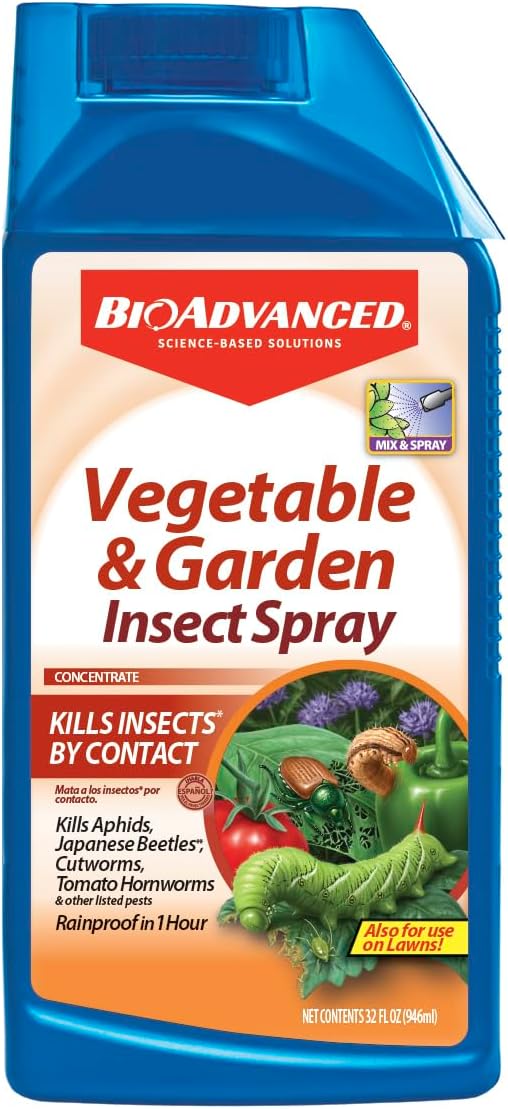
BioAdvanced Vegetable & Garden Insect Spray Concentrate (32 fl oz)
| Item Form | Spray |
|---|---|
| Target Species | Insects |
| Liquid Volume | 32 fluid ounces |
| Active Ingredients | Cyfluthrin |
This BioAdvanced concentrate is designed to protect outdoor edible and ornamental plants by killing over 70 listed pests on contact, including aphids, tomato hornworms, whiteflies, and Japanese beetles. You mix the 32-ounce bottle into a compatible sprayer to make up to 64 gallons of finished spray, then coat foliage until wet but not dripping. Notable features are its cyfluthrin active ingredient for quick knockdown and a rainproof claim after one hour, which helps preserve control if rain arrives shortly after application. For performance-oriented gardeners it delivers fast results across a broad pest list and the concentrate format keeps ongoing cost per application lower than ready-to-use products. Important limitations are that it is a broad-spectrum synthetic insecticide so it will affect beneficial insects on contact and it requires careful mixing and PPE when handling concentrated product. Also users must follow the label for pre-harvest intervals on edibles and for safe use around pollinators.
Best for: Gardeners who prioritize fast, reliable pest control for vegetable beds and productive ornamental plantings and who are comfortable using concentrated insecticides with proper safety precautions.
Less Ideal for: Those who want an organic or pollinator-friendly approach or who prefer ready-to-use, hands-off products for very small balcony or container gardens.
- Concentrate makes up to 64 gallons so cost-effective for larger gardens
- Kills a wide range of listed pests on contact, including caterpillars and beetles
- Becomes rainproof within one hour, reducing loss of effectiveness from light rain
- Synthetic broad‑spectrum insecticide that can harm beneficial insects on contact
- Requires mixing and careful handling of concentrated chemical
Verdict: Choose this concentrate when you need powerful, fast-acting control across a broad list of vegetable garden pests and want a cost-effective option for treating larger areas.
Bonide Captain Jack's Deadbug Brew Concentrate, 16 oz

| Unit Count | 16 Ounce |
|---|---|
| Item Form | Spray |
| Target Species | Insects |
| Active Ingredients | Spinosad (mixture of Spinosyn A and Spinosyn D) |
Bonide Captain Jack's Deadbug Brew is a spinosad-based concentrate designed to control a wide range of caterpillars, beetles, leaf miners, borers and other chewing and some chewing-sucking pests in vegetable gardens and on fruit and ornamental plants. You mix the concentrate with water and apply it with a trigger, hand-held, backpack, or hose-end sprayer, which makes it flexible for small beds and larger plots. Notable features include an active ingredient approved for organic gardening and label claims that it has limited impact on many predatory beneficial insects and mites when used as directed. Practically, it works well for targeted spot treatments and for protecting fruiting vegetables and cole crops from hungry larvae. Limitations are that it requires correct mixing and careful application timing to avoid harming beneficials and that it does not control all pest types equally, so you may still need complementary controls for sucking pests or heavy infestations.
Best for: Gardeners who prioritize practical, effective control of chewing pests in vegetable beds and fruiting plants and who want an organically approved product they can apply across small to medium plots.
Less Ideal for: Gardeners seeking a single product to manage severe, mixed infestations including many sucking pests or those unwilling to follow label mixing and application restrictions.
- Contains spinosad, an effective active ingredient approved for organic gardening
- Concentrated formula mixes with water for economical coverage
- Works through multiple application methods: trigger, handheld, backpack, or hose-end sprayer
- Targets a broad list of chewing pests including caterpillars, borers, and leaf miners
- Not a broad-spectrum solution for all pest types, limited effects on some sucking pests
- Requires careful mixing and timing to minimize impact on beneficial insects
Verdict: A concentrated, organically approved spinosad spray that delivers targeted, economical control of caterpillars and other chewing pests in vegetable gardens.
Sevin Insect Killer Ready-to-Use, 32 fl oz

| Item Form | Liquid Ready to Use |
|---|---|
| Target Species | Insects |
| Liquid Volume | 32 fluid ounces |
Sevin Insect Killer Ready-to-Use is a pre-mixed spray designed for quick knockdown of common garden insects across fruits, vegetables and ornamentals. Use it by shaking the bottle, holding the nozzle about a foot from plants and applying an even fan spray to affected foliage. The formula claims control of more than 700 insects including aphids, Japanese beetles, hornworms and Colorado potato beetles, so it is useful for routine spot treatments and emergency infestations. Practical benefits include fast visible results on contact and safe reentry for people and pets once the spray has dried, which makes it convenient for busy gardens. Important limitations are that it is a broad-spectrum insecticide so it can harm beneficial insects and you should avoid spraying open blooms to protect pollinators, and the RTU format means you cannot adjust concentration for very sensitive crops. For gardeners looking for an inexpensive, ready-to-use option to protect vegetables from intense pest pressure, this bottle is a straightforward choice; those wanting targeted or organic control may prefer other products.
Best for: Gardeners who want an affordable, no-mix insecticide to quickly suppress heavy pest outbreaks on vegetables and ornamentals and prefer convenience over specialized or organic options.
Less Ideal for: Growers focused on organic or pollinator-friendly practices, or those who want fine control over application rates and selective products.
- Ready-to-use spray requires no mixing and is simple to apply
- Labels list control for a very broad range of common garden pests
- Fast acting with visible results on contact
- Safe for reentry by people and pets once the spray has dried
- Broad-spectrum formula can harm beneficial insects and pollinators
- Cannot dilute or adjust concentration for delicate crops or spot treatments
- Not suitable for use on open blooms to protect pollinators
Verdict: A budget-friendly, ready-to-use insecticide that delivers fast, broad-spectrum control for vegetable gardens when quick, convenient knockdown is the priority.
Monterey Spinosad Insecticide, 32 oz (concentrate)

| Unit Count | 32 Fluid Ounces |
|---|---|
| Item Form | Oil |
| Target Species | Insects |
Monterey Spinosad is a concentrated, spinosad-based insecticide designed to control caterpillars, leafminers, thrips, borers and other chewing and certain chewing-sucking pests in vegetable gardens and around the yard. It is OMRI listed, so it fits into organic vegetable production, and can be mixed for use in trigger, hand-held, backpack, or hose-end sprayers depending on the scale of the job. The product is fast acting and virtually odorless because it is bacterially derived, and the included measuring spoon helps ensure accurate dilution for repeatable applications. Practical benefits include broad coverage of common garden pests, suitability for edible crops when label directions are followed, and flexible application methods from spot treatments to larger beds. Important limitations are the need to handle and mix a concentrate safely using protective clothing and gloves and to follow timing and pre-harvest intervals on the label; it does not replace cultural controls and may require repeated applications for heavy infestations.
Best for: Gardeners who prioritize reliable, organic-compatible pest control for vegetable beds and fruit trees and who are willing to mix a concentrate and follow label timing for safe use.
Less Ideal for: Casual gardeners who want a ready-to-use bottle with no mixing or those seeking a single product to manage sap-sucking pests and diseases without integrated cultural practices.
- OMRI listed so acceptable for certified organic and home organic vegetable gardens
- Contains spinosad, effective against many common chewing pests like caterpillars and leafminers
- Versatile application options including trigger, backpack, and hose-end sprayers
- Concentrate format lets you treat large areas without frequent repurchasing
- Fast acting and low odor for more comfortable application
- Concentrate requires careful measuring and protective gear during mixing and application
- Will not control all pest types so identification and targeted timing are still required
Verdict: A dependable OMRI-listed spinosad concentrate for gardeners who need effective, organic-compatible control of common chewing pests in vegetable beds.
Bonide Captain Jack's Ready-to-Use Neem Oil Spray, 32 oz

| Item Form | Liquid |
|---|---|
| Target Species | Insects |
| Liquid Volume | 32 fluid ounces |
| Active Ingredients | Clarified Hydrophobic Extract of Neem Oil |
Bonide Captain Jack's Ready-to-Use Neem Oil is a 32-ounce spray designed to protect vegetable gardens from common pests and fungal diseases. It is applied directly to foliage with the trigger bottle; shake well, spray all surfaces including leaf undersides, and reapply every 7 to 14 days or at the first sign of infestations. The active clarified hydrophobic neem extract kills eggs, larvae, and adults and also suppresses powdery mildew, rust, and other fungal issues, while controlling spider mites, aphids, whiteflies and similar pests. Because it is labeled for organic gardening and safe up to day of harvest, it fits into edible-garden routines without complicated mixing. Practical limitations are that it is a contact and systemic-limited botanical, so thorough coverage and repeated applications are required for tougher outbreaks, and treatments should avoid peak sunlight to reduce plant stress. The ready-to-use format is convenient for small to medium beds but may be slower or costlier than concentrated formulations for large acreage.
Best for: Gardeners who want an easy, organic-compatible spray for spot treatments and regular preventative applications in small to medium vegetable beds. It suits buyers who prioritize products with wide user acceptance and clear label instructions.
Less Ideal for: Large-scale growers or gardeners who need to treat many beds frequently and prefer concentrated formulations to reduce cost and application time.
- Kills multiple life stages of pests including eggs, larvae, and adults
- Also acts as a fungicide and miticide for combined pest and disease control
- Ready-to-use trigger bottle requires no mixing and is labeled for organic gardening
- Safe to use on vegetables up to the day of harvest when applied per label
- Requires thorough coverage and repeat applications for full control
- Ready-to-use bottle may be less economical than concentrates for large gardens
Verdict: A convenient, organic-approved neem spray that combines insect, mite, and fungal control for home vegetable gardens where easy, proven protection matters.
Choosing the Right Insecticide for Vegetable Gardens: Key Factors to Consider
Spectrum of Control
Different insecticides target different feeding types and life stages. Some act broadly against chewing caterpillars, beetles, and grasshoppers, while others are specialized for sap-sucking pests like aphids, whiteflies, and mites. Choosing a product with the right spectrum reduces wasted treatments and helps prevent unnecessary harm to non-target organisms.
Knowing which pests are recurring in your bed lets you prioritize a product that will handle those specific threats. If multiple pest types appear, consider whether you prefer a broad-spectrum product or a targeted option you can rotate with biological controls.
Food-Safety and Residue
For vegetable gardens, residue risk and the label's pre-harvest interval are critical. Some active ingredients break down quickly and allow harvest within a few days, while others require longer wait times. Shorter pre-harvest intervals give more flexibility for frequent harvesting crops and reduce the chance of unacceptable residues on produce.
Also consider how the formulation adheres to leaves and fruit. Systemic products may move into plant tissues and persist differently than contact sprays. Always match the product's residue profile to the types of vegetables you grow and how soon you plan to harvest after treatment.
Selectivity and Impact on Beneficial Insects
Beneficial insects provide free pest suppression and pollination services. Some insecticides are broad-spectrum and kill beneficial predators and pollinators on contact. Others are more selective, targeting insect physiology or life stages that pests have but beneficials lack.
Choosing selective options and using them at times when pollinators are not active preserves these helpful populations. In integrated approaches, selectivity matters more than raw potency because a preserved predator community reduces long-term pest pressure.
Application Method and Practicality
Home gardeners need products that are easy to measure, mix, and apply accurately in small plots and containers. Ready-to-use sprays, hose-end attachments, and concentrated liquids each have pros and cons. Consider tank-mixing complexity, sprayer compatibility, and how straightforward the label instructions are for small-volume applications.
Practicality also covers storage safety, disposal instructions, and whether the product requires specialized personal protective equipment. A product that is awkward to apply or store is less likely to be used correctly.
Resistance Management and Rotation Options
Repeated use of the same active ingredient can select for resistant pest populations. A good plan includes rotating insecticides with different modes of action and integrating non-chemical controls to reduce selection pressure.
When choosing an insecticide, check the mode of action grouping and pair products that differ across sprays. Also incorporate cultural tactics such as row covers, crop rotation, and timely removal of heavily infested plants to keep reliance on chemical controls to a minimum.
When to Treat Vs When to Observe
Not every sighting of an insect needs treatment. Low-level pest presence often results in negligible damage, and beneficial insects can keep populations in check. Inspect plants for actual damage such as defoliation, stunted growth, or sap-sucking symptoms before reaching for an insecticide.
Set action thresholds for common crops and pests. For example, a few aphids clustered on an inner shoot may be tolerable, whereas rapidly growing colonies or visible leaf curling are signals that intervention is needed.
- Look for feeding damage, not just insects.
- Check multiple plants and locations before deciding.
- Monitor beneficial insect presence as part of the decision.
Application Timing to Protect Pollinators
Timing sprays for early morning or late evening reduces exposure to active pollinators. Avoid applying insecticides during bloom unless the label explicitly allows it with mitigation measures. When treatment during bloom is unavoidable, use the most selective option available and apply directly to the pests where possible.
- Treat outside peak pollinator activity hours.
- Prefer targeted spot treatments over blanket spraying.
- Remove or cover beehives and flowering plants nearby when necessary.
Integrating Cultural and Mechanical Controls
Cultural tactics reduce the need for chemical inputs. Practices like crop rotation, sanitation by removing plant debris, and choosing pest-resistant varieties lower pest pressure before it becomes severe. Mechanical controls such as handpicking, water sprays to dislodge insects, and row covers can be highly effective in small plots.
Using these methods in concert with careful insecticide selection extends the useful life of chemical options and helps maintain a healthy garden ecosystem.
- Rotate crops to interrupt pest life cycles.
- Use physical barriers for vulnerable crops early in the season.
- Remove and dispose of heavily infested plant material promptly.
Mixing, Measuring, and Application Safety
Accurate measuring and thorough mixing ensure the product performs as expected. Follow label directions for dilution rates closely; over-diluting reduces effectiveness while overdosing increases risk to plants and beneficials. Use the recommended protective equipment and avoid applying on windy days to reduce drift.
Clean sprayers between different products to prevent unwanted chemical interactions and label any storage containers clearly. Keep treated produce separate until the mandated pre-harvest interval has passed.
- Use calibrated measuring tools for small-volume mixes.
- Label spray bottles with product name and dilution ratio.
- Rinse sprayers thoroughly after use according to instructions.
Reading and Following the Label
The product label is the legal and practical guide for safe and effective use. It contains critical information about crop-specific restrictions, pre-harvest intervals, and required personal protective equipment. Gardeners should read both the front panel and the detailed directions before each application.
Labels also state re-entry intervals for treated areas and describe environmental precautions. Respecting these instructions protects you, helpers, and wildlife, and ensures compliance with safe-use standards.
- Confirm the product is labeled for your specific vegetable crops.
- Note pre-harvest and re-entry intervals before applying.
- Follow disposal and storage instructions to limit environmental risk.
How We Chose the Best Insecticide for Vegetable Gardens
We focused on performance and safety metrics that matter in edible plantings. Primary evaluation criteria included speed and spectrum of activity against common garden pests, the insecticide's safety profile for use on edible crops including pre-harvest intervals and residue concerns, and selectivity toward beneficial insects such as pollinators and predatory insects. We also judged ease of application in small-scale plots, formulation practicality for gardeners, and label clarity on safe use and restrictions. Products were excluded if labels prohibited use on edible crops or if safety instructions made practical home use unrealistic. We also excluded formulations lacking clear guidance on pre-harvest intervals or those with indiscriminate broad-spectrum toxicity to beneficial insects. The final shortlist favors insecticides that balance efficacy with food-crop safety, clear application directions, and formulations suited to backyard and raised-bed gardening. These filters align with the scoring metrics used in each product card.
FAQ
Can I use the same insecticide on all my vegetables?
It depends. Some insecticides are labeled for a wide range of edible crops, while others are restricted. Check the label for crop-specific approvals and pre-harvest intervals because different vegetables tolerate residues differently.
How soon after spraying can I safely harvest vegetables?
That varies by active ingredient and formulation. Labels list a pre-harvest interval that ranges from a day to several weeks. Always follow the label for the shortest safe interval applicable to the crop you treated.
Will using insecticide kill pollinators in my garden?
Some products can harm pollinators on contact. Proper timing, selective products, and avoiding sprays during bloom significantly reduce risk. Spot treatments and evening applications further protect pollinating insects.
Are systemic insecticides safe for root vegetables and leafy greens?
Systemic products move inside plant tissues and can be present in harvested parts. Whether they are appropriate depends on the product's label and residue guidelines for specific crops like root vegetables and leafy greens. Choose products with suitable approvals and short pre-harvest intervals for edible parts.
How can I reduce the chance of pests becoming resistant?
Rotate insecticides with different modes of action, combine chemical controls with cultural and mechanical tactics, and avoid frequent calendar-based spraying. Targeted applications only when thresholds are exceeded reduce selection pressure.
Is organic always safer for vegetable gardens?
Organic options can be safer in some respects but are not automatically benign. They can still have toxicity to non-targets and may have different residue or re-application needs. Evaluate organic products for selectivity, effectiveness, and label instructions just like conventional options.
Final Verdict
Choose insecticides for vegetable gardens by balancing immediate pest control needs with food-safety and ecosystem impacts. Prioritize products labeled for the specific vegetables you grow, short pre-harvest intervals when you harvest frequently, and options that minimize harm to beneficial insects. Adopt integrated tactics: use cultural and mechanical controls first, apply targeted insecticides only when thresholds are exceeded, and rotate modes of action to reduce resistance. Following these priorities will help you protect yields while keeping produce safe and pollinators healthy.
