

Note: This article contains affiliate links. If you click on these links and make a purchase, I may earn a small commission at no extra cost to you. This helps support my research and content. Read my full affiliate disclosure here.
If you grow vegetables, herbs, or flowers in confined beds, a reliable raised bed irrigation system changes how you garden. The right system keeps root zones evenly moist, reduces water waste, and frees you from daily hand-watering during hot stretches or busy weeks. In this guide we shortlisted seven top options suited to raised beds and comparable containers, and evaluated each on accuracy of watering, ease of installation, and durability in outdoor conditions. Use the guidance below to match a system to your bed layout, planting density, and maintenance habits before checking the product summaries.
Top Picks at a Glance
| Best Overall The best all-around choice for most situations | Garden In Minutes 3×6 Garden Grid Watering System |  |
| Best Quality Built to a higher standard if you want something more solid | Rain Bird GARDENKIT Drip Irrigation Raised Bed Garden Watering Kit |  |
| Best Value The sweet spot between price and what you get | MIXC 1/4" 100ft Drip Irrigation Kit with 16 Adjustable Brass Nozzles and Connectors |  |
| Best Budget The cheapest option that still gets the job done reliably | PESIODU 50 ft Drip Irrigation Kit with 11 Emitters and Quick-Connect Tubing |  |
| Highest Rated A top-rated pick with lots of positive feedback | NWSTESLE 2026 Upgrade Drip Irrigation System — 200 ft Kit with 36 Adjustable Brass Nozzles |  |
| Most Popular A crowd favorite that many people choose with confidence | Garden In Minutes Garden Grid 4×4 Raised Bed Watering System |  |
| Best Seller A high-volume bestseller chosen again and again | CARPATHEN Drip Irrigation System Kit with 100 ft Tubing |  |
Garden In Minutes 3×6 Garden Grid Watering System
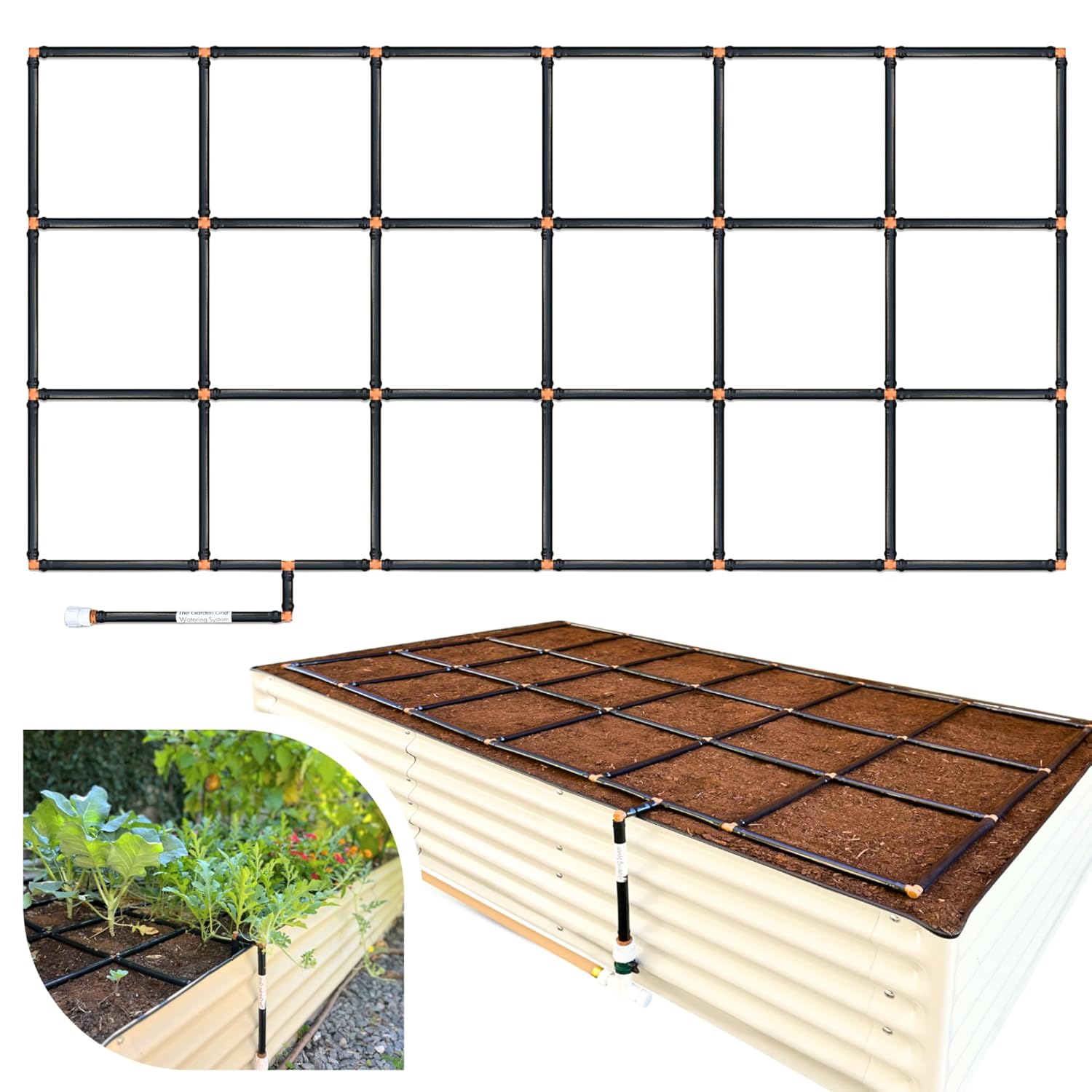
| Size | 3×6 |
|---|---|
| Hose Length | 66 inches |
| Special Features | Misting |
| Maximum Pressure | 50 psi |
| Material | Polypropylene (PP) |
The Garden In Minutes 3×6 Garden Grid is a prebuilt irrigation mat designed to fit standard 3×6 raised beds and vegetable plots. You lay the three snapped-together sections on the soil, attach the feed tube to a regular garden hose and the grid supplies multiple low-angle misting streams to each planting square for even soil-level irrigation. It is quick to install with no cutting, punching, or emitter placement required and the grid doubles as a square-foot spacing guide when planting. The system uses semi-flexible LLDPE tubing with durable POM fittings, which reduces common drip-kit failures and clog-prone emitters. Practical benefits include consistent watering across all 18 planting squares, the ability to leave it in place all season, and easy pairing with a hose timer for unattended schedules. Limitations are that it is sized for a 3×6 bed so you will need additional grids or connectors for larger layouts, and the system depends on adequate hose pressure and correct placement to avoid pooling or under-watering at bed edges.
Best for: Gardeners who want a simple, low-maintenance irrigation solution for a standard 3×6 raised bed and value quick installation and consistent watering without designing a custom drip system.
Less Ideal for: People with large, irregularly shaped beds or those who need adjustable, plant-level emitters for individual crop watering should consider more configurable irrigation kits.
- Preassembled sections make setup under a minute with no special tools
- Even soil-level coverage across 18 planting squares to prevent dry spots
- Durable materials: UV-resistant LLDPE tubing and POM fittings reduce failures
- Grid also serves as a planting spacing guide for square-foot gardening
- Designed specifically for 3×6 beds so extra units are needed for larger or irregular beds
- Performance depends on proper hose pressure and correct placement within the bed
Verdict: If you have a 3×6 raised bed and want a ready-to-use, durable system that delivers even, no-fuss watering, this preassembled Garden Grid is a fast, reliable choice.
Rain Bird GARDENKIT Drip Irrigation Raised Bed Garden Watering Kit

| Size coverage | 4' x 8' |
|---|---|
| Hose length | 35 feet |
| Emitter spacing | 6 inches |
| Maximum pressure | 25 psi |
| Material | Resin |
The Rain Bird GARDENKIT provides a ready-to-install drip system sized for a 4' x 8' raised bed and includes a pressure regulator, filter, fittings, stakes, and 35 feet of emitter tubing with 70 built-in pressure-compensating emitters spaced every 6 inches. It is typically used by connecting the regulator to an outdoor faucet, running the distribution tubing to the bed, and staking the emitter tubing around plant roots for targeted low-volume watering. The pressure-compensating emitters deliver a consistent 0.8 gallons per hour across the run, which helps produce even moisture for vegetables and reduces water use compared with overhead watering. Installation is straightforward with the illustrated manual and the tubing can be buried or left on the soil surface. Important limitations: the kit is sized for one 4' x 8' bed and the manufacturer warns against extending the 1/4
Best for: Gardeners who prioritize consistent, efficient watering and measurable performance in a single raised bed and want a durable, ready-to-install solution.
Less Ideal for: Those who need to irrigate multiple large beds or long runs from a single faucet without buying additional kits or accessories.
- Pressure-compensating emitters spaced every 6 inches provide even watering along the tubing run
- Includes regulator, filter, faucet adapter and a wide set of fittings for plug-and-play installation
- Emitter tubing and components are designed for season-after-season use with durable resin construction
- Emitter design delivers low-volume 0.8 gph flow to conserve water and target root zones
- Kit is sized for a single 4' x 8' raised bed and should not be extended with additional 1/4" tubing
- No hose-end timer included so automation requires a separate purchase
Verdict: Choose this kit when you want a high-performance, pressure-compensated drip system that reliably waters a single 4' x 8' raised bed with minimal setup.
MIXC 1/4" 100ft Drip Irrigation Kit with 16 Adjustable Brass Nozzles and Connectors

| Fit Type | 1/4" |
|---|---|
| Hose Length | 100 feet |
| Maximum Pressure | 60 psi |
| Power Source | Water Pressure-driven |
| Special Features | Programmable |
This MIXC kit supplies a complete 100 ft run of 1/4" tubing plus connectors, bendable emitter rods and 16 adjustable metal nozzles so you can build a simple raised bed irrigation layout without specialty tools. Typical use is laying the 1/4" line along beds, adding three-way or Y connectors where you need branches, inserting the aluminum-core emitter rods and pointing the copper nozzles to target plant roots or foliage. Notable features include the US-focused 1/4" fit type to match common drip lines, quick-connect fittings for fast assembly and 360° adjustable copper nozzles that let you change spray patterns from mist to directed drip. Practical benefits are straightforward installation, flexibility to position emitters precisely and more durable metal nozzles compared with all-plastic kits. Important limitations are that the system is pressure-driven with a recommended limit of about eight emitters per 50 ft of tubing, so larger raised bed systems usually need a larger main line or additional loops to maintain pressure; the kit also does not include a timer so scheduling requires an external controller.
Best for: Gardeners who want a practical, no-frills drip solution for raised beds and container rows and who prioritize reliable fit and easy reconfiguration over automated scheduling.
Less Ideal for: Large or high-flow irrigation projects that require many emitters per run or integrated automation without adding a separate timer or higher-capacity main tubing.
- Complete 100 ft 1/4" tubing and comprehensive connector set for end-to-end installs
- 360° adjustable copper nozzles for precise watering patterns
- Bendable aluminum-core emitter rods let you aim water exactly where plants need it
- Quick-connect fittings speed up assembly and make reconfiguration easier
- Designed for 1/4" lateral lines so flow drops if you exceed recommended emitter count without a larger main supply
- No built-in timer or controller included
Verdict: A practical, easy-to-install 1/4" drip kit that gives precise, durable emitter placement for raised beds when you want a configurable manual system.
PESIODU 50 ft Drip Irrigation Kit with 11 Emitters and Quick-Connect Tubing

| Hose Length | 50 feet |
|---|---|
| Number of Pieces | 11 |
| Power Source | Water Pressure-driven |
| Fit Type | Quick Connect |
| Material | Plastic |
This PESIODU kit is a compact starter drip irrigation system aimed at small gardens and raised beds. It supplies 50 feet of 1/4" PE tubing plus a Y quick-connect splitter and a mix of 11 emitters: adjustable vortex drippers, steady stream drippers and bendable 360° misting nozzles. You install the tubing from a faucet or supply line, use the push-fit connectors and stakes to route lines through raised beds or containers, and position the emitters near roots or seedlings for targeted watering. Practical benefits include water-efficient delivery to plant roots, flexible layout for rows or individual pots and effortless quick-connect assembly for DIY setups. The plastic components keep cost down but mean fittings and emitters are less rugged than professional kits, and the 50 ft length limits coverage to a single small bed or a few containers unless extended with extra tubing. Expect decent performance for seasonal vegetable beds, starter gardens and greenhouse benches where affordability and simplicity matter.
Best for: Gardeners on a tight budget who need a simple, no-frills irrigation solution for one raised bed, a few containers, or a small greenhouse area and value easy DIY setup.
Less Ideal for: Large vegetable plots, multi-bed systems, or users who want heavy-duty, long-lasting commercial fittings should consider more robust or expandable kits.
- Includes 50 ft of 1/4" tubing and a Y quick-connect splitter for easy DIY routing
- Mix of adjustable emitters (vortex, stream, mist) for different plant needs
- Quick-connect push-fit parts simplify installation without tools
- Water pressure-driven automatic watering reduces waste compared with overhead watering
- Plastic fittings and emitters may wear faster than metal or commercial-grade parts
- 50 ft tubing may be insufficient for larger raised bed layouts without buying extensions
Verdict: A low-cost, easy-to-install starter kit that delivers targeted watering for a single raised bed or a few containers.
NWSTESLE 2026 Upgrade Drip Irrigation System — 200 ft Kit with 36 Adjustable Brass Nozzles

| Hose Length | 200 feet |
|---|---|
| Included Components | 1/4" tubing, 36 nozzles, connector, nails, pipe plugs, cable ties |
| Fit Type | Quick Connect |
| Special Features | Adjustable, Automatic Watering, Misting |
This NWSTESLE kit supplies 200 feet of 1/4" tubing, quick‑connect fittings, and 36 adjustable brass nozzles so you can build a customizable irrigation layout for raised beds, pots, patios, or greenhouses. Installation is hands‑on but straightforward: lay tubing, snap in the quick connectors and nozzles, stake as needed, and connect to a standard hose timer for automated schedules. The solid brass 360° nozzles offer four spray modes — mist, shower, stream, and drip — letting you dial water delivery from delicate seedlings to established vegetables. The quick‑connect fittings and included tri‑elbows make configuring and re-routing lines easier and help reduce leaks compared with basic push‑fit kits. Practical benefits include targeted root watering to conserve water and flexible staking so emitters reach under foliage or into corners. Expect a typical DIY assembly time depending on garden complexity and occasional adjustments to nozzle angles and flow; the kit’s plastic tubing and fittings mean long‑term durability depends on outdoor conditions and winter care.
Best for: Gardeners who prioritize a dependable, customizable irrigation setup for raised beds and mixed container layouts and want hardware that minimizes leaks and simplifies maintenance.
Less Ideal for: People seeking a completely hands‑off, preassembled sprinkler system ready out of the box or those who need metal supply lines for permanent in‑ground installation.
- Solid brass 360° nozzles resist rust and provide four spray modes for varied plant needs.
- 200 feet of 1/4" tubing covers multiple raised beds or a combination of beds and containers.
- Quick‑connect fittings and tri‑elbows simplify layout changes and reduce common leak points.
- Includes a comprehensive accessory pack (stakes, plugs, nails, cable ties) for complete installation.
- Tubing and some fittings are plastic and will require winterizing or replacement under prolonged UV exposure.
- No hose timer included so automation requires purchasing a compatible timer separately.
Verdict: Choose this kit when you want a reliable, leak‑resistant DIY irrigation system for raised beds that delivers adjustable, targeted watering with durable brass nozzles.
Garden In Minutes Garden Grid 4×4 Raised Bed Watering System

| Size | 4×4 |
|---|---|
| Hose Length | 14 inches |
| Maximum Pressure | 10 psi |
| Material | UV Resistant LLDPE Tubing with POM Fittings |
The Garden In Minutes 4×4 Garden Grid is a pre-assembled watering mat designed to simplify irrigation for a standard 4×4 raised bed. You lay the two halves on the soil, press them together, attach the short feed hose to your garden hose and the grid supplies 16 squares of plantable space with multiple low-pressure streams per square. Notable features include UV-resistant LLDPE tubing, POM fittings, a built-in filter, and adjustable flow control that works up to 10 psi. In practice it removes the need to cut tubing or place emitters and gives consistent, soil-level watering that reduces dry spots and saves time compared with hand-watering or DIY drip layouts. It is durable enough for seasonal use and can be paired with a hose timer for automatic schedules. Limitations are that the product is sized only for roughly 44 x 44 inch beds so it does not cover nonstandard or larger beds and it relies on a compatible hose connection and low water pressure for optimal distribution.
Best for: Buyers who want a low-effort, reliable irrigation solution for a single 4×4 raised bed and value proven performance and ease of setup over tinkering with custom drip layouts.
Less Ideal for: Gardeners with large, irregularly shaped, or multiple raised beds who need scalable or modular irrigation coverage should consider other systems.
- Pre-assembled, tool-free setup gets a 4×4 bed planted and watered in about a minute
- Even soil-level coverage across 16 planting squares reduces dry spots
- Built-in filter and durable UV-resistant materials minimize clogging and extend service life
- Adjustable water flow lets you match output to plant needs and low-pressure systems
- Only sized for a standard 4×4 bed so multiple units or alternative solutions are needed for different bed sizes or shapes
Verdict: If you want a quick, proven way to get consistent, soil-level watering in a standard 4×4 raised bed, this pre-assembled Garden Grid makes it effortless.
CARPATHEN Drip Irrigation System Kit with 100 ft Tubing

| Hose Length | 100 feet |
|---|---|
| Number of Pieces | 58 |
| Maximum Pressure | 45 psi |
| Power Source | Water Pressure-driven |
| Special Features | Adjustable emitters, UV resistant, above- or below-ground use |
This CARPATHEN kit supplies everything a small raised bed gardener needs to put in a simple, reliable drip system. The package includes 50 ft of 5/16" mainline and 50 ft of 1/4" distribution tubing plus tees, connectors, end plugs and a mix of adjustable stream and vortex emitters so you can branch off and place emitters at individual plants. Emitters are adjustable by twisting the cap, and the longer stakes help keep heads stable in loose soil. Components are barbed for secure push-fit connections and the tubing is UV resistant so it can be used above ground or buried. It runs off water pressure and is rated up to about 45 psi, which is suitable for typical garden taps, and the emitters are removable for cleaning to reduce clogging. The kit is aimed at small setups and supports roughly 20 to 30 emitters without additional tubing, so larger raised-bed layouts will need extra mainline or additional kits. Assembly and spacing require some planning and basic cutting of tubing, so expect a short hands-on setup rather than a plug-and-play timered system.
Best for: Home gardeners who want a dependable, low-complexity drip solution for one to three raised beds and prefer a proven kit they can assemble and adjust themselves.
Less Ideal for: Gardeners who want a turnkey, timer-controlled irrigation system for large areas or those who prefer fully automatic pressure-regulated setups.
- Complete starter kit with mainline, distribution tubing, emitters and assorted fittings for a working system out of the box
- Adjustable emitters let you fine tune flow to individual plants and are removable for easy cleaning
- Barbed push-fit connections and larger 0.28" barb reduce the chance of fittings blowing off under pressure
- UV resistant tubing suitable for above-ground or buried installation
- Designed for small to medium layouts and will need extra tubing or kits for larger raised-bed systems
- No automatic timer or pressure regulator included so you must manage run times and ensure appropriate pressure
Verdict: A well-rounded, easy-to-customize starter drip kit that reliably waters small raised beds and is built for gardeners who prefer a low-risk, hands-on setup.
Choosing the Right Raised Bed Irrigation System: Key Factors to Consider
Water Delivery Method
How water is delivered drives how the root zone wets and how much maintenance you will need. Dripline and soaker hoses put water directly at or below the surface and reduce evaporation, which is ideal for vegetable beds. Micro-sprays and mini-sprinklers wet a wider surface area and can be useful for mixed plantings or beds with light surface mulch.
Consider how the delivery method interacts with your soil type. Sandy soils need more frequent, shorter runs; clay soils tolerate slower, longer applications. Also think about mulching: thicker mulch layers can hide drip tubing and reduce evaporation but may require slightly higher flow to penetrate the cover.
Bed Size and Layout Compatibility
Raised beds vary from narrow one-row beds to wide double-row beds. A system that works well in a narrow bed may leave dry zones in a wider bed unless emitters are spaced appropriately. Measure plant spacing and bed width, then choose tubing and emitter spacing that put water where roots are most active.
Think about access points and planting patterns. Systems that allow lateral runs and adjustable emitter locations let you customize watering rows for staggered plantings or densely spaced transplants without rewiring the whole bed.
Flow Control and Zoning
Being able to control flow to different beds or sections matters when you grow multiple crops with different moisture needs. Simple manual valves let you isolate individual beds, while systems compatible with multiple timer zones give automated control for different schedules.
Also pay attention to pressure requirements. Some micro-irrigation components need pressure regulation to avoid misting or uneven output. Systems that include or support regulators and pressure-compensating emitters provide steadier results across long runs.
Durability and Weather Resistance
Outdoors a raised bed irrigation system must resist UV exposure, temperature swings, and occasional mechanical stress from tools or foot traffic. Look for UV-stabilized tubing and fittings that resist cracking and brittle failure. Durable connectors and good-quality quick couplers reduce leaks and make seasonal disassembly easier.
Consider winterizing needs too. If you live where freezing is common, choose components you can easily drain or remove to avoid frost damage. Durability also affects long-term maintenance costs and how often you need to replace emitters or sections of line.
Ease of Maintenance
Raised bed systems can clog from mineral deposits or organic particles, especially where water source quality varies. Systems with accessible inline filters or easily removable emitters make flushing and servicing straightforward. Simple visual indicators like detachable end caps or clear filters speed routine checks.
Maintenance also covers repairs. Standardized fittings and common tubing sizes make it easier to find replacement parts and to swap broken sections without redoing large areas. Consider whether the system requires tools for basic repairs or if gardeners can perform fixes with common hand tools.
Integration With Automation
Automation turns a garden from manual to hands-off, but integration needs planning. Systems that work with battery or mains-powered timers, moisture sensors, and smart controllers make it possible to run tailored schedules. Evaluate whether a system accepts standard timer fittings or requires adapters.
Also examine how automation affects watering frequency. Automated schedules should reflect seasonal changes and planting stages. Systems that allow easy override or manual bleed-off give you control when transplants or young seedlings need special attention.
Planning Your Layout Before Installation
Start by mapping your bed and marking plant rows and access paths. Place main supply tubing along the bed edge or through an accessible channel so you can reach connectors without disturbing plants. Sketch emitter or dripline runs to match plant groups rather than treating the bed as a single uniform zone.
Leave room for turns and fittings and avoid tight bends that kink tubing. If you plan to add a timer or filter, allocate a small, protected area near the water source so those components are easy to reach for maintenance.
- Measure bed width and length and note plant spacing.
- Plan supply line placement to minimize disturbance.
- Account for future expansions when choosing connector locations.
Installing Dripline and Soaker Options
Dripline and soaker hoses are common for raised beds because they apply water directly where roots need it. Install dripline with emitters facing toward the plants and bury shallowly or cover with mulch for evaporation control. Soaker hoses can be laid in serpentine patterns for even coverage but watch for higher flow requirements and potential clogging.
Use clamps or staples rated for irrigation to secure tubing and prevent movement during planting or when harvesting. Run a short test before covering lines with soil or mulch to confirm emitters deliver evenly.
- Use pressure-compensating dripline for long runs.
- Flush lines before first season to remove debris.
- Anchor tubing to prevent shifting under mulch.
Smart Timers and Scheduling Tips
A timer simplifies consistent runs and reduces overwatering. Program shorter runs more frequently for sandy soils and longer, less frequent runs for heavier soils. Early morning schedules reduce evaporation and disease risk by allowing foliage to dry during the day.
If you use a moisture sensor, place it at root-zone depth in representative spots and let it control cycles during transitional seasons. Avoid relying on fixed schedules during planting or harvest windows; manual adjustments are often necessary for seedlings or after heavy rains.
- Prefer multiple short cycles over one long soak for better infiltration in many soils.
- Check timers after power changes or battery replacement to avoid missed runs.
Winter Care and Seasonal Maintenance
Before the first frost, drain or remove exposed low-pressure tubing and store removable parts indoors. If you have fixed lines, blow them out gently with low-pressure air or drain them thoroughly to prevent freeze damage. Replace worn emitters and check for brittle tubing at the start of each season.
During the season, inspect connections periodically for leaks and flush lines monthly if your water is high in organic matter or minerals. Keeping a small spare parts kit on hand helps you rebuild a run quickly without interrupting irrigation.
- Remove or insulate timers and electrical components for winter.
- Keep spare emitters, connectors, and a filter cartridge accessible.
Adjusting Systems for Different Crops
Different crops have different root profiles and moisture needs. Shallow-rooted herbs and lettuces benefit from emitters placed closer and set to lower output, while deeper-rooted vegetables respond to less frequent, longer applications. Group plants with similar water needs into zones to simplify scheduling and avoid stress from over- or under-watering.
For succession planting, use movable laterals or removable driplines so you can reconfigure runs as spacing changes. This flexibility extends the life of a system across multiple growing cycles.
- Zone beds by crop type rather than watering the entire garden uniformly.
- Reposition or reduce emitter flow for newly transplanted seedlings.
How We Chose the Best Raised Bed Irrigation System
We focused on practical irrigation features that matter in raised beds rather than broad marketing claims. Key evaluation criteria included water delivery method, installation simplicity, emission uniformity, material durability, and adaptability to bed sizes and plant types. Water delivery method covers dripline, soaker hose, and micro-spray setups and how evenly they wet the root zone. Installation simplicity measured whether a system can be fitted without special tools and how long a typical raised bed takes to plumb. Emission uniformity assessed spacing, flow control, and how well the system avoids dry pockets in densely planted beds. Material durability examined UV resistance, kink resistance, and connector robustness for season-to-season use. Adaptability considered how easily a kit can be shortened, expanded, or zoned for multiple beds and whether it integrates with timers or pressure regulators. We excluded systems intended solely for large-scale irrigation, sprinkler-only lawn setups, or products that require professional plumbing. The result is a list of practical, gardener-friendly systems that work well in raised beds and similar small-footprint growing areas.
FAQ
Can I install a raised bed irrigation system without tools?
Many systems are designed for homeowner installation and use push-fit connectors and simple cutters. Basic hand tools like scissors or a tubing cutter and a small screwdriver are usually sufficient. More permanent installations may benefit from a quick clamp tool for secure staples.
How often should I run irrigation in raised beds?
Frequency depends on soil type, weather, and plants. Sandy soils usually need shorter, more frequent runs while clay soils do better with longer, less frequent watering. Aim for root-zone moisture without surface runoff and adjust based on plant responses.
Will drip systems clog and how do I prevent it?
Clogging can occur where water contains sediment or biological material. Use an inline filter and flush lines periodically, especially before the first season and after any maintenance. Pressure-compensating emitters are less prone to clogging variability but still benefit from basic filtration.
Can I use a timer with a raised bed irrigation system?
Yes. Most raised bed systems accept standard battery or AC timers. For best results pair timers with pressure regulation and, if possible, multiple zones so you can tailor schedules to different beds or crop groups.
How do I winterize a raised bed irrigation system?
Drain exposed lines, remove and store removable components, and if necessary blow out low-pressure tubing with gentle air to remove standing water. Insulate or bring indoors any electrical timers or controllers to prevent frost damage.
Is it better to bury dripline or leave it on the surface?
Both approaches work. Shallow burial or covering with mulch reduces evaporation and hides tubing from view, while surface runs are easier to inspect and repair. Choose based on your maintenance preferences and mulching strategy.
Final Verdict
Raised bed irrigation systems save time and produce more consistent moisture at the root zone, but they are not one-size-fits-all. Prioritize how water is delivered, whether you need zoning or automation, and how durable the components must be for your climate. Balance initial installation ease against long-term maintenance and expansion needs. With those tradeoffs in mind, select a system that matches your bed layout and crop mix so you get dependable watering with minimal fuss.
