

Note: This article contains affiliate links. If you click on these links and make a purchase, I may earn a small commission at no extra cost to you. This helps support my research and content. Read my full affiliate disclosure here.
If you need to move through cords of wood quickly, a high speed log splitter changes how much you can get done in a day. These machines vary in cycle time, splitting force, bed length, and durability, and the right choice depends on how often you run the unit and the size of logs you handle. This guide collects the top shortlisted high speed log splitters for heavy-duty firewood work and explains the practical differences that matter in the yard. Below we evaluate each option on key shop and field criteria like cycle speed, splitting force, and build quality so you can match a splitter to your workload and wood type.
Top Picks at a Glance
| Best Overall The best all-around choice for most situations | BILT HARD 22-Ton Gas Log Splitter with 209cc Engine and 14 GPM Two-Stage Pump |  |
| Best Value The sweet spot between price and what you get | Ezasin 20-Ton Gas Log Splitter with 209cc 7HP Engine |  |
| Highest Rated A top-rated pick with lots of positive feedback | GasXcel 20-Ton Gas Powered Horizontal Log Splitter (209CC) |  |
| Most Popular A crowd favorite that many people choose with confidence | SuperHandy 20-Ton Portable Gas Log Splitter with 7HP Engine |  |
| Best Seller A high-volume bestseller chosen again and again | Landworks Portable 20-Ton Gas Log Splitter, 7 HP, Rapid Auto Return |  |
BILT HARD 22-Ton Gas Log Splitter with 209cc Engine and 14 GPM Two-Stage Pump

| Splitting force | 22 tons |
|---|---|
| Engine | 209cc gas |
| Hydraulic flow | 14 GPM two-stage pump |
| Max log length | 21 inches |
| Cycle time | 7 seconds |
This BILT HARD splitter is built for homeowners and small farms who need fast, reliable firewood processing. Powered by a 209cc gas engine and a two-stage 14 GPM gear pump, it moves the cylinder quickly before contact and switches to high pressure for splitting, producing a quoted 7 second cycle time and up to 22 tons of force for hardwoods. The horizontal design, steel frame, and 3.5×19 inch cylinder make it stable during use and able to handle logs up to 21 inches long. Practical features include pneumatic 13×5.0-6 wheels, a removable stand that converts to a tow bar, and a steel splitting wedge for consistent splits. Expect good throughput for stacking firewood batches and easy repositioning around a property. It is heavy and requires assembly and a gas engine upkeep routine, and its size and weight mean it is less convenient for occasional light-duty users or those who need a compact electric option. For buyers prioritizing speed and raw splitting power, this model is a capable choice.
Best for: Buyers who need a fast, high-capacity splitter for regular firewood production on a property and value throughput and towing convenience over compact size.
Less Ideal for: Those who only split small amounts occasionally, need a quiet or electric option, or have limited space for storing a heavy machine should consider lighter alternatives.
- High splitting force up to 22 tons for handling seasoned hardwoods
- 14 GPM two-stage pump with fast 7 second cycle time for higher throughput
- Towable design with pneumatic wheels and removable tow bar for easy transport
- Rugged steel frame and a steel splitting wedge for consistent, durable splitting
- Heavy and bulky which makes setup and permanent storage more demanding
- Requires gas engine maintenance and fuel so it is not as low-maintenance as electric alternatives
Verdict: If you want a high-speed, towable splitter that handles hardwoods reliably, this 22-ton BILT HARD model delivers strong, fast throughput for regular firewood production.
Ezasin 20-Ton Gas Log Splitter with 209cc 7HP Engine
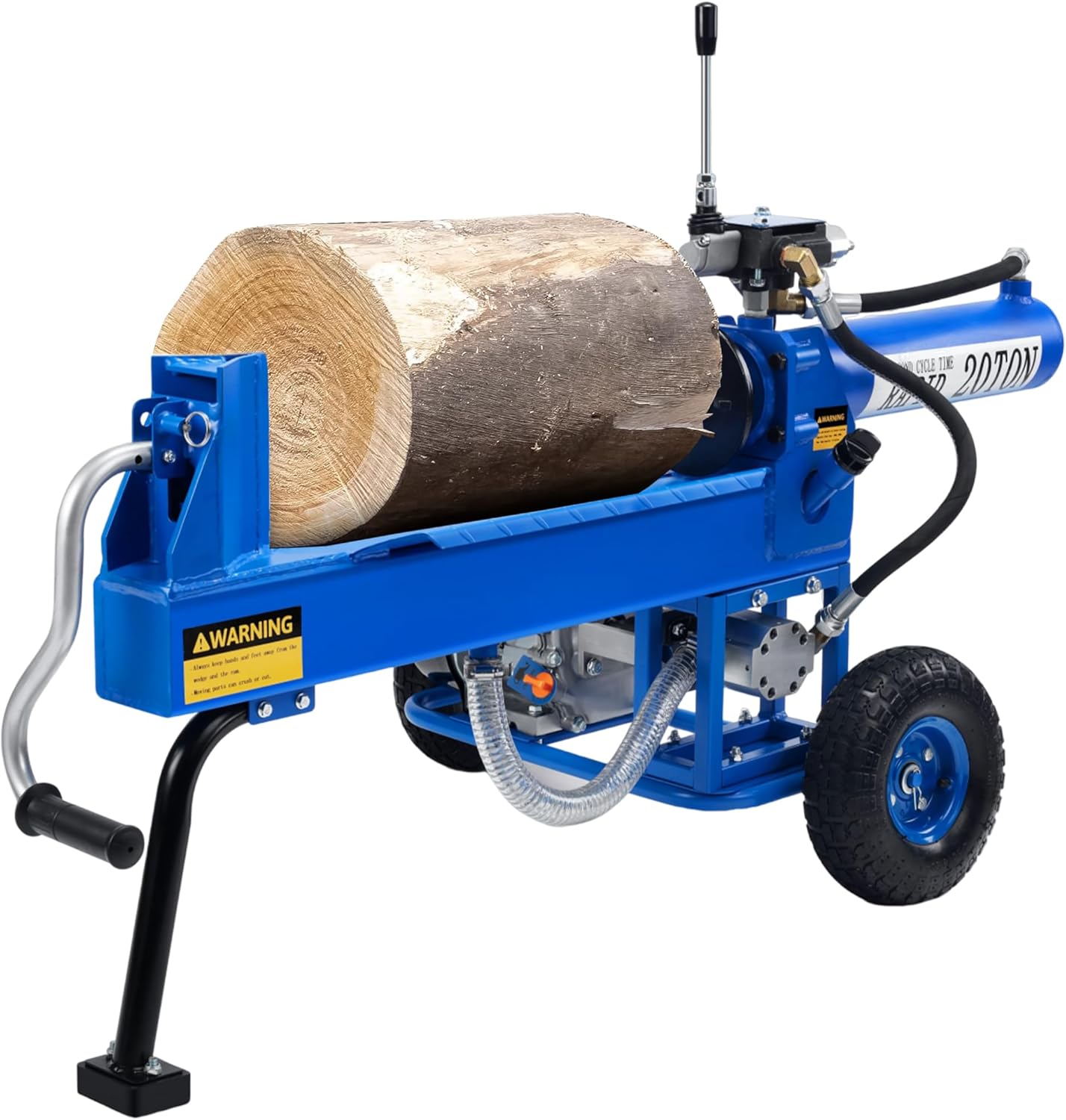
| Splitting force | 20 ton |
|---|---|
| Engine | 209CC 7HP |
| Cycle time | 8 seconds |
| Log capacity | Up to 20.5" long and 16" wide |
This Ezasin 20-ton gas log splitter pairs a 209cc 7HP engine with a dual-stage hydraulic pump to deliver fast, powerful splits for household and small-farm use. It is typically used on rounds and knotty hardwoods up to the listed capacity, with an alloy steel 90° wedge and an auto-return valve that speeds workflow by automatically retracting the ram after each split. The dual-stage pump gives quick approach speed for positioning the ram and switches to high pressure for stubborn logs, which together with an advertised 8-second cycle time makes it suitable for high-throughput tasks. Practical features include pneumatic 10-inch tires for yard mobility and a relatively low-maintenance layout, though it requires pre-filling specific hydraulic and engine oils and regular servicing like any gas unit. Expect typical gas-engine noise, the need for fuel storage, and occasional maintenance of the hydraulic system. For someone who wants fast, mechanical splitting without electric hookups, this model delivers strong performance with the usual upkeep of a gasoline hydraulic machine.
Best for: Buyers who prioritize fast, mechanical splitting for regular firewood or farm work and need a portable gas-powered solution that maximizes throughput over convenience.
Less Ideal for: Those who want a quieter, low-maintenance electric splitter or who lack space and resources for fuel storage and engine upkeep should consider other options.
- High 20-ton splitting force suitable for hardwoods and knotty logs
- Fast 8-second cycle time enabled by a dual-stage hydraulic pump
- Auto-return valve streamlines repeated splitting and reduces operator fatigue
- 209cc 7HP gas engine provides off-grid power and strong torque
- Pneumatic 10-inch tires and steel frame make it reasonably mobile around a yard or job site
- Requires gasoline and specific hydraulic and engine oils and routine maintenance
- Gas engine produces noise and emissions compared with electric alternatives
Verdict: If you need high-speed, off-grid splitting for hardwoods, this 20-ton gas splitter delivers strong, efficient performance with mobile convenience.
GasXcel 20-Ton Gas Powered Horizontal Log Splitter (209CC)

| Power | 209CC engine |
|---|---|
| Splitting force | 20 tons |
| Cycle time | 8-second auto return |
| Max log length | 20 inches |
The GasXcel 20-ton gas log splitter is built for fast, reliable firewood processing. It uses a 209CC four-stroke engine with a 2-stage gear pump to drive a hydraulic ram that completes cycles in about 8 seconds and returns automatically, so you can process many logs with minimal downtime. The hardened steel wedge and robust steel frame are designed for repeated use on dry, wet, or knotted wood up to 20 inches long and about 16 to 18 inches diameter. Mobility is practical for a unit this size thanks to ergonomic handles and 10-inch pneumatic tires that let you move it around uneven yards. Setup and control are straightforward with simple hydraulic operation, so operators can focus on throughput rather than fiddly adjustments. Expect a substantial machine footprint and the usual needs of gas equipment such as fuel, periodic maintenance, and noise. For high-speed seasonal splitting this model prioritizes dependable, continuous operation over lightweight convenience.
Best for: Buyers who need a dependable, high-throughput splitter for seasonal or frequent firewood processing and prioritize continuous performance over ultra-lightweight transportability.
Less Ideal for: People who need an ultra-compact, quiet, or electric solution for occasional light splitting or who prefer minimal maintenance and storage footprint.
- High 20-ton splitting force handles dry, wet, and knotted logs
- Fast 8-second auto-return cycle increases throughput for batch splitting
- 209CC gas engine with 2-stage gear pump provides independent hydraulic power
- Hardened steel wedge and steel frame built for repeated, heavy-duty use
- As a gasoline unit it requires fuel, routine engine maintenance, and generates noise
- At roughly 130 pounds it is portable but still substantial to maneuver and store
Verdict: Choose this splitter when you want fast, dependable gas-powered performance for high-volume firewood splitting.
SuperHandy 20-Ton Portable Gas Log Splitter with 7HP Engine

| Splitting force | 20 Ton |
|---|---|
| Engine | 7HP gas engine |
| Max log length | 20 inches |
| Max log diameter | 16 inches |
This SuperHandy log splitter is a portable, gas-powered horizontal splitter designed to handle large batches of firewood quickly. The 7HP engine drives a two-stage Bucher hydraulic gear pump to deliver a constant 20-ton splitting force, and the ram returns automatically so you can keep a steady rhythm while working through a woodpile. It splits logs up to about 20 inches long and 16 inches in diameter and uses a steel wedge and full-beam frame aimed at field durability. Mobility is practical for a machine this size thanks to 10-inch transport wheels and a setup that is straightforward on level ground. Cycle time is short, so it is suited to high-speed splitting tasks where you need throughput without an electrical outlet. Important limits are that it is gas powered so it needs outdoor, well-ventilated use and regular engine and hydraulic maintenance; hydraulic fluid is not included. Assembly and moving the unit alone may be awkward given the overall mass despite the wheels.
Best for: Buyers who need a fast, field-capable splitter to process large amounts of firewood without depending on electricity and who prefer a proven mechanical design backed by user feedback.
Less Ideal for: People who only split a few logs occasionally or who need a lightweight, fully portable unit for one-person lifting and storage.
- 20 tons of consistent splitting force driven by a 7HP gas engine for heavy-duty splitting
- Rapid auto-return ram and short cycle time for high throughput
- Portable horizontal design with 10-inch wheels for site-to-site movement
- Full-beam steel wedge construction for durability in field use
- Requires gasoline and outdoor ventilation which limits indoor or garage use
- Hydraulic fluid is not included and routine engine/hydraulic maintenance is necessary
Verdict: Choose this splitter if you want a high-throughput, gas-powered 20-ton machine built to move between sites and handle large firewood workloads.
Landworks Portable 20-Ton Gas Log Splitter, 7 HP, Rapid Auto Return

| Engine | 7 HP gas |
|---|---|
| Splitting force | 20 ton |
| Max log length | 20 inches |
| Max log diameter | 16 inches |
This Landworks 20-ton log splitter is a gas-powered, horizontal beam machine designed to handle sizable firewood quickly. It pairs a 7 HP engine with a two-stage Bucher gear pump and a stainless steel wedge to split logs up to 20 inches long and 16 inches in diameter. The rapid auto-return ram and a quoted 7.5-second cycle time make it well suited to high-speed splitting tasks where you need to process a lot of wood. Built-in transport wheels and a full-steel beam simplify moving it around a yard or site. Practical benefits include consistent linear power for smoother splits and user-friendly control lever placement for prolonged use. Important limitations are that it is gas only, so it requires outdoor use, fuel and routine engine and hydraulic maintenance, and hydraulic fluid is not included. Assembly and familiarity with safe operating practices are required before use.
Best for: Buyers who need a fast, portable gas splitter for processing large volumes of firewood and who prefer a proven mechanical design over experimental electric alternatives.
Less Ideal for: People who need a low-maintenance, indoors-compatible, or electric-powered splitter or who cannot manage fuel storage and routine engine upkeep.
- High 20-ton rated splitting force for heavy logs
- Fast 7.5-second cycle time with rapid auto-return for high throughput
- 7 HP gas engine provides portable power without needing electricity
- Stainless steel wedge and steel thrust plate for durable splitting performance
- 10-inch transport wheels and compact horizontal design for easier site movement
- Requires gasoline and regular engine and hydraulic maintenance
- Hydraulic fluid is not included so you must supply AW32 or equivalent before use
Verdict: Choose this Landworks 20-ton gas splitter if you want a portable, high-speed machine that can quickly process large quantities of firewood without relying on electrical power.
Choosing the Right High Speed Log Splitter: Key Factors to Consider
Cycle Speed and Throughput
Cycle speed defines how fast the ram returns and pushes, which directly affects how many logs you split per hour. Faster cycle times reduce the time you spend waiting between strokes, making a noticeable difference when processing many small to medium rounds. For larger or irregular pieces, speed still matters because recovery time determines how quickly the operator can reposition and feed the next log.
High throughput machines usually rely on a more powerful hydraulic pump or a two-stage valve to maintain speed under load. Pay attention to individual cycle ratings and realistic measurements rather than optimistic manufacturer claims, because real-world speed can drop with heavier or knotted wood.
Hydraulic Force and Pressure
Splitting force, usually stated in tons, controls what size and species of wood the splitter can manage. Higher force is essential for old-growth hardwoods, large-diameter rounds, or pieces with heavy knots. Lower-force high-speed models may work well for softer species and smaller logs but will struggle or stall on dense hardwood.
Consider both peak tonnage and the hydraulic system's ability to sustain force through the full stroke. A machine with good sustained force will finish a stubborn split without repeated attempts, saving time and reducing wear.
Bed Length, Log Capacity, and Stability
Bed length determines the maximum log length you can split without reorienting rounds. Longer beds reduce handling time for larger fuelwood. Capacity also includes the cradle or log-holding features that keep rounds steady during fast cycles; poor support leads to shifting and inefficient splits.
Stability under load is critical. A narrow or lightly braced bed will flex during high-speed operation, causing misfeeds and safety issues. Look for robust crossmembers and secure mounting points that resist vibration at speed.
Frame Construction and Longevity
A high speed log splitter endures many repeated impacts and hydraulic cycles. Strong welded frames, reinforced joints, and corrosion-resistant finishes preserve alignment and reduce maintenance. Lighter stamped or thin-gauge frames may be tempting for lower weight but often show fatigue sooner when used heavily.
Check for replaceable wear parts at high-stress nodes and straightforward access to service points. Machines designed for frequent use will have components sized to resist creeping, bending, or weld separation over thousands of cycles.
Operator Controls and Safety Features
Ergonomic controls let you run at speed without tiring the hands or making frequent adjustments. Two-handed safety controls, clear valve placements, and predictable ram response reduce accidents during quick feeding. Controls that require awkward reaches or constant fine tuning slow down throughput and increase the chance of errors.
Also evaluate guarding, emergency stops, and safe log-holding features. A fast machine without reliable safety interlocks raises the risk during repetitive work, especially when an operator is pushing to finish a job.
Matching Splitter Speed to Your Workload
Think about how many cords you split in a typical season and the hours you want to spend. If you split occasionally, extreme cycle speed is less important than reliability. For daily, high-volume work, prioritize machines with short cycle times and hydraulic systems rated for sustained operation. Faster machines shine when the operator can keep a steady feed rhythm.
Also consider the average log size. High-speed splitters excel on smaller rounds where operators can feed without heavy repositioning. For very large diameters, cycle speed matters less because each split takes more force and time.
- Estimate cords per week to align machine throughput with time available
- Select faster cycle ratings when breaking many small to medium rounds
- Balance speed with force for large or knotty hardwoods
Power Source and Hydraulic Systems
High speed splitters may be driven by petrol engines, electric motors, or tractor PTO. Each power source affects start-up behavior, maintenance, and noise. Electric high-speed units provide smoother, quieter operation for smaller yards, while petrol engines offer mobility and higher peak power for remote sites.
Hydraulic pump flow rate and relief settings determine how the ram behaves under load. Look for systems with adequate flow to maintain speed during the working stroke and stable pressure control to prevent slo wdowns on dense wood.
- Electric units suit regular home use where power is available
- Engine-driven splitters give higher mobility and peak power
- PTO models integrate with tractors for farm use
Setup, Transport, and Storage Considerations
High speed splitters are often heavier and need stable ground for safe operation. Consider trailer-mounted or wheeled frames for moving between sites and check hitch compatibility if you plan to tow. Storage space and protection from moisture will prolong hydraulic and steel components.
Some models fold or break down for compact storage. If you have limited space, prioritize a design that reduces footprint without compromising bed length or stiffness.
- Confirm tow or lift points and overall transport weight
- Look for folding beds or removable tongues where space is tight
- Store hydraulic machinery under cover to protect seals and metal
Maintenance and Common Wear Points
High-throughput operation increases wear on seals, hoses, bearings, and welds. Regular inspection of hydraulic hoses and fittings prevents leaks that reduce performance and create safety hazards. Greasing pivot points and checking fasteners keeps the frame aligned and prevents premature wear.
Replaceable wedge edges and easily serviced valves simplify downtime. Know which parts are considered consumable and how accessible they are, because frequent field repairs add up in labor time.
- Inspect hoses and fittings before each heavy session
- Keep spare wear parts like seals and wedge-edge inserts on hand
- Follow recommended hydraulic fluid intervals to protect pumps
Noise, Vibration, and Operator Comfort
High speed operation often brings increased vibration and noise. Consider machine isolation, rubber mounts, or operator positioning to reduce fatigue. Quieter electric options reduce hearing strain, while petrol models may require hearing protection during extended use.
Vibration can loosen fasteners over time, so check mountings regularly. Comfortable handle layouts and reduced reach distance let an operator maintain higher throughput with less strain.
- Plan for hearing protection during long sessions
- Check for vibration isolation features on the frame
- Prefer control layouts that minimize repetitive awkward motions
How We Chose the Best High Speed Log Splitter
We shortlisted high speed log splitters by applying criteria that reflect real-world use in busy yards and small commercial operations. Primary evaluation metrics included cycle speed and stroke frequency, because faster return and ram travel directly reduce time spent per log. Splitting force and hydraulic pressure were measured as the core performance indicator for handling large or knotty hardwoods. Build quality and frame design were assessed for durability during repeated high-throughput use and to limit maintenance downtime. Feed and bed length mattered for safety and for accommodating longer rounds without constant repositioning. Finally we considered control ergonomics and mobility features that affect operator fatigue and setup time. We excluded light-duty household splitters and machines designed only for occasional use; the list focuses on units built for frequent, sustained operation. Units lacking sufficient specification for cycle time or hydraulic force were not included. The scoring criteria below reflect the specific, scoreable dimensions we used to compare options.
FAQ
How fast should a high speed log splitter be for a small commercial operation?
It depends on your throughput goals, but aim for a model with a short cycle time and a hydraulic flow that sustains speed under load. For small commercial work, balance cycle speed with splitting force so frequent fast strokes do not stall on dense hardwoods.
Can electric high speed splitters keep up with petrol models?
Electric units can match petrol models for cycle smoothness and are suitable for many high-throughput situations if they have sufficient motor power and a robust hydraulic pump. They are limited by available electrical supply and typically less portable than engine-driven machines.
What maintenance matters most for high-paced splitter use?
Regular hydraulic system checks are critical: inspect hoses, fittings, and seals, and change fluid at recommended intervals. Also monitor frame welds, fasteners, and wedge wear; those items wear faster under high cycle counts.
Are longer beds always better for fast splitting?
Longer beds reduce handling for longer rounds and let you split without constant repositioning, which aids throughput. However, longer beds add weight and may require stronger frames and more storage space, so match bed length to the typical log sizes you process.
How important are two-handed controls on a fast splitter?
Two-handed controls are a key safety feature that also influence throughput. They reduce accidental single-hand operation and encourage predictable feeding rhythms. Ergonomic placement matters because awkward controls slow the operator and increase fatigue.
Final Verdict
Choose a high speed log splitter by first matching cycle speed and splitting force to the volume and species of wood you process. For heavy or knotty hardwoods prioritize sustained hydraulic force and a robust frame; for high-throughput work with smaller rounds, shorter cycle times and good operator ergonomics will save the most time. Balance portability, power source, and maintenance needs against expected workloads. Prioritize machines with accessible service points and solid construction so you maintain high output with minimal downtime.
