

Note: This article contains affiliate links. If you click on these links and make a purchase, I may earn a small commission at no extra cost to you. This helps support my research and content. Read my full affiliate disclosure here.
If you burn wood or manage a small woodlot, a compact splitter can save hours of tiring manual work without taking up a garage bay. Small electric log splitters are built to handle shorter rounds and lighter cords, letting you process kindling and firewood with less physical strain and a smaller footprint. This guide shortlists seven top options suitable for patio use, tight storage spaces, and occasional to seasonal splitting. We evaluated each machine on practical garden and home-use criteria like splitting force, cycle speed, and how easy it is to move and store, then summarized the strengths gardeners care about. Read on to see which features matter most and which splitter types fit your routine.
Top Picks at a Glance
| Best Overall The best all-around choice for most situations | Earthquake 5‑Ton Electric Log Splitter (1500 W, 15‑Amp) |  |
| Best Quality Built to a higher standard if you want something more solid | PPOLB 7 Ton Electric Hydraulic Log Splitter, 15A Portable Horizontal Wood Splitter |  |
| Best Value The sweet spot between price and what you get | PowerSmart 6.5-Ton Electric Log Splitter with 15A Motor |  |
| Best Budget The cheapest option that still gets the job done reliably | Beuioslyr 110V Electric Wood Splitter, 3.3 kW, Splits Logs up to 9.45" |  |
| Highest Rated A top-rated pick with lots of positive feedback | TECSPACE 7 Ton Electric Log Splitter with 15 Amp Motor |  |
| Most Popular A crowd favorite that many people choose with confidence | Boss Industrial 7-Ton Electric Hydraulic Log Splitter |  |
| Best Seller A high-volume bestseller chosen again and again | Sun Joe LJ602E 15-Amp 5-Ton Electric Log Splitter |  |
Earthquake 5‑Ton Electric Log Splitter (1500 W, 15‑Amp)

| Rated splitting force | 5 tons |
|---|---|
| Motor power | 1500 W (15 amp) |
| Max recommended log size | Up to 10" diameter, 20" length |
| Item weight | 90 pounds |
The Earthquake 5‑Ton Electric Log Splitter is a plug‑in hydraulic splitter designed for homeowners who want a quieter, cleaner alternative to gas models. It uses a 1500‑watt, 15‑amp electric motor driving a precision pump and copper windings to provide a reliable 5‑ton push capable of splitting logs up to about 10 inches in diameter and 20 inches long. Typical use is simple: plug into a standard 120V outlet, position the log, and actuate the ram for consistent, repeatable splits. Notable features include precision pump gears for steady force, transport wheels and rubber‑coated legs for easier moving, and a multi‑year limited warranty. Practical benefits are reduced maintenance and no fuel or exhaust, making it suitable for residential yards, wood stoves, and seasonal firewood prep. Trade‑offs are expected for a machine this size: it is not aimed at heavy commercial use and requires an electrical outlet on site, which limits remote or off‑grid work. The unit’s 90 pound weight is manageable with the wheel design but still requires care when moving.
Best for: Buyers who want a low‑maintenance, gas‑free log splitter for seasonal firewood and regular residential use and who value predictable, consistent splitting over raw commercial power.
Less Ideal for: Users who need a high‑capacity splitter for large scale or continuous commercial logging or those who frequently work in locations without electrical access.
- 5 tons of hydraulic splitting force suitable for typical household logs
- 1500 W (15‑amp) electric motor for plug‑in, gas‑free operation
- Precision pump gears and copper motor windings for steady, reliable performance
- Built‑in transport wheels and rubber‑coated legs for easier mobility
- Requires a standard 120V outlet so not suitable for off‑grid locations
- Not intended for heavy commercial or continuous industrial use
Verdict: A convenient, plug‑in 5‑ton splitter that delivers reliable, low‑maintenance performance for homeowners preparing seasonal firewood.
PPOLB 7 Ton Electric Hydraulic Log Splitter, 15A Portable Horizontal Wood Splitter

| Splitting force | 7 ton |
|---|---|
| Power | 1500 W / 15 Amp |
| Max log length | 21.2 inches |
| Max log diameter | 12 inches |
The PPOLB 7 Ton Electric Hydraulic Log Splitter is a compact, portable machine built to turn medium hardwoods into firewood without gas. It uses a 15 amp (1500 W) electric motor driving a hydraulic ram to deliver up to seven tons of splitting force, handling logs up to 21.2 inches long and 12 inches diameter in a horizontal setup. Typical use is straightforward: roll it close to the work pile on its transport wheels, place a log on the cradle, and operate the two-hand safety controls for a single-cycle split. Notable features include a reinforced steel frame, a durable wedge, overload protection, and a space-saving footprint that stores easily in a garage or shed. The practical benefits are consistent splitting power for household heating needs, quieter operation than gas models, and simple electric setup with no fuel mixing. Important limitations are its reliance on a 15 amp circuit so extension and outlet placement matter, and its 7-ton rating which is good for small to medium logs but may struggle with extremely large or very knotty hardwoods.
Best for: Homeowners who need a reliable, low-maintenance splitter for routine firewood production and prefer quieter electric operation and easy storage.
Less Ideal for: People who split very large commercial quantities of timber or routinely work with oversized logs should consider a heavier-duty gas or higher-tonnage splitter.
- 7-ton hydraulic force suitable for splitting most small to medium hardwoods
- 1500 W / 15 amp electric motor provides steady torque with no fumes
- Compact, wheeled design for easier storage and transport
- Two-hand safety controls and overload protection enhance operator safety
- Requires a 15 amp electrical supply which can limit placement and use
- Not ideal for very large, extremely knotty, or oversized logs
Verdict: A compact, user-friendly 7-ton electric splitter that makes dependable firewood for small to medium backyard needs without the fuss of gas engines.
PowerSmart 6.5-Ton Electric Log Splitter with 15A Motor

| Splitting force | 6.5 Tons |
|---|---|
| Motor | 120V, 15A, 1.75 HP |
| Cycle time | 21 Seconds |
| Log capacity | Up to 20" length, 10" diameter |
This PowerSmart electric log splitter is a straightforward machine for homeowners who need a safer, faster alternative to an axe. It uses a 15 amp, 120V induction motor and a 6.5-ton hydraulic system to split logs up to 20 inches long and 10 inches in diameter with a roughly 20 to 21 second cycle time. The stainless steel wedge and 40 degree angle are built for accurate splits while the double-rail leg and wide rear wheels make it reasonably stable and portable around a yard. Practical touches include easy push-button operation and a modest hydraulic tank that accepts AW32 or automatic transmission fluid depending on temperature. The unit is intended for light-duty seasonal firewood prep rather than commercial workloads; expect slower performance on very knotty hardwood and you may need to refill or service hydraulic fluid over time. At about 100 pounds it is mobile for one or two people but not truly handheld. For routine homeowner use it reduces physical strain and speeds splitting, though heavy or continuous professional work will demand a larger machine.
Best for: Homeowners who want a reliable, low-effort way to process seasonal firewood and prioritize ease of use and portability over commercial throughput.
Less Ideal for: Contractors or buyers who need continuous, heavy-duty splitting for large-volume or industrial jobs should choose a larger-capacity, professional unit instead.
- 6.5 tons of hydraulic force handles typical homeowner logs up to 20" long
- 15A induction motor with 21 second cycle time for quick, repeatable splits
- Stainless steel 40° wedge provides accurate splitting
- Wide rear wheels and compact footprint make it easier to move and store
- Designed for light-duty use and can struggle or slow down on very knotty or large hardwoods
- At about 100 pounds it requires effort or a second person to relocate frequently
Verdict: A practical, easy-to-use electric splitter that gives homeowners fast, low-effort firewood processing for typical seasonal needs.
Beuioslyr 110V Electric Wood Splitter, 3.3 kW, Splits Logs up to 9.45"

| Load Power | 3.3KW |
|---|---|
| Rated Power | 2.3KW |
| Speed | 450rpm |
| Applicable Wood Diameter | Up to 9.45 in / 24 cm |
| Voltage | 110V/50Hz |
This compact electric log splitter is built for homeowners who need a safer, less physical way to prepare firewood. It uses a corded 110V power source and a 3.3 kW load motor with a three-stage external gear reduction to deliver high torque at 450 rpm, allowing it to split hardwoods and softwoods up to about 9.45 inches in diameter. The unit is freestanding with ergonomic handles for moving it around and an automatic shutoff for basic safety. Construction uses aluminum, PA6 plastic, and iron with heat-treated components and a pure copper motor that should hold up under regular household use. Limitations to note are the corded power requirement and mid-size capacity, so it is aimed at small batches rather than large commercial volumes; the manufacturer also advises splitting cured wood and not positioning logs vertically. For buyers on a budget this model offers a practical, lower-maintenance alternative to gas splitters with fewer emissions and simpler upkeep.
Best for: Buyers who want an affordable, low-maintenance electric splitter for occasional home firewood preparation and who prioritize ease of use over commercial throughput.
Less Ideal for: People who need high-capacity, continuous splitting for commercial or large-scale firewood production or who require cordless operation for remote sites.
- Corded electric power eliminates gas, exhaust, and spark-plug maintenance.
- 3.3 kW load power with 200 N·m maximum torque and three-stage reduction for effective splitting up to 9.45 inch logs.
- Automatic shutoff and cooling holes improve basic user safety and thermal stability.
- Freestanding design with ergonomic handles makes it easier to move and position around a yard.
- Corded 110V operation limits use away from outlets without an extension or generator.
- Not intended for high-volume commercial use due to mid-size capacity and recommended batch operation.
Verdict: A budget-friendly, corded electric splitter that reliably handles small to medium logs for homeowners who want an easier, lower-maintenance alternative to manual or gas splitters.
TECSPACE 7 Ton Electric Log Splitter with 15 Amp Motor

| Splitting Force | 7 Ton |
|---|---|
| Power Source | Corded Electric |
| Motor | 15 Amp |
| Splitting Direction | Horizontal |
| Stand Included | Yes |
The TECSPACE 7 Ton Electric Log Splitter is a corded horizontal splitter designed to make household firewood preparation faster and less physically demanding. It pairs a 15 amp electric motor with a hydraulic ram to produce 7 tons of splitting force, so it tackles medium-diameter logs for backyard fire pits or home heating. Typical use is simple: place a log on the horizontal bed, engage the actuator and the ram forces the log against the wedge. Notable features include a compact, portable layout with built-in wheels on some variants and a straightforward control setup that reduces learning curve for first-time users. Practical benefits include quieter operation and lower maintenance compared with small gas models, plus no fuel mixing. Limitations are that corded power restricts placement away from outlets and the 7-ton force is best for moderate-sized rounds rather than very large or knotty hardwoods. If you need heavy-duty commercial splitting or remote, off-grid operation you will want a different class of splitter.
Best for: Buyers who prioritize dependable, low-maintenance performance for regular home firewood tasks and want an easy-to-use electric splitter for backyard or garage use.
Less Ideal for: Those who need a heavy-duty splitter for commercial use or frequent splitting of oversized hardwood rounds, or shoppers who require off-grid portability.
- 7 tons of hydraulic splitting force suitable for typical home firewood preparation
- 15 amp electric motor offers reliable corded power with lower maintenance than gas
- Horizontal bed and simple controls make operation straightforward for beginners
- Compact design with built-in wheels improves portability and storage
- Corded power limits where you can operate the splitter without a long extension cord
- 7-ton capacity may struggle with very large diameter or heavily knotty hardwood logs
Verdict: A dependable, low-maintenance electric splitter that delivers 7 tons of force and straightforward operation for most home firewood needs.
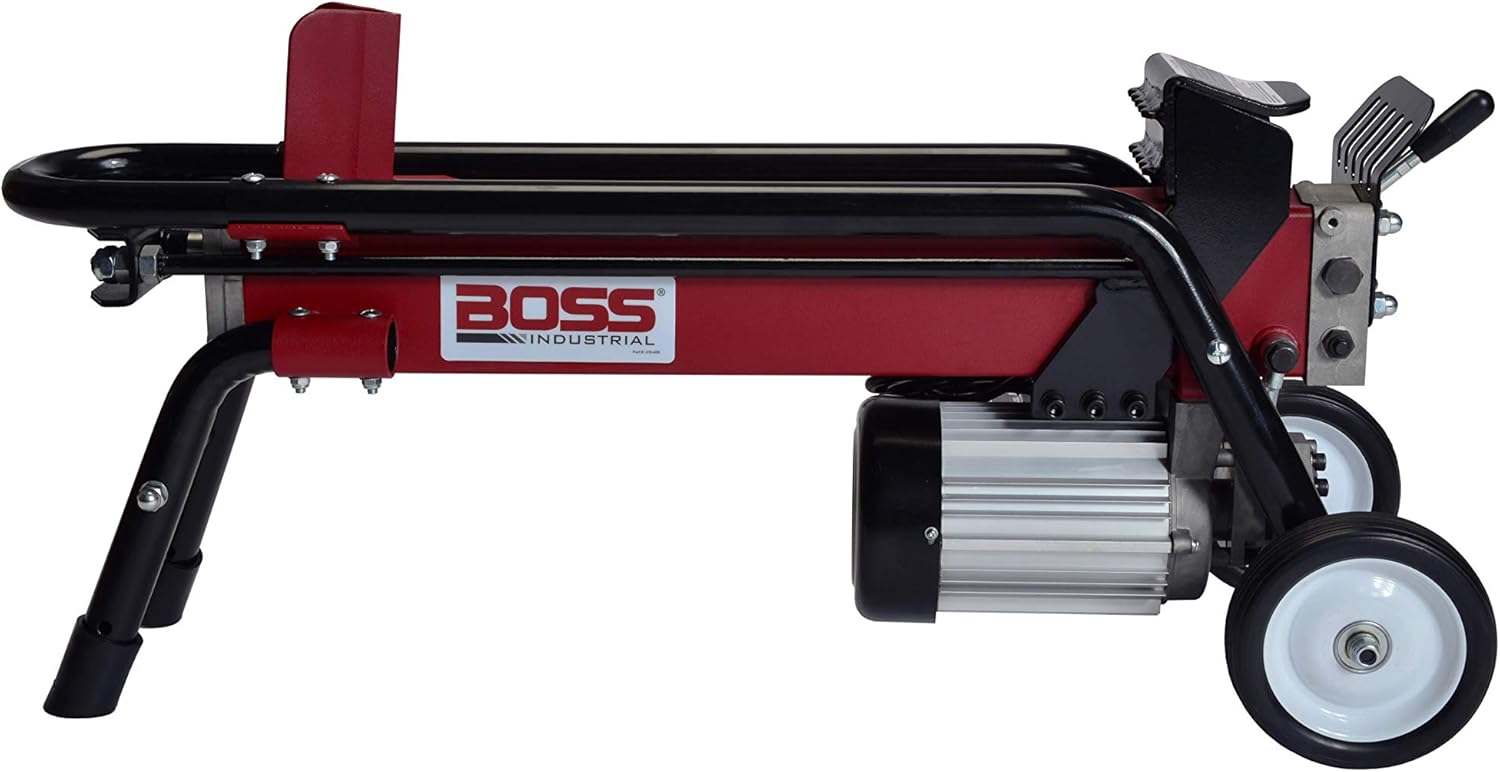
Boss Industrial 7-Ton Electric Hydraulic Log Splitter
| Splitting force | 7 tons |
|---|---|
| Hydraulic pressure | 3700 PSI |
| Motor power | 2 horsepower |
| Cycle time | 14 seconds |
| Oil capacity | 4 quarts |
The Boss Industrial 7-ton electric hydraulic log splitter is a straightforward, user-friendly machine for splitting firewood at home, in the garage, or at a cabin. It uses a 2-horsepower electric motor and hydraulic system rated at 3700 PSI to push logs into a 5-inch steel wedge, splitting rounds up to 10 inches in diameter and 20.5 inches long. Single-handed operation with a self-return lever makes repeated cycles simple and safer for casual users, while rubber rear wheels and a front handle let you move the unit around the yard or store it in a shed. Built-in side rails stabilize logs during the cut and the 14-second cycle time keeps work moving without long waits. The machine is heavier than small manual tools but lighter than many gas units, and its electric motor means no fumes or pull-start hassle. Limitations are its maximum log diameter and length, so it is not suited for very large hardwood rounds, and it requires an outdoor or garage outlet for power.
Best for: Buyers who want a low-fuss, reliable electric splitter for routine household firewood with emphasis on ease of use and safe operation.
Less Ideal for: People who need to split oversized hardwood rounds frequently or who work far from electrical power should consider heavier-duty or gas-powered alternatives.
- 7 tons of hydraulic splitting force with 3700 PSI for effective splitting of typical firewood
- Electric 2 HP motor provides push-button starting with no fumes or pull-starting
- Single-handed control with self-return lever improves ease of use and safety
- Rubber wheels and front handle make the unit reasonably portable for yard storage
- Maximum log diameter of 10 inches and length of 20.5 inches limits use on very large rounds
- Requires an electrical outlet so not ideal for remote locations without power
Verdict: A dependable, easy-to-use electric splitter that delivers 7 tons of force for homeowners who want a low-maintenance way to produce firewood.
Sun Joe LJ602E 15-Amp 5-Ton Electric Log Splitter

| Power | 15-amp motor |
|---|---|
| Max splitting force | 5 tons |
| Max log capacity | Up to 20.5 in long x 10 in wide |
| Power source | Corded electric |
The Sun Joe LJ602E is a compact, corded electric log splitter intended for home use and small batches of firewood. It uses a 15-amp motor driving a hydraulic ram to produce up to 5 tons of force, enough to split typical logs up to 20.5 inches long and 10 inches wide. The steel frame and hydraulic design let you split rounds with minimal physical strain compared with an axe. Built-in safety features include a dual-handed safety switch and an overload circuit reset, and rear wheels make it easy to move around the yard. Practical benefits are straightforward: faster, more consistent splitting for homeowners who need seasonable firewood without renting larger equipment. Limitations are its light-duty focus and corded power requirement, which restricts use to accessible outdoor outlets and means it is not suited for heavy commercial workloads or very large hardwood rounds. Assembly and periodic hydraulic maintenance are required to keep it functioning reliably.
Best for: Homeowners who want an affordable, no-fuss electric splitter to process seasonal firewood without renting a gas unit and who prioritize safety and ease of use backed by user feedback.
Less Ideal for: Commercial users or anyone who needs to split large volumes of oversized, very hard logs or who requires cordless operation for remote sites.
- 15-amp motor with approximately 5 tons of splitting force for consistent splitting of standard firewood sizes
- Splits logs up to 20.5 inches long by 10 inches wide to handle common home firewood
- Dual-handed safety switch and overload reset for safer operation
- Steel frame and hydraulic ram provide durability and reduced physical effort
- Rear wheels improve portability around the yard
- Corded power limits use to areas with an electrical outlet and extension management
- Designed for light to medium duty so it can struggle with very large or extremely dense hardwood logs
Verdict: A budget-friendly, safety-minded electric splitter that reliably handles typical home firewood without the hassle of gas engines.
Choosing the Right Small Electric Log Splitter: Key Factors to Consider
Splitting Force and Log Size Compatibility
Splitting force determines what size and species of wood a small electric splitter can handle. Hardwoods and wet logs need more tons of force to split cleanly, while softwoods and smaller-diameter rounds require less. Match the stated splitting tons to the typical log diameter and species you plan to process.
If you mostly split 10 to 14 inch rounds, a lower-tonnage unit can still be efficient if it has a sharp wedge and steady hydraulic pressure. For intermittent splitting of 16 to 18 inch hardwoods, choose a machine with higher rated force and accept a heavier, less compact unit. Underestimating needed force forces repeated cycles, stressful handling, and faster wear on the unit.
Cycle Speed, Duty Cycle, and Productivity
Cycle speed is the time it takes for the ram to extend and retract; duty cycle describes how long you can run the machine before it needs a cooldown. Faster cycles and a realistic duty cycle let you process more wood during a single session and make the machine feel responsive for short jobs.
Manufacturers may quote optimistic cycle times measured empty. Real-world productivity depends on load, hydraulic system design, and whether the splitter is two-handed or single-action. Consider how many rounds you expect to split in a typical session and choose a model with a duty cycle that matches that workload to avoid overheating or extended breaks.
Portability, Footprint, and Storage
Small electric splitters are often chosen to fit a garage corner, shed, or patio. Weight, footprint, and whether the unit folds or has a tow kit determine where you can store it and how you move it around the yard.
If you have limited storage or need to wheel the splitter between locations, prioritize lighter models with wheels or compact folding designs. If storage is fixed and you want more power, accept a larger footprint but plan for a stable base to prevent tipping during use.
Electrical Requirements and Setup
Electric splitters vary from standard household plug compatibility to models that require heavier 240V circuits. Confirm the circuit and outlet you have available before choosing; using an undersized extension or circuit can cause tripping and reduced performance.
Also consider cord length, whether the unit accepts common outdoor-rated extension cords, and whether the motor has thermal protection. Simpler electrical needs reduce installation hassle and keep the splitter usable across more locations.
Safety Features and User Controls
Safety matters because split wood can kick or bind and rams exert thousands of pounds of force. Two-handed controls prevent accidental activation, automatic ram return reduces manual handling, and sturdy guards limit access to the wedge while the ram is in motion.
Look for stable log supports, clear operational labels, and easy shutdown or emergency-stop designs. Good safety features lower the chance of pinches and makes the splitter practical for household use with occasional helpers.
Maintenance, Serviceability, and Durability
A small electric splitter should be easy to maintain because owners often store them outdoors or use them irregularly. Accessible hydraulic fittings, replaceable wear items, and clear service points extend useful life.
Consider corrosion-resistant finishes if you live in wet climates, and check how simple it is to top off hydraulics or change filters. Durable construction pays off when a machine sits through winters and is expected to start reliably each season.
Best Uses for Small Electric Splitters
Small electric log splitters excel at processing firewood for home heating, camping wood, and occasional yard cleanup. They are especially well suited for homeowners who store a modest cord or need to convert fallen branches into usable fuel without the physical strain of an axe.
These machines are typically optimized for shorter, narrower rounds and lighter workloads. Expect a balance between convenience and capacity rather than the nonstop throughput of larger gas or 240V hydraulic models.
- Patio and garage storage friendly
- Good for kindling and small to medium rounds
- Lower noise and simpler startup compared with gas models
Preparing Logs and Site Setup
Prepare a level, stable surface for splitting and clear surrounding debris that could trip you when handling rounds. Position the splitter so you can feed logs from the front and move away safely after each stroke.
Cut logs to the recommended maximum length for your chosen unit and remove loose bark or large embedded dirt to prevent blade dulling and reduce wear. Wear eye protection, gloves, and sturdy boots while handling wood and the machine.
- Work on hard-packed ground or a level concrete pad
- Use a consistent log length to speed processing
- Keep bystanders and pets well clear of the work area
Noise, Emissions, and Neighborhood Considerations
One advantage of electric splitters is reduced noise and zero exhaust, which matters for shared properties or neighborhoods with noise restrictions. Electric motors run quieter than small gas engines and do not need fuel mix or carburetor maintenance.
Still, cycle noise and the clatter of splitting wood can carry. If you will be splitting early or late, check local rules and consider sound-dampening placement, such as behind a shed or away from property lines.
- Electric units produce no exhaust fumes
- Quieter operation makes them better for residential areas
- Plan positioning to minimize noise impact on neighbors
Storage and Winter Care
Store the splitter in a dry, covered place when not in use to protect the hydraulic system and electrical components. If outdoor storage is unavoidable, use a breathable tarp and keep drainage clear to avoid standing water pooling around the motor or base.
Before winter storage, clean wood debris, check hydraulic fluid levels if applicable, and remove or protect the power cord from rodents and UV exposure. A little seasonal maintenance reduces startup time and surprises in spring.
- Keep electrical connections dry and off the ground
- Drain or protect hydraulic systems per manufacturer guidance
- Inspect seals and hoses before each season
Accessory Tips and Useful Add-Ons
A simple log cradle or stand reduces bending and keeps rounds aligned for faster feeding. Wheeled bases and light trailers make moving the splitter easier if you need to service multiple sites on a property.
Consider a small tarp or pop-up canopy for short weather protection while working, and keep a basic tool kit and spare wedge bolts on hand for quick adjustments. These low-cost accessories raise day-to-day convenience more than power upgrades do.
- Log cradles save your back and speed throughput
- Wheels or a small cart help with mobility
- Basic maintenance tools should be stored alongside the splitter
How We Chose the Best Small Electric Log Splitter
We focused on machines suited to small-scale wood preparation and urban or suburban homes where storage, noise, and ease of use matter. Selection began with units whose specifications and user-focused features matched light-to-moderate splitting tasks rather than heavy commercial workloads. We excluded any machines designed primarily for large, industrial logs or that require dedicated hydraulic power beyond typical household circuits. Evaluations emphasized concrete, measurable dimensions: splitting force expressed in tons, cycle speed and duty cycle for how much wood you can process per hour, portability and storage footprint, electrical requirements and cord or plug type, and user safety features such as two-handed controls and automatic return. We also considered build durability for outdoor storage and maintenance needs like hydraulic system access and replacement parts availability. Units that lacked basic safety interlocks, required complex permanent installation, or delivered insufficient splitting force for standard 12 to 18 inch rounds were removed from consideration.
FAQ
Can a small electric log splitter handle hardwoods like oak?
It often depends on the rated splitting force and log diameter. Small electric splitters can handle hardwoods in smaller diameters, but very large or knotty hardwood rounds may require higher tonnage or multiple passes.
Do I need a special outlet to run a small electric splitter?
Many compact electric splitters run on standard household circuits, but some higher-capacity units need a 240V circuit. Check the electrical specifications and ensure your extension cords and breakers match the requirement.
How long can I run a small electric splitter before it needs to cool down?
Run time varies by motor and hydraulic design. Lighter-duty models are intended for intermittent use and will have a lower duty cycle, while better-built units support longer sessions. Look for published duty-cycle guidance and thermal protection features.
Are electric splitters safer than using an axe or maul?
Electric splitters reduce repetitive swinging and the risk of missed strikes, but they introduce pinch and crush hazards. Two-handed controls, stable mounting, and safe log handling practices make them a practical and generally safer alternative for many users.
How do I maintain a small electric log splitter between seasons?
Basic maintenance includes keeping the machine clean, checking hydraulic fluid and hoses, protecting electrical connections from moisture, and inspecting the wedge for chips or dulling. Address any leaks or damaged components before storage.
Final Verdict
Choosing the right small electric log splitter comes down to matching splitting force, cycle speed, and portability to the wood you handle and how often you work. Prioritize the minimum tonnage needed for your typical rounds, then consider duty cycle and storage needs so the machine fits your schedule and space. Accept tradeoffs between compactness and power. If you mostly process small to medium rounds and value quiet, simple setup, a compact electric unit will be efficient and easy to store. If you occasionally take on larger hardwoods, favor higher force and a sturdier build even if it costs maneuverability.
