

Note: This article contains affiliate links. If you click on these links and make a purchase, I may earn a small commission at no extra cost to you. This helps support my research and content. Read my full affiliate disclosure here.
Daylilies reward gardeners with long-lasting blooms and tough performance, but the right fertilizer can make a visible difference in flower count and foliage health. Choosing fertilizer for daylilies matters because these plants respond to both nutrient balance and timing. Too much nitrogen encourages leaf growth at the expense of flowers; too little potassium or phosphorus can limit bud set and bloom size. This guide shortlists five top options suitable for daylily beds and containers. Each pick was evaluated for nutrient ratio, ease of application, longevity of effect, and how it fits common garden routines. Read on for practical guidance on feeding schedules, application techniques, and what to expect after you fertilize.
Top Picks at a Glance
| Best Overall The best all-around choice for most situations | Miracle-Gro Water Soluble Bloom Booster Flower Food, 10-52-10, 1 lb |  |
| Best Value The sweet spot between price and what you get | Southern Ag All Purpose Granular Fertilizer 10-10-10 (5 lb) |  |
| Best Budget The cheapest option that still gets the job done reliably | Miracle-Gro Water Soluble All Purpose Plant Food (1.5 lb) |  |
| Highest Rated A top-rated pick with lots of positive feedback | Miracle-Gro Water Soluble All Purpose Plant Food, 12.5 lb. |  |
| Most Popular A crowd favorite that many people choose with confidence | Miracle-Gro Water Soluble All Purpose Plant Food, 3 lb |  |
Miracle-Gro Water Soluble Bloom Booster Flower Food, 10-52-10, 1 lb

| Item Form | Liquid |
|---|---|
| Application Method | Water Soluble |
| Coverage | 500 square feet |
| Target Species | all blooming plants |
| Mixing Ratio | 1 tablespoon/gallon (1.5 tsp for indoor) |
Miracle-Gro Bloom Booster is a water-soluble flower food with a high phosphorus ratio (10-52-10) designed to increase bloom production in flowering plants. You mix the powder with water (1 tablespoon per gallon for outdoor use, a reduced rate for indoor plants) and apply with a watering can or the Miracle-Gro garden feeder; one feeder refill is said to cover about 500 sq ft. It feeds quickly through roots and foliage, making it useful during bud set and active bloom for faster, more abundant flowers. Practical benefits include easy mixing, predictable coverage for garden beds and containers, and clear directions for frequency of use. Important limitations are its bloom-focused formulation, which emphasizes flowering over leafy growth, and the need to follow label rates to avoid overfeeding; it is not a complete maintenance fertilizer for all seasonal needs. For balanced garden care you may still want a general-purpose fertilizer at other times of the season.
Best for: Gardeners who want a simple, fast-acting booster to maximize blooms on flowering perennials and container plants, and who follow a regular feeding routine.
Less Ideal for: Those seeking an all-season, balanced maintenance fertilizer for foliage development or gardeners who prefer slow-release granular nutrition over frequent liquid feedings.
- High phosphorus formula to encourage bigger and more frequent blooms
- Water-soluble for quick uptake and easy application by watering can or garden feeder
- Clear mixing ratios and feeding schedule for regular use during bud set and bloom
- Coverage guidance that helps plan applications for beds and containers
- Focused on flowering rather than balanced vegetative nutrition
- Must be applied regularly during the blooming period to see results
Verdict: Use this high-phosphorus, water-soluble booster when you want faster, fuller blooms from daylilies and other flowering perennials during their bloom period.
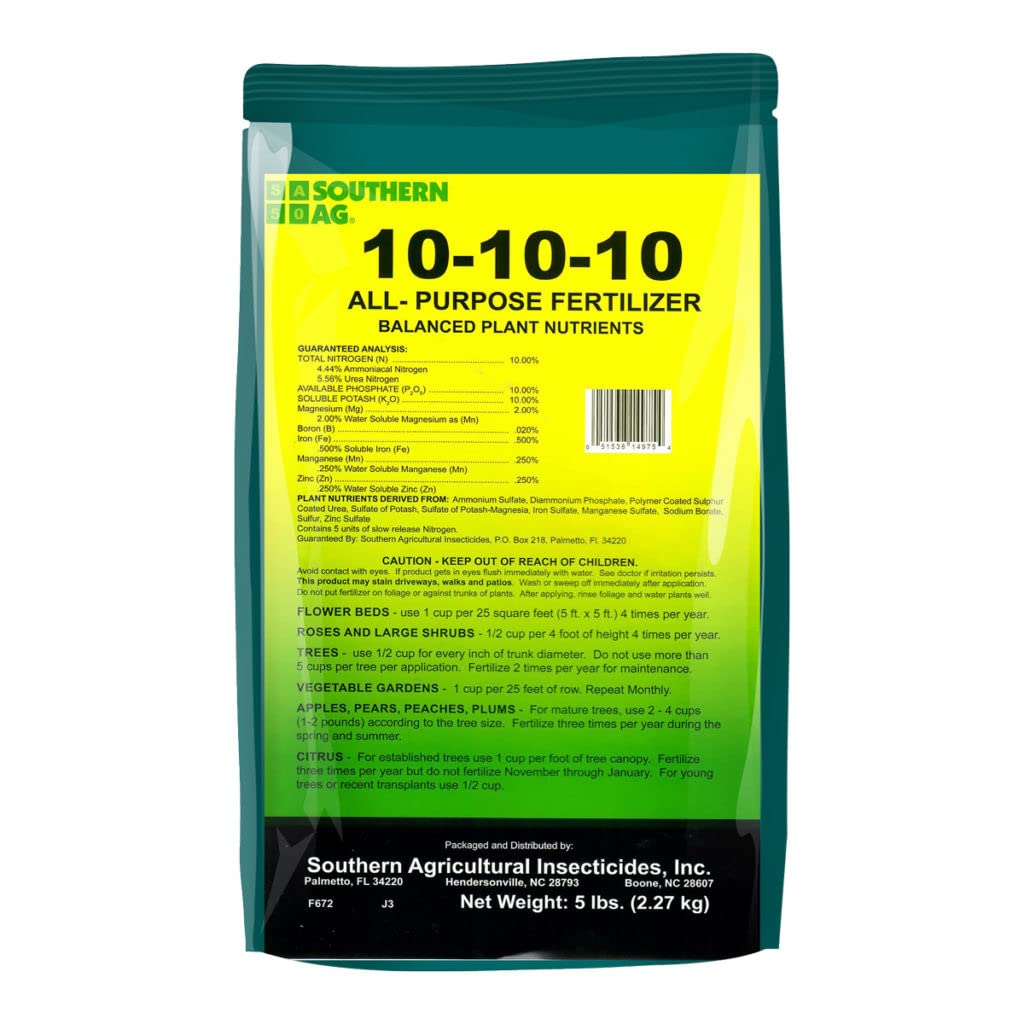
Southern Ag All Purpose Granular Fertilizer 10-10-10 (5 lb)
| Item Form | Granules |
|---|---|
| Specific Uses For Product | Citrus and Fruit Trees, Flowerbeds, Roses, Large Shrubs, Vegetable Gardens |
| Application Method | Broadcast evenly over area and water in. |
| Mixing Ratio | 10:10:10 |
| Unit Count | 80 Ounce |
This 5 lb bag of Southern Ag 10-10-10 granular fertilizer supplies equal parts nitrogen, phosphorus, and potassium with added minor elements to support general plant growth. It is designed to be broadcast evenly over flowerbeds, vegetable gardens, roses, shrubs, and fruit or citrus trees then watered in. Typical use is straightforward: measure by cup according to the directions, spread across the planting area, and irrigate to incorporate nutrients into the root zone. Notable practical features include a uniform granule form for even distribution and clear application rates for different plants and tree sizes. The balanced N-P-K makes it suitable for maintenance feeding of established perennials such as daylilies without forcing excessive foliage at the expense of blooms. Limitations are that it is a general-purpose formula rather than a bloom-boosting fertilizer and safety notes warn against contact with foliage, runoff into water, and staining hard surfaces, so careful application is needed. For gardeners who want a simple, predictable maintenance feed, this product covers a wide range of uses with easy instructions.
Best for: Gardeners who prioritize straightforward, reliable maintenance feeding for mixed beds and perennial borders and want an easy-to-apply, balanced fertilizer they can use across many plants.
Less Ideal for: If you want a targeted bloom-boosting or high-phosphorus formula specifically to force maximum daylily blooms, choose a fertilizer formulated for flowering rather than a general-purpose mix.
- Balanced 10-10-10 N-P-K suitable for general maintenance feeding
- Uniform granular form helps achieve even coverage when broadcast
- Includes minor elements such as iron and zinc to support overall plant health
- Clear, plant-specific application rates and simple water-in instructions
- Not formulated specifically for flower/ bloom enhancement so may not maximize daylily flowering potential
- Safety instructions require care to avoid staining and runoff near water
Verdict: A simple, reliable 10-10-10 granular feed that makes routine maintenance fertilizing of daylilies and mixed garden beds easy and predictable.
Miracle-Gro Water Soluble All Purpose Plant Food (1.5 lb)

| Item Form | Powder |
|---|---|
| Application Method | Watering Can |
| Target Species | For all flowers, vegetables, trees, shrubs and houseplants |
| Mixing Ratio | 24-8-16 |
| Coverage | Full |
This powder plant food dissolves in water and delivers a quick nutrient boost to flowers, vegetables, shrubs and houseplants. Typical use is mixing the recommended scoop into a watering can or garden feeder and applying to the soil near plant roots every 1 to 2 weeks; the product starts working almost immediately because it is water-soluble. Notable features include a high-nitrogen 24-8-16 formula for rapid leafy growth, an included scoop for dosing, and guidance for both indoor and outdoor application. For daylilies specifically it will encourage vigorous foliage and larger blooms when used sparingly during the growing season. Practical benefits are fast availability of nutrients and flexible use in containers or in-ground beds. Important limitations are the high nitrogen ratio, which can favor foliage over flower production if overused, and the need for regular reapplication rather than a slow-release feeding schedule. Budget gardeners will appreciate that a 1.5 lb container covers roughly 600 sq ft, but frequent feeding means you may prefer larger sizes or lower-frequency alternatives for long seasons of heavy use.
Best for: Gardeners who want a cheap, fast-acting feed for mixed borders and container plants and who are willing to follow a regular fortnightly feeding schedule to keep plants vigorous.
Less Ideal for: Growers who prefer low-maintenance, slow-release fertilizers or who want a bloom-focused formula tailored specifically to maximizing flowers rather than foliage.
- Water-soluble formula provides nutrients to roots quickly
- Versatile for indoor and outdoor use including containers and beds
- Includes dosing scoop and clear mixing directions
- Feeds a broad range of plants so one product works for mixed borders
- One 1.5 lb container claims coverage of about 600 sq ft
- High nitrogen ratio may promote leafy growth at the expense of blooms if overapplied
- Requires regular reapplication every 1–2 weeks rather than providing long-term release
Verdict: A cost-effective, fast-acting water-soluble fertilizer that’s ideal for budget-minded gardeners who want quick, regular feeding to keep daylilies and other plants vigorous.
Miracle-Gro Water Soluble All Purpose Plant Food, 12.5 lb.

| Item Form | Powder |
|---|---|
| Specific Uses For Product | Plant Food |
| Coverage | general purpose, suitable for various plants |
| Mixing Ratio | 1 tablespoon per gallon of water |
| Unit Count | 200 Ounce |
Miracle-Gro Water Soluble All Purpose Plant Food is a concentrated powdered fertilizer you mix with water to feed flowers, vegetables, shrubs, trees, and houseplants. It is typically used by dissolving the measured scoop in a watering can or filling a garden feeder to apply at the soil line, supplying nutrients directly to roots every 1 to 2 weeks. The formula is labeled 24-8-16 and starts working instantly to promote growth compared with unfed plants. Practical benefits include simple dilution instructions, a large 12.5 pound container that covers roughly 5,000 sq. ft., and flexibility to use in containers or in-ground beds. Because it is water soluble it is easy to apply during the growing season and can be integrated into a regular feeding routine for daylilies to encourage bigger clumps and more blooms. Important limitations are that it is a general-purpose NPK mix rather than a bloom-specific formula and frequent application is required for best results, so users should follow the directions to avoid overfeeding. The product also requires measuring and dissolving rather than a slow-release convenience option.
Best for: Gardeners who prioritize a reliable, easy-to-use fertilizer to maintain steady growth and larger clumps of daylilies throughout the season and who plan to feed on a schedule.
Less Ideal for: Growers who want a one-and-done slow-release product or who need a bloom-specific high-phosphorus formula for peak flowering performance.
- High nitrogen content (24) supports vigorous vegetative growth
- Water-soluble formula feeds plants instantly when applied
- Large 12.5 lb container covers a substantial garden area (about 5,000 sq. ft.)
- Clear mixing directions and included scoop make dosing straightforward
- Not a bloom-boosting or specialty formula optimized specifically for flowering plants
- Requires regular reapplication during the growing season instead of slow-release convenience
Verdict: A dependable, fast-acting water-soluble fertilizer that reliably promotes vigorous growth for daylilies when used as part of a regular feeding routine.
Miracle-Gro Water Soluble All Purpose Plant Food, 3 lb

| Item Form | Powder |
|---|---|
| Application Method | Mix with water in a watering can |
| Fertilizer Analysis | 24-8-16 |
| Unit Count | 48 Ounce |
| Coverage | Feeds approximately 1,200 sq. ft. |
Miracle‑Gro Water Soluble All Purpose Plant Food is a powdered NPK fertilizer (24-8-16) designed to be mixed with water and applied with a watering can or compatible garden feeder. It is typically used every 7 to 14 days to give container plants, flower beds, vegetables, trees, shrubs, and houseplants a quick nutrient boost that starts working at the roots. The product includes dosing guidance and a scoop for indoor and outdoor mixes, and one 3 lb container covers a large area. Practical benefits include fast uptake compared with granular feed, easy dilution for foliar or soil applications, and suitability for a wide range of plant types. Limitations are that it provides a short‑term, feed‑and‑flush style of nutrition so repeated applications are needed for sustained fertility, and its high nitrogen ratio may favor leaf growth over flowering if overused. Users should follow the label to avoid overfeeding and protect skin and eyes from contact.
Best for: A gardener who wants a reliable, easy-to-use booster for established perennials and mixed beds and who values proven performance and clear application instructions.
Less Ideal for: Those seeking a slow‑release, low‑maintenance fertilizer program or an organic certified option should consider other products.
- Fast‑acting water‑soluble formula delivers nutrients to roots quickly
- Clear dosing guidance for indoor and outdoor use with included scoop
- Versatile for in‑ground beds, containers, and houseplants
- Covers a large area from a single 3 lb container
- Requires frequent reapplication for continuous feeding
- Higher nitrogen formulation can reduce flowering if used too often
Verdict: Choose this if you want a dependable, fast‑acting soluble fertilizer to give daylilies and mixed garden beds a quick, noticeable nutrient boost.
Choosing the Right Fertilizer for Daylilies: Key Factors to Consider
Nutrient Ratio And Balance
Daylilies perform best with a fertilizer that supports bud formation without overstimulating leaf growth. A balanced formula with moderate nitrogen, adequate phosphorus, and good potassium helps plants set more buds and produce stronger stems.
Too much nitrogen will push foliage and reduce the number and quality of flowers. Look for ratios that provide phosphorus in a measurable amount and ensure micronutrients like magnesium and iron are present or available in the soil. For seasonal feeding, a slightly higher middle number can be useful at pre-bloom time, while maintenance feedings can use lower nitrogen levels to preserve plant habit.
Release Type And Longevity
How a fertilizer releases its nutrients affects how often you need to feed and how steady the plant response will be. Slow-release or controlled-release fertilizers give a steady supply that reduces application frequency and the risk of nutrient spikes.
Water-soluble or liquid feeds produce quicker, visible responses and are useful for immediate bloom boosting or when plants show deficiency. Consider your maintenance style: if you prefer fewer applications, choose longer-lasting granules; if you like quick corrections ahead of a flower show, use a water-soluble feed.
Application Method And Ease
Practicality matters in perennial beds. Granular feeds can be broadcast across a bed and worked slightly into the root zone, while spike-style products are inserted near individual crowns. Liquid fertilizers are mixed and poured or applied with a hose-end feeder.
Ease includes clear instructions, minimal equipment needs, and safety for nearby plants. If you maintain many clumps or have mixed borders, bulk granular options save time. For container-grown daylilies, measured liquid or dilute water-soluble feeds reduce the risk of salt buildup.
Soil Interaction And pH Effects
Different fertilizers interact with soil chemistry in various ways. Some products can acidify or alkalize the root zone over time and affect nutrient availability. Daylilies are tolerant of a range of pH, but consistent nutrient availability leads to better bud set.
Assess your soil type and test pH before committing to a long-term fertilizer plan. Choose formulations that do not dramatically shift pH or that include buffering agents. In heavy clay or poorly drained sites, favor feeds that release slowly to avoid nutrient tie-up or leaching.
Salt Index And Container Suitability
Salt buildup is a common problem in containers. High-salt fertilizers can damage roots, especially when water evaporates quickly and salts concentrate near the crown.
For pots, pick low-salt or water-soluble formulas designed for frequent, dilute feeding. In-ground beds tolerate higher salt indices because rainfall and soil volume dilute salts, but container-grown daylilies need gentler feeds and occasional flushing to prevent accumulation.
Timing And Seasonal Feeding Strategy
When you apply fertilizer matters as much as what you apply. Early spring feed encourages healthy foliage and bud initiation. A targeted pre-bloom feed with bloom-promoting phosphorus supports larger flower counts, while a late-summer feed should be conservative to avoid stimulating late growth that can be damaged by frost.
Plan feedings around your local climate and bloom cycle. For repeat-blooming varieties, smaller, more frequent applications may sustain flowering, whereas once-blooming types benefit most from a strong pre-bloom feed followed by light maintenance.
How Much Fertilizer Daylilies Typically Need
Most established daylily clumps need moderate feeding rather than heavy fertilization. For in-ground plantings a single application in spring plus an optional light midseason feeding is sufficient for many gardens. Young divisions and newly planted clumps benefit from a gentler program-smaller doses more often to support root establishment without burning the crown.
- Established beds: one moderate granular application in early spring, optional light feed at bud set.
- New transplants: dilute liquid feeds every 2 to 4 weeks during the first season.
- Containers: lower-strength liquid feeding every 2 weeks and occasional leaching to prevent salts.
Applying Fertilizer Without Damaging Crowns
Daylily crowns sit near the soil surface and can be sensitive to direct contact with concentrated fertilizer. Spread granular fertilizer evenly around the drip line rather than directly on top of the crown. Lightly work granules into the soil surface or water thoroughly after applying to move nutrients into the root zone.
If using spikes, place them a few inches away from the crown and follow label depth guidance. With liquids, water the root zone first then apply the diluted feed to reduce the risk of burn and ensure even uptake.
- Keep dry granules off the crown to avoid chemical burn.
- Water immediately after applying dry feeds to activate nutrients.
- For containers, remove top debris and apply diluted solutions to the potting mix.
Common Nutrient Deficiencies To Watch For
Yellowing leaves, poor bud set, or small, weak flowers often indicate an imbalance. Pale foliage with green veins can suggest iron or manganese deficiency on alkaline soils, while overall pale growth may point to low nitrogen. Sparse or aborted buds often result from insufficient phosphorus or potassium.
Before increasing fertilizer strength, confirm the problem with a soil test or compare symptoms to common deficiency patterns. Applying the wrong nutrient can mask the real issue or worsen conditions by shifting pH.
- Nitrogen deficiency: overall pale leaves and poor growth.
- Phosphorus lack: few buds, small flowers, weak root development.
- Potassium shortage: weak stems, fewer blooms, leaf tip scorch.
Feeding Daylilies In Different Garden Settings
Daylilies adapt to beds, borders, and containers, but feeding needs vary. In mixed borders, competition from trees or shrubs may require slightly more frequent feeding or localized applications to ensure clumps get enough nutrients. In heavy clay soils, opt for slow-release formulas to reduce leaching and nutrient tie-up.
Containers need more frequent, lighter feedings and periodic flushing. If you grow daylilies in raised beds with new soil mixes, initial fertility management may be longer while the soil organic matter stabilizes. Monitor plant response and adjust frequency rather than continually increasing dose.
- Mixed borders: spot treat around clumps to avoid feeding competitors.
- Raised beds: test soil after initial establishment to set a feeding baseline.
- Containers: dilute feeds and flush pots periodically to prevent salt buildup.
Organic Versus Synthetic Options For Daylily Beds
Organic fertilizers release nutrients as soil microbes break down material, often improving long-term soil structure and microbial health. They are gentler and reduce burn risk but may act more slowly and vary in nutrient concentration from batch to batch. Synthetic fertilizers are predictable and fast-acting, which is useful for planned bloom boosts or correcting deficiencies quickly.
Many gardeners combine approaches: an organic soil amendment in fall and targeted synthetic or water-soluble feeds in spring and pre-bloom. Consider local soil biology, maintenance time, and your comfort with application frequency when choosing between organic and synthetic strategies.
- Organics improve soil over time but act slower.
- Synthetic feeds offer precise control for pre-bloom boosts.
- Integrated strategies can provide both soil health and predictable flowering results.
How We Chose the Best Fertilizer for Daylilies
We selected fertilizers that suit typical daylily habits and planting situations rather than extreme niche solutions. Editorial filters prioritized nutrient chemistry and real-world garden usability. Key evaluation criteria included nutrient ratio and balance, release type and longevity, application method and ease, soil interaction and pH neutrality, and suitability for beds versus containers. We excluded specialist vegetable or lawn formulas that are formulated for very different growth patterns, and we did not include products intended solely for turf, orchids, or aquatic plants. We focused on fertilizers that provide phosphorus and potassium at levels that support bud formation, controlled nitrogen to avoid excessive foliage, and predictable release characteristics so gardeners can plan feeding around bloom cycles. Practical considerations such as spreader compatibility, frequency of reapplication, and how a fertilizer behaves in typical garden soils were key. The final shortlist emphasizes balanced bloom feeding, straightforward instructions, and reliable results across clay, loam, and container mixes.
FAQ
When is the best time to fertilize daylilies?
Usually early spring as new growth begins and again at bud set leads into peak bloom. Avoid heavy late-summer feeding that could stimulate tender growth before frost. Timing can be adjusted based on local climate and a variety's bloom pattern.
Can I use a general-purpose garden fertilizer on daylilies?
Often yes if the formula is balanced and not excessively high in nitrogen. Avoid turf-specific or vegetable-only blends that focus on leaf growth. Choose a general-purpose formula with moderate nitrogen and some phosphorus for bud development.
How do I feed daylilies in containers differently from in-ground plants?
Containers need lower-strength, more frequent feedings and occasional flushing to prevent salt buildup. Use water-soluble or low-salt formulas and apply at roughly half to three-quarters the strength recommended for in-ground beds, depending on potting mix and drainage.
Will overfertilizing help produce more flowers?
No. Excessive nitrogen can increase foliage at the expense of flowers and may stress the plants. Follow label rates and prioritize balanced or bloom-focused ratios rather than increasing overall dose to force results.
Should I amend soil before planting daylilies or rely on fertilizer later?
Amend soil to provide good structure and baseline nutrients at planting time, especially in poor or heavy soils. Organic matter helps water retention and root growth. After establishment, targeted fertilization supports bloom cycles but does not replace good initial soil preparation.
Final Verdict
Choose a fertilizer for daylilies that fits your garden rhythm and planting situation. Prioritize a nutrient ratio that supports bud formation without excessive nitrogen, pick a release type that matches how often you want to apply, and adapt the method for containers or mixed borders. Accept tradeoffs: fast-acting liquids give quick results but need repeat applications, while slow-release granules lower maintenance but act more gradually. With the right balance and timing, you can increase bloom counts and keep foliage healthy without complicated programs.
