

Note: This article contains affiliate links. If you click on these links and make a purchase, I may earn a small commission at no extra cost to you. This helps support my research and content. Read my full affiliate disclosure here.
Picking the right fertilizer for early spring sets the season up for healthy green-up, stronger roots, and fewer setbacks later in summer. In cool, wet soils young shoots need available nitrogen for leaf growth but also enough phosphorus and potassium to support roots and stress resilience. Using a product suited to early-season conditions helps you avoid leaching, burning, or uneven growth. This guide covers seven top picks for early-spring fertilizer that work across lawns, flower beds, and vegetable starts. We shortlisted options that balance timely nutrient availability, safety for tender shoots, and ease of application. Read on to see the evaluation factors we used and practical tips for applying fertilizers as soil and weather change.
Top Picks at a Glance
| Best Overall The best all-around choice for most situations | Scotts Turf Builder Starter Food for New Grass, 15 lb |  |
| Best Quality Built to a higher standard if you want something more solid | Espoma Organic Spring Lawn Booster 30 lb (8-0-0) |  |
| Best Value The sweet spot between price and what you get | Milorganite 6-4-0 Slow-Release Fertilizer, 32 lb (Includes Feeding Tips Brochure) |  |
| Best Budget The cheapest option that still gets the job done reliably | Farmer's Secret Spring Booster Fertilizer (8 oz) – Concentrated 8-16-8 Liquid |  |
| Highest Rated A top-rated pick with lots of positive feedback | FoxFarm Happy Frog Jump Start Fertilizer (4 lb) |  |
| Most Popular A crowd favorite that many people choose with confidence | Scotts Turf Builder Lawn Food, 12.5 lb |  |
Scotts Turf Builder Starter Food for New Grass, 15 lb

| Formula (NPK) | 24-25-4 |
|---|---|
| Form | Powder/granular |
| Application Method | Spreader |
| Coverage | 5000 square feet |
Scotts Turf Builder Starter Food for New Grass is a 24-25-4 granular starter fertilizer made for use when sowing seed, laying sod, or installing plugs and sprigs. You apply it with a broadcast or drop spreader at planting and again 2–4 weeks later; the high phosphate content is intended to promote early root development so seedlings establish more quickly and grow thicker. In practice the powder spreads evenly with a Scotts spreader and is simple to use for a typical suburban lawn. It is safe on all grass types and sized for mid‑sized lawns with one 15 lb. bag covering about 5,000 square feet. The main limitation is that it is a starter formula only, so you will need a regular maintenance fertilizer after the initial establishment period rather than relying on this bag for season‑long feeding. Also it is granular, so timely watering after application is important for best seed and root response.
Best for: Homeowners planting or reseeding lawns in early spring who want a straightforward, science-backed starter fertilizer to speed establishment and build stronger roots.
Less Ideal for: Gardeners seeking a season‑long or slow‑release feeding program or those who prefer liquid fertilizers and foliar feeding methods.
- High phosphate 24-25-4 formula to promote early root development
- Designed for use at planting with guidance for spreader settings
- Covers a large area per bag—about 5,000 sq. ft.
- Safe for use on all grass types and with seed, sod, plugs, or sprigs
- Starter formula only so you must switch to maintenance fertilizer after establishment
- Granular product requires proper spreading and watering for best results
Verdict: Use this specifically when starting or reseeding lawns in early spring to accelerate root growth and get new grass established faster.
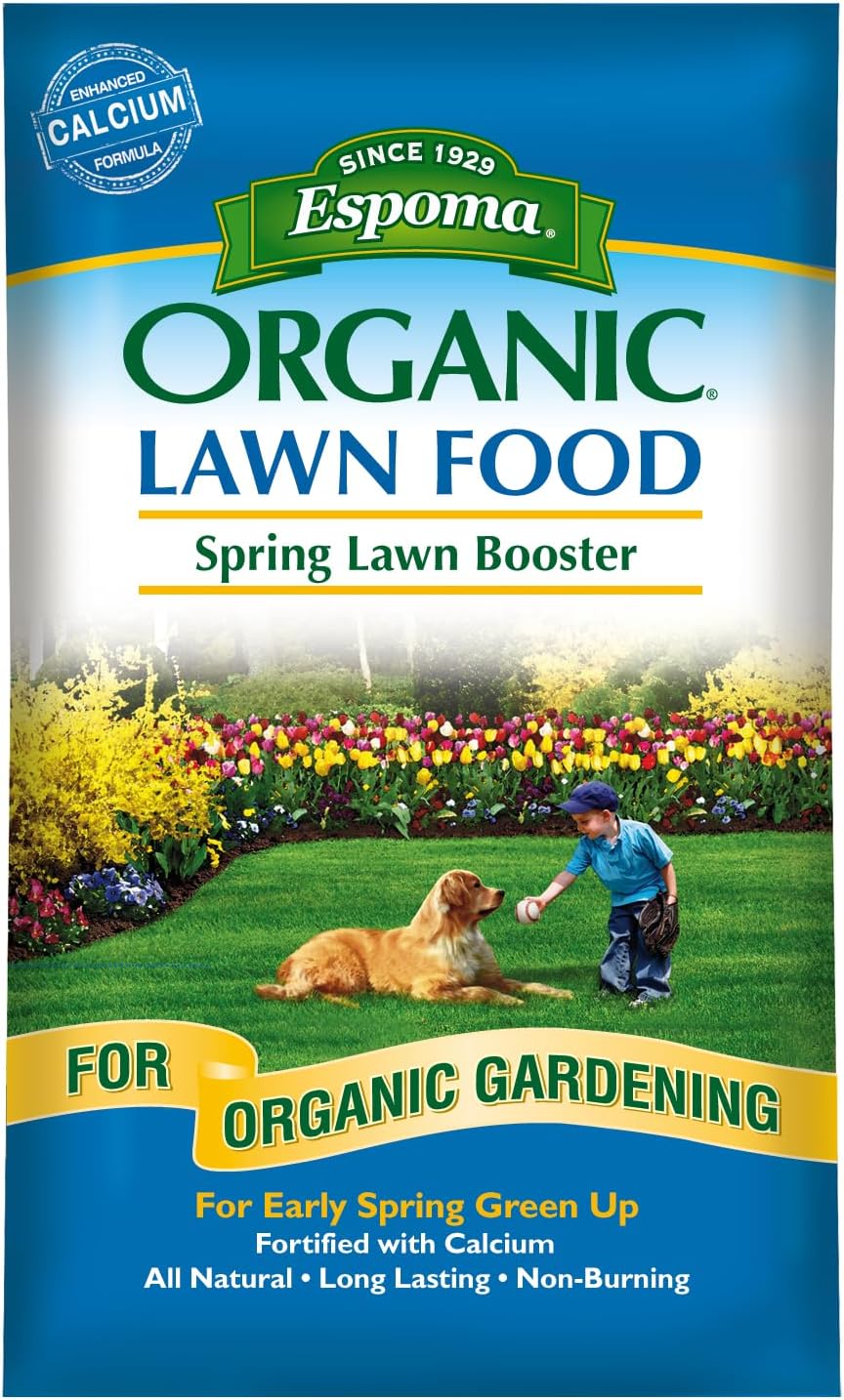
Espoma Organic Spring Lawn Booster 30 lb (8-0-0)
| Item Form | Granules |
|---|---|
| Application Method | broadcast spreader |
| Coverage | up to 5,000 sq ft |
| Mixing Ratio | 8-0-0 |
Espoma Organic Spring Lawn Booster is a granular, organic 8-0-0 fertilizer formulated for early spring turf feeding. You apply it with a broadcast or drop spreader across lawns up to about 5,000 square feet to deliver long-lasting slow‑release nitrogen and added calcium aimed at strengthening shoots and improving green-up. Because it is an organic input, nitrogen is released gradually rather than providing an instant flush, which reduces burn risk and sustains growth over weeks. It is labeled for use on both cool- and warm‑season grasses including fescue, bluegrass, rye and zoysia, and carries an organic input material registration for gardeners who want certified organic inputs. The practical trade-off is that results appear more slowly than with fast‑release synthetic fertilizers, so it is best for gardeners prioritizing steady, safer spring performance rather than an immediate color boost. Coverage per 30 lb bag is suitable for small to medium yards and it works well as the first step in an organic spring program.
Best for: Gardeners who want a performance-focused, organic spring feeding that prioritizes sustained turf strength and steady green‑up over instant color. Best for owners managing small to medium lawns who plan an organic seasonal program.
Less Ideal for: If you need an immediate, dramatic color boost or manage large acreage where fast results matter, a quick‑release synthetic fertilizer or bulk commercial product is a better fit.
- Organic formulation approved as an organic input material
- Slow‑release nitrogen for sustained spring green‑up
- Enhanced with calcium to support turf health
- Suitable for both cool and warm season grasses
- Applies with a standard broadcast or drop spreader and covers up to 5,000 sq ft
- Slower visible results compared with synthetic quick‑release fertilizers
- One bag covers only small to medium lawns so larger properties need multiple bags
Verdict: Choose this product if you want an organic, slow‑release spring fertilizer that delivers steady, low‑risk green‑up for small to medium lawns.
Milorganite 6-4-0 Slow-Release Fertilizer, 32 lb (Includes Feeding Tips Brochure)

| N-P-K | 6-4-0 |
|---|---|
| Form | Pelletized |
| Coverage | 2,500 Square Feet |
| Unit count | 32 lb bag |
Milorganite 6-4-0 is a pelletized, slow-release organic fertilizer intended for regular feeding of lawns and garden plants. You apply it with a broadcast or rotary spreader or by hand; one 32 lb bag covers about 2,500 sq ft and the included brochure gives seasonal timing and spreader settings. Its low-salt formula and organically complex iron help green turf without the burn or concrete staining sometimes seen with synthetic options. Nutrients are released slowly over roughly 8 to 10 weeks, so it reduces the need for frequent reapplication and does not require watering in immediately after use. Because it is 85% organic matter by weight and made from heat-dried microbes, it also improves soil structure and microbial activity over time, which is useful in clay or sandy soils. Limitations are that it is not a quick-acting synthetic feed for instant green-up and some people may notice a mild earthy odor right after application that dissipates with watering or rain.
Best for: Buyers who want a reliable, low-maintenance spring fertilizer that improves soil health while providing steady nitrogen and greening for lawns and mixed garden beds.
Less Ideal for: Gardeners seeking instant, rapid green-up or highly concentrated synthetic nutrient boosts should choose a fast-release fertilizer instead.
- Slow-release nitrogen feeds lawns and garden plants for 8–10 weeks reducing reapplication frequency
- Low-salt formula minimizes risk of burn and streaking in hot or dry conditions
- Contains organically complex iron for steady greening without staining hardscape
- Pelletized form works with broadcast, rotary, or manual application methods
- High organic matter content improves soil structure and microbial activity over time
- Not a fast-acting fertilizer for immediate color or growth response
- Has an initial earthy odor that can attract pets until washed in or dissipated
Verdict: Choose Milorganite for an early-spring feed when you want steady, low-risk greening and soil-building benefits rather than instant results.
Farmer's Secret Spring Booster Fertilizer (8 oz) – Concentrated 8-16-8 Liquid

| Item Form | Liquid |
|---|---|
| Application Method | Water |
| Target Species | All plants |
| Mixing Ratio | 1 teaspoon per gallon |
This concentrated 8-16-8 liquid spring booster is designed to give plants a strong early-season start by encouraging leaf and shoot development. You dilute one teaspoon per gallon and apply through regular watering or foliar spray, so it fits easily into weekly feeding routines for gardens, containers, and landscape beds. The high nitrogen content helps establish vigorous foliage that supports later blooms and fruiting, and the small 8 ounce bottle produces many gallons of feed because the formulation is super concentrated. Practical benefits include simple mixing, suitability for a wide range of plant types, and a compact bottle that is easy to store. Important limitations are the small bottle size for larger gardens and the fixed N-P-K ratio that may not suit plants needing lower nitrogen or higher phosphorus for early bloom. If you prefer a single, easy-to-use spring tonic to boost early growth and maximize how far a small bottle will go, this product performs reliably when used at the recommended dilution.
Best for: Home gardeners who want an affordable, concentrated spring tonic to quickly boost early-season leaf growth and who prefer a simple weekly feed that stretches a small bottle over many applications.
Less Ideal for: Gardeners managing large acreage or those who need a bloom-boosting or low-nitrogen formula tailored to specific plant nutrient needs should consider other options.
- Super concentrated formula stretches one small bottle into many gallons of feed
- Simple water-based application with an easy 1 teaspoon per gallon mixing ratio
- Formulated specifically for spring use to encourage early leaf and shoot development
- Suitable for a wide range of plants including vegetables, flowers, trees, shrubs
- 8 ounce bottle may be insufficient for larger gardens without frequent repurchase
- Fixed 8-16-8 N-P-K ratio may not be ideal for plants that need lower nitrogen or higher bloom-focused phosphorus
Verdict: A concentrated, easy-to-use spring feed that gives budget-minded gardeners a lot of feed from a small bottle to kickstart early-season growth.
FoxFarm Happy Frog Jump Start Fertilizer (4 lb)

| Item Form | Granules |
|---|---|
| Specific Uses For Product | Root Development |
| Unit Count | 64 Ounce |
| Mixing Ratio | 3-4-3 |
FoxFarm Happy Frog Jump Start is a granular transplant and seedling fertilizer designed to help new plants take hold after moving or repotting. You mix the granules into potting mix or soil at the recommended rate, set the plant, and water to begin feeding phosphorus-rich nutrients that encourage early shoot and root growth. The 3-4-3 NPK ratio emphasizes phosphorus for establishment, and the included mycorrhizal fungi aim to improve root efficiency and nutrient uptake. Practical benefits include straightforward application, OMRI-listed formulation suitable for organic systems, and a 4 lb size that covers multiple repottings or small beds. Expect faster initial rooting and reduced transplant shock when used as directed. Limitations are that it is a starter formula not intended for long-term feeding or bloom boosting, and users must follow mixing directions to avoid over-application; it also provides modest nutrient concentrations compared with concentrated liquid feeds. This product fits into a seasonal early-spring routine when the goal is to get transplants established before regular fertilizer schedules resume.
Best for: Gardeners who prioritize consistent establishment of transplants in early spring and want a reliable, easy-to-use starter fertilizer to reduce transplant shock.
Less Ideal for: Gardeners seeking a single product to feed mature, flowering plants long term or those who prefer quick-adjustable liquid nutrient programs.
- Formulated specifically for transplanted seedlings and repotted plants
- Contains phosphorus-focused 3-4-3 NPK to support early growth
- Includes mycorrhizal fungi to help root establishment and nutrient uptake
- Granular form is easy to mix into soil and apply for small beds or containers
- Designed as a starter fertilizer so it is not a complete long-term feeding solution
- Lower nutrient concentration compared with concentrated liquid fertilizers
Verdict: Use this starter fertilizer in early spring to reliably help transplants and seedlings establish strong roots and reduce transplant shock.
Scotts Turf Builder Lawn Food, 12.5 lb

| Item Form | Powder |
|---|---|
| Specific Uses For Product | Lawn |
| Coverage | 5,000 sq. ft. |
| Target Species | grass |
| Mixing Ratio | 32:0:4 |
Scotts Turf Builder Lawn Food is a ready-to-use granular fertilizer for established lawns that supplies nutrients to thicken turf and build deeper roots. It is applied with a broadcast or drop spreader to a wet or dry lawn and can be watered in for faster results. The product is pesticide-free and formulated for any grass type, making it versatile for early spring feeding to encourage green-up after winter. The manufacturer provides spreader settings for consistent application and clear safety and cleanup guidance. As a single-bag option covering about 5,000 sq. ft., it suits small to medium yards or spot treatment, but heavier-feeding schedules for larger areas will need multiple bags. Because it is a straightforward lawn food without built-in weed control, you may need separate weed treatments if weeds are a concern. The powdered granular form is easy to store but can track if spilled, so follow the instructions to sweep excess back onto the lawn.
Best for: Gardeners who want a reliable, no-fuss early spring feed to encourage green-up and strengthen existing turf and who value clear instructions and consistent results.
Less Ideal for: People who need a combined weed-and-feed product or those managing large lawns who prefer single-bag coverage for extensive areas.
- Works on all grass types so it is versatile for mixed lawns
- Builds stronger, deeper roots to improve drought and nutrient uptake
- Clear application guidance and spreader settings for even coverage
- Pesticide-free formula suitable for routine seasonal feeding
- Covers only about 5,000 sq. ft. per bag so larger yards require multiple bags
- Does not include weed control so weeds need a separate solution
Verdict: A dependable early-spring lawn food that greens and strengthens turf without pesticides, ideal for homeowners wanting straightforward seasonal feeding.
Choosing the Right Fertilizer for Early Spring: Key Factors to Consider
Nutrient Ratio and Early-Season Needs
Early spring growth typically benefits from a higher proportion of available nitrogen to encourage leaf development, but phosphorus and potassium remain important for root establishment and stress tolerance.
Choosing a fertilizer with a balanced early-spring formulation prevents leggy or weak top growth and supports developing root systems. Look for products that list the N-P-K ratio clearly and include secondary nutrients if your soil test shows deficiencies.
Release Profile and Timing
Release profile determines how fast nutrients become available after application. Quick-release fertilizers give an immediate green-up but can spike growth and increase burn risk if overapplied. Controlled-release or slow-release formulations feed plants more evenly and reduce leaching risk in cool, wet soils common in early spring.
Match the release profile to your goals: use faster-acting options when you need rapid correction or green-up, and choose controlled-release types when you want steadier nutrition and fewer repeat applications.
Salt Index and Safety for Tender Shoots
Salt index and labeled application rates indicate how likely a fertilizer is to stress or burn new shoots and roots. Early spring plants are vulnerable because soils are often still cool and microbe activity that moderates fertilizer salts is lower.
Opt for lower-salt formulations or reduce application rates on young transplants. Many granular fertilizers also recommend incorporation or light watering after application to minimize contact stress on delicate roots.
Application Method and Garden Type Compatibility
Different gardens favor different application methods. Lawns usually need even broadcasting or drop-spreader application, while flower beds and vegetable patches may use top-dressing, side-dressing, or soluble feeds.
Pick a fertilizer that fits how you plan to apply it. Water-soluble products are handy for quick foliar or root feeding, while granular or coated granules work well for long-term feeding schedules and less frequent handling.
Environmental Considerations and Runoff Risk
Early spring often brings rain and runoff, so choosing fertilizers that limit leaching helps protect waterways. Slow-release formulations, stabilized nitrogen, and products with lower water-soluble phosphorus are safer choices in runoff-prone areas.
Also consider timing – applying on dry days with a forecast of light rain reduces runoff risk compared with heavy rain events. Choosing products with clear stewardship instructions helps reduce environmental impact.
Label Clarity and Ease of Use
Clear labeling matters for correct application rates, timing recommendations, and crop-specific instructions. Early-spring timing can vary by region, so products with straightforward guidance on rate adjustments and safety margins make it easier to apply confidently.
Prefer fertilizers with easily understood mixing directions for liquid feeds and spreader settings for granular products. This reduces user error and improves outcomes for inexperienced gardeners.
When to Apply Fertilizer in Early Spring
Aim to fertilize once soil temperatures consistently reach the threshold appropriate for the plants you are feeding. For cool-season lawns and most perennials that is often when soil at 2 to 4 inches depth stays above about 40 to 50 degrees Fahrenheit. For warm-season turf or heat-loving annuals wait until soils have warmed further so nutrients are used effectively rather than lost to microbes or runoff.
- Check a soil thermometer rather than calendar dates for timing accuracy.
- Avoid fertilizing when ground is waterlogged or frozen to prevent runoff and poor uptake.
- If you need rapid green-up, choose a soluble feed but use conservative rates on new growth.
How to Apply Fertilizer Without Burning New Growth
Spread granular products evenly and follow spreader settings on the label. For planted beds, broadcast and then lightly rake or water in so granules do not sit tight against tender stems. For transplants, side-dress at a small distance from the stem to avoid direct contact with concentrated salts.
- Use the recommended rate for the plant type and reduce by 25 percent on very young or stressed plants.
- When using liquid feeds, dilute to the recommended concentration and apply during the morning to allow leaves to dry.
- After application, water lightly unless the label instructs otherwise; this helps move nutrients into the root zone.
Adjusting Early-Season Feeding by Plant Type
Lawns, perennials, shrubs, and vegetables have different early-season priorities. Lawns generally benefit from a single early nitrogen-rich application to jump-start green-up. Perennials and shrubs often need a gentler balance that supports both shoots and root growth. Vegetables that will be harvested for leaves need more nitrogen, whereas root and fruit crops benefit from controlled nitrogen with sufficient phosphorus.
- For leafy vegetables, favor available nitrogen in early spring then adjust as plants mature.
- For bloom-bearing perennials, moderate nitrogen with attention to phosphorus supports flower bud set later in the season.
- For newly planted shrubs and trees, use formulations that emphasize root support and avoid heavy early nitrogen that encourages excessive top growth.
Soil Testing and Corrective Applications
A simple soil test taken in late winter or very early spring tells you baseline nutrient levels and pH. Use test results to correct specific deficiencies rather than applying a blanket high-nitrogen feed that may be unnecessary or harmful. If the soil test shows low phosphorus or low pH, address those specific problems with targeted products or amendments. Follow test-based recommendations for application rates and avoid overlapping applications that could push nutrients beyond optimal ranges.
- Retest every 2 to 3 years to track changes in fertility.
- Consider localized applications for small beds rather than blanket treatments across an entire yard.
Combining Fertilizer with Early-Season Cultural Tasks
Timing fertilization with tasks like dethatching, light aeration, or top-dressing can maximize uptake and improve soil structure. For lawns, apply fertilizer after dethatching and before overseeding for best seed germination and establishment. For beds, incorporating organic matter and a matched early-spring fertilizer improves nutrient retention and supports microbiology as soils warm.
- Apply organic amendments several weeks before peak feeding so they start to break down.
- Avoid heavy mechanical soil disturbance immediately after broadcasting fertilizer to prevent uneven distribution.
How We Chose the Best Fertilizer for Early Spring
We evaluated fertilizers for early spring using criteria that matter in real garden conditions. Primary filters included nutrient formulation and release profile, because the right N-P-K balance and whether nutrients are quick-release, slow-release, or blended affects green-up and root development. Application flexibility was assessed, including suitability for granular spreading, broadcasting on lawns, top-dressing beds, or dissolving for liquid feeding. We checked safety for new growth and young transplants by looking at typical salt index ranges and recommended application rates, and we favored products that reduce burn risk when used at recommended rates. Environmental impact and runoff risk were considered through nutrient-release characteristics and the likelihood of leaching in cool, wet soils. Ease of use and clarity of labeling were included to reflect how straightforward it is for gardeners to apply at the right timing. We excluded specialty products aimed only at dormant-season use, heavy-duty turf renovation concentrates, and any fertilizer formulations intended exclusively for container-only crops. The final list focuses on broadly useful early-spring fertilizers that balance availability and safety for a range of yard and garden situations.
FAQ
Can I use a summer lawn fertilizer in early spring?
Often summer formulations are higher in nitrogen or designed for hotter conditions and may not be ideal for early spring. Using a product labeled for spring or cool-season use reduces burn risk and matches nutrient timing better.
How long after applying early-spring fertilizer will I see results?
Results depend on release type and weather. Quick-release fertilizers can show visible green-up within a week, while slow-release products may act over several weeks to months. Soil temperature and moisture also affect uptake.
Is it safe to fertilize newly planted transplants in early spring?
You can fertilize new transplants, but use reduced rates or milder formulations to avoid salt stress. Side-dressing and keeping fertilizer away from direct root contact minimizes burn risk.
Should I water immediately after fertilizing in early spring?
Light watering often helps move nutrients into the root zone, but follow label instructions. Avoid heavy irrigation right after application if the ground is saturated, as that increases runoff risk.
How does slow-release fertilizer help in rainy early-spring weather?
Slow-release formulations release nutrients gradually, reducing the chance that heavy spring rains will wash them away. That steadier supply also lowers the need for repeat applications during unsettled weather.
Final Verdict
Prioritize nutrient balance and release characteristics when choosing a fertilizer for early spring. Match the product to your plant types and local soil temperatures, and favor lower-salt or controlled-release options on tender new growth to reduce burn and runoff risk. Use soil testing and clear label instructions to set rates and timing. When you align fertilizer formulation, application method, and early-season conditions, you get steadier green-up and stronger root development with fewer corrective steps later in the season.
