

Note: This article contains affiliate links. If you click on these links and make a purchase, I may earn a small commission at no extra cost to you. This helps support my research and content. Read my full affiliate disclosure here.
You want weeds gone without putting people, pets, or desirable plants at unnecessary risk. The right safe weed killer reduces hand-weeding time while preserving soil life and minimizing drift onto flowers, vegetables, and lawns. This guide highlights six top-rated safe weed killers shortlisted for common home garden uses and evaluates each on key gardener-focused criteria like selectivity, persistence, and ease of application. Read on to understand how these options behave in real garden situations and which product features matter most for your yard, patio containers, or vegetable beds.
Top Picks at a Glance
| Best Overall The best all-around choice for most situations | Just For Pets Pet Safe Weed Killer, 1 Gallon Ready-to-Use |  |
| Best Quality Built to a higher standard if you want something more solid | Ortho GroundClear Weed & Grass Killer with Comfort Wand, 1 gal. |  |
| Best Value The sweet spot between price and what you get | Spruce Weed & Grass Killer Refill, Ready-to-Use 64 fl oz |  |
| Best Budget The cheapest option that still gets the job done reliably | Spruce EZ-AIM Weed & Grass Killer₃, Precision Spray 3-pack (10 oz each) |  |
| Highest Rated A top-rated pick with lots of positive feedback | Calyptus 50% Concentrated Vinegar Cleaner, 2 Gallon (Two 1‑Gallon Jugs) |  |
| Most Popular A crowd favorite that many people choose with confidence | Spruce Weed & Grass Killer Power Wand Kit with 64 oz Refill |  |
Just For Pets Pet Safe Weed Killer, 1 Gallon Ready-to-Use

| Unit Count | 128 Fluid Ounces |
|---|---|
| Item Form | Liquid |
| Active Ingredients | Vinegar |
This one-gallon ready-to-use weed killer is a vinegar-based, non-glyphosate formula packaged with a pump sprayer for straightforward spot treatment of unwanted weeds and grass. You simply shake, pressurize the sprayer, and coat target plants; visible wilting can appear within hours and clearer results are typical by 24 hours. The product is presented as pet- and family-friendly when used according to directions and is suitable for hardscape areas, rock beds, driveways, patios and fence lines where you want non-selective contact control. Practical benefits include no mixing or measuring, fast action on common weeds like dandelions and crabgrass, and a formulation that avoids glyphosate. Important limitations are that it is non-selective so it will harm desirable plants on contact, it requires thorough coverage to be effective, and contact herbicides sometimes need repeat applications for deep-rooted perennials. Also follow drying and safety guidance before allowing pets or children back into treated areas.
Best for: Homeowners who prioritize low-toxicity, easy-to-use weed control around hardscapes and landscape beds and want a quick, no-mix solution that avoids glyphosate.
Less Ideal for: Gardeners seeking a selective herbicide for lawns or those needing a systemic solution for tough perennial roots should consider other products or integrated removal methods.
- Ready-to-use pump sprayer requires no mixing or measuring
- Vinegar-based formula with no glyphosate for a more natural active ingredient
- Fast visible results often within 24 hours on annual weeds and grasses
- Versatile for use on driveways, sidewalks, patios, rock beds and fence lines
- Non-selective contact action can damage desirable plants if oversprayed
- May require repeat treatments for deep-rooted or persistent perennial weeds
Verdict: A fast, ready-to-use vinegar weed killer for homeowners who want a non-glyphosate, easy contact solution for weeds on hardscape and beds.
Ortho GroundClear Weed & Grass Killer with Comfort Wand, 1 gal.

| Item Form | Spray |
|---|---|
| Coverage | 5120 square feet |
| Unit Count | 128 Fluid Ounces |
| Active Ingredients | Ammonium Nonanoate |
Ortho GroundClear is a one-gallon ready-to-use weed and grass spray designed for spot and surface treatment on driveways, walkways, patios, and landscape beds. The formula absorbs on contact and shows visible browning in about 15 minutes, becoming rainproof roughly two hours after drying, which helps when weather is unpredictable. The included Comfort Wand makes it easy to aim at weeds growing between gravel and pavers without soaking surrounding surfaces. It is OMRI Listed, so it can fit into some organic-minded maintenance routines. Coverage is large for a single container, and the product lists ammonium nonanoate as the active ingredient, which works by contact so small or actively growing weeds are best treated. Because it is a contact herbicide, perennial or well-established weeds may need repeat applications or mechanical removal for full control, and care is required to avoid spray drift onto desirable plants. Follow safety directions and keep pets and children away until treated areas are dry.
Best for: Homeowners who want a practical, hands-on solution to remove weeds from gravel driveways and hardscapes and who prioritize quick, targeted results with minimal setup.
Less Ideal for: People seeking a long-term systemic control for deep-rooted perennial weeds or a total lawn herbicide should consider systemic products or integrated mechanical removal instead.
- Fast visible results on contact, often browning in about 15 minutes.
- Comfort Wand enables precise targeting in gravel joints and along edges.
- Becomes rainproof in approximately 2 hours, reducing loss from unexpected rain.
- OMRI Listed, compatible with some organic production standards.
- Contact-only action means deeper or perennial roots may require multiple applications.
- Spray can damage nearby desired plants if not applied carefully.
Verdict: A fast, ready-to-use contact spray with a comfort wand that makes quick, precise weed control on gravel driveways simple and practical.
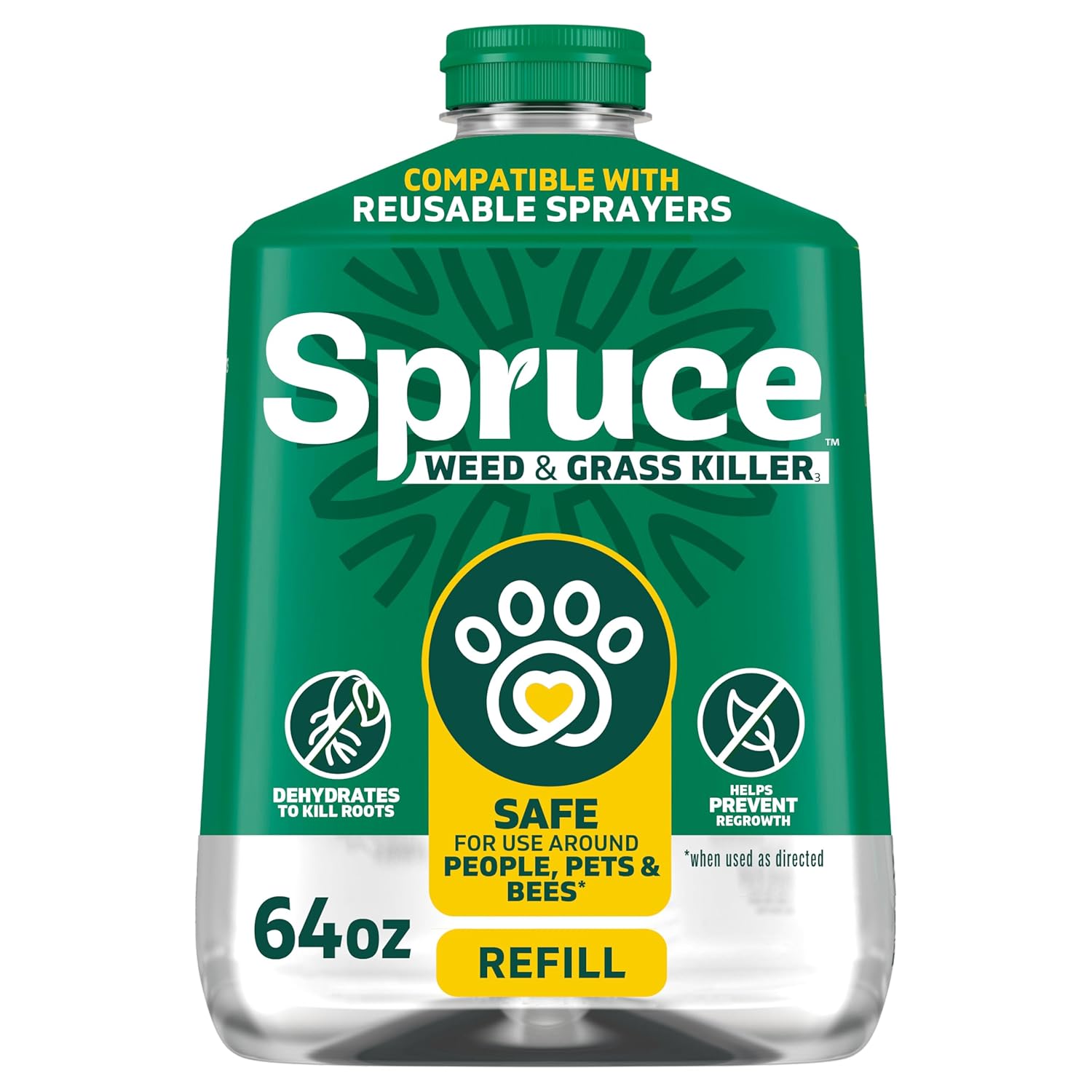
Spruce Weed & Grass Killer Refill, Ready-to-Use 64 fl oz
| Unit Count | 64 Fluid Ounces |
|---|---|
| Item Form | Spray |
| Coverage | 1 bottle treats up to 400 weeds |
| Active Ingredients | Sodium Lauryl Sulfate, Geraniol, Cornmint Oil |
This 64 fl oz Spruce refill is a no-mix replacement for the brand's Snap & Spray system that provides a convenient, ready-to-use weed and grass killer for spot treatments. It works on contact, dehydrating foliage with visible leaf darkening or wilting within an hour and complete plant death often by 24 hours. The formula relies on water, essential oils and sodium lauryl sulfate rather than synthetic herbicides, which makes it suitable for use around people and pets when directions are followed. One bottle is rated to treat up to about 400 weeds and is designed for hard surfaces, mulch beds, driveways and pavers rather than broadcast lawn application. Practical features include a snap-on refill top for the existing spray handle and a fast rainproof window of roughly 10 minutes. Be aware it is non-selective and must be applied carefully to avoid desirable plants, and it is most effective on young or small weeds rather than deep perennial roots where reapplication may be needed.
Best for: Buyers who want a low-fuss, pet-conscious spot weed killer for driveways, pavers and mulch beds and who prioritize convenience and visible speed of action.
Less Ideal for: Homeowners seeking a selective lawn treatment or long-term control of deeply rooted perennials should consider different systemic or professional options.
- Ready-to-use refill eliminates mixing and pouring
- Visible results in about one hour with full effect by 24 hours
- Formulated with water and essential oils for pet- and people-friendly use when directed
- Covers a high estimated count — one bottle treats up to 400 weeds
- Snap-on refill design fits the Spruce Snap & Spray handle for quick replacement
- Non-selective formula will damage desirable plants if oversprayed
- Less effective on large established perennial roots compared with systemic herbicides
Verdict: Choose this refill if you want a fast, ready-to-use, pet-conscious spot treatment that snaps into the Spruce spray handle for effortless weed control on hardscapes and beds.
Spruce EZ-AIM Weed & Grass Killer₃, Precision Spray 3-pack (10 oz each)

| Unit Count | 30 Fluid Ounces |
|---|---|
| Number of Packs | 3 |
| Item Form | Spray |
| Coverage | 1 bottle treats up to 60 weeds |
| Active Ingredients | Sodium Lauryl Sulfate, Geraniol, Cornmint Oil |
The Spruce EZ-AIM 3-pack is a spot-treatment weed and grass spray designed for cracks, edges, mulch beds, driveways and pavers. Each lightweight can is nitrogen-pressurized and dispenses a precision stream intended to wet leaves and stems until they wilt; visible leaf darkening or wilting can appear within an hour and complete death often follows by 24 hours. The formula relies on water, essential oils (geraniol and cornmint) and a surfactant (sodium lauryl sulfate), so it kills on contact without synthetic glyphosate. It is easy to use: unlock the nozzle, hold 12 to 24 inches from the target, spray until wet and relock when finished. Practical benefits include fast visible results, a precision applicator for small spaces, and a formula marketed as safe around people, pets and bees when directions are followed. Important limitations are that it is nonselective so avoid spraying desirable plants or lawns, effectiveness requires direct leaf contact and warm dry conditions above 60°F, and one can treats roughly 60 weeds so larger areas will need multiple cans or a refillable system.
Best for: Buyers who want a fast, easy, lower-toxicity option to spot-treat weeds around walkways, patios and beds without mixing concentrates and who prioritize straightforward, grab-and-spray convenience on a budget.
Less Ideal for: Homeowners needing to clear large lawns or heavy infestations should consider concentrated or larger-capacity solutions rather than single-use aerosol cans.
- Visible results often within one hour and full kill by 24 hours when used as directed
- Precision EZ-AIM nozzle for spot treating cracks, edges and small spaces
- Formulated with essential oils and surfactant as a non-glyphosate, ready-to-use spray
- Pack of three cans increases coverage without needing dilution or mixing
- Nonselective contact formula requires careful aim to avoid desirable plants
- Limited coverage per can—about 60 weeds—so not suited for large infestations
Verdict: A convenient, lower-toxicity ready-to-use spray that quickly kills individual weeds and is budget-friendly for spot treatments.
Calyptus 50% Concentrated Vinegar Cleaner, 2 Gallon (Two 1‑Gallon Jugs)

| Ingredients | 50% Vinegar |
|---|---|
| Units | 256 Fluid Ounces |
| Manufacturer | Calyptus |
| Product Type | Technical‑grade vinegar concentrate |
Calyptus 50% concentrated vinegar is a technical‑grade acetic acid concentrate intended for heavy cleaning tasks that you dilute to typical household strength. The twin one‑gallon pack is designed to make dozens of gallons of cleaning solution for tackling limescale, mineral deposits, soap scum, grease and general grime both indoors and outdoors. It is marketed as septic safe and suitable for use around the home when diluted to the recommended acidity. Because it is a concentrated, nonfood grade product, users mix measured cups into water to reach roughly 5% acidity before applying, which keeps storage and transport efficient compared with buying many premixed bottles. Notable features include domestic manufacture, leak‑resistant jugs, and clear dilution guidance. Important limitations are that this is technical‑grade vinegar not meant for consumption and it requires careful dilution and handling to avoid skin or plant damage if misused as a weed‑killer or cleaner; it is stronger than household vinegar and should be used with gloves and eye protection.
Best for: Buyers who prioritize a reliable, high‑strength cleaning supply for repeated heavy‑duty tasks and who are comfortable measuring and diluting concentrates for home or outdoor use.
Less Ideal for: People seeking an off‑the‑shelf, ready‑to‑use household cleaner or anyone who prefers products safe for food contact without special handling.
- Very high concentration lets you dilute many gallons from each jug, reducing storage and repeated purchases
- Formulated for heavy‑duty descaling and grease removal that household vinegar struggles with
- Sold as technical‑grade with clear dilution instructions for making standard 5% solutions
- Septic safe and labeled for indoor and outdoor cleaning when used diluted
- Technical grade not intended for food use so it must be stored and handled as a chemical
- Requires accurate measuring and personal protective equipment when mixing and applying
Verdict: If you want a dependable, high‑strength concentrate to make many gallons of effective cleaning or nonfood weed‑control solution, this Calyptus 50% vinegar is a practical choice.
Spruce Weed & Grass Killer Power Wand Kit with 64 oz Refill

| Unit Count | 64 Fluid Ounces |
|---|---|
| Coverage | 1 bottle treats up to 400 weeds |
| Item Form | Multiple |
| Liquid Volume | 64 fluid ounces |
This kit combines a 64 oz ready-to-use herbicide with a battery-powered Power Wand for fast, targeted spot treatments. The formula is non-mixing and designed to work on contact, dehydrating leaves so you can see darkening or wilting within an hour and complete die-off by about 24 hours when used as directed. The wand is reusable and comes with two AA batteries so you can spray cracks, edges, mulch beds, driveways, and walkways without pouring or measuring. Practical benefits include ease of use, rainproofing within 10 minutes, and a formula advertised as safe around people, pets, and bees when directions are followed. Limitations are that it is non-selective so it must be applied carefully to avoid desirable plants and grass, it is intended for spot treatment rather than broadcast lawn application, and best results require spraying in dry, warm conditions above 60°F with no immediate rain forecast.
Best for: Buyers who want a fast, easy-to-use spot weed killer for driveways, cracks, mulch beds, and edges and who prioritize quick visible results and minimal setup.
Less Ideal for: Those needing large-area lawn herbicide or selective weed control within turf should look for products made for broadcast lawn treatments or selective formulas.
- Ready-to-use 64 oz refill eliminates measuring or mixing
- Visible results in about one hour and full effect around 24 hours
- Includes battery-powered reusable wand for precision spot treatments
- Rainproof within 10 minutes so light showers are less likely to wash it off
- Formulated for use around people, pets, and bees when directions are followed
- Non-selective formula can damage desirable plants if oversprayed
- Designed for spot treatments not for broadcasting over large lawns
- Performance depends on spraying in recommended weather conditions
Verdict: A convenient, no-mix spot-treatment kit that delivers fast visible weed kill with a reusable powered wand for precise, low-fuss applications.
Choosing the Right Safe Weed Killer: Key Factors to Consider
Plant Selectivity
Knowing whether a weed killer is selective or nonselective determines where you can use it. Selective products target specific plant groups such as broadleaf weeds or grassy species and let desirable turf or ornamentals survive when used correctly. Nonselective options kill or damage most green plants on contact and are best reserved for paved areas, gravel beds, or carefully protected garden patches.
Selectivity affects application technique too. When working near mixed plantings or vegetable rows, choose a selective formula or use shielded spot treatments to avoid accidental injury to crops and companion plants.
Environmental Persistence
Persistence describes how long an active ingredient and its breakdown products remain active in soil or water. Low-persistence products break down quickly, reducing the window when new seedlings or nearby plants are at risk. Longer persistence can provide extended control but increases the chance of harming non-target plants and beneficial soil organisms.
Consider persistence relative to your planting plans. If you rotate beds frequently or plan to transplant seedlings soon, favor options with short soil residency to avoid stunting young plants or contaminating raised-bed soils.
Application Safety And Drift
Application safety covers both user exposure and the risk of product moving off-target. Formulation type, spray droplet size, and recommended weather conditions change how likely a product is to drift onto adjacent plants. Low-odor and low-volatile formulas are easier to use in close quarters and around children or pets.
Read and follow label precautions for personal protective equipment and mixing instructions. Using a shielded sprayer, wick applicator, or targeted brush can greatly reduce off-target damage when treating weeds near sensitive plantings.
Compatibility With Edible Gardens
If you grow vegetables or herbs, compatibility with edible crops is crucial. Some safe weed killers are labeled for use directly in and around food-bearing plants when applied as directed, while others should never contact edible foliage or soil destined for transplants. Residue intervals and harvest restrictions determine how soon you can safely eat produce after treatment.
Also consider container and raised-bed use. Small soil volumes retain residues differently than open ground, so choose low-persistence formulas or spot-treat weeds manually in container plantings to avoid contaminating edible soils.
Speed Of Control And Visible Results
Gardeners often want to see weeds wilt or brown quickly, but rapid visible control does not always equal thorough or lasting suppression. Fast-acting contact agents can provide immediate cosmetic improvement but may require more frequent reapplications for deep-rooted perennials. Systemic, slower-acting products translocate to roots and can give better long-term control of certain species.
Match the expected speed to your goals. For quick cleanups before an event, a contact product may be fine. For long-term bed maintenance, favor products with systemic action and a suitable persistence profile.
Application Practicalities And Handling
Consider how the product is mixed, applied, and stored in typical backyard settings. Ready-to-use sprays are convenient for small infestations and spot treatments, while concentrates are economical for larger areas but require careful measuring and mixing. Packaging that incorporates childproof caps, clear measuring marks, and dilution guidance reduces handling errors.
Also account for reapplication schedules, storage stability, and whether the label requires irrigation delays or rainfast periods. These factors affect how often you need to re-treat and how the product fits into routine garden maintenance.
When To Use Spot Treatment Versus Broadcast Application
Spot treatment is the safest way to control isolated weeds in mixed plantings. It limits exposure of surrounding desirable plants and reduces overall herbicide use. Use a wand with a narrow spray tip, a shielded sprayer, or a wick applicator to confine contact to the weed foliage.
Broadcast application is appropriate for dense weed infestations in lawns, driveways, or large beds with uniform planting. Before broadcasting, identify the dominant weed types and confirm the product label allows the treatment where you plan to apply it.
- Spot treatment: target individual plants, lower chemical use.
- Broadcast: efficient for widespread problems but higher risk to nearby plants.
- Use weather windows with low wind and no rain forecast for 24 hours.
Using Safe Weed Killers Near Water And Pollinator Areas
Products vary in aquatic toxicity and pollinator risk. When treating areas near ponds, streams, or storm drains, choose formulations labeled as low-risk to aquatic life and follow buffer zone instructions closely. Avoid spraying during bloom periods when pollinators are active.
Consider physical controls like mulching or hand-weeding for sensitive shoreline plantings and pollinator gardens. These methods require more labor but eliminate runoff and drift concerns entirely.
- Keep sprays at least the label-recommended distance from water.
- Do not apply to flowering plants visited by pollinators.
- Rinse and dispose of application equipment per label directions.
Integrating Safe Weed Killers With Cultural Control
Herbicides are most effective when combined with good cultural practices. Dense planting, regular mulching, and timely mowing or hand-pulling reduce weed seed germination and the need for repeated chemical control. Improving soil health and fertility helps desirable plants outcompete weeds.
Use weed killers as a spot tool to remove persistent patches while maintaining cultural defenses that prevent reestablishment. Rotating control methods lowers the chance of relying on chemicals as the sole strategy.
- Mulch annual beds to block light and reduce weed emergence.
- Improve drainage and soil structure to favor garden plants over weeds.
- Follow-up with mechanical removal of dead roots for perennial weeds.
Safe Application Timing And Weather Considerations
Temperature, humidity, and recent rainfall affect both efficacy and safety. Many products work best when weeds are actively growing and temperatures are moderate. Avoid applications during heat extremes or drought stress, which can reduce uptake and increase risk to desirable plants.
Wind increases drift risk, so apply on calm days. Also observe rain forecasts because heavy rain shortly after spraying can wash products into non-target areas or reduce contact time on foliage.
- Apply on calm, dry days when weeds are actively growing.
- Allow recommended rain-free period after application.
- Avoid treating stressed or newly planted ornamentals.
Safe Disposal And Storage For Gardeners
Store products in their original containers, tightly closed and out of reach of children and pets. Keep them in a cool, dry place away from food and seed. Do not transfer concentrates into unmarked or food-related containers.
Dispose of leftover product and rinse water according to local regulations and the label. Improper disposal can contaminate soil and waterways, negating the safety benefits of choosing a low-toxicity option.
- Keep spills minimal and clean up immediately with absorbent material.
- Triple-rinse empty containers if label directs, then recycle where accepted.
- Record purchase and application dates to track reapplication schedules.
How We Chose the Best Safe Weed Killer
We focused on products that offer effective weed control with lower toxicity profiles and documented modes of action that limit collateral damage. Our selection criteria prioritized plant selectivity so gardeners can treat weeds near ornamentals or edible crops, and environmental persistence to avoid long-term soil residues that interfere with successive plantings. We also valued formulations and application methods that reduce drift and accidental exposure, plus ease of use for typical home gardeners. Practical handling factors such as required reapplication intervals and safety directions were included because they affect real-world outcomes. Excluded items include general-purpose herbicides with high aquatic toxicity or persistent soil activity that make them unsuitable for small-scale garden settings, and products lacking clear safety instructions. The short list reflects a balance between efficacy and lower environmental impact, with attention to how each option performs in lawns, beds, containers, and near water features.
FAQ
Are safe weed killers effective on perennial weeds?
Often they can be, but it depends on the active ingredient and how it is applied. Systemic low-toxicity options that translocate to roots have a better chance at perennial control, though repeated treatments or mechanical removal may still be needed.
Can I use safe weed killers in vegetable beds?
It depends on the product label and persistence. Some low-toxicity formulations are labeled for use in vegetable gardens when applied carefully, while others should not contact edible soil or foliage. Always follow label directions and observe any pre-harvest intervals.
How soon can I plant after using a safe weed killer?
That usually depends on environmental persistence and the product label. Many low-persistence options allow replanting within days to weeks, while other formulations require longer waiting periods. Check the label for specific planting intervals.
Will safe weed killers harm soil microorganisms?
Some low-toxicity options have minimal impact, but effects vary by active ingredient and concentration. Choosing products with short persistence and using spot treatments lowers the likelihood of long-term harm to beneficial soil organisms.
What steps reduce the risk of drift when spraying?
Use low-drift nozzles, spray during calm conditions, apply larger droplet sizes, and employ shields or wick applicators. Avoid spraying near blooming plants or in windy conditions to protect non-target species.
Is organic always safer than synthetic for weed control?
Not necessarily. Organic active ingredients can still cause plant damage or have environmental impacts if misused. Evaluate products by toxicity, persistence, and appropriate use rather than assuming organic equals safe in every situation.
Final Verdict
Prioritize where and how you need control when choosing a safe weed killer. Match selectivity to the planting context, favor low-persistence formulas where you plan future plantings, and use application methods that limit drift and exposure. Combining targeted herbicide use with cultural and mechanical controls reduces chemical dependence and delivers more reliable long-term results. Decide based on the tradeoffs between speed and persistence, and pick the product whose safety profile aligns with nearby plants, pets, and water features. That approach helps you remove weeds effectively while keeping the rest of your garden healthy.
