

Note: This article contains affiliate links. If you click on these links and make a purchase, I may earn a small commission at no extra cost to you. This helps support my research and content. Read my full affiliate disclosure here.
When ants establish trails inside the house you need a solution that removes the colony while keeping people and pets safe. Natural ant control options use ingredients and delivery methods that reduce toxic exposure but still rely on baiting, barriers, or contact action to break infestations. This guide covers six shortlisted natural ant killers for indoors and explains how each was evaluated for safety, effectiveness, and ease of use. Read on to understand the tradeoffs between quick control, household safety, and practical application in kitchens, living rooms, and other indoor spaces.
Top Picks at a Glance
| Best Overall The best all-around choice for most situations | Wondercide Indoor Pest Control Spray, Lemongrass, 16 oz |  |
| Best Quality Built to a higher standard if you want something more solid | EcoVenger Ant & Crawling Insect Killer Spray, 16 oz (Plant-Based) |  |
| Best Value The sweet spot between price and what you get | Harris Diatomaceous Earth Crawling Insect Killer, 8 oz |  |
| Best Budget The cheapest option that still gets the job done reliably | STEM Plant-Based Bug Spray for Ants, Roaches and Flies, 12 fl oz |  |
| Highest Rated A top-rated pick with lots of positive feedback | NCSIFDD Ant Away Ant Repellent Gel, 6-Pack |  |
| Most Popular A crowd favorite that many people choose with confidence | Mighty Mint Peppermint Oil Insect Repellent Spray, 16 oz |  |
Wondercide Indoor Pest Control Spray, Lemongrass, 16 oz

| Item Form | Spray |
|---|---|
| Target Species | Ants, Roaches, Spiders, Flies, Fleas, Ticks, Mosquitoes, Silverfish, Moths, Gnats |
| Liquid Volume | 16 fluid ounces |
| Active Ingredients | 4.2% Cedar Oil; 2.2% Sodium Lauryl Sulfate; 1.5% Lemongrass Oil; 0.1% Sesame Oil |
Wondercide Indoor Pest Control is a ready‑to‑use lemongrass‑scented spray that targets flying and crawling insects around the home. You spray it on baseboards, entry points, under sinks, in cabinets and directly on visible pests to kill or repel ants, roaches, flies, fleas, mosquitoes and other common household bugs. The formula relies on essential oils (cedarwood and lemongrass) plus mild surfactants, so it can be used multiple times per week and is labeled safe around dogs and cats when directions are followed. Practical features include a trigger sprayer with adjustable mist or targeted stream and multi‑surface use in kitchens, bathrooms and living areas. Expect quick knockdown of insects you hit directly and ongoing repellent effect when applied to perimeter areas, but it is not a long‑term structural treatment for heavy infestations and it can irritate eyes or sensitive skin if mishandled. The natural scent may slightly tint very light fabrics, so spot testing is recommended. For everyday, preventive pest control in pet households this product is a convenient, lower‑toxicity option.
Best for: Buyers who want a practical, lower‑toxicity spray to reduce and repel common indoor insects around a home with pets and who prioritize easy, repeatable treatments over professional pest control.
Less Ideal for: People dealing with severe, long‑standing infestations or who need a residual, long‑term structural solution should consider professional pest control or stronger targeted products.
- Plant‑based active ingredients (cedarwood and lemongrass oils) that provide knockdown and repellent action
- Labeled safe for use around people and pets when directions are followed, suitable for frequent applications
- Adjustable trigger sprayer for full mist or targeted spray and multi‑surface use
- Kills and repels a wide range of indoor pests including flies, ants, roaches, fleas and mosquitoes
- Not intended as a professional structural treatment for heavy infestations
- Can cause eye or skin irritation if contact occurs and may slightly discolor very light fabrics
Verdict: A convenient plant‑powered indoor spray that practical buyers can use frequently around pets and living spaces to quickly kill and repel common flies and household pests.
EcoVenger Ant & Crawling Insect Killer Spray, 16 oz (Plant-Based)

| Unit Count | 16 Fluid Ounces |
|---|---|
| Item Form | Spray |
| Target Species | Odorous House Ants, Fire Ants, Roaches, Fleas, Spiders |
| Active Ingredients | Citronella Oil, Geraniol, Cedarwood Oil, Sodium Lauryl Sulfate |
| Liquid Volume | 480 ml |
EcoVenger Ant & Crawling Insect Killer is a ready-to-use, botanical spray designed to eliminate ants and other crawling pests quickly while leaving a light citrus/woody scent. In practice you spray active ants and their trails for immediate knockdown and treat entry points, baseboards, and mounds to create a residual barrier that the manufacturer says lasts up to four weeks. The formula lists plant-derived actives such as geraniol, citronella and cedarwood oils rather than traditional neurotoxic insecticides, which makes it suitable for use around homes with pets when directions are followed. Notable features include fast kill times (claims of house ants in about a minute and fire ants in minutes), a non-staining finish safe for carpets and fabrics, and a fine spray nozzle for targeted treatment. Limitations: botanical products can require thorough application to reach nests and deep queen chambers, so severe infestations may need repeat or professional intervention; effectiveness versus every species and in every environment will vary compared with conventional synthetics. For pet-safe indoor control and perimeter work this provides a practical, lower-toxicity option with measurable residual effects.
Best for: Buyers who prioritize effective, lower-toxicity pest control for indoor use around pets and family and want a product that acts fast and leaves a short-lived pleasant scent.
Less Ideal for: People facing very large or established colonies who need a single heavy-duty chemical solution or those who prefer synthetic pesticides for guaranteed uniform efficacy across all pest species.
- Plant-based active ingredients suitable for homes with children and pets when used as directed
- Fast on-contact knockdown of ants and other crawling pests according to product claims
- Leaves no oily residue and is labelled non-staining for use on carpets and fabrics
- Provides residual repellency for up to four weeks when applied to trails and entry points
- May require thorough application into nest chambers for complete colony elimination, which can be labor-intensive
- Performance can vary by species and infestation severity compared with conventional chemical pesticides
Verdict: A fast-acting, plant-based spray that delivers pet-friendly indoor ant control with several weeks of residual protection.
Harris Diatomaceous Earth Crawling Insect Killer, 8 oz

| EPA registration | No. 3-18 |
|---|---|
| Active ingredient | 100% freshwater diatomaceous earth |
| Intended use | Indoor & outdoor |
This ready-to-use diatomaceous earth product provides a non-chemical way to control ants and other crawling pests around the home. You apply the fine powder in cracks, along baseboards, near entry points, or in crawlspaces using the included puffer tip for targeted placement. The diatomaceous earth works mechanically by abrading insect exoskeletons and causing dehydration, so insects that contact the dust typically die within 48 hours. Because the material is 100% freshwater diatomaceous earth with no additives and is EPA registered, it is a good fit when you want a low-toxicity option usable near people and pets when directions are followed. It stays effective indefinitely as long as it stays dry, making it a convenient barrier treatment in attics, basements, garages, and around foundations. Limitations are that it must remain dry to work and it is a contact-only control method, so heavy infestations or nesting insects may require repeated application or combined methods for faster results.
Best for: Practical households that prioritize low-toxicity, long-lasting ant control and want a simple, targeted treatment they can apply themselves around entry points and inside cracks.
Less Ideal for: People facing severe or widespread infestations who need rapid knockdown or prefer liquid chemical treatments should consider professional services or a different product.
- 100% freshwater diatomaceous earth with no additives for a non-chemical control option
- Built-in puffer tip allows precise application into cracks and crevices
- Remains effective indefinitely when kept dry, providing long-lasting barrier protection
- Mechanically kills a wide range of crawling insects including ants, roaches, fleas, and bed bugs
- Only effective on insects that contact the powder and must stay dry to work
- Not a fast-acting spray alternative for large, established infestations
Verdict: Choose this product if you want a low-toxicity, long-lasting mechanical barrier to control ants and other crawling insects around the home.
STEM Plant-Based Bug Spray for Ants, Roaches and Flies, 12 fl oz

| Active ingredients | Geraniol 6.2%, Lemongrass Oil 0.5% |
|---|---|
| Other ingredients | White Mineral Oil, Isopropyl Myristate, (+)-Ethyl Lactate 93.9% |
| Form | Trigger spray |
| Use | Indoor and outdoor spot treatments |
This STEM bug spray is a trigger-spray insecticide formulated with plant-derived actives such as geraniol and lemongrass oil to kill ants, roaches and flies on contact. It is intended for targeted indoor and outdoor spot treatments: shake, hold about a foot from the insect and spray directly on or where insects congregate. The product’s botanical formula and absence of added dyes or strong chemical fragrances make it a reasonable choice for homes where users prefer less synthetic-smelling options. The trigger bottle gives control for spot application and repeated short bursts, and the directions note it is oil-based so spills should be cleaned promptly. Important limitations are that it is not for spraying on people, pets or plants and requires direct hits for best effect rather than long-range fogging. For persistent infestations you may need supplemental measures because this is designed for surface and contact kills rather than residual baiting or area-wide control.
Best for: Buyers who want an affordable, low-odor botanical spray for quick spot control of common household pests and who prioritize a simple, easy-to-use trigger bottle for targeted treatments.
Less Ideal for: People facing large or hidden infestations who need long-lasting residual control or bait-style solutions should consider professional products or integrated pest control approaches.
- Plant-based active ingredients (geraniol and lemongrass oil) that reduce strong chemical odor
- Trigger-spray bottle for controlled, targeted application
- Labeled for both indoor and outdoor spot treatments when used as directed
- No added dye or fragrance listed, which minimizes residue and scent
- Oil-based formula can leave slippery residue if spilled
- Requires direct spraying of insects for effectiveness and offers limited residual control
- Not safe to spray on people, pets or plants
Verdict: A budget-friendly, low-odor plant-based trigger spray that provides quick, targeted kills of ants, roaches and flies for everyday spot treatments.
NCSIFDD Ant Away Ant Repellent Gel, 6-Pack

| Unit Count | 12 Count |
|---|---|
| Number of Pieces | 1 |
This ant repellent gel is a concentrated applicator product intended for targeted spot treatments around entry points, baseboards, window frames, and known ant trails. You remove the cap, attach the precision tip, and apply pea‑sized drops into crevices or along trails; the manufacturer notes it can take 3–5 days to work through a colony and helps keep ants away for up to 60 days in treated areas. Practical benefits include the narrow applicator for neat placement in tight gaps, suitability for both indoor and outdoor problem spots, and a formulation presented as family and pet safe when used as directed. Important limitations are that results are not instantaneous and multiple applications or placements may be needed to control larger or multiple colonies, and effectiveness depends on correctly locating trails and nest access points. For someone who wants a low‑mess, targeted solution rather than broad broadcast treatments, this gel is a convenient option.
Best for: Buyers who prioritize dependable, low‑mess spot treatment for recurring ant sightings and prefer a product they can place precisely where ants travel.
Less Ideal for: People needing rapid elimination of very large or widespread infestations or those who prefer broadcast sprays or professional colony eradication services.
- Precision applicator allows neat, pea‑sized placements in tight crevices and along ant trails
- Labeled for both indoor and outdoor use so the same product can treat kitchens, baseboards, and patios
- Formulation described as family and pet safe when used according to directions
- Single placements can provide protection in treated areas for up to 60 days
- Not an immediate knockdown—can take 3–5 days to affect a colony
- May require several placements and correct trail identification to fully control larger infestations
Verdict: Use this precision gel when you want a neat, family‑safe spot treatment that targets ant trails and entry points rather than a broad spray solution.
Mighty Mint Peppermint Oil Insect Repellent Spray, 16 oz
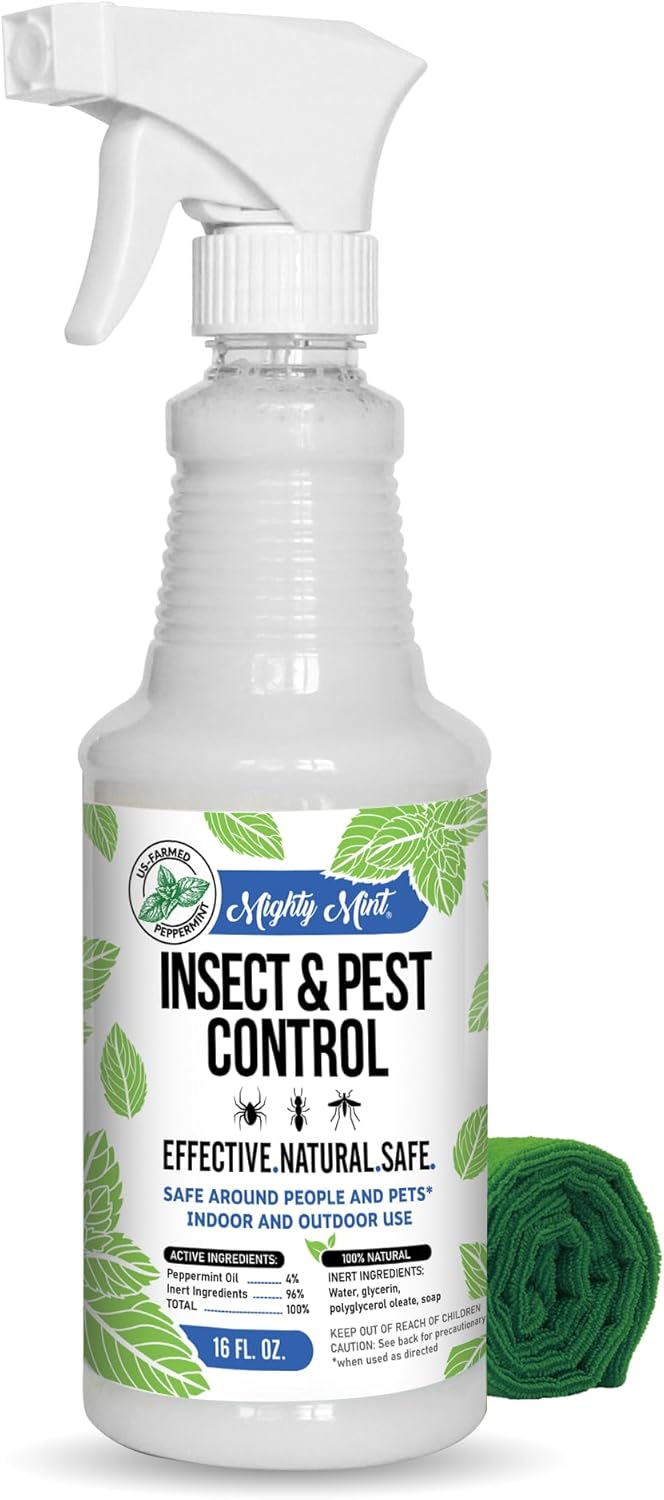
| Ingredients | Water, Glycerine, Polyglycerol oleate, Soap, Peppermint oil |
|---|---|
| Use Areas | Indoor / Outdoor |
| Size | 16 oz |
Mighty Mint is a plant-based, ready-to-use spray that uses concentrated peppermint oil to repel a broad range of household and patio pests. You apply it directly to problem areas such as baseboards, entryways, patios and around outdoor seating; the manufacturer recommends shaking and spraying until surfaces are covered and repeating applications two or more times per week for best results. Notable features include a peppermint-only scent profile, a formulation that avoids synthetic fragrances and the convenience of a 16 oz spray bottle for targeted spot treatments. Practical benefits are that it is safe to use around people and pets when dry and does not leave obvious stains on most surfaces, and the scent can make treated areas smell fresher than chemical alternatives. Important limitations are that it is a repellent rather than a pesticide so it works by discouraging pests rather than killing them, effectiveness depends on regular reapplication and it should not be applied when pollinators are present or to skin or food-contact surfaces.
Best for: Buyers who prioritize natural, low-toxicity solutions and want a targeted spray to reduce insects around patios and entryways while keeping family and pets in mind.
Less Ideal for: Anyone needing a one-time extermination or long-term residual pesticide for severe infestations should consider professional treatments or products formulated to kill pests rather than repel them.
- Plant-based peppermint formula that avoids synthetic fragrances
- Ready-to-use spray for quick, targeted indoor and outdoor applications
- Safe for people and pets when used as directed and allowed to dry
- Nonstaining on most surfaces and leaves a fresh mint scent
- Repels rather than kills insects so regular reapplication is needed to maintain protection
- Strong peppermint concentration may bother scent-sensitive individuals and requires keeping children and pets away until dry
Verdict: Choose Mighty Mint when you want a pet-friendly, plant-based spray to reduce patio and entryway insects with a fresh peppermint scent.
Choosing the Right Natural Ant Killer for Indoors: Key Factors to Consider
Human and Pet Safety
Indoor use raises exposure concerns, especially in homes with children, pets, or people with sensitivities. Prioritize products with low-toxicity active ingredients, clear labeling on indoor exposure limits, and packaging designed to keep baits inaccessible to non-targets. Consider whether the product leaves residues on countertops or floors and whether it emits strong odors that could irritate household members.
Also think about placement options. Tamper-resistant bait stations or enclosed packs reduce accidental contact. Weight the tradeoff between higher immediate knockdown chemistry and a slower-acting bait that is safer for household members.
Bait Attractiveness and Target Species
Different indoor ant species prefer sugars, proteins, or greasy foods. A bait that attracts the specific ants in your home is much more likely to reach the colony and work as intended. Look for products that specify the types of food the bait mimics or that list efficacy against common indoor species.
If you are unsure which ants are present, choose a bait that balances sugar and protein attractiveness or combine placement of complementary baits. Bait persistence matters too: baits that dry out or spoil quickly lose effectiveness before worker ants carry them back to the nest.
Mode of Action and Kill Timing
Natural or low-toxicity products often rely on slower-acting toxicants, desiccants, or biological agents. Slower kill times can be an advantage because workers carry bait back to the colony, but they also mean you may not see immediate trail disruption. Fast-contact remedies can reduce visible ants quickly but may prevent bait transfer to the nest.
Know whether you need rapid knockdown for visible infestations or colony elimination over time. Match expectations to the product's described mode of action and follow instructions carefully to allow bait uptake and transfer when required.
Residue, Odor, and Cleanup
Indoors, any product that leaves a sticky trail, residue, or strong smell becomes a household nuisance. Natural options vary: some are dry baits that leave minimal residue, others are gels or liquids that can mark surfaces. Consider where you will place treatments and whether you can protect food preparation areas.
Also consider ease of cleaning if spill or accidental contact occurs. Products that clean up with soap and water and that do not stain surfaces are preferable for kitchens and dining rooms.
Application Method and Accessibility
How a product is applied affects safety and convenience. Tamper-resistant stations, pre-filled bait tubes, or self-contained traps are safer in homes with kids and pets. Powder or dust applications require care to avoid inhalation, and sprays can create airborne particles.
Think about how often you must reapply or replace bait. Options that provide multi-week activity reduce maintenance. Also consider whether the product fits along baseboards, inside cabinets, or behind appliances where ants travel.
Durability and Storage
Indoor baits should remain effective when stored between uses and should resist drying out or microbial spoilage. Check how products must be stored and whether they have limited shelf life once opened. Durable packaging and resealable containers help maintain attractiveness and reduce waste.
Also plan for seasonal patterns. Some treatments may perform differently with humidity or temperature changes common in indoor environments, so durability under household conditions matters for long-term control.
Identifying Indoor Ant Behavior
Ants inside the house usually form trails between a food source and their nest. Observing when and what they are attracted to helps you choose the right bait type. Worker ants that prefer sweets will ignore protein baits and vice versa, so a quick visual check of what they visit can save time.
Trails often originate from wall voids, baseboards, or appliance gaps. Follow the trail to find likely placement points for bait stations rather than spraying visible workers. Placing bait along established trails increases the odds that workers will carry it back to the colony.
- Watch what ants feed on for a few minutes to determine bait type
- Place baits near trails, not directly where people touch
- Protect bait stations from pets and children
Placement Strategies for Kitchens and Food Areas
In kitchens, place bait stations along baseboards, behind appliances, or under sinks where ants travel but out of reach of food preparation surfaces. Avoid placing baits directly on counters where food is handled. Use enclosed bait stations to prevent accidental contact and to keep the bait dry.
Rotate placement if you see no uptake after a few days. Ant foraging routes can shift, so a bait that is ignored in one spot may be collected in another. Keep surfaces clean and remove other food sources to improve bait attractiveness.
- Use enclosed stations near entry points or along baseboards
- Keep counters and floors free of crumbs to encourage bait uptake
- Monitor and move bait stations if no activity is visible within 3 days
Non-Bait Indoor Control Tactics
Natural indoor ant control is not limited to baits. Physical exclusion and sanitation reduce future problems. Seal cracks, repair screen gaps, and use weatherstripping to limit entry points. Reducing moisture and storing food in sealed containers removes attractants.
For visible ant lines, cleaning trails with a mild detergent can remove pheromone cues and reduce recruitment. Sticky or sugary residues should be cleaned promptly to discourage sustained foraging along the same paths.
- Seal entry points and gaps where ants enter
- Store pantry items in airtight containers
- Clean ant trails to disrupt pheromone signals
When to Use Rapid-Acting Versus Slow-Acting Options
Rapid-acting contact treatments reduce visible ant numbers quickly but can prevent workers from taking bait back to the nest. Use them if you need immediate removal of nuisance ants in living spaces, understanding that recurrence is possible if the colony remains intact.
Slow-acting baits allow transfer to the nest and are generally better for long-term colony control. If safety and household exposure are priorities, slow-acting, low-toxicity baits placed in tamper-resistant stations are often the preferred strategy for indoor infestations.
- Choose fast contact control for immediate visible reduction
- Choose slow-acting baits for colony elimination
- Combine tactics carefully to avoid interfering with bait uptake
Monitoring and Follow-Up
Check bait stations every few days for uptake and for signs of reduction in foraging. Continue monitoring for at least two weeks because colony-level effects can take time to appear. Replace or refresh baits when they dry out or are exhausted.
If activity persists after a full bait cycle, revisit sanitation and placement, and consider alternate bait types that target different food preferences. Persistent infestations may indicate a large colony or satellite nests requiring broader measures.
- Inspect baits every 3 to 5 days
- Refresh or move baits when uptake declines
- Re-evaluate sanitation and exclusion if ants persist
How We Chose the Best Natural Ant Killer for Indoors
We shortlisted products that are specifically formulated or intended for indoor use and that emphasize reduced chemical toxicity, predictable bait behavior, and practical application in occupied living spaces. Evaluation focused on concrete, gardener- and homeowner-relevant dimensions: human and pet safety profile, bait attractiveness and persistence, residual indoor odor or residue, ease of placement and cleanup, and documented modes of action against common indoor ant species. We excluded outdoor-only formulations, general-purpose garden insecticides that list outdoor use only, and products lacking clear ingredient or safety labeling. We favored products with clear instructions for indoor use, stable bait matrices that do not spoil quickly, and modes of action effective against both sugar- and protein-seeking ants. Results were also filtered for ease of use in kitchens and food-prep areas and for options that minimize airborne sprays or dust indoors.
FAQ
Are natural ant baits safe around kids and pets?
Many natural baits use low-toxicity ingredients and come in enclosed stations that reduce risk. However, some active ingredients can still be harmful if ingested in quantity. Choose tamper-resistant placements and follow label precautions for households with small children or curious pets.
How long does a natural bait take to eliminate an indoor colony?
Timing depends on the bait type, colony size, and how quickly workers locate and carry bait back to the nest. Expect several days to a few weeks for colony-level control. Faster visible reduction may occur with contact treatments, but colony elimination usually requires slower bait transfer.
Can I use outdoor ant treatments inside the house?
Outdoor-only formulations are not intended for indoor exposure and can present greater risks to occupants. Use products labeled for indoor use and follow instructions to avoid residues on food-preparation surfaces.
Should I clean ant trails before deploying baits?
Cleaning trails can reduce recruitment to a food source but may also cause workers to search new routes and find bait. If you already placed bait along a trail, avoid cleaning that immediate path until you see uptake. Otherwise, cleaning is a good sanitation step.
What if ants ignore the bait?
Ants may ignore a bait if it does not match their food preference or if competing food is available. Remove alternative food sources, try a bait with a different attractant profile, and reposition stations along active trails to improve uptake.
Final Verdict
Indoor ant control with natural products requires balancing safety, bait attractiveness, and application practicality. Prioritize low-toxicity, tamper-resistant options when people or pets share the space, and match bait type to the ants' food preference for the best chance of colony control. Expect slower but safer results from transfer-based baits and use exclusion and sanitation to reduce reinfestation risk. With careful placement and monitoring you can remove indoor ant problems while keeping household exposure low.
