

Note: This article contains affiliate links. If you click on these links and make a purchase, I may earn a small commission at no extra cost to you. This helps support my research and content. Read my full affiliate disclosure here.
Mulberry trees respond quickly to the right feeding schedule, but the wrong fertilizer can mean excess leafy growth or poor fruit set. If you grow mulberries in a backyard, small orchard, or patio container, selecting an appropriate fertilizer matters for tree vigor, flowering, and long-term soil health. This guide covers seven shortlisted fertilizers chosen for different mulberry situations, from young transplants to mature fruiting trees. We evaluated options across nutrient balance, ease of application, and how they affect root and canopy development so you can pick the feeding approach that fits your soil, age of tree, and fruiting goals.
Top Picks at a Glance
| Best Overall The best all-around choice for most situations | Espoma Organic Tree-Tone 6-3-2 Granular Tree Fertilizer, 4 lb |  |
| Best Quality Built to a higher standard if you want something more solid | Farmer's Secret Fruit Tree Booster Liquid Fertilizer (8 oz) |  |
| Best Value The sweet spot between price and what you get | Osmocote Smart-Release Plant Food Plus, 2 lb |  |
| Best Budget The cheapest option that still gets the job done reliably | Jobe's Organics Granular Fruit & Nut Fertilizer, 4 lb |  |
| Highest Rated A top-rated pick with lots of positive feedback | Wellspring Gardens Mulberry Fuel Slow-Release Fertilizer (1 lb) |  |
| Most Popular A crowd favorite that many people choose with confidence | Miracle-Gro Water Soluble All Purpose Plant Food, 1.5 lb |  |
| Best Seller A high-volume bestseller chosen again and again | Miracle-Gro Shake 'N Feed Flowering Trees & Shrubs Plant Food, 8 lb |  |
Espoma Organic Tree-Tone 6-3-2 Granular Tree Fertilizer, 4 lb

| Item Form | Granules |
|---|---|
| Specific Uses For Product | Organic Plant Food – fertilizer |
| Application Method | Ready to use |
| Target Species | All shade, fruit and ornamental trees including apple and peach trees |
Espoma Tree-Tone is a ready-to-use granular organic fertilizer designed for established trees. You broadcast the granules around the dripline in spring and fall to supply slow-release nitrogen, moderate phosphorus and low potassium while also adding calcium to support healthy growth and fruit set. Its organic ingredients and Bio-tone formula make it appropriate for organic production and reduce the need for mixing or special application equipment. Practical benefits include gentle feeding that lowers burn risk compared with synthetic high-salt fertilizers, and a formulation meant for shade, fruit and ornamental trees so you can use the same product on multiple tree species. Limitations are its modest N-P-K numbers, which means it is better for maintenance feeding than for aggressively pushing rapid growth, and the 4 lb bag only covers a few small trees so larger specimens or multiple trees will require additional bags.
Best for: Buyers who want a straightforward, organic maintenance fertilizer for shade, fruit and ornamental trees and prefer simple seasonal feeding with minimal fuss.
Less Ideal for: Gardeners seeking high-strength or corrective fertilizer for severely deficient trees or those managing many large trees should consider larger or more concentrated options.
- Ready-to-use granules require no mixing and are simple to apply around the tree dripline
- Organic formula approved for organic gardening and built with natural ingredients
- Includes 5% calcium to help fruit set and overall tree health
- Balanced low-strength N-P-K (6-3-2) suitable for regular maintenance feeding of trees
- Modest nutrient analysis is not ideal for rapid corrective feeding or heavy fruit production
- 4 lb bag provides limited coverage for large trees or multiple specimens
Verdict: A convenient organic maintenance feed for trees that prefers gentle, seasonal feeding over aggressive growth stimulation.
Farmer's Secret Fruit Tree Booster Liquid Fertilizer (8 oz)
| Item Form | Liquid |
|---|---|
| Specific Uses For Product | Plant Growth, Fruit Production |
| Coverage | Full |
| Target Species | Apple, Banana, Peach |
| Mixing Ratio | 1 teaspoon per gallon (directions) |
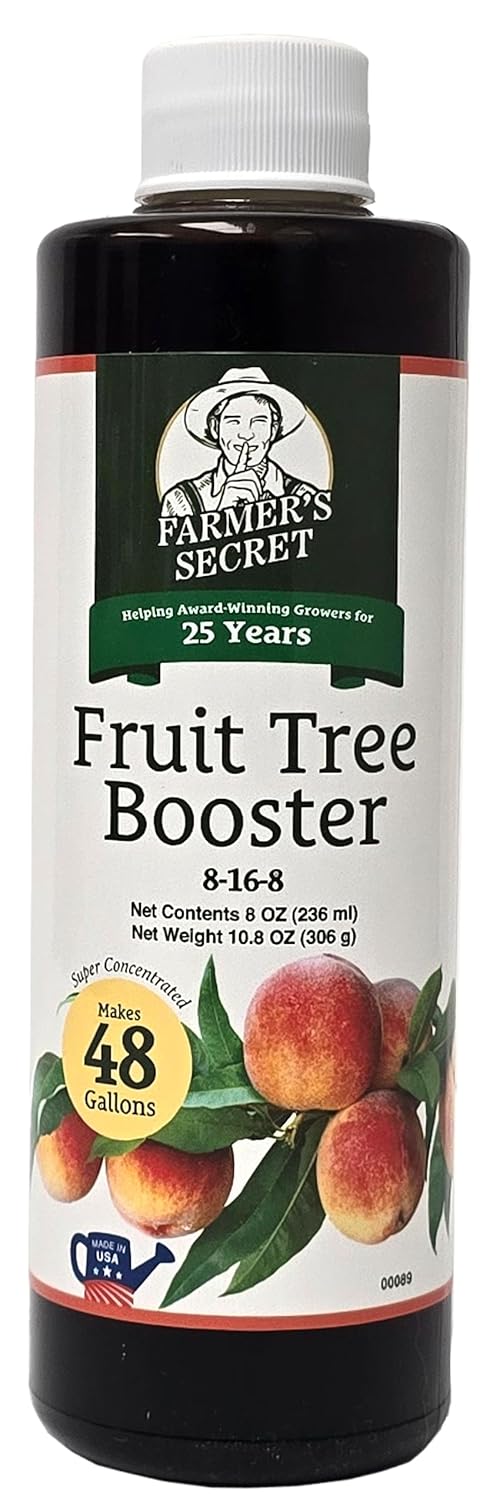
Farmer's Secret Fruit Tree Booster is a super-concentrated liquid fertilizer designed to boost root development and fruit set by delivering a phosphorus-forward nutrient mix in a small bottle. You dilute one teaspoon per gallon and apply weekly around the drip line or as a foliar spray, making it easy to use with a watering can, sprayer, or irrigation system. The formula lists primary macronutrients plus trace minerals and is positioned for early growth through budding, with higher recommended rates for young and mature trees. Its concentration means a little product goes far, so one small bottle covers multiple feedings. Practical benefits include faster nutrient availability compared with granular feeds and flexible application options for both soil and foliar feeding. Important limitations are that the 8 ounce size requires careful measuring for larger plantings and that frequent weekly feedings may be more labor intensive than slower-release alternatives. Also the exact NPK numbers are not printed on the provided label text, so users who require precise nutrient ratios may find the information limited.
Best for: Gardeners focused on maximizing fruit production and root strength who are willing to measure and apply a concentrated liquid on a weekly schedule.
Less Ideal for: People who prefer low-maintenance, slow-release granular fertilizers or who manage many large trees and want bulk coverage without frequent mixing.
- Highly concentrated so small doses cover many feedings
- Phosphorus-rich formula targeted to improve root development and fruit production
- Suitable for soil or foliar application and compatible with watering cans, sprayers, and irrigation
- Contains multiple trace minerals in addition to NPK for broader nutritional support
- Small 8 oz bottle can be inconvenient for feeding multiple or large trees
- Label copy does not show exact NPK ratio values for users who want precise nutrient analysis
Verdict: If you want a concentrated weekly feed that promotes stronger roots and better fruiting, this liquid booster delivers focused nutrition in small doses.
Osmocote Smart-Release Plant Food Plus, 2 lb

| Item Form | Granules |
|---|---|
| Application Method | Sprinkle |
| Target Species | All plants |
| Mixing Ratio | 1 capful (3 tablespoons) per 2 gallons of soil or per 4 sq. ft. |
Osmocote Smart-Release Plant Food Plus is a granular, resin-coated fertilizer designed to feed plants steadily for up to six months with 11 essential nutrients. You apply it by sprinkling the recommended scoop into the top inch or two of potting mix or garden soil and then watering; for large pots or garden beds follow the indicated rate and reapply every six months. The resin coating times nutrient release to soil temperature and moisture, which reduces the need for frequent feeding and lowers burn risk when used as directed. It works for a wide range of plants and settings, so it is convenient for seasonal maintenance of container-grown or in-ground trees like young mulberries. Limitations are that a 2 lb container covers only about 75 sq ft, so larger trees or full-season feeding may require multiple containers, and you must follow the dosing guidance precisely for indoor plants where rates are lower. This is a straightforward choice for gardeners who want predictable, low-effort nutrient delivery rather than custom N-P-K tweaking or fast-acting soluble fertilizers.
Best for: Gardeners who want a low-maintenance, all-purpose fertilizer to provide steady nutrition with minimal monitoring, especially for container-grown or young fruit trees that benefit from predictable feeding.
Less Ideal for: Growers seeking rapid, adjustable nutrient boosts or those managing large mature trees and extensive beds should consider bulk granular or soluble fertilizers formulated for higher acreage.
- Controlled, slow release through resin coating reduces frequent applications
- Contains 11 essential nutrients for broad-spectrum feeding
- Suitable for both indoor and outdoor use including containers and garden beds
- No-burn pledge when used as directed lowers risk of fertilizer damage
- Small 2 lb container covers only about 75 sq ft so may not be economical for large trees or beds
Verdict: Choose this product when you want simple, six-month slow-release feeding that keeps mulberry saplings and other plants nourished with minimal effort.
Jobe's Organics Granular Fruit & Nut Fertilizer, 4 lb

| NPK | 3-5-5 |
|---|---|
| Target Species | Fruit and nut |
| Item Form | Granules |
| Application Frequency | Every 4-8 weeks |
This granular fertilizer is designed to feed fruit and nut trees through slow-release nutrients targeted at the roots. With an NPK of 3-5-5 and added calcium, magnesium, and sulfur, it is applied around the dripline every 4 to 8 weeks during the growing season to support flowering and fruit set. The OMRI listing and organic inputs like feather and bone meal make it suitable for gardeners who prefer organic programs, and the granular form is easy to measure and sprinkle without mixing. Practical benefits include steady nutrient availability that reduces the risk of burning and increased soil microorganism activity that helps long-term soil health. Limitations are the small 4 lb bag, which will only cover a few trees or a single mature mulberry for one season, and the relatively low nitrogen percentage compared with some tree-specific fertilizers, so heavier-feeding trees may need more frequent applications or supplemental feeding. It is not a liquid or foliar feed, so results appear over weeks rather than immediately.
Best for: Home gardeners who want an easy-to-use organic granular fertilizer for a single mulberry or a small number of fruit trees and who prioritize safe, soil-friendly inputs.
Less Ideal for: Those managing large orchards or needing a fast-acting high-nitrogen feed for rapid leafy growth should choose larger commercial formulations or supplemental products.
- OMRI listed organic formula suitable for organic gardens
- Slow-release granular form provides steady feeding and lowers burn risk
- Balanced 3-5-5 NPK with added calcium and micronutrients for fruit and root development
- Small 4 lb bag limits coverage for multiple or large trees
- Lower nitrogen content may require additional feedings for very vigorous growth
Verdict: A small, OMRI-listed granular fertilizer that provides steady, soil-friendly nutrition ideal for organic home mulberry care.
Wellspring Gardens Mulberry Fuel Slow-Release Fertilizer (1 lb)

| Item Form | Granules |
|---|---|
| Application Method | Spread around the base of plants |
| Target Species | Mulberries, berries, cherries, nuts |
| Mixing Ratio | 20:6:9 |
| Unit Count | 16 Fluid Ounces |
This granular slow-release fertilizer is formulated specifically for mulberry trees and compatible fruiting plants such as berries, cherries, and nuts. It supplies a 20-6-9 N-P-K ratio in a resealable 1 pound bag and is applied by spreading the granules around the base of the plant to begin a roughly 90-day nutrient release cycle. For routine mulberry care it simplifies feeding by reducing how often you need to fertilize while delivering steady nitrogen for foliage and potassium for fruit development. The resealable packaging keeps unused product fresh for later applications and the granule form avoids the need to mix solutions. Limitations to note are that application rates must be followed to avoid overfeeding and this product does not replace the need for site-appropriate soil care such as pH adjustment or irrigation management. If you want predictable, low-maintenance feeding for established mulberries, this fertilizer fits into a reliable seasonal care routine, though gardeners who prefer immediate, water-soluble feeding or exact micro-nutrient blends may need an additional product.
Best for: Gardeners who prioritize consistent, low-maintenance feeding for mulberry trees and other small fruit trees and want a predictable, season-long nutrient source.
Less Ideal for: Growers who need quick, water-soluble boosts, precise micronutrient formulas, or who prefer liquid feeding programs for container-grown specimens.
- Formulated N-P-K balance (20-6-9) tailored for fruit development and foliage growth
- Slow-release granules provide steady nutrition for about 90 days reducing application frequency
- Resealable packaging preserves product between uses for multiple seasons
- Granule form requires surface application and cannot be used as a water-soluble feed without a different product
- Does not address soil pH or micronutrient deficiencies on its own
Verdict: Choose this product if you want a dependable, slow-release granular fertilizer that simplifies mulberry feeding with steady nutrition over a season.
Miracle-Gro Water Soluble All Purpose Plant Food, 1.5 lb

| Item Form | Powder |
|---|---|
| Application Method | Watering Can |
| Target Species | For all flowers, vegetables, trees, shrubs and houseplants |
| Mixing Ratio | 24-8-16 |
Miracle-Gro Water Soluble All Purpose Plant Food is a quick-release powder you dissolve in water and apply with a watering can or garden feeder to give plants an immediate nutrient boost. Typical use is mixing the recommended scoop with water and soaking the soil at the base of each plant every 7 to 14 days for outdoor plants or every two weeks for houseplants. The product contains a 24-8-16 NPK formulation that supplies a strong dose of nitrogen for leafy growth along with phosphorus and potassium. For a mulberry tree, this fertilizer can jump-start vegetative growth and support overall vigor when used during the active growing season, applied to the root zone and not to foliage. Practical benefits include fast availability of nutrients and easy mixing for spot treatments or small garden areas. Important limitations are the high nitrogen level relative to phosphorus and potassium, so it may be better for promoting leaf and shoot growth than for fruiting if used alone; also it is a soluble, repeat-application product so it requires regular feeding rather than long-term slow release.
Best for: Buyers who want a reliable, proven quick-feed fertilizer to stimulate growth in established ornamental and fruit trees and prefer clear usage instructions and broad community acceptance.
Less Ideal for: Gardeners seeking a single slow-release product to feed trees through an entire season or those focused primarily on maximizing fruit set without supplementing phosphorus and potassium.
- Fast-acting water-soluble formula supplies nutrients quickly to the root zone
- High nitrogen content supports rapid vegetative growth
- Simple mixing and application with a watering can or compatible garden feeder
- Labeled for use on a wide range of outdoor trees, shrubs, vegetables, and houseplants
- High nitrogen ratio may favor leaf growth over fruit production if used alone
- Requires frequent reapplication because it is water-soluble rather than slow-release
Verdict: A fast-acting, widely used water-soluble feed that quickly boosts vegetative growth and is a practical follow-up feed for mulberry trees during the growing season.
Miracle-Gro Shake 'N Feed Flowering Trees & Shrubs Plant Food, 8 lb

| Item Form | Granules |
|---|---|
| Application Method | shake evenly onto the soil |
| Target Species | flowering trees, shrubs and other acid-loving plants |
| Mixing Ratio | 18:6:12 |
| Unit Count | 128 Ounce |
This granular Shake 'N Feed formula is designed to feed flowering trees and shrubs for up to three months with a continuous-release 18-6-12 NPK mix. You apply it by shaking or sprinkling evenly onto the soil under the branch spread and then watering to activate feeding, or work it into potting mix at planting for containers. The bag lists organic-style ingredients such as kelp, earthworm castings, feather meal and bone meal intended to support soil microbes and root development, which can improve water efficiency and long-term vigor. Practical benefits include straightforward, low-maintenance quarterly feeding and broad suitability for acid-loving ornamentals like hydrangeas and rhododendrons. Limitations to expect are that the product is tailored to acid-loving flowering species rather than all trees, and it provides a medium coverage so large specimen trees will need multiple applications or heavier rates; it is a slow-release feeder rather than a fast corrective treatment for acute nutrient deficiencies.
Best for: Buyers who want a low-effort, reliable quarterly feeder to maintain color and blooms on ornamental, acid-loving trees and shrubs without frequent reapplication.
Less Ideal for: Gardeners needing a fast-acting corrective fertilizer for severe nutrient deficiencies or those managing large non-acid-loving specimen trees that require high coverage.
- Continuous-release formula that feeds for up to three months reducing application frequency
- Contains organic-derived inputs like kelp and earthworm castings to support soil microbes
- Clear, simple application: shake onto soil under branch spread and water to activate
- Formulated for acid-loving flowering trees and shrubs so it is not a universal tree fertilizer
- Medium coverage may require more product or repeated spot applications for large trees
Verdict: A simple, low-maintenance granular feeder that reliably supplies three months of nutrition for flowering, acid-loving trees and shrubs.
Choosing the Right Fertilizer for Mulberry Trees: Key Factors to Consider
Nutrient Ratio and Timing
Mulberry trees need a balanced supply of nitrogen, phosphorus, and potassium that shifts as the tree matures. Young trees typically benefit from a slightly higher nitrogen ratio to promote shoot and root growth, while established fruiting trees need phosphorus and potassium to support flower and fruit formation.
Timing matters because feeding too late in the season can stimulate tender late growth that is vulnerable to winter damage. Choose a fertilizer whose N-P-K and recommended schedule align with whether you want to encourage canopy growth, flower set, or fruit development.
Release Type and Predictability
Slow-release and controlled-release fertilizers provide a steady nutrient supply that reduces the risk of leaf burn and nutrient leaching. They work well for established trees where steady availability is preferred.
Water-soluble or quick-release fertilizers give an immediate boost and are useful for correcting a deficiency or jump-starting a young tree, but they require more frequent applications and careful dosing. Consider how predictable the release pattern is for your irrigation and rainfall conditions.
Application Method and Labor
Fertilizers come in granular, spike, liquid, and organic granular forms, and each requires different effort and equipment. Granular spread around the root zone and watered in is low-tech and good for larger yards. Spikes are simple but can deliver nutrients unevenly if root distribution is wide.
Liquid feeds are precise and fast but require mixing and possibly a hose-end applicator. Match the application method to how much labor you want to invest and how accessible the trees are.
Soil Condition and pH Compatibility
Mulberries tolerate a range of soils but perform best in well-drained, moderately fertile loam with near-neutral pH. Some fertilizers can alter soil pH over time or interact with existing soil chemistry, affecting nutrient availability.
Test soil pH and nutrient levels before committing to a feeding program. Choose a fertilizer whose secondary benefits, such as adding organic matter or supporting microbial life, will help correct local soil limitations rather than exacerbate them.
Salt Index and Root Safety
High-salt fertilizers can damage fine feeder roots and cause leaf scorch, especially in containers or compacted soils. Slow-release and organic fertilizers generally have lower salt indexes and are safer for sensitive or newly planted mulberries.
For young trees and container-grown specimens, prioritize lower-salt options and follow label dilution and application-distance guidance to protect root health.
Long-Term Soil Health and Organic Content
Fertilizers that contribute organic matter support soil structure, water retention, and microbial activity, all of which benefit mulberry trees over the long term. Synthetic formulations can correct nutrient shortages quickly but do not improve soil organic content.
Consider alternating or combining a mineral fertilizer with organic inputs like compost to maintain a fertile, biologically active rooting zone that sustains productivity across seasons.
Feeding Schedule by Tree Age
Young transplants and saplings need a different approach than mature, fruiting trees. For the first couple of years focus on establishing root systems with moderate, frequent feedings that emphasize nitrogen and include micronutrients. Avoid heavy late-season nitrogen that can delay hardening off before winter.
Mature trees benefit from a feeding plan that supports blossom and fruit set. A lighter application in early spring and a maintenance feed after fruit set can help sustain tree vigor without promoting excessive vegetative growth.
- Saplings: smaller, balanced feeds every 6 to 8 weeks during growing season
- Mature trees: targeted spring feed and optional midseason maintenance
- Avoid late summer high-nitrogen applications that stimulate soft new growth
Applying Fertilizer to Container-Grown Mulberries
Containers concentrate salts and deplete nutrients faster than in-ground plantings. Use lower-salt formulations and leach containers with extra water periodically to prevent buildup. Organic-based feeds and slow-release granules are often better for pots because they release nutrients gradually and contribute some organic matter to the potting mix.
- Use a balanced, low-salt feed for containers
- Repot or refresh potting mix every 2 to 3 years to restore structure and fertility
- Flush container soil with extra water after several feeding cycles to prevent salt accumulation
Combining Fertilizer with Compost and Mulch
Mulch and compost work with fertilizers by conserving moisture, moderating soil temperature, and slowly releasing nutrients. Apply a 2 to 4 inch layer of organic mulch but keep it pulled slightly away from the trunk to avoid rot.
Topdress with compost annually around the dripline to gradually improve soil structure and supply micronutrients that granular fertilizers might not cover. This combination reduces the need for heavy synthetic inputs over time.
- Apply compost in a ring around the dripline, not against the trunk
- Use organic mulch to protect feeder roots and reduce irrigation needs
- Adjust fertilizer amounts downward when regular compost topdressing is part of the routine
Addressing Common Nutrient Deficiencies
Mulberry trees often show deficiency signs like pale leaves, poor fruiting, or stunted growth. Yellowing between veins can indicate iron or magnesium issues, while overall pale leaves often mean nitrogen is low. A soil test helps identify what is lacking before adding broad-spectrum nutrients.
Targeted applications of the missing element, such as a foliar iron supplement or a phosphorus boost for poor fruit set, can correct the problem faster than general feeding. Avoid blanket high-dose applications that mask underlying soil imbalances.
- Get a soil test before making corrective feeds
- Use foliar sprays for quick micronutrient correction when needed
- Increase phosphorus only if blossom and fruit problems are evident
Water Management and Fertilizer Effectiveness
Fertilizer uptake depends on consistent soil moisture. In droughty or compacted soils, nutrients may remain unavailable to roots. Water deeply and infrequently to encourage roots to explore the soil and take up applied nutrients.
Avoid applying quick-release fertilizer to dry, compacted soil because it can lead to uneven nutrient distribution and root stress. Time feedings for when soil moisture is adequate or follow with a thorough watering.
- Water deeply after granular applications to move nutrients into the root zone
- Avoid feeding during prolonged droughts unless you plan to irrigate
- Match application frequency to local rainfall patterns to reduce leaching risk
How We Chose the Best Fertilizer for Mulberry Trees
We selected fertilizers that are practical for mulberry care and that address the most common issues gardeners face with this tree species. Our filters prioritized nutrient formulations suited to fruiting hardwoods, products with clear N-P-K labeling, and options that match typical mulberry planting situations such as in-ground, raised bed, and container culture. Evaluation emphasized measurable dimensions: nutrient balance and release type, suitability for tree age and size, application method and frequency, and effects on soil biology. We excluded products that lacked clear nutrient analysis or that were formulated only for turf or non-fruiting ornamentals. We also filtered out specialty mixes with ingredients that could cause salt buildup or that require complex, repeated laboratory adjustments. Practical performance and gardener experience were weighed alongside labels and instructions. Where possible we favored fertilizers that offer straightforward dosing, compatibility with common mulberry soils, and minimal maintenance risks like root burn or excessive vegetative growth.
FAQ
How often should I fertilize a young mulberry tree?
Young mulberries usually benefit from light, balanced feeding every 6 to 8 weeks during the first two growing seasons. Use a formulation with a bit more nitrogen to support shoot and root development, and avoid heavy late-season applications.
Can I use a general fruit-tree fertilizer on mulberries?
Often you can, provided the product lists an appropriate N-P-K for fruiting hardwoods and has clear application instructions. Prefer formulas that balance nitrogen for growth with phosphorus and potassium for flowering and fruiting.
Is organic fertilizer better for mulberry trees than synthetic?
Organic feeds improve soil structure and microbial life and lower salt risk, which benefits long-term tree health. Synthetic fertilizers can correct deficiencies quickly. Many gardeners use a mix of both to gain immediate corrections and long-term soil improvement.
How do I correct yellowing leaves on my mulberry?
Yellowing can signal nutrient deficiencies, commonly nitrogen or iron. Start with a soil test to confirm the cause. A balanced feed or a targeted micronutrient application can correct the issue depending on the diagnosis.
Can I fertilize mulberries in containers the same way as in-ground trees?
Container-grown mulberries need gentler, lower-salt feeds and more frequent monitoring because nutrients and salts concentrate in potting media. Use slow-release or diluted liquid feeds and flush the container occasionally to prevent buildup.
When is the best time of year to fertilize mulberries?
Early spring application just before new growth begins is usually best to support bud break and flower development. A light midseason feed can help sustain fruiting, but avoid high-nitrogen applications late in the season.
Final Verdict
Choose a fertilizer for mulberry trees based on tree age, soil test results, and how hands-on you want to be with applications. Prioritize a nutrient balance and release type that match your goals: nitrogen for young growth, and more phosphorus and potassium for mature fruiting trees. Consider lower-salt and organic options for containers and newly planted trees to protect feeder roots. A combined approach that uses mineral fertilizers for immediate corrections and organic inputs to build soil over time gives the most reliable results. Follow label rates, monitor tree response, and adjust timing to local climate so you get vigorous growth and consistent fruit production.
