

Note: This article contains affiliate links. If you click on these links and make a purchase, I may earn a small commission at no extra cost to you. This helps support my research and content. Read my full affiliate disclosure here.
If you share your yard with dogs, pick a weed control solution that removes unwanted plants without creating a hazard for pets or the family. The right dog safe weed killer balances effectiveness on common garden and lawn weeds with low residual risk and minimal soil impact. This guide covers six shortlisted, top-rated dog-friendly weed killers and explains how we evaluated them. We'll focus on how well each option controls typical weeds, how long any treated area remains unsafe for pets, and practical application tips you can use in a real yard or fenced area.
Top Picks at a Glance
| Best Overall The best all-around choice for most situations | Just For Pets Pet Safe Weed Killer, 1 Gallon with Sprayer |  |
| Best Quality Built to a higher standard if you want something more solid | Natural Armor Weed & Grass Killer, 1 Gallon (128 oz) with Sprayer |  |
| Best Value The sweet spot between price and what you get | Spruce Weed & Grass Killer Refill, Ready-to-Use 64 oz |  |
| Best Budget The cheapest option that still gets the job done reliably | Bonide Captain Jack's Deadweed Brew Ready-to-Use Spray, 32 oz |  |
| Highest Rated A top-rated pick with lots of positive feedback | Natural Elements Ready-to-Use Weed Killer, 4 Gallon |  |
| Most Popular A crowd favorite that many people choose with confidence | Spruce Weed & Grass Killer Kit with Power Wand and 64 oz Refill |  |
Just For Pets Pet Safe Weed Killer, 1 Gallon with Sprayer

| Unit Count | 128 Fluid Ounces |
|---|---|
| Item Form | Liquid |
| Active Ingredients | Vinegar |
| Coverage | Area treatable with 128 fluid ounces |
Just For Pets Pet Safe Weed Killer is a ready-to-use liquid weed control product that uses vinegar as the active ingredient and includes a pump sprayer for spot treatment. You apply it by shaking, pumping to pressurize the sprayer, and coating unwanted weeds and grasses until thoroughly wet. It is designed for fast visible wilting, often within 24 hours and sometimes in as little as one hour, making it useful for quick cleanup on driveways, sidewalks, patios, rock beds, and fence lines. Being glyphosate-free and marketed for pet-safe use, it is a sensible choice where people and animals frequent treated areas, provided directions are followed and surfaces are dry before allowing access. The non-selective, contact action means it kills whatever is sprayed, so careful application is required near desirable plants. Also, vinegar-based solutions are less persistent than synthetic herbicides, so repeat applications may be needed for tough perennial weeds or heavy infestations. The included sprayer simplifies small jobs but is less efficient than spray rigs for large properties.
Best for: Homeowners who want a quick, low-chemical way to remove weeds around high-traffic areas and who prioritize pet and family safety when choosing garden products.
Less Ideal for: Large lawns or heavy infestations where a systemic herbicide or professional equipment is needed, and gardeners who need selective control within planted beds.
- Ready-to-use formula with no mixing required for quick spot treatments
- Glyphosate-free vinegar formula marketed as safer around people and pets when used as directed
- Includes pump sprayer for convenient application on hard surfaces and beds
- Fast-acting contact action with visible wilting often within 24 hours
- Non-selective contact herbicide that will damage any plant it touches requiring careful application near desired plants
- May require repeated treatments on persistent perennial weeds since vinegar is less systemic than synthetic herbicides
Verdict: Choose this glyphosate-free, ready-to-use weed killer when you want a fast, pet-conscious solution for spot-treating weeds around homes and hardscapes.
Natural Armor Weed & Grass Killer, 1 Gallon (128 oz) with Sprayer

| Unit Count | 128 Fluid Ounces |
|---|---|
| Item Form | Spray |
| Active Ingredients | Vinegar |
| Coverage | Flower beds, shrubs, trees, driveways, edging, fence lines, foundations, gravel areas, mulch beds, overgrown weed areas, parking areas, patios, pavers, pool areas, rock walls, pathways, walkways, wells, and water systems |
This 1-gallon Natural Armor formula is a ready-to-use, vinegar-based weed and grass killer designed for spot and area treatment where vegetation is unwanted. It connects to the included sprayer and is intended for use on driveways, patios, gravel, mulch beds, fence lines and around foundations and pavers. The product advertises fast visible browning within hours and covers many common weeds and grasses without using glyphosate. Practical benefits include a large single-gallon supply for treating multiple areas and a simple spray-and-go workflow with no mixing required. It is marketed as plant-based and pet-friendly when used as directed, and the concentrated vinegar active ingredient gives it quick contact action on above-ground growth. Important limitations are that it targets exposed plant tissue so regrowth from roots or perennial weeds may require repeated treatments, and the strong vinegar can be corrosive or damaging to desirable plants if oversprayed. Users should also follow safety guidance to keep children and pets away during application and avoid use near desirable vegetation or sensitive surfaces.
Best for: Gardeners and homeowners who prioritize quick, chemical-free knockdown of visible weeds across driveways, patios and nonplant areas and want a large ready-to-use supply for multiple treatments.
Less Ideal for: People seeking a long‑term systemic solution for tough perennial weeds or lawn-wide weed control should consider products formulated for root uptake or professional services.
- Large 1-gallon supply reduces refill frequency for medium to large yards
- Ready-to-use spray with included sprayer requires no mixing or measuring
- Vinegar-based formulation avoids glyphosate and works quickly on exposed foliage
- May not control deep-rooted perennials or provide long-term residual control
- Risk of damage to desirable plants or hard surfaces if oversprayed
Verdict: If you want a large, fast-acting, glyphosate-free spray to quickly knock down visible weeds on hardscapes and unwanted areas, this gallon-ready Natural Armor formula is a practical choice.
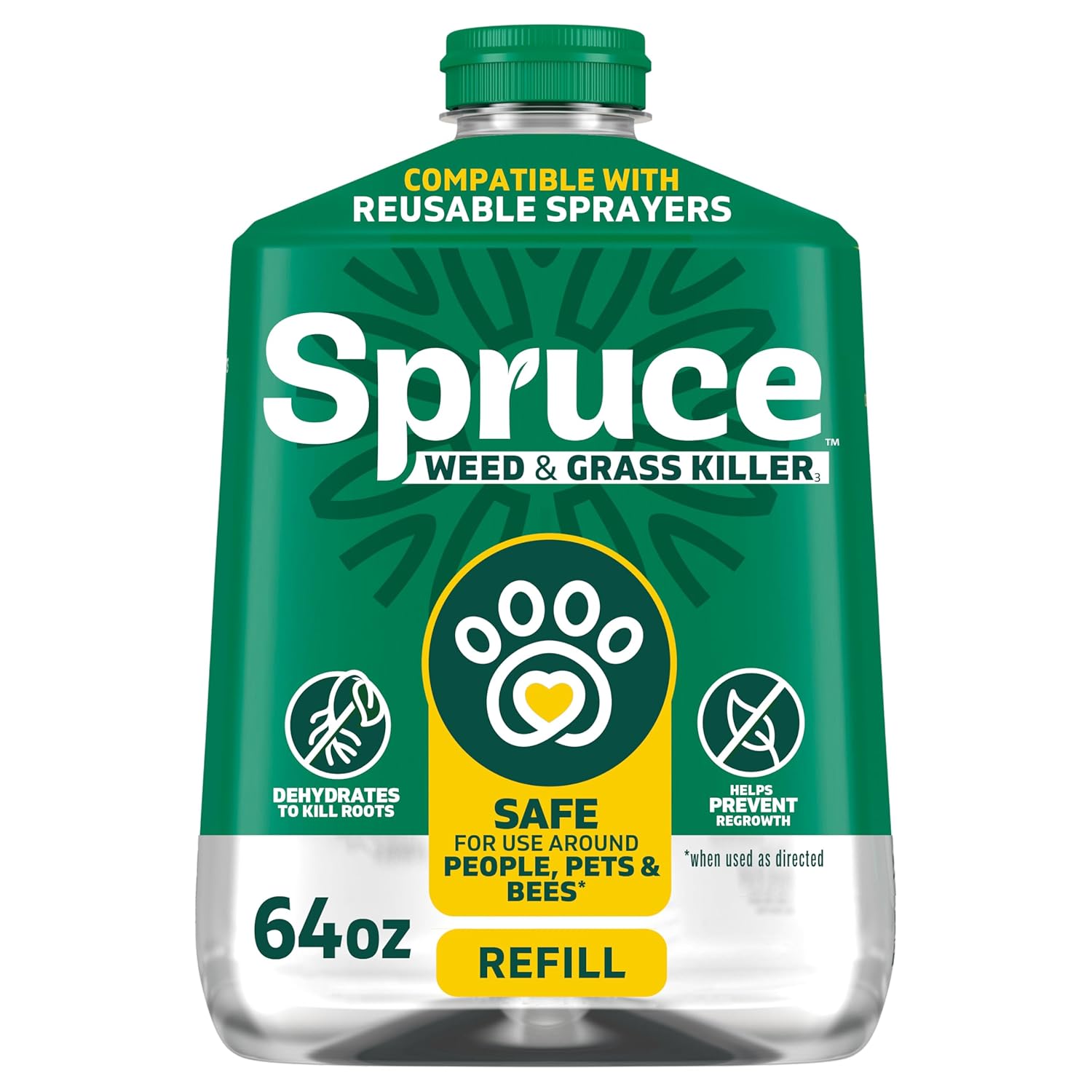
Spruce Weed & Grass Killer Refill, Ready-to-Use 64 oz
| Unit Count | 64 Fluid Ounces |
|---|---|
| Coverage | 1 bottle treats up to 400 weeds |
| Item Form | Spray |
| Active Ingredients | Sodium Lauryl Sulfate, Geraniol, Cornmint Oil |
This 64 oz Spruce refill is designed to snap into the brand's Snap & Spray kit and replace mixed or pump bottles with a ready-to-use concentrate that treats up to 400 weeds. It works on contact, dehydrating foliage with visible leaf darkening or wilting within an hour and full death often by 24 hours. The formula uses water, essential oils and a surfactant rather than synthetic herbicides, which makes it marketed as safe around people and pets when applied as directed. Typical uses are spot-treating weeds in mulch beds, driveways, pavers and walkways or refilling a powered wand for precision edging. Practical benefits include a no-mix refill workflow, rainproofing within ten minutes and compatibility with Spruce application handles for targeted application. Limitations are that it is non-selective so it will damage desirable plants and should not be used on lawns, and performance can be reduced in cold or wet conditions so timing matters for best results.
Best for: Buyers who prioritize straightforward, low-fuss weed control around hard surfaces and beds and want a refill that works with a precision spray system to save time and reduce mess.
Less Ideal for: People needing a selective lawn weed treatment or those who prefer systemic, long-residual herbicides for perennial root control should consider other options.
- Ready-to-use refill eliminates mixing and pouring for faster application
- Visible effects within about one hour for quick confirmation of efficacy
- Formulated with water and essential oils rather than traditional synthetic herbicides
- Compatible with Snap & Spray/Powdered Wand system for precise spot treatment
- Rainproof within 10 minutes so light showers are less likely to wash treatment away
- Non-selective formula that will harm desirable plants if oversprayed
- Effectiveness depends on application conditions so must be used on dry, calm days above recommended temperatures
Verdict: A no-mix, pet-friendly refill that delivers fast, targeted weed control around hardscapes for buyers who want a clean, low-effort solution.
Bonide Captain Jack's Deadweed Brew Ready-to-Use Spray, 32 oz

| Unit Count | 32 Ounce |
|---|---|
| Item Form | Spray |
| Coverage | Annual |
| Active Ingredients | Herbicide |
Bonide Captain Jack's Deadweed Brew is a pre-mixed spray that kills many broadleaf weeds and grasses quickly and can be used around garden beds, walkways, driveways, and other hardscape areas. The trigger-spray bottle is ready to use with no mixing required, so you can treat visible weeds on contact and expect wilting within hours; once dry the formula is described as waterproof, so light rain shortly after application is less likely to wash it away. It is labeled for use in organic gardening, which makes it a practical choice for vegetable and flower borders when used according to directions. The product works in cooler temperatures down to about 40°F, broadening the application window. Limitations are that it is a non-selective herbicide so it will damage desirable plants on contact and is not a spot-freeze solution for deep perennial roots, so repeat treatments may be needed for persistent weeds. Follow label safety instructions and avoid spraying where pets frequent until treated areas have dried.
Best for: Gardeners on a budget who want an easy, ready-to-use organic-approved spray for quick spot treatment of visible weeds around gardens, paths, and hardscape areas.
Less Ideal for: People who need a selective lawn treatment that spares grass or those seeking a systemic long-term solution for deep-rooted perennial weeds.
- Ready-to-use spray requires no mixing and is easy to apply.
- Fast-acting formula with visible wilting within hours.
- Approved for organic gardening, suitable for use near edible beds when label directions are followed.
- Works at temperatures as low as 40°F, extending seasonal use.
- Non-selective formula will damage any plants it contacts, so careful spot application is required.
- May require repeat applications for perennial or deeply rooted weeds.
Verdict: A convenient, budget-friendly ready-to-use organic-approved spray for quickly knocking down visible weeds around garden beds and hardscape.
Natural Elements Ready-to-Use Weed Killer, 4 Gallon

| Item Form | Liquid |
|---|---|
| Coverage | Broad Spectrum Coverage |
| Unit Count | 512 Fluid Ounces |
| Active Ingredients | Acetic Acid (concentrated vinegar-based formula) |
Natural Elements 4‑gallon weed killer is a concentrated ready-to-use liquid herbicide that uses commercial-grade acetic acid to burn back unwanted weeds, grasses, moss, and algae. You use it like a standard spray-on contact herbicide: apply directly to foliage on a warm, dry day, spray until leaves are visibly wet, and expect wilting within an hour and broader damage within 24 hours. The formula adheres to leaf surfaces and causes rapid dehydration, so it works fast on emerged annuals and many perennial tops without systemic action. Practical benefits include easy application from the gallon jugs and broad-spectrum coverage for driveways, patios, gravel, fence lines, and mulched beds. It is marketed as safe for people and pets after the spray has fully dried, which suits household yards where safety matters. Important limitations are that it is a nonselective contact herbicide so it will kill desirable grass and plants on contact and it does not provide long-term residual control or root kill of many established perennials, so repeat applications or mechanical removal may be necessary for stubborn weeds.
Best for: Homeowners who prioritize a fast, reliable contact herbicide that can be used around family and pets and who need an easy, no-mix solution for hardscapes and weed patches.
Less Ideal for: Gardeners seeking selective lawn treatments, prolonged residual control, or a systemic herbicide to eliminate deep-rooted perennials should look at alternative products.
- Uses commercial-grade acetic acid for fast visible weed burn within hours
- Ready-to-use gallon jugs require no mixing or dilution
- Broad-spectrum coverage suitable for hardscapes, gravel, and mulched areas
- Formulated to be safe for people and pets once the spray has dried
- Nonselective contact action kills any plant it hits including desirable turf
- No systemic or long-term residual control against roots of established perennials
Verdict: Choose this ready-to-use, vinegar-based weed killer when you want a fast, dependable contact herbicide that is safe for people and pets once dry.
Spruce Weed & Grass Killer Kit with Power Wand and 64 oz Refill

| Unit Count | 64 Fluid Ounces |
|---|---|
| Coverage | 1 bottle treats up to 400 weeds. |
| Item Highlight | Pet Safe Weed Killer Spray, Reusable Weed Sprayer, 2 AA Batteries Included |
| Item Form | Multiple |
The Spruce Weed & Grass Killer kit pairs a 64 oz no-mix herbicide with a rechargeable-style powered wand that makes spot treatment fast and precise. It is intended for cracks, walkways, mulch beds, and other non-lawn areas where broadleaf and grassy weeds like dandelions, crabgrass, and clover appear. The formula is water-based with essential oils and surfactant so you do not need to measure or dilute, and the company says visible leaf damage appears within an hour and full death by 24 hours. The included wand runs on 2 AA batteries and is designed to deliver a steady spray from about 12 inches away; the refillable bottle and reusable sprayer aim to reduce waste over time. Practical benefits include quick results, easy targeted application to avoid desirable plants, and a pet-friendly label when used as directed. Important limitations are that it is non-selective so accidental overspray will harm nearby plants and that it should not be applied directly on lawns; follow timing and weather guidance for best efficacy and safety.
Best for: Buyers who prioritize a pet-safe labeled option and want a simple, no-mix spray kit for targeted spot treatment on hardscape, beds, and pathways.
Less Ideal for: Gardeners who need a selective lawn weed control solution or who frequently treat large turf areas should consider lawn-specific products instead.
- Ready-to-use 64 oz no-mix formula removes the need for measuring or diluting
- Visible effects often appear within an hour with full control by 24 hours
- Labeled safe around people, pets, and bees when directions are followed
- Comes with a battery-powered reusable wand for precise spot treatment
- One bottle claims coverage for up to 400 weeds, reducing repeat purchases
- Non-selective formula will damage desirable plants if accidentally sprayed
- Not intended for application on lawns, limiting some use cases
- Effectiveness depends on following specific weather and timing instructions
Verdict: A convenient, pet-labeled spot-treatment kit that gives fast visible results without mixing, ideal for quick weed control around paths and beds.
Choosing the Right Dog Safe Weed Killer: Key Factors to Consider
Active Ingredients and Toxicity Profile
Understanding the active ingredient tells you how the product controls weeds and what the short-term and long-term risks are to pets. Some active ingredients break down quickly and have low acute toxicity to mammals, while others remain active in the soil and can be harmful if ingested or contacted. Look for formulas with clear toxicity data or third-party safety evaluations, and note whether the label gives specific precautions for pets.
The active ingredient also determines application limits and whether repeat treatments are safe. For pet owners, favor ingredients with short degradation times and explicit pet-focused guidance on the label. If you have dogs that dig or chew vegetation, consider non-systemic or contact options that reduce the likelihood of plant tissue carrying residues that a pet might ingest.
Label Directions and Re-entry Intervals
Labels spell out how long treated areas remain unsafe and what measures reduce exposure risk. Re-entry intervals can vary from minutes to days depending on formulation and whether the product is a contact spray, systemic treatment, or granular. Clear, conservative directions on when dogs can return to treated turf are essential for planning lawn activities.
Also check whether the product requires keeping pets off the area until spray has dried, or fenced removal of treated clippings. A product with short, easy-to-follow re-entry instructions simplifies use for active households and reduces accidental exposures.
Effectiveness Against Common Yard Weeds
A dog safe label is only useful if the product actually controls the weeds you have. Different weeds respond to different modes of action; broadleaf weeds and grassy weeds often need different approaches. Evaluate whether the product lists the common species in your area such as dandelion, clover, chickweed, crabgrass, or nutsedge.
Consider whether a product is contact-only or systemic. Contact products may require repeat treatments for deep-rooted perennials, while systemic options can eliminate roots but may have longer residual times. Match the expected weed pressure and species to the product's control spectrum.
Application Method and Practicality
How you apply a weed killer affects accuracy, risk to pets, and daily yard routines. Ready-to-use sprays allow precise spot treatment but can be slower for large areas. Concentrates and hose-end applicators cover more ground but require correct dilution and carry the risk of overapplication. Granular options can be easier to broadcast but may get moved by pets or sprinklers.
Choose a delivery method that fits the size of your yard and your tolerance for mixing or measuring. Also consider whether additional gear such as a pump sprayer is needed and whether application can be done without leaving residues on walkways or pet toys.
Impact on Lawn and Non-target Plants
Dog-safe does not automatically mean harmless to all plants. Some pet-friendly formulas are selective and target broadleaf weeds while leaving turf grasses intact. Others are non-selective and can damage ornamental beds or desirable groundcovers if applied carelessly. Read how selective a product is and whether it requires careful spot treatment near flower beds or vegetable gardens.
If you have mixed planting areas or newly seeded turf, choose a product labeled safe for those conditions. Consider how the product might affect young grass, container plants, or nearby vegetable patches where pets also roam.
Environmental Persistence and Soil Health
Persistence in soil influences both safety for digging animals and effects on soil microbes and future plantings. Short-lived active ingredients break down faster and reduce the window of potential harm, while persistent chemicals can accumulate or delay replanting. For dog owners who allow digging, low soil persistence reduces the chance of pets encountering residues in excavated soil.
Also think about runoff and nearby water features. Products that bind tightly to soil and degrade quickly lower contamination risk to ponds or drainage areas frequented by wildlife and pets.
Spot Treatment Strategies for Dog Areas
Spot treating weeds where dogs spend the most time minimizes chemical use and limits pet exposure. Focus on pathways, shaded corners, and play areas rather than broadcasting across the whole yard. Use a targeted applicator or a small pump sprayer to place product only on the unwanted plants and avoid overspray onto grass or toys.
After application, remove any treated plant debris and keep dogs out until the treatment has dried or until the product label allows re-entry. For persistent patches, alternate mechanical removal and targeted treatment to reduce the need for repeat chemical applications.
- Apply when dogs are indoors or confined and keep them away until re-entry time ends
- Use protective gloves and avoid treating areas with lots of pet bedding or food
- Combine manual weeding with spot treatments for deep-rooted perennials
Safe Timing and Weather Considerations
Choose calm, dry weather for application to reduce drift and runoff. Avoid treating before heavy rain which can move product into drainage or lakes used by pets. Early morning or late afternoon applications often provide the best window for drying before pets return to the lawn.
Temperature can affect how fast products break down. Hot, sunny days may speed drying and reduce re-entry intervals for some formulations, while cool, wet conditions can prolong residues. Check the label for specific environmental guidance.
- Avoid windy days to prevent drift onto non-target plants
- Do not apply before irrigation or expected rain unless label permits
- Note drying times to schedule pet access safely
Nonchemical Alternatives and Integrated Approaches
Mechanical control, mulch, and improved lawn care reduce weed pressure and lessen reliance on chemical controls. Regular mowing at proper heights, overseeding thin patches, and correcting soil compaction make turf more competitive against weeds. For pet owners, cultural controls are often the safest first step.
Physical removal and boiling water or steam-based spot treatments can handle small infestations without chemical exposures. Combining nonchemical methods with occasional pet-safer products creates a layered, low-risk strategy for maintaining a healthy yard.
- Overseed bare spots to deny weeds a foothold
- Use landscape fabric and mulch in beds to suppress weeds
- Hand-pull weeds before they set seed to reduce future problems
Protecting Vegetable Beds and Ornamental Areas
When pets have access to vegetable gardens or flower beds, use barriers or temporary fencing during and after treatment. Many pet-safe lawn options are not labeled for edible beds, so avoid drift and keep pets away from any treated soil where root crops grow. If you need to treat near edibles, prefer physical removal and spot-control measures.
For ornamental beds with desirable plants, always test a small area or use a shielded applicator to prevent contact with flowers and foliage. Recovery from accidental exposure is easier with fast-acting, short-residual formulas.
- Install temporary fencing around beds during treatment
- Cover shallow-rooted vegetables or remove harvestable produce before treatment
- Rinse pet paws and fur if they contact treated areas
Storing and Disposing of Leftover Product Safely
Store weed control products in their original containers and keep them locked away from pets and children. Follow label instructions for storage temperatures and avoid leaving containers where dogs can knock them over or chew labels off. Keep the product out of reach and in a dry place.
Dispose of unused product and empty containers according to local regulations. Do not pour leftovers into storm drains or compost piles. If you have leftover solution in a sprayer, follow label directions for neutralizing or using it up safely to avoid accidental pet exposures.
- Keep product in original labeled container with childproof cap
- Rinse sprayers outdoors away from water features and pet areas
- Follow municipal guidelines for hazardous household waste disposal
How We Chose the Best Dog Safe Weed Killer
We focused on products formulated or labeled for use around pets and domestic lawns, prioritizing evidence of reduced acute toxicity and clear application instructions. Evaluation criteria emphasized measurable weed control on the most common broadleaf and grassy weeds, the documented pet-safety profile and re-entry interval, and the impact on desirable turf and garden plants. We also assessed ease of application, including spray or granular delivery and whether the product requires additional equipment or mixing. Residual soil activity and degradation rate were considered to gauge how long treated areas might remain risky to diggers or chewers. Products were excluded if they lacked explicit pet-safety guidance, did not list target weeds clearly, or relied on active ingredients known to have long-term soil persistence. We also excluded items with no clear homeowner application instructions. The final list balances practical yard performance with conservative safety features and clear labeling so gardeners can match a product to their lawn type and pet habits.
FAQ
How long after application can my dog go back on treated grass?
It depends on the product and formulation. Many pet-focused products allow pet access after the spray dries, while others specify waiting 24 hours or longer. Always follow the label re-entry time and keep dogs off treated areas until that interval has passed.
Are organic weed killers always safer for dogs?
Not necessarily. Organic or natural products can still cause irritation or be toxic if ingested. Safety depends on the active ingredient, concentration, and how the product is used. Evaluate the label and handle all products with care around pets.
Can I treat a spot while my dog is outside if I keep them away from that area?
Yes, spot treatment while a dog is supervised elsewhere can be effective provided you prevent access until the product is safe according to the label. Remove any treated clippings and store tools out of reach to limit accidental contact.
Will a pet-safe weed killer harm my garden vegetables or flowers?
Some pet-safe lawn products are selective and will not harm certain turf grasses, but many are not labeled for use on edibles or ornamentals. Avoid drift and shield desirable plants during application. When in doubt, use physical methods near vegetables.
What should I do if my dog licks treated grass?
If exposure occurs, rinse the dog's mouth and paws with water and consult a veterinarian, especially if the label warns of ingestion risks or if symptoms like vomiting or lethargy appear. Keep the product container or label available to inform the vet of the active ingredient.
Final Verdict
Choosing a dog safe weed killer requires balancing effective control of the weeds you face with a conservative approach to pet exposure and soil persistence. Prioritize products with clear pet-safety guidance, short re-entry intervals, and action against the specific species in your lawn. Combine targeted chemical use with cultural practices like proper mowing, overseeding, and manual removal to reduce chemical reliance. Ultimately, pick a solution that matches how your pets use the yard and how much effort you want to put into application and monitoring. With the right product and responsible application, you can keep weeds under control while protecting your dogs and the rest of your household.
