

Note: This article contains affiliate links. If you click on these links and make a purchase, I may earn a small commission at no extra cost to you. This helps support my research and content. Read my full affiliate disclosure here.
When you need to cut thick stems or manage mature trees, the right loppers for large branches make the job safer and faster. Heavy-duty loppers give you the leverage to slice through wide-diameter wood, reduce the need for a saw, and help keep pruning cuts clean so wounds heal well. This guide covers our shortlisted top picks for large-branch loppers and explains the criteria used to evaluate reach, cutting capacity, shaft construction, and ergonomics. Read on for practical guidance on choosing a long-reach, high-capacity pair of loppers suited to heavy pruning tasks, plus maintenance tips and safety considerations before you start cutting.
Top Picks at a Glance
| Best Overall The best all-around choice for most situations | Kimura Pro Heavy Duty Telescopic Ratchet Anvil Loppers |  |
| Best Quality Built to a higher standard if you want something more solid | Corona Clipper 32-inch MAXFORGED Orchard Loppers (AL 8462) |  |
| Best Budget The cheapest option that still gets the job done reliably | GARTOL 29-Inch Heavy Duty Anvil Lopper with Compound Action |  |
| Highest Rated A top-rated pick with lots of positive feedback | Hickok 36" Heavy Duty Bypass Loppers |  |
| Most Popular A crowd favorite that many people choose with confidence | Fiskars PowerGear2 32" Bypass Lopper — 2" Cut Capacity |  |
Kimura Pro Heavy Duty Telescopic Ratchet Anvil Loppers

| Cutting width | 40 millimeters |
|---|---|
| Blade Material | Japanese SK5 Carbon Steel |
| Product Style | Pro 301 – Ratchet |
| Handle Material | Plastic, Rubber |
These Kimura Pro loppers combine a ratchet power multiplier with an anvil SK5 carbon steel blade to tackle larger branches with less muscle. In typical use you extend the aluminum handles from about 25 to 37 inches, position the anvil blade against the branch and squeeze; the ratchet mechanism reduces effort and lets you finish thicker cuts in stages. The PTFE coating and anvil edge help prevent sap build-up and improve glide while the soft TPR grips make repetitive cutting more comfortable. Practical benefits include reach for higher or awkward cuts, boosted cutting force for branches up to roughly 40 mm, and durable construction aimed at regular yard work. Important limitations are that anvil loppers compress live wood rather than producing the cleaner scissor-style cut of bypass blades, and the ratchet mechanism requires multiple squeezes on very thick wood which slows single-stroke cutting. These are best when you need power and reach for large branches rather than the finest pruning finish.
Best for: Gardeners who want a balanced, all-purpose heavy-duty lopper for clearing large branches and occasional tree work where reach and cutting power matter more than the cleanest pruning cut.
Less Ideal for: Pruners who prioritize the cleanest possible finish on living shrubs or delicate pruning where bypass blades are preferred.
- Ratchet mechanism multiplies cutting force for easier work on thick branches
- Telescopic aluminum handles extend reach for higher or awkward cuts
- Japanese SK5 carbon steel blade with PTFE coating resists sap build-up and holds an edge
- Lightweight design with soft TPR grips improves comfort during extended use
- Anvil-style cutting can crush live wood and give a rougher finish than bypass loppers
- Ratchet action may require several squeezes to complete very thick cuts
Verdict: Choose these loppers when you need extra cutting power and reach to tackle large branches with less effort.
Corona Clipper 32-inch MAXFORGED Orchard Loppers (AL 8462)
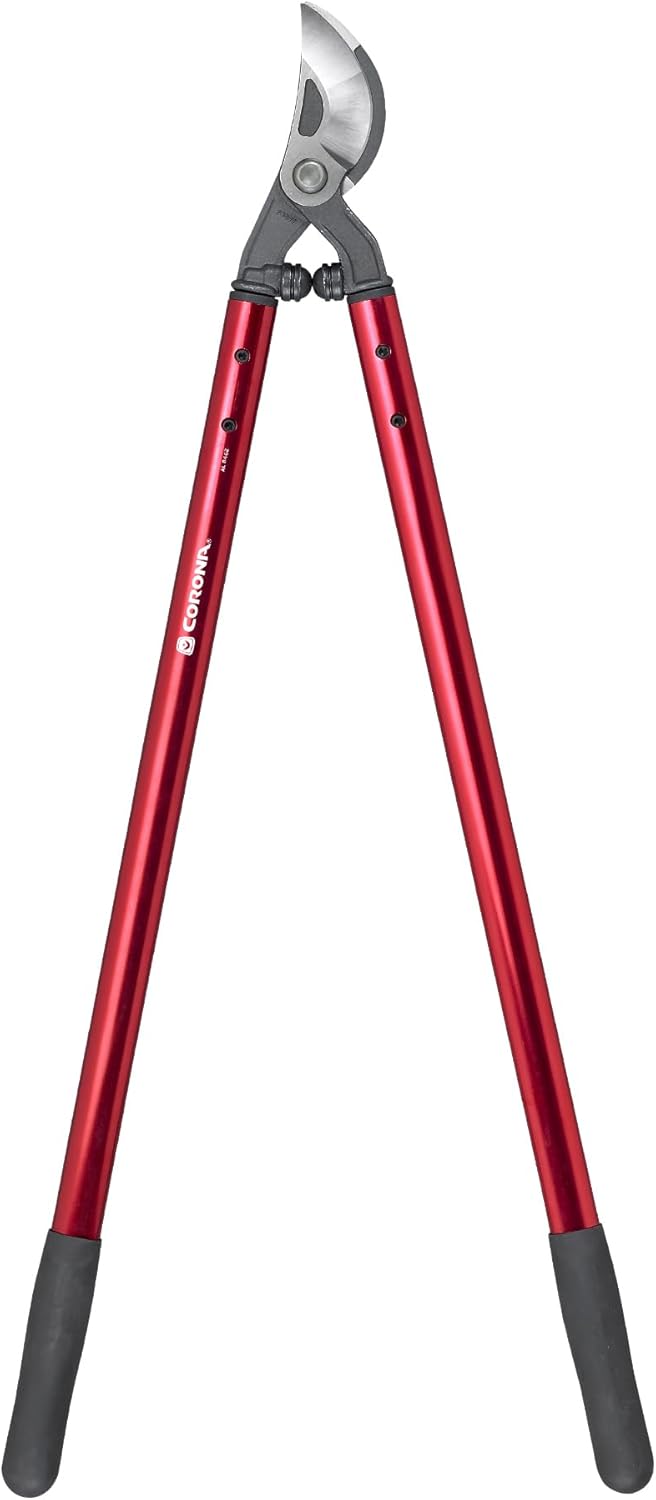
| Cutting width | 2.25 inches |
|---|---|
| Size | 32" |
| Blade Type | Bypass |
| Blade Material | Titanium |
The Corona MAXFORGED AL 8462 orchard loppers are built for heavy pruning and orchard work where power and durability matter. With MAXFORGED steel blades and a 32-inch handle length, these bypass loppers generate strong leverage to cut through branches up to 2.25 inches in diameter; the serrated blade edge helps prevent slipping on thicker wood. Typical use is seasonal tree pruning, removing large shoots, and routine orchard maintenance where repeated, confident cuts are needed. The titanium-coated blade material and alloy-steel handles give the tool a robust feel and resist wear from frequent use. Practical benefits include cleaner, more controlled cuts that encourage healthier regrowth and a high-visibility red finish that is easy to find in a busy shed. The trade-offs are the tool's larger footprint and weight, which make it less convenient for light touch-up pruning or extended overhead work without breaks. For backyard users who need real cutting power, these loppers perform like a pro-grade tool and hold up to demanding jobs.
Best for: Gardeners and landscapers who prioritize cutting performance and durability for larger branches and orchard maintenance and who want a tool that handles frequent heavy pruning.
Less Ideal for: Casual gardeners who only need light pruning, people who prefer a very lightweight tool for extended overhead work, or those focused on delicate shaping tasks.
- MAXFORGED steel construction for strength and durability under heavy use
- 32-inch handles provide excellent leverage for cutting thicker branches
- Bypass, serrated blades deliver clean, controlled cuts that reduce damage to live wood
- Ambidextrous design suits both left- and right-handed users
- Larger size and weight can be tiring during long sessions or for small users
- Not suited for very fine pruning or detailed shaping work
Verdict: Choose these loppers when you need pro-level leverage and forged steel strength to cut through large branches reliably.
GARTOL 29-Inch Heavy Duty Anvil Lopper with Compound Action

| Cutting width | 2 inches |
|---|---|
| Blade Type | Anvil |
| Blade Material | High Carbon Steel (SK5) with Teflon coating |
| Handle Material | Iron with TPR grip |
The GARTOL 29-inch anvil lopper is built for heavy pruning of dry and woody growth where extra leverage is needed. Its four-bar compound linkage multiplies hand force to make cutting thicker branches noticeably easier, and the Teflon-coated SK5 carbon steel blade resists sap build-up and stays sharper longer. The tool is typically used for removing dead limbs, cutting back mature shrubs, and general yard cleanup where clean bypass cuts are not required. Handles are long and rigid iron tubes with non-slip TPR grips that give good control when applying force. Practical benefits include replaceable blade and anvil parts for longer service life and a 2-inch cutting capacity that covers most small-to-medium hardwood branches. Important limitations are that anvil-style cutting can crush live green wood and does not leave the same clean wound as bypass loppers, so it is best reserved for dead or woody material. Also the tool is sizeable and geared for leverage rather than precision around delicate plants.
Best for: Home gardeners and budget-conscious yard keepers who need a durable, high-leverage tool for removing dead or woody branches without frequent replacement.
Less Ideal for: Pruners focused on precise, live-wood pruning or working in dense, tight planting beds should choose a bypass lopper or smaller shears instead.
- Compound-action four-bar linkage increases cutting power about threefold compared with standard loppers
- Teflon-coated SK5 high-carbon steel blade resists sap and corrosion for smoother cuts
- Replaceable blade and anvil extend usable life and reduce long-term replacement cost
- Long, stiff handles with non-slip TPR grips provide strong leverage and control
- Anvil-style cutting can crush live green branches and is not ideal for making clean pruning cuts on healthy plants
- Heavier, longer design reduces maneuverability in tight spaces or for fine pruning
Verdict: A cost-conscious, heavy-duty anvil lopper that delivers extra cutting power and replaceable parts for long-term yard work on dead and woody branches.
Hickok 36" Heavy Duty Bypass Loppers

| Cutting width | 2.25 inches |
|---|---|
| Blade Material | Alloy Steel |
| Handle Material | Aluminum |
| Blade Type | Bypass |
The Hickok 36-inch heavy duty loppers are built for demanding pruning tasks where leverage and blade strength matter. The long aircraft-grade aluminum handles reduce user fatigue while delivering strong cutting force, and the forged high-alloy steel bypass blade with a deep hook is shaped to hold and slice through branches cleanly. In practice this tool is used for trimming medium to large limbs, orchard work, hedge shaping, and clearing storm-damaged growth — the 2.25-inch cut capacity covers most heavy backyard and commercial pruning needs. Notable features include ambidextrous operation, a sharp bypass edge for cleaner cuts that help plant health, and a commercial-grade build made in the USA. The main limitations are the fixed long handle length, which makes the lopper less maneuverable in very tight spaces and heavier to swing overhead compared with shorter models, and it requires routine sharpening and pivot maintenance to stay at peak performance. For someone who wants a durable, pro-level lopper that balances power and reduced weight, this is a solid choice.
Best for: Gardeners and professionals who need a sturdy, long-reach lopper for regular heavy pruning, orchard work, or clearing large limbs and who value durability over compactness.
Less Ideal for: Casual gardeners looking for a compact or lightweight tool for frequent close-up trimming or for users who need telescoping reach or very low tool weight.
- Forged high-alloy steel blade delivers strong, clean cuts up to 2.25 inches
- Aircraft-grade aluminum handles reduce weight and user fatigue
- Commercial-grade construction made in the USA for durability
- Ambidextrous design suitable for left- or right-handed use
- Fixed 36-inch length can be awkward in tight spaces or for precise low-level work
- Requires periodic sharpening and pivot maintenance to retain cutting performance
Verdict: A professional, durable 36-inch lopper that gives strong clean cuts and reduced fatigue for regular heavy pruning tasks.
Fiskars PowerGear2 32" Bypass Lopper — 2" Cut Capacity

| Cutting width | 32 inches |
|---|---|
| Cut capacity | 2 inches |
| Blade Type | Bypass |
| Blade Material | Alloy Steel |
| Handle Material | Aluminum |
The Fiskars PowerGear2 32" bypass lopper is built for pruning medium-thick branches with less wrist and hand strain. Its patented PowerGear2 leverage multiplies cutting force so a single-handed pull slices through up to 2" green wood that would otherwise need much more effort. The hardened alloy-steel blades have a low-friction coating to resist gumming and rust and the serrated edge helps hold the branch while you cut. Long aluminum handles with SoftGrip touchpoints give comfortable control and reach for higher or deeper cuts. Practical benefits include cleaner cuts on live growth, better mechanical advantage compared with basic loppers, and durable construction backed by a lifetime warranty. Limitations are that it is a fixed-length, non-telescoping tool so reach is limited to 32" and it is intended for live branches up to 2" in diameter rather than heavy deadwood or very large limbs. Users should still use pruning judgment for branch size and safety when working above shoulder height.
Best for: Buyers who want a proven, lower-effort lopper for routine pruning and shaping of trees and shrubs where social proof and reliability matter.
Less Ideal for: If you need extended reach for tall limbs or a tool for cutting very large or dead hardwood branches, choose an extendable or higher-capacity cutter instead.
- PowerGear2 gearing multiplies leverage for easier cutting of up to 2" branches
- Hardened alloy-steel blades with low-friction coating reduce gumming and resist rust
- Serrated bypass blade provides cleaner cuts on live growth
- Long aluminum handles with SoftGrip points improve comfort and control
- Fixed 32" length limits reach compared with extendable loppers
- Not designed for very large or heavily dead wood beyond the 2" cut capacity
Verdict: A reliable, easy-to-use lopper that delivers significantly more cutting power for everyday tree and shrub pruning.
Choosing the Right Loppers for Large Branches: Key Factors to Consider
Cutting Capacity and Blade Type
How wide a branch the loppers can cut determines whether a single tool will handle the job or whether you need to switch to a saw. Rated cutting capacity is often presented in inches or millimeters; aim for a rating comfortably larger than the largest stems you expect to prune so the blade does not bind.
Blade type influences the cutting action. Bypass blades slice like scissors and leave cleaner cuts on living wood, which helps faster healing. Anvil-style blades crush, which can be useful for dead wood but risks damaging living branches. For large live branches, look for bypass blades with robust bevels and enough clearance for thick wood.
Shaft Strength, Length, and Mechanics
Longer shafts give extra reach and leverage, letting you cut higher or reduce bending, but they also increase bending stress and can be harder to control. Shaft material matters: solid forged steel or heavy-duty aluminum with reinforced joints resists torque when cutting thick hardwoods, while telescoping or multi-piece shafts add versatility but must lock securely to avoid failure.
Consider mechanical advantage systems such as compound hinges or gear-driven heads. These reduce the force you need to apply but introduce moving parts that should be well-made and serviceable. For large branches, choose a shaft and hinge system engineered to handle heavy loads without flexing or slipping.
Blade Material and Edge Retention
Blade steel and heat treatment affect how long the edge stays sharp under repeated cuts into tough wood. High-carbon or alloy steels with a durable hardening process maintain a keen edge longer and stand up to pruning abrasive or knotty wood. Coatings can reduce stickiness and slow corrosion, which helps when cutting sap-rich or wet branches.
A blade that is easy to sharpen in the garden or at home prolongs the life of the loppers. Consider whether replacement blades or sharpening access is available; a well-maintained edge reduces the force needed and produces healthier cuts on living trees.
Ergonomics and User Comfort
Cutting large branches often requires two-handed effort and sustained pressure. Comfortable, non-slip grips reduce hand fatigue and improve control. Grip diameter should suit your hands, and cushioned handles or vibration-damping features help when making repeated cuts.
Balance matters: a head-heavy tool leaves you fighting the weight, while an evenly balanced pair feels more predictable when swinging or positioning. Also consider how the tool behaves when working from ladders, stands, or uneven ground; narrow profile heads and smooth action can make awkward cuts safer.
Maintenance, Repairability, and Weather Resistance
Tools exposed to sap, moisture, and dirt need corrosion-resistant finishes and hardware that resists seizing. Loppers that disassemble for sharpening, part replacement, or hinge lubrication last longer and offer better long-term value.
Look for replaceable bolts, accessible pivot points, and straightforward sharpening angles. A lopper that can be maintained with basic tools and occasional lubrication will keep cutting reliably across seasons, reducing the chance of blade binding or joint failure when tackling large branches.
Weight and Portability for Garden Tasks
Weight affects how long you can work comfortably and how easy the loppers are to carry between sites. Heavier-duty loppers built for thick branches often weigh more because of stronger shafts and larger blades. Decide whether you need maximum cutting power for occasional heavy pruning or a lighter tool for frequent general use.
Portability also includes whether the tool collapses or telescopes for transport and storage. If you move between beds, climb ladders, or carry tools long distances, a design that balances cutting capacity with manageable weight is preferable.
When to Use Loppers Instead of a Saw
Loppers are ideal for cutting branches that are too big for pruners but still within a diameter you can reach and control safely. They are faster than bringing out a saw for mid-sized limbs and leave cleaner cuts on live wood when using bypass blades.
If a branch exceeds the lopper's rated capacity or is awkwardly positioned, switch to a pruning saw to avoid stressing the tool or risking a stuck blade. Use loppers for pruning tasks where leverage and clean scissor-like cuts are the priority.
- Use loppers for stems roughly up to the tool's rated diameter, typically small to medium hardwood limbs.
- Avoid forcing loppers through oversized branches to protect the hinge and shaft.
Safety Practices for Cutting Large Branches
Cutting big branches changes force dynamics and increases risk. Always wear eye protection and gloves, and clear the area below the branch before cutting to avoid falling-object injuries. Position yourself so the branch will fall away from you and others.
Be mindful of overhead hazards like power lines. When working from ladders, have a stable partner or use platform support. If a cut looks under tension or may snap unpredictably, consider using wedges or making relief cuts, or switch to a saw and adopt a safer multi-step approach.
- Inspect the branch for rot or cracks that could cause sudden breakage.
- Stand to the side of the cutting line and keep bystanders clear.
Sharpening and Basic Maintenance Tips
Keep blades sharp for cleaner cuts and less physical effort. Use a fine file or sharpening stone following the blade bevel, and maintain the original angle. Clean sap and debris after use with a rag and mild solvent, then dry and apply a light oil to prevent rust.
Check pivot bolts and locking mechanisms regularly and tighten as needed. If a compound hinge becomes stiff, disassemble if possible, clean old grease, and apply fresh lubricant to keep motion smooth under load.
- Sharpen blades in small increments and test cuts on scrap wood.
- Store loppers in a dry place with the blades closed and locked.
Working From Height and Reaching Taller Branches
For high branches, long-handled loppers give extra reach but reduce control. Use a stable ladder or a pruning platform when precision is required. Consider the tradeoff between reach and leverage: a very long shaft increases torque and may require more force or a compound-action mechanism to cut large stems.
If you need both reach and power, look for loppers that combine a sturdy shaft with a high-mechanical-advantage head. When possible, have a partner steady the ladder or support the branch while you cut to reduce movement and improve safety.
- Plan each cut so the branch falls in a safe direction.
- Avoid overreaching; move the ladder instead of stretching your arms.
Choosing Between Replaceable and Integral Blades
Replaceable blades let you swap in a fresh cutting edge or a different blade geometry if you cut a lot of varied wood. Integral blades that are part of the head can be stronger at the joint but may be harder to replace or service. Decide which approach fits your maintenance habits and expected usage.
If you prefer simple field serviceability, prioritize designs with easy replacement hardware and commonly available parts. If you want maximum rigidity and fewer failure points under heavy loads, an integrated blade-head design with robust pivot hardware may be better.
- Check vendor or manufacturer guidance for blade replacements and spare parts availability.
- Consider ease of disassembly for sharpening when evaluating designs.
How We Chose the Best Loppers for Large Branches
We focused on tools built to handle big-diameter pruning in yards and small-acreage settings. Selection favored loppers with confirmed cutting capacity for large branches, robust shaft or handle construction, and blade designs that maintain a sharp edge against hardwood. We prioritized models that balance reach and control so gardeners can cut thicker stems without excessive fatigue or unsafe body positions. Evaluation criteria included maximum cutting diameter or rated branch size, shaft material and strength under torque, blade geometry and edge-retention, ergonomics and grip comfort for two-handed use, and overall durability for seasonal heavy use. We excluded light-duty or bypass models rated only for small ornamental pruning and any loppers intended primarily for hedge shaping. The final list contains tools that meet load-bearing expectations while remaining practical for regular garden maintenance.
FAQ
What diameter of branch can loppers for large branches typically cut?
Typical heavy-duty loppers are rated to cut wider diameters than hand pruners, often several inches across. Ratings vary by model, so match the stated cutting capacity to the largest live stems you plan to prune; if unsure, assume a lower safe limit and use a saw for bigger limbs.
Are bypass or anvil loppers better for big live branches?
Bypass loppers are usually better for live branches because they make a slicing cut that promotes faster healing. Anvil styles can be effective on dead wood but may crush living tissue and increase the risk of damage on large live stems.
How important is a compound hinge for cutting large branches?
Compound hinges reduce the force you need to apply, which is helpful when cutting thick hardwood. They introduce more moving parts though, so quality of construction matters. A well-built compound system can make heavy pruning much easier for most gardeners.
Can I use telescoping loppers for large branches?
Telescoping loppers provide adjustable reach but must have secure locks and robust shaft materials to handle torque. They can be practical if you need variable reach, but verify the locking mechanism and overall shaft strength before relying on them for heavy cuts.
How often should I sharpen lopper blades used on large branches?
Frequency depends on how abrasive the wood is and how often you prune. For seasonal heavy use, check and sharpen blades every few weeks or whenever cuts start to tear rather than slice cleanly. Regular minor touch-ups are better than infrequent major sharpening.
Are heavier loppers always better for big branches?
Not always. Heavier loppers often mean stronger construction and larger blades, but they can tire you faster and be harder to maneuver. Balance the need for cutting power with how long you will use the tool and whether you need to carry it between sites.
Final Verdict
For pruning large branches, prioritize cutting capacity, a strong shaft and secure hinge system, and a blade that stays sharp under heavy use. Recognize the tradeoff between reach and control: the longest, most powerful loppers are not always the best choice if you will use them for extended periods or in tight spaces. Choose a tool that matches the maximum branch diameter you expect, offers serviceable components for sharpening and maintenance, and feels comfortable in your hands. With the right balance of strength and ergonomics, you can tackle heavy pruning tasks more safely and with cleaner cuts that promote tree health.
