

Note: This article contains affiliate links. If you click on these links and make a purchase, I may earn a small commission at no extra cost to you. This helps support my research and content. Read my full affiliate disclosure here.
Spring is the time when perennial broadleaf weeds push new growth and threaten a tidy lawn. Choosing the right spring weed killer for lawns matters because the wrong product can scorch turf, leave bare patches, or fail to stop resprouting weeds. This guide shortlists the top options suited for common cool- and warm-season turfgrasses and evaluates them on real garden concerns like weed control speed and turf safety. The picks below have been selected for gardeners who want reliable spring control with manageable recovery time. Read on to understand the evaluation criteria and practical use tips before you apply anything to your lawn.
Top Picks at a Glance
| Best Overall The best all-around choice for most situations | Scotts Turf Builder Halts Crabgrass Preventer with Lawn Food (covers 5,000 sq. ft.) |  |
| Best Quality Built to a higher standard if you want something more solid | Scotts Turf Builder Weed & Feed Lawn Fertilizer, 42.87 lb |  |
| Best Value The sweet spot between price and what you get | Scotts Liquid Turf Builder with Plus 2 Weed Control, 32 fl. oz. |  |
| Best Budget The cheapest option that still gets the job done reliably | Spectracide Weed Stop for Lawns Plus Crabgrass Killer, Ready-to-Use, 1 Gallon |  |
| Highest Rated A top-rated pick with lots of positive feedback | Quali-Pro Prodiamine 65 WDG Pre-Emergent Herbicide, 5 lb |  |
Scotts Turf Builder Halts Crabgrass Preventer with Lawn Food (covers 5,000 sq. ft.)

| Item Form | Granule |
|---|---|
| Coverage | 5000 square feet |
| Fertilizer analysis | 30-0-4 |
| Unit Count | 213.6 Ounce |
Scotts Turf Builder Halts combines a pre-emergent crabgrass preventer with a spring lawn fertilizer so you both stop new crabgrass from sprouting and feed your turf for faster green-up. It is designed for early spring application to established warm- and cool-season lawns (examples listed on the label) and requires watering within a few days after spreading to activate the barrier. Typical use is broadcasting the granules with a rotary or drop spreader at the recommended setting and applying before temperatures regularly reach the 80s. The package covers 5,000 sq. ft., making it well suited to small to medium yards or targeted areas. The product will not kill existing mature weeds so it works best as a preventive step in a seasonal care plan rather than a curative treatment. For best results follow the timing and spreader settings on the label and avoid using on dichondra or bentgrass. If you need to remove active crabgrass now you will need a post-emergent solution in addition to this product.
Best for: Homeowners who want a simple, preventative spring treatment that both feeds the lawn and blocks new crabgrass from emerging, and who plan seasonal lawn maintenance with a spreader.
Less Ideal for: People needing an immediate cure for existing crabgrass or those with dichondra or bentgrass lawns should choose a different product or an additional post-emergent treatment.
- Combines pre-emergent weed control with fertilizer for two functions in one application.
- Clear application instructions and recommended spreader settings simplify correct coverage.
- Feeds lawn for faster spring green-up while establishing a seasonal barrier against listed grassy weeds.
- Suitable for a wide range of common turfgrass types listed on the label.
- Bag quantity covers a defined 5,000 sq. ft. area, useful for planning applications.
- Does not control established or mature crabgrass or other existing weeds.
- Not safe for dichondra and bentgrass, so limited on those lawn types.
Verdict: A convenient early-spring two-in-one granular that prevents new crabgrass while feeding your lawn for a quicker spring green-up.
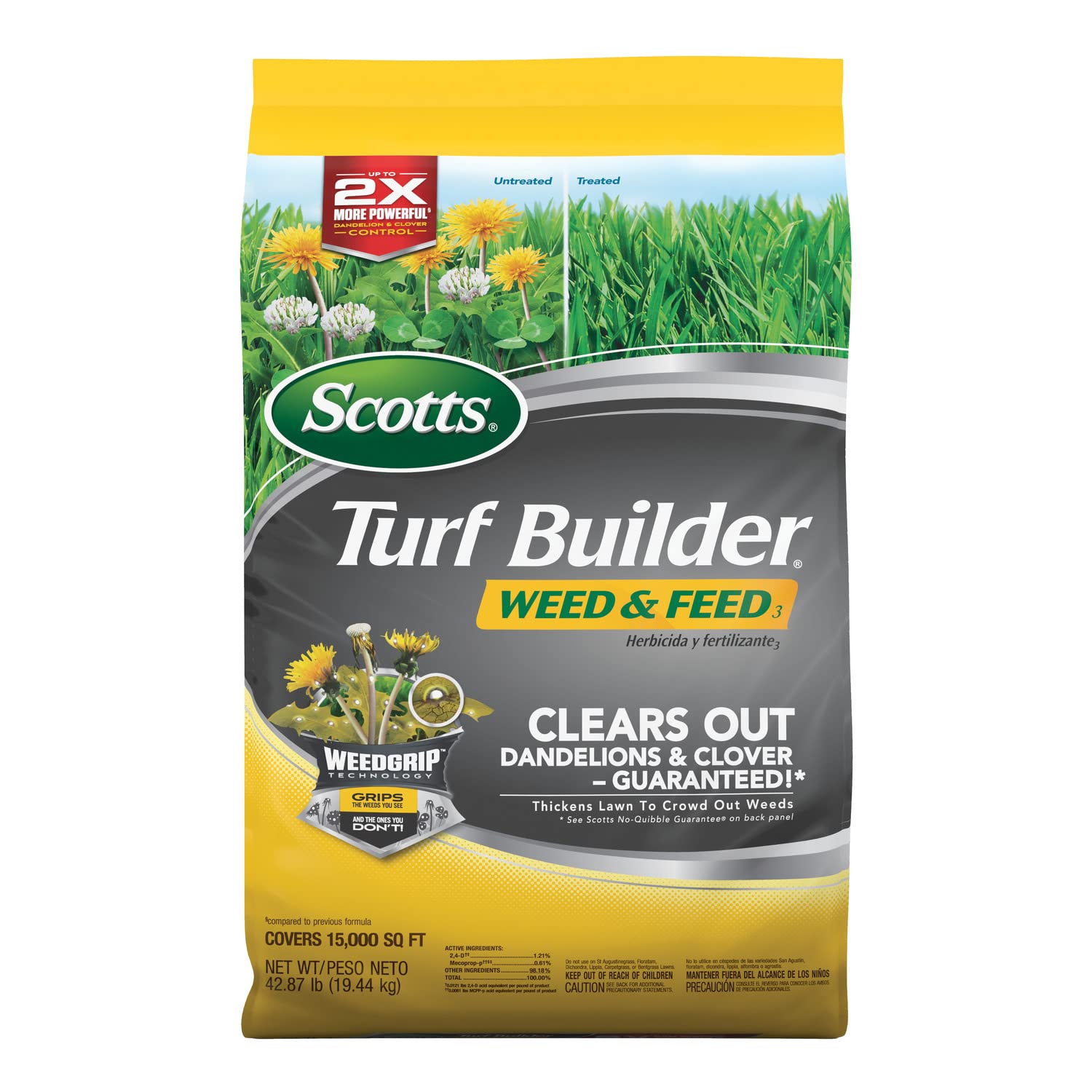
Scotts Turf Builder Weed & Feed Lawn Fertilizer, 42.87 lb
| Item Form | Granule |
|---|---|
| Coverage | 15000 square_feet |
| Active Ingredients | 24-D Mecoprop-p |
Scotts Turf Builder Weed & Feed is a granular combination product intended for late-spring application when broadleaf weeds are actively growing. You spread it over a wet lawn using a broadcast or drop spreader set to Scotts' recommended settings; the herbicide particles stick to weed leaves and the fertilizer feeds the turf to encourage thicker growth that helps suppress future weeds. Notable features include WeedGrip Technology for improved weed contact, labeled control of more than 50 listed weeds such as dandelion and clover, and coverage rated up to 15,000 sq. ft. per 42.87 lb bag, which suits larger yards. Practical benefits are targeted broadleaf weed control and simultaneous feeding so you can treat and feed in a single pass. Important limitations: it should not be applied to certain grass types (for example St. Augustine and bentgrass), it requires specific temperature and moisture conditions for best results, and you must keep people and pets off the lawn until dust settles and avoid watering for 24 hours after application.
Best for: Gardeners who prioritize visible, fast broadleaf weed reduction and want a single-product solution to both kill weeds and feed a large lawn in late spring.
Less Ideal for: Owners of lawns planted with St. Augustine, bentgrass, or other listed sensitive turf species and gardeners who need a year-round or crabgrass-specific program.
- Combines weed control and fertilizer so you can treat and feed in one application
- WeedGrip Technology improves herbicide contact for better control of visible broadleaf weeds
- Large coverage suitable for up to 15,000 sq. ft., reducing how often you need to buy product
- Not safe for several turfgrass types including St. Augustine and bentgrass
- Requires application only when weeds are actively growing and when daytime temps are 60°F–90°F to be effective
Verdict: Choose this if you want a single, performance-focused late-spring treatment that kills common broadleaf weeds while feeding and thickening a large lawn.
Scotts Liquid Turf Builder with Plus 2 Weed Control, 32 fl. oz.

| Item Form | Spray |
|---|---|
| Coverage | 6000 square_feet |
| Liquid Volume | 32 fluid ounces |
| Active Ingredients | Nitrogen |
This ready-to-spray Scotts bottle combines a liquid lawn food with a broadleaf weed killer so you can feed and treat a lawn in one pass. You connect the hose-end applicator, spray evenly when weeds are actively growing, then stop and disconnect the hose; the formula begins working on contact and weeds typically curl within days. The product targets common lawn weeds such as dandelions and clover and supplies nitrogen to improve turf vigor. Practical benefits include fast coverage without mixing, up to 6,000 sq ft treatment on warm-season lawns (4,000 sq ft for cool-season lawns), and simple timing guidance to avoid watering for 48 hours after application. Limitations to consider are that it only controls listed broadleaf weeds so grassy weeds and some stubborn species may need repeat or alternative treatments, and application warnings mean you must avoid spraying when temperatures exceed 85°F and keep it off garden beds and non-listed turf. Some warm-season grasses may show temporary injury, so follow on-label directions for your grass type.
Best for: Homeowners who want a quick, no-fuss spring treatment to feed turf and knock back common broadleaf weeds in a single step and who prefer straightforward, time-efficient lawn care.
Less Ideal for: Those needing selective control of grassy weeds, users with vegetable or flower beds adjacent to treated areas, or lawn managers who need treatments safe for all grass varieties under heat stress.
- Ready-to-spray hose-end bottle requires no measuring or mixing
- Combines lawn fertilizer and broadleaf weed control in a single application
- Covers large areas: up to 6,000 sq ft for warm-season lawns and 4,000 sq ft for cool-season lawns
- Starts working on contact so visible weed curling appears within days
- Only controls listed broadleaf weeds and will not manage grassy weeds
- Requires a 48-hour no-water window after application to be effective
Verdict: A fast, no-mix spring solution to feed your lawn while knocking down common broadleaf weeds across a large yard.
Spectracide Weed Stop for Lawns Plus Crabgrass Killer, Ready-to-Use, 1 Gallon

| Item Form | Spray |
|---|---|
| Coverage | Up to 5,000 sq ft |
| Liquid Volume | 1 gallons |
This one-gallon ready-to-use Spectracide formula is designed to kill a wide range of common lawn weeds on contact while leaving turf unharmed when used as directed. It is typically applied with the built-in sprayer across lawns after mowing, during daytime temperatures between about 45°F and 90°F. Notable features include a contact formula that claims visible results in roughly five hours, coverage up to 5,000 square feet per container, and a long list of targeted weeds that includes crabgrass, dandelion, clover, and yellow nutsedge. The practical benefit is convenience: no mixing or extra equipment is required and a single jug treats a medium-sized yard. Important limitations are temperature constraints and specific guidance for Bermudagrass where temporary discoloration can occur if applied above recommended temperatures, so timing matters in spring. Also, because it kills by contact, new weed growth or missed patches may need repeat treatments for fuller control.
Best for: Budget-minded homeowners who want a convenient, no-mix weed spray to treat a typical spring lawn and prefer a single-product solution for common weeds.
Less Ideal for: People managing large acreage or those wanting systemic, long-term preemergent crabgrass control should consider professional products or complementary treatments.
- Ready-to-use spray requires no mixing or extra applicator
- Kills both broadleaf and grassy weeds, including crabgrass
- Visible results in about five hours after application
- Covers up to 5,000 square feet per gallon
- Effectiveness depends on contact so missed areas or new weeds may need reapplication
- Has temperature limits and can temporarily discolor Bermudagrass if applied too hot
Verdict: A convenient, ready-to-use gallon that treats a medium lawn and quickly knocks down a wide range of spring weeds without mixing.
Quali-Pro Prodiamine 65 WDG Pre-Emergent Herbicide, 5 lb

| Item Form | Granule |
|---|---|
| Coverage | Pre-emergent grass and broadleaf weed control, season long crabgrass control |
| Active Ingredients | Prodiamine 65% |
Quali-Pro Prodiamine 65 WDG is a professional-strength pre-emergent herbicide sold as yellow granules designed to prevent germination of common annual turf weeds. It is typically broadcast over lawns, turf, and landscape areas in spring or fall before weed seeds germinate; the granules are watered in to form a protective barrier in the topsoil. The 65% prodiamine formulation gives long residual control of crabgrass and many broadleaf annuals, and the product is stated to tank-mix well with fertilizers and iron solutions for combined feed-and-prevent treatments. Practical benefits include reliable season-long suppression when applied at recommended timing and rates, and suitability for large areas such as lawns, golf courses, and landscape beds. Important limitations are that it is a preventive product only so it will not control weeds already emerged, and correct timing and even application are essential for effectiveness; it also requires following label precautions for turf species and non-target plants. This product best suits users who prioritize consistent, long-lasting pre-emergent control and are comfortable with scheduled preventive applications.
Best for: Buyers who want dependable, season-long prevention of crabgrass and other annual turf weeds and who plan applications at the correct pre-germination timing.
Less Ideal for: Gardeners seeking a post-emergent solution for existing weed infestations or those who prefer non-chemical cultural weed control methods.
- High-concentration active ingredient (Prodiamine 65%) for long residual control
- Formulated as granules that can be mixed with fertilizer or iron solutions
- Labeled for use on lawns, turf, and large sites like golf courses and landscapes
- Works only as a pre-emergent and will not kill established weeds
- Effectiveness depends on correct timing, watering-in, and even coverage
Verdict: Choose this product when you need a proven, long-lasting pre-emergent to prevent spring and fall annual weeds in lawns.
Choosing the Right Spring Weed Killer for Lawns: Key Factors to Consider
Type of Weeds Present
Different herbicide chemistries target different weed groups. Broadleaf weeds like dandelions, clovers, and plantain respond to selective phenoxy and auxin-type products, while grassy weeds need different active ingredients. Knowing whether your lawn problem is primarily broadleaf, grassy, or seedling annuals determines which spring weed killer for lawns will be effective.
Misidentifying the weed type leads to wasted applications and slower recovery. Spend a few minutes in spring inspecting common patches and note whether the plants have broad leaves, rosette growth, or grassy blades before selecting a treatment.
Turfgrass Species and Sensitivity
Cool-season grasses and warm-season grasses differ in their tolerance to herbicides and to early-season stress. Some chemistries are safe on one turf species but can damage another, particularly when grasses are coming out of dormancy or under cool, wet conditions.
Match the product label recommendations to your grass type and avoid applications when turf is stressed by drought, recent reseeding, or extreme cold. Lawn sensitivity affects both the timing and the concentration you should use for spring applications.
Timing and Lawn Growth Stage
Spring timing matters because many selective weed killers work best when weeds are actively growing, not when they are dormant or just germinating. Apply when soil temperatures and air temperatures promote weed growth but before weeds set seed for best season-long control.
Early application can reduce competition as turf green-up proceeds, but too-early use on very slow-growing grass increases the chance of turf injury. Consult local growing cues such as consistent daytime temperatures or common bloom times for indicator weeds.
Application Method and Precision
Products come as ready-to-use sprays, hose-end concentrates, or granular formulas. Sprays allow for targeted spot treatments while granulars simplify broadcast coverage for larger lawns. Hose-end and concentrates can be cost-effective but require careful calibration to avoid uneven application.
Precision matters to avoid streaks, overlap, or missed areas. Consider the shape and access of your lawn, presence of landscaping beds, and whether you prefer spot treating individual weeds or treating the entire lawn for even control.
Environmental and Non-target Considerations
Runoff, drift, and proximity to pollinator plants or water features influence product choice. Some active ingredients have specific buffer requirements near bodies of water or ornamental beds. Look for labels that specify restrictions and follow them precisely to reduce off-target damage.
Avoid applying before heavy rain, use droplet size and nozzle types that reduce drift, and consider timing applications to limit exposure of flowering plants visited by bees and other pollinators.
Post-application Lawn Care
How you care for the lawn after application affects recovery and long-term results. Mowing height, watering schedule, and reseeding windows all interact with herbicide activity. For example, some products advise waiting a specific number of days before overseeding or heavy watering.
Plan post-application practices so turf recovers quickly: follow recommended wait times before reseeding, avoid scalping during recovery, and resume a regular fertilization plan only when the grass shows healthy regrowth.
When To Treat In Spring
Target weeds when they are actively growing but before they set seed. For many regions that means treating in early to mid-spring once soil temperatures consistently rise and lawn growth resumes.
If you wait too long you risk more extensive seed production and root reserves that make weeds harder to control. Conversely, treating too early during turf dormancy increases the chance of injury.
- Look for leaf-out and steady daytime temperatures as cues
- Avoid applications before heavy rain or frost
- Spot-treating small patches can delay a full-lawn application
Safe Application Tips
Read and follow label directions for rates, spray pressure, and protective equipment. Use the recommended nozzle and maintain steady walking speed for even coverage.
Calibrate hose-end or concentrated sprayers before treating the lawn, and avoid applying on windy days to reduce drift onto garden beds or neighboring properties.
- Wear gloves and eye protection as directed
- Keep children and pets off treated areas for the label-specified time
- Rinse equipment thoroughly after use
Spot Treatment Vs Whole-Lawn Approaches
Small, isolated weed patches are often best handled with spot treatments to minimize chemical use and reduce risk to turf and surrounding plants. For widespread weed pressure or preemptive seasonal control, whole-lawn applications deliver more uniform results.
Consider starting with spot treatments in early spring and switching to a broader application only if weed pressure increases or covers a large portion of the lawn.
- Spot treat when infestations are under 15 percent of lawn area
- Use broadcast coverage when weeds are widespread or for consistent preemergent programs
Combining Cultural Practices With Chemical Control
Healthy turf is the best long-term defense against weeds. Pair chemical control with cultural practices like proper mowing height, timely fertilization, and core aeration. These measures reduce bare spots and give desirable grass a competitive edge.
Overreliance on herbicides without improving lawn care often leads to recurring problems. Integrating both approaches improves the durability of spring control.
- Raise mower height in spring to encourage deeper roots
- Address soil compaction and thin areas before overseeding
- Fertilize according to your grass type and local recommendations
Safety Around Pets and Play Areas
If your lawn is a frequent play area for children or pets, choose products with clear re-entry intervals and follow those wait times strictly. Some formulations require watering in after a certain period to reduce residue while others simply need a set dry time.
Consider timing applications when pets can be kept indoors or in a separate area until the product is no longer active on the grass surface.
- Post signs or otherwise mark treated areas until safe
- Store all herbicides out of reach and in original containers
- Consider spot-treating high-traffic areas last
How We Chose the Best Spring Weed Killer for Lawns
We focused on treatments suited to spring application windows and common turfgrasses, prioritizing products that reliably control broadleaf weeds while minimizing harm to desirable grass. Key evaluation criteria included documented effectiveness against typical spring weeds, turf safety margin across common lawn species, and speed of visible control, because gardeners want to see results before heavy use periods. We also checked application flexibility such as hose-end, granular, or ready-to-use formats and how easy directions are to follow for safe timing and coverage. We excluded products labeled only for non-turf uses, spot-only herbicides that lack lawn-wide guidance, and formulations requiring professional licensing. We favored options that balance control and recovery rather than extreme strength that increases burn risk. The list reflects products that fit a range of lawn sizes and gardener skill levels while emphasizing clear label instructions and predictable outcomes.
FAQ
Can I apply a spring weed killer right after overseeding?
Usually it depends on the product and the seed species. Many selective herbicides advise waiting several weeks after overseeding to allow seedlings to establish. Check the label for specific wait times and prioritize seed safety to avoid damaging new turf.
Will a spring weed killer damage flower beds next to the lawn?
Drift and runoff can harm adjacent ornamentals. Use low-drift nozzles, avoid spraying on windy days, and keep a safe buffer from planted beds. For delicate plants, consider spot treating or applying barriers during application.
How long before rainfall can I apply a liquid spring weed killer?
It often depends on the formulation. Some products require a dry period of a few hours to adhere to leaves, while others instruct watering in after application. Follow label guidance and avoid applying right before heavy rain to prevent wash-off and reduced effectiveness.
Can I use the same spring treatment on cool-season and warm-season lawns?
Not always. Some active ingredients are labeled for one turf type and not the other, and timing differs by grass species. Match the product label to your turf to avoid injury and to ensure the herbicide is effective against the weeds present.
Is spot treating better than whole-lawn application?
Spot treating conserves product and reduces non-target exposure when weed pressure is low. Whole-lawn applications are more efficient for widespread infestations or preventive programs. Choose based on infestation extent and lawn layout.
Final Verdict
Prioritize matching the herbicide chemistry to the types of weeds present and the species of turf in your yard. Timing and application method are the main tradeoffs: early, targeted spot treatments reduce chemical use but may require follow-up, while full-lawn spring applications deliver uniform control but need careful calibration to avoid turf stress. Focus on turf safety margins, follow label directions exactly, and pair chemical treatments with good cultural practices for the best season-long results. With this approach you can confidently choose a spring weed killer for lawns that controls weeds while protecting healthy grass.
