

Note: This article contains affiliate links. If you click on these links and make a purchase, I may earn a small commission at no extra cost to you. This helps support my research and content. Read my full affiliate disclosure here.
If you grow Endless Summer hydrangeas you know they respond strongly to feeding and soil chemistry. The right fertilizer helps produce bigger, longer-lasting flower heads while keeping foliage vigorous through the growing season. This guide focuses on fertilizers formulated for Endless Summer hydrangeas and similar reblooming hydrangeas, summarizing the top picks and why they matter in a garden setting. We shortlisted six fertilizers that suit container and in-ground plantings, then evaluated them on nutrient balance, pH influence, ease of application, and longevity of effect. Read on for practical notes to match a fertilizer to your soil, season, and desired bloom habit.
Top Picks at a Glance
| Best Overall The best all-around choice for most situations | Miracle-Gro Water Soluble Bloom Booster Flower Food, 5.5 lb |  |
| Best Quality Built to a higher standard if you want something more solid | BUILD A SOIL Vegan Bloom Booster Powder Fertilizer, 1 lb |  |
| Best Value The sweet spot between price and what you get | ENVY Acid-Loving Special Water-Soluble Plant Food (24 oz) |  |
| Best Budget The cheapest option that still gets the job done reliably | RAINFLOW 10-30-20 Blossom Booster Water-Soluble Fertilizer (11.28 oz) |  |
| Highest Rated A top-rated pick with lots of positive feedback | Espoma Holly-Tone Organic Fertilizer for Acid-Loving Plants, 4 lb. Bag (Pack of 2) |  |
| Best Seller A high-volume bestseller chosen again and again | Jobe's Organics Granular Rose & Flower Fertilizer, 4 lb |  |
Miracle-Gro Water Soluble Bloom Booster Flower Food, 5.5 lb

| Item Form | Powder |
|---|---|
| Application Method | Mix with water |
| Target Species | Flower |
| Mixing Ratio | 1:Water |
Miracle-Gro Water Soluble Bloom Booster is a powder fertilizer you mix with water to feed flowering plants quickly and regularly. It is designed for container and in-ground flowers and is commonly applied every 7 to 14 days during bud set and bloom; indoor use calls for a much lower dose. The standout feature is its 10-52-10 NPK formula, which supplies a big dose of phosphorus to encourage more blooms and stronger flower color. Practical benefits include fast uptake when watered in, flexible dosing for small pots or larger beds, and broad compatibility with common flowering shrubs and perennials including hydrangeas. The product covers a large area from a single 5.5 lb container when used to recommended rates. Limitations are that frequent feeding is required during the blooming period and the high middle number makes it a bloom booster rather than an all-purpose maintenance feed, so it should be alternated with balanced feeds if you also need vegetative growth or long-term soil building.
Best for: Gardeners who prioritize abundant flowering and want a fast-acting booster for containers or garden beds, especially during bud set and peak bloom.
Less Ideal for: People seeking a single fertilizer for overall plant maintenance or for strong leafy growth should choose a balanced or slow-release formula instead.
- High-phosphorus 10-52-10 formula formulated to promote more blooms
- Water-soluble powder mixes quickly for fast uptake when applied with water
- Flexible application rates for indoor containers and outdoor beds
- Large 5.5 lb container covers up to about 2,200 sq. ft. at recommended rates
- Requires reapplication every 7 to 14 days during bloom period
- Focused on bloom promotion so not ideal as a sole long-term balanced fertilizer
Verdict: Use this water-soluble, high-phosphorus bloom booster when you want visibly more and stronger blooms on hydrangeas and other flowering plants during the bloom period.
BUILD A SOIL Vegan Bloom Booster Powder Fertilizer, 1 lb

| Item Form | Powder |
|---|---|
| Specific Uses For Product | Plant Growth |
| Target Species | Flowers |
| Mixing Ratio | 1 tsp/gal (living soil); 1-2 tbsp/gal (soilless/hydro) |
Build A Soil Vegan Bloom Booster is a powdered, organic-focused fertilizer designed to push flowering performance on hydrangeas, roses, hibiscus and other ornamentals. It is mixed into water (very low rates for living soil, higher for soilless or hydroponics) and applied as a feed to encourage fuller bud set, richer color and extended bloom periods. Notable features include a high-phosphorus leaning formula described as low in nitrogen, a powdered form that stores easily and manufacturer mixing guidelines for a range of uses from container plants to acreage. In practice this product benefits flowering shrubs and container hydrangeas by directing nutrition toward blooms rather than excessive leaf growth, and the powder format makes measuring and customizing strength straightforward. Important limitations are a need to follow protective handling advice when mixing and the requirement to adjust concentration depending on whether you use living soil or soilless media, which adds a small learning step for new users.
Best for: Gardeners who prioritize bloom performance and want a targeted feed to increase flower size and color on Endless Summer hydrangeas and other ornamentals, especially those willing to adjust feed strength by media type.
Less Ideal for: Beginners who prefer one-step granular fertilizers or those looking for an all-purpose feed for foliage-dominant growth rather than bloom-focused results.
- Formulated to boost flowering with a nutrient balance that favors bud formation and color
- Powder form stores compactly and allows precise mixing for different growing systems
- Clear mixing ratios provided for living soil, soilless, hydroponic and acreage applications
- Marketed as vegan and organic-focused, suitable for gardeners avoiding animal-derived inputs
- Requires careful dilution and different rates by growing method, which can be confusing initially
- Contains handling precautions such as avoiding skin and eye contact during mixing
Verdict: Choose this bloom booster when you want a focused, vegan powder fertilizer that pushes fuller, more colorful blooms on Endless Summer hydrangeas.
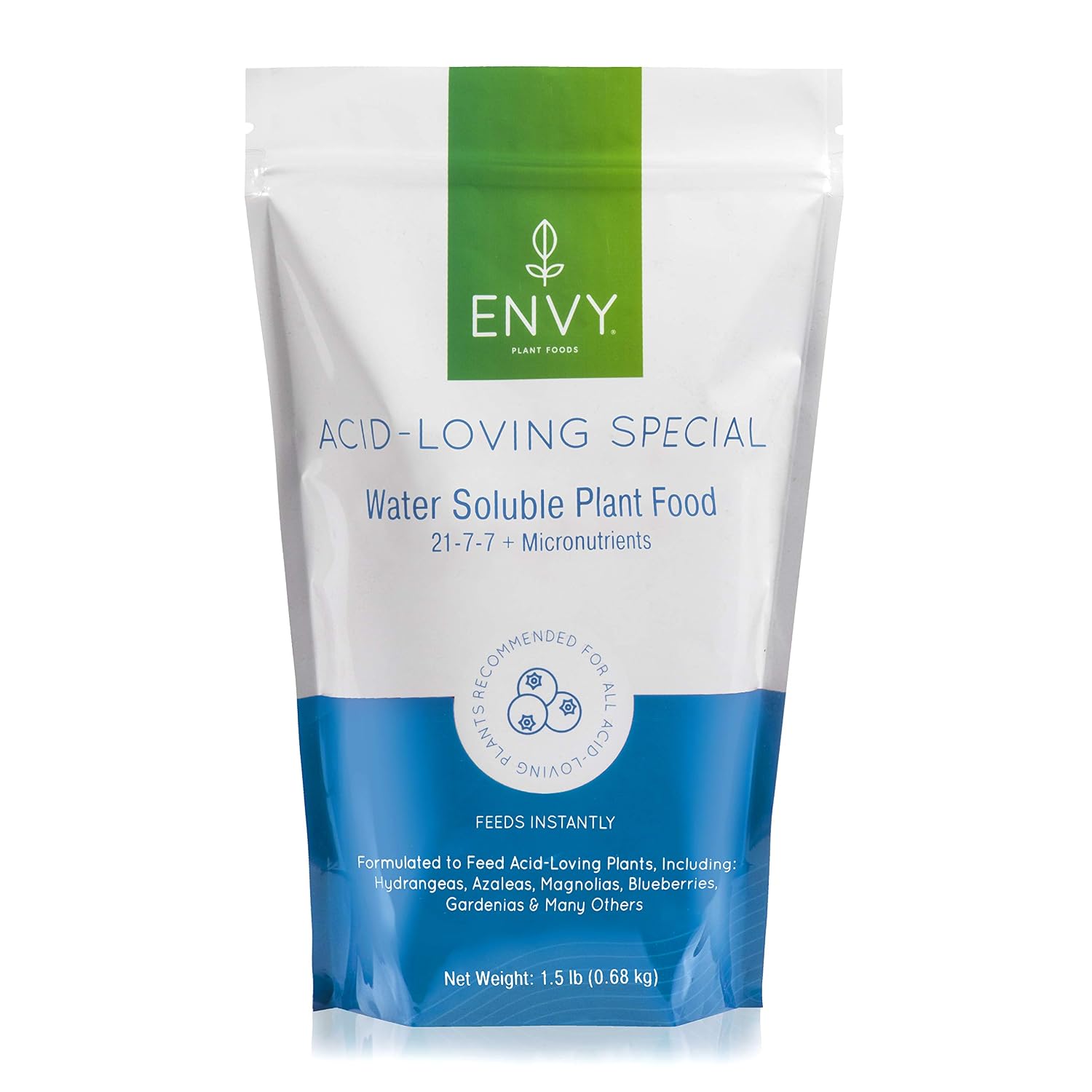
ENVY Acid-Loving Special Water-Soluble Plant Food (24 oz)
| Item Form | Liquid |
|---|---|
| Application Method | Water Soluble |
| Target Species | Azaleas; Hydrangeas; Magnolias; Gardenias; Camellias; Rhododendrons; Blueberries; Citrus |
| Mixing Ratio | 21:7:7 |
ENVY Acid-Loving Special is a liquid, water-soluble plant food designed to feed acid-loving shrubs and fruiting plants. You mix the concentrate at the labeled 21:7:7 ratio and apply it with a watering can or hose-end applicator to encourage leaf growth, stronger blooms and berry set on hydrangeas, azaleas, rhododendrons and blueberries. The formula is targeted for acid-loving species and comes in a resealable pouch with a measuring scoop, which makes dosing easy and reduces waste between applications. Because it is fully water soluble it dissolves quickly and can be used both in-ground and in containers where pH-sensitive plants need extra nutrients. Limitations are that the product is a general acid-loving blend rather than a specialized high-phosphorus bloom booster, and application frequency and exact dilution matter for results so users should follow the directions to avoid overfeeding. For gardeners focused on consistent, straightforward feeding of hydrangeas in summer, this is a usable, low-mess option.
Best for: Gardeners who want a simple, repeatable feeding routine for hydrangeas and other acid-loving shrubs and prefer a low-mess, measurable liquid fertilizer.
Less Ideal for: Growers seeking a bloom-specific high-phosphorus fertilizer or those who prefer granular slow-release feeds for hands-off seasonal feeding.
- Formulated specifically for acid-loving plants including hydrangeas and blueberries
- 100% water-soluble for fast mixing and even distribution
- Resealable pouch and included measuring scoop simplify storage and dosing
- Suitable for use in both containers and landscape plantings
- Not a specialized high-phosphorus bloom booster and so may be less effective for forcing larger flowers
- Mixing ratio requires careful measuring to avoid over-application
Verdict: A practical, water-soluble fertilizer that makes regular summer feeding of hydrangeas and other acid-loving plants quick, measurable, and low-mess.
RAINFLOW 10-30-20 Blossom Booster Water-Soluble Fertilizer (11.28 oz)

| Item Form | Granules |
|---|---|
| Application Method | Water-soluble |
| Target Species | Flowers |
| Unit Count | 11.28 Ounce |
This RAINFLOW 10-30-20 Blossom Booster is a small, water-soluble granule fertilizer aimed at enhancing bloom production and color on flowering shrubs and potted flowers. You mix measured granules into water for a fast-dissolving feed that supplies a high phosphorus ratio to encourage flower formation, making it useful during the flowering season for plants like hydrangeas. It is sold in an 11.28 ounce packet that is easy to store and carry, and the blue granules make measuring and visualizing application straightforward. The formula is versatile enough for outdoor beds, containers, and indoor flowering plants and is formulated for quick absorption so you see results sooner than with many slow-release options. Limitations are the small package size if you have a large planting area and the single NPK balance that is tuned to blooms rather than general maintenance or leafy growth, so you may need a complementary fertilizer for other stages of plant development.
Best for: Home gardeners caring for flowering shrubs and container flowers who prioritize visible bloom improvement on a modest budget and prefer an easy-to-mix, fast-acting feed.
Less Ideal for: Large-scale gardeners or landscapers needing bulk fertilizer for many plants should choose bulk or slower-release formulations better suited to ongoing maintenance.
- High phosphorus 10-30-20 formula that specifically promotes flowering and bloom color
- Water-soluble granules that dissolve quickly for rapid nutrient uptake
- Compact 11.28 oz package that is easy to store and handle for small gardens or containers
- Small unit size may require multiple purchases for larger beds or repeated seasonal use
- Focused NPK ratio favors blooms and is not intended as an all-purpose or foliage-strengthening fertilizer
Verdict: Choose this if you want an affordable, fast-acting, high-phosphorus feed to boost hydrangea blooms and other flowering plants in small gardens or containers.
Espoma Holly-Tone Organic Fertilizer for Acid-Loving Plants, 4 lb. Bag (Pack of 2)

| Item Form | Powder |
|---|---|
| Specific Uses For Product | Organic,Plant Food |
| Application Method | Sprinkle over the root zone and water in |
| Target Species | Acid-loving Plants |
| Unit Count | 128 Ounce |
Espoma Holly-Tone is an organic, slow-release plant food designed for acid-loving species such as Endless Summer hydrangeas. It comes as a ready-to-use powder you sprinkle around the root zone and water in, so no mixing is required. The 4-3-4 NPK formula with added sulfur helps maintain the slightly acidic soil conditions hydrangeas prefer while feeding plants gradually through the growing season. Practical benefits include steady nutrient supply that supports flowering and foliage without a quick flush of growth, and organic certification for use in organic gardens. You can apply it in spring and fall or for berries in early and late spring, which fits routine seasonal care. Limitations are that coverage is described as medium so larger shrub beds may need multiple bags, and as a slow-release organic product results are not immediate compared with synthetic fertilizers. For gardeners who prioritize consistent, low-risk feeding and want an organic option tailored to acid-loving shrubs, Holly-Tone is a reliable choice.
Best for: Gardeners who want a dependable organic fertilizer to maintain soil acidity and steady nutrition for Endless Summer hydrangeas as part of regular seasonal care.
Less Ideal for: Gardeners who need rapid, immediate results or who are treating very large beds on a tight budget should consider higher-coverage or fast-action alternatives.
- Formulated specifically for acid-loving plants, supporting hydrangea health and blooms
- Slow-release organic nutrients provide steady feeding over time
- Ready-to-use powder requires no mixing and is applied by sprinkling around the drip line
- Contains sulfur to help maintain soil acidity preferred by hydrangeas
- Approved for organic gardening
- Medium coverage per bag may require multiple bags for larger plantings
- Effects develop gradually rather than producing quick visible results
Verdict: Choose Espoma Holly-Tone when you want a steady, organic fertilizer that reliably supports flowering hydrangeas and maintains soil acidity.
Jobe's Organics Granular Rose & Flower Fertilizer, 4 lb

| Item Form | Granules |
|---|---|
| Specific Uses For Product | Plant Growth,Root Development,Seed Developmen,tSoil Conditioning |
| Coverage | Medium |
| Target Species | roses, hydrangeas, hibiscus, azaleas, and other flowering shrubs |
| Mixing Ratio | 3-5-3 |
Jobe's Organics Granular Rose & Flower Fertilizer is an OMRI-listed, granular organic fertilizer designed to feed roses and other flowering shrubs during the growing season. You apply it around the root zone every six weeks during bloom time; the granules release nitrogen, phosphate, potash and secondary nutrients to support flower production, root development and soil conditioning. The product's 3-4-3 mixing ratio and measured granule form make it easy to apply without specialized equipment and reduce the risk of overfeeding. Because it is free of synthetic chemicals and labeled safe for use around children and pets when used as directed, it suits gardeners who prefer low-chemical approaches and predictable results. Limitations are its medium coverage per 4 lb bag and the need for repeated applications through the season rather than a single long-term feed, so larger hydrangea plantings will require multiple bags or more frequent reapplication.
Best for: Gardeners who prioritize low-risk, organic feeding for flowering shrubs and want a predictable, easy-to-apply granular fertilizer for seasonal bloom support.
Less Ideal for: People managing large-scale plantings or those who want a single, long-duration fertilizer application should consider higher-coverage or slow-release alternatives.
- OMRI listed for organic gardening, suitable for certified organic production
- Balanced 3-4-3 nutrient ratio that supports blooms and root development
- Granular form is easy to measure and apply to the root zone
- Formulated without synthetic chemicals and labeled safe for use around children and pets when used as directed
- 4 lb bag provides only medium coverage, so larger beds need frequent replenishment
- Requires reapplication every six weeks during bloom season rather than providing season-long feeding
Verdict: A trusted OMRI-listed granular fertilizer that delivers measured, seasonal bloom support for hydrangeas and other flowering shrubs.
Choosing the Right Fertilizer for Endless Summer Hydrangeas: Key Factors to Consider
N-P-K Ratio and Bloom Focus
The N-P-K ratio tells you the relative amounts of nitrogen, phosphorus, and potassium. Endless Summer hydrangeas bloom best when fertilizer supplies enough phosphorus and potassium to support flower formation without excessive nitrogen that drives leaf growth at the expense of blooms. Look for balanced or bloom-focused formulations labeled for flowering shrubs.
Too much nitrogen can produce lush foliage but fewer or smaller flower heads. Conversely, very low nitrogen combined with adequate phosphorus favors flowering but can leave foliage pale if micronutrients are missing. Understanding the label helps you choose a fertilizer that encourages abundant, well-formed flowers while keeping leaves healthy.
Soil pH Influence and Color Goals
Endless Summer hydrangeas can show color responses to soil acidity, and some fertilizers affect soil pH over time. If you want bluer flowers, products that help maintain slightly acidic soil or that are compatible with pH-lowering amendments are preferable. If you prefer pink or do not want to alter color, choose a neutral fertilizer that does not acidify the root zone.
Consider whether the fertilizer contains acidic ingredients such as sulfur or ammonium forms of nitrogen, and factor in your existing soil pH. Regular pH testing will tell you whether the feed is shifting the root environment and whether additional lime or sulfur is needed to reach your color or health goals.
Formulation Type and Watering Needs
Fertilizers come as granules, water-soluble powders, liquid concentrates, spikes, and slow-release coated granules. Water-soluble feeds give quick nutrient availability and are useful during bloom flushes, while slow-release granules reduce application frequency and lower the risk of nutrient burn. Spikes and tablets are convenient for containers but can deliver uneven dosing in mixed soils.
Choose the formulation that matches your watering habits and soil texture. In dry, sandy soils, soluble feeds may wash through quickly and require more frequent applications. In heavier soils, slow-release feeds provide steady nutrition without spikes in available salts.
Micronutrients and Leaf Health
Beyond N-P-K, micronutrients such as magnesium, iron, and manganese matter for overall shrub vigor and leaf color. Hydrangeas can show chlorosis if iron or magnesium is deficient, especially in alkaline soils. A fertilizer that includes or allows easy supplementation of these micronutrients helps maintain deep green foliage, which supports photosynthesis and better flowering.
If your soil test shows deficiencies, prioritize a fertilizer that either contains those micronutrients or pair the feed with targeted foliar or soil treatments. Consistent leaf health reduces stress and encourages repeat blooming throughout the season.
Application Timing and Frequency
When you feed Endless Summer hydrangeas affects both bloom timing and shrub health. These reblooming varieties set flowers on both old and new wood, so a program that begins in spring and includes periodic boosts through summer helps maintain continuous flowering. Overfeeding late in the season can delay dormancy and increase winter injury risk.
Match application frequency to the product type: slow-release products often need one spring application, while water-soluble feeds are used every few weeks during active growth. For containers, shorter intervals with lighter doses are usually safer because root zones heat up and dry faster.
Container Versus In-Ground Use
Containers concentrate salts and nutrients around the root ball and heat up faster than garden beds, which affects both fertilizer choice and dose. For potted Endless Summer hydrangeas, select lower-dose or slow-release formulations designed for container shrubs, and flush pots occasionally to prevent salt buildup.
In-ground shrubs have access to a larger soil buffer and can handle broader formulations, but soil texture and drainage still matter. Adjust the application rate and frequency based on planting style and local climate to avoid root stress or nutrient leaching.
Timing Feedings for Reblooming Hydrangeas
Endless Summer varieties rebloom on old and new wood, so timing matters more than for single-bloom types. Start feeding when new growth appears in spring, then give light, regular boosts through the main bloom period to encourage additional flushes.
Stop heavy applications late in the season to allow shrubs to harden off before winter. For areas with long growing seasons, switch to a maintenance dose in late summer and reduce frequency as fall approaches.
- Begin with a balanced or bloom-focused feed at first leaf expansion.
- Use quick-release feeds for a fast bloom boost, slow-release for maintenance.
- Reduce or stop high-nitrogen feeding 8 to 10 weeks before expected frost.
Adjusting Fertilizer for Soil Type and Climate
Sandy soils drain quickly and lose nutrients faster, so they respond well to more frequent, lighter feedings or to slow-release products with predictable release profiles. Clay soils retain nutrients longer but can tie up certain micronutrients; work with soil test recommendations.
Climate matters too. Hot, dry summers increase stress and can cause rapid nutrient uptake or burn from concentrated feeds. In cooler, moist climates, slower nutrient release helps avoid over-stimulating tender late-season growth.
- Sandy soil: smaller, more frequent doses or stabilized slow-release.
- Clay soil: watch for micronutrient availability and avoid surface salt buildup.
- Hot climates: prefer diluted soluble feeds and avoid midday applications.
How to Apply Different Formulations Safely
Granular fertilizers should be worked into the topsoil lightly or applied on the surface and watered in, keeping material away from direct contact with stems. Water-soluble feeds require accurate measuring and even distribution to avoid hot spots.
Spikes are convenient but can concentrate nutrients in a small area; space them evenly around the dripline. For containers, dissolve soluble feeds at reduced strength and pour evenly into the potting mix to avoid salt concentration near the stem.
- Water in granular applications to move nutrients into the root zone.
- Measure soluble feeds precisely and use a watering can for even coverage.
- Flush container soil periodically to prevent salt buildup from concentrated feeds.
Using pH Amendments With Fertilizer
If you are adjusting flower color by changing soil acidity, coordinate pH amendments with your fertilization schedule. Sulfur or acidifying fertilizers can lower pH over time, while lime raises pH and may reduce iron availability.
Apply pH amendments according to soil test recommendations and allow time for changes to take effect before evaluating color shifts. Avoid applying strong pH modifiers at the same time as concentrated feeds to reduce the risk of root stress.
- Test soil pH before starting any color-adjustment program.
- Make pH changes gradually and monitor leaf response.
- Space pH amendment applications away from high-concentration fertilizer events.
Troubleshooting Common Feeding Problems
Yellowing leaves, poor blooms, or scorched leaf edges can indicate nutrient imbalance, salt buildup, or improper application timing. Match symptoms to likely causes: uniform yellowing often signals nitrogen or iron issues, while edge burn suggests over-application or salt stress.
When in doubt, stop feeding and flush the soil, then resume with a gentler program after reevaluating soil tests. Foliar sprays can correct some micronutrient deficiencies quickly, but they are not a substitute for balanced root-zone nutrition.
- Leaf chlorosis may respond to iron or magnesium supplements if pH is appropriate.
- Salt buildup: flush containers or lightly cultivate beds and reduce feed concentration.
- Weak bloom set: consider a bloom-focused feed and ensure adequate phosphorus is present.
How We Chose the Best Fertilizer for Endless Summer Hydrangeas
We prioritized fertilizers that address the specific needs of Endless Summer hydrangeas: consistent bloom production, leaf health, and the ability to work with typical garden soil pH ranges. Selection started with products formulated for flowering shrubs and hydrangeas specifically, then filtered for clear nutrient labeling, appropriate N-P-K ratios, and inclusion or exclusion of pH-modifying ingredients depending on intended color goals. Evaluation criteria emphasized measured nutrient balance for bloom versus vegetative growth, the product's effect on soil pH or compatibility with pH adjustment, ease and safety of application in both containers and beds, and the reliable duration of feeding per application. We also considered formulation type because granules, spikes, and water-soluble feeds behave differently in wet soils or drought-prone sites. Exclusions: we excluded general all-purpose feeds without specific guidance for flowering shrubs and any products that lacked transparent ingredient or application instructions. We did not include products intended solely as soil amendments or single-nutrient supplements unless they were commonly used as a complete feeding solution for hydrangeas.
FAQ
How often should I feed Endless Summer hydrangeas?
It depends on the formulation. Slow-release products typically require one spring application, while water-soluble feeds are commonly used every 2 to 4 weeks during active growth. For containers, use lighter, more frequent feedings to avoid salt buildup.
Will fertilizer change my hydrangea flower color?
Some fertilizers influence soil acidity depending on their ingredients, so they can indirectly affect flower color over time. To target blue or pink tones, prioritize pH management with soil testing and use fertilizers that are compatible with your color goals.
Can I use general-purpose garden fertilizer on Endless Summer hydrangeas?
General-purpose fertilizers can work but may not optimize bloom production. Look for feeds labeled for flowering shrubs or hydrangeas with a nutrient balance that supports blooms rather than excessive leaf growth.
What are signs of overfertilizing hydrangeas?
Signs include leaf edge burn, unusually lush foliage with few blooms, and salt crusts on container soil. If you see these, stop feeding, water deeply to leach excess salts, and resume with a lower concentration or less frequent schedule.
Should I adjust feeding for potted versus in-ground hydrangeas?
Yes. Containers concentrate nutrients and dry out faster, so use lower rates or slower-release products and flush pots periodically. In-ground plants can handle standard application rates but adjust for soil texture and drainage.
Final Verdict
Choosing the right fertilizer for Endless Summer hydrangeas means balancing bloom-promoting nutrients with overall plant health and soil conditions. Prioritize a feed that supplies phosphorus and potassium without excessive nitrogen, matches your watering habits, and works with your soil pH goals. Weigh formulation, timing, and container versus in-ground needs when deciding. With a consistent, appropriate feeding plan and occasional soil testing, you can encourage larger blooms, healthier foliage, and reliable reblooming through the season.
