

Note: This article contains affiliate links. If you click on these links and make a purchase, I may earn a small commission at no extra cost to you. This helps support my research and content. Read my full affiliate disclosure here.
Pests can quickly set back a season of hard work, so picking the right insect killer for plants matters. The right product removes damaging insects while minimizing harm to foliage, beneficial insects, and soil life. This guide shortlists six top options suited for common garden and indoor-plant problems across containers, raised beds, and landscape beds. We evaluated products for how quickly they work, how safe they are to use around plants and people, and how easy they are to apply. Read on for concise guidance about which characteristics matter most and what to expect in everyday garden use.
Top Picks at a Glance
| Best Overall The best all-around choice for most situations | BioAdvanced 3-in-1 Insect, Disease and Mite Control Spray, 32 fl oz |  |
| Best Quality Built to a higher standard if you want something more solid | Athena IPM Insecticide & Fungicide Ready-to-Use Spray (32 fl oz) |  |
| Best Value The sweet spot between price and what you get | BioAdvanced Organics Neem Oil Spray, Ready-to-Use, 24 fl oz |  |
| Best Budget The cheapest option that still gets the job done reliably | BioAdvanced Rose & Flower Insect Killer Spray, 24 oz |  |
| Highest Rated A top-rated pick with lots of positive feedback | Sevin Insect Killer Concentrate II, 32 oz |  |
| Best Seller A high-volume bestseller chosen again and again | Bonide Captain Jack's Neem Oil Spray for Plants, 32 oz Ready-to-Use |  |
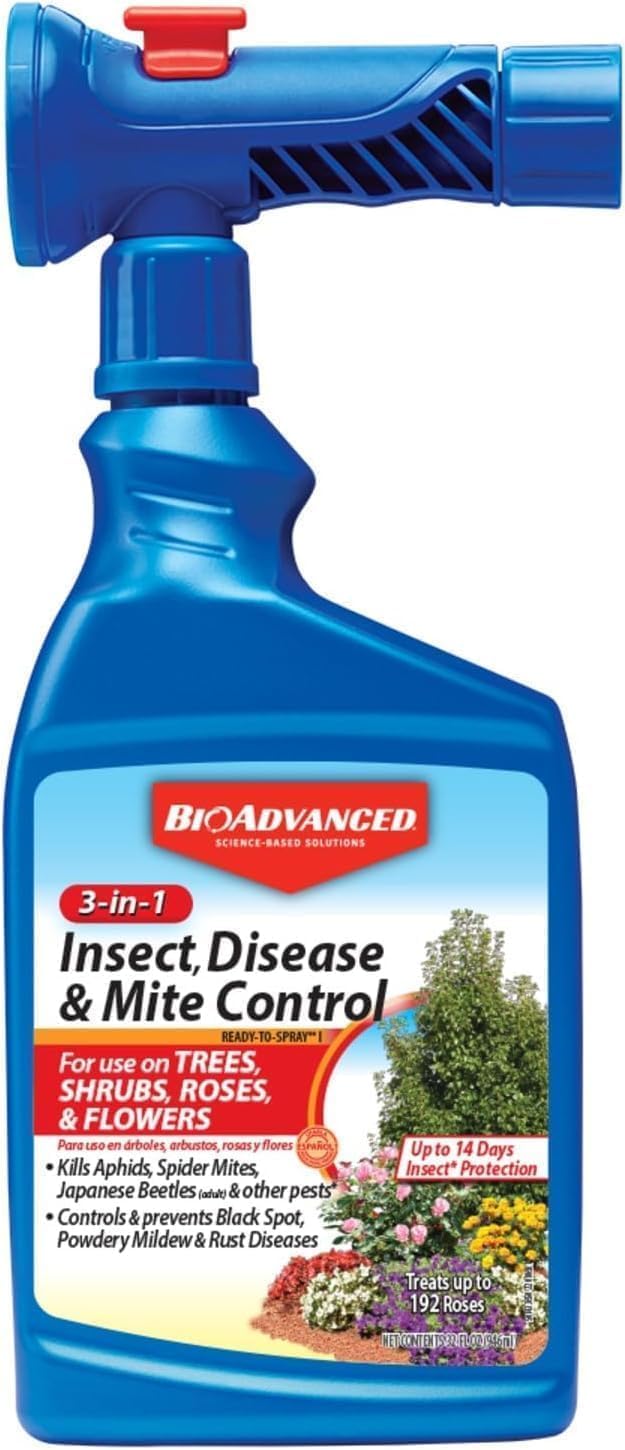
BioAdvanced 3-in-1 Insect, Disease and Mite Control Spray, 32 fl oz
| Unit Count | 32 Fluid Ounces |
|---|---|
| Item Form | Spray |
| Target Species | Aphids, caterpillars, leafminers, whiteflies and other listed pests |
| Active Ingredients | Tau-fluvalinate 0.61%, Tebuconazole 0.65% |
This BioAdvanced 3‑in‑1 spray combines insect control, disease treatment, and mite suppression in a single hose‑end application, which makes routine backyard plant care straightforward. You attach the bottle to a garden hose, spray plants including leaf undersides, and the formula kills listed insects on contact while also preventing and curing common fungal diseases such as black spot and powdery mildew. The product advertises systemic, rainproof protection that can last up to 14 days and it treats a large number of plants per bottle, so it is convenient for seasonal maintenance of roses, ornamentals, and small shrubs. Notable active ingredients address different pest types, and the hose‑end delivery speeds coverage for medium gardens. Important limitations are that it is a chemical control so users must follow safety directions and avoid use where restrictions apply, and you will need repeat applications every 7 to 14 days for ongoing problems. It is best used as part of an integrated program rather than the sole tactic for severe infestations or for insect pests not listed on the label.
Best for: Gardeners who want a convenient, all-in-one product to manage common insects, fungal diseases, and mites on roses and ornamental plants without separate treatments.
Less Ideal for: Organic gardeners or anyone seeking nonchemical biological controls should look for organic-labeled or manual options instead.
- Three-in-one formula treats insects, fungal diseases, and spider mites in a single application
- Hose-end ready design covers plants quickly and evenly, including leaf undersides
- Rainproof protection claimed to last up to 14 days, reducing reapplication frequency
- Covers many plants per bottle, suitable for treating medium-sized rose and ornamental plantings
- Contains synthetic active ingredients and requires careful safety handling
- Needs reapplication every 7–14 days for ongoing control
- Not appropriate in locations where local sale or use is restricted
Verdict: Buy this if you want a single, hose-end spray that quickly controls common insects, fungal diseases, and mites on roses and ornamentals with minimal fuss.
Athena IPM Insecticide & Fungicide Ready-to-Use Spray (32 fl oz)

| Brand | Athena |
|---|---|
| Unit Count | 32 Fluid Ounces |
Athena IPM is a ready-to-use spray that combines insecticidal and fungicidal action for fast contact control of common plant pests and powdery mildew. You use it straight from the bottle: shake and spray foliage, stems, and affected areas in greenhouses, indoor plant collections, vegetable beds, or hydroponic setups without measuring or mixing. The formula is listed as EPA 25(b) minimum risk ingredients, which allows frequent, on-demand applications around people and pets when directions are followed. Practical strengths are the convenience of RTU packaging, broad listed coverage across pest and disease targets, and suitability for many plant types and production settings. Limitations are that it is a contact-control product so it works best on exposed pests and fresh infestations rather than systemic or hidden populations, and the provided safety notes require careful handling to avoid contact and keep away from children and food areas. For growers prioritizing straightforward, repeatable pest and mildew suppression, this is a usable, low-odour option.
Best for: Growers who want a convenient, professional-style spray for fast knockdown of visible pests and mildew and who prioritize repeatable, easy application across indoor and small-scale outdoor plantings.
Less Ideal for: People seeking a systemic long-term solution for persistent infestations or those who prefer strictly organic certified products should consider alternatives.
- Ready-to-use spray requires no mixing or special equipment
- Broad-spectrum action listed for spider mites, aphids, thrips and powdery mildew
- Formulated with EPA 25(b) minimum risk ingredients for lower-toxicity use when directed
- Suitable for a wide range of plant settings including houseplants, gardens, greenhouses and hydroponics
- Contact-only mode limits effectiveness against hidden or systemic infestations
- Contains chemicals with a California Prop 65 warning and requires careful storage and handling
Verdict: Buy this if you need a convenient, ready-to-use spray that delivers fast, broad-spectrum contact control of common plant pests and powdery mildew.
BioAdvanced Organics Neem Oil Spray, Ready-to-Use, 24 fl oz

| Unit Count | 24 Fluid Ounces |
|---|---|
| Item Type Name | Ready-to-Use |
| Active Ingredients | Clarified Hydrophobic Extract of Neem Oil 0.9% |
| Specification Met | OMRI |
| Target Species | Spider |
This ready-to-use BioAdvanced Organics Neem Oil spray is designed to give home gardeners a single product that tackles insects, mites, and common fungal diseases. It comes in a trigger-spray bottle for direct application to leaves and stems and is labeled for use on roses, ornamentals, fruits, vegetables, and shrubs. The active clarified hydrophobic neem extract works on contact to kill eggs, larvae, and adults of aphids, whiteflies, spider mites, and other listed pests while also helping prevent and control blackspot, powdery mildew, rust, and similar diseases when used on a 7–14 day schedule. Practical benefits include organic-friendly approval for use up to the day of harvest and the convenience of a multi-action formula so you do not need separate products for insects and fungal problems. Limitations are that it is a contact treatment so thorough coverage is required and it may need repeated applications during heavy infestations or disease pressure. Expect reliable, garden-scale control when applied as directed and checked regularly for retreatment.
Best for: Gardeners who want a single, easy-to-use product to manage both pests and common fungal diseases across ornamental and edible plants and who prioritize organic-friendly options and convenience.
Less Ideal for: Commercial growers or users seeking systemic long-term control or products formulated for large acreage where concentrated, professional treatments are preferred.
- Ready-to-use trigger spray for easy, no-mixing application
- Multi-action formula that acts as an insecticide, miticide, and fungicide
- OMRI-listed and approved for use up to the day of harvest on edible plants
- Effective on multiple life stages including eggs, larvae, and adults
- Works by contact so full coverage is required for effectiveness
- May require frequent reapplication under heavy pest or disease pressure
Verdict: Choose this ready-to-use neem oil spray if you want a single organic-friendly product that handles insects, mites, and common fungal diseases across edible and ornamental garden plants.
BioAdvanced Rose & Flower Insect Killer Spray, 24 oz

| Unit Count | 24 Fluid Ounces |
|---|---|
| Item Form | Spray |
| Target Species | Insects |
| Active Ingredients | Cyfluthrin 0.003% |
| Specification Met | EPA |
This ready-to-use BioAdvanced spray is formulated to control common rose and flower pests like aphids, whiteflies, Japanese beetles, caterpillars, and other listed insects. You use it by spraying foliage until evenly coated but not dripping, which makes spot treatments quick and simple for beds, shrubs, and vegetable gardens. Notable features include a fast-acting cyfluthrin formula that claims contact kill and up to 14 days of residual protection, plus an easy trigger bottle for direct application. Practically, it is convenient for gardeners who want a single product to treat a range of outdoor plants without mixing concentrates. The product is clearly labeled for outdoor use and lists EPA registration, which helps with safe application when directions are followed. Limitations are that it is a synthetic insecticide so timing and drift matter around beneficial insects and pollinators, and some users may prefer an organic option for edible gardens. Also the ready-to-use format means you cannot dilute it for larger area treatments.
Best for: Gardeners who want an affordable, easy-to-use spray to quickly knock down common pests on roses, flowers, and nearby edibles and prefer a ready-made product rather than mixing concentrates.
Less Ideal for: People seeking strictly organic pest control or those who need a product designed for broad large-area applications should consider other options.
- Kills over 100 listed insects on contact, including aphids and Japanese beetles
- Provides up to 14 days of protection after application
- Ready-to-use spray bottle for quick spot treatments without mixing
- EPA-registered active ingredient (cyfluthrin) for predictable performance
- Contains a synthetic insecticide so it can harm beneficial insects if used indiscriminately
- Ready-to-use format cannot be diluted for treating very large areas
Verdict: A practical, ready-to-use insect spray that delivers fast contact kill and short-term protection for common rose and flower pests at a budget-friendly convenience level.
Sevin Insect Killer Concentrate II, 32 oz

| Item Form | Liquid |
|---|---|
| Liquid Volume | 32 fluid ounces |
| Target Species | Insects |
| Active Ingredients | Zeta Cypermethrin |
Sevin Insect Killer Concentrate II is a liquid concentrate designed to protect ornamental and edible plants by contact-killing more than 500 insect pests. You measure the concentrate using the included cap (label rate 4 fl. oz per gallon), dilute it in a sprayer, then apply the solution to foliage, shrubs, lawns and garden beds while avoiding open blooms. The formula lists zeta-cypermethrin as the active ingredient and advertises residual activity up to three months for many pests. Practical benefits include broad-spectrum control across fruits, vegetables and ornamentals and flexible application with handheld, hose-end, or tank sprayers. Important limitations are that it kills by contact only so thorough coverage is required, it is not registered for use on spotted lanternflies in California, and it can harm pollinators if used on blooming plants. Follow label directions for reuse intervals, reentry, and safety precautions to minimize off-target effects.
Best for: Gardeners who prioritize dependable, broad pest control for both edible and ornamental plantings and want a concentrate they can mix to treat beds, shrubs, and lawns with standard sprayers.
Less Ideal for: Those who prioritize organic or pollinator-safe products or small-scale users who prefer ready-to-spray formulations should consider alternatives.
- Broad-spectrum formula that lists control for over 500 insect species
- Concentrated liquid lets you mix only the amount needed for the job
- Works with common sprayers including handheld, hose-end, and tank types
- Advertised residual protection for many pests lasting up to three months
- Contact-only action requires thorough coverage and repeat applications for hidden pests
- Contains a synthetic pyrethroid that can be toxic to pollinators and aquatic life if misapplied
Verdict: Choose this concentrate if you want a reliable, broad-spectrum insecticide you can mix and apply with standard sprayers to protect vegetables, fruits, and ornamentals.
Bonide Captain Jack's Neem Oil Spray for Plants, 32 oz Ready-to-Use

| Item Form | Liquid |
|---|---|
| Target Species | Insects |
| Liquid Volume | 32 fluid ounces |
| Active Ingredients | Clarified Hydrophobic Extract of Neem Oil |
Bonide Captain Jack's Ready-to-Use Neem Oil is a multi-purpose garden spray that controls insects, mites, and several fungal diseases using a clarified neem oil extract. It comes in a 32 oz trigger bottle so you can spray directly onto roses, vegetables, shrubs, trees, and houseplants without mixing concentrates. The label notes it kills eggs, larvae, and adults of common pests such as aphids, whiteflies, and spider mites and also helps prevent powdery mildew and blight when applied at the first sign of disease. Application is straightforward: shake, cover all plant surfaces including undersides of leaves, and reapply every 7 to 14 days as needed while avoiding peak sunlight. Because it is approved for organic gardening and is plant-safe when used according to directions, it is a low-toxicity option for routine garden pest control. Users should still follow safety directions to keep it away from children and pets and be aware that repeated sprayings are required for ongoing outbreaks rather than a one-time cure.
Best for: Gardeners who prefer a low-toxicity, ready-to-use spray for routine control of common pests and fungal issues and who value an organic-approved product that is safe for edible and ornamental plants when used properly.
Less Ideal for: People seeking a fast-acting knockdown chemical for severe infestations or those who want a single-application permanent solution should consider stronger targeted treatments.
- Ready-to-use trigger bottle requires no mixing and is easy to apply
- Combines insecticide, miticide, and fungicide action for broad garden protection
- Kills multiple life stages of pests including eggs, larvae, and adults
- Approved for organic gardening and safe for use up to day of harvest when used as directed
- Requires repeated applications (typically every 7–14 days) for sustained control
- Can be phytotoxic if applied in peak sunlight or overused
Verdict: A convenient, organic-approved neem spray that provides broad, low-toxicity control of common garden pests and fungal problems for routine plant care.
Choosing the Right Insect Killer for Plants: Key Factors to Consider
Mode of Action and Spectrum
Understanding how an insect killer acts on pests matters because it affects which insects it controls and how quickly populations decline. Some products act on contact and require direct spray to be effective, while others are systemic and move into plant tissue to control sap-feeding pests. Broad-spectrum modes can knock back many pest types but also risk harming beneficial insects. A narrower spectrum or targeted mode of action lets you address a specific problem without unnecessary collateral impacts.
When choosing, match the mode to the pest biology and the location of the infestation. For example, contact sprays work best on exposed caterpillars and aphids, whereas systemic options are often better for root-feeding or sap-sucking species that hide in leaf tissue or soil. Rotate modes of action across seasons when possible to reduce the chance of resistance developing in pest populations.
Plant Safety and Phytotoxicity
Plant safety covers how a product interacts with different species, growth stages, and foliage conditions. Some formulations can scorch tender new growth, cause leaf yellowing, or stain blooms if applied in hot sun or at high concentrations. Labels provide temperature, dilution, and timing guidance to reduce harm, but gardeners should also consider their collection of plant types-ornamentals, succulents, and edible crops can have very different tolerances.
Test sprays on a single plant or small area before broad application, follow label maximum concentrations, and avoid treating during heat stress or drought. Consider reentry intervals for edible plants and whether a product is approved for use on food crops if you grow herbs, vegetables, or fruit.
Application Method and Convenience
How a product is applied determines how effectively you can target pests and how much time it takes. Ready-to-use sprays are convenient for small container collections and spot treatments, while concentrates can be diluted for larger beds, hose-end applicators, or soil drenches. Granules or baits might be preferable for soil-dwelling pests or for placing near the root zone without wetting foliage.
Consider ergonomics and packaging, too. Trigger sprayers that clog or concentrate bottles that require measuring without clear markings add friction and increase dosing errors. Pick formats that match the scale of your garden and your comfort with mixing and protective equipment.
Residual Activity and Reapplication Needs
Residual activity refers to how long a product continues to suppress pests after application. Short-residual, contact solutions often require frequent reapplication but reduce long-term exposure to beneficials. Longer-residual options can protect plants longer but may persist in soil or on foliage, influencing beneficial insect safety and harvest intervals.
Balance desired protection period against environmental persistence. For seasonal outbreaks you may prefer a product with longer residual control; for regular monitoring and integrated pest management, shorter residuals combined with spot treatments may be a better fit.
Impact on Pollinators and Beneficial Insects
Garden health depends heavily on pollinators and predatory insects that naturally suppress pests. Some insect killers are highly toxic to bees, lady beetles, lacewings, and other beneficials, especially when applied to blooms or during active foraging periods. Choosing products with reduced toxicity to beneficials or using application timing to avoid bloom periods helps preserve these allies.
When possible, use targeted applications, treat in early morning or late evening when pollinators are less active, and avoid spraying flowering parts. Also consider non-chemical options as part of an integrated program to keep beneficial populations robust.
Residue on Edibles and Soil Persistence
If you are treating edible plants or growing in containers that will later hold vegetables, consider labels for preharvest intervals and soil persistence. Some systemic actives can move into edible tissues and require waiting periods before harvest; others break down rapidly and are suitable for frequent use. Soil persistence also affects successive plantings and the soil food web. Opt for products with clear, short preharvest intervals for food crops and low soil persistence when you plan successive plantings in the same spot.
For container growers, think about potting mix and drainage, because residues can concentrate in limited media. Flushing containers after treatment and following label instructions will help reduce unintended residues.
Common Garden Pests and Best Matching Controls
Different insects need different strategies. Sap feeders like aphids and whiteflies are often controlled by systemic or translaminar products that reach underside foliage, while chewing pests such as caterpillars and beetles respond better to contact sprays or biologicals that coat leaf surfaces. Soil-dwelling pests require drenches or granular treatments targeted to the root zone. Understanding the pest life stage and where it lives on the plant makes it easier to pick a delivery method that reaches the pest reliably.
Timing treatments to life cycles improves results. Treating eggs or early instars takes less effort than tackling large, established populations. Regular scouting and early intervention reduce the need for broad-spectrum sprays and help protect beneficial insects.
- Sap feeders: consider systemic or translaminar options
- Chewers: contact sprays and biologicals work on exposed larvae
- Soil pests: use drenches or granules placed at the root zone
- Timing: target young stages for more effective control
Integrating Non-Chemical Options
Chemical insect killers are one tool in a gardener's toolbox. Physical measures such as hand-picking, row covers, sticky traps, and pruning out infested growth reduce pest pressure without chemical inputs. Encouraging predator insects by planting diverse flowering species and providing habitat increases long-term resilience.
Pairing cultural controls with selective products reduces sprays and helps maintain beneficial populations. For example, removing heavily infested leaves followed by a targeted spray can clear an outbreak while limiting exposure to the rest of the garden.
- Hand removal and pruning for low-level infestations
- Row covers and screens for preventing colonization
- Trap cropping and companion planting to divert pests
- Habitat plantings to attract predators and pollinators
Safe Application Practices
Follow label instructions for dilution, timing, and safety equipment. Wear basic PPE recommended on the product label, avoid windy days, and never spray in temperatures that can stress plants. Apply in the early morning or late evening to reduce exposure to pollinators and to minimize evaporation or burn risk.
Adopt spot treatments rather than whole-garden broadcast spraying when possible, and avoid treating blooms. Keep a simple record of applications so you can track what worked and avoid overuse of the same mode of action.
- Use recommended PPE and follow dilution instructions
- Avoid spraying during bloom or windy conditions
- Prefer spot treatments and targeted applications
- Record applications and rotate modes of action
Managing Resistance and Long-Term Control
Repeated use of a single active ingredient can select for resistant pest populations. Rotate products with different modes of action and combine chemical controls with cultural and biological tactics to reduce selection pressure. Monitor treated areas for unusual survival after applications, which can signal resistance development.
Maintain good garden hygiene. Removing crop residue, rotating plant families, and avoiding continuous plantings of the same host reduce pressure on any single control tactic and lower overall pest populations in the long term.
- Rotate modes of action to delay resistance
- Use integrated tactics to reduce reliance on chemicals
- Scout for control failures and adjust strategy accordingly
- Practice crop rotation and remove infested debris
Treatment Considerations for Container and Indoor Plants
Containers and indoor plants concentrate pests and residues, so choose products labeled for confined spaces and potting media. Foliar sprays can drip into soil or onto furniture, so cover surfaces and protect non-target plants during application. For houseplants, quarantining an infested specimen and using targeted treatments reduces spread.
Drench applications in containers require attention to drainage and potential runoff. Use minimal effective doses and allow soil to dry appropriately between treatments to avoid root stress.
- Use products labeled for indoor and container use
- Quarantine affected plants to prevent spread
- Protect surfaces and adjacent plants when spraying
- Monitor drainage and avoid overwatering after drenches
How We Chose the Best Insect Killer for Plants
We focused on practical garden performance and plant safety when narrowing candidates for this roundup. Key evaluation criteria included mode of action and spectrum, because a targeted active ingredient often limits collateral damage while still controlling the pests gardeners encounter most. We assessed formulation and application options to judge user control and placement accuracy, such as ready-to-use sprays versus concentrates suitable for drip or foliar applications. Plant safety was judged by label guidance for sensitive plants, phytotoxicity reports under normal use, and recommended wait times before reentry or harvest. Environmental considerations played a role, including persistence in soil, toxicity to pollinators or aquatic life, and compatibility with integrated pest management. We also considered ease of use: clarity of instructions, required safety PPE, and packaging that supports precise dosing. We excluded products lacking clear label directions for ornamental or edible plants, those with restricted-use classifications, and any option that showed consistent reports of plant damage under labeled conditions. The final selection represents broadly useful, labeled choices that balance pest control with protecting plants and the garden ecosystem.
FAQ
Will an insect killer harm my beneficial insects?
Many insect killers can affect beneficials depending on mode of action and application timing. Targeted, spot treatments and avoiding sprays during bloom reduce risks. Choosing selective products and applying in the evening or early morning helps protect pollinators and predators.
How soon will I see results after applying an insect killer?
Results vary by product and pest. Contact treatments can show visible reduction within hours of direct contact, while systemic options may take several days to be fully effective as they move through the plant. Persistent monitoring after treatment is important to judge success.
Can I use the same product on edible and ornamental plants?
Some products are labeled for both edible and ornamental uses, but many have specific preharvest intervals or usage restrictions. Always check the label for food-crop approvals, harvest wait times, and maximum application rates before treating edible plants.
How often should I reapply treatments?
Reapplication depends on residual activity, pest pressure, and product label directions. Short-residual contact solutions may require more frequent applications, while longer-residual options need fewer repeats. Follow label intervals and avoid overuse to protect beneficials and limit resistance.
Are systemic insect killers safe for potted plants?
Systemics can be useful for potted plants because they reach pests in foliage and roots, but label guidance for container use must be followed. Watch for phytotoxicity on sensitive species and consider potential residue buildup in small volumes of potting mix.
What should I do if a product causes leaf burn or damage?
Stop applications immediately and rinse affected foliage with water if label guidance allows. Move plants out of direct sun and avoid further treatments until they recover. Record the conditions of application to avoid repeating the same mistake and choose gentler options for sensitive specimens.
Final Verdict
Prioritize products that match the pest biology, application scale, and plant sensitivity in your garden. Balance fast, effective control with plant safety and protection of beneficial insects by choosing appropriate modes of action, following label instructions, and using targeted applications. For most gardeners, a combination of cultural controls and selective insect killers delivers reliable results while preserving garden health. Focus on labeling, timing, and rotation to make confident choices that solve pest problems without undermining long-term garden resilience.
