

Note: This article contains affiliate links. If you click on these links and make a purchase, I may earn a small commission at no extra cost to you. This helps support my research and content. Read my full affiliate disclosure here.
If you have weeds pushing up between pavers, choosing the right weed killer changes how your patio looks and how much maintenance it needs. Treatment that strips foliage but leaves roots can mean repeat scraping and joint refilling, while overly aggressive products can discolor or damage stone and sand joints. This guide covers seven top picks for weed killer for paver patio, shortlisted for real outdoor use. We evaluate how well each option kills existing weeds, prevents quick regrowth, and how safe it is for common hardscape materials. Read on to see practical notes on application, surface care, and the criteria we used to pick products for patios, walkways, and other paved outdoor spaces.
Top Picks at a Glance
| Best Overall The best all-around choice for most situations | Roundup Dual Action 365 Weed & Grass Killer Plus 12 Month Preventer, 1 gal. |  |
| Best Quality Built to a higher standard if you want something more solid | Ortho GroundClear Year-Long Vegetation Killer2 Concentrate, 32 fl oz |  |
| Best Value The sweet spot between price and what you get | Compare-N-Save Glyphosate Concentrate Grass & Weed Killer, 2.5‑Gallon |  |
| Best Budget The cheapest option that still gets the job done reliably | Spectracide One-Shot Weed & Grass Killer 32 oz Ready-to-Use Spray |  |
| Highest Rated A top-rated pick with lots of positive feedback | Spectracide Weed & Grass Killer Concentrate, 16 fl oz |  |
| Most Popular A crowd favorite that many people choose with confidence | Spectracide Weed & Grass Killer with AccuShot Power Sprayer, 1.33 Gal |  |
| Best Seller A high-volume bestseller chosen again and again | Roundup Weed & Grass Killer4 Refill, 1.25 gal |  |
Roundup Dual Action 365 Weed & Grass Killer Plus 12 Month Preventer, 1 gal.

| Unit Count | 128 Fluid Ounces |
|---|---|
| Item Form | Spray |
| Coverage | 300 square feet |
| Active Ingredients | Triclopyr; Fluazifop-P-Butyl; Imazapic; Diquat Dibromide |
This one-gallon Roundup Dual Action 365 combines fast-acting contact herbicides with a longer-lasting residual to both kill visible weeds and prevent new growth for up to a year when applied correctly. It is intended for non-lawn areas such as cracks in driveways, sidewalks, patios, gravel and under decks. The Comfort Wand one-touch continuous spray makes treating a contiguous area less fatiguing and helps deliver an even application. Visible wilting can appear within hours and treated areas become rainproof in roughly 30 minutes. The label stresses spraying the entire target area, not just individual plants, because the preventer works by creating an invisible soil barrier. Practical limits include use only on non-lawn surfaces and adherence to label rates and reapplication intervals; it is not suitable for spot-spraying near desirable plants or for use on turf you want to keep. If you need a fast, long-lasting solution for clearing and keeping paved and gravel areas weed-free, this product streamlines both tasks in a single application.
Best for: Buyers who want a straightforward, long-lasting solution to clear and keep paved, gravel, and other non-lawn areas weed-free with minimal repeated effort.
Less Ideal for: Gardeners who need selective control inside lawns, around flower beds, or who prefer an organic or nonchemical approach should consider other products or methods.
- Kills existing broadleaf and grassy weeds and many tough species.
- Provides up to 12 months of prevention when the entire area is treated.
- Comfort Wand with one-touch continuous spray reduces hand fatigue and promotes even coverage.
- Fast visible results in hours and becomes rainproof in about 30 minutes.
- Formulated only for non-lawn areas so it will damage desirable turf and plants if misapplied.
- Requires treating the entire area to establish the preventive barrier rather than only spot-treating visible weeds.
Verdict: If you need a single product that quickly kills weeds and then prevents new growth for up to a year in non-lawn areas, this is a convenient, long-lasting option.
Ortho GroundClear Year-Long Vegetation Killer2 Concentrate, 32 fl oz

| Liquid Volume | 32 fluid ounces |
|---|---|
| Coverage | 300 square feet |
| Item Form | Liquid |
| Active Ingredients | Imazapyr; Isotropylamine Salt; Pelargonic Acid |
Ortho GroundClear is a fast-acting concentrate designed for homeowners who need long-term suppression of weeds and grasses on hardscape areas. Mix 24 fl. oz. per gallon of water and apply with a tank sprayer to driveways, patios, gravel, fence lines, and other spots where you do not want any plant growth. The formula starts working immediately and becomes rainproof in about an hour, so light showers shortly after application are less likely to reduce effectiveness. A single 32 fl. oz. bottle makes roughly 1.33 gallons of spray and can treat about 300 to 400 square feet depending on label directions. Active ingredients include imazapyr and pelargonic acid, giving both systemic and contact action for thorough kill and up to 12 months of prevention. Important limitations are that it is non-selective so it will kill desirable plants on contact and must be used only where no vegetation is wanted, and it requires careful handling and follow of safety instructions. For budget-focused buyers it delivers long coverage per bottle, reducing how often you need to reapply compared with short-term products.
Best for: Homeowners who need a low-cost, long-lasting herbicide to keep driveways, patios, walkways, and gravel areas free of weeds without frequent reapplication.
Less Ideal for: Gardeners who need to selectively remove weeds from planted beds or who prefer ready-to-use sprays for spot treatments should look for a selective or RTU product instead.
- Year-long prevention of regrowth reduces frequency of reapplication
- Fast-acting and rainproof in about one hour so treatments hold up in changing weather
- Concentrate format treats several hundred square feet from one bottle
- Effective on hardscape and gravel where no plants are desired
- Non-selective formula will damage or kill any desirable plants it contacts
- Requires mixing and a sprayer rather than ready-to-use convenience
Verdict: If you want one concentrated bottle that treats several hundred square feet and keeps hardscape areas weed-free for up to a year, this product delivers strong long-term value.
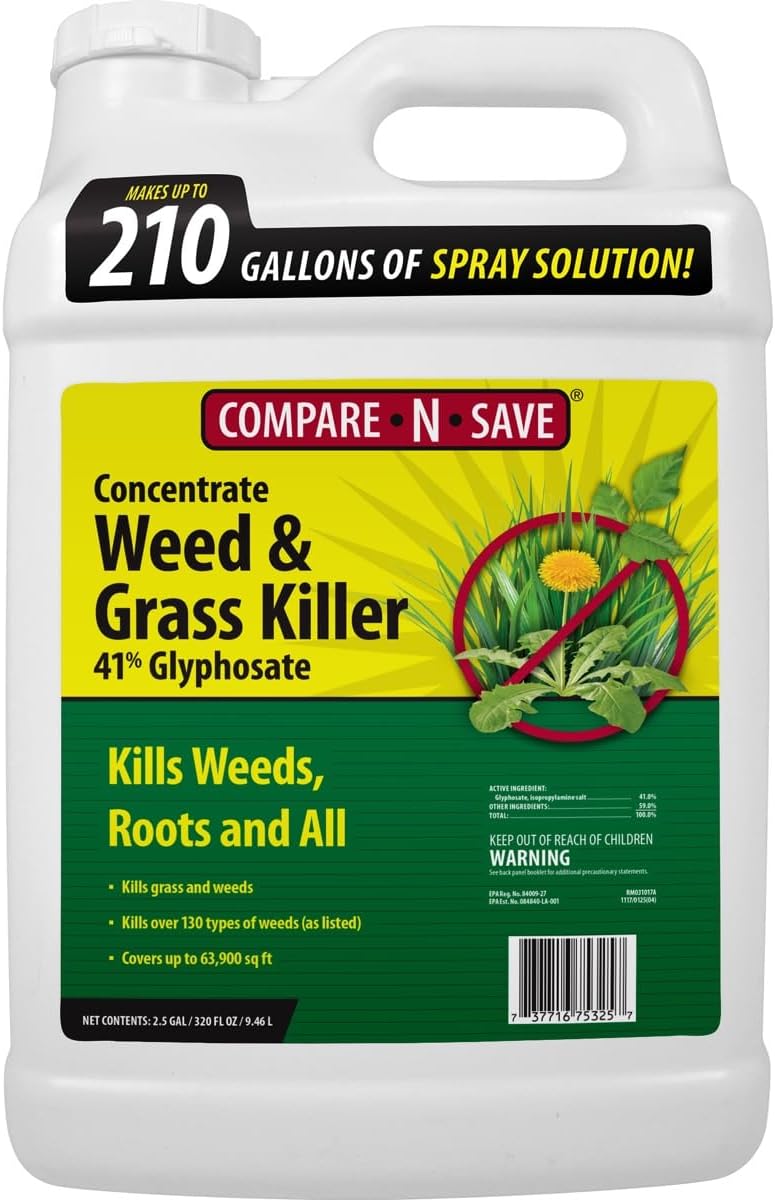
Compare-N-Save Glyphosate Concentrate Grass & Weed Killer, 2.5‑Gallon
| Active Ingredients | glyphosate |
|---|---|
| Liquid Volume | 2.5 gallons |
| Coverage | 630000 square feet |
| Item Form | Spray |
This 2.5‑gallon concentrate contains 41% glyphosate and is intended to be diluted with water to make ready‑to‑use spray for removing weeds and grasses from patios, walkways, driveways, and around fences or beds. Typical use is mixing the recommended ounces per gallon in a pump or hose sprayer and applying directly to foliage on a dry, warm day; visible browning appears in two to four days and treated plants are killed to the root. Notable features include a high concentration that makes up to 210 gallons of spray and a short rainproof window of about two hours, which helps planning around weather. Practical benefits for patio maintenance are efficient coverage of large areas and the ability to clear pavers and joints prior to re-sanding or sealing. Important limitations are that it is nonselective so it will kill any green plant it contacts and it has no residual preemergent activity, so repeat treatments or follow-up maintenance are required for new growth. Users must follow label safety directions when using around edible gardens or desirable plants.
Best for: Homeowners and property stewards who want an efficient, no-nonsense solution to remove weeds and grasses from hardscape areas and prepare patios for repair or sealing.
Less Ideal for: Those seeking a selective lawn spot treatment, a long‑term preemergent solution, or users unwilling to follow herbicide safety precautions should consider alternative methods.
- High glyphosate concentration yields a large volume of ready‑to‑use spray from one container
- Fast visible results in 2–4 days for most weeds and grasses
- Short rainproof time (about 2 hours) makes scheduling easier after application
- Nonselective formula will damage any desirable vegetation if contacted
- No residual control so it will not prevent future weed germination
Verdict: A concentrated, fast‑acting glyphosate formula that efficiently clears weeds from paver patios and other hardscape areas, making it a practical choice for large maintenance jobs.
Spectracide One-Shot Weed & Grass Killer 32 oz Ready-to-Use Spray

| Unit Count | 32 Fluid Ounces |
|---|---|
| Coverage | 500 Square Feet |
| Item Form | Spray |
| Active Ingredients | Imazapyr, Diquat Dibromide, Dicamba, others |
This ready-to-use Spectracide One-Shot spray is designed for spot treatment of unwanted weeds and grass on driveways, walkways, patios and other nonplant areas. You simply aim and spray without mixing; the formula acts quickly with visible wilting the same day and claims to prevent regrowth for up to five months. It is rainproof within an hour and labeled for outdoor use when temperatures are above 60 F. Notable features include a leaf-to-root active ingredient blend and a 32 oz bottle that covers up to 500 square feet. Practical benefits are fast results, no measuring or dilution, and a concentrated coverage area that makes it convenient for clearing cracks and paved areas. Important limitations are strict application restrictions: do not use near desirable plants, food gardens or bodies of water, and the product remains active in soil for up to a year so it is not suitable where you plan to replant soon. Also, strong active ingredients require careful handling and keeping people and pets away during application.
Best for: Buyers who want an affordable, no-fuss spot weed killer for hard surfaces and cracks and who prioritize quick visible results and low prep work.
Less Ideal for: Gardeners who need to preserve surrounding plants, plan to replant soon in treated soil, or who require an all-vegetation-safe solution for beds and lawns.
- Ready-to-use spray that requires no mixing and is simple to apply
- Fast-acting formula with visible results the same day
- Kills to the root and claims up to five months of regrowth prevention
- Rainproof within one hour, allowing treatment even with short weather windows
- Remains active in soil for up to one year, preventing replanting in treated areas
- Not safe for use near desirable plants, water features, or food gardening
Verdict: A convenient, budget-friendly ready-to-use spray that quickly clears weeds and grass from driveways and patios with long-lasting control.
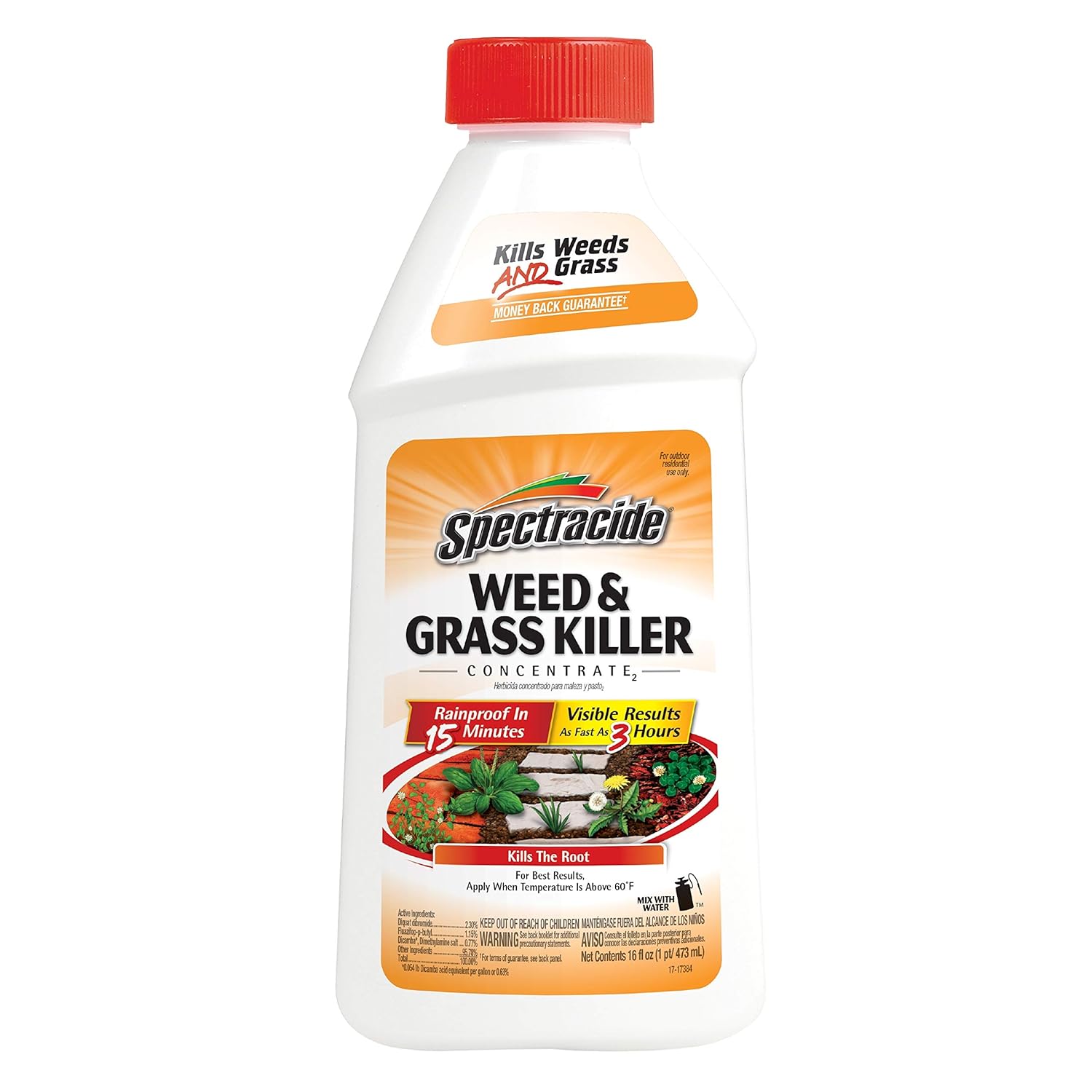
Spectracide Weed & Grass Killer Concentrate, 16 fl oz
| Unit Count | 16 Fluid Ounces |
|---|---|
| Item Form | Spray |
| Coverage | 7 fl oz per gallon covers up to 300 sq ft |
| Rainproof time | 15 minutes |
| Visible results | As fast as 3 hours |
This Spectracide concentrate is a practical, fast-acting option for clearing unwanted weeds and grasses from hard surfaces and around garden beds. You mix the 16 fl oz bottle with water and apply with a tank sprayer for spot treatments; the label rate (7 fl oz per gallon) covers roughly 300 sq ft per treatment. The formula is rainproof after 15 minutes and can show visible dieback in as little as three hours, letting you replant in treated areas after about a day. It is nonselective, so it kills foliage down to the root and requires care to avoid desirable plants. Because it is a concentrate, small bottles treat a larger area than ready-to-use sprays, which is useful for recurring patch treatments while keeping storage space low. Important limits are the usual safety precautions for herbicides and the need to shield nearby plants and follow temperature guidance for best results. For someone wanting a straightforward, effective knockdown of pavement and edge weeds, this performs reliably when used as directed.
Best for: Buyers who want a cost-effective, no-nonsense herbicide to tackle spot infestations on driveways, walkways and edges and who are comfortable mixing and applying a concentrate.
Less Ideal for: Customers who need a gentle or selective lawn-safe product or who prefer ready-to-use sprays with no mixing should look elsewhere.
- Concentrated formula covers a larger area per ounce than ready-to-use products
- Fast visible results in as little as 3 hours and rainproof after 15 minutes
- Kills weeds and grasses down to the root for longer-lasting control
- Nonselective formula can damage desirable plants if oversprayed
- Requires mixing and a separate tank sprayer rather than a ready-to-use bottle
Verdict: A concentrated, fast-acting spot herbicide that delivers economical, root-killing weed control for paved areas and edges.
Spectracide Weed & Grass Killer with AccuShot Power Sprayer, 1.33 Gal

| Unit Count | 170 Fluid Ounces |
|---|---|
| Item Form | Spray |
| Coverage | 1 gallon |
| Active Ingredients | Diquat Dibromide 0.12%, Fluazifop-p-butyl 0.06%, Dicamba 0.04% |
Spectracide Weed & Grass Killer pairs a concentrated non-selective formula with a battery-powered AccuShot sprayer to clear weeds from driveway cracks, patios and around foundations. The product is used by aiming and spraying foliage until leaves are covered; the active ingredients move through the leaf to the root and can show visible die-back in as little as three hours. The AccuShot wand is extendable and provides continuous spray without manual pumping, which improves accuracy for narrow cracks and reduces hand fatigue during larger jobs. It is rainproof within 15 minutes, so treated areas are protected quickly. Practical benefits include fast results that let you replant or resume use of the area within a day and a reusable sprayer for follow-up applications. Important limitations are that the herbicide is non-selective so it will kill any plant it contacts, it requires careful handling and PPE to avoid skin or eye exposure, and the sprayer runs on four AA batteries that must be replaced periodically. Follow label directions to avoid runoff into water.
Best for: Buyers who want a fast, no-nonsense solution for weeds growing in driveways and hard surfaces and who prioritize tools with clear user feedback and proven results.
Less Ideal for: Gardeners who need a selective lawn-safe treatment, people unwilling to follow pesticide safety precautions, or those treating areas adjacent to water features.
- AccuShot battery-powered wand gives continuous spray for accurate application in tight cracks
- Formula moves through foliage to kill weeds down to the root with visible results in about three hours
- Rainproof after 15 minutes so treatments are not easily washed away by brief showers
- Covers approximately 300 square feet per gallon, suitable for multiple crack-treatment sessions
- Non-selective herbicide will damage any desirable plants it contacts
- Sprayer requires four AA batteries and occasional replacement to maintain function
- Product is toxic to aquatic life and must not be used near water or allowed to run off
Verdict: A fast-acting, easy-to-aim non-selective herbicide with a battery-powered wand that is well suited to reliably clear weeds from driveway cracks and other hard surfaces.
Roundup Weed & Grass Killer4 Refill, 1.25 gal

| Unit Count | 160 Fluid Ounces |
|---|---|
| Coverage | 375 square feet |
| Item Form | Spray |
| Active Ingredients | Triclopyr, Fluazifop P-Butyl, Diquat Dibromide |
This 1.25 gallon Roundup Weed & Grass Killer4 refill is designed to be poured into an empty spray container to treat weeds and grassy weeds around beds, walkways, driveways, foundations, and other hardscape edges. It contains multiple active ingredients that attack broadleaf weeds and grasses to the root and promises visible wilting within hours and rainproofing in as fast as 30 minutes, which makes it convenient when weather windows are short. The refill covers about 375 square feet and is intended for use in and around established plantings when applied carefully to avoid drift onto desirable plants. Practical benefits include fast action, the ability to replant some areas within a specified wait period, and compatibility with the brand’s comfort wand refills so you avoid frequent repurchasing of small bottles. Important limitations are that it is a nonselective herbicide so it will damage desirable plants if misapplied and treated areas should be kept clear of people and pets until spray dries; follow label directions closely for safe use and replanting intervals.
Best for: Buyers who prioritize reliable, fast-acting weed control for routine maintenance of beds, edges, and hardscape areas and who follow label directions to minimize risk.
Less Ideal for: Gardeners who need selective control inside densely planted flower beds or who prefer organic or nonchemical weed management methods.
- Kills a broad range of weeds and grasses to the root, including dandelion and crabgrass
- Fast visible results in hours and becomes rainproof in about 30 minutes
- Large 1.25 gal refill reduces need for frequent repurchases and covers roughly 375 sq ft
- Formulated to refill compatible spray wand for easy application around beds and hardscapes
- Nonselective formula that will harm desirable plants if it drifts or is oversprayed
- Requires careful handling and adherence to label safety and replanting intervals
Verdict: Choose this refill if you want a fast, proven, large-format herbicide that quickly kills tough weeds and grasses and refills a compatible spray wand for area-wide maintenance.
Choosing the Right Weed Killer for Paver Patio: Key Factors to Consider
Kill Speed and Visible Control
How quickly a product shows results matters for patio work because visible dieback lets you decide whether to repeat treatment or hand-weed. Fast-acting materials can brown foliage within days, making it easier to remove dead tissue from joints. However, very rapid desiccants may only affect above-ground parts and leave roots intact, so speed must be balanced against depth of control.
Consider whether you need immediate cosmetic improvement or longer-term suppression. For heavy infestations you may accept a slower systemic action that kills roots, while for seasonal maintenance a contact product may be fine if paired with regular joint maintenance.
Residual Control and Reemergence
Residual activity determines how long the product reduces new seedlings. On a paver patio this translates into months less pulling, sweeping, or re-sanding joints. Some formulations offer short-term residual action that suppresses germination in the treated area; others stop growth only on contacted plants.
Think about how often you are willing to reapply. If you prefer low-maintenance patios, choose products that provide measured residual suppression without leaving sticky or staining residues on stone surfaces.
Surface Compatibility and Staining Risk
Pavers come in many materials and finishes, and some weed control chemicals can etch, bleach, or darken surfaces. Surface compatibility is a top priority because damage is often permanent or labor-intensive to fix. Porous natural stone and colored concrete can react differently than dense brick.
Always consider the product label for notes on staining and test in an inconspicuous spot first. Products that require rinsing after a set dwell time reduce staining risk, while those left to dry should be formulated for hardscape use.
Effect on Joint Material and Sand
Joints filled with coarse sand, polymeric sand, or mortar respond differently to treatments. Some solvents or surfactants can break down polymer binders or loosen sand, making joints wash out or crumble. If you have newly installed or polymeric joints, choose a product with minimal solvent action and avoid heavy pressure washing immediately after treatment.
Preserving joint material avoids extra repair work and keeps pavers locked in place. Consider mechanical joint maintenance combined with chemical control to reduce reliance on stronger chemistries.
Application Method and Practicality
How you apply a product affects precision and safety on a patio. Ready-to-use sprays let you target cracks but may produce more drift. Concentrates reduce packaging waste and may be more economical, yet they require measuring and mixing and increase chance of application errors.
Also evaluate whether a product needs protective gear, special applicators, or post-application rinsing. For casual gardeners low-fuss products with clear directions reduce mistakes and accidental surface damage.
Environmental Behavior and Nearby Plants
Patio weed control often sits next to beds, lawns, or container plants. Some chemistries move in runoff or can volatilize and harm nearby foliage. Consider the potential for runoff during rain, irrigation, or washing the patio.
If desirable plants border your hardscape, use products with low mobility, apply on calm dry days, and consider physical barriers or spot treatment methods to protect them.
Preparing a Paver Patio Before Treatment
Start by removing loose debris, sweeping out joints, and pulling large weeds by hand. Reducing above-ground material lets the chemical contact actively growing tissue and prevents wasted product on thick mats of dead material. For stubborn, deep-rooted weeds, loosen the joint material slightly with a narrow tool so herbicide reaches lower tissues.
paragraphs_extra[]:[],
- Sweep and remove loose moss or organic debris first.
- Hand-pull large weeds or use a weeding tool to expose roots where practical.
- Note areas with recent joint repairs or sensitive stone for spot-testing.
Application Tips to Protect Stone and Surroundings
Apply on dry, calm days to minimize runoff and drift. Use targeted spot treatment along joints rather than broad spraying of the entire patio when possible. When treating near garden beds or containers, wet the soil around desirable plants to reduce uptake and consider temporary physical barriers.
paragraphs_extra[]:[],
- Start with the lowest effective rate recommended on the label.
- Keep a wet cloth or water source nearby to immediately rinse accidental overspray from stone.
- Avoid application right before expected rain; check the forecast.
Mechanical Follow-Up and Joint Repair
Chemical control rarely solves joint deterioration. After weeds die and you remove debris, inspect joints. Refill or recompact sand, or reapply polymeric sand where needed to prevent new weed seed from taking hold. For patios with persistent weed seed banks, combining mechanical removal with a follow-up contact or residual treatment reduces long-term labor.
paragraphs_extra[]:[],
- Re-sand and compact joints after thorough cleaning.
- Consider a preventative sweep of fine sand to fill small gaps.
- Schedule seasonal inspections to catch regrowth early.
Seasonal Timing and Weather Considerations
Most weed control works best when weeds are actively growing, typically spring through early fall. Cool-season weeds may respond differently than warm-season varieties. Apply when soil and air temperatures fall within the product label's recommended range for best uptake and root action.
paragraphs_extra[]:[],
- Target treatments during active growth periods for the dominant weed species on your patio.
- Avoid applying during drought stress or extreme heat when plants are dormant or wilting.
- Allow treated foliage to dry fully before any planned rinsing unless label instructs otherwise.
Nonchemical and Preventative Alternatives
Consider physical methods and preventive practices to reduce reliance on chemicals. Boiling water applied carefully to joints, manual scraping, and the use of a stiff brush can control small seedlings effectively. Improving drainage and keeping the patio free of accumulated soil and organic debris reduces seed germination.
paragraphs_extra[]:[],
- Use flame weeding carefully and only where safe and legal.
- Apply a joint stabilizer or polymeric sand after cleaning to limit new seed establishment.
- Install edging or barriers to stop soil and weed seed migrating onto the patio.
How We Chose the Best Weed Killer for Paver Patio
We focused on real-world performance where pavers and joints are the priority. Selection began by filtering for products intended or commonly used on hardscapes rather than turf-only or garden-only formulations. We prioritized options that balance fast visible control with a lower risk of staining, surface etching, or harm to joint material. Efficacy against common patio weeds such as grasses, chickweed, and moss was a must; products that only suppress top growth without addressing root or regrowth potential were deprioritized. Evaluation criteria emphasized kill speed, residual control to slow reemergence, and surface compatibility with concrete, brick, natural stone, and polymeric sand. Ease of application and whether a product requires special equipment or extensive rinsing were considered, as was environmental behavior related to runoff and surrounding plantings. Products that pose high risk to surrounding desirable plants without clear containment methods were excluded. The final shortlist reflects those that meet these functional filters and practical gardener needs.
FAQ
Can I use the same weed killer I use on my lawn on a paver patio?
Often lawn formulations are not ideal for hardscape because they are designed for soil uptake and turf safety. Some lawn products can leave residues or cause staining on stone. Check the label for hardscape use and test in an inconspicuous area before treating the entire patio.
Will a weed killer harm polymeric sand or mortar joints?
Some solvents and surfactants can weaken polymeric binders or cause mortar to soften if not rinsed according to instructions. New or recently installed joints are especially vulnerable. When in doubt, test a small area and follow product guidance about rinsing and drying.
How long after treatment can I re-sand or walk on the patio?
Drying and settling times vary by product but waiting until treated foliage is brittle and dry is a safe practice for walking. Re-sanding should wait until debris is removed and the surface is dry; check label directions for any required wait times to avoid trapping residues in the new joint material.
Are natural or vinegar-based solutions effective on paver patios?
Vinegar and acetic acid solutions can burn foliage and work for small annual weeds but often lack residual control and may need repeated applications. High-strength acetic acid can also etch sensitive stone, so use with caution and test first. For large infestations, a targeted product designed for hardscapes may be more efficient.
How should I protect nearby plants and containers during application?
Water the soil around desirable plants before treating the patio to reduce uptake, and use physical shields like cardboard or plastic to block drift. Apply on low-wind days and consider spot treatments rather than broad sprays to minimize exposure.
Final Verdict
Choose a weed killer for paver patio by balancing control depth and surface safety. Prioritize products that offer measurable residual suppression if you want lower maintenance, but do so only after confirming they are safe for your particular paver material and joint type. Combine chemical control with mechanical cleaning and joint repair to reduce repeat treatment and keep the patio stable and attractive. Final verdict: focus first on surface compatibility and application precision, then consider residual activity and ease of use to match your maintenance style and the patio's material.
