

Note: This article contains affiliate links. If you click on these links and make a purchase, I may earn a small commission at no extra cost to you. This helps support my research and content. Read my full affiliate disclosure here.
You want a product that both knocks back broadleaf weeds and supplies the nutrients your lawn needs through the season. Picking the right weed and feed lawn fertilizer affects how quickly weeds die, how evenly grass greens up, and how often you must reapply. This guide covers seven shortlisted weed and feed options chosen for common home lawn situations, from cool-season turf to warm-season lawns and mixed lawns with patchy weeds. We evaluate each product for how effectively it controls typical broadleaf weeds and how reliably it delivers balanced nutrients through a season. Below you will find practical notes on application timing, spreader setup, and how product formulation can change results. Read on for testing-aligned criteria and buying guidance to match your lawn conditions.
Top Picks at a Glance
| Best Overall The best all-around choice for most situations | Scotts Turf Builder Triple Action 3-in-1 Lawn Fertilizer and Weed Control, 33.94 lb |  |
| Best Quality Built to a higher standard if you want something more solid | The Andersons Professional Surge Weed and Feed 16-0-9 Granules (40 lb) |  |
| Best Value The sweet spot between price and what you get | BioAdvanced 5-in-1 Weed and Feed Granules, 9.6 lb |  |
| Best Budget The cheapest option that still gets the job done reliably | Spectracide Weed & Feed 20-0-0 Ready-to-Spray, 32 oz |  |
| Highest Rated A top-rated pick with lots of positive feedback | Scotts Turf Builder WinterGuard Fall Weed & Feed, 11.43 lb |  |
| Most Popular A crowd favorite that many people choose with confidence | Scotts Turf Builder Weed & Feed (42.87 lb) |  |
| Best Seller A high-volume bestseller chosen again and again | Scotts Turf Builder Weed & Feed 3, Granular Lawn Fertilizer (14.29 lb) |  |
Scotts Turf Builder Triple Action 3-in-1 Lawn Fertilizer and Weed Control, 33.94 lb

| Item Form | Granule |
|---|---|
| Coverage | All-purpose (treats 12,000 sq. ft. per bag) |
| Active Ingredients | Pendimethalin, 2,4-D, Dicamba |
| Unit Count | 543.04 Ounce |
Scotts Turf Builder Triple Action combines a fertilizer with both post-emergent broadleaf weed control and pre-emergent crabgrass prevention in one granular bag. It is applied with a broadcast spreader to a wet lawn in spring when weeds like dandelions are actively growing; after application you wait 24 hours then water to move the product into the soil and activate the crabgrass prevention. Notable features include a single-bag coverage of about 12,000 sq. ft., a formula labeled for many common turf grasses, and active ingredients (pendimethalin, 2,4-D, dicamba) that target both grassy and broadleaf weeds. In practice this streamlines a spring lawn routine by combining feeding and weed control, reducing separate product steps and applications. Limits to consider are the chemical active ingredients, which require following safety guidance for people and pets and mean it is not appropriate for organic lawns; it prevents but does not kill established crabgrass; and proper timing and spreader calibration are important to avoid uneven coverage or damage to sensitive grass types.
Best for: Homeowners who want a single, springtime product to simplify lawn care by combining feeding with weed control and crabgrass prevention across a medium to large yard.
Less Ideal for: People seeking organic or herbicide-free lawn solutions or those who need to eliminate established crabgrass or weeds immediately should consider other specialist products.
- Three functions in one product: fertilizes while killing listed broadleaf weeds and preventing crabgrass for months.
- Covers a large area from a single 33.94 lb. bag, suitable for typical residential yards up to 12,000 sq. ft.
- Granular form works with common Scotts spreaders for straightforward, even application when set up correctly.
- Label lists compatibility with many common turf grasses so you can use it on most lawns in spring.
- Contains synthetic herbicide active ingredients that require safety precautions and are not suitable for organic lawn care.
- Will not kill existing crabgrass; it is a pre-emergent that prevents future germination for about four months.
- Effectiveness depends on correct timing, wet-application and follow-up watering which adds an extra step to use correctly.
Verdict: If you want a straightforward springtime product that feeds your lawn while controlling broadleaf weeds and preventing crabgrass across a large yard, this one-bag 3-in-1 solution simplifies the job.
The Andersons Professional Surge Weed and Feed 16-0-9 Granules (40 lb)

| Item Form | Granule |
|---|---|
| Coverage | 16000 square_feet |
| Unit Count | 640 Ounce |
| Active Ingredients | Herbicide |
The Andersons Professional Surge is a 40 lb granular weed-and-feed formulated to kill broadleaf weeds and feed turf across up to 16,000 square feet. It is typically applied to established lawns when broadleaf weeds are actively growing; instructions recommend mowing a day or two beforehand, applying to a damp lawn so granules stick to leaves, and avoiding irrigation or rain for at least 24 hours after treatment. Notable features include a four-way herbicide blend that targets more than 250 common weeds and small particle granules for better coverage per square inch. Practical benefits are season-long performance even in cooler spring and fall temperatures and the convenience of combining weed control and fertilization in one application for large yards. Important limitations are that it is not suitable for newly seeded turf or certain grass types such as Floratam St. Augustine, dichondra, carpetgrass, or creeping bentgrass, and it requires careful timing around watering and weather to avoid reduced effectiveness.
Best for: Homeowners who prioritize season-long performance and want a single product that both controls broadleaf weeds and fertilizes large established lawns.
Less Ideal for: People seeding new turf, maintaining sensitive or excluded grass species, or those who cannot reliably avoid watering or rain for a day after application.
- Combines four-way herbicide with 16-0-9 fertilizer for simultaneous weed control and feeding
- Covers up to 16,000 sq ft per bag, suitable for large lawns
- Small particle granules for improved coverage and contact with weed foliage
- Designed to perform in cooler spring and fall conditions
- Not safe for specific turf types like Floratam St. Augustine, dichondra, carpetgrass, or creeping bentgrass
- Must avoid watering or rain for at least 24 hours after application to maintain effectiveness
- Not recommended for newly seeded or recently sodded lawns without reduced rates or waiting periods
Verdict: Choose this product when you need professional-strength, season-long broadleaf weed control combined with fertilizer for large, established lawns.
BioAdvanced 5-in-1 Weed and Feed Granules, 9.6 lb

| Item Form | Granule |
|---|---|
| Coverage | 4000 square_feet |
| Unit Count | 153.6 Ounce |
| Active Ingredients | Dicamba, Quinclorac |
BioAdvanced 5-in-1 Weed and Feed is a granule lawn treatment that combines selective herbicides with fertilizer to kill more than 200 listed broadleaf weeds and control crabgrass while feeding and greening the lawn. You apply it with a broadcast or drop spreader to established, actively growing turf, water after spreading, and avoid mowing for at least a day. The formula advertises both rapid knockdown of existing crabgrass and a residual barrier that helps prevent listed weeds for up to six months, while the fertilizer component claims to feed and green turf for up to three months. Practical benefits include one-pass convenience for homeowners who want weed control plus nutrition without multiple products and clear safety directions for pets and kids (keep off until dry). Important limitations are that it is a chemical herbicide containing dicamba and quinclorac so it is not suitable for sensitive planting areas or for use where broadleaf plants or desirable clovers are wanted, and label directions and local regulations must be followed; it is also not for sale in certain states and territories noted on the label.
Best for: Homeowners who want a single, efficient product to both reduce common lawn weeds and improve turf color with minimal repeat treatment and straightforward application.
Less Ideal for: People managing mixed-species lawns with desirable broadleaf plants, organic gardeners, or those who need a non-chemical solution should consider alternative approaches.
- Kills a wide range of broadleaf weeds and controls crabgrass down to the root
- Provides both weed control and fertilizer in a single application for convenience
- Residual prevention effect that can protect against listed weeds for up to six months
- Works with standard broadcast or drop spreaders for even coverage
- Contains synthetic herbicides (dicamba and quinclorac) that restrict use near sensitive plants and require careful handling
- Not available for sale in some states and territories
Verdict: Choose this if you want a convenient one-application product that kills many tough lawn weeds and feeds your turf at the same time.
Spectracide Weed & Feed 20-0-0 Ready-to-Spray, 32 oz

| Unit Count | 32 Fluid Ounces |
|---|---|
| Item Form | Spray |
| Coverage | 7500 square_feet |
| Active Ingredients | Nitrogen |
Spectracide Weed & Feed 20-0-0 is a hose-end spray designed to kill common broadleaf weeds such as dandelion, chickweed and clover while delivering a nitrogen boost to your lawn. The QuickFlip sprayer connects to a garden hose so there is no measuring or mixing required, which makes treatment fast for medium to large lawns. The formula advertises coverage up to 7,500 square feet and the package notes best results when lawns are watered 1 to 2 days before application and not applied in temperatures over 85°F. Practical benefits include simple application, combined weed control and fertilization in one step, and a high-nitrogen feed that can green turf quickly. Important limitations are that it targets broadleaf weeds only, requires careful handling and protective gear because it can irritate skin or eyes, and it should not be used on areas planned for seeding or sodding for six months. Follow label directions for timing and safety to avoid damage to desirable plants.
Best for: Budget-minded homeowners who want an easy, single-step product to reduce weeds and feed an established lawn across a moderate-to-large area.
Less Ideal for: People planning to overseed or reseed lawns within six months or those needing treatment for grassy weeds or moss.
- Ready-to-spray QuickFlip hose-end applicator eliminates measuring and mixing
- Combined weed control and lawn feeding in a single application
- Covers up to 7,500 square feet, suitable for medium to large lawns
- Contains 20% nitrogen for noticeable green-up
- Controls broadleaf weeds only and will not manage grassy weeds or moss
- Hazardous if misused—requires protective clothing and careful application
- Not suitable for areas to be seeded or sodded for at least six months
Verdict: Buy this if you want an inexpensive, no-mix hose-end product that quickly combines broadleaf weed control with a high-nitrogen feed for established lawns.
Scotts Turf Builder WinterGuard Fall Weed & Feed, 11.43 lb

| Item Form | Granule |
|---|---|
| Coverage | 4000 square feet |
| Item Highlight | Kills over 50 listed lawn weeds |
Scotts Turf Builder WinterGuard is a combined weed killer and fertilizer designed for a single fall application to prepare lawns for winter and improve spring recovery. It is applied with a broadcast or drop spreader on a moist lawn when weeds are actively growing and temperatures are between 60 and 90°F. The bag covers about 4,000 sq. ft. and the formula targets more than 50 listed lawn weeds such as clover and dandelion while supplying nutrients to build stronger roots after summer stress. Notable features include WeedGrip technology to help granules stick to weed leaves and specific spreader setting recommendations for easier, even application. Practical benefits are reduced weeding in spring and improved turf health going into dormancy. Limitations to consider are seasonal use only in fall, grass species restrictions (do not use on St. Augustinegrass, Dichondra, Carpetgrass, Bentgrass and others), and the need to avoid watering for 24 hours after application to ensure effectiveness.
Best for: Homeowners who want a dependable, one-application fall product to reduce spring weeds and strengthen lawn roots, and who follow label directions and use a spreader for even coverage.
Less Ideal for: People needing year-round weed control or owners of unsupported grass species who require a product safe for their turf variety.
- Combines weed control and fertilizer for one-step fall lawn care
- Targets over 50 common lawn weeds including clover and dandelion
- Provides nutrients intended to build stronger roots for winter recovery
- Clear application guidance and spreader settings for even coverage
- Intended for fall use only and not effective as an all-season treatment
- Not safe for several grass types so label restrictions must be followed
Verdict: Choose this product if you want a reliable, single fall application that kills common lawn weeds and feeds the turf to build stronger roots for next spring.
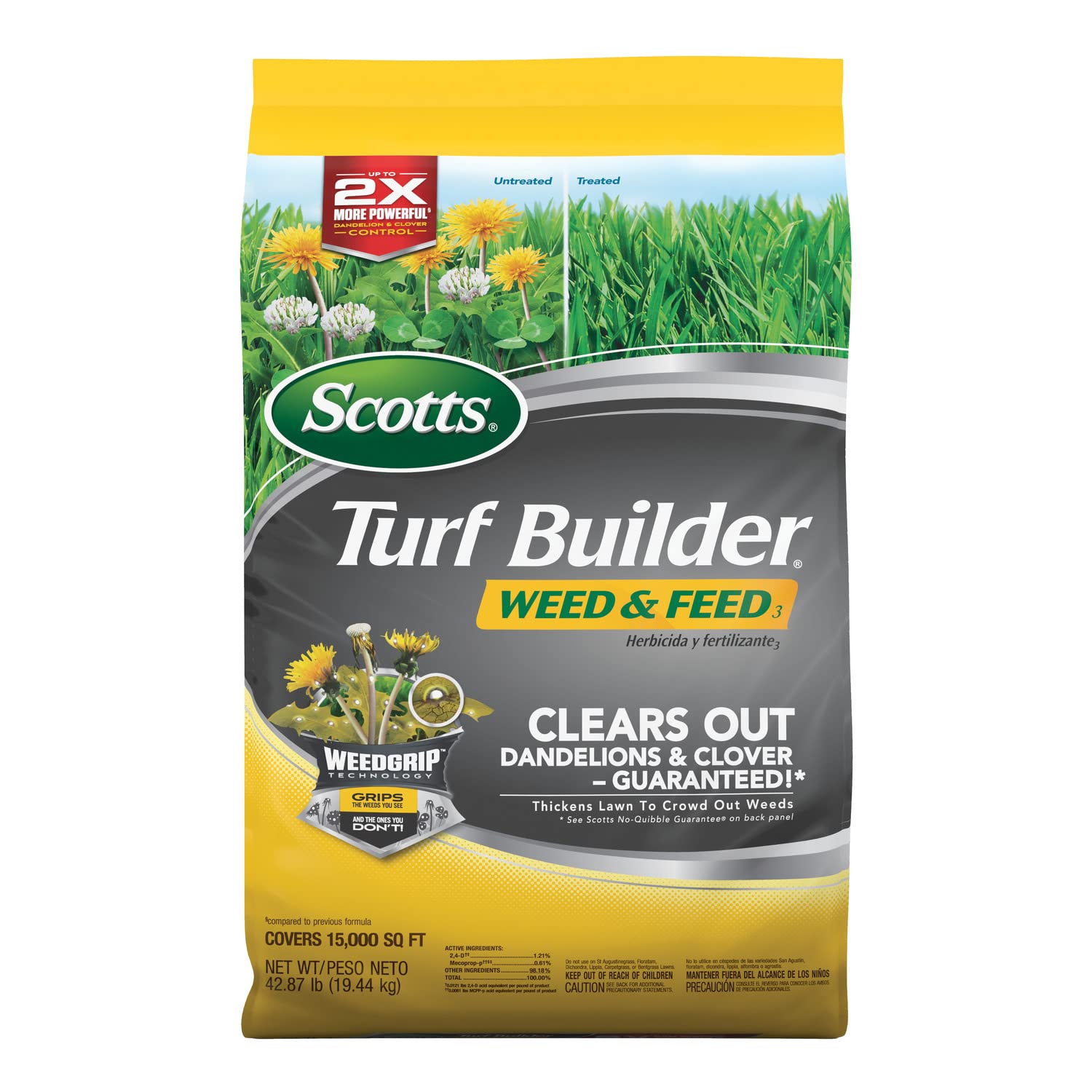
Scotts Turf Builder Weed & Feed (42.87 lb)
| Item Form | Granule |
|---|---|
| Coverage | 15000 square_feet |
| Active Ingredients | 24-D Mecoprop-p |
Scotts Turf Builder Weed & Feed combines a broadleaf weed killer with a granular lawn fertilizer to clear visible dandelions, clover, and many other listed weeds while strengthening grass. It is applied with a broadcast or drop spreader to a moist lawn when daytime temperatures are between about 60 and 90°F; Scotts gives spreader settings and recommends not watering for 24 hours after application so particles adhere to weed leaves. The bag covers a large area, making it suitable for whole-yard treatments, and the WeedGrip Technology is designed to improve contact with weeds for more consistent control. Practical benefits include thicker turf over time that helps crowd out future weeds and a single-step treatment that combines feeding and weed control. Important limitations are specific grass restrictions — do not use on St. Augustinegrass, Bentgrass, Dichondra, Lippia, or Carpetgrass — and timing and weather sensitivity, since application during rain or outside the recommended temperature range reduces effectiveness. Follow label safety directions to keep children and pets away until dust settles.
Best for: Homeowners who want a straightforward, one-step solution to reduce broadleaf weeds across a medium to large lawn and prefer a product backed by many user experiences.
Less Ideal for: Owners of the excluded turf types or people who need year-round or crabgrass-specific control should consider alternative, grass-safe or season-specific products.
- Combines weed control and fertilizer in one application to save time
- Large coverage up to 15,000 sq. ft. suitable for full-yard treatments
- WeedGrip Technology formulated to improve herbicide contact for better control
- Granular form works with common spreaders and has clear spreader settings provided
- Not safe for several turf types including St. Augustine and Bentgrass
- Effectiveness depends on proper timing, moisture, and waiting 24 hours before irrigation
Verdict: A reliable one-step granular weed-and-feed for homeowners who need wide-area broadleaf weed control and turf feeding in a single application.
Scotts Turf Builder Weed & Feed 3, Granular Lawn Fertilizer (14.29 lb)

| Item Form | Granule |
|---|---|
| Coverage | 5000 square_feet |
| Active Ingredients | 2,4-D 1.220%, Mecoprop 0.081% |
Scotts Turf Builder Weed & Feed 3 is a combined weed killer and granular fertilizer intended for late-spring lawn treatment when weeds are actively growing. You broadcast it with a spreader (Scotts gives specific spreader settings) onto a dew-wet lawn so granules stick to weed leaves and deliver the active herbicides 2,4-D and mecoprop while also supplying nutrients to thicken turf. In practice it controls common broadleaf weeds such as dandelion and clover and promotes denser grass that helps suppress future weeds. The bag size covers about 5,000 square feet, which suits a typical medium yard. Important limitations: it should not be applied to sensitive species like St. Augustine, bentgrass, dichondra, lippia, or carpetgrass and you must avoid irrigation or rain for 24 hours after application and keep people and pets off the treated area until dust settles. For homeowners who want a single-product approach to kill weeds and feed lawns in one step, it is an effective, straightforward option when used according to label directions.
Best for: Homeowners who want a simple, one-step solution to reduce common broadleaf weeds while feeding their lawn and who prefer established, label-driven products.
Less Ideal for: Gardeners with sensitive turf species or those seeking organic or pet-free chemical programs should consider alternative targeted products or non-chemical methods.
- Combines herbicide and fertilizer so you kill broadleaf weeds while feeding turf in one application.
- Clear application guidance with recommended spreader settings makes it easy for a homeowner to get even coverage.
- Covers up to 5,000 sq. ft. from a single 14.29 lb bag, suitable for many medium-sized yards.
- Contains WeedGrip Technology that helps granules adhere to weed leaves for better control.
- Not safe for several turf types including St. Augustine and bentgrass so must verify grass compatibility before use.
- Requires dry window after application and restricted access for people and pets until dust settles.
- Contains synthetic herbicides, so it is not suitable for gardeners wanting fully organic treatments.
Verdict: A reliable, easy-to-use weed-and-feed for homeowners who want one product to both kill common broadleaf weeds and thicken their lawn.
Choosing the Right Weed and Feed Lawn Fertilizer: Key Factors to Consider
Weed Control Spectrum
Different weed-and-feed formulations target different groups of broadleaf weeds. Knowing which weeds are present in your lawn matters because some common garden weeds respond quickly to certain herbicides while others are more resistant. A broader spectrum product can reduce the number of follow-up treatments, but broader does not always mean safer for nearby ornamentals.
Also consider whether the product lists post-emergent activity only or includes pre-emergent components. Post-emergent herbicides act on established weeds and usually show visible decline in days to weeks. Pre-emergents prevent seedlings from establishing and are useful for timed seasonal control. Match the control spectrum to the weeds you actually see to avoid unnecessary chemical exposure and to reduce repeat applications.
Nutrient Formulation and Release
Look beyond the headline N-P-K ratio to how nitrogen is delivered. Fast-release nitrogen gives a quicker green-up but can spike growth and require more frequent mowing. Slow-release or polymer-coated nitrogen feeds turf gradually and supports steady growth with fewer flushes. Phosphorus and potassium levels matter for root health and stress tolerance, depending on soil tests and local regulations.
Consider how long the label says the fertilizer will feed the lawn. A product that supplies steady nutrition for 6 to 8 weeks reduces frequency of application, which can be easier for busy homeowners. If you have compacted or nutrient-poor soil, pairing a slow-release feed with cultural practices like aeration will deliver better long-term results than relying on repeated high-dose applications.
Application Timing and Seasonal Fit
Timing is critical for both herbicide efficacy and turf safety. Many weed-and-feed products are formulated for either cool-season or warm-season grasses and have specific temperature or growth-stage windows for application. Applying at the wrong time can stress turf or reduce herbicide activity, leaving weeds unaffected.
Consider local climate and mowing schedule. Early spring and mid-fall applications can be effective for cool-season lawns, while warm-season lawns often need summer timing when weeds are actively growing. Also note whether re-seeding or overseeding is planned, since most weed-and-feed products have restrictions that preclude seeding for a set period after application.
Spreader Compatibility and Coverage
Even distribution is one of the simplest determinants of success. Granular weed-and-feed products require correct spreader setup; a poor spread pattern leaves striping, uneven feeding, and patchy weed control. Check whether a product lists recommended spreader models and settings or gives an application rate per 1,000 square feet.
Also think about granule size and flowability. Products that clump or have inconsistent granules can clog spreaders and create uneven results. If you have a small lawn or irregular beds, a handheld broadcast or drop spreader may be preferable for control. For larger properties, bigger walk-behind spreaders with adjustable gates improve speed and consistency.
Safety, Label Instructions, and Environmental Considerations
Read label precautions for protected species, water proximity, and re-entry intervals. Herbicides used in weed-and-feed mixtures can harm non-target plants and vulnerable pollinator plantings if applied carelessly. Labels often specify buffer distances from ponds, streams, and storm drains; follow those directions to reduce runoff risk.
Consider pet and child re-entry times and whether irrigation is allowed after application. Some products require no watering for a set number of hours to allow herbicide uptake, while others work best with light irrigation. Environmental rules at the local level may restrict certain active ingredients, so check regulations before purchasing.
Seeding and Lawn Renovation Compatibility
If you plan to overseed or repair bare patches, many weed-and-feed fertilizers have seeding restrictions that delay germination for weeks. That makes them less suitable during renovation projects. Alternatively, some formulations are designed to be safe for newly seeded turf after a specific waiting period.
Decide whether immediate weed control or seed establishment is the priority. For renovation, consider applying a straight fertilizer and using spot-treatment herbicides to control weeds where seedlings are not present. Match your long-term lawn improvement plan to the product's post-application restrictions to avoid wasted effort.
When to Use Weed-and-Feed Vs Separate Treatments
A combined weed-and-feed product simplifies a routine by delivering both herbicide and fertilizer in a single application, which suits homeowners with moderate weed pressure and established turf. Choosing a combined product reduces the number of passes over the lawn but ties the timing of feeding to the ideal timing for weed control, which can be a downside in some seasons.
Separate treatments give greater flexibility: you can feed on a schedule that matches turf growth and apply herbicide only when weeds are actively growing. For lawns with heavy weed pressure, spot treatments plus a balanced feed often yield better long-term control than a single mixed application.
- Use weed-and-feed for routine maintenance when weeds are a manageable portion of the lawn.
- Use separate treatments if you plan to overseed or are dealing with large weed outbreaks.
Applying Safely Around Gardens and Trees
Avoid broadcasting weed-and-feed product across flower beds, vegetable plots, shrubs, or young trees. Drift, granule scatter, and runoff can damage non-target plants. When treating close to desirable plantings, use a drop spreader or hand-apply granules to keep product on turf only.
Leave a buffer zone around roots of trees and shrubs where herbicide movement is likely. If you need to treat large areas near sensitive plantings, consider spot treating weeds on the turf and using a plain fertilizer for overall turf nutrition.
- Prevent drift by applying on calm days and avoiding high winds.
- Water management post-application matters; follow label timing for irrigation to balance uptake and runoff risk.
Spreader Setup and Application Tips
Calibrate your spreader before the first application. Measure a known area, apply product at a recommended setting over that area, and adjust settings to match the intended rate. This simple check reduces waste and prevents over-application that can burn turf.
Walk at a steady pace and overlap passes slightly to avoid stripes. Store leftover product in a dry place and keep the spreader hopper clean to prevent corrosion and clumping. Clean up stray granules on patios and walkways to protect adjacent plantings and reduce slip hazards.
- Wear gloves and avoid inhaling dust while loading the spreader.
- Follow label instructions for required mowing height before and after application.
Interpreting N-P-K and Active Ingredient Labels
The N-P-K numbers tell you the nutrient balance but not how nitrogen is released. Look for terms like slow-release, polymer-coated, or water-insoluble nitrogen to identify products that feed gradually. Active herbicide ingredients will be listed with percentages; those names indicate which weed types are targeted.
If you are unsure about label jargon, match the active ingredient names to common weed targets through local extension resources. Local extension offices can also advise if certain herbicide chemistries are restricted in your area.
- Favor products that list spreader settings and application rates in the label.
- Cross-check active ingredients against common weeds in your yard for better targeting.
Managing Expectations After Application
Expect visible weed decline within a few days to several weeks depending on weed type, herbicide mode of action, and weather. Some perennial weeds take longer to show full control and may need follow-up treatments.
Turf response varies by formulation. A noticeable green-up is normal with effective nutrient delivery, but over-application can cause excessive top growth and increase clipping volume. Plan your mowing and irrigation schedule around the product's recommended windows.
- Record the application date and any weather events that follow to inform future timing.
- Avoid reseeding immediately after treatment unless the label explicitly allows it.
How We Chose the Best Weed and Feed Lawn Fertilizer
We shortlisted products that are formulated to both suppress broadleaf weeds and provide measurable nutrient ratios for turf. Our filters emphasized products suited to home lawn use, clear application windows, and labels that list active herbicide ingredients and N-P-K values. We excluded granular mixes that are purely fertilizer without herbicide, and we did not consider weed-killer-only concentrates that require separate fertilizing. Evaluation focused on concrete, gardener-facing dimensions: weed control spectrum and expected speed of visible decline; nutrient formulation and season-long nutrient release; ease of even application with common fertilizer spreaders; safety windows for pets, children, and desirable plants; and label clarity including timing and re-entry guidelines. Products that lacked clear application instructions, omitted a spreader setting guide, or were intended only for commercial turf were not included. These selection criteria align directly with the scoring metrics used in each product scorecard.
FAQ
Can I apply weed-and-feed products when I plan to overseed?
Usually not. Most weed-and-feed formulations restrict seeding for a set number of weeks after application because herbicide components can prevent seed germination. Check the product label and delay overseeding until the recommended waiting period has passed.
How long after application will I see weeds die?
Visible decline often appears within several days for annual broadleaf weeds and a couple of weeks for tougher perennial species. Weather and weed species influence the timeline, so allow several weeks before judging effectiveness.
Is it safe to use weed-and-feed if I have pets and children?
Safety depends on the product's re-entry interval and label precautions. Many products specify a wait time before allowing foot traffic, pets, or children on treated turf. Follow label directions for re-entry and any required watering or mowing restrictions.
Can I water my lawn right after applying a weed-and-feed fertilizer?
It depends on the label. Some products require a dry period to allow herbicide uptake, while others recommend light irrigation to move fertilizer into the soil. Follow the product's specific instructions on watering after application.
Will a weed-and-feed product harm nearby flower beds or vegetables?
Drift or runoff can harm non-target plants. Avoid broadcasting near beds and leave recommended buffer zones. Use a drop spreader or hand-apply granules to keep product on turf and prevent accidental contact with sensitive plantings.
How often should I reapply a weed-and-feed product?
Reapplication frequency depends on the product's nutrient release duration and the level of weed pressure. Many formulations are designed for one application every 6 to 12 weeks during the growing season, but follow label limits on maximum annual applications.
Final Verdict
Prioritize the combination of weed control spectrum and nutrient delivery that matches your lawn type and seasonal goals. If your lawn is being renovated or you plan to overseed, choose feeding and weed strategies that do not conflict with seed germination. For routine maintenance, emphasize spreader calibration and safe application practices to get even coverage and minimize harm to nearby plants. Weed-and-feed products can simplify yard care when used at the right time for your turf species and weed situation. Focus on label instructions, timing, and matching active ingredients to the weeds you have, and you will be better positioned to choose the best product for your lawn.
