

Note: This article contains affiliate links. If you click on these links and make a purchase, I may earn a small commission at no extra cost to you. This helps support my research and content. Read my full affiliate disclosure here.
Picking the right fertilizer for maple trees makes a noticeable difference in vigor, canopy density, and fall color. Maples have specific nutrient rhythms and sensitivity to salt and overfeeding, so a generic lawn product is often not ideal. This guide covers seven top choices shortlisted for typical home landscapes and larger shade trees, with clear notes on what each option does best. We evaluate candidates for nutrient balance, application ease, and seasonality so you can match a product to tree age, soil type, and desired outcome. Read on for practical guidance that helps you pick the right feeding approach for your maples.
Top Picks at a Glance
| Best Overall The best all-around choice for most situations | Jobe's Slow Release Tree & Shrub Fertilizer Spikes, 15 Count (NPK 16-4-4) |  |
| Best Quality Built to a higher standard if you want something more solid | FoxFarm Happy Frog Japanese Maple Fertilizer, 4 lb |  |
| Best Value The sweet spot between price and what you get | SimplyGro Tree & Shrub Fertilizer Spikes (12 spikes, 8-8-8) |  |
| Best Budget The cheapest option that still gets the job done reliably | Dr. Earth Organic Acid Lover Fertilizer for Azalea, Camellia, Rhododendron & Maple (1 lb) |  |
| Highest Rated A top-rated pick with lots of positive feedback | Lutz Corporation Maple-Birch Tree Fertilizer Spikes, 40-Pack |  |
| Most Popular A crowd favorite that many people choose with confidence | Jobe's Slow Release Tree and Shrub Fertilizer Spikes, 9 Count |  |
| Best Seller A high-volume bestseller chosen again and again | Jobe's Organics Tree & Shrub Fertilizer Spikes 16-4-4, 30 Count (2-Pack) | 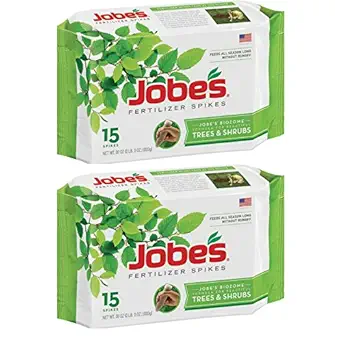 |
Jobe's Slow Release Tree & Shrub Fertilizer Spikes, 15 Count (NPK 16-4-4)

| NPK | 16-4-4 |
|---|---|
| Application method | Insert spikes into soil |
| Coverage | 15 fertilizer spikes |
| Target species | Tree and Shrub |
Jobe's Slow Release Tree and Shrub Fertilizer Spikes are preformed sticks you drive into the soil around a tree's drip line to deliver a slow-release 16-4-4 nutrient mix directly to the root zone. You typically use them twice a year in early spring and late fall, spacing spikes in a circle at the drip line and avoiding placement too near the trunk. The spikes are easy to install with the included plastic cap and hammer and eliminate granular spreading, runoff, or visible mess. The slow-release formula and feather meal and bone meal-derived nutrients provide steady nitrogen for leaf growth along with phosphate and potash for root development and overall plant vigor. For a balanced gardener focused on straightforward, low-maintenance care, these spikes save time and reduce the risk of overapplication. Important limitations are that spikes are single-season applications placed manually and may not provide precisely tailored micronutrients for specific soil deficiencies, and multiple spikes may be needed for larger or mature maples.
Best for: Home gardeners who want a simple, low-maintenance way to feed maples and other deciduous trees without mixing granulars or liquid feeds, and who prefer targeted root-zone nutrition applied seasonally.
Less Ideal for: Gardeners who need a customized soil amendment program, immediate corrective feeding, or continuous monthly feeding for high-demand trees.
- Slow-release 16-4-4 formula feeds roots over the season to support foliar growth and root development
- Premeasured spikes cut down on mess, runoff, and the chance of overfertilizing
- Simple twice-yearly application is low effort and fits into routine seasonal care
- Formulation includes organic-derived sources such as feather meal and bone meal
- May not supply specific micronutrients or soil pH adjustments that some maples need
- Requires manual placement around the drip line and multiple spikes for large trees
Verdict: A low-effort, seasonally applied slow-release spike that delivers balanced NPK nutrition directly to maple tree roots for straightforward maintenance.
FoxFarm Happy Frog Japanese Maple Fertilizer, 4 lb

| Item Form | Powder |
|---|---|
| Specific Uses For Product | Japanese maples, evergreens, hydrangeas, junipers, dogwoods, flowering ornamentals, and other low pH feeders |
| Application Method | Mix into soil or top-dress |
| Coverage | Medium |
| Mixing Ratio | 2 tablespoons per 1 gallon |
FoxFarm Happy Frog Japanese Maple Fertilizer is a powdered, monthly-feed product designed specifically for low-pH feeders such as Japanese maples, hydrangeas, and ornamental evergreens. It is typically mixed into potting soil or used as a top-dress and watered in; the package recommends 2 tablespoons per gallon for container mixes and provides straightforward application guidance for established plants. The 4-3-4 N-P-K balance combined with beneficial soil microbes and mycorrhizal fungi aims to improve root efficiency so trees uptake nutrients and water more effectively, which can translate into fuller foliage and sturdier branch development over a season. Practical benefits include targeted nutrition for acid-loving species, ease of use for new plantings and established specimens, and medium coverage suitable for small to medium trees. Limitations to note are that the formula is tailored to low-pH feeders so it is not an all-purpose fertilizer for every garden plant and powdered products require careful measuring and mixing to avoid overapplication.
Best for: Gardeners who prioritize strong seasonal performance for Japanese maples and other acid-loving ornamentals and who want a fertilizer that supports root health and visible foliage improvements.
Less Ideal for: Gardeners seeking a single all-purpose fertilizer for mixed plantings or those who prefer liquid feeds and precise, frequent dosing schedules.
- Formulated specifically for low-pH feeders like Japanese maples to address their nutrient needs
- Includes beneficial soil microbes and mycorrhizal fungi to improve root nutrient and water uptake
- Easy application as a mix-in or top-dress with a clear mixing ratio provided
- Balanced 4-3-4 N-P-K to encourage leafy growth and support branch development
- Not suitable as a universal fertilizer for plants that prefer neutral or alkaline soils
Verdict: Choose this fertilizer if you want a targeted, microbe-enhanced feed that boosts root efficiency and visible growth in Japanese maples and other low-pH ornamentals.
SimplyGro Tree & Shrub Fertilizer Spikes (12 spikes, 8-8-8)

| Item Form | Sticks |
|---|---|
| Application Method | Hammer the spike into the ground |
| Specific Uses For Product | Outdoor Gardening, Plant Growth, Plant Nutrition, Root Development, Tree & Shrub Fertilizer |
| Mixing Ratio | 8:8:8 |
| Unit Count | 12 Count |
SimplyGro Tree & Shrub Fertilizer Spikes are pre-measured 8-8-8 sticks you hammer into the root zone to supply nitrogen, phosphorus, and potassium over time. They are used by pushing a spike into soil around the drip line in spring and again in fall to support leaf growth, flowering and root strength. The spikes are rigid TruSpikes that the manufacturer says resist breaking and deliver nutrients directly to roots, which reduces surface runoff and makes dosing simple. For a maple tree this product offers a convenient, low-effort way to correct general nutrient needs without mixing granular or liquid feeds. Limitations are that the formula is a balanced general fertilizer rather than a maple-specific blend, so it will not correct pH issues or target micronutrient deficiencies, and coverage varies by tree size so you must estimate the number of spikes per tree. Best used as routine, general feeding rather than a corrective treatment for obvious nutrient problems.
Best for: Buyers who want a low-maintenance, set-and-forget way to provide routine nutrition to landscape trees like maples without mixing fertilizers or frequent applications.
Less Ideal for: Gardeners seeking species-specific formulations, soil pH correction, or precise micronutrient management should consider alternatives like soil tests and targeted fertilizers or amendments.
- Pre-measured 8-8-8 formula supplies NPK for general tree and shrub nutrition
- TruSpike design resists breaking for easier insertion and handling
- Feeds at the root zone to reduce surface nutrient loss and runoff
- Simple seasonal application: typically applied in spring and fall
- Balanced NPK mix is not tailored for species-specific needs or micronutrient correction
- Coverage per spike is not specified, so larger trees may require estimation of quantity needed
Verdict: An easy, low-effort way to give maples routine NPK nutrition with pre-measured spikes for seasonal feeding.
Dr. Earth Organic Acid Lover Fertilizer for Azalea, Camellia, Rhododendron & Maple (1 lb)

| Item Form | Powder |
|---|---|
| Specific Uses For Product | Organic |
| Coverage | Medium |
| Target Species | Rhododendron |
This Dr. Earth Acid Lover fertilizer is an organic powder designed for acid-loving species and can be used at planting or as a routine feed for trees like maples that prefer slightly acidic soil. It contains the three primary nutrients nitrogen phosphorus and potassium along with a live probiotic inoculant and mycorrhizae intended to improve soil biology and help plants adapt after transplanting. Typical use is mixing per the product directions at planting or broadcasting at recommended intervals to maintain soil life and nutrient availability. Practical benefits include organic certification and non-GMO verification which suit gardeners focused on natural soil improvement and longer-term soil health rather than quick synthetic feeding. The product comes in a small 1 lb unit which is convenient for trialing around a few young maples or for use in containers but means you will need more frequent purchases for larger trees or multiple specimens. The powder form requires careful measuring and even application to avoid uneven spots and it does not list an N-P-K breakdown on the label shown here which limits precise nutrient planning for larger landscape applications.
Best for: Gardeners who prioritize organic soil health and want a natural fertilizer to support young maples or a small group of acid-loving plants, especially those testing an organic option before scaling up.
Less Ideal for: Landscapers or homeowners with multiple mature maple trees who need bulk coverage and precise N-P-K information should look for larger commercial formulations.
- Organic and non-GMO verified so it supports natural soil management
- Includes probiotic microbes and mycorrhizae to boost soil biology and transplant success
- Formulated specifically for acid-loving species, matching maple needs where soil acidity is desired
- Small 1 lb package is easy to store and good for trialing on a few young trees or containers
- Only sold in a small 1 lb size which is not cost-effective for mature or multiple maple trees
- Label information here does not provide a full N-P-K ratio for precise nutrient planning
- Powder form requires careful measuring and even application to avoid patchy results
Verdict: Choose this if you want a small organic fertilizer that boosts soil biology and is suited to acid-loving plants and young maples.
Lutz Corporation Maple-Birch Tree Fertilizer Spikes, 40-Pack

| Item Form | Sticks |
|---|---|
| Target Species | trees, shrubs |
| Mixing Ratio | 8-10-10 |
| Unit Count | 40 Count |
These Lutz Maple-Birch fertilizer spikes are slow-release sticks designed to be hammered into the soil at the drip line to feed trees and shrubs for up to 12 months. Each spike contains an 8-10-10 NPK mix plus sulfur, iron, and manganese to address common northern deficiencies that cause leaf yellowing and poor vigor. Use is simple: insert the spikes around the root zone once per year without measuring or mixing, making them a low-effort option for seasonal maintenance. The inclusion of sulfur helps acidify soil microsites and improve iron and manganese uptake, which is particularly useful for maples prone to chlorosis. Because the feed is slow and localized, it reduces the risk of burning and keeps lawn surface tidy compared with granular applications. Limitations are that placement must be around active roots to be effective and a single 40-count pack may not cover many large trees, so plan quantities by tree size. For gardeners seeking a hassle-free, targeted annual treatment, these spikes make nutrient management straightforward.
Best for: Gardeners who prioritize reliable, low-maintenance care for maples and other northern trees and want a once-a-year, targeted nutrient solution that corrects micronutrient deficiencies.
Less Ideal for: Those managing large numbers of trees or very large specimens who need bulk coverage or who prefer granular or liquid feeding methods for whole-yard applications.
- Slow-release formula feeds up to 12 months with a single application
- Contains iron and manganese to address chlorosis in northern trees
- Easy no-mess installation with no measuring or mixing required
- Includes sulfur to help lower soil pH and improve micronutrient uptake
- 40-count may be insufficient for multiple large trees requiring several spikes each
- Must be placed at the drip line near active roots to be effective
Verdict: A convenient, once-a-year slow-release spike formulated to reliably correct iron and manganese deficiencies in maples and other northern trees.
Jobe's Slow Release Tree and Shrub Fertilizer Spikes, 9 Count

| Unit Count | 9 Count |
|---|---|
| Application Method | Insert spikes into soil |
| Item Form | Sticks |
| Mixing Ratio | 15-3-3 |
| Target Species | Tree and Shrub |
These Jobe's fertilizer spikes deliver a simple, low-effort way to feed established trees and shrubs by placing pre-measured sticks into the root zone around the drip line. Designed for twice-yearly use in early spring and late fall, the 15-3-3 slow-release formula supplies nitrogen, phosphorus, and potassium directly where active roots absorb nutrients while reducing surface runoff and mess. Use is straightforward: space the spikes around the drip line, tap them slightly below the soil surface, and leave them to release nutrients over the season. The main practical benefits are convenience, consistent dosing that reduces risk of overfertilizing, and targeted delivery that avoids foliar application or liquid mixing. Limitations are that spikes provide season-long, moderate feeding rather than fast corrective feeding, and they must be spaced correctly and kept at least the recommended distance from the trunk to be effective. For larger or nutrient-deficient maples you may need additional soil testing or supplemental treatments.
Best for: Homeowners who want a low-effort, low-risk way to maintain healthy maples and other acid-loving trees using a product backed by many positive reviews and clear instructions.
Less Ideal for: People managing nutrient-deficient or newly planted maples that need immediate or customizable feeding plans should choose a concentrated liquid or granular fertilizer and consider soil testing.
- Pre-measured spikes reduce guesswork and prevent over-application
- Slow-release 15-3-3 formula feeds roots over the growing season
- Simple installation with no mixing, runoff, or strong odors
- Targets nutrient delivery at the tree drip line where roots are active
- Provides moderate, gradual feeding and is not suitable for rapid correction of nutrient deficiencies
- Pack size of nine spikes may be insufficient for many large or multiple maple trees
Verdict: Use these pre-measured slow-release spikes for an easy, low-risk twice-yearly feeding regimen to keep established maple trees healthy without guesswork.
Jobe's Organics Tree & Shrub Fertilizer Spikes 16-4-4, 30 Count (2-Pack)

| Item Form | Sticks |
|---|---|
| Application Method | Insert spikes around each tree's dripline |
| Coverage | Medium |
| Target Species | Trees and shrubs |
| Mixing Ratio | 16:4:4 |
Jobe's Organics Tree & Shrub Fertilizer Spikes are pre-measured, slow-release sticks you push into the soil around a tree's dripline to supply nutrients through the growing season. They are intended for use in early spring and late fall and are especially convenient for homeowners who prefer a low-effort feeding method with no mixing or measuring. The 16-4-4 ratio provides a higher proportion of nitrogen for steady green growth while the spike form minimizes runoff and surface mess. Practical benefits include simple installation, season-long nutrient delivery, and reduced risk of overapplication because each spike is a fixed dose. Limitations are that spikes only feed the root zone where placed, so proper placement around mature maples is important, and they do not address micronutrient or soil pH needs. For large properties you will need many spikes, and they are less useful when deep root feeding or precise soil amendments are required.
Best for: Homeowners who want a low-effort, reliable feeding method for maples and other deciduous trees and prefer predictable, measured applications to avoid accidental overfertilizing.
Less Ideal for: Gardeners who need soil-specific corrections, targeted micronutrient treatments, or professional deep-root feeding for large specimen trees.
- Pre-measured slow-release formula reduces risk of overfeeding
- Easy to apply by inserting around the tree dripline with no mixing
- Provides season-long nutrient delivery below the soil surface
- Formulation designed for trees and shrubs, including deciduous species
- Spike placement must be correct to reach active roots on larger trees
- Not suitable for correcting soil pH or specific micronutrient deficiencies
- Requires many spikes for large or multiple trees, increasing effort
Verdict: Use these pre-measured, slow-release spikes when you want a simple, low-risk seasonal fertilizer for maple trees without mixing or measuring.
Choosing the Right Fertilizer for Maple Trees: Key Factors to Consider
Nutrient Ratio and Release Type
Maple trees respond differently to quick-release versus slow-release nutrients. A fertilizer with a balanced ratio of nitrogen, phosphorus, and potassium supports leaf growth, root development, and winter hardiness. High nitrogen early in the season encourages canopy growth, while a moderate potassium level helps stress tolerance and fall color.
Slow-release formulations provide steady feeding over weeks or months, which reduces the risk of nutrient burn and excessive late-season growth that can interfere with hardening off. Quick-release options can correct obvious deficiencies but require careful timing and accurate rates to avoid shock.
Salt Index and Root Safety
Many maples have relatively shallow, fibrous root systems that are sensitive to salts and soluble fertilizers. A low salt index reduces the chance of root dehydration and leaf scorch, particularly when watering is inconsistent. Products labeled for trees or with controlled-release coatings tend to be gentler on roots than concentrated soluble mixes.
Consider soil moisture and drainage when applying fertilizer; dry soils plus high-salt products increase burn risk. If you routinely use de-icing salts on nearby sidewalks or driveways, choose a lower-salt fertilizer and monitor for edge scorch where runoff might reach the root zone.
Application Method and Ease
How a fertilizer is applied affects accuracy and the time you need to spend. Granular spread-and-wash products are simple for homeowners and reduce handling of liquids, while water-soluble fertilizers allow quick uptake but require careful dilution and thorough root-zone watering. Spike or tablet forms place nutrients closer to roots but can be labor intensive for large trees.
Compatibility with common spreaders or drop spreaders and clear label rates by trunk diameter or canopy size make home application easier and reduce the risk of over- or under-feeding.
Timing and Seasonality
Timing of application is crucial for maples. Spring feeding supports new leaf and shoot growth, while late-summer feeding should be avoided because it can delay dormancy. Many gardeners use an early-spring application and, if needed, a light mid-summer touch only with slow-release products. Some formulations are designed for a single annual application that lasts through the growing season.
Consider local climate and the specific maple species when planning timing. In cooler regions, slightly later spring applications may be appropriate, while warmer zones may benefit from earlier feedings.
Soil Type and pH Interaction
Soil texture and pH influence nutrient availability for maples. Acidic to neutral pH is typical for many maple species; if soil is alkaline, certain micronutrients can become unavailable. Some fertilizers include micronutrients or acidifying components to correct deficiencies, while others focus purely on macronutrients.
A soil test before application helps match fertilizer composition to existing conditions. Sandy soils leach nutrients faster and may benefit from slow-release products, whereas clay soils hold nutrients longer but need careful use to avoid buildup.
When to Feed Maples During the Year
Feed maples in early spring as buds swell and new leaves form. This timing supports root uptake and reduces the chance of pushing late-season growth that could be damaged by frost.
Avoid heavy late-summer or fall fertilization, which can prolong soft growth and reduce cold hardiness. In many situations a single, well-timed application in spring is sufficient, especially when using a slow-release formula.
- Early spring for main feeding
- Light mid-summer only if necessary and with slow-release products
- Do not fertilize late summer or fall
How to Apply Fertilizer Around a Maple
For granular products, broadcast evenly across the drip line rather than in a tight ring at the trunk. Many roots that absorb nutrients extend beyond the canopy, so spreading to the outer root zone improves uptake. Always follow label rates by canopy diameter or trunk caliper.
For water-soluble feeds, dilute precisely and water thoroughly afterward to move nutrients into the root zone. Spike and tablet systems should be placed according to label spacing to avoid concentrated pockets of nutrients.
- Measure canopy or trunk before calculating rate
- Avoid piling product against the trunk
- Water in well after application to reduce burn risk
Adjusting Feed for Young Trees Versus Established Specimens
Young maples need a gentler approach: lower overall nutrient amounts and formulations with a balanced N-P-K that support root establishment as well as top growth. Overfeeding young trees can create disproportionate leaf growth at the expense of root development.
Established trees tolerate larger total nutrient amounts but benefit most from slow-release, low-salt options applied across the root zone. Mature specimens rarely need frequent feeding if soil organic matter is healthy; targeted applications correct specific deficiencies.
- Use lower rates for newly planted or juvenile trees
- Focus on balanced nutrition for establishment
- Established trees often need only periodic corrective feeding
Organic Options and Soil-Building Approaches
Organic fertilizers and compost can supply nutrients while improving soil structure and microbial activity. They release nutrients more slowly and reduce salt concerns, making them a good match for sensitive maples and long-term soil health.
Compost topdressings, well-rotted manures, and organic tree feeds are best used as part of a broader soil-building plan rather than quick corrective fixes. A soil test helps you decide whether to rely on organic amendments or add targeted mineral fertilizers.
- Organics improve soil biology and structure
- Slower nutrient release lowers burn risk
- Combine soil amendments with targeted mineral feeds as needed
Common Application Mistakes to Avoid
Do not apply fertilizer in a concentrated band around the trunk or in deep holes filled with granular product. These methods increase burn risk and encourage roots to concentrate unnaturally.
Do not assume lawn fertilizer rates apply to trees. Lawn formulations often have higher salt content and are measured per area of turf, not per tree. Follow label instructions for individual trees and adjust rates based on canopy size and soil tests.
- Avoid trunk rings and deep, concentrated placements
- Do not use lawn rates for trees
- Water after application to minimize salt damage
How We Chose the Best Fertilizer for Maple Trees
We focused on criteria that reflect how fertilizers behave around maple trees in real gardens. Primary evaluation factors included nutrient ratio and release type to match maples' spring growth and fall coloration needs; salt index and formulation to avoid root burn on sensitive shallow-rooted species; nutrient granule or spreader compatibility for easy backyard application; and suitability across common soil types and tree ages. We also judged seasonality and timing guidance because correct timing reduces stress and improves nutrient uptake. Environmental impact and runoff risk were considered for home landscapes near lawns, beds, or water features. We excluded products formulated only for lawns, high-chloride mixes, or those lacking clear application instructions for individual trees. The shortlisted fertilizers all met our practical criteria for safe, effective feeding of maple trees under typical homeowner conditions.
FAQ
How often should I fertilize a mature maple tree?
Mature maples usually need fertilizing only once a year with a balanced slow-release product unless a soil test shows deficiencies. Occasional corrective treatments can be applied in spring if growth appears weak.
Can I use lawn fertilizer on my maple trees?
Often lawn fertilizers have higher salt content and rates intended for turf, not trees. Using lawn products without adjusting the rate and understanding the salt index can cause root burn, so choose tree-specific instructions instead.
Is organic fertilizer safe for maples?
Organic fertilizers are generally safer for maples because they release nutrients slowly and improve soil biology. They are a good option for reducing burn risk, though they may take longer to correct visible deficiencies.
What is the best time of year to apply fertilizer to maples?
Early spring, as buds swell, is the best time to apply fertilizer to maples. Avoid heavy late-summer or fall applications to prevent pushing late growth that could be damaged by cold weather.
How do I calculate the right amount of fertilizer for my tree?
Calculate amounts based on the product label instructions tied to trunk diameter or canopy spread. If the label uses area rates, measure the drip line and convert accordingly. A soil test provides the best guidance for adjusting typical rates.
Final Verdict
Choosing the right fertilizer for maple trees means matching nutrient composition, release behavior, and application method to tree age and soil conditions. Prioritize balanced N-P-K and a low salt index for sensitive roots, and favor slow-release formulations when possible to reduce burn risk and support steady growth. Use timing, proper placement, and soil testing to refine your approach. With the right feeding strategy you can support healthy canopy development, stronger roots, and more consistent fall color without creating unnecessary stress for the tree.
