

Note: This article contains affiliate links. If you click on these links and make a purchase, I may earn a small commission at no extra cost to you. This helps support my research and content. Read my full affiliate disclosure here.
Picking the right fertilizer for mango trees makes a real difference in flowering, fruit set, and overall tree vigor. Mango trees have specific nutrient rhythms: they need a steady supply of nitrogen when growing foliage, extra phosphorus and potassium around bloom and fruit development, and micronutrients to avoid leaf yellowing and poor fruit quality. This guide covers seven carefully shortlisted fertilizers suited for mango tree care across common backyard and small-orchard situations. We explain why each option made the list and summarize the practical criteria used to evaluate them, including nutrient profile and ease of use. Read on to see which product types fit your soil, tree age, and seasonal feeding plan.
Top Picks at a Glance
| Best Overall The best all-around choice for most situations | TPS Nutrients Mango Tree Liquid Fertilizer, 8 oz |  |
| Best Quality Built to a higher standard if you want something more solid | Down To Earth Organic Fruit Tree Fertilizer, 6-2-4, 5 lb |  |
| Best Value The sweet spot between price and what you get | HiThrive Mango Tree Liquid Fertilizer, 16 oz |  |
| Best Budget The cheapest option that still gets the job done reliably | Jobe's Organics Granular Fruit & Citrus Fertilizer, 4 lb |  |
| Highest Rated A top-rated pick with lots of positive feedback | Miracle-Gro Shake 'N Feed Citrus, Avocado & Mango Plant Food (4.5 lb) |  |
| Most Popular A crowd favorite that many people choose with confidence | Miracle-Gro Fruit & Citrus Plant Food Spikes (12 spikes, 10-15-15) |  |
TPS Nutrients Mango Tree Liquid Fertilizer, 8 oz

| Item Form | Liquid |
|---|---|
| Specific Uses For Product | Mango Tree Fertilizer |
| Coverage | Full |
| Target Species | Mangoes |
| Mixing Ratio | 1:100 |
This 8 oz liquid formula from TPS Nutrients is made specifically for mango trees and tropical fruit plantings. It is mixed at 1:100 and applied as a feed to support shoot and leaf development, improve root health, and help reduce fruit drop so harvests look fuller and more consistent. The product includes added calcium, magnesium, and kelp-enriched minerals, which help with fruit set and general tree vigor rather than acting as a general-purpose houseplant feed. Because it is a concentrated liquid, a small bottle treats many applications when diluted, making it convenient for backyard trees and small orchard rows. Important limitations are that the label is focused on mangoes so it may not be ideal for trees with very different nutrient needs, and users must follow safety guidance and mixing rates carefully to avoid over-application. For gardeners in warm climates looking for a targeted mango feed, this product offers a compact, easy-to-use option.
Best for: Gardeners growing mangoes or other tropical fruit trees in warm-climate yards or small orchards who want a targeted, easy-to-mix feed to improve fruit set and tree vigor.
Less Ideal for: Large commercial growers or those seeking an all-purpose fertilizer for a wide range of plants should consider broader-spectrum or bulk fertilizers instead.
- Formulated specifically for mango and tropical fruit trees to support fruit development
- Includes calcium, magnesium, and kelp-enriched minerals for improved fruit set and vigor
- Concentrated liquid with a 1:100 mixing ratio so a small bottle treats many applications
- Designed for full coverage use on yard and patio trees and small orchards
- Label and formulation targeted at mangoes so may not suit trees with different nutrient needs
- Small 8 oz bottle may be insufficient for large orchards unless bought in multiples
Verdict: A concentrated, mango-focused liquid feed that makes targeted fruit and root support simple for home gardeners and small orchards.
Down To Earth Organic Fruit Tree Fertilizer, 6-2-4, 5 lb

| Item Form | Powder |
|---|---|
| Specific Uses For Product | Plant Growth,Potting |
| Target Species | fruit trees |
| Mixing Ratio | 6:2:4 |
This organic fruit tree fertilizer is a soil-applied, powder/granular blend designed to feed fruiting trees including mangoes by supplying steady nutrient release and added calcium for better fruit development. It is typically broadcast or hand-applied around the tree drip line, lightly worked into the top inch of soil and watered in; the product is not water soluble so it acts through soil biology rather than immediate foliar uptake. Notable features include an NPK of 6-2-4, a mix of animal, marine and plant ingredients such as fish bone meal, blood meal, kelp and rock phosphate, and OMRI listing for organic production. In practice this means slower, long-lasting nutrient availability that supports flowering, fruit set and flesh quality without synthetic salts. Limitations are that it is not a quick foliar fix for acute deficiencies and application rates must be followed to avoid overfeeding; users seeking fast correction of yellowing or severe nutrient shortages may need a soluble supplement first.
Best for: Home orchardists and serious mango growers who prioritize steady, organic nutrition and better fruit quality over instant greening.
Less Ideal for: Gardeners who need rapid correction of nutrient deficiencies or who prefer ready-to-use liquid fertilizers and foliar feeds.
- OMRI listed and formulated from natural ingredients suitable for organic orchards
- 6-2-4 NPK with added calcium supports fruit set and development
- Slow-release, soil-targeted formula feeds trees over time rather than causing salt buildup
- Shelf stable and does not expire when stored dry
- Not water soluble so it will not correct acute nutrient deficiencies quickly
- Requires manual broadcasting and light incorporation which is more labor intensive than granular spikes or liquid feeds
Verdict: Choose this product when you want an OMRI-listed, slow-release organic fertilizer that improves mango fruit set and quality through soil feeding rather than quick foliar fixes.
HiThrive Mango Tree Liquid Fertilizer, 16 oz

| Item Form | Liquid |
|---|---|
| Application Method | Spray |
| Coverage | Full |
| Target Species | Mango |
| Mixing Ratio | 1:16 |
HiThrive Mango Tree Liquid Fertilizer is a concentrated 16 oz plant food designed specifically for mango trees and formulated with macronutrients and micronutrients to encourage leafy growth, stronger roots, and sweeter fruit. It mixes at a 1:16 ratio and can be applied by watering can, hose-end sprayer, or as a foliar spray, which makes it easy to use across container and in-ground trees. The label calls out nitrogen, phosphorus and potassium plus elements like calcium, iron and zinc, so it addresses common deficiencies that cause yellowing or slow growth. Practical benefits include a small bottle that stretches to many gallons of ready-to-use solution, clear mixing instructions for different application methods, and an easy schedule for weekly to monthly feeding depending on season. Expect noticeably fuller foliage and improved fruit set when used as directed during active growth. The product is focused on nutrition rather than soil amendment, so growers who need pH adjustment, organic certification, or slow-release granular feeding should plan to use it alongside other cultural practices rather than as a sole long-term soil conditioner.
Best for: Gardeners who want a straightforward, concentrated feed to boost mango tree growth and fruiting and who prioritize easy mixing and repeatable application for practical maintenance.
Less Ideal for: Growers seeking an organic, granular, or soil-building fertilizer as their primary long-term amendment should consider other products or combine this with soil conditioners.
- Concentrated 16 oz bottle mixes to 16 gallons, providing extended use from a small container
- Formulated with NPK plus micronutrients like calcium, iron and zinc to correct common deficiencies
- Multiple application methods supported: watering can, foliar spray, and hose-end sprayer
- Clear mixing ratios and seasonal feeding schedule simplify routine maintenance
- Not an organic-certified product, so it may not suit organic orchard management
- Does not amend soil structure or provide slow-release nutrition
Verdict: A concentrated, easy-to-use liquid feed that stretches far and reliably boosts mango tree foliage and fruit when used as part of routine seasonal care.
Jobe's Organics Granular Fruit & Citrus Fertilizer, 4 lb

| NPK | 3-5-5 |
|---|---|
| Form | Granules |
| OMRI listed | Yes |
| Unit count | 64 Ounce |
| Application method | Spread evenly around base |
Jobe's Organics Granular Fruit & Citrus Fertilizer is a small-bag, slow-release granular formula designed to feed fruiting trees and plants with balanced nutrition. Typical use is to spread the granules evenly around the root zone and water in every 4 to 8 weeks during the growing season. The 3-5-5 NPK plus calcium and sulfur sources aims to support flowering, fruit set, and overall plant vigor while minimizing the risk of burn that can come from high-soluble fertilizers. Being OMRI-listed and derived from feather meal, bone meal, and poultry manure makes it suitable for organic gardens and for growers who prefer natural inputs. The resealable 4 lb bag fits small yards or specimen trees and is easy to measure for repeat applications. Limitations are the relatively small unit size if you have multiple or large mature mango trees and the lower nitrogen level compared with some mango-specific feeds that target heavy vegetative growth; you will need to reapply through the season or buy multiple bags for larger plantings.
Best for: Gardeners who want an organic, easy-to-apply granular fertilizer for a single mango tree or a few young fruiting trees and who prioritize natural inputs and simple repeat applications.
Less Ideal for: People managing several mature mango trees or commercial plantings that need high-volume or higher-nitrogen formulations should choose larger bulk fertilizers or mango-specific products designed for heavy feeding.
- OMRI-listed organic formula suitable for certified organic production
- Balanced 3-5-5 NPK geared toward fruiting and blossom development
- Slow-release granular form reduces risk of fertilizer burn and gives longer feeding
- Resealable 4 lb bag is convenient for measured, repeat applications
- Small 4 lb quantity may not be economical for multiple or large mature trees
Verdict: A small, OMRI-listed granular fertilizer that delivers balanced, slow-release nutrition ideal for home growers wanting an organic feed for one or a few mango trees.
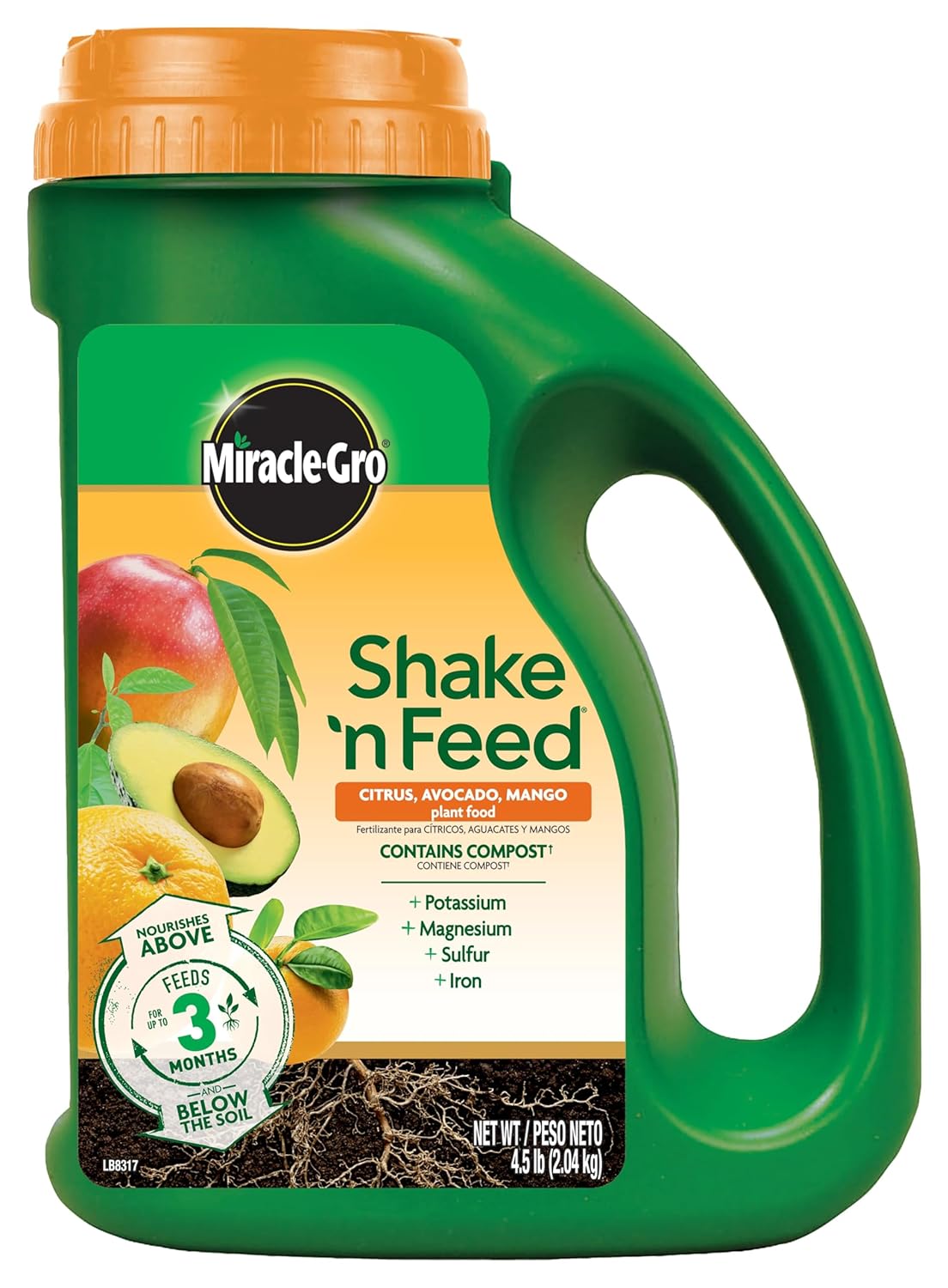
Miracle-Gro Shake 'N Feed Citrus, Avocado & Mango Plant Food (4.5 lb)
| Item Form | Granules |
|---|---|
| Application Method | Shake evenly onto soil |
| Target Species | citrus, avocado, mango |
| Mixing Ratio | 8-2-10 |
| Coverage | Medium |
This granular Shake 'N Feed formula is designed to support citrus, avocado, and mango trees in both containers and in-ground plantings by delivering nutrients slowly over about three months. You apply it by shaking the granules evenly onto soil within the canopy spread, working them lightly into the top inch or two of soil for in-ground trees or mixing at planting for containers, then watering to start release. The listed N-P-K (8-2-10) and added micronutrients such as potassium, magnesium, sulfur, and iron help correct common deficiencies and support root strength through microbial activity in the mix. The product covers a medium area per jug and is convenient for seasonal reapplication every three months so maintenance is simple. Limitations are typical of granular, slow-release feeds: it is not a quick foliar fix for an acute nutrient problem and dosing requires attention to label rates to avoid overfeeding. It also does not replace targeted soil testing or cultural care for long-term orchard issues.
Best for: Gardeners who want a reliable, low-maintenance fertilizer for mango trees and prefer scheduled, slow-release feeding rather than frequent liquid applications.
Less Ideal for: Growers needing fast corrective feeding, those managing large commercial orchards who require tailored soil-test-based programs, or users who prefer liquid feeds for foliar application.
- Slow-release formula feeds up to three months so applications are infrequent
- Formulated specifically for citrus, avocado, and mango trees with N-P-K 8-2-10 blend
- Includes micronutrients (K, Mg, S, Fe) and microbes to help address common deficiencies and support roots
- Works for both container and in-ground trees with simple shake-and-water application
- Not suitable for rapid correction of acute deficiencies since effects are gradual
- Requires careful application around root zone to avoid contact with trunk and foliage
Verdict: A dependable, slow-release granular feed that simplifies seasonal nutrition for mango trees so you can maintain healthy growth with quarterly applications.
Miracle-Gro Fruit & Citrus Plant Food Spikes (12 spikes, 10-15-15)

| Item Form | Sticks |
|---|---|
| Specific Uses For Product | Fruit & Citrus Tree Care |
| Application Method | Insert spikes into the ground |
| Mixing Ratio | 10:15:15 |
| Number of Items | 12 |
These preformed plant food spikes deliver targeted nutrition to fruit and citrus trees by releasing nutrients directly into the root zone when driven into the soil around the tree dripline. Intended for a simple twice-a-year program, you place spikes around the dripline (spacing per the label), press or tap them into softened soil, and let them dissolve slowly to feed roots throughout the growing season. The 10-15-15 NPK balance emphasizes phosphorus and potassium to support flowering and fruit set as well as overall plant vigor, and the sticks are low-effort compared with regular granular or liquid feedings. Practical benefits include predictable seasonal feeding, minimal measuring or mixing, and suitability for citrus, mango, avocado, and even palms. Important limitations are that spikes are designed for spring and fall use only so they are not a quick fix for sudden nutrient deficiency and you must follow the package chart to avoid under- or over-applying around larger trees. These spikes work best as part of a broader care plan that includes watering, pruning, and soil management.
Best for: Home gardeners who want a low-effort, seasonally scheduled fertilizer to support fruiting trees and prefer straightforward, proven solutions backed by broad user experience.
Less Ideal for: Those needing fast corrective feeding, precise nutrient tailoring, or continuous fertilization for container-grown or high-demand trees should consider water-soluble or granular alternatives.
- Targets nutrients to the root zone for efficient uptake
- Easy, low-mess application with no mixing or measuring
- 10-15-15 NPK formulated to encourage flowering and fruit development
- Pack of 12 covers multiple trees or repeat seasons
- Seasonal use only so not suitable for urgent corrections
- Requires soil softening before insertion which can be harder in dry or compacted soils
Verdict: Use these spikes if you want a simple, low-maintenance twice-year feeding that delivers fruit-focused NPK directly to tree roots.
Choosing the Right Fertilizer for Mango Trees: Key Factors to Consider
Nutrient Balance and Guaranteed Analysis
A fertilizer's guaranteed analysis tells you the percentage of nitrogen, phosphorus, and potassium and helps match feeding to tree needs. Young mango trees need higher nitrogen for vegetative growth, while mature, fruiting trees benefit from greater potassium and some extra phosphorus to support flowers and fruit set. Comparing N-P-K and identifying available forms, such as ammoniacal nitrogen or soluble phosphate, helps predict short-term versus sustained effects.
Overfeeding one macronutrient can cause imbalances that reduce flowering or cause excessive vegetative growth at the expense of fruit. Look for clear labels that list micronutrients too; deficiencies in zinc, boron, or iron commonly affect mango leaf color and fruit quality.
Release Pattern and Timing
How quickly nutrients become available affects when and how often you need to feed. Quick-release formulations give a fast green-up useful for late-winter foliar push or correcting deficiencies, but they require more frequent applications. Slow-release or controlled-release fertilizers provide steadier nutrition over months and reduce risk of nutrient burn and leaching in sandy soils.
Timing matters for mango trees: a feed timed before the main flush supports new leaf growth, while a bloom-time, higher-potassium feed supports fruit set and development. Choose a release pattern that fits your maintenance schedule and local climate variability.
Micronutrient Composition
Mango trees commonly show deficiencies in micronutrients that do not appear in an N-P-K ratio. Zinc is often necessary to encourage proper leaf and fruit formation, while boron plays a role in fruit set. Iron and manganese influence leaf color and photosynthetic efficiency.
Fertilizers that include a reliable micronutrient package or that can be complemented with foliar sprays give more consistent results than N-P-K-only blends. Soil tests can reveal which micronutrients are missing so you can choose a product that corrects specific shortfalls.
Formulation Type and Application Method
Fertilizers come as granules, water-soluble powders, liquids, and slow-release coated pellets. Granular and slow-release products are convenient for broadcasting under the canopy and require less frequent attention. Water-soluble and liquid feeds are best for foliar sprays or root drenching when you need rapid uptake, such as correcting a deficiency during flowering.
Consider how you will apply the product under a mature canopy and whether the formulation allows even distribution around the drip line. For container-grown mango trees, water-soluble or liquid formulas offer more precise dosing and faster correction of nutrient problems.
Soil Type and Watering Regime
Soil texture and fertility influence how nutrients move and remain available. Sandy soils leach nutrients quickly and benefit from slow-release formulations or frequent light feeds. Clay soils hold nutrients longer but may require attention to salt buildup from repeated quick-release applications.
Your watering frequency also changes fertilizer choice. If you irrigate often, choose more stable or split-feeding schedules to avoid loss of soluble nutrients. Always account for local rainfall patterns that can flush applied nutrients away during heavy rains.
Tree Age, Size, and Root Zone Coverage
Young mango trees have smaller root zones and need lower total nutrient amounts delivered more frequently to support steady growth. Mature trees have expansive roots and need larger, well-distributed applications to reach absorbing roots near and outside the drip line.
Measure or estimate canopy radius to determine how broadly to apply fertilizer. Overconcentrating granules near the trunk risks root burn and fails to feed the feeder roots farther out. Choosing a product that provides application guidance by tree size makes correct dosing easier.
When to Feed Mango Trees Throughout the Year
Feeding should follow the tree's growth cycle. A light maintenance feed in late winter or early spring supports the vegetative flush, while a bloom-stage feed with extra potassium and phosphorus helps blooms set and reduces fruit drop. After harvest, a restorative feed with balanced N-P-K and micronutrients helps the tree recover and build reserves for the next season.
- Apply maintenance feeds once or twice depending on fertilizer release rate.
- Time bloom-stage feeding just before expected flowering for best uptake.
- Avoid heavy nitrogen applications late in the season that can delay dormancy or reduce cold tolerance.
Interpreting Leaf Symptoms and Soil Tests
Yellowing, stunted growth, or poor fruit set often point to specific nutrient shortages or pH issues. A soil test gives a baseline for macronutrients, pH, and available micronutrients. Leaf tissue analysis during the growing season provides a snapshot of what the tree is actually absorbing.
- Use soil tests to choose base fertilizers and correct pH before major feeding.
- Look for interveinal chlorosis for iron or manganese issues; small deformed leaves can indicate zinc deficiency.
- Keep records of leaf tests year to year to track trends and adjust fertilizer plans.
Best Practices for Application Around Mature Trees
For mature trees, apply fertilizer in a broad band across the drip line where most feeder roots occur. Avoid piling granules against the trunk. When using water-soluble feeds, split the dose into multiple root-drench applications for even distribution and to reduce runoff. Mulching after application helps retain moisture and prevents surface nutrient loss.
- Calculate total annual nutrient needs by canopy area rather than by trunk size.
- Water in granular fertilizers lightly to move nutrients into the root zone.
- Avoid fertilizing during extreme heat or drought stress to prevent leaf burn and poor uptake.
Combining Soil Amendments and Organic Options
Organic fertilizers and compost improve soil structure and microbial activity while supplying nutrients more slowly than synthetic blends. Combining organic matter with a targeted mineral fertilizer can give both immediate and long-term benefits. For soils with low organic content, regular compost topdressing helps improve water retention and nutrient holding capacity.
- Use compost or well-rotted manure sparingly around the root zone to add organic matter without overwhelming young roots.
- Match mineral supplements to deficits revealed by soil testing rather than blanket feeding.
- Consider slow-release organic pellets for low-maintenance orchards.
How We Chose the Best Fertilizer for Mango Trees
Our selection focused on fertilizers and feeding approaches that deliver predictable results for mango trees across common climates and garden sizes. We prioritized products and formulations that supply the macro- and micronutrients mango trees most often need at different life stages, and that offer clear application guidance suitable for home gardeners and small-scale growers. Evaluation criteria included nutrient balance and guaranteed analysis, release pattern (quick-release versus controlled or slow-release), suitability for active fruiting versus maintenance feeding, application practicality in trees of various sizes, and presence of essential micronutrients like zinc and boron. We also considered formulation safety for roots and graft unions and compatibility with typical soil types where mangoes are grown. Excluded items were generic garden fertilizers with incomplete nutrient data, products intended only for lawns or houseplants, and amateur recipes that do not provide measured nutrient analysis. The goal was to highlight feeding options that are evidence-based, easy to follow, and match the seasonal needs of mango trees.
FAQ
How often should I feed a young mango tree?
Young mango trees usually need light, frequent feeding during the first two to three years to support steady growth. Use a balanced, lower-strength feed every 6 to 8 weeks in the growing season or a slow-release formula applied per label directions.
Can I use a general fruit tree fertilizer on mangoes?
Often a general fruit tree fertilizer will work if its nutrient balance matches mango needs, especially potassium and micronutrients. Check the guaranteed analysis and ensure it supplies zinc or other micronutrients that mangoes commonly require.
Should I apply fertilizer under the canopy or at the drip line?
Focus applications across the drip line where most feeder roots are active. Distribute granules or drenches broadly rather than concentrating them at the trunk to feed the roots that absorb most of the nutrients.
Are foliar feeds useful for mango trees?
Foliar sprays can quickly correct certain micronutrient deficiencies like zinc or iron and are helpful during critical periods such as early fruit set. They are a complementary tool and not a substitute for proper root-zone fertilization.
How does soil pH affect fertilizer choice for mango trees?
Soil pH affects nutrient availability; micronutrients like iron and zinc become less available in alkaline soils. If pH is outside the ideal range, correct that issue first so fertilizers can be absorbed effectively.
Can I overfertilize mango trees?
Yes. Excessive nitrogen can encourage vegetative growth at the expense of flowering and fruiting and can increase susceptibility to disease. Follow recommended rates and adjust based on tree response and soil tests.
Final Verdict
Choose a fertilizer plan that matches your mango tree's age, soil conditions, and seasonal goals. Prioritize a clear nutrient profile with the right balance for growth versus fruiting, include key micronutrients if tests show deficiencies, and pick a release pattern that fits your maintenance rhythm. Tradeoffs involve frequency of application versus stability of supply. For most gardeners, combining a base slow-release approach with targeted, soluble feeds during bloom and quick corrections via foliar sprays gives reliable results without excessive risk. Base your final choice on soil testing and the tree's growth stage to feed confidently and efficiently.
