

Note: This article contains affiliate links. If you click on these links and make a purchase, I may earn a small commission at no extra cost to you. This helps support my research and content. Read my full affiliate disclosure here.
St. Augustine lawns are beautiful when healthy and stubborn when disease strikes. Choosing the right fungicide for St. Augustine grass matters because this turf type is prone to several distinctive fungal problems and reacts differently to active ingredients and application timing. In this guide we short-list the most suitable options for home lawns and small properties and explain how we judged disease coverage, turf safety, and ease of use. You will get practical guidance on which product traits matter in a real yard and how to match application frequency and safety precautions to your lawncare routine. Read on for a concise evaluation of the top picks and the decision factors that should steer your choice.
Top Picks at a Glance
| Best Overall The best all-around choice for most situations | Quali-Pro Propiconazole 14.4 Fungicide, 32 oz |  |
| Best Quality Built to a higher standard if you want something more solid | Atticus Artavia 2 SC Azoxystrobin Fungicide, 1 Gallon |  |
| Best Value The sweet spot between price and what you get | BioAdvanced Fungus Control for Lawns, 32 fl oz |  |
| Best Budget The cheapest option that still gets the job done reliably | Bonide Fung-onil Multi-Purpose Fungicide, 32 oz Ready-to-Use Spray |  |
| Highest Rated A top-rated pick with lots of positive feedback | Monterey Fungi-Max Systemic Fungicide, 16 oz (with Measuring Spoon) |  |
| Most Popular A crowd favorite that many people choose with confidence | Scotts DiseaseEx Lawn Fungicide, 10 lb |  |
Quali-Pro Propiconazole 14.4 Fungicide, 32 oz

| Unit Count | 32 Fluid Ounces |
|---|---|
| Item Type Name | Fungicide |
| Item Form | Oil |
| Target Species | Fungus |
| Special Features | organic |
This 32-ounce Propiconazole 14.4 product from Quali-Pro is a concentrated fungicide designed for broad-spectrum control of common turf and ornamental diseases. It is a microemulsion formulation that mixes into spray tanks with less odor and improved stability, and its locally systemic activity helps protect treated tissue and reduce reinfection. Typical use is as a preventive or curative spray on lawns, including St. Augustine grass, and on nursery or landscape plants; it is also labeled for trees and golf course turf. Notable strengths are the long-lasting activity against issues like brown patch, gray leaf spot, dollar spot and powdery mildew and the ability to tank-mix with many other fungicides. Limitations are that it is a professional-strength active ingredient requiring careful measurement and adherence to label restrictions, and it does not replace integrated cultural practices like proper mowing and irrigation. Users should follow application rates and safety precautions to avoid phytotoxicity and off-target exposure.
Best for: Homeowners or grounds managers who want a reliable, professional-strength fungicide to manage recurring fungal diseases on St. Augustine turf and surrounding ornamentals and who are comfortable following label directions.
Less Ideal for: Casual gardeners unwilling to follow precise application instructions or those seeking an organic-only option should consider gentler or cultural approaches instead.
- Broad-spectrum control of common turf diseases affecting warm-season grasses
- Microemulsion formula for improved tank stability and lower odor during mixing
- Locally systemic mode of action for longer residual control on treated tissue
- Compatible as a tank-mix partner with many other fungicides for flexible programs
- Contains a potent active ingredient that requires strict adherence to label directions and PPE
- Not a standalone solution for disease prevention because cultural practices are still required
Verdict: A concentrated, long‑lasting propiconazole fungicide that gives dependable control of the major fungal problems on St. Augustine grass when used according to label directions.
Atticus Artavia 2 SC Azoxystrobin Fungicide, 1 Gallon

| Active Ingredients | Azoxystrobin |
|---|---|
| Formulation | Suspension Concentrate |
| Unit Count | 128 Fluid Ounces |
| Target Species | Fungus |
Artavia 2 SC uses azoxystrobin to provide systemic, root-to-leaf protection for turf and ornamentals and is designed for repeat applications on a 14 to 28 day schedule. In practice it is mixed into water at label rates and sprayed over lawns or landscape plants to prevent or suppress more than 20 turf diseases and 30 ornamental diseases, including anthracnose and common St. Augustine problems like brown patch and leaf spot. The suspension concentrate formulation moves within the plant, so it protects new growth and offers up to 28 days of residual control under typical conditions. It is intended for commercial and residential use across lawns, golf turf, and greenhouse/nursery ornamentals, and pets may return to treated areas once sprays are dry. Important limits are standard for a group 11 fungicide: it is best used preventively or at first signs of disease and should be rotated with fungicides from other groups to reduce resistance risk. Mixed spray solutions should be used same day and not stored.
Best for: Buyers who prioritize strong, professional-level disease control for turf and landscape ornamentals and who follow label-driven spray schedules and rotation plans.
Less Ideal for: Homeowners seeking an organic or non-systemic option or those who prefer single-application ready-to-use products without measuring and mixing.
- High azoxystrobin concentration (22.9%) delivers systemic root-to-leaf activity
- Broad-spectrum label covering 20+ turf diseases and 30+ ornamental diseases
- Residual control up to 28 days reduces spray frequency
- Suitable for lawns, golf turf, nurseries, and landscapes with label rates
- Requires preventive timing or early application for best results
- Must rotate chemical classes to manage resistance risk
- Mixed spray solutions cannot be stored and must be used same day
Verdict: Choose Artavia 2 SC for professional-strength, long-lasting preventive control of the common fungal diseases that plague St. Augustine grass.
BioAdvanced Fungus Control for Lawns, 32 fl oz

| Unit Count | 32 Fluid Ounces |
|---|---|
| Liquid Volume | 32 fluid ounces |
| Active Ingredients | Propiconazole 2.42% |
| Specification Met | EPA |
BioAdvanced Fungus Control for Lawns is a 32-ounce, ready-to-spray liquid fungicide designed to cure and prevent common turf diseases. You connect the bottle to a garden hose and apply it across the lawn for quick coverage; a single bottle claims to treat up to 5,000 square feet. The active ingredient propiconazole is systemic, so it is taken up by grass blades and provides rainproof protection that does not wash away with watering. It lists control for brown patch, dollar spot, rusts, red thread and several other common diseases and is intended for routine spot treatments or broader lawn applications during disease outbreaks. Practical benefits include easy hose-attachment application, broad disease coverage, and roughly month-long protection, which reduces repeat treatments through a season. Important limitations are that it is a chemical fungicide so users must follow safety directions and avoid contact with skin and eyes, and it is formulated only for lawns so it should not be used on ornamentals or vegetables.
Best for: Homeowners who want a simple, low-effort way to treat and prevent common turf diseases across a typical yard and prefer a hose-applied, systemic product that lasts about a month per application.
Less Ideal for: Gardeners seeking organic, non-chemical solutions or those who need a fungicide labeled for use on vegetables, flowers, or non-turf plants should consider other products.
- Ready-to-use hose-end bottle for fast, even application
- Systemic propiconazole formula provides up to 30 days of rainproof protection
- Covers common lawn diseases such as brown patch, dollar spot, rusts and red thread
- One 32 oz bottle claims coverage up to 5,000 square feet
- Designed only for lawns and not suitable for ornamentals or edible plants
- Contains a chemical fungicide that requires protective handling and strict adherence to label safety instructions
Verdict: A convenient hose-end systemic fungicide that treats and prevents common lawn diseases with about 30 days of rainproof protection.
Bonide Fung-onil Multi-Purpose Fungicide, 32 oz Ready-to-Use Spray

| Unit Count | 32 Ounce |
|---|---|
| Item Form | Spray |
| Target Species | Fungicide |
| Active Ingredients | Chlorothalonil |
Bonide Fung-onil is a 32-ounce ready-to-use spray that uses chlorothalonil to control and prevent common fungal problems such as leaf spot, blight, rust, and mildew. It comes in a trigger-sprayer bottle so you can shake and apply directly to affected lawns and plants without mixing concentrates. Typical use is to spray both tops and bottoms of leaves or turf blades until wet and repeat every 7 to 14 days when disease pressure appears. The practical benefits are broad-spectrum activity across vegetables, ornamentals, shrubs, trees, and grass, convenient spray delivery for small areas and quick application, and a trusted active ingredient for preventative protection. Important limitations are that it is a chemical fungicide so users must follow label safety directions and reapply on a schedule rather than rely on a single treatment, and it is not an organic option. For someone managing recurring fungal issues on turf like St. Augustine grass, this product provides an easy, affordable way to reduce disease spread when used as part of routine care and proper cultural practices.
Best for: Gardeners on a tight budget who need a straightforward, ready-to-use fungicide to manage recurring fungal problems on lawns and landscape plants and who prioritize convenience and proven chemistry over organic options.
Less Ideal for: Homeowners seeking certified organic treatments, those who prefer systemic or single-application alternatives, or users who do not want to follow safety precautions for chemical fungicides.
- Ready-to-use trigger bottle requires no mixing for quick spot treatments
- Chlorothalonil offers broad-spectrum control of leaf spot, blight, rust, mildew and other common fungal diseases
- Suitable for use on a wide range of plants including turf, ornamentals, vegetables and fruit
- Convenient 32 oz size covers multiple small-to-medium applications
- Chemical active ingredient limits use for organic or low-chemical gardening approaches
- Requires repeated applications on a 7 to 14 day schedule while disease pressure persists
Verdict: A low-cost, ready-to-use broad-spectrum fungicide that makes routine disease control on St. Augustine grass and other garden plants quick and simple.
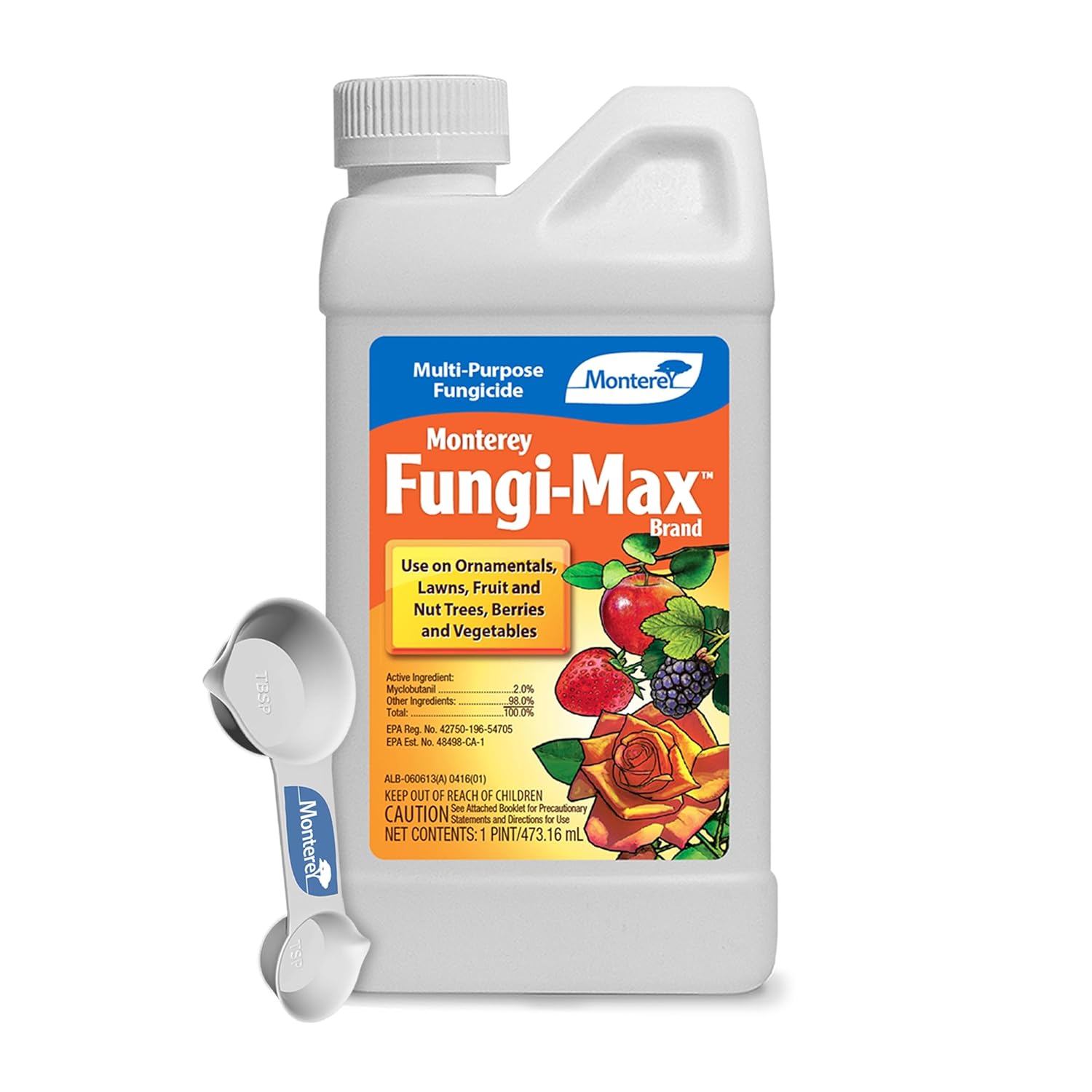
Monterey Fungi-Max Systemic Fungicide, 16 oz (with Measuring Spoon)
| Item Form | Liquid |
|---|---|
| Application Method | Spray |
| Coverage | Wide range of plants and plant types |
| Target Species | Flowers, Vegetables, Trees, Lawn Grass |
| Unit Count | 16 Fluid Ounces |
Monterey Fungi-Max is a concentrated, systemic liquid fungicide designed for outdoor lawns, ornamentals, and edibles and is applied by diluting in water and spraying with a tank or pump sprayer. For St. Augustine grass it targets common turf diseases—brown patch, dollar spot, rust and other leaf spot diseases—and the systemic action helps protect treated areas for up to about two weeks per application. The product covers a wide range of plants so you can use the same material on roses, shrubs, fruiting plants and turf, simplifying disease management across the yard. It ships in a 16 fluid ounce bottle with a measuring spoon to make dilution easier, but you must follow label directions for timing and rates and use a proper sprayer for even coverage. Trade-offs are that it is a concentrated liquid that requires mixing and spray equipment and benefits are strongest when applied at first signs or preventatively rather than after severe turf decline.
Best for: Home lawn owners who prioritize reliable, preventive disease control for St. Augustine grass and prefer a single concentrated product that can also treat ornamentals and edibles.
Less Ideal for: Gardeners who want a ready-to-use spray or who lack any sprayer equipment should consider pre-mixed alternatives or professional application.
- Systemic formulation gives multi-day protection after application
- Broadly labeled for lawns plus flowers, vegetables, shrubs and trees
- Concentrated 16 fl oz bottle with measuring spoon for controlled dilution
- Effective when used at first signs or preventatively for common turf diseases
- Requires dilution and a sprayer which adds setup compared with ready-to-use products
- Not intended as an instant fix for heavily damaged turf
Verdict: Choose Monterey Fungi-Max when you want a concentrated, systemic fungicide that delivers reliable preventive control for St. Augustine grass and other landscape plants.
Scotts DiseaseEx Lawn Fungicide, 10 lb

| Unit Count | 160 Ounce |
|---|---|
| Item Type Name | Scotts DiseaseEx For All Grass Types 10lb PACK OF 4 |
| Active Ingredients | Azoxystrobin |
Scotts DiseaseEx is a granular fungicide intended for homeowners who want to prevent and treat common lawn diseases. It is applied with a broadcast or drop spreader and the label lists specific spreader settings for both preventative and curative rates, which helps get an even application. The product controls 26 listed diseases, including brown patch, powdery mildew, necrotic ring spot, and rust, and the manufacturer says it begins working within 24 hours and protects up to four weeks per application. One 10 lb bag covers roughly 5,000 sq. ft. and can be reapplied every 14 to 28 days if needed. Important practical considerations: it contains azoxystrobin, so you must follow the safety directions about keeping people, pets, and water bodies away from treated areas and avoid overapplication for the year. It is formulated for routine preventive maintenance as well as curative use at first signs of disease, but correct spreader calibration and timing are necessary to get the claimed coverage and consistent control.
Best for: Homeowners who prioritize proven, brand-backed disease control and want a preventative product they can apply during routine lawn maintenance.
Less Ideal for: People who need an organic or non-chemical solution or who have lawns adjacent to sensitive ponds or waterways where runoff risk is unacceptable.
- Controls a broad spectrum of turf diseases (26 listed) including brown patch and powdery mildew
- Begins working within 24 hours and provides up to four weeks of protection per application
- Clear spreader settings provided for both broadcast and drop spreaders to aid even coverage
- One 10 lb bag treats up to 5,000 sq. ft., suitable for small to medium lawns
- Contains azoxystrobin which is toxic to aquatic life so care is needed to avoid runoff
- Requires accurate spreader calibration and careful timing to achieve effective, uniform control
Verdict: Choose Scotts DiseaseEx when you want a fast-acting, broad-spectrum granular fungicide for routine preventive and early curative lawn care.
Choosing the Right Fungicide for St. Augustine Grass: Key Factors to Consider
Disease Spectrum
Know which fungi the product controls because St. Augustine grass faces several distinct pathogens that respond differently to active ingredients. Some fungicides target foliar pathogens like gray leaf spot and brown patch while others suppress soilborne issues such as take-all root rot. Choosing a product with the right spectrum reduces wasted applications and gives faster visible recovery.
If you are treating an active outbreak, prioritize products labeled for the diagnosed disease. For preventive programs, favor active ingredients with broader residual activity across the common turf pathogens. Always match the label disease list to the symptoms you observe to avoid ineffective treatments.
Turf Safety and Phytotoxicity Risk
St. Augustine varieties can be sensitive to certain active ingredients and stressed turf increases the chance of phytotoxic reactions. Look for products that list St. Augustine on the label and specify safe temperature ranges for application. Some fungicides advise against application during heat stress or drought because leaf burn or discoloration is more likely.
Also consider contact versus systemic modes of action. Systemic products are often gentler in low doses but can have longer withholding or irrigation restrictions. Read label instructions for application rates, tank mixes, and recommended test areas when using a new product on your lawn.
Residual Duration and Retreatments
Residual activity determines how long the fungicide continues to protect turf before you must reapply. A longer residual can reduce labor and help prevent recurring outbreaks during vulnerable weather, but products with extended residuals may have stricter use limits or seasonal restrictions.
Plan applications around forecasted conditions and typical disease pressure in your area. For prolonged wet or humid stretches, shorter-interval products applied preventively may outperform longer-residual products used only after symptoms appear.
Application Method and Ease of Use
Home gardeners often prefer formulations that fit existing equipment and comfort level. Ready-to-use hose-end sprayers reduce mixing errors but may limit coverage area. Concentrates require accurate measuring and proper sprayer calibration, which affects application uniformity and efficacy.
Consider mixing instructions, tank-cleaning requirements, and whether the product requires watering in or has a re-entry interval. Ease of use affects whether you can apply the product at recommended intervals and in the correct rates.
Compatibility with Lawn Care Schedule
Integrating fungicide applications with mowing, fertilization, and irrigation is important for both safety and effectiveness. Some fungicides recommend treating before or after mowing, while others require a certain window before fertilizer or wetting events.
Coordinate applications to avoid overlapping practices that stress turf. For example, avoid heavy nitrogen applications immediately before a fungicide that increases heat stress risk. Following the label timing reduces the chance of adverse reactions and improves disease control outcomes.
Environmental and Safety Considerations
Consider toxicity to people, pets, and non-target organisms when choosing a product. Read label details on re-entry intervals, pet-safe timing, and precautions to prevent runoff into storm drains or water features. Some formulations require special handling or personal protective equipment during mixing and spraying.
Proper storage and disposal instructions should be followed to reduce environmental impact. If nearby pollinator plants or water bodies exist, select options and timing that minimize off-target exposure and movement.
Common Diseases That Affect St. Augustine Lawns
St. Augustine grasses are commonly affected by a small set of fungal diseases that produce distinct symptoms. Brown patch appears as circular tan areas with dark margins during hot, humid conditions, while gray leaf spot causes irregular leaf lesions and thinning in late summer. Large patch and take-all root rot produce decline from the root system, often mistaken for nutrient deficiency or insect damage.
Identifying symptoms early helps you pick a fungicide with the appropriate activity and timing. Many curative treatments work best when applied at first sign of disease, whereas some products are more effective as preventive measures during high-risk weather.
- Brown patch: circular patches, active in warm, humid weather
- Gray leaf spot: small irregular lesions that coalesce under high humidity
- Large patch and root rots: gradual thinning, root decline, and poor recovery
How to Spot Disease Vs Cultural Stress
Not all brown or thinning areas are fungal. Heat stress, drought, compaction, and poor fertility can mimic disease symptoms. Inspect roots for rot, check for uniformity of symptoms across shaded versus sunny areas, and note weather patterns leading up to the outbreak.
If symptoms are confined to low-lying wet spots or follow periods of heavy irrigation, soilborne pathogens may be responsible. For irregular, patchy decline after heat waves, start with cultural corrections and monitor closely before applying curative treatments.
- Inspect thatch depth and soil moisture
- Compare symptoms across shaded and exposed zones
- Use a step test or small core to check root health
Application Timing and Best Practices
Timing is a crucial part of successful fungicide use. Many turf fungicides perform best when applied at the first sign of disease or as a preventive spray when conditions favor fungal growth. Avoid treatments during midday heat or drought stress to reduce the risk of leaf burn.
Calibrate sprayers for even coverage and follow label rates exactly. When applying to a home lawn, work from one edge to the other to prevent missed strips and rinse equipment after use. Pay attention to re-entry intervals and recommended irrigation windows for activating or removing residues.
- Apply early morning or late afternoon when temperatures are moderate
- Calibrate your sprayer to match the recommended gallons per 1,000 square feet
- Keep track of retreatment intervals on a lawn-care calendar
Integrating Fungicides with Cultural Controls
Fungicides are most effective when combined with cultural practices that reduce disease pressure. Improve drainage, avoid overwatering, raise mower height for St. Augustine varieties, and remove excess thatch to promote air flow. Healthy turf is less likely to suffer severe outbreaks.
Adjust irrigation timing to water deeply and infrequently, ideally early in the morning so foliage dries quickly. Reduce nitrogen inputs during active disease pressure unless a soil test indicates a deficiency that must be corrected.
- Raise mower height to reduce leaf surface moisture
- Dethatch or core-aerate if thatch exceeds recommended depth
- Water deeply but less frequently and avoid evening irrigation
Safety, Storage, and Environmental Stewardship
Handle all fungicides with appropriate personal protective equipment and follow label instructions for mixing, application, and storage. Keep products locked away and clearly labeled to prevent accidental exposure to children and pets.
Prevent runoff by avoiding applications before heavy rain and by containing rinse water. Dispose of empty containers and any leftover product according to label directions. Consider buffer zones near water features and pollinator plantings when scheduling treatments.
- Store in original containers in a cool, dry place out of reach of children
- Avoid application before forecasted heavy rain
- Follow local regulations for container disposal
How We Chose the Best Fungicide for St. Augustine Grass
We prioritized products that reliably address the fungal diseases most common on St. Augustine grass and that can be used safely on home lawns. Selection criteria emphasized proven disease spectrum, turf phytotoxicity risk, and application logistics that matter for homeowners. We also looked for formulations and labels that support both curative and preventive use, clear mixing and timing directions, and compatibility with typical lawn-care equipment. Concretely, we filtered for products labeled for St. Augustine turf and evaluated their efficacy across brown patch, gray leaf spot, take-all root rot, and large patch where applicable. We assessed turf safety by noting documented phytotoxicity risks and recommended temperature windows. Ease-of-application factors included ready-to-use versus concentrate formulations, spray vs granular options, and re-entry or watering-in requirements. Residual activity and recommended retreatment interval were treated as separate dimensions because they affect schedule and labor. Excluded items included general garden fungicides without turf labeling, experimental or unregistered compounds, and products whose labels restrict use on residential lawns. The final list balances disease control capability with homeowner practicality and safety.
FAQ
How soon will I see improvement after a fungicide application?
Improvement often depends on disease type and how advanced the outbreak is. You may see reduced lesion spread within a few days and visible turf recovery in one to three weeks under favorable conditions. Severe root rots take longer to recover and may require cultural corrections alongside treatment.
Can I apply fungicide at the same time as fertilizer?
It usually depends on the product label. Some fungicides recommend avoiding heavy nitrogen applications immediately before or after treatment because vigorous leaf growth can increase stress. Check label directions for any timing restrictions and consider splitting applications to reduce turf stress.
Is it okay to use a general garden fungicide on St. Augustine grass?
Often those products lack turf-specific labeling and may not list St. Augustine or the turf diseases you need to control. Always choose products labeled for use on St. Augustine turf to ensure safety and efficacy. Unlabeled use risks phytotoxicity and regulatory noncompliance.
How do weather and season affect fungicide choice?
Warm, humid periods increase the risk of foliar diseases and may call for more frequent preventive applications. Cooler, wetter seasons favor different pathogens and may require products with activity against soilborne fungi. Match the fungicide residual and retreatment interval to seasonal disease pressure.
Can I rotate fungicide active ingredients to prevent resistance?
Yes. Rotating modes of action is a recommended practice to slow resistance development. Alternate products with different active ingredient groups according to label guidance and avoid repeated applications of the same mode of action in consecutive treatments.
Final Verdict
Choosing an effective fungicide for St. Augustine grass means balancing disease coverage, turf safety, and how the product fits your lawn-care routine. Prioritize products labeled for the specific diseases you see, follow temperature and application guidance to reduce phytotoxic risk, and coordinate treatments with watering and mowing schedules. Remember that fungicides work best when combined with good cultural practices. Make decisions based on the disease spectrum, residual needs, and application practicalities to restore turf health with the least disruption.
