

Note: This article contains affiliate links. If you click on these links and make a purchase, I may earn a small commission at no extra cost to you. This helps support my research and content. Read my full affiliate disclosure here.
Growing giant pumpkins demands more than rich soil and plenty of water. The right fertilizer program supplies the specific nutrients pumpkins use during vine growth, bloom set, and fruit filling, and it can make the difference between an average gourd and a truly large one. This guide focuses on fertilizers for giant pumpkins and explains why nutrient ratios, release type, and application timing matter in real garden and patch conditions. We shortlisted seven top options that fit common growing strategies and soil types and evaluated them against practical gardener needs. Read on to understand the criteria we used and how each fertilizer style supports big-patch results.
Top Picks at a Glance
| Best Overall The best all-around choice for most situations | Pendelton Pumpkin Juice Foliar Liquid Fertilizer 11-8-5 (1 qt) |  |
| Best Quality Built to a higher standard if you want something more solid | FoxFarm Grow Big Liquid Plant Food (16 fl oz) |  |
| Best Value The sweet spot between price and what you get | Alaska Fish Fertilizer for Plants, OMRI Listed 5-1-1 (Liquid) |  |
| Best Budget The cheapest option that still gets the job done reliably | Miracle-Gro Water Soluble Tomato Plant Food, 1.5 lb |  |
| Highest Rated A top-rated pick with lots of positive feedback | HyR BRIX Custom Blend Pumpkin Fertilizer 8-6-12, 45 lb |  |
| Most Popular A crowd favorite that many people choose with confidence | Miracle-Gro Water Soluble All Purpose Plant Food, 3 lb |  |
Pendelton Pumpkin Juice Foliar Liquid Fertilizer 11-8-5 (1 qt)
| Form | Liquid |
|---|---|
| Application Method | foliar |
| Target Species | pumpkins and vegetables |
| Mixing Ratio | 128:1 |
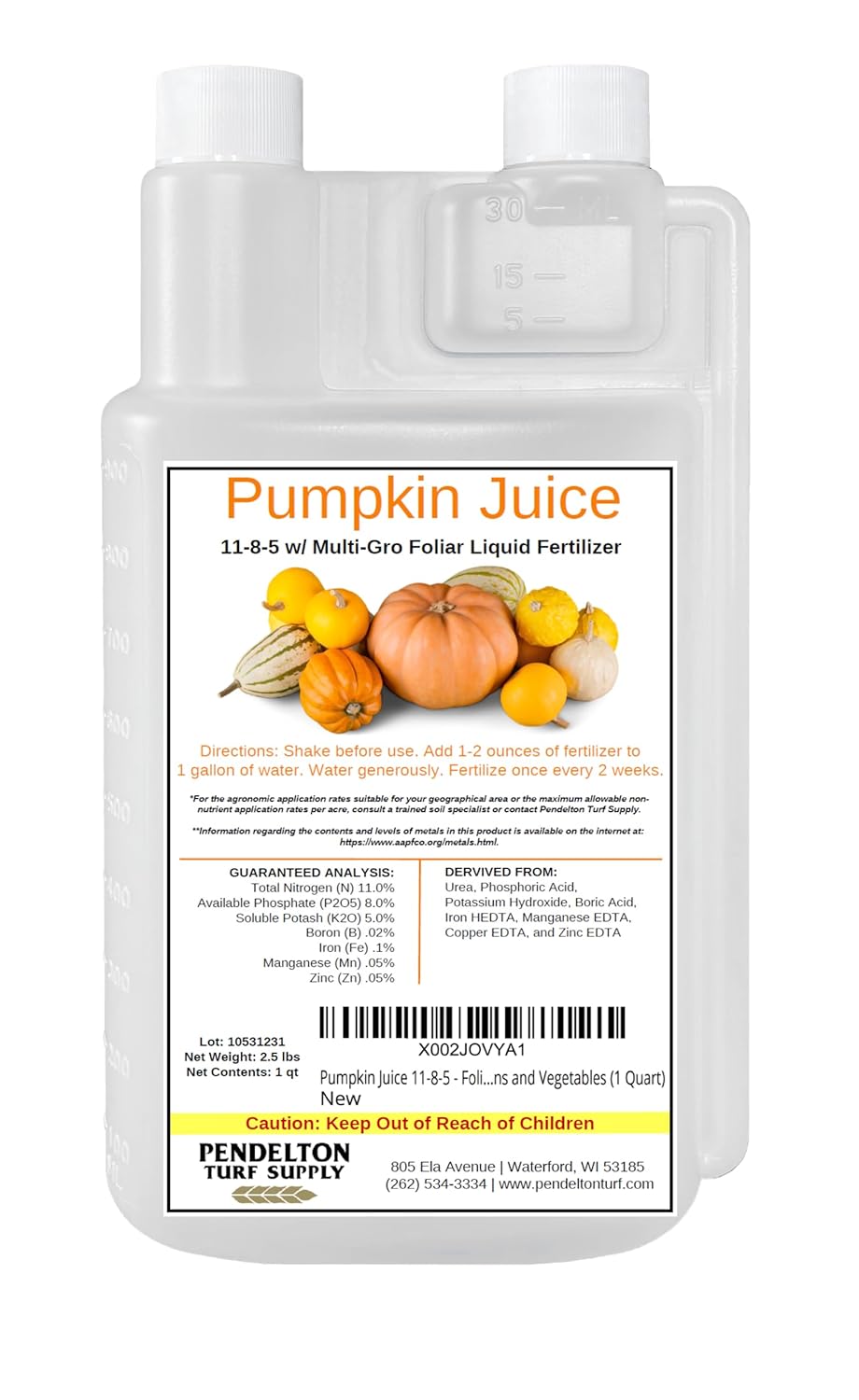
Pendelton Pumpkin Juice is a concentrated foliar liquid fertilizer designed to feed both through leaves and roots, formulated specifically for pumpkins and other vegetables. You dilute it at the recommended ratio (roughly 1 to 2 ounces per gallon) and spray foliage or drench the soil to supply a boost of nitrogen, phosphorus, potassium and trace micronutrients. The 11-8-5 analysis plus added iron, manganese, zinc and boron supports vigorous vegetative growth, flowering and fruit set, and the bottle includes a squeeze-measure cap for easy dosing. As a supplement it works well alongside a regular soil fertility program to jump-start plants, correct minor deficiencies, or push growth during key stages. Limitations are that it is an acidic, supplemental feed rather than a complete soil amendment so it should not replace balanced base fertilization, and foliar sprays require careful timing and mixing to avoid leaf burn or runoff.
Best for: Gardeners growing pumpkins who want a targeted, easy-to-use growth booster to increase vigor, flowering and yield while maintaining a regular soil fertility plan.
Less Ideal for: Those looking for an all-in-one soil amendment or who prefer purely granular slow-release fertilizers for low-maintenance feeding should consider other options.
- High-concentrate formula that makes up to 32 gallons from a 1 quart bottle
- Balanced 11-8-5 NPK with added micronutrients for flowering and fruit set
- Designed for foliar and root application to provide quick nutrient uptake
- Easy measure-and-pour bottle simplifies accurate dilution
- Intended as a supplement and not a complete soil fertility solution
- Acidic formulation requires correct mixing and timing to avoid foliar injury
Verdict: Use this concentrated foliar booster when you need a quick, nutrient-rich lift to improve pumpkin growth, flowering and yields alongside your regular soil program.
FoxFarm Grow Big Liquid Plant Food (16 fl oz)

| NPK | 6-4-4 |
|---|---|
| Form | Liquid |
| Unit Count | 16 Fluid Ounces |
| Mixing Ratio | 2 teaspoons per 1 gallon |
FoxFarm Grow Big is a 6-4-4 liquid concentrate designed to boost vegetative size and structure for vegetables, roses and houseplants. Mix at the manufacturer recommendation (2 teaspoons per gallon) and apply as part of your watering or as an early-morning foliar spray; the low pH formula helps keep micronutrients stable for reliable uptake. For tomato growers it delivers a nitrogen-forward balance that supports leafy growth and strong vines during the pre-flowering and fruit-set stages, and the pint concentrate is easy to store and measure. Notable features include quick-soluble liquid delivery and clear feeding guidance so you can feed every other watering without extensive guesswork. Limits to consider are that this is a vegetative feed rather than a bloom/fruit-specific formula, so you will want to switch to a bloom or fruit-focused fertilizer at flowering to optimize fruit development, and a pint will require careful dilution for larger vegetable beds or multiple plants. Overall it is a dependable, easy-to-use vegetative booster when you want predictable growth before tomatoes set heavy fruit.
Best for: Gardeners who prioritize consistent, predictable vegetative growth for tomato plants and want a straightforward, low-fuss feeding routine. Ideal for growers who value reliable nutrient uptake and clear instructions over experimental blends.
Less Ideal for: Growers seeking an all-in-one bloom and fruit booster or those managing large-scale tomato plantings who need bulk quantities of fertilizer.
- Concentrated liquid formula for fast nutrient uptake and easy mixing.
- Low pH formulation that helps keep micronutrients stable and available.
- Clear mixing instructions and flexible application by watering or foliar spray.
- Nitrogen-focused NPK (6-4-4) that promotes robust vegetative growth and strong vines.
- Not formulated specifically for flowering or heavy fruiting stages so a bloom/fruit fertilizer is needed later.
- Pint size may be small for larger vegetable gardens and requires frequent repurchasing.
Verdict: A dependable, easy-to-use liquid concentrate that reliably promotes vigorous vegetative growth in tomatoes during the pre-flower stages.
Alaska Fish Fertilizer for Plants, OMRI Listed 5-1-1 (Liquid)

| Item Form | Liquid |
|---|---|
| Specific Uses For Product | Indoor, Outdoor |
| Application Method | Mix with water and apply to plants |
| Coverage | 1000 square feet |
| Mixing Ratio | 5:1:1 |
Alaska Fish Fertilizer is a liquid 5-1-1 fish emulsion designed to feed plants gradually without burning, making it suitable for repeated applications through the growing season. You mix the concentrate with water and apply to soil or containers every few weeks; the manufacturer highlights a 5:1:1 mixing ratio and recommends regular use during active growth. The product is OMRI listed, so it fits organic growing plans, and its fish-based nutrients also support soil microbial activity rather than just providing quick-release salts. Practical benefits include easy mixing, broad suitability for vegetables and ornamentals, and a formula that is unlikely to scorch foliage when used as directed. Limitations are that the N-P-K is modest for crops with extreme nutrient demands and repeated applications are required for steady results. Also the fish emulsion scent may be noticeable when applying and in storage, and it is a liquid concentrate so you will need measuring equipment and space to store the bottle.
Best for: Gardeners who prioritize predictable, organic nutrition and want an easy-to-use liquid feed that supports soil health for vegetables and large garden crops.
Less Ideal for: Growers seeking a single high-analysis fertilizer to drive extreme, rapid weight gain in giant pumpkins should consider targeted high-nitrogen or bloom boosters instead.
- OMRI listed for certified organic use
- Gentle 5-1-1 formula that reduces risk of burning when applied correctly
- Liquid concentrate mixes easily with water for straightforward application
- Supports soil biology as well as supplying primary nutrients
- Broadly suitable for vegetables, flowers, shrubs and containers
- Relatively low N-P-K for very heavy feeders like giant pumpkins so higher-rate or supplemental feeding may be needed
- Distinct fish odor during application and storage
Verdict: A reliable organic liquid feed that delivers gentle, soil-friendly nutrition for gardeners who prioritize consistent, easy-to-manage fertility.
Miracle-Gro Water Soluble Tomato Plant Food, 1.5 lb

| Item Form | Liquid |
|---|---|
| Application Method | Water Soluble |
| Target Species | Great for tomatoes and vegetables |
| Mixing Ratio | 18-18-21 |
Miracle-Gro Water Soluble Tomato Plant Food is a water-soluble fertilizer intended to boost vegetable growth by delivering nutrients quickly through a watering can or Miracle-Gro Garden Feeder. Its 18-18-21 mixing ratio supplies balanced nitrogen, phosphorus, and potassium so plants get a steady supply of the elements they need for leafy growth, flowering, and fruit set. Use it by mixing the recommended dose into a watering can for outdoor containers or in-ground beds and apply every 7 to 14 days during the growing season. The product works fast because it dissolves completely and can be applied directly to the root zone, which is useful for impatient gardeners trying to push tuber and foliage development in potatoes. On the downside it is a concentrated chemical fertilizer rather than an organic option and requires careful measuring to avoid overfeeding. Coverage notes from the brand indicate a small 1.5 lb package is meant to feed a modest area when used with the Garden Feeder, so larger plots will need multiple containers.
Best for: Ideal for gardeners on a budget who want a straightforward, fast-acting fertilizer to boost potato foliage and tuber development without complicated application methods.
Less Ideal for: Not the best choice for growers seeking organic or slow-release nutrition or for those managing large acreages who need bulk, long-lasting supplies.
- Water-soluble formula mixes easily for quick nutrient uptake
- Balanced NPK (18-18-21) supports foliage, flowers, and fruit development
- Designed for use with watering cans or the Miracle-Gro Garden Feeder for convenient application
- Feeds quickly when applied every 7 to 14 days during the growing season
- Concentrated synthetic formula, not an organic fertilizer
- 1.5 lb package is small for larger vegetable plots and will require frequent repurchasing
Verdict: A simple, fast-acting water-soluble fertilizer that gives budget-minded vegetable growers an easy way to boost potato growth and yields.
HyR BRIX Custom Blend Pumpkin Fertilizer 8-6-12, 45 lb

| NPK Analysis | 8-6-12 |
|---|---|
| Form | Granules |
| Coverage | 2,142 Square Feet |
| Specific Uses For Product | Supports Pumpkin Growth |
| Slow Release | Yes |
This HyR BRIX Custom Blend is a one-application, slow-release granular fertilizer formulated for pumpkin and squash production. Applied before planting and mixed into the soil, its 8-6-12 NPK plus added calcium and sulfur aim to support vigorous vine growth, stronger cell walls, and steady nutrient supply through the season. The bag also contains earthworm castings and mineral-based ingredients intended to promote beneficial soil biology and improve nutrient efficiency. Practical benefits include season-long feeding without repeated applications and coverage large enough for several home garden beds. Important limitations to note are that it is a bulk 45 lb bag which requires storage space and handling, and it must be incorporated and watered as directed to avoid concentrated pockets that can harm seedlings. Also, specific application rates and timing must be followed to prevent overapplication and nutrient imbalance. For gardeners prioritizing consistent, low-maintenance feeding for pumpkins, this product delivers a reliable, soil-focused formula.
Best for: Gardeners who want a dependable, low-maintenance fertilizer to feed pumpkin patches through the season with minimal reapplication and a focus on soil health.
Less Ideal for: People who need small-quantity packaging for container gardening or those unwilling to handle and store a heavy bulk bag.
- Formulated NPK 8-6-12 tailored for pumpkin and vine crops
- Slow-release granules provide season-long nutrition with a single application
- Contains calcium and sulfur to support plant structure and protein-related functions
- Includes earthworm castings and minerals to encourage soil biology and nutrient availability
- Large 45 lb bag requires storage and can be cumbersome to handle
- Must be mixed into soil and watered after application to avoid localized root damage
Verdict: Choose this product if you want a reliable, soil-focused slow-release fertilizer that feeds pumpkins all season with a single application.
Miracle-Gro Water Soluble All Purpose Plant Food, 3 lb

| Item Form | Powder |
|---|---|
| Application Method | Mix with water in a watering can |
| Fertilizer Analysis (N‑P‑K) | 24-8-16 |
| Unit Count | 48 Ounce |
| Coverage | Feeds approximately 1,200 sq. ft. |
Miracle‑Gro Water Soluble All Purpose Plant Food is a powdered NPK 24‑8‑16 formula that dissolves in water to give plants a quick nutrient boost. You mix measured scoops into a watering can and apply to the soil at the base of plants every 7–14 days for outdoor use or every 14 days for houseplants. Notable features include a high nitrogen content for leafy growth, compatibility with containers and in‑ground beds, and guidance for use with a Miracle‑Gro Garden Feeder for larger areas. In practical terms this is a fast‑acting feed that encourages bigger, greener foliage and works well in regular maintenance of perennials like hostas. Limitations are that it is a fast‑release fertilizer rather than a slow‑release option, so it requires regular reapplication and careful measuring to avoid overfeeding. Also, the 24‑8‑16 balance is geared toward vegetative growth, so it is not optimized if you want to prioritize flowering or bloom boosting.
Best for: Buyers who want a reliable, fast‑acting feed to maintain lush, leafy perennials and container plants and who value proven products with broad user endorsement.
Less Ideal for: Gardeners seeking a single, long‑lasting granular fertilizer or a bloom‑focused formula should consider alternative slow‑release or high‑phosphorus products.
- Water‑soluble powder mixes easily for quick uptake by roots
- High nitrogen formula promotes robust leafy growth ideal for shade plants
- Clear mixing and application instructions for both indoor and outdoor use
- Suitable for containers and in‑ground gardens and compatible with garden feeders
- Requires frequent applications so it is not a low‑maintenance, slow‑release option
- High nitrogen ratio is less suitable when the primary goal is more flowers than foliage
Verdict: A fast‑acting, water‑soluble fertilizer that reliably produces bigger, greener hosta leaves when used as directed.
Choosing the Right Fertilizer for Giant Pumpkins: Key Factors to Consider
Nutrient Ratio and Growth Stage Needs
Pumpkin plants have shifting nutrient priorities from seedling to harvest. Early stages benefit from moderate nitrogen to build vine and leaf area so the plant can capture sunlight. When flowers set and the fruit begins to grow, phosphorus and potassium become more important to support root energy transfer, flowering, and carbohydrate movement into the developing pumpkin.
Choosing a fertilizer with the right ratios or a plan that shifts feeds over the season helps prevent excessive vine growth at the expense of fruit size or, conversely, weak vines that cannot support a large fruit. Look for clearly labeled N-P-K values and consider supplementing with microelements like magnesium and calcium if soil tests indicate deficiencies.
Release Type and Timing Control
Granular controlled-release fertilizers supply nutrients steadily over weeks and reduce the need for frequent feeding. That steady supply can support sustained fruit filling without spikes that cause excessive vegetative growth or salt stress. Soluble feeds and water-soluble powders give faster response and are useful for correcting deficiencies or delivering a targeted boost at bloom and early fruit set.
Plan fertilization to match critical windows: a formulation higher in nitrogen during early vegetative growth, then switch to higher phosphorus and potassium once fruit set begins. The ability to side-dress or foliar-feed at those moments improves garden-level control.
Application Method and Patch Size
How you apply fertilizer depends on patch size and equipment. Small backyard growers often hand-apply granules or use a watering can for soluble feeds, while larger patches benefit from spreaders or fertigation systems. Side-dressing near the root zone of the developing pumpkin concentrates nutrients where the plant needs them without overfeeding surrounding soil.
Consider particle size for even spreading and whether a product dusts or clumps in humid conditions. Ease of measurement and clear label instructions make repeatable applications simpler for consistent results.
Salt Index and Plant Safety
High-salt fertilizers can risk root burn or reduce water uptake, especially when applied close to young roots or in dry soil. Giant pumpkin growers must avoid products with excessively high soluble salt levels or use them diluted and well-watered-in. Slow-release and organic-based fertilizers typically have lower immediate salt stress.
Salt risk also matters when you are side-dressing near a newly set small plant or using foliar applications. Follow label dilution rates and irrigate after application if salt concentration is a concern.
Compatibility With Soil Amendments and Organic Matter
Many pumpkin growers build soil fertility with compost, manure, or cover crops. The fertilizer you choose should complement these organic sources. For example, synthetic high-phosphorus starters pair well with rich compost that supplies trace elements, while organic fertilizers can boost microbial activity and long-term structure.
Check for mixing compatibility if you plan to combine granular products or to use in the same feeding schedule as compost teas. Some formulations may require different timing or application methods when used with high-organic soils.
Micronutrients and Blossom Health
Beyond N-P-K, micronutrients like calcium, magnesium, boron, and manganese influence pollination success, cell wall strength, and overall fruit integrity. Calcium in particular helps reduce blossom-end issues and supports strong rind formation in large pumpkins.
If soil tests show low micronutrients, choose a fertilizer or supplemental treatment that supplies them, or plan foliar sprays at bloom when uptake is most effective. Getting leaf and bloom nutrition right helps increase fruit set and reduces hollow or malformed fruit as the gourd expands.
When to Shift From Vine Growth to Fruit Feeding
Timing the transition in your feeding program is one of the most important decisions for giant pumpkin growers. Early in the season focus on building vigorous, healthy vines with moderate nitrogen. As pollination occurs and fruit sets, gradually reduce nitrogen and raise phosphorus and potassium to encourage carbohydrate partitioning into the fruit. This shift often begins shortly after successful pollination and is guided by observing fruit development rather than calendar dates alone.
- Begin with a balanced or slightly nitrogen-biased feed for the first 4 to 6 weeks after transplanting or emergence.
- Apply a phosphorus- and potassium-focused feed at and after flowering to support fruit fill.
- Side-dress near the root zone of the developing pumpkin rather than broadcasting heavy doses across the whole patch.
Foliar Feeding Vs Root Feeding
Foliar sprays offer a quick correction for micronutrient shortages and can be timed to bloom for immediate uptake when roots are slow to deliver. They are best used as a supplement, not a primary source of macronutrients, because leaves can only absorb limited nitrogen, phosphorus, and potassium amounts without risk of burn.
Root feeding through granular or soluble soil applications provides sustained macronutrient delivery and builds reserves in the soil. For large fruits, a combination works well: root feeds for baseline macronutrients and targeted foliar sprays for microelements at bloom and early fruit development.
- Use foliar sprays early in the morning or late afternoon to reduce leaf scorch.
- Do not rely solely on foliar N for long-term growth; give macronutrients via the soil for sustained supply.
Testing Soil and Adjusting the Plan
A soil test before planting gives you a baseline for pH, phosphorus, potassium, and micronutrient status. Pumpkins prefer slightly acidic to neutral soil, and pH affects nutrient availability, so correct extreme pH before relying on fertilization alone. Adjust fertilizer choices to fill the gaps your soil test reveals rather than applying generic high-analysis feeds.
Regular tissue testing during the season is useful for serious growers aiming for very large fruit because it captures what the plant is actually taking up. Small adjustments after tissue or soil results can prevent wasted fertilizer and reduce the risk of nutrient antagonism.
- Perform a soil test in fall or early spring to set baseline fertilizer choices.
- Consider leaf tissue tests at bloom for growers pursuing championship-sized pumpkins.
Integrating Organic Matter and Long-Term Soil Health
Building long-term fertility helps maintain patch productivity year after year. Incorporate compost and aged manure in the off-season to improve soil structure and microbial life. That improves nutrient retention and reduces dependence on high-frequency synthetic inputs.
When using slow-release organic fertilizers, expect slower early-season vigor but better soil biology over multiple seasons. Many growers combine organic amendments with targeted synthetic feeds during critical fruit-fill stages to capture the benefits of both approaches.
- Topdress with compost in fall to build reserves for next season.
- Combine long-term organic amendments with targeted fertilization at key growth stages for best results.
Practical Application Tips for Backyard Growers
Measure and map where each plant will develop so you can place side-dress applications accurately as fruits grow. Keep a simple log of dates and amounts to repeat successful strategies from year to year. Water well after applying granular feeds to move nutrients into the root zone and to reduce the risk of salt injury.
Protect young roots by avoiding heavy fertilizer placement close to seedlings. Use lighter starter applications at planting and intensify feeding only after plants are established and can tolerate stronger nutrient levels.
- Use a tape measure or marker to note planting distances and where to side-dress later.
- Irrigate thoroughly after applying soluble feeds or concentrated granules to prevent root burn.
How We Chose the Best Fertilizer for Giant Pumpkins
We focused on fertilizers that deliver the specific nutrient needs of large pumpkin varieties and that work for outdoor garden plots and small acreage patches. Selection began with formulations that provide elevated phosphorus and potassium relative to nitrogen during fruit set and filling, plus options with higher nitrogen for early vine development. We prioritized products with predictable release profiles: both controlled-release granules and soluble feeds so growers can match timing to crop stages. Application flexibility was important, so we considered broadcast, side-dress, and foliar-apply compatibility. Practical handling was another filter. We looked for fertilizers with clear nutrient labeling, manageable particle size for even spreading, and minimal risk of salt burn when used per instructions. Environmental fit and soil health were considered by favoring formulas that allow incorporation of organic matter or that pair well with compost and cover cropping. Exclusions included specialty mixes meant only for lawns, formulations with ambiguous nutrient analysis, and products unsuited to outdoor, in-ground pumpkin culture. The resulting criteria emphasize nutrient ratio, release type, application method, salt risk, and compatibility with common patch practices.
FAQ
How often should I feed giant pumpkins during the growing season?
Feeding frequency depends on fertilizer type. Controlled-release granules can be applied once or twice per season, while soluble feeds or foliar sprays are usually applied every 1 to 3 weeks during key growth phases. Adjust based on plant vigor and soil test results.
Can I use only organic fertilizer for giant pumpkins?
Yes, organic programs can produce large pumpkins but often require earlier soil-building and more attention to timing. Organic sources release nutrients more slowly, so plan amendments well before critical fruit-fill stages or supplement with targeted feeds if rapid nutrient availability is needed.
Will too much nitrogen harm fruit size?
Excessive nitrogen late in the season encourages leafy growth at the expense of fruit filling, which can reduce final pumpkin size. Shift to higher phosphorus and potassium after fruit set and avoid high-nitrogen applications during heavy fruit development.
When should I side-dress a developing pumpkin?
Side-dress shortly after the fruit sets and again during the rapid growth phase, usually several weeks later. Place fertilizer a few inches from the vine and water it in to deliver nutrients to the roots without causing direct root burn.
Do I need to worry about fertilizer salt burn in heavy soils?
Clay or compacted soils can concentrate salts and increase burn risk, especially with soluble high-salt feeds. Use lower-salt options, dilute soluble fertilizers appropriately, and irrigate after application to flush salts into the root zone.
Are micronutrients necessary for large pumpkin production?
Micronutrients like calcium and magnesium play a supporting role in fruit set and rind strength. If soil tests or tissue samples show deficiencies, apply targeted supplements or foliar feeds at bloom and early fruit growth.
Final Verdict
Choosing the right fertilizer for giant pumpkins comes down to matching nutrient ratios, release behavior, and application method to the plant's growth stages and your patch size. Prioritize a program that builds early vine health with moderate nitrogen then shifts to higher phosphorus and potassium for fruit fill. Consider salt risk, how the product fits with your soil-building approach, and whether foliar supplements are needed for micronutrients. With a clear feeding plan and attention to timing you can reduce surprises and give your pumpkins the nutrient support they need to reach their fullest potential.
