

Note: This article contains affiliate links. If you click on these links and make a purchase, I may earn a small commission at no extra cost to you. This helps support my research and content. Read my full affiliate disclosure here.
Moving seedlings from flats or cells into larger pots or the garden is a critical stage. The right soil for transplanting seedlings provides a light, friable structure for roots to explore, holds enough moisture to prevent wilting, and delivers gentle nutrients so young plants can grow without burning tender roots. In this guide we shortlisted seven top soils suitable for transplanting seedlings and explain how each type supports quick root establishment, moisture management, and early growth. Below you will find practical evaluation points and buying factors that help you pick the right soil mix for your planting setup, whether you are moving seedlings into pots, raised beds, or directly into garden rows.
Top Picks at a Glance
| Best Overall The best all-around choice for most situations | FoxFarm Happy Frog Potting Soil, 2 cu ft (Container Garden) with 2 Plant Tags |  |
| Best Quality Built to a higher standard if you want something more solid | FoxFarm Ocean Forest Potting Soil, 12 Quart |  |
| Best Value The sweet spot between price and what you get | Miracle-Gro Indoor Potting Mix for Seed Starting (2-pack, 8 qt each) |  |
| Best Budget The cheapest option that still gets the job done reliably | SunGro Organic Seedling Mix – 8 Quart Peat Moss Blend |  |
| Highest Rated A top-rated pick with lots of positive feedback | Sol Soils Seedling & Propagation Mix |  |
| Most Popular A crowd favorite that many people choose with confidence | Miracle-Gro Potting Mix, 16 qt. (2-Pack) |  |
| Best Seller A high-volume bestseller chosen again and again | Back to the Roots 3-in-1 Seed Starting Mix, 6 Quart, Organic, Peat-Free |  |
FoxFarm Happy Frog Potting Soil, 2 cu ft (Container Garden) with 2 Plant Tags

| Brand Name | FoxFarm |
|---|---|
| Item Highlight | Ready-to-Use Amended Container Blend with Soil Microbes, Earthworm Castings, Bat Guano, and Aged Forest Products |
| Unit Count | 600 Ounce |
| Volume | 2 cubic feet |
FoxFarm Happy Frog Potting Soil is a premixed container blend designed to supply potted plants with an active population of beneficial microbes and nutrient-rich amendments. It is typically used to fill pots for seedlings, transplants, and established container specimens where roots cannot reach native soil. Notable features include earthworm castings, bat guano, aged forest products, and a pH adjusted formula intended to improve nutrient uptake and encourage root development. For transplanting seedlings this mix provides a loose, biologically active medium that helps young roots expand and access nutrients quickly, reducing early transplant shock. The bag is ready to use out of the package so you can pot up seedlings without additional amendments, and the included plant tags make tracking varieties and dates easier. Important limitations are that it is a container-specific mix so it is not a direct substitute for in-ground garden soil and heavier feeders may still need follow-up fertilization as plants mature.
Best for: Gardeners who want a convenient, biologically active potting mix for transplanting seedlings and maintaining container plants with minimal upfront mixing.
Less Ideal for: Those needing a soil for in-ground beds or landscapers who require bulk garden topsoil should look for products formulated for soil amendment rather than container use.
- Pre-amended with earthworm castings, bat guano, and aged forest humus for immediate nutrient availability
- Contains beneficial soil microbes to support root establishment and nutrient uptake
- pH adjusted for better early-stage nutrient absorption
- Ready-to-use bag simplifies potting and transplanting tasks
- Includes two plant tags for labeling seedlings and transplant dates
- Formulated specifically for containers so it is not intended as a direct replacement for garden bed soil
- May require additional fertilizer later for heavy-feeding or long-season crops
Verdict: A plug-and-play, microbe-rich potting mix that helps seedlings and transplants establish strong roots in containers.
FoxFarm Ocean Forest Potting Soil, 12 Quart

| Item Form | Granules |
|---|---|
| Specific Uses For Product | Dry Fertilizer |
| Coverage | 4.8 sq ft |
| Mixing Ratio | 1:1 |
FoxFarm Ocean Forest is a pre-mixed potting soil designed to give seedlings and container plants a strong start. The mix combines aged forest products, sandy loam and sphagnum peat moss to keep the texture light and well aerated while retaining moisture; that makes it easy to plant straight from the bag for transplanting seed starts into individual pots. It is amended with fish meal, crab meal and earthworm castings so young plants get an initial nutrient charge and typically do not need extra fertilizer for the first 30 days. Practical benefits include good drainage for root development, a pH adjusted formula for nutrient uptake, and a ready-made option for top dressing or blending with other soils. Important limitations are that it is a bagged potting medium intended for containers rather than in-ground beds and the built-in nutrients are finite so feeding will be necessary after the initial month for sustained growth.
Best for: Gardeners focused on strong early performance when moving seedlings into containers who want a dependable, nutrient-rich starting medium that reduces immediate fertilizer needs.
Less Ideal for: People looking for a bulk in-ground garden soil or a long-term slow-release planting mix for large beds should consider alternatives tailored for landscape planting.
- Ready-to-use mix that works straight from the bag for transplanting seedlings
- Light, aerated texture promotes root development and drainage
- Contains organic amendments (fish meal, crab meal, earthworm castings) for initial nutrient support
- pH adjusted to improve early nutrient uptake
- Nutrient reserve is limited so additional feeding is needed after about 30 days
Verdict: Choose this potting soil when you want a ready-made, nutrient-amended medium that helps seedlings establish quickly after transplanting.
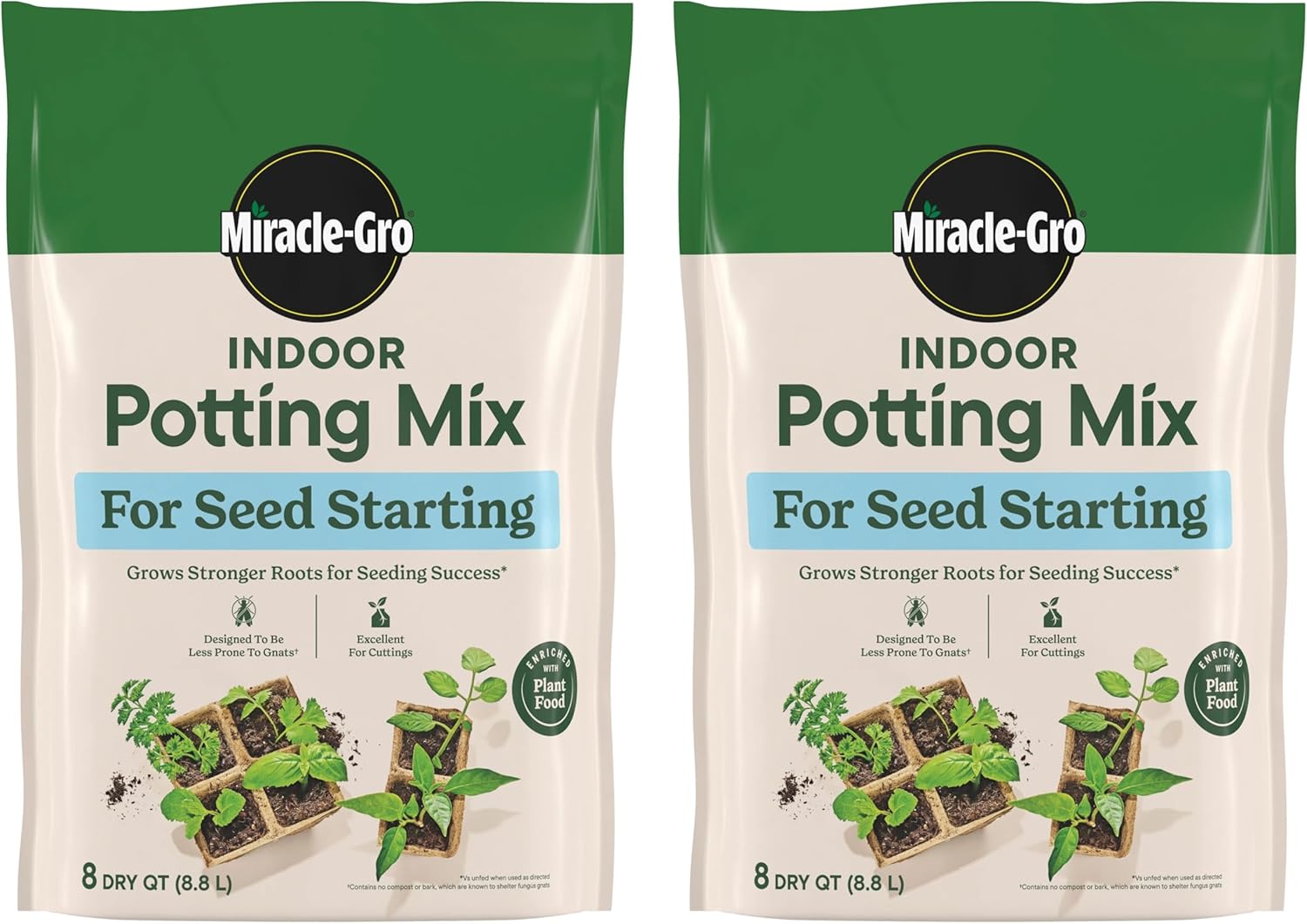
Miracle-Gro Indoor Potting Mix for Seed Starting (2-pack, 8 qt each)
| Number of Packs | 2 |
|---|---|
| Unit Count | 512 Ounce |
| Item Type Name | Potting Mix |
| Volume | 8 quarts |
Miracle-Gro Indoor Potting Mix for Seed Starting is a lightweight, ready-to-use soil blend designed to get seedlings and cuttings off to a strong start. You use it to fill cell trays, small pots, or propagation containers, keeping the mix consistently moist and out of direct sun until roots establish. The formula is enriched with plant food so young plants have accessible nutrients during early growth, and it specifically avoids compost and bark to lower the chance of fungus gnat problems. Practically, one 8 qt. bag fills multiple 72-cell trays, and this two-pack gives enough for several sowing sessions or larger propagation projects. The main limitations are that it contains fertilizer so you should follow handling guidance and avoid overfeeding or creating runoff, and it is a seed-starting mix rather than a long-term potting soil so seedlings should be transplanted into a finishing soil once established. For growers focused on straightforward, low-fuss propagation, this mix cuts prep time and reduces common pest concerns while delivering consistent germination performance.
Best for: Gardeners who prioritize efficient, reliable seed starting and propagation and want a low-prep, pest-reducing mix to get seedlings to the transplant stage quickly.
Less Ideal for: People seeking a long-term finishing potting soil or an organic compost-rich medium for direct-to-containers growing should consider other mixes tailored to those needs.
- Lightweight, fine-textured blend suited to seed germination and cuttings
- Pre-enriched with plant food to support early root and shoot growth
- Formulated without compost or bark to reduce fungus gnat sheltering
- Two 8 qt. bags provide enough mix to fill multiple 72-cell trays for multiple sowings
- Contains fertilizer so it requires careful handling and may not be appropriate for immediate edible transplants without rinsing or acclimation
Verdict: Choose this mix when you want a low-fuss, pest-conscious seed-starting medium that feeds seedlings through early root development.
SunGro Organic Seedling Mix – 8 Quart Peat Moss Blend

| Volume | 8 quarts |
|---|---|
| Style Name | Peat Moss |
| Unit Count | 1 Count |
This SunGro seedling mix is a fine-textured peat-based blend designed for starting seeds and transplanting seedlings into larger cells or pots. It is commonly used in flats, pots, and plug trays where even moisture and a gentle structure help young roots establish quickly. Notable features include an organic wetting agent for consistent water absorption and Resilience, a silicon-enriched additive intended to support resistance to wilting. The mix’s fine texture holds moisture well without compacting, which promotes even germination and strong, uniform seedlings suitable for vegetables, herbs, and flowers. Because it is OMRI-listed, it fits into organic growing systems and is appropriate for edible transplants. Limitations are that peat-based mixes can dry out faster in very warm conditions and may require careful watering and protective handling to avoid skin or eye irritation during use. For gardeners focused on reliable, organic seed starting, this mix offers straightforward, predictable performance for moving seedlings up to transplanting size.
Best for: Gardeners who want an inexpensive, certified organic seed-starting mix that gives predictable germination and healthy roots for vegetables, herbs, and flowers.
Less Ideal for: Home growers seeking a peat-free or slow-drying professional propagation substrate or those who prefer ready-to-use mixes with added fertilizers for long-term pots.
- OMRI-listed organic formula suitable for edible and ornamental seedlings
- Fine texture that promotes uniform germination and healthy root development
- Includes organic wetting agent for consistent water absorption
- Contains silicon-enriched Resilience additive to help reduce wilting risk
- Peat-based mix can require more attentive watering in warm or dry conditions
- Safety precautions advised as product may irritate skin and eyes if handled without protection
Verdict: A reliable, OMRI-listed organic seed-starting mix that delivers even moisture and healthy root development for transplant-ready seedlings.
Sol Soils Seedling & Propagation Mix

| Brand Name | sol soils |
|---|---|
| Unit Count | 128 Ounce |
| Style Name | Seedling & Propagation Mix |
| Volume | 1 gallons |
This seedling and propagation mix is built for starting seeds and rooting cuttings reliably in small pots or trays. The formula combines calcined clay for consistent moisture balance, coconut husk for aeration and water retention, hardwood biochar to support microbes and nutrient holding, and earthworm castings as a gentle nutrient source. In practice it gives even moisture without turning soggy, reduces compaction compared with plain potting soil, and helps young roots establish quickly. Because it is finer textured and sterile, it is convenient for delicate seedlings and reduces early damp-off risk when used with proper watering. Expect some batch-to-batch variation in chunkiness since bags are hand-mixed, and the coconut husk benefits from pre-soaking to leach tannins before use. This mix is best used for seed trays, cell packs, and propagation flats rather than large repotting jobs, and it will extend the period before repotting compared with standard mixes.
Best for: Buyers who prioritize consistent, low-risk seed starting and want a turn-key propagation medium that helps seedlings establish quickly with minimal fuss.
Less Ideal for: Gardeners looking for a bulk potting soil for mature houseplants or large repotting projects should choose a different, higher-volume mix.
- Fine, sterile texture designed specifically for seed starting and rooting cuttings
- Calcined clay and coconut husk balance moisture to reduce compaction and root rot risk
- Hardwood biochar and earthworm castings improve nutrient retention and microbial support
- Formulated to be more forgiving of common watering mistakes for consistent seedling growth
- Small bag size intended for seed starting rather than large-scale repotting
- Hand-mixed batches may vary slightly in chunkiness between bags
Verdict: A dependable, seed-focused propagation mix that gives consistent moisture control and microbial support for reliable seedling and cutting starts.
Miracle-Gro Potting Mix, 16 qt. (2-Pack)

| Volume | 16 quarts (per bag) |
|---|---|
| Number of Packs | 2 |
| Feeds Plants | Up to 6 months |
| Intended Use | Outdoor containers |
Miracle-Gro Potting Mix is a lightweight, fast-draining soil blend designed specifically for containers and outdoor potted plants. In practice it is used to fill pots, hanging baskets, and planters before transplanting seedlings or repotting established plants; the bag instructions show filling a pot about one third, seating the plant, topping off and watering through. The mix contains peat moss, perlite and compost plus starter fertilizer so newly transplanted seedlings get immediate nutrients and improved aeration for root development. For seedling transplants this means easier root spread, less compaction than garden earth, and built-in feeding for roughly a single growing cycle. Limitations are that it is formulated for containers rather than in-ground beds and will need replenishing or repotting after the advertised feeding period; the peat-based composition also dries faster than heavier soils, so watch moisture for sensitive seedlings. Overall it is a straightforward, widely used option for gardeners who want a reliable container medium when moving seedlings into pots.
Best for: Gardeners who need a reliable, ready-made potting medium for transplanting seedlings into containers and want the convenience of built-in feeding and good drainage.
Less Ideal for: Those planting directly into raised beds or in-ground gardens should choose a garden soil formulated to amend native soil rather than this container mix.
- Formulated for containers with ingredients that improve drainage and aeration
- Includes starter fertilizer that feeds plants for up to six months
- Consistent texture reduces soil compaction and helps roots establish after transplanting
- Not intended for in-ground garden beds so not suitable as a direct garden soil replacement
- Peat-based mix dries relatively quickly and may require more frequent watering for small seedlings
Verdict: A dependable, nutrient-containing container potting mix that makes transplanting seedlings into pots easier and helps them establish quickly.
Back to the Roots 3-in-1 Seed Starting Mix, 6 Quart, Organic, Peat-Free

| Unit Count | 192 Fluid Ounces |
|---|---|
| Style Name | 3-in-1 Seed Starting Mix |
| Brand Name | Back to the Roots |
This seed starting mix is designed for raising seedlings and young transplants, combining coconut coir, mycorrhizae, dolomitic limestone and nutrient-rich amendments to promote healthy root growth. It is ready to use in trays, small pots, or cell packs and aims to balance moisture retention with drainage so seeds germinate without sitting in water. Notable features include added worm castings and yucca extract for nutrient availability and moisture control, plus mycorrhizae to improve root uptake. In practice the blend simplifies early-stage care by reducing the need for frequent fertilizing and making overwatering less likely, which is helpful when moving seedlings into larger pots or the garden. Because the product is peat-free and made in the USA, it appeals to gardeners who prioritize sustainability and consistent formulation. Limitations are that the bag is relatively small for multiple flats and heavier feeders will need additional fertilizer later; also specific particle sizes or exact nutrient analyses are not listed so growers wanting precise control may supplement as they scale up.
Best for: Buyers who want a ready-made, low-risk seed starting mix that encourages reliable germination and root development without needing complex amendments.
Less Ideal for: Growers who start very large numbers of seedlings, need exact nutrient or particle-size data, or who prefer to custom-blend their own potting media.
- Formulated for seedlings with mycorrhizae and worm castings to support early root development
- Peat-free blend using coconut coir and yucca extract for moisture control and sustainability
- Includes dolomitic limestone to help balance pH and reduce nutrient lockup
- Ready-to-use mix that reduces the need for immediate fertilizing after germination
- Bag size is modest for gardeners who start many flats or larger batches of seedlings
- No detailed N-P-K or particle size breakdown provided for precision growers
Verdict: A reliable, ready-to-use organic seed starting mix that reduces early-care mistakes and helps seedlings establish strong roots.
Choosing the Right Soil for Transplanting Seedlings: Key Factors to Consider
Particle Size and Soil Texture
Seedling roots need a medium that is light and easy to penetrate. A soil with a mix of fine particles and small aggregates lets roots move freely without compacting. Too many fine particles can hold excess water and reduce oxygen, while overly coarse mixes drain too quickly and stress seedlings.
Assess texture by feeling the mix: it should crumble easily when squeezed and show no dense clumps. The right texture reduces transplant shock by allowing roots to grow into surrounding media within days.
Drainage and Moisture Retention Balance
Seedlings are vulnerable to both drowning and drying out. A transplant mix must strike a balance: it should drain excess water to prevent root rot but retain enough moisture to keep young roots hydrated between waterings.
Look for mixes that include components like coarse perlite, sand, or pine bark to improve drainage and materials such as coconut coir or composted fine bark for gentle moisture retention. How often you water and your container size will also influence which balance works best.
Nutrient Level and Release Rate
Young plants need accessible nutrients, but they are sensitive to high fertilizer concentrations. Soils tailored for transplanting seedlings typically have low to moderate starter nutrients or rely on a slow-release formula that does not overwhelm roots.
A controlled, steady release supports steady growth without burning delicate roots. If you plan to fertilize after transplant, choose a leaner mix and provide nutrients gradually once roots are established.
Cleanliness and Disease Control
Disease pressure can quickly ruin seedlings. Sterilized or pasteurized soils reduce the incidence of damping-off and soil-borne pathogens. Components sourced and processed for pathogen control matter when starting or transplanting seedlings.
Avoid unprocessed garden soil or composts that may carry fungal spores or weed seeds. Some mixes include beneficial microbes that can suppress pathogens, which helps seedlings compete against opportunistic organisms.
pH and Chemical Compatibility
Most seedlings prefer a near-neutral pH, but some vegetable and specialty crops have specific needs. A transplant soil should not have extreme pH or salts that can hinder nutrient uptake.
Check whether the mix is labeled balanced or suitable for seedlings. High soluble salt levels in some manures or concentrated amendments can damage new roots, so low-salt, neutral mixes are safest for initial transplant stages.
Physical Stability During Handling
Transplanting often involves moving pots, repotting, and watering. A mix that holds an open structure without collapsing or slumping protects roots during handling and maintains oxygen flow.
Stable mixes resist compaction when watered and when disturbed by roots, which helps maintain consistent moisture and aeration as seedlings expand into their new container or bed.
When To Transplant Seedlings
Transplant timing depends on plant type and root development rather than strictly on calendar dates. Seedlings are ready when they have a couple of true leaves and a well-formed root system that holds soil when lifted. Outdoor transplants also need hardened off foliage to tolerate sun and wind.
- Check roots by easing the seedling from its cell; visible, white roots that are not rootbound indicate readiness.
- Transplant cooler-season crops earlier in spring and heat-loving crops after frost risk has passed.
- Harden off seedlings gradually over a week before outdoor moves to reduce shock.
Container Choice and Its Interaction With Soil
The container you use changes how a soil performs. Small cells dry faster and need mixes with higher water retention, while larger pots can use lighter, faster-draining mixes. Ensure containers have adequate drainage holes so the soil's drainage properties function as intended.
- Use shallower cells for quick-growing transplants and deeper pots for longer-term growth.
- Liners and trays retain more moisture; account for that by choosing a slightly faster-draining mix if using non-porous containers.
- Match pot size to plant stage to minimize stress and watering frequency.
Preparing Garden Beds Before Transplanting
When moving seedlings into garden soil, prepare planting holes with loose, friable bed soil or a small pocket of transplant mix. This gives roots immediate access to a workable medium and reduces initial compaction at the root ball boundary. Avoid burying seedlings too deep; set them at the same depth they were growing unless stem planting is appropriate for that species.
- Loosen the surrounding soil to a depth of several inches so roots can expand easily.
- In heavy clay, incorporate coarse organic matter to improve drainage and aeration around the transplant.
- Water the bed before planting so soil settles and you can see where additional amendments are needed.
Watering Technique After Transplanting
Initial watering should settle the soil and eliminate air pockets without saturating the root zone. Use gentle, even water to moisten the root ball and surrounding soil. After that, maintain consistent moisture while allowing brief surface drying between waterings to promote root growth into the new medium.
- Water in the morning to reduce fungal risk and let foliage dry during the day.
- Avoid frequent shallow watering; encourage deeper, less frequent moisture to develop stronger roots.
- Mulch lightly around garden transplants to preserve moisture but keep mulch away from direct stem contact.
Adjusting Soil Mixes for Specific Crops
Some seedlings, such as brassicas or many vegetables, tolerate a standard transplant mix, while others, like succulents or native wildflowers, need faster-draining or lower-nutrient media. Tailor the mix by altering the proportion of drainage components, organic matter, or coarse sand depending on the crop's preferences.
bullets:[
Increase coarse grit or perlite for succulents and cacti to avoid rot.
Add a small fraction of compost or worm castings for hungry annual vegetables that will be fertilized later.
- Increase coarse grit or perlite for succulents and cacti to avoid rot.
- Add a small fraction of compost or worm castings for hungry annual vegetables that will be fertilized later.
How We Chose the Best Soil for Transplanting Seedlings
We prioritized mixes that help fragile seedlings survive and thrive after transplanting by focusing on the attributes that matter most during early development. Our selection filters emphasized particle texture and drainage to prevent waterlogging, stable moisture retention to avoid repeated drying, and low to moderate nutrient levels to reduce fertilizer burn. We also considered pathogen suppression through clean, pasteurized components and the presence of biological activity that supports root growth. Evaluation criteria included physical structure (particle size and friability), water management (drainage versus retention), nutrient profile and release rate, and disease cleanliness or sterilization. We excluded heavy garden topsoil and mixes formulated for established ornamentals or vegetables that contain high fertilizer rates. Products that were clearly intended only as soil amendments rather than complete transplanting media were not included. The result is a curated group of soils and mixes that match real transplant situations: pots, cold frames, and in-ground starter rows.
FAQ
How soon after transplanting should I start fertilizing seedlings?
Wait until seedlings show new growth after transplanting, usually one to three weeks. Start with a weak, balanced fertilizer and increase strength gradually as plants establish larger root systems.
Can I use regular garden soil to transplant seedlings?
Regular garden soil is often too heavy and can compact around small roots. If using garden soil, amend it heavily with coarse organic matter and grit to improve drainage and friability, or use garden soil only as a small backfill around a cleaner transplant mix.
Should transplant soil be sterile or contain live microbes?
Sterile mixes reduce risk of damping-off and other soil diseases, which is an advantage for vulnerable seedlings. Some mixes include beneficial microbes that help root growth; both approaches can work if the mix is otherwise clean and well-structured.
How do I know if my transplant soil is holding too much water?
Signs include wilting despite saturated surface, yellowing leaves, or a sour smell from the root zone. Test by feeling the soil several inches down; if it is wet and cold, improve drainage or repot into a coarser mix.
Final Verdict
Choose a transplant soil that balances airy structure with gentle moisture retention and low starter nutrients. Prioritize mixes that are clean, friable, and matched to your container size and crop type. Tradeoffs are common: lighter mixes aid root exploration but need more frequent watering, while richer mixes reduce watering needs but can stress delicate roots if nutrient levels are high. Focus on texture, drainage, and cleanliness to minimize transplant shock and promote quick root growth so you can confidently move seedlings into their next stage.
