

Note: This article contains affiliate links. If you click on these links and make a purchase, I may earn a small commission at no extra cost to you. This helps support my research and content. Read my full affiliate disclosure here.
Granular weed and grass killers give you a controlled, low-drift way to remove unwanted plants from lawns, gravel areas, and garden beds. The right granular product reduces sprayer time, limits off-target contact, and can provide both immediate knockdown and residual control depending on formulation. This guide shortlists seven top granular options gardeners commonly choose for targeted spot treatment and perimeter maintenance. We evaluated each product for application accuracy, control speed, residual activity, and how it behaves around desirable plants. Use the summary below to match product strengths to your site conditions and maintenance style before checking individual product details.
Top Picks at a Glance
| Best Overall The best all-around choice for most situations | Scotts Weed Control for Lawns, 14 lb. Granules |  |
| Best Quality Built to a higher standard if you want something more solid | The Andersons Barricade Professional-Grade Granular Pre-Emergent Weed Control (40 lb) |  |
| Best Value The sweet spot between price and what you get | The Andersons Barricade Granular Pre-Emergent Weed Control (18 lb, covers 5,800 sq ft) |  |
| Best Budget The cheapest option that still gets the job done reliably | Hi-Yield Herbicide Granules Weed and Grass Preventer, 4 lb |  |
| Highest Rated A top-rated pick with lots of positive feedback | LebanonTurf Prodiamine 0.58% Granular Pre-Emergent (covers 20,000 sq ft) |  |
| Most Popular A crowd favorite that many people choose with confidence | Scotts Turf Builder Weed & Feed 3, Granular Lawn Fertilizer and Weed Killer, 14.29 lb |  |
| Best Seller A high-volume bestseller chosen again and again | Preen Extended Control Weed Preventer, 13.75 lb. |  |
Scotts Weed Control for Lawns, 14 lb. Granules

| Item Form | Granule |
|---|---|
| Coverage | 5000 square_feet |
| Active Ingredients | 1.108% 2,4-D, 0.167% Mecoprop-p, 0.071% Dicamba |
Scotts Weed Control for Lawns is a ready-to-use granular broadleaf weed killer intended for residential turf. You broadcast it over actively growing weeds in spring or early fall using a spreader, avoid watering for 1 to 2 days so the granules contact leaves, then water thoroughly to move the product into the root zone. The formula contains 2,4-D, Mecoprop-p, and Dicamba and is labeled to control common targets such as dandelion, clover, chickweed, and ground ivy. Practical benefits include easy application with a recommended Scotts spreader, single-bag coverage of 5,000 sq. ft., and a fast contact action that works down to the root. Important limitations are the species exclusions and turf cautions — it must not be used on certain grasses (Dichondra, Carpetgrass, Floratam St. Augustine, Creeping Bentgrass) or where desirable clover grows, and care is needed to follow spreader settings and post-application watering instructions. For a balanced homeowner wanting straightforward, granular broadleaf control on compatible lawns, this is a convenient option.
Best for: Homeowners who want a simple, granular solution to reduce common broadleaf weeds across a medium-sized lawn and prefer an easy spreader-applied product.
Less Ideal for: People managing sensitive turf varieties listed on the label or those who need a weed product safe for lawns with desirable clover or specialized grass species.
- Controls over 200 broadleaf weed species including dandelion and clover
- Covers up to 5,000 sq. ft. from a single 14 lb. bag
- Granular form is easy to apply with a spreader and avoids mixing
- Starts working on contact and is formulated to kill to the root
- Not safe for several turf types and must be avoided where desirable clover exists
- Requires careful timing, spreader settings, and 1–2 days without rain or watering after application
Verdict: A convenient, spreader-ready granular formula for homeowners who need reliable broadleaf weed control on compatible lawns up to 5,000 sq. ft.
The Andersons Barricade Professional-Grade Granular Pre-Emergent Weed Control (40 lb)

| Item Form | Granule |
|---|---|
| Coverage | 12880 square_feet |
| Active Ingredients | Herbicide (prodiamine 0.48%) |
| Unit Count | 640 Ounce |
The Andersons Barricade is a granular pre-emergent designed to stop common weeds before they emerge rather than kill existing plants. It contains 0.48% prodiamine and uses a dispersible granule formulation that dissolves quickly with watering so the active ingredient moves into the soil where seeds germinate. Typical use is a broadcast application across established turf and ornamental beds in early spring or fall following label rates to cover up to the listed square footage. Notable features include small particle granules for broader coverage and a professional-strength active ingredient used to prevent crabgrass, poa annua, goosegrass and many broadleaf weeds. The practical benefits are long-lasting prevention when timed correctly and efficient coverage for larger yards thanks to the 40 lb bag. Limitations to plan for are that it will not remove existing weeds, it requires precise application timing and watering to activate, and safety precautions are necessary because the product is harmful if ingested or contacts skin.
Best for: Buyers who prioritize proven, professional-strength prevention for medium to large lawns and want a product backed by many user reviews and established performance.
Less Ideal for: Gardeners who need to eliminate established weeds, have very small yards where large-volume packaging is impractical, or prefer non-chemical weed control methods.
- Dispersible granule formula that dissolves quickly with water to move the active ingredient into the soil
- Professional-grade active ingredient prodiamine effective against common grassy and broadleaf weeds
- Small particle size for broader coverage per square inch
- Large 40 lb bag intended to cover a wide area without frequent repurchasing
- Does not control or kill existing weeds, only prevents new ones
- Requires correct timing and follow-up watering to be effective
- Contains herbicide active ingredients that require careful handling and adherence to safety directions
Verdict: Choose Barricade when you need a reliable, professional-strength pre-emergent to prevent common lawn weeds across a large area.
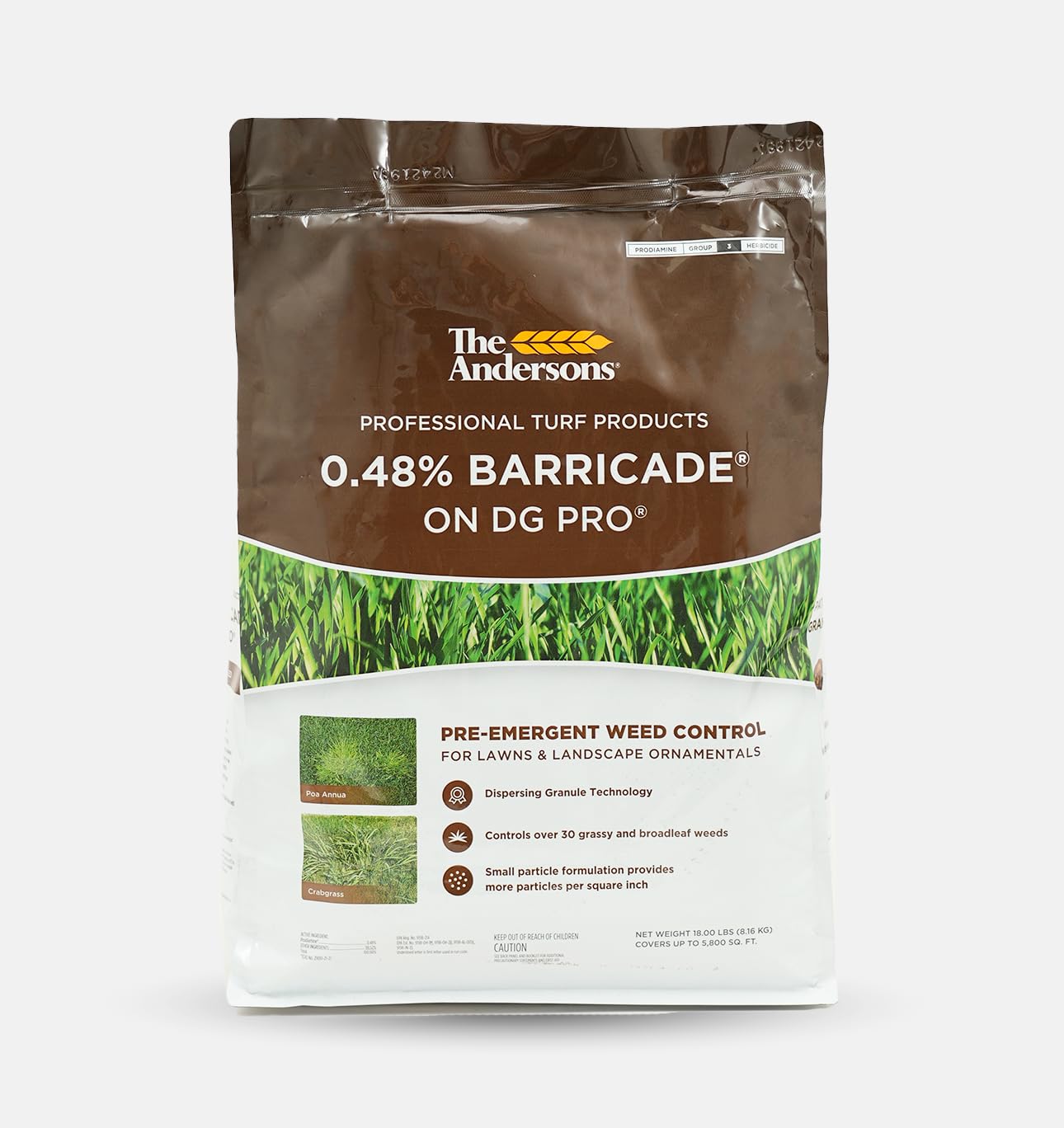
The Andersons Barricade Granular Pre-Emergent Weed Control (18 lb, covers 5,800 sq ft)
| Item Form | Granule |
|---|---|
| Coverage | 5800 square feet |
| Unit Count | 288 Ounce |
| Active Ingredients | Prodiamine 0.48% |
Barricade is a granular pre-emergent that stops common lawn weeds before they emerge, using 0.48% prodiamine in a dispersible granule formula. You apply it across the lawn in early spring or fall and water it in so the small DG Technology particles dissolve and move the active ingredient into the soil. That combination gives broader, more even coverage per square inch and is especially aimed at preventing crabgrass, poa annua and other annual grassy and broadleaf weeds across up to 5,800 square feet from a single 18 pound bag. The product is straightforward to use with a spreader and fits routine seasonal maintenance plans. Important limits are that it will not kill weeds already established and must be timed correctly for best effect. Also, because it is a professional-strength herbicide buyers should follow safety directions closely and keep pets and children off treated areas until safe.
Best for: Homeowners who plan seasonal lawn maintenance and want a single, high-coverage pre-emergent to prevent crabgrass and common annual weeds across medium to large yards.
Less Ideal for: People needing a post-emergent solution for existing weeds, or gardeners who prefer non-chemical weed control methods.
- Designed to prevent both grassy and broadleaf annual weeds including crabgrass and poa annua
- DG Technology dispersible granules dissolve quickly when watered for consistent soil incorporation
- Covers up to 5,800 square feet from a single 18 pound bag, suitable for typical residential lawns
- Contains professional-grade active ingredient prodiamine for season-long pre-emergent control
- Will not control weeds that are already established in the lawn
- Must be applied in the correct seasonal window (early spring or fall) to be effective
- Requires watering after application and careful safety handling around children and pets
Verdict: Pick Barricade when you want a professional-strength, high-coverage pre-emergent that reliably prevents crabgrass and other annual weeds across a typical residential lawn.
Hi-Yield Herbicide Granules Weed and Grass Preventer, 4 lb

| Item Form | Granule |
|---|---|
| Unit Count | 64 Ounce |
| Active Ingredients | Trifluralin |
| Coverage | Full |
Hi-Yield Herbicide Granules is a pendimethalin-based pre-emergent sold in a 4-pound container for treating smaller turf and ornamental areas. It is applied at the start of the growing season to form a barrier that prevents common annual weeds and grasses such as crabgrass from emerging. The granule form makes it easy to broadcast by hand or with a small spreader and it lists coverage as full when used according to label directions. Practical benefits include season-long suppression in treated spots and a simple single-application workflow for beds and small lawn patches. Important limitations are that it is a preventative product so it will not remove established weeds and must be timed properly before germination, and application rates vary by planting type so users must follow the label. For gardeners on a budget, this product offers straightforward protection for small areas without complicated equipment, but it is not a substitute for post-emergent control of existing weeds.
Best for: Gardeners and homeowners who want an inexpensive, easy-to-apply pre-emergent to protect small lawns, flowerbeds, or patch repairs and who prioritize simple seasonal prevention over ongoing weed removal.
Less Ideal for: People needing to remove existing weed infestations or those managing large acreage where a higher-capacity commercial product or professional application would be more efficient.
- Pendimethalin pre-emergent ingredient effective against many annual grasses and weeds
- Granular form is easy to apply by hand or with a small spreader
- Single season prevention when applied at the start of the growing season
- Packaged for small turf and ornamental areas, avoiding waste for small jobs
- Does not control established weeds or broadleaf plants once they have emerged
Verdict: A budget-friendly granular pre-emergent that gives straightforward season-long prevention for small lawns and beds when applied correctly.
LebanonTurf Prodiamine 0.58% Granular Pre-Emergent (covers 20,000 sq ft)

| Item Form | Granule |
|---|---|
| Coverage | 20,000 sq. ft. |
| Active Ingredients | Prodiamine |
This granular pre-emergent uses 0.58% prodiamine on a BIODAC carrier to stop crabgrass and many grassy weeds from germinating across lawns and landscaped areas. It is applied with a broadcast spreader in early spring, with a recommended follow-up in late May or early June; the manufacturer warns not to overseed for three to four months after application. The product covers a large area per unit, making it suitable for whole-yard preventive programs and for professional maintenance of turf, trees, shrubs, and flowers. Its granular form simplifies handling compared with liquids and reduces immediate runoff risk, while the prodiamine chemistry provides season-long residual control when applied correctly. Limitations include the planting restriction after application and that it prevents seed germination so it cannot be used where you plan to establish new lawn from seed shortly after treatment. Also availability is restricted in several states, so check local regulations before planning use.
Best for: Buyers who prioritize a dependable, season-long preventive approach to crabgrass control and want a product that fits routine lawn maintenance schedules used by homeowners or pros.
Less Ideal for: Gardeners planning to establish new lawns from seed shortly after treatment or those needing an option legal in excluded states should consider alternatives.
- Granular formula on BIODAC carrier for easy broadcast spreading
- Contains 0.58% prodiamine, a proven pre-emergent for crabgrass and grassy weeds
- Large coverage of 20,000 sq. ft. per unit reduces application frequency
- Suitable for use across lawns and landscaped beds to protect turf and plantings
- Prevents seed germination so you cannot overseed or plant grass seed for 3–4 months after application
- Not labeled for sale or use in a number of states, limiting availability and compliance
Verdict: Choose this granular 0.58% prodiamine product when you need a reliable, large‑area pre-emergent to prevent crabgrass and other grassy weeds.
Scotts Turf Builder Weed & Feed 3, Granular Lawn Fertilizer and Weed Killer, 14.29 lb

| Item Form | Granule |
|---|---|
| Coverage | 5000 square_feet |
| Active Ingredients | 2,4-D 1.220%, Mecoprop 0.081% |
Scotts Turf Builder Weed & Feed3 is a granular lawn product that combines a fertilizer with broadleaf weed control for routine lawn maintenance. It is applied with a broadcast or drop spreader to a wet lawn when daytime temperatures are between 60 and 90°F, and it uses WeedGrip technology to help granules stick to weed leaves for better uptake. In practice it kills common weeds such as dandelion and clover while delivering nutrients to thicken grass, so treated areas often green up and look fuller over a few weeks. The package covers about 5,000 sq. ft. and manufacturer instructions recommend avoiding certain grass types and keeping people and pets off the lawn until dust settles. Important limitations are that it is not safe for some turf species and must not be watered for 24 hours after application; timing and correct spreader settings affect results. For homeowners wanting a combined feed-and-weed treatment for standard lawns, it simplifies two tasks into one application, but it requires following the label closely for safe and effective use.
Best for: Homeowners seeking a straightforward, combined fertilizer and weed-control treatment to maintain and thicken common cool- and warm-season turf in a typical yard.
Less Ideal for: Specialist turf managers, owners of sensitive turf varieties (listed on the label), or those who need spot treatment only rather than whole-lawn applications.
- Combines fertilizer and broadleaf weed control in one granular product
- WeedGrip formulation helps granules adhere to weed leaves for improved herbicide contact
- Covers approximately 5,000 sq. ft. per 14.29 lb bag, suitable for many small to medium lawns
- Clear application guidance for use with common spreaders and specific temperature/wetting windows
- Contains active herbicide ingredients not appropriate for all turf types and must be avoided on listed grasses
- Requires strict timing and no watering for 24 hours after application to be effective and safe
Verdict: A practical one-step weed-and-feed for typical lawns that feeds turf while targeting common broadleaf weeds across a 5,000 sq. ft. area.
Preen Extended Control Weed Preventer, 13.75 lb.

| Item Form | Granule |
|---|---|
| Coverage | 2,245 sq. ft |
| Active Ingredients | Isoxaben, trifluralin |
| Unit Count | 220 Ounce |
Preen Extended Control is a ready-to-use granular pre-emergent that prevents weed seeds from germinating so you spend less time hand-weeding. It is applied to the soil surface or on top of mulch, then watered in to activate an invisible barrier; a flip-top applicator helps distribute granules evenly. The formula lists isoxaben and trifluralin as active ingredients and is labelled safe to use around many established perennials, shrubs, groundcovers, and trees when directions are followed. One application covers a large area and can protect beds for up to six months, reducing the need for frequent reapplications. Important limitations are that it will not kill existing weeds, is not for use on lawns, vegetable gardens, flower seedings, or food-producing areas, and granules must be kept off foliage to avoid damage. For gardeners who prefer a conservative, low-maintenance approach, this product offers long-lasting, predictable prevention when used according to label instructions.
Best for: Gardeners who want a cautious, low-maintenance solution to prevent new weeds in established beds and who follow label directions carefully.
Less Ideal for: Growers who need post-emergent weed control, people planting seeds or vegetables, or those who prefer organic or non-chemical weed management.
- Long single-application protection up to six months over large areas
- Ready-to-use granules with a flip-top applicator for even distribution
- Works around many established ornamentals when label directions are followed
- Contains two active ingredients for broad-spectrum pre-emergent control
- Does not control or remove existing weeds, only prevents new seeds from germinating
- Not safe for lawns, vegetable gardens, flower seeds, or food-producing plants
Verdict: Choose Preen Extended Control when you want a long-lasting, easy-to-apply pre-emergent that reliably prevents new weeds in established garden beds.
Choosing the Right Granular Weed and Grass Killer: Key Factors to Consider
Application Method and Spread Pattern
How granules deliver active ingredients matters because uneven distribution causes patchy control or damage to desirable plants. A product that flows consistently through common spreaders gives even coverage across lawns or pathways. For hand-applied spot treatments, granules that resist clumping and bounce provide more predictable placement.
Also consider granule size and coating. Finer granules may spread more evenly but can be more prone to wind drift during application. Coated granules can reduce dust and improve handling but may require different timing for rain activation.
Control Spectrum and Target Plants
Different formulations focus on broadleaf weeds, grassy weeds, or both. Match the product to the dominant problem in your yard. A broad-spectrum granular will tackle dandelions and many annual weeds but may be slower or less effective on tough perennial grasses. Conversely, a grass-targeting granular will suppress grassy invasives while leaving many broadleaf plants less affected.
Knowing which species you need to control helps prevent unnecessary damage to desirable groundcovers and reduces the need for retreatment.
Knockdown Time and Visible Symptoms
Some granular products produce visible wilting or browning within days, which is useful when you need quick aesthetic results or rapid removal before a project. Others work more slowly, delivering systemic control that kills roots over weeks. Faster acting options are often contact or combination formulas and may require careful application to avoid harming nearby plants.
Consider whether quick top-growth control or long-term root kill is more important for your timing and project goals.
Residual Activity and Reapplication Interval
Residual control in the soil can prevent reinfestation but also increases the risk to newly planted ornamentals or seeded turf. If you plan to reseed or plant in treated areas, choose a product with minimal or short-lived residual activity. For perimeter maintenance where replanting is unlikely, longer residuals reduce labor and retreatment frequency.
Check label statements about planting restrictions and how long treated soil remains herbicidal before committing to a granular that leaves long residues.
Safety, Plant Tolerance, and Environmental Considerations
Granular formulations reduce drift but still pose risks if applied too close to desirable plants or water features. Evaluate the product's known tolerance range for common ornamentals and turfgrass to avoid injury. Consider the impact on pollinators and nearby vegetable plantings; many granules have restrictions for edible crops.
Follow label guidance for buffer distances, runoff avoidance, and pet access times to protect beneficial insects, soil life, and water quality.
Ease of Use and Equipment Compatibility
How easily you can apply a granular product affects both accuracy and the time you spend. Products that work with standard broadcast or drop spreaders scale well for larger lawns, while those designed for hand application are better for spot treatments or narrow beds.
Look for clear calibration instructions, consistent flow through equipment, and packaging that limits spillage. Compatibility with common spreader settings and easy-to-follow dilution or activation steps saves time and reduces the chance of application errors.
When to Use Granular Formulations
Granular weed killers are best when you need controlled placement without the drift risk of sprays. They work well on lawns, gravel paths, driveways, and around hardscapes where you want targeted control and less contact with surrounding plantings.
Granules also permit simple broadcast application for wide areas and precise spot applications for individual weeds. Use them when soil activation by rain or irrigation is acceptable within the product's label timing.
- Good for perimeter and patch treatments
- Preferable near delicate ornamentals when applied precisely
- Useful where spray drift is a concern
Timing Applications for Best Results
Apply granular products when weeds are actively growing and temperatures match label recommendations. Early spring and fall are often the most effective periods because young weeds are more susceptible and translocation to roots is more likely.
Avoid application before heavy rain that can cause runoff, and wait to seed or transplant as directed by the product label. For quick visual results, target warm, sunny periods when foliage will show symptoms more rapidly.
- Apply to actively growing weeds
- Avoid heavy rain within 24 hours unless label allows
- Respect planting windows stated on the label
Safe Use Near Garden Beds and Edibles
Granular herbicides can injure nearby ornamentals and vegetable crops if applied too close or if granules migrate into root zones. Keep a clear buffer between treated areas and plantings, and consider physical barriers or careful hand application around sensitive plants.
If you plan to plant vegetables or root crops, pick a product with minimal residual activity or that specifically permits planting after a short interval. Always follow label instructions for buffer zones and soil incorporation where required.
- Maintain buffer zones from edible gardens
- Use targeted hand application near ornamentals
- Avoid treating when strong runoff is likely
Managing Treated Debris and Disposal
After treatment, do not compost removed weeds that may still contain herbicide residues. Bag and discard green waste from treated areas according to local guidelines to prevent spreading live or contaminated plant material into other garden areas.
Clean application equipment and spreaders to prevent unintentional transfer of granules to storage areas or onto non-target landscapes. Rinse and dispose of wash water in accordance with label and local regulations.
- Do not compost treated plant material
- Wash equipment away from water sources
- Follow local disposal rules for herbicide containers
How We Chose the Best Granular Weed and Grass Killer
We focused on practical, gardener-centered criteria that predict real-world performance of granular weed and grass killers. Primary evaluation dimensions included application precision and spreadability, which determine how easy it is to deliver an even dose without drifting onto desirable plants. We assessed control spectrum and knockdown speed to understand which broadleaf weeds and grasses a product will reliably eliminate and how quickly symptoms appear. Residual activity and longevity were reviewed to identify products suited to long-term perimeter control versus short-term spot treatments. Safety and plant tolerance considerations were examined for typical garden plantings, ornamental beds, and established turf to help minimize accidental damage. Ease of use and equipment compatibility were included to reflect how the granules perform with broadcast spreaders, hand spreaders, or by hand for targeted spots. We excluded products that are primarily liquid formulations or those intended only for industrial or non-residential use. Poorly documented formulations and items lacking clear application instructions were also removed. The final shortlist reflects a balance of application control, weed spectrum, residuum behavior, and gardener-friendly handling.
FAQ
Will granular weed killers hurt my lawn?
It depends on the product and timing. Some granules are formulated for selective control in established turf while others are nonselective and will damage grasses. Check application windows and label directions for turf-safe use and avoid treating when grass is stressed.
How soon can I plant after using a granular product?
Planting intervals vary by formulation. Some products allow seeding or planting within weeks, while others require months. Always follow the specific planting restrictions on the product label to avoid crop failure or root injury.
Can I apply granules before rain?
Many granular products are designed to activate with light irrigation or rain, but heavy rain can cause runoff and off-site movement. Apply when a moderate amount of moisture is expected, or follow label instructions on irrigation timing to ensure activation without displacement.
Is granular application safer than liquid spraying?
Granules reduce airborne drift and can be easier to place precisely, which lowers some risks. However, they still pose hazards if granules land in beds, on desirable plants, or near water. Proper application technique and adherence to buffer recommendations remain important.
How often will I need to reapply granular herbicides?
Reapplication frequency depends on the product's residual activity and the severity of the weed problem. Short-residual formulas may need multiple treatments in a season, while longer-residual products can control regrowth for several months. Follow label guidance for retreatment intervals.
Final Verdict
Choose a granular weed and grass killer by prioritizing the match between control spectrum and your target weeds, the desired speed of knockdown, and acceptable residual duration for your planting plans. Balance ease of application with safety around ornamentals and edible areas. Prioritizing those tradeoffs will help you select a product that fits your timing and maintenance style and reduce the risk of non-target damage.
