

Note: This article contains affiliate links. If you click on these links and make a purchase, I may earn a small commission at no extra cost to you. This helps support my research and content. Read my full affiliate disclosure here.
Removing persistent vines safely requires more than brute force. The right herbicide for vines reduces regrowth, limits damage to desirable plants, and makes follow-up work manageable in beds, fences, or along property edges. This guide covers seven shortlisted herbicides chosen for their real-world performance in vine control, different application styles, and suitability near ornamentals. Below we explain how each option behaves in the garden and the practical tradeoffs to expect, then summarize the evaluation criteria used to choose the picks.
Top Picks at a Glance
| Best Overall The best all-around choice for most situations | Roundup Poison Ivy Plus Tough Brush Killer with Comfort Wand, 1 gal |  |
| Best Quality Built to a higher standard if you want something more solid | RM43 43% Glyphosate Plus Weed Preventer, 1 Gallon |  |
| Best Value The sweet spot between price and what you get | BioAdvanced Brush Killer Plus Concentrate (32 fl oz) |  |
| Best Budget The cheapest option that still gets the job done reliably | Bonide Poison Oak & Ivy Killer Ready-to-Use Spray, 32 oz |  |
| Highest Rated A top-rated pick with lots of positive feedback | Honcho K6 Glyphosate Herbicide, 2.5 Gallon |  |
| Most Popular A crowd favorite that many people choose with confidence | Bonide Stump-Out Stump & Vine Killer, 8 oz with Applicator | 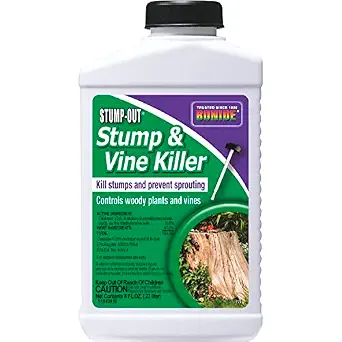 |
| Best Seller A high-volume bestseller chosen again and again | Roundup Weed & Grass Killer4 with Pump 'N Go 2 Sprayer, 1.33 gal. |  |
Roundup Poison Ivy Plus Tough Brush Killer with Comfort Wand, 1 gal

| Unit Count | 128 Fluid Ounces |
|---|---|
| Item Form | Spray |
| Coverage | 300 square feet |
| Liquid Volume | 1 gallons |
This Roundup formulation is a gallon-ready spray designed to tackle poison ivy, poison oak, poison sumac, wild blackberry, kudzu and other stubborn vines and brush. It comes with a reusable one-touch comfort wand that lets you apply the spray precisely without bending, which is handy along fence lines, around trees or on vines climbing poles. The label claims rainproof protection in as fast as 30 minutes and visible plant dieback in hours, and the product lists coverage up to about 300 square feet per container. Active ingredients include triclopyr and additional herbicidal compounds targeted at woody and broadleaf species, so it works to kill to the root rather than just defoliate. Important limitations are standard safety and reentry restrictions until treated foliage has dried and following label instructions for planting windows after use. This is a practical option when you need a straightforward, targeted solution for persistent vines and brush and want the convenience of an attached wand for precision work.
Best for: Gardeners and homeowners who need a reliable, easy-to-use product to remove established vines and woody brush around yards, fences, and foundations and who value precision application without heavy equipment.
Less Ideal for: Those managing large acreage or needing a lawn-safe, broadcast weed control solution should look for products formulated for turf or with longer preventive activity.
- Formulated specifically for tough vines and woody brush like poison ivy and kudzu
- Includes a reusable one-touch comfort wand for precise, ergonomic spraying
- Fast rainproof protection (about 30 minutes) and visible results in hours
- Ready-to-use gallon covers up to 300 sq ft for spot and small-area treatments
- Not for use where people or pets will contact treated plants until spray is fully dry
- Contains multiple active herbicides so requires careful handling and strict adherence to label directions
Verdict: A practical, ready-to-use herbicide with a precision wand that makes removing established vines and tough brush around the yard straightforward and efficient.
RM43 43% Glyphosate Plus Weed Preventer, 1 Gallon

| Active Ingredients | glyphosate |
|---|---|
| Unit Count | 128 Fluid Ounces |
| Item Form | Spray |
| Coverage | 17297 square feet |
RM43 is a concentrated, mix-with-water herbicide intended for thorough, long-lasting control of unwanted vegetation. It combines glyphosate with a weed preventer to kill existing growth to the root and suppress regrowth for up to a year when applied to non-crop areas such as fence lines, around buildings, and driveways. Typical use is dilution into a sprayer for spot or area treatments; one gallon treats large areas (manufacturer lists coverage up to about 17,297 sq ft per gallon). Notable features include a high active ingredient concentration, rainfast performance within two hours, and no re-entry restrictions after the spray has dried. The practical benefit is efficient large-area control with fewer repeat applications compared with short‑acting products. Important limitations are that it is non-selective so it will damage desirable plants if contacted and it must be used only on non-crop or non-landscaped areas following safety directions and local regulations.
Best for: For homeowners or property managers who prioritize maximum, long-lasting control of aggressive vines and want a product that treats large areas with fewer follow-up applications.
Less Ideal for: Not a good choice for gardeners who need selective control around ornamentals, vegetable beds, or in planting areas where desirable plants are present.
- High concentration for effective systemic control to the root
- Includes a preventative component to inhibit new growth for up to one year
- Rainfast in about two hours so treatments are less likely to wash off
- Large coverage per gallon suitable for extensive or repeated vine infestations
- Non-selective formulation will kill or damage desirable plants on contact
- Intended only for non-crop areas and requires careful handling and disposal
Verdict: Choose RM43 when you need powerful, long‑lasting, large‑area control of invasive vines in non‑crop areas.
BioAdvanced Brush Killer Plus Concentrate (32 fl oz)

| Unit Count | 32 Fluid Ounces |
|---|---|
| Coverage | 4000 square_feet |
| Item Form | Spray |
| Active Ingredients | triclopyr |
BioAdvanced Brush Killer Plus is a concentrated spray-on herbicide designed to control tough vines and woody brush such as poison ivy, poison oak, kudzu, blackberry and many listed weeds. You mix the concentrate with water using the bottle’s measuring marks, apply it to actively growing, leafed-out plants, and the triclopyr-based formula moves systemically through foliage and roots so treated plants die back over 1 to 6 weeks. It becomes rainproof in about four hours, which helps avoid reapplication after light rain. The product covers up to 4,000 square feet per bottle when diluted to the recommended rate, so it is suited to larger patches rather than single small weeds. Because results take time to appear and the herbicide is selective for brush and broadleaf plants, you may need follow-up treatments for re-sprouts or for species not on the label. Handle with care and follow label directions to avoid contact with desirable plants and to meet local safety and disposal rules.
Best for: Buyers who want an efficient, science-based solution to remove patches of vines and woody brush without repeated spot-spraying and who plan treatments when plants are actively growing.
Less Ideal for: Gardeners who need instant knockdown, require a non-chemical mechanical approach, or who only need to remove small single weeds by hand should consider alternatives.
- Systemic triclopyr formula kills brush down to the root for longer control
- Concentrate mixes for economical coverage up to 4,000 sq ft per bottle
- Rainproof in about 4 hours so light rain is less likely to wash it away
- Label lists many targeted tough species including poison ivy, poison oak, kudzu and blackberry
- Works slowly with visible decline over 1–6 weeks so immediate removal is not achieved
- Selective to brush and broadleaf weeds so not effective on all plant types
Verdict: Choose this concentrated systemic brush killer when you need a practical, economical product to eliminate established vines and woody brush down to the roots.
Bonide Poison Oak & Ivy Killer Ready-to-Use Spray, 32 oz

| Unit Count | 32 Ounce |
|---|---|
| Item Form | Spray |
| Coverage | approximately 1000 square feet |
| Active Ingredients | Herbicide |
This ready-to-use Bonide spray is designed to control poison ivy, poison oak, and a range of broadleaf weeds by delivering a systemic herbicide straight from the trigger bottle. You use it by aiming and spraying the foliage of actively growing vines and weeds; no mixing or measuring is required, which makes it convenient for quick spot treatments. Notable features include a fast-acting formula that begins work overnight and becomes rainfast once dry, and an application coverage claim of roughly 1,000 square feet per bottle. Practical benefits for vine control are ease of use, reliable root-killing action on broadleaf vines, and minimal prep or cleanup. Important limitations are that it is non-selective to unwanted broadleaf plants so care is needed around desirable ornamentals, it should not be used on windy days to prevent drift, and it is intended for spot or targeted treatments rather than broadcast application of large areas. Follow label safety directions and avoid contact with skin or eyes when applying.
Best for: Buyers who want a simple, no-mess solution for removing poison ivy or broadleaf vines from lawn edges and small patches and who prioritize convenience over dilution control. It suits homeowners looking for a quick spot-treatment option rather than large scale landscape management.
Less Ideal for: Landscape professionals or gardeners who need concentrated herbicide for treating large acreage or selective control of specific non-broadleaf species should consider other products or application equipment.
- Ready-to-use trigger bottle requires no mixing or dilution
- Systemic formula kills vines to the root for longer control
- Becomes rainfast after drying so light rain soon after application is less likely to reduce effectiveness
- Suitable for spot treating poison ivy and oak without harming lawn grasses when used as directed
- Non-selective toward broadleaf plants so nearby ornamentals can be harmed if oversprayed
- Not intended for large broadcast applications where a concentrated product or sprayer tank might be more economical
Verdict: A ready-to-use, root-killing spray that makes fast, no-mess spot control of poison ivy and oak easy for homeowners.
Honcho K6 Glyphosate Herbicide, 2.5 Gallon

| Unit Count | 320 Fluid Ounces |
|---|---|
| Item Form | Liquid |
| Active Ingredients | Glyphosate (potassium salt) 48.7% |
Honcho K6 is a high-load potassium glyphosate concentrate designed for post-emergence, systemic control of a broad range of weeds, brush, vines, and woody plants. It is mixed with water or other carriers and applied with field or industrial sprayers for tasks like fence-row cleanup, shrub bed maintenance, and targeted vine removal. Notable features include a high active ingredient concentration for reliable uptake, an integrated surfactant to improve leaf coverage and absorption, and no soil residual activity so treated areas do not retain long-term herbicide in the soil. For practical use it delivers consistent knockdown of top growth and root systems when applied according to label directions and with proper protective equipment. Important limitations are that it is a nonselective systemic herbicide so any desirable plants it contacts can be killed, and regulatory restrictions prohibit its use in some states, so you must follow label rules and local regulations. Its concentrated formula is suited to users comfortable with measuring and mixing for larger treatment areas.
Best for: Buyers who prioritize consistent, professional-strength weed control for removing vines, brush, and woody plants across fence rows or farmstead areas and who are comfortable mixing and applying concentrated herbicides safely.
Less Ideal for: Casual gardeners who need a selective product around ornamentals or small beds, or users unwilling to follow strict safety and regulatory instructions.
- High concentration of glyphosate for effective systemic control of vines and woody plants
- Built-in surfactant improves leaf coverage and uptake without needing separate additives
- No soil residual activity reduces long-term impact on treated soil
- Large 2.5 gallon volume allows multiple applications over broad areas
- Nonselective formula will damage or kill any desirable plants it contacts
- Not permitted for use in certain states and requires strict adherence to label directions
- Requires careful measuring and compatible sprayer equipment for safe, effective application
Verdict: Choose Honcho K6 when you need a reliable, concentrated systemic glyphosate to remove persistent vines and woody plants across large areas.
Bonide Stump-Out Stump & Vine Killer, 8 oz with Applicator

| Unit Count | 8 Ounce |
|---|---|
| Item Form | Spray |
| Coverage | Stumps, woody plants, vines, broadleaf weeds |
| Active Ingredients | 3,5,6-Tricloro-2-Pyridinyloxyacetic Acid |
Bonide Stump-Out is a concentrated stump and vine killer designed for targeted outdoor use. It is intended to be applied undiluted to cut stumps to prevent resprouting or mixed for foliar spraying of woody vines and broadleaf weeds with a hose-end or tank sprayer. The included brush applicator makes it straightforward to apply directly to stump surfaces and avoid overspray near turf. Active ingredient information indicates a pyridine-based chemical that typically works within one to six weeks, so you can expect progressive dieback rather than instant browning. Practical benefits include focused control of vines like poison ivy and poison oak without treating large swaths of lawn, and an option to use as a foliar spray for hard-to-reach vines. Important limitations are that it is a chemical control requiring careful handling and strict adherence to label directions, and results are not immediate so follow-up checks are often needed to confirm complete kill. Protective gear and attention to placement are necessary to avoid harming desirable plants.
Best for: Gardeners who want a proven, targeted chemical solution to remove established vines and prevent stump resprouting and who prioritize clear product performance and peer-tested results.
Less Ideal for: Those seeking an immediate nonchemical or organic method or users unwilling to follow safety and label instructions should consider alternative mechanical or organic controls.
- Concentrated formula for strong control of stumps, woody plants, vines, and broadleaf weeds
- Includes brush applicator for precise, directed application to stumps and stems
- Can be applied undiluted for stump treatment or through hose-end or tank sprayers for foliar work
- Effective against poison ivy and poison oak with visible results within 1 to 6 weeks
- Requires careful handling and protective gear because it contains a potent chemical active ingredient
- Not an instant solution; plants and stumps can take weeks to fully die back
Verdict: Choose this product when you need a reliable, targeted chemical treatment to kill vines and prevent stump regrowth with an easy applicator for precise placement.
Roundup Weed & Grass Killer4 with Pump 'N Go 2 Sprayer, 1.33 gal.

| Unit Count | 170 Fluid Ounces |
|---|---|
| Item Form | Spray |
| Coverage | 300 Square_Feet |
| Active Ingredients | Triclopyr, Fluazifop-P-Butyl, Diquat Dibromide |
This Roundup kit combines a 1.33 gallon ready-to-use herbicide with the Pump 'N Go 2 sprayer for targeted spot treatments of weeds and unwanted vines. It is formulated to kill tough broadleaf weeds and grasses down to the root and lists common targets such as dandelion, crabgrass, clover, and poison ivy, making it useful for vine control when applied directly to foliage. The built-in sprayer and extendable wand let you apply a continuous spray for up to 10 minutes without mixing, which helps reach low or hard-to-access stems without bending. The product claims visible results in hours, is rainproof in about 30 minutes, and allows replanting within specified windows. Important limitations are safety and precaution requirements: avoid contact with desirable plants, keep people and pets away until spray dries, and follow label directions for planting intervals and protective clothing. This is not a selective systemic for every vine species, so careful spot application is necessary for effective vine kill and to avoid damaging nearby ornamentals.
Best for: Gardeners who want a straightforward, ready-to-use herbicide and sprayer for spot-treating persistent vines and broadleaf weeds without mixing concentrates and who prioritize predictable, fast results.
Less Ideal for: People seeking a highly selective or organic option for vine control or those who need a herbicide specifically labeled for all vine species and systemic stump treatment should look elsewhere.
- Ready-to-use formulation with no mixing required for convenience
- Pump 'N Go sprayer and extendable wand enable precise, continuous spraying up to 10 minutes
- Works on a wide range of common broadleaf weeds and grasses, including poison ivy and dandelions
- Rainproof in about 30 minutes with visible results in hours
- Contains multiple active ingredients requiring careful handling and protective gear
- Not plant-selective so accidental spray can damage desirable plants
Verdict: A convenient pump-and-go herbicide kit for homeowners who want fast, targeted control of broadleaf weeds and many common vines without mixing chemicals.
Choosing the Right Herbicide for Vines: Key Factors to Consider
Mode of Action and Systemic Reach
Understanding mode of action helps predict whether a treatment will kill a vine's roots or only scorch leaves. Systemic herbicides move within plant tissues to reach roots, which is critical for species that resprout from deep or extensive root systems.
If you need long-term control of woody vines or runners that resprout from roots, prefer systemic formulations and follow label guidance on timing so the plant is actively moving nutrients. For quick visual control or cleanup before disposal, contact herbicides can brown foliage fast but often require repeated applications to exhaust root reserves.
Selectivity and Timing Near Desirable Plants
Selectivity determines how likely an herbicide is to damage nearby flowers, shrubs, or turf. Some formulations are broad-spectrum and will injure or kill non-target plants if drift or runoff occurs.
Plan applications when wind is low, use shields or spot treatments, and consider directional tools to limit exposure. Also consider seasonal timing; applications when vines are actively growing increase uptake and reduce the need for repeat treatment, while dormant-season cuts plus targeted treatment may be safer near ornamentals.
Application Method and Equipment Compatibility
Different formulations require different tools: ready-to-use sprayers for small patches, concentrated mixes for larger infestations, or wipers for stem-only treatment. Your choice affects labor, accuracy, and risk of non-target contact.
Match the product form to the scale of the job. A small bed with a few vines may be best managed with a trigger sprayer or hand-applied gel. Larger infestations often benefit from backpack sprayers or hose-end setups that deliver consistent coverage. Consider whether you need tank-mix compatibility with surfactants or adjuvants for better leaf coverage.
Environmental Persistence and Soil Residue
Some herbicides leave soil residues that inhibit transplanting or damage future plantings. Residual activity can be useful for preventing vine seedlings but may be a liability when you want to reestablish desirable plants in the treated area.
If you plan to replant soon, choose products with minimal soil persistence and follow label timelines for safe replanting. For long-term suppression in pathways or around fences, a product with residual control can reduce retreatment frequency but requires careful placement and runoff prevention.
Safety, Label Restrictions, and Legal Use
Always follow label directions. Labels specify allowable uses, buffer zones, personal protective equipment, and disposal instructions. Misuse can cause plant injury, environmental harm, or regulatory violations.
Check label restrictions for use near water, on slopes, or around edible plants. Use appropriate protective gear for mixing and applying concentrates, and store chemicals securely away from children and pets.
Cost Per Treated Area and Coverage Efficiency
Cost matters less as a first filter for small jobs but becomes important for large infestations. Concentrates typically offer lower cost per treated area but require accurate mixing and more equipment cleaning.
Estimate the area of infestation and calculate approximate coverage from the product label. Factor in repeat-application needs; a cheaper product that requires multiple repeat treatments may be more expensive over time than a more effective systemic option.
Common Vine Types and How They Respond
Different vine species respond differently to chemical control. Fast-growing herbaceous vines with shallow roots often succumb to repeated contact applications, while woody vines and those with extensive underground runners need systemic uptake to fully suppress regrowth.
- Herbaceous climbers often brown quickly but can regrow from root fragments.
- Woody creepers and vines with deep roots usually require translocated herbicides applied during active growth.
- Invasive runners can spread via rhizomes, so treat beyond the visible canopy to limit reinvasion.
Timing Applications for Best Uptake
Apply treatments when vines are actively transporting sugars and water, typically during spring and summer growth. This increases movement of systemic herbicides to roots and improves the chance of long-term control. Avoid applications on drought-stressed or dormant plants because translocation is reduced. Fall can also be effective for some woody vines because stored carbohydrates move to roots, but check label guidance for seasonal restrictions.
- Apply on dry, calm days to reduce drift.
- Avoid mowing or cutting immediately before treatment unless label recommends treating fresh regrowth.
Spot Treatment and Mechanical Integration
Combining mechanical removal with targeted herbicide applications reduces chemical use and improves control. Cut-stump treatments and wiper applications let you target stems while minimizing exposure to nearby plants. For sprawling infestations, remove as much aboveground material as practical before treating regrowth to increase herbicide contact with leaves or to expose stems for painted applications.
- Cut-stump: apply herbicide to cambium immediately after cutting for systemic uptake.
- Wiper or paint-on methods: lower drift risk and protect ornamentals.
Protecting Soil and Water
Prevent runoff and avoid treating near storm drains or waterways unless the label permits aquatic use. Use targeted methods and avoid broadcast spraying on slopes where runoff risk is high. Rinse and dispose of equipment wash water according to label rules and local regulations to minimize contamination risk.
- Keep a buffer zone from bodies of water and desirable plants.
- Use absorbent barriers or physical containment when mixing and applying concentrates.
Preparing for Replanting After Treatment
If you plan to replant an area after vine removal, choose a formulation with a known replanting interval and follow label timelines. Some products restrict planting of certain species for months or seasons. Solarization, thorough compost removal, and waiting the recommended interval reduce the risk of injury to new plantings.
- Check label for safe replanting intervals by plant type.
- Delay planting of sensitive species until residue has dissipated.
How We Chose the Best Herbicide for Vines
We started by prioritizing products and formulations that gardeners commonly use to control woody and herbaceous vines in landscapes and beds. Selection focused on modes of action known to be effective on vine species, including systemic translocation for deep rootkill and contact activity for quick brownout. We compared application methods that gardeners can reliably deploy, such as ready-to-use sprayers, hose-end options, and concentrated mixes for backpack sprayers. Key evaluation criteria were effectiveness on common vine types, selectivity near ornamentals, application practicality and equipment compatibility, residual soil activity, and safety or handling requirements. We excluded products intended only for agricultural row-crop use, non-chemical mechanical-only options, and items lacking clear label instructions for home landscapes. Final picks balanced predictable vine control with clear use instructions and options for different site constraints like proximity to desirable plants or pets.
FAQ
Will a single application kill deep-rooted woody vines?
Often a single application is not enough for deeply rooted woody vines. Systemic products used at the right time can move to roots, but established vines may need follow-up treatments or integrated mechanical removal to prevent resprouting.
Can I treat vines without harming nearby flowers and shrubs?
You can limit collateral damage by using targeted methods such as cut-stump, wiper, or spot-spray applications, applying on calm days, and shielding desirable plants. Choosing a selective label and timing applications when vines actively translocate herbicide also helps.
Is it safe to use herbicides for vines near water features?
Many herbicides have restrictions near water. Check the product label for aquatic use approvals and mandatory buffer zones. When in doubt, use physical removal or contact local extension guidance for aquatic-safe options.
How long before I can replant in a treated area?
Replanting intervals vary by product and plant type. Some herbicides have minimal soil persistence while others require waiting months. Always follow the label replanting guidance to avoid damage to new plants.
Are ready-to-use products effective for large infestations?
Ready-to-use formulations are convenient for small patches but can be inefficient for large areas due to higher cost per treated area and limited tank capacity. For extensive infestations, concentrates and proper spraying equipment are often more practical.
What personal protective equipment should I use when applying vine herbicides?
Wear gloves, eye protection, and clothing that covers arms and legs at minimum. For concentrates or aerosolizing applications, add a respirator as recommended on the label and follow mixing and handling instructions carefully.
Final Verdict
Choose an herbicide for vines based on the vine species, proximity to desirable plants, and whether you need quick browning or true rootkill. Prioritize systemic action and correct timing when long-term control is the goal, and select targeted application methods to protect ornamentals and water features. Balance residual activity against plans to replant and match the formulation to the scale of the job. With careful technique and adherence to label directions, you can remove persistent vines while minimizing collateral impacts and repeat treatments.
