

Note: This article contains affiliate links. If you click on these links and make a purchase, I may earn a small commission at no extra cost to you. This helps support my research and content. Read my full affiliate disclosure here.
A Wifi smart irrigation controller automates your watering schedule while responding to local weather and plant needs. For home gardeners, the right controller reduces runoff, prevents overwatering, and keeps beds, containers, and turf healthier with less daily attention. This guide covers six shortlisted controllers that suit typical backyard and patio setups and explains the practical tradeoffs you should expect in installation, connectivity, and irrigation logic. Below you will find top picks that span simple retrofit options to more feature-rich hubless units, plus the evaluation criteria we used to shortlist them and the factors that matter when matching a controller to your garden. Read on to see which type of controller fits your watering style and setup.
Top Picks at a Glance
| Best Quality Built to a higher standard if you want something more solid | Hunter Hydrawise HPC400 Smart WiFi Sprinkler Controller, 4‑Zone |  |
| Best Value The sweet spot between price and what you get | Orbit B-hyve Smart 6-Zone Indoor/Outdoor Sprinkler Controller |  |
| Best Budget The cheapest option that still gets the job done reliably | HiOazo Smart Sprinkler Controller (4-Zone, App-Controlled) |  |
| Highest Rated A top-rated pick with lots of positive feedback | Hunter PRO-HC PHC-1200 12-Station Wi‑Fi Irrigation Controller with Hydrawise |  |
| Most Popular A crowd favorite that many people choose with confidence | Rachio 3 Smart Sprinkler Controller (8-Zone) |  |
| Best Seller A high-volume bestseller chosen again and again | Rachio 3 Smart Sprinkler Controller, 16-Zone |  |
Hunter Hydrawise HPC400 Smart WiFi Sprinkler Controller, 4‑Zone

| Stations / Zones | 4 (expandable) |
|---|---|
| Smart Control | Hydrawise WiFi app |
| Weather Based Watering | Real‑time forecast adjustments |
| Installation | Touchscreen programming, DIY friendly |
| Outdoor Rating | Weather resistant enclosure |
The Hunter Hydrawise HPC400 is a smart WiFi irrigation controller intended to replace a traditional timer and give you remote, weather‑adjusted control of your sprinkler system. Install it on an exterior wall and wire up to four zones, then use the Hydrawise app or web portal to set schedules, run zones on demand, and let the controller automatically adjust watering based on local forecasts. Notable features include touchscreen programming for quick setup, weather‑based adjustments that aim to reduce water use, and the ability to expand to many more zones via optional modules as your landscape grows. Practical benefits are convenience and potential water savings from automatic weather adjustments, plus a weather‑resistant enclosure for reliable outdoor use. Important limitations are that the base unit only supports four zones out of the box so larger systems require buying expansion modules, and advanced commercial features are beyond this residential/light commercial controller. The unit is designed for DIY installation but users who prefer a hands‑off professional setup should plan accordingly.
Best for: Homeowners who want a performance‑focused smart controller that optimizes watering with weather data and remote app control, and who prefer to install and manage the system themselves.
Less Ideal for: Large commercial sites or users who need many zones immediately without buying expansion hardware are better served by higher‑station controllers or professional systems.
- Hydrawise app and web control allow remote scheduling and manual runs from anywhere
- Weather‑based adjustments reduce unnecessary watering and can lower water usage
- Touchscreen and labeled wiring simplify DIY installation and setup
- Outdoor‑rated, weather‑resistant enclosure for reliable field use
- Expandable zone capacity lets the system grow beyond the initial 4 zones
- Ships as a 4‑zone controller so adding more zones requires purchasing expansion modules
- Some advanced or commercial irrigation features are not included in this residential model
Verdict: Choose the HPC400 if you want a reliable, weather‑smart WiFi controller that delivers remote control and water‑saving automation for a performance‑minded residential landscape.
Orbit B-hyve Smart 6-Zone Indoor/Outdoor Sprinkler Controller

| Voltage | 110 volts |
|---|---|
| Display Type | LCD or LED |
| Operating Temperature | 75 °C |
| Item Type Name | B-hyve Smart 6-Zone Indoor/Outdoor Sprinkler Controller, Compatible with Alexa |
The Orbit B-hyve 6-zone controller automates lawn and garden watering by letting you create and adjust custom schedules from a waterproof wall-mounted console or the smartphone app. It connects to your home Wi-Fi and uses WeatherSense to modify run times based on local weather so you avoid overwatering after rain and increase watering during dry spells. Typical use is assigning separate programs to different zones—lawns, flower beds, vegetable patches or drip lines—then letting the controller make day-to-day adjustments remotely. Notable features include app control from anywhere, voice assistant compatibility, an LCD console for local setup, and indoor/outdoor rated weatherproof housing. Practical benefits are reduced water waste, easier seasonal schedule changes, and centralized control for multiple landscape areas. Important limitations are that this model is a 6-zone unit so larger properties may need a higher-zone controller and it requires a 2.4 GHz Wi-Fi network for connectivity in some installations.
Best for: Homeowners who want to streamline irrigation and cut water use with automated, weather-adjusted schedules and remote control for typical suburban lawns and garden beds.
Less Ideal for: Large properties or commercial landscapes that need more than six zones or centralized professional irrigation management.
- WeatherSense adjusts schedules automatically using local weather data
- App and Wi‑Fi control for remote scheduling and manual activation
- Waterproof indoor/outdoor enclosure suitable for garage or outside wall mounting
- Supports six independent zones to tailor watering across multiple areas
- Limited to six zones which may be insufficient for very large or complex irrigation systems
- Requires reliable Wi‑Fi for full remote features
Verdict: Choose this controller if you want a reliable, weather-smart way to automate and remotely manage watering for a typical multi-zone home landscape.
HiOazo Smart Sprinkler Controller (4-Zone, App-Controlled)

| Zones | 4 |
|---|---|
| Control | App |
| WiFi | 2.4GHz |
| Included components | Controller, screws, power adapter, labels, 4 wire connectors |
The HiOazo Smart Sprinkler Controller is a compact, app-driven irrigation controller designed to replace a basic manual or legacy timer and add remote control for up to four zones. Using the Hioazo app over 2.4 GHz WiFi, you can create as many as 16 watering plans and run them on Standard or Soak irrigation modes to better match soil needs. The unit includes weather-smart logic that will skip cycles for rain, frost, or wind, which helps reduce unnecessary watering. Installation is straightforward and intended as a DIY swap for most existing systems, and the controller ships with the common connectors and a power adapter. Practical benefits are remote scheduling, finer control across four separate zones, and automatic skip to conserve water. Limitations are the 4-zone capacity if you have larger systems and the requirement for 2.4 GHz WiFi only, which could be a constraint in homes using 5 GHz-only networks or weak signal outdoors.
Best for: Buyers looking for an affordable way to add smart remote control and basic weather-adaptive scheduling to a small to medium yard with up to four zones and who prefer a simple DIY install.
Less Ideal for: Homeowners with extensive irrigation setups needing more than four zones or users who cannot provide a reliable 2.4 GHz WiFi signal to the controller location.
- App control for remote scheduling and real-time monitoring via 2.4 GHz WiFi
- Supports up to 4 independent zones and up to 16 distinct watering plans
- Weather-smart automatic skip for rain, frost, and wind to save water
- Includes necessary connectors and a power adapter for DIY installation
- Limited to 4 zones, so not suitable for larger multi-zone irrigation systems
- Only supports 2.4 GHz WiFi which may require network adjustments
Verdict: A cost-conscious, easy-to-install smart controller that adds remote app control and weather-aware watering to small four-zone systems.
Hunter PRO-HC PHC-1200 12-Station Wi‑Fi Irrigation Controller with Hydrawise
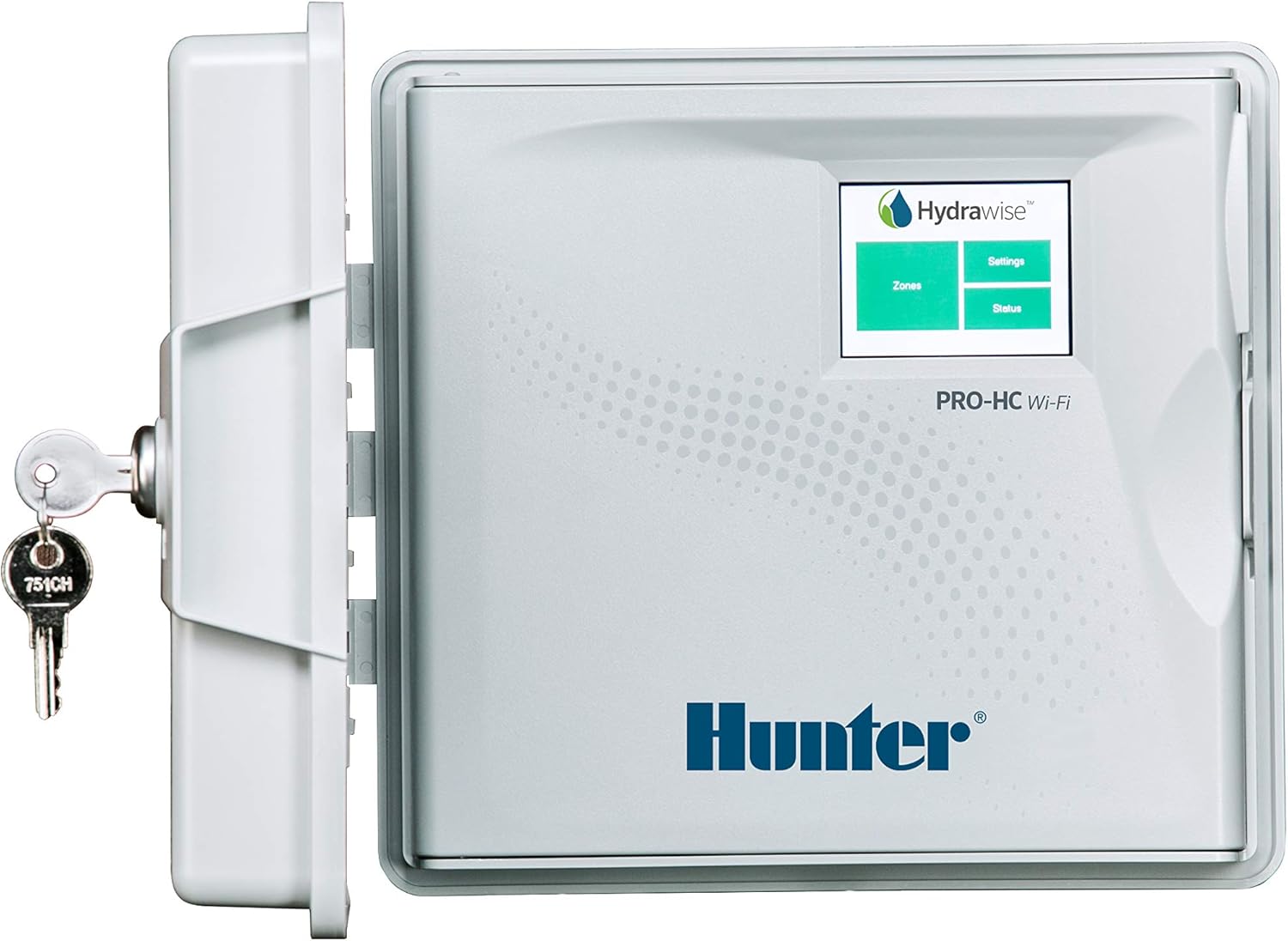
| Unit Count | 12 Count |
|---|---|
| Voltage | 120 volts |
| Display Type | LCD or LED |
| Material Type | Plastic |
The Hunter PRO-HC PHC-1200 is a professional-grade 12-station Wi‑Fi irrigation controller designed for reliable residential use. It connects to Hunter's Hydrawise web-based platform so you can create and adjust schedules remotely, monitor run times, and receive system warnings. The unit installs in place of a standard controller and provides an LCD display for local programming plus automatic seasonal adjustments when linked to weather data. Build quality is typical of Hunter equipment with a plastic enclosure and standard 120V power. Practical benefits include centralized control of multiple zones, reduced manual visits to the timer, and the ability to fine-tune watering based on weather forecasts. Limitations are that this model is focused on automated scheduling rather than advanced on-site diagnostics and it requires a stable Wi‑Fi connection and account setup to access the cloud features. It is best for users who prioritize dependable, remote-managed irrigation rather than ultra-simple analog timers.
Best for: Homeowners who need a dependable multi-zone controller and want to manage watering remotely using weather-based schedules and a web interface.
Less Ideal for: People who want a completely offline or ultra-simple mechanical timer or those without stable home Wi‑Fi who cannot use cloud features.
- Controls up to 12 irrigation stations for multi-zone yards
- Wi‑Fi connectivity with Hydrawise web software for remote scheduling and seasonal adjustments
- LCD display for clear local programming and status
- Standard 120V power compatibility for residential electrical systems
- Requires a reliable Wi‑Fi connection and Hydrawise account to access full remote features
- Plastic enclosure offers less ruggedness than metal weatherproof housings
Verdict: Buy this if you want a reliable 12‑station Wi‑Fi controller that puts remote, weather‑aware scheduling and centralized zone control at the center of your irrigation system.
Rachio 3 Smart Sprinkler Controller (8-Zone)

| Zones supported | 8 zones |
|---|---|
| Voltage | 120 volts |
| Display Type | LED |
| Operating Temperature | 4 °F |
The Rachio 3 is a user-friendly smart sprinkler controller designed to replace traditional dial timers and give you precise, app-based control over lawn and garden watering. It connects to dual-band WiFi and the free Rachio app so you can create schedules, run a zone on demand with Quick Run, and monitor estimated water usage from anywhere. The system’s Weather Intelligence automatically skips or adjusts watering for rain, wind, freeze, and saturation and updates seasonally to reduce overwatering. Setup is DIY-friendly and typically completes in under 30 minutes using common tools; the unit supports 8-zone wiring and can work with 16-zone systems via other models. Practical benefits include water savings, simpler seasonal adjustments, and integrations with Alexa, Google Home, and IFTTT. Important limitations are that scheduling changes require the app for full functionality and the controller is indoor rated without a separate weatherproof enclosure for outdoor mounting; also well systems may need a pump for adequate pressure. LED indicators and physical Quick Run buttons give basic local control when needed.
Best for: Buyers who prioritize reliable, evidence-backed smart irrigation that reduces water use and want confidence from wide adoption and integrations.
Less Ideal for: Users who need an outdoor-rated controller straight out of the box or who prefer full local control without relying on a smartphone app.
- Automated Weather Intelligence skips watering for rain, wind, freeze and saturation to save water.
- App-based scheduling and remote control with Quick Run for on-demand zone runs.
- Dual-band WiFi and wide smart home compatibility including Alexa, Google Home and IFTTT.
- Fast DIY install with included power supply and mounting hardware for most existing systems.
- Indoor-rated unit requires a separate weatherproof enclosure for outdoor installs.
- Core scheduling and advanced adjustments must be made through the app rather than the controller alone.
Verdict: A proven, easy-to-install smart controller that automates watering with weather-aware schedules to cut waste and simplify yard care.
Rachio 3 Smart Sprinkler Controller, 16-Zone

| Zones | Up to 16 |
|---|---|
| Display Type | LED |
| Voltage | 110 volts AC |
| Operating Temperature | 15 °C |
The Rachio 3 replaces traditional dial timers with a Wi-Fi connected controller and smartphone app to automate sprinkler scheduling across up to 16 zones. It uses hyperlocal Weather Intelligence to skip watering for rain, freeze, wind, or saturation and adjusts seasonal schedules so you do not have to guess how often to run zones. Setup is designed for homeowners, with a typical install taking under 30 minutes and included power supply and mounting hardware. The controller supports dual-band Wi-Fi and integrations with Alexa, Google Home and IFTTT, and offers Quick Run buttons for manual zone watering when needed. Practical benefits include water savings from automated weather skips, grow-in scheduling for new lawns, and remote access to run or pause zones. Limitations to note are that the controller is indoor rated by default (an outdoor enclosure is required for exterior mounting) and well systems may need a pump to maintain pressure for reliable operation.
Best for: Homeowners who want a reliable, turn-key smart irrigation controller that minimizes manual scheduling and reduces water waste through automated weather-based adjustments.
Less Ideal for: Users who need an outdoor-rated controller straight out of the box or those relying on low-pressure well systems without a booster pump should consider alternatives.
- Hyperlocal Weather Intelligence that automatically skips watering for rain, freeze, wind and saturation
- Supports up to 16 zones for larger yards or complex landscapes
- Dual-band Wi-Fi and app control for remote scheduling and manual runs
- Quick Run physical buttons for on-demand watering without the app
- Indoor-rated unit requires a separate weatherproof enclosure for outdoor installs
- May need a pump when used with low-pressure well systems
Verdict: Choose the Rachio 3 if you want a proven, easy-to-install smart controller that saves water by automatically adjusting schedules based on local weather.
Choosing the Right Wifi Smart Irrigation Controller: Key Factors to Consider
Compatibility With Existing Irrigation
Confirm which valve types and voltages your system uses. Many residential controllers support standard 24V solenoid valves, but some systems use pump-start relays or nonstandard wiring; knowing this prevents installation headaches.
Also check the number of zones the controller supports versus the zones you currently run and any planned expansion. If you use drip lines and soaker hoses alongside spray heads, look for a controller that allows staggered start times and overlapping cycles to reduce pressure issues. Compatibility affects whether you can retrofit the controller yourself or need professional wiring.
Weather Sensing and Local Adjustment
Controllers that adjust schedules based on local weather data help reduce watering during rain or high humidity and boost runtime during heat waves. Understand whether the unit relies on internet weather services, an on-site sensor, or a combination; internet-only solutions can be fast and broad, but local sensors capture microclimates such as shady yards or coastal fog.
Also examine how aggressive the adjustment logic is. Some controllers scale run times precisely by evapotranspiration estimates while others make coarse pause/resume decisions. The level of automation influences how often you will need to tweak schedules manually.
Ease of Setup and WiFi Reliability
Installation complexity varies from simple plug-and-play wall units to models requiring more involved wiring to a transformer or multiple valves. Choose based on your comfort with basic electrical wiring and access to the controller location.
WiFi connectivity quality is crucial for reliable remote control. Check whether the controller supports 2.4 GHz networks, how it handles intermittent connectivity, and if it stores schedules locally so watering continues during outages. A smooth pairing process and straightforward firmware updates reduce long-term maintenance.
Scheduling Flexibility and Zone Control
Different gardens need different scheduling finesse. Look for controllers that support multiple start times, cycle-and-soak programming to prevent runoff, and custom runtimes per zone. For mixed planting areas such as beds and turf, zone-specific schedules prevent overwatering delicate plants.
Also consider how many custom programs you can store and whether seasonal adjustments or plant-type presets are available. Greater scheduling flexibility reduces the need for manual intervention as plants and seasons change.
Power and Backup Options
Most residential controllers run on mains power with a transformer that steps down to 24V, but some offer battery backup or capacitor-based memory to preserve schedules during outages. For locations with frequent interruptions, backup helps avoid missed cycles or lost programming.
If you plan to place the controller outdoors, verify power source accessibility and whether the unit includes surge protection. Power considerations influence where you mount the controller and whether additional hardware is needed.
Physical Durability and Outdoor Protection
Outdoor controllers must resist rain, sunlight, and temperature swings. Look for units with robust weatherproof enclosures and appropriate IP ratings for your climate. Even indoor-rated controllers can be used in protected enclosures, but that adds installation complexity.
Consider how exposed wiring will be routed and whether the controller has sealed connectors to reduce corrosion risk over seasons. Longevity and maintenance needs are directly tied to physical protection against the elements.
Planning a Controller Placement
Choosing the right mounting spot reduces signal and wiring problems. Place the controller where you can run short, protected wiring to valves and where the unit can access a stable WiFi signal, ideally within a strong part of your home network. If the controller will be mounted outdoors, choose a sheltered wall beneath eaves or use a small weather-resistant box to keep direct rain off connectors.
- Mount within reach of the transformer and main valve wiring runs
- Avoid locations that routinely flood or are in direct sun all day
- Test WiFi signal strength before final mounting
Setting Up Zones for Mixed Plantings
Divide your irrigation into zones by plant water need and irrigation method. Group spray heads that require higher pressure separately from drip or soaker lines. This allows you to set shorter, more frequent runs for drip zones and longer, less frequent cycles for turf or shrubs. Proper zone planning reduces water waste and helps maintain healthy root systems.
- Put plants with similar water needs on the same zone
- Use cycle-and-soak to prevent runoff on slopes or compacted soil
- Label valves and map zones before programming the controller
Connecting Local Sensors and Rain Overrides
Local sensors such as rain, freeze, or soil moisture probes add on-the-ground feedback that internet weather services cannot always capture. If your yard has shady microclimates or tree cover that blocks precipitation, a soil moisture sensor can stop unnecessary watering. When installing sensors, place them in representative planting areas, not near sprinkler spray where readings may mislead the controller.
- Place soil sensors at root depth for target plants
- Install rain sensors away from drip emitters and under canopy when necessary
- Ensure the controller supports the sensor type you choose
Maintenance Tips to Keep Systems Reliable
Seasonal checks prevent sudden failures. Flush and inspect drip lines each spring, verify that solenoid valves are free of debris, and test each zone manually using the controller app or local controls. Keep firmware updated for connectivity and weather logic improvements, and inspect seals and connectors for corrosion annually.
- Run manual zone tests after winterization and before peak season
- Replace worn valve diaphragms and clean filters regularly
- Keep an up-to-date wiring map and save controller backups when supported
How We Chose the Best Wifi Smart Irrigation Controller
Our selection focused on devices designed for residential and small-plot gardening that deliver reliable automated watering using WiFi connectivity and weather-aware logic. We prioritized controllers that are widely applicable to in-ground irrigation, raised beds with drip lines, and container systems. Evaluation criteria included setup and wiring flexibility, real-world weather adjustment accuracy, zone control granularity, compatibility with common valves and pumps, and durability for outdoor mounting. We also weighed user-facing software quality: clarity of scheduling, local manual control, and remote access responsiveness. Battery backup or retained program memory was considered for reliability during outages. We excluded specialized commercial controllers, units that require proprietary hubs without WiFi fallback, and products intended exclusively for large-scale agricultural installations. The final list favors controllers that balance easy installation, meaningful automatic adjustments, and dependable connectivity for home gardeners.
FAQ
Will a Wifi smart controller work if my router is weak in the yard?
It often depends. Most controllers require a stable 2.4 GHz connection; if the router signal is weak, extensions or a mesh node closer to the controller usually solve the issue. Some controllers store schedules locally so watering continues during brief outages, but remote access and weather updates will be limited until connectivity improves.
Can I control a pump rather than valves with these controllers?
Many residential controllers can switch a pump via a relay or have a dedicated pump start terminal, but requirements vary. Confirm that the controller supports pump-start wiring or that an external relay compatible with your pump is available.
Do I need local sensors if the controller uses internet weather data?
Local sensors provide microclimate accuracy that internet services may miss, so they are useful if your garden has unique conditions like persistent shade or a rain shadow. Internet data covers broad weather changes well, but combining both gives the most reliable adjustments.
How many zones do most home Wifi controllers handle?
Typical residential controllers handle between four and sixteen zones, with common models supporting six to eight zones suitable for many homes. Choose based on current zone count plus any future expansion plans.
Is professional installation necessary?
Not always. Home gardeners comfortable with low-voltage wiring and basic plumbing can often retrofit a controller themselves. If your system uses nonstandard wiring, pumps, or buried transformers, professional help reduces risk and ensures correct wiring.
Final Verdict
Choose a Wifi smart irrigation controller by matching the unit to your wiring, zone count, and the level of automation you want. Prioritize controllers that support the number of zones you need, offer robust weather or sensor-based adjustments, and provide reliable WiFi behavior so schedules remain consistent. Accept tradeoffs between simplicity and advanced features. If you prefer set-and-forget convenience, pick a controller with strong automatic weather adjustments and good app controls. If your garden has varied microclimates or mixed irrigation methods, favor controllers that accept local sensors and offer detailed zone programming.
