

Note: This article contains affiliate links. If you click on these links and make a purchase, I may earn a small commission at no extra cost to you. This helps support my research and content. Read my full affiliate disclosure here.
Succulents respond to light differently than common houseplants, and the wrong artificial light can cause stretching, discoloration, or stress. Choosing the right grow light for succulents matters because these plants need a balance of intensity, spectrum, and low heat to mimic bright, indirect sun without cooking leaves. This guide covers seven well-chosen options suited to succulents and similar low-water rosette plants. Each shortlisted grow light was evaluated for spectrum, heat output, run-time efficiency, and ease of placement so you can match a unit to your shelf, windowsill, or small greenhouse. Below you will find practical guidance on what to prioritize and how each light type behaves in a real indoor succulent setup.
Top Picks at a Glance
| Best Overall The best all-around choice for most situations | GooingTop Standing LED Grow Light for Indoor Plants, 6000K Full Spectrum |  |
| Best Quality Built to a higher standard if you want something more solid | SANSI 36W Full-Spectrum LED Grow Light Bulb (E26) |  |
| Best Value The sweet spot between price and what you get | RWNTAO 2-Head Full Spectrum Clip LED Grow Light (84 LEDs) |  |
| Best Budget The cheapest option that still gets the job done reliably | GYTF Halo 6000K LED Full-Spectrum Plant Grow Light with Adjustable Pole and Timer |  |
| Highest Rated A top-rated pick with lots of positive feedback | Sonamindary GL04 10W Full-Spectrum LED Grow Light (Single Head) |  |
| Most Popular A crowd favorite that many people choose with confidence | GooingTop HY-021 6000K Full-Spectrum Clip Grow Light |  |
| Best Seller A high-volume bestseller chosen again and again | Aokrean Halo Full-Spectrum LED Grow Light with Base (3-Pack) |  |
GooingTop Standing LED Grow Light for Indoor Plants, 6000K Full Spectrum

| Wattage | 100 watts |
|---|---|
| Number of Light Sources | 148 |
| Power Source | Corded Electric |
| Mounting Type | Floor Mount |
| Timing setting | 4H/8H/12H |
This freestanding GooingTop LED grow light is designed to mimic daylight for indoor plants using a mix of white, red, and blue LEDs (148 total) and a 6000K full-spectrum output. It typically sits on its adjustable tripod and uses two 8-inch light strips on flexible goosenecks so you can aim light at individual succulents or a small tray of seedlings. The inline remote and touch control let you set a 4/8/12 hour timer and switch between half and full brightness, which helps automate light cycles without constant oversight. Practical benefits include high LED count for even coverage across about 1 to 2 square meters, sturdy iron stand that adjusts from low to taller tabletop height, and low power draw compared with traditional bulbs. Limitations are that it is not waterproof so it must stay dry, the light temperature leans cool (6000K) which some growers prefer to supplement during flowering stages, and the tripod form factor takes more floor or table space than slim clip lights. For balanced indoor growers who want easy setup and programmable cycles, it performs well for daily lighting needs.
Best for: Growers who want an easy-to-use, programmable lamp for a few succulents or a small indoor collection and value flexible aiming and simple automation.
Less Ideal for: People needing a waterproof fixture for humid misting setups or large-scale, multi-shelf propagation where wider commercial fixtures are required.
- Full-spectrum LED array (148 LEDs) designed to support all growth stages
- Adjustable tripod and gooseneck heads let you aim light precisely at individual plants
- Remote control and 4/8/12 hour timer with two brightness levels for automated schedules
- Relatively low power draw while delivering high output suitable for small to medium setups
- Not water resistant so it must be kept away from watering or humid greenhouse conditions
- Cool 6000K-dominant spectrum may need supplemental warmer light for late flowering or color tuning
Verdict: A convenient, adjustable full-spectrum standing grow light that gives balanced daily lighting and simple timers for small succulent collections.
SANSI 36W Full-Spectrum LED Grow Light Bulb (E26)

| Wattage | 36 watts |
|---|---|
| Light Color | 4000K Daylight |
| PPF | 65.6 μmol/s |
| Light Source Operating Life | 25000 hours |
| Bulb Base | E26 |
The SANSI 36W grow light bulb is an E26-socket LED that provides full-spectrum, 4000K daylight meant to replace high-wattage incandescent bulbs for indoor plants. It is typically used screwed into household fixtures or lamp sockets above seedlings, potted houseplants, or small grow racks to provide consistent supplemental light. Notable features include a high CRI (95+), a reported PPF of 65.6 μmol/s and PPFD around 265.6 μmol/s/m² at 1 ft, ceramic Chip-on-Ceramic (COC) construction for improved heat transfer, and an ETL safety listing. In practice the lamp produces bright, natural-looking light that reduces the red-blue color bias of many grow lamps and helps you judge plant health by eye. The ceramic design and hollow heat-sink approach should improve reliability and longevity, and the 25,000-hour rated life keeps replacement frequency low. Limitations are that the bulb is not dimmable and its coverage area is relatively small, so multiple bulbs or close placement are required for larger setups or flowering-stage light demands.
Best for: Buyers who prioritize measurable light performance and reliable construction for small to medium indoor plant setups and want a neutral daylight spectrum for accurate plant assessment.
Less Ideal for: Growers who need wide-area coverage or variable intensity control for large flowering setups should consider multi-chip fixtures or dimmable lights instead.
- Full-spectrum 4000K output with CRI 95+ makes light easy to work under and close to natural sunlight
- High reported PPFD (≈265.6 μmol/s/m² @1 ft) and PPF 65.6 μmol/s support efficient photosynthesis for seedlings and foliage
- Ceramic Chip-on-Ceramic construction and hollow heat dissipation improve thermal management and long-term reliability
- ETL listed and rated for 25,000 hours, indicating safety and a long service life
- Not dimmable which limits fine control over light intensity for different growth stages
- Small effective coverage area, so multiple bulbs are needed for larger plant groups
Verdict: A performance-focused, full-spectrum E26 grow bulb that delivers high usable light and durable ceramic construction for reliable results with seedlings and small houseplant collections.
RWNTAO 2-Head Full Spectrum Clip LED Grow Light (84 LEDs)
| Light Source Type | LED |
|---|---|
| Number of Light Sources | 84 |
| Control Method | App |
| Power Source | Corded Electric |
| Additional Features | Dimmable, Timer |
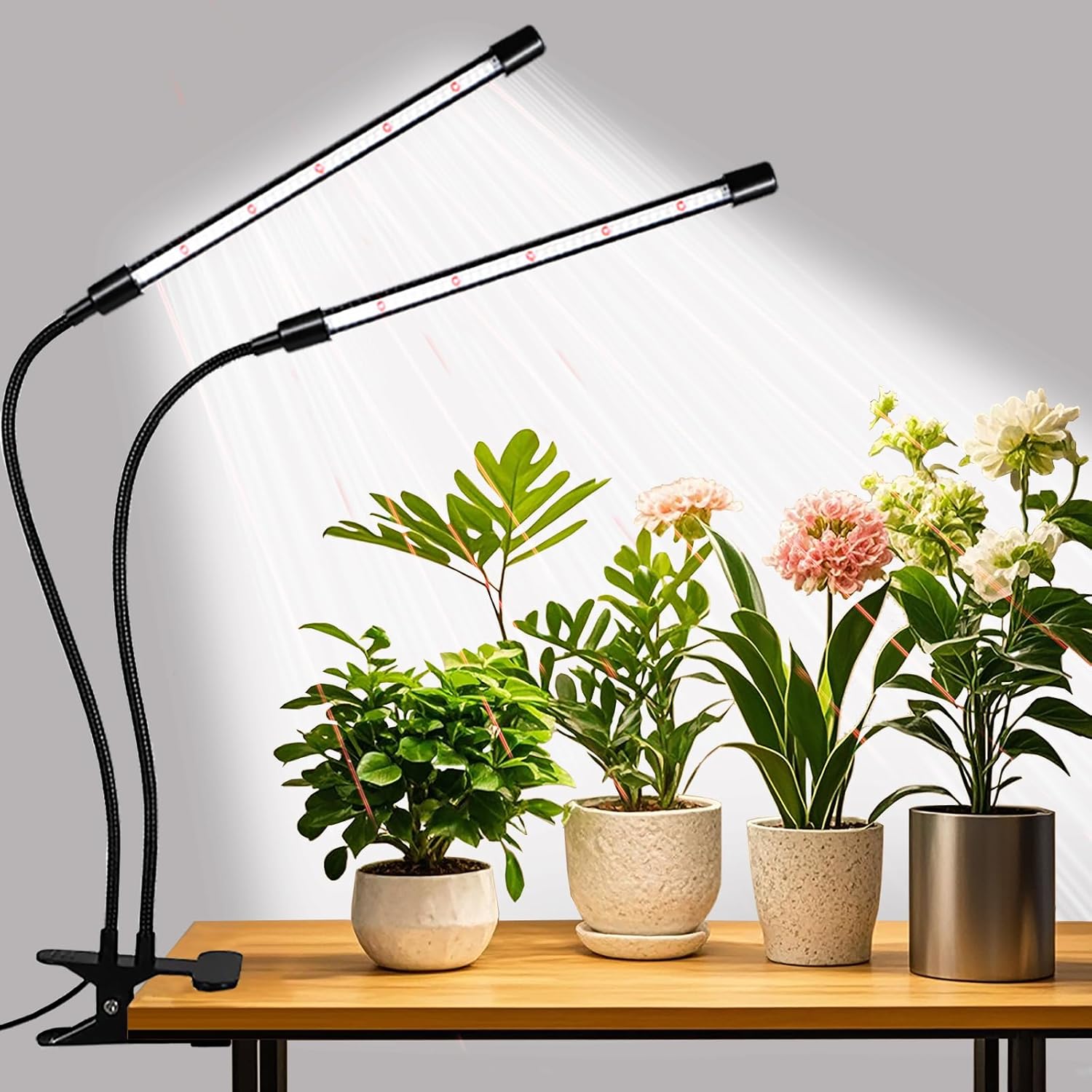
This RWNTAO two-head clip grow light supplies a full spectrum (white plus red) using 84 LEDs across two adjustable bars and is aimed at small-scale indoor growing like seedlings and potted plants. You clamp the unit to a shelf or table and position the flexible gooseneck heads to target young tomato seedlings or multiple small pots. Useful controls include 10 dimmable levels, three color modes (white, red, red+white) and a cycle memory timer with 3/9/12-hour presets so lights can run on a repeat schedule while you are away. The clamp and 360 degree goosenecks make it easy to get even coverage for a few seedlings without rigging a fixture. Practical limits are its modest LED count and single USB/5V power arrangement, which mean it is best for a small tray of seedlings rather than an entire grow rack; distance and coverage recommendations in the description should be followed for good results. Build is mainly aluminum or plastic and the clip supports thicker surfaces for stable placement.
Best for: A cost-conscious grower who needs an easy-to-use light for a few tomato seedlings or small trays and values simple timers and adjustable brightness over high-end output.
Less Ideal for: Growers planning to light large seedling batches, multiple racks, or full canopy coverage should choose a higher-output panel sized for their space.
- Full-spectrum white plus red LEDs suitable for vegetative and flowering stages
- 10 dimmable levels and 3 timer presets for hands-off, repeatable schedules
- Flexible 360° goosenecks and a strong clamp for accurate placement and stable mounting
- Designed for small setups so it will not provide sufficient coverage or intensity for large seedling flats or multiple tiers
Verdict: A budget-friendly, clamp-mounted full-spectrum LED grow light that gives tomato seedling growers simple timer and dimming controls for reliable small-scale starts.
GYTF Halo 6000K LED Full-Spectrum Plant Grow Light with Adjustable Pole and Timer

| Bulb Base | E26 |
|---|---|
| Light Source Type | LED |
| Number of Light Sources | 48 |
| Wattage | 10 watts |
| Additional Features | 4/8/12/18Hrs Timer/5-Level Dimmable |
The GYTF Halo is a small, budget-friendly grow lamp designed for indoor potted plants and seedlings. It uses 48 LEDs (36 white, 6 red, 6 blue) arranged in a circular head to deliver a 6000K full-spectrum output while drawing about 5 to 10 watts, so it runs cheaply. You mount the ring on the supplied aluminum pole, insert the pole into potting soil, then angle and height-adjust the light (about 7 to 18 inches) to focus on a single plant or a small cluster. A remote lets you choose five brightness levels and set an automatic 4/8/12/18 hour daily timer so the lamp repeats the schedule without daily intervention. The unit is corded and intended for indoor use only and is not water resistant, so placement near wet areas or outdoors is unsuitable. For small desks, shelves, or a handful of seedlings it delivers convenient, low-cost supplemental light, but it is not designed to replace larger fixtures for multiple plants or high-light crops.
Best for: People who want an inexpensive, easy-to-use supplemental light for a few indoor pots, seedlings, or a desk plant and prefer a plug-and-play solution with timer and dimming.
Less Ideal for: Growers needing wide-area coverage, lighting for multiple shelves, or a waterproof fixture for humid environments should consider larger or purpose-built LED systems.
- Full-spectrum LED array with white, red, and blue diodes tailored for plant growth
- Built-in 4/8/12/18 hour timer and five-step dimming for automated daily schedules
- Low power draw making it inexpensive to run for long periods
- Adjustable pole and 180° rotating lamp head to target light precisely
- Includes remote and necessary mounting components for quick setup
- Not water resistant so it must stay dry and indoors
- Small coverage area suitable for one or a few pots rather than larger setups
- Voltage listing and some specs are unclear compared with typical LED grow fixtures
Verdict: A very affordable, low-power full-spectrum lamp with timer and dimming that is ideal for supplementing light to a few indoor potted plants.
Sonamindary GL04 10W Full-Spectrum LED Grow Light (Single Head)

| Wattage | 10 watts |
|---|---|
| Color Temperature | 5000 Kelvin |
| Light Source | LED |
| Power Source | Corded Electric |
| Bulb Base | E26 |
The Sonamindary GL04 is a small, single-head grow light intended for desktop or shelf use where plants need a reliable supplemental light source. It delivers a 5000K full-spectrum output and claims a PPFD of about 375 μmol/m²/s at 6 inches, which is useful for seedlings, herbs, succulents, and foliage plants. The lamp uses an E26 bulb base and is corded electric with a built-in timer option, and the silicone-sleeved flexible arm makes it easy to position the beam over individual pots or grouped plants. For succulents the concentrated light and adjustable head let you direct intensity where plants stretch or need stronger light without moving pots. The light is not water resistant and is made of plastic, so it is best kept in dry indoor spots. Because it is a single-head, coverage is limited for larger collections and may require multiple units for racks or wide shelves. The GL04 is straightforward to set up and aims to give steady supplemental illumination for small indoor succulent displays.
Best for: Buyers who want a compact, dependable supplemental light for a few indoor succulents or a small shelf and who prioritize consistent, easy-to-position illumination.
Less Ideal for: Not a good fit for collectors with large plant racks or those needing waterproof fixtures for humid terrariums or greenhouse use.
- Full-spectrum 5000K LED designed for plant growth
- Flexible silicone-sleeved arm for precise positioning
- Compact desktop/table installation fits small indoor setups
- Timer feature for consistent daily light cycles
- E26 base and replaceable bulb type allow simple maintenance
- Single head limits effective coverage for multiple or large succulents
- Not water resistant so must be kept away from humidity or wettings
Verdict: A compact, easy-to-position full-spectrum LED that reliably provides focused supplemental light for small succulent collections.
GooingTop HY-021 6000K Full-Spectrum Clip Grow Light

| Power Source | Corded Electric |
|---|---|
| Color Temperature | 6000 Kelvin |
| Light Output Maximum | 2500 lumens |
| Light Source Special Features | Dimmable |
| Number of Light Sources | 84 |
This GooingTop HY-021 is a compact clip-on grow light built for small houseplants, seedlings and shelf gardens. It uses 84 LEDs (white plus deep red) to deliver a 6000K full-spectrum output intended to mimic midday sun, with a high color-rendering output that also makes it pleasant as a reading lamp. Two flexible gooseneck heads and a strong clamp let you aim light precisely over pots and seed trays, while the attached remote provides 50%/100% dim levels and repeating timers at 4, 8 or 12 hours for hands-off scheduling. Practical benefits include low power draw (listed as roughly 10 W LED draw), a claimed 1 to 2 square meter coverage for seedlings, and an included timer that simplifies day/night cycles. Limitations are its design for small setups rather than large grow racks and the clip mounting limits placement compared with freestanding fixtures. The unit also relies on the corded remote instead of a smartphone app and the lifespan claim is typical of LEDs but not independently verifiable from the listing.
Best for: Buyers who want a simple, low-power, plug-and-play grow light to boost seedlings and a few houseplants on a desk or shelf and who value an easy-to-use timer and adjustable brightness.
Less Ideal for: Growers planning multi-shelf installations, larger vegetable grows, or who need networked or app-based control should consider larger bar lights or fixtures designed for commercial racks.
- Full-spectrum 6000K output with added 660 nm red LEDs to support vegetative growth and flowering
- Attached remote with dimming (50%/100%) and repeat timer settings (4/8/12 hours) for easy scheduling
- Flexible dual goosenecks and strong clamp enable precise positioning over small pots and seed trays
- High reported color rendering for comfortable viewing and accurate plant color assessment
- Low electrical draw around 10 W while covering small growing areas
- Clip-mount design and stated 1–2 m² coverage make it better suited to individual plants or small trays rather than large multi-shelf setups
- No smart app or wireless control option; remote is cord-attached which limits placement flexibility
Verdict: A compact, easy-to-use clip grow light that delivers full-spectrum light and convenient timer/dim controls for small indoor plant setups.
Aokrean Halo Full-Spectrum LED Grow Light with Base (3-Pack)

| Number of Light Sources | 48 |
|---|---|
| Power Source | Corded Electric |
| Bulb Base | GU10 |
| Lighting Method | LED |
| Timer | 6/12/16H |
The Aokrean Halo grow light kit delivers a compact, user-friendly solution for small indoor plants and succulents. Each lamp has 48 LEDs and offers three spectrum modes (white, warm white, and red mix), five brightness levels and a 6/12/16 hour auto on/off timer so you can set daily light cycles without extra electronics. The lights can be used two ways: pushed into the soil or placed in the included ABS base under a pot, and the pole telescopes to roughly cover short to medium‑height plants. The faux wood grain finish looks more decorative than a bare plastic lamp, which helps these blend into living spaces. For succulent growers this means easy, low‑effort supplemental light with adjustable intensity and timed schedules to reduce overexposure. Limitations are its small halo size and 48 LED count per head, so it is best for single pots or small clusters rather than large trays or dense seedlings, and the base relies on the pot to stabilize the stand.
Best for: A cautious buyer who wants a simple, low‑maintenance supplemental light for a few succulents or small indoor pots and values timed schedules and adjustable intensity.
Less Ideal for: Growers who need to light large numbers of plants, long seedling trays, or taller specimens should choose a larger high‑output fixture with broader coverage.
- Full spectrum with three lighting modes to match succulent light needs
- Built‑in 6/12/16 hour timer for repeatable daily cycles without extra plugs
- Height adjustable pole and two installation methods for flexible placement
- Includes three lamps, adapters and bases so multiple pots can be lit at once
- Small lamp head and 48 LEDs limit effective coverage to individual pots or very small groupings
- Base stability depends on pot weight pressing it down, so lighter containers may wobble
Verdict: Aokrean Halo is a simple, decorative full‑spectrum grow light kit that gives risk‑averse succulent growers timed, adjustable light for individual pots without complicated setup.
Choosing the Right Grow Light for Succulents: Key Factors to Consider
Spectrum and Color Temperature
Succulents need a spectrum that supports compact growth and pigmentation rather than just foliage expansion. A spectrum with strong blue and red peaks and a balanced white component helps maintain short internodes and vibrant colors. Color temperature expressed as Kelvin and a published spectral distribution help you estimate whether the light favors vegetative growth or flowering. For practical use, lights described as full-spectrum or those listing PAR values in the 400-700nm range give the best guidance for succulent health.
Avoid fixtures that only advertise lumen output without spectral detail because lumens measure human-perceived brightness, not plant-useful photons. When choosing, consider whether you want a warmer-looking white for display or a cooler white that more closely mimics daylight and supports compact growth.
Intensity, Footprint, and Adjustable Output
How much usable light reaches the plant matters more than the lamp's raw power rating. Succulents thrive under moderate to high light; too little causes stretching, and too much can scorch. Look at the light footprint at typical hanging or shelf heights so you can see how many 2-4 inch pots will receive adequate PPFD. Adjustable intensity is valuable because it lets you tailor output for seedlings, juvenile plants, and mature specimens without changing the fixture.
Consider fixtures with dimming or multiple power modes and reflectors or lenses that shape coverage. For dense displays, wider coverage is better. For single specimens in small pots, a focused beam with adjustable height gives more control.
Heat Output and Leaf Safety
Succulents store water in leaves and stems, making them vulnerable to heat stress and sunburn when lights run close to foliage. Low heat output reduces risk and allows you to position lights nearer for higher usable intensity. Good heat management includes passive heat sinks, active ventilation with quiet fans, or efficient LED diodes that run cool.
Assess how close a fixture can safely be placed to leaves and whether the manufacturer provides clearance recommendations. If you plan to run lights for many hours daily, prioritize units that dissipate heat well to protect delicate tips and pigmented edges.
Size, Mounting, and Placement Options
Succulents are often grown on shelves, in windowsills, or in compact grow cabinets, so fixture size and mounting flexibility matter. A slim gooseneck lamp might fit a windowsill setup while multi-bar panels suit tiered shelving. Mounting hardware and included clips, hangers, or stands simplify setup and reduce the need for DIY solutions.
Also think about adjustability for height and angle so you can change light distance as plants grow. Portability matters if you rotate plants seasonally or move them to brighter natural light for part of the year.
Energy Use and Duty Cycle
Most indoor succulent growers run lights daily for 8 to 12 hours, so energy consumption adds up. Efficient LEDs that convert more electricity into plant-usable photons reduce operating cost and heat. Look for clear wattage ratings and, if provided, reported PPFD per watt to compare efficiency.
Timer compatibility and built-in scheduling can save effort and ensure consistent photoperiods. If you manage multiple fixtures, consider the cumulative power draw to avoid overloading circuits in small indoor spaces.
Ease of Use and Controls
Simple, intuitive controls make daily maintenance easier. Dimmers, timers, and programmable modes let you simulate seasonal shifts or set consistent photoperiods for propagation and growth. Physical knobs or on-fixture buttons are useful in humid greenhouse spaces where remotes can fail; integrated displays and tactile controls give reliable operation.
Think about whether you need waterproofing or dust resistance for greenhouse benches, and whether the lamp's controls are accessible once mounted in place.
Types of Grow Lights and How They Behave with Succulents
Different fixture types deliver light differently to succulents. Strip or bar-style LEDs offer even coverage over multiple small pots and work well for tiered shelves. Single-head lamps and goosenecks concentrate light for one specimen and are handy for accenting a prized rosette. Panel-style units provide the most uniform footprint for a small hobby bench or a desktop greenhouse.
In practice, LED fixtures are favored for succulents because they run cooler and offer spectral tuning. Fluorescent tubes can still be useful for lower-intensity needs and propagation, but they are bulkier and less energy efficient. High-intensity horticultural lamps are unnecessary for most succulent collections and can increase heat risk.
- Bar LEDs: even coverage, good for multiple pots
- Panel LEDs: uniform footprint for benches
- Single-head lamps: focused light for specimens
- Fluorescent: lower intensity, bulkier setup
Setting Light Schedules and Avoiding Stress
Succulents generally perform well on a consistent daily cycle that mimics natural daylength. Many growers use 8 to 12 hours of artificial light depending on the species and ambient natural light. Shorter photoperiods can encourage compactness in some genera, while longer light periods support faster growth during the active season.
Avoid sudden changes in intensity or photoperiod. When introducing stronger artificial light, raise the fixture a bit and gradually move it closer over a week to let plants acclimate. Watch for signs of stress such as bleached patches, shriveling, or elongated growth and adjust schedule or distance accordingly.
- Start with 8-10 hours daily for most rosettes
- Increase gradually when shifting from natural light
- Monitor for bleaching and adjust distance
Placement Tips for Small Displays and Windowsills
Placement affects how much natural light succulents receive in addition to your grow light. For windowsills with ample sun, a low-output lamp used as a supplement can prevent afternoon heat build-up. For shelves that receive little daylight, position fixtures so the brightest portion of the footprint falls on the most light-hungry plants.
Keep airflow in mind; stagnant air plus artificial heat can encourage pests and rot. Leave small gaps between pots and avoid stacking leaves directly under reflectors. For multi-level shelving, stagger lights so upper fixtures do not shadow lower ones.
- Use supplemental lights near bright windows rather than high-powered fixtures
- Stagger shelves to prevent shadowing
- Ensure adequate airflow around fixtures
Propagation and Seedlings Under Artificial Light
Young succulent cuttings and seedlings benefit from gentler light with close placement. Lower intensity with a higher blue component supports sturdier root and leaf development. Consider fixtures with adjustable intensity or a propagation mode to reduce stress while roots form.
Keep propagation trays shallow to maintain consistent distance from the light. A small fan on low can improve humidity control and reduce fungal risk without drying out cuttings too quickly.
- Use softer, closer light for cuttings
- Favor higher blue spectrum during rooting
- Provide gentle airflow to reduce fungal issues
Maintenance and Long-Term Care of Fixtures
Regular maintenance extends fixture life and keeps output consistent. Dust and grime reduce usable light, so wipe lenses, reflectors, and LED bars periodically. Check ventilation openings and fans for lint build-up to maintain heat management.
Replace or service fixtures if you notice dimming or color shifts. Track total hours of use if the manufacturer provides a rated lifespan, and plan for replacements or upgrades before intensity drops significantly.
- Clean lenses and reflectors every few months
- Inspect fans and vents for dust
- Monitor light output and color for signs of aging
How We Chose the Best Grow Light for Succulents
We selected lights that are appropriate for succulent culture and small cacti work by applying a consistent set of editorial filters. Primary evaluation focused on spectral quality and usable photosynthetic photon flux in the wavelengths succulents use for compact growth. Heat control and fixture ventilation were required because succulents tolerate bright light but not sustained high leaf temperatures. Third, we checked light footprint and adjustable intensity so a single unit can handle a cluster of small pots or an individual specimen. Energy efficiency and runtime options mattered for indoor growers who run lights daily. Ease of mounting, included hardware, and simple controls were final filters to ensure real-world usability. We excluded units designed exclusively for large-scale greenhouse rows, high-intensity horticultural fixtures that require professional wiring, and lamps with little spectral information. The result is a selection of versatile, low-heat, spectrum-balanced grow lights suitable for succulents in home and small greenhouse settings.
FAQ
How many hours of light do succulents need under a grow light?
Most succulents do well with 8 to 12 hours of daily light under artificial sources. Species and ambient natural light affect the exact need, so start in that range and adjust based on growth and leaf color.
How far should a grow light be from succulent leaves?
Distance depends on fixture intensity. Low-output lamps can be a few inches away while more powerful panels should be 12 inches or more. Raise the light initially and move it closer over several days while watching for bleaching or heat stress.
Can I use a regular LED shop light for succulents?
A regular LED can provide brightness but may lack the spectral balance succulents need for compact growth. If using a general LED, choose fixtures with a cooler color temperature and provide sufficient intensity while monitoring plant form.
Do succulents need a different spectrum for propagation versus mature growth?
Propagation often benefits from a slightly higher blue component to encourage root and compact leaf development. Mature plants can tolerate a broader spectrum with more red for flowering and pigmentation.
Will artificial light change the color of my succulents?
Yes. Spectrum and intensity influence pigmentation. Increased intensity and a balanced spectrum can enhance reds and purples, while low light tends to wash out color and cause stretching.
Is heat from grow lights harmful to succulents?
Excessive heat can cause leaf scorch and dehydration. Choose low-heat fixtures or ensure adequate distance and ventilation. Run times and fixture placement both influence leaf temperature.
Final Verdict
When choosing a grow light for succulents, prioritize spectral quality, adjustable intensity, and low heat output. Those three tradeoffs determine whether plants stay compact, colorful, and stress-free under artificial lighting. Consider fixture size and mounting options to match your display, and factor in energy use if you run lights daily. With the right balance of spectrum and placement, you can reproduce bright, controlled light that keeps succulents healthy and attractive.
