

Note: This article contains affiliate links. If you click on these links and make a purchase, I may earn a small commission at no extra cost to you. This helps support my research and content. Read my full affiliate disclosure here.
If you grow or maintain zoysia turf you know weeds can quickly undermine appearance and vigor. Selecting the right herbicide for zoysia grass matters because some chemistries injure zoysia while others leave tough grassy or broadleaf weeds untouched. This guide shortlists six top-rated herbicide options chosen for common zoysia situations, from spot treatments to larger lawn applications. We evaluate products on turf safety, weed-spectrum control, and ease of application so you can match a choice to your lawn goals. Read on for practical notes that help you decide which approach fits your maintenance plan.
Top Picks at a Glance
| Best Overall The best all-around choice for most situations | Syngenta Recognition Herbicide 0.45 oz Water-Dispersible Granules |  |
| Best Quality Built to a higher standard if you want something more solid | BASF Drive XLR8 Crabgrass Killer Concentrate, 64 oz |  |
| Best Budget The cheapest option that still gets the job done reliably | Image Weed Killer for Southern Lawns Ready-to-Spray, 32 fl oz |  |
| Highest Rated A top-rated pick with lots of positive feedback | SEDGEHAMMER Nutsedge Herbicide, 1.33 oz concentrate (2-pack) |  |
| Most Popular A crowd favorite that many people choose with confidence | Celsius WG Granular Herbicide 2-Pack |  |
Syngenta Recognition Herbicide 0.45 oz Water-Dispersible Granules

| Item Form | Granule |
|---|---|
| Coverage | Selective weed coverage (sedges, grasses, broadleaf weeds) |
| Liquid Volume | 0.45 fluid ounces |
Syngenta Recognition is a water-dispersible granular herbicide designed for post-emergent weed control on warm-season turf such as St. Augustinegrass, zoysiagrass, kikuyugrass and buffalograss. It is applied at low rates per acre and can be tank-mixed with other turf herbicides like Turflon Ester Ultra to broaden activity against difficult broadleaf weeds. The product highlights a proprietary safener that improves turf safety, which is particularly useful when treating sensitive St. Augustine lawns or when mixing with Fusilade II to remove bermudagrass selectively. In practice, Recognition delivers targeted control of sedges including nutsedge, kyllinga, and common broadleaf invaders when used according to label directions. Practical benefits include reliable selectivity and compatibility with common turf tank mixes, reducing the need for repeated spot treatments. Limitations are that it is a professional-strength concentrate requiring careful measurement and adherence to application rates and restrictions, and it addresses a specific weed spectrum so additional products may be needed for complete seasonal control of all lawn weeds.
Best for: Buyers who prioritize consistent, professional-grade control on St. Augustine and other warm-season grasses and who are comfortable following label rates and tank-mix practices.
Less Ideal for: Homeowners seeking a ready-to-use, one-product solution or those uncomfortable mixing concentrated professional herbicides should consider simpler consumer products or hire a licensed applicator.
- Formulated for strong selective control of sedges, grasses, and broadleaf weeds in warm-season turf
- Includes a safener for improved turf safety on sensitive species like St. Augustinegrass
- Low application rate per acre makes it economical for larger lawns or professional use
- Compatible with common turf herbicides for tank-mix flexibility and broader weed control
- Requires precise measuring and following label directions due to concentrated formulation
- Not a one-step solution for every lawn weed species and may need complementary products
Verdict: Choose Recognition when you need a reliable, turf-safe post-emergent herbicide for targeted control of sedges and common broadleaf weeds in St. Augustine and other warm-season lawns.
BASF Drive XLR8 Crabgrass Killer Concentrate, 64 oz
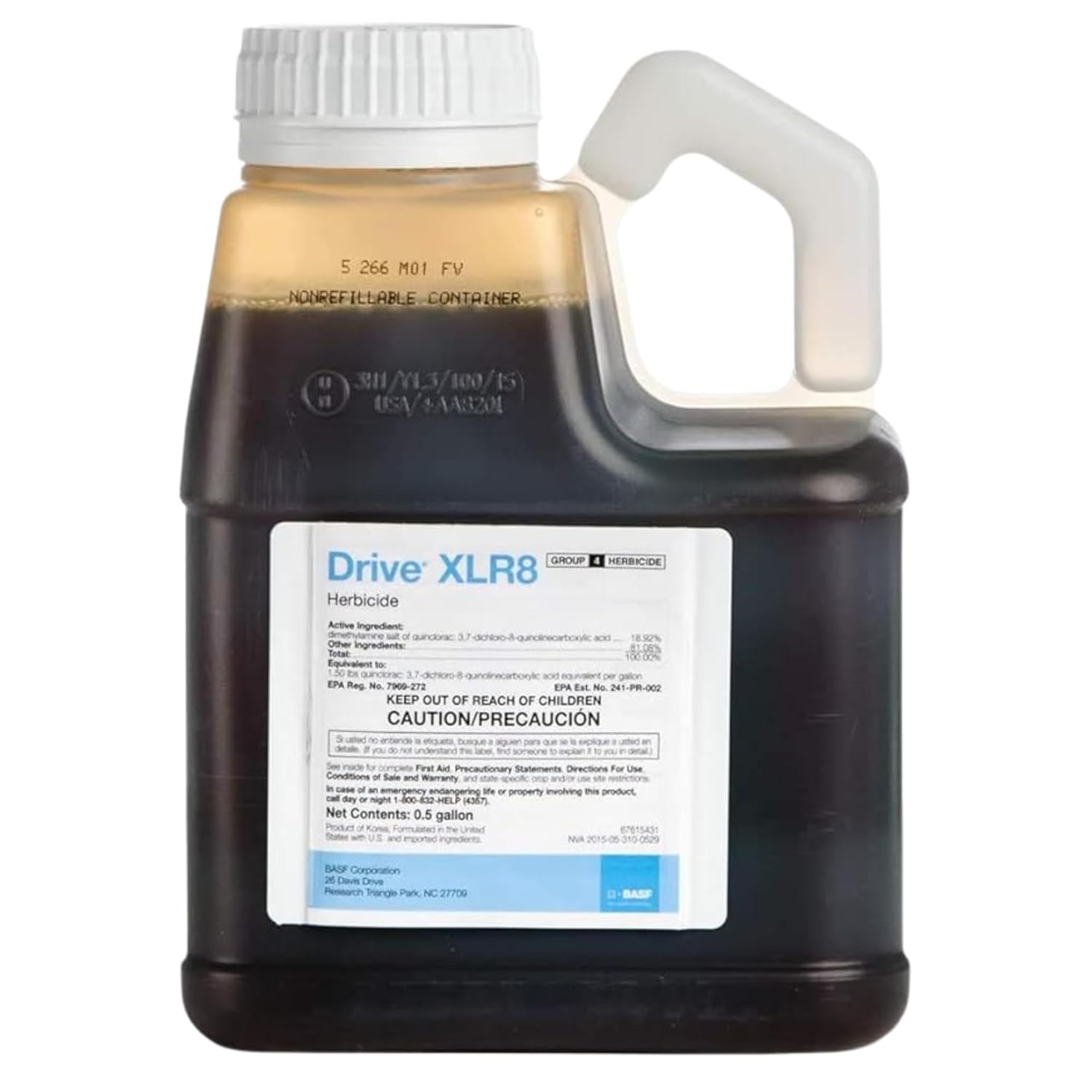
| Unit Count | 64 Ounce |
|---|---|
| Item Form | Liquid |
| Active Ingredients | Quinclorac 18.92% |
| Coverage | Full |
Drive XLR8 is a concentrated liquid herbicide built mainly to knock down crabgrass and other grassy and broadleaf weeds in turf. You mix a small measured amount with water and a methylated seed oil adjuvant and spray over the turf for spot or broadcast treatment. Its water-based formulation and quinclorac active ingredient deliver relatively fast uptake and labeled rainfast protection within about an hour, and the product advertises up to 30 days of residual control, which reduces how often you need to reapply. It is labeled for both warm- and cool-season turf and can be tank-mixed with other turf herbicides when label directions allow, giving flexibility for complicated weed problems. Important limitations are that it is a chemical herbicide that requires careful PPE and strict adherence to label directions, and some local restrictions apply, including reduced use patterns in certain states and spot-application limits. For gardeners who follow the label, it offers reliable, professional-strength control of crabgrass and many common lawn weeds.
Best for: Homeowners and groundskeepers who want a strong, professional-style postemergent solution to quickly reduce crabgrass and mixed weed populations and who are comfortable following label safety and application steps.
Less Ideal for: People seeking an organic or nonchemical approach to crabgrass control or users who prefer no-handling of concentrated herbicides should consider alternative cultural or nonchemical options.
- Concentrated 64 oz formula covers large areas when mixed per label directions
- Water-based formulation for faster plant uptake and rainfast protection in under an hour
- Provides up to 30 days of residual control against crabgrass and several grassy weeds
- Labeled for use on both warm-season and cool-season turf and compatible with some tank mixes
- Requires careful handling and PPE because it is a chemical herbicide
- Some state-specific use restrictions and label limitations apply
Verdict: Choose Drive XLR8 when you want a concentrated, fast-acting postemergent herbicide that delivers reliable crabgrass control and multi-week residual protection.
Image Weed Killer for Southern Lawns Ready-to-Spray, 32 fl oz

| Item Form | Liquid |
|---|---|
| Coverage | 5,000 sq. ft |
| Unit Count | 32 Fluid Ounces |
| Active Ingredients | Penoxsulam & Sulfentrazone |
This ready-to-spray Image weed killer connects to a garden hose for quick coverage of a typical yard and is formulated specifically for southern lawns, including Zoysia. It targets broadleaf weeds such as dandelion, chickweed, and clover and starts showing results within hours while being labeled as safe for southern turf when used as directed. The 32-ounce bottle covers up to 5,000 square feet, making it convenient for homeowners who want a single-step spray solution instead of mixing concentrates. Practical benefits include easy hose-end application, a fast-acting formula, and active ingredients designed to control tough weeds down to the root. Limitations are that it is a broadleaf herbicide, so it will not control grassy weeds and requires following temperature and safety instructions exactly to avoid turf damage or contact with people and pets. For spot treatments or small lawns the hose connection may waste product compared with a targeted sprayer, and repeat applications may be necessary for persistent infestations.
Best for: Homeowners with southern lawns who want a low-effort, budget-friendly way to knock back broadleaf weeds across medium to large yards and prefer a hose-end product over mixing concentrates.
Less Ideal for: Gardeners needing selective control of grassy weeds, those with very small lawns who want to minimize product use, or users who prefer spot treatment with a hand sprayer.
- Ready-to-spray hose-end design for fast, no-mixing application
- Formulated for southern turf including Zoysia, Bermudagrass, St. Augustine, and Centipedegrass
- Covers up to 5,000 sq. ft. from a single bottle
- Fast-acting formula that visibly reduces broadleaf weeds within hours
- Does not control grassy weeds or grassy weed species
- Requires careful application and adherence to temperature and safety directions to avoid damage or exposure
Verdict: A convenient, ready-to-spray herbicide designed to quickly reduce broadleaf weeds in Zoysia and other southern lawns with minimal fuss.
SEDGEHAMMER Nutsedge Herbicide, 1.33 oz concentrate (2-pack)

| Unit Count | 1.3 Ounce |
|---|---|
| Active Ingredient | 75% halosulfuron-methyl |
| Use Rate | 0.9 g per 1,000 sq ft |
| Coverage per Bottle | ≈40 gallons of spray |
Sedgehammer is a concentrated post‑emergent herbicide built to target nutsedge down to its tubers and nutlets, which helps prevent regrowth that often plagues warm‑season lawns like Zoysia. The product is a water dispersible granule with 75% halosulfuron‑methyl; you mix a measured 0.9 g scoop into a gallon of water plus a non‑ionic surfactant and spray actively growing nutsedge at the 3–8 leaf stage. Leaves usually yellow within 10–14 days and the plant dies in about three to four weeks, and one bottle makes roughly 40 gallons of spray for larger areas. It is labeled for use on many turf types, including Zoysia, and is suitable for lawns, sports fields and sod farms when used as directed. Practical benefits include a very low use rate and effectiveness on below‑ground nutlets, making it a good fit for repeat offenders. Important limitations are the need to buy a compatible surfactant separately, care to avoid desirable plants, and adherence to timing and reapplication intervals for heavy infestations.
Best for: Homeowners and turf managers who prioritize reliable, long‑term nutsedge control on established Zoysia lawns and need a concentrated product that covers large areas with few applications.
Less Ideal for: Gardeners who need an all‑purpose weed control for flower beds or vegetable gardens or who prefer ready‑to‑use sprays that do not require mixing or added surfactant.
- Targets nutsedge tubers and nutlets for longer‑lasting control
- Very low use rate makes a small bottle treat large turf areas
- Selective on established warm‑season grasses including Zoysia when used as labeled
- Fast visible effects with leaf yellowing in 10–14 days and full results in about 3–4 weeks
- Requires a separate non‑ionic surfactant to be effective
- Can injure desirable plants if spray contacts their foliage
Verdict: If you need a concentrated, reliable treatment that reaches nutsedge tubers and suits established Zoysia turf, this product delivers focused, long‑lasting control.
Celsius WG Granular Herbicide 2-Pack

| Item Form | Granule |
|---|---|
| Item Highlight | Full Season Southern Lawn Weed Control | Safe on St. Augustine, Bermuda & Zoysia | Covers 4,000 sq ft | Kills 120+ Weeds |
| Manufacturer | Envu |
| Brand | Bug And Blade |
Celsius WG is a granular, two-treatment weed control system designed specifically for warm-season lawns like zoysia. The kit supplies two packets intended for a spring and a late-summer or fall application to cover up to 4,000 sq ft, and the triple-mode active ingredient mix is intended to attack weeds with three independent mechanisms to reduce resistance. In use you broadcast the granules when weeds are actively growing and above about 60°F; weeds stop growing within hours, yellowing appears in 1–2 weeks, and full control typically follows in 1–4 weeks. The product includes laminated weed ID cards to help you target common problem species and notes the lawn is safe for family and pets once the granules have dried. Limitations are that it is formulated only for warm-season turf and must be applied according to the label timing and rates for safe turf tolerance and effective results, and persistent perennials may need a follow-up application.
Best for: Homeowners or lawn-care-minded users with zoysia or other warm-season turf who prioritize effective, season-long weed control and want a planned two-application program.
Less Ideal for: Those managing cool-season lawns or users who need an all-purpose herbicide for mixed grass types should consider alternatives labeled for their turf.
- Two-packet system covers a full season with spring and season-ending treatments
- Formulated for safe use on zoysia and other warm-season turfgrasses
- Triple-mode-of-action formula helps control weeds with resistance to single-mode herbicides
- Includes laminated weed ID cards to simplify identification and timing
- Not labelled for cool-season grasses so it cannot be used on lawns like fescue or bluegrass
- May require a second follow-up application for stubborn perennial weeds
Verdict: If you need a targeted, season-long program for zoysia and other warm-season lawns, this two-pack granular system delivers reliable, resistance-minded weed control.
Choosing the Right Herbicide for Zoysia Grass: Key Factors to Consider
Turf Safety and Label Guidance
Zoysia is sensitive to some selective herbicides and tolerant of others. Always check the product label for explicit instructions for zoysia turf, including allowable application rates, recommended growth stage for the grass, and any temperature restrictions. Using a product not labeled for zoysia risks thinning, discoloration, or patching that can take months to repair.
Label guidance also spells out required wait times before overseeding or reseeding and any restrictions on mowing or irrigation after application. For homeowners, selecting a herbicide with clear zoysia directions reduces the chance of accidental damage and simplifies follow-up care.
Weed Spectrum and Identification
Different herbicides control different groups of weeds. Some target broadleaf species such as clover and dandelion while others are effective against annual grassy weeds or certain perennial grasses. Identifying the primary weeds in your zoysia lawn helps determine whether you need a broadleaf-only product, a grass-targeting option, or a combination approach.
Misidentifying weeds can lead to repeated applications with little benefit and increased turf stress. Choose a product whose active ingredient list and labeled control spectrum match the common weeds present in your yard for the most efficient control.
Timing and Turf Condition
Herbicide effectiveness and turf safety depend heavily on timing. Apply selective treatments when weeds are actively growing and zoysia is not under stress from drought, extreme heat, or recent fertilization spikes. Post-emergent products work best on young, actively growing weeds; pre-emergent options prevent seed germination and are distinct in timing and purpose.
Avoid treating during peak summer stress on zoysia or immediately after mechanical damage. Proper timing reduces scorch risk and improves long-term control, making treatments more predictable and less likely to require corrective measures.
Application Method and Coverage
How you apply a herbicide affects safety and performance. Spot treatments allow concentrated control of isolated patches and limit exposure to the surrounding turf, while broadcast applications are suited to widespread infestations but demand precise calibration and uniform coverage.
Consider nozzle selection, spray volume, and overlap to avoid streaking or missed areas. For homeowners, using a handheld sprayer for spots and a walk-behind sprayer or hose-end applicator for larger areas can provide the right balance of accuracy and efficiency.
Residual Activity and Follow-Up
Some herbicides offer residual control that suppresses weed emergence for weeks to months, while others have little to no residual effect and rely on repeat treatments. Residual activity can reduce the need for frequent reapplication but may also delay overseeding or repair work.
Understand how long a product remains active in the soil and how that fits your lawn management calendar. Plan follow-up mowing, irrigation, and any renovation tasks around the expected residual window to avoid interfering with turf health or violating label restrictions.
Environmental and Safety Considerations
Herbicides vary in their environmental persistence, off-target movement risk, and safety precautions. Choose products with application requirements that match your site, especially if you have nearby ornamental beds, vegetable gardens, or water features. Buffer zones and wind conditions matter for reducing drift onto desirable plants.
Always follow personal protective equipment recommendations and storage/disposal instructions. Minimizing runoff and respecting labeled buffer distances protects non-target plants, pets, and beneficial insects while keeping your use compliant.
Deciding Between Pre-emergent and Post-emergent Options
Pre-emergent herbicides form a barrier that prevents weed seeds from germinating and are most useful for annual grassy weeds and crabgrass prevention. They must be applied before the target weed seeds germinate, so timing is tied to soil temperatures and local climate patterns.
Post-emergent products treat actively growing weeds and are necessary for established broadleaf or perennial grassy weeds. For zoysia, choose post-emergent chemistries labeled for turf use and apply when weeds are small and actively growing to improve control and reduce turf stress.
- Use pre-emergents in spring and fall according to local germination windows.
- Reserve post-emergents for visible infestations and spot control when possible.
Spot Treatment Techniques for Isolated Weeds
Spot treatments concentrate herbicide on visible weeds, limiting exposure of the surrounding zoysia. For small patches, use a spray bottle or a wand with a low-pressure nozzle and apply during calm weather to minimize drift.
For persistent patches, treat once and monitor for regrowth before repeating. Repeated high-rate spot applications can increase risk to nearby turf, so consider mechanical removal or targeted cultural corrections if chemical control fails.
- Apply on calm, cool mornings for best uptake.
- Avoid mowing for 24 to 48 hours after spot applications when labels recommend it.
Managing Tough Perennial Weeds in Zoysia
Perennial weeds with deep roots or rhizomes often require more than one strategy. A targeted herbicide can weaken perennial weeds over several applications, but combine chemical control with hand removal of mature crowns when possible.
Improving turf density through proper fertilization, irrigation, and mowing height reduces space for perennials to re-establish. Thicker, healthier zoysia makes herbicide control more successful and reduces the need for aggressive chemical programs.
- Cut back large weed growth before treatment to improve herbicide contact with actively growing tissue.
- Schedule follow-up checks at 2 to 6 weeks after treatment to assess effectiveness.
Safety Steps Around Ornamentals and Water
Maintain buffer zones between treated turf and ornamental beds or water features to prevent off-target damage and runoff. Where possible, wet down nearby hard surfaces and cover delicate plants during application to catch overspray.
Follow label directions for setbacks and avoid treating before heavy rain to reduce the chance of chemical transport. If working near storm drains or natural water bodies, use the lowest effective rate and adhere strictly to safety precautions.
- Avoid application on windy days or before expected heavy rain.
- Store and dispose of leftover mixtures according to label instructions.
Integrating Herbicide Use Into a Cultural Program
Herbicides are most effective when combined with cultural practices that favor zoysia. Proper fertilization, irrigation, and mowing at the recommended height improve turf density and shade out weeds. Aeration and overseeding where appropriate can fill thin patches that invite weed colonization.
Use herbicides selectively and as one tool in a seasonal maintenance plan. Overreliance on chemicals without addressing underlying turf weaknesses often leads to recurring problems and increased chemical use over time.
- Mow at the recommended height for zoysia to promote lateral spread and thicker sod.
- Address compacted areas and thin patches before relying on chemical control alone.
How We Chose the Best Herbicide for Zoysia Grass
We focused on safety and predictable results in zoysia turf, prioritizing formulations and application patterns that minimize risk of grass injury while controlling the weeds zoysia owners most often face. Our selection filters included documented turf tolerance to zoysia, label guidance for zoysia lawns, and real-world suitability for both spot and broadcast applications. Evaluation criteria emphasized turf safety on established zoysia, the breadth of weed control (broadleaf and grassy weeds), residual activity and regrowth suppression, and application practicality such as mixing, spray coverage, and re-entry intervals. We also considered formulation flexibility for different scales of treatment and compatibility with normal lawn care tasks like mowing and irrigation. Exclusions included products without explicit zoysia labeling, experimental chemistries lacking turf-use data, and general garden weed killers not rated for lawn use. The result is a set of options that balance effectiveness with conservative turf protection for common homeowner and professional zoysia scenarios.
FAQ
Can I use a general lawn weed killer on zoysia grass?
It depends. Some general lawn herbicides are labeled for zoysia, while others are not. Always read the product label for zoysia-specific guidance because using an unlabeled product can damage the turf.
When is the best time to apply herbicide to control crabgrass in zoysia?
For crabgrass prevention, apply pre-emergent treatments before soil temperatures trigger seed germination, typically in early spring. For existing crabgrass, use post-emergent options when the plants are young and actively growing for better control.
Will spot-treating harm nearby zoysia turf?
Spot treatment minimizes exposure but still carries some risk if applied too heavily or in hot, stressed conditions. Use low-pressure spray, avoid overapplication, and follow label rates to reduce the chance of turf injury.
How soon can I mow after applying a herbicide to zoysia?
Mowing timing varies by product. Many labels recommend waiting 24 to 48 hours after application, while some require longer intervals. Check the label to avoid removing treated leaf tissue before the herbicide is absorbed.
Can I overseed zoysia after using a herbicide?
That depends on the herbicide's residual activity. Some products prevent seed germination for weeks to months, which will interfere with overseeding. Review label restrictions and wait the recommended interval before reseeding.
Final Verdict
Prioritize turf safety and the specific weeds you need to control when choosing a herbicide for zoysia grass. Match timing, application method, and residual expectations to your lawn management calendar and use spot treatments whenever possible to limit turf exposure. Combining selective herbicide use with cultural practices like proper mowing, watering, and fertilization produces the most reliable long-term results and reduces repeat chemical reliance.
