

Note: This article contains affiliate links. If you click on these links and make a purchase, I may earn a small commission at no extra cost to you. This helps support my research and content. Read my full affiliate disclosure here.
Picking the right fertilizer for peonies in spring matters because these plants set buds and build the energy they need for a full season of blooms. The wrong feeding approach can encourage weak stems, excessive foliage, or poor flower set. This guide covers seven shortlisted fertilizers selected for their nutrient profiles, feeding methods, and suitability for established peony clumps and newly planted roots. You will find practical notes on application timing, how nutrients affect bloom development, and which formats fit different gardening styles. Read on to see how each option measures up against the key criteria gardeners care about.
Top Picks at a Glance
| Best Overall The best all-around choice for most situations | Miracle-Gro Water Soluble Bloom Booster Flower Food, 5.5 lb |  |
| Best Quality Built to a higher standard if you want something more solid | FoxFarm Tiger Bloom Liquid Plant Food (1 pint) |  |
| Best Value The sweet spot between price and what you get | Scotts All Purpose Flower & Vegetable Continuous Release Plant Food, 3 lb |  |
| Best Budget The cheapest option that still gets the job done reliably | Jobe's Organics Flowering Plant Fertilizer Spikes, 10-10-4, 100 Count (2-Pack) |  |
| Highest Rated A top-rated pick with lots of positive feedback | Miracle-Gro Water Soluble Bloom Booster Flower Food, 10-52-10, 1 lb |  |
| Most Popular A crowd favorite that many people choose with confidence | Miracle-Gro Water Soluble All Purpose Plant Food, 1.5 lb |  |
| Best Seller A high-volume bestseller chosen again and again | Miracle-Gro Shake 'N Feed Rose & Bloom Plant Food, 4.5 lb |  |
Miracle-Gro Water Soluble Bloom Booster Flower Food, 5.5 lb

| Item Form | Powder |
|---|---|
| Application Method | Mix with water |
| Target Species | Flower |
| Mixing Ratio | 1:Water |
Miracle‑Gro Water Soluble Bloom Booster is a powdered, water‑mix fertilizer designed to be dissolved and applied every 7 to 14 days to flowering plants. It carries a high middle number NPK (10‑52‑10) so it delivers an extra boost of phosphorus to encourage bud set and larger blooms, and it can be used for in‑ground beds, containers and indoor flowering plants when diluted to the package directions. The included mixing guidance and scoop make it straightforward to dose for small containers or larger garden areas, and one 5.5 lb container covers a substantial area. Practical benefits include fast uptake when watered in at the base of plants and compatibility with common feeders or a watering can. Limitations are that the concentrated phosphorus focus is for flowering performance rather than overall foliage growth and it requires regular reapplication through the blooming season rather than a single slow‑release feed. Also users should follow safety directions when handling and avoid overfeeding sensitive or newly transplanted plants.
Best for: Gardeners who prioritize showy, frequent blooms and want a product they can apply regularly to flower beds and containers during the flowering season.
Less Ideal for: People looking for an all‑season, low‑maintenance slow‑release fertilizer or those who need a balanced feed for foliage and establishment of new transplants.
- High phosphorus NPK (10-52-10) targets bud set and bloom production
- Water‑soluble powder mixes quickly for fast feeding and easy use in a watering can or garden feeder
- Suitable for both in‑ground beds and container flowering plants including roses and hydrangeas
- Covers a large area from a single 5.5 lb container when used to label directions
- Requires frequent applications during bloom period rather than providing long‑term slow release
- Formulation focuses on flowering so it is less balanced for leafy growth or general maintenance
Verdict: Choose this bloom booster if your goal is bigger, more frequent flowers by feeding a high‑phosphorus, fast‑acting soluble fertilizer during bloom season.
FoxFarm Tiger Bloom Liquid Plant Food (1 pint)
| Item Form | Liquid |
|---|---|
| Specific Uses For Product | Hydroponic |
| Application Method | Watering; Foliar spraying |
| Target Species | Flowering Plants |
| Mixing Ratio | 1:200 or 1:300 |
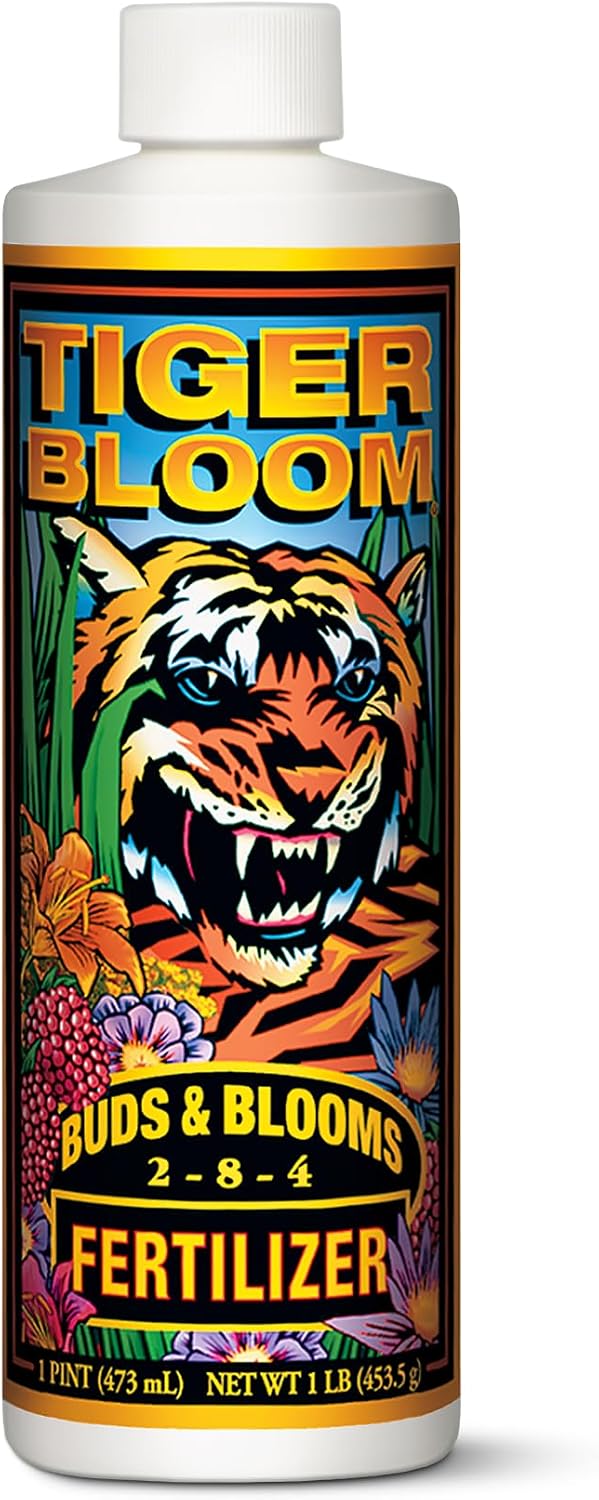
Tiger Bloom is a liquid, high-phosphorus fertilizer designed to push plants into a strong flowering and fruiting phase. You mix a small amount into the irrigation water or use it as a foliar spray and apply from first signs of flowering through harvest. The 2-8-4 formula and included micronutrients support bud set and larger blooms, and the concentrate mixes at 1:200 to 1:300 for routine feeding or 2 to 4 teaspoons per gallon for heavier feeding. It works in both soil and hydroponic setups and is formulated for quick nutrient uptake and stable micronutrient availability during storage. Practical benefits include flexible application methods, suitability for intensive flowering cycles, and a small bottle that lasts when used at recommended dilutions. Important limitations are that it is bloom-focused rather than an all-purpose feed so it may not meet vegetative needs, and the phosphorus content means users near waterways should follow local regulations to avoid runoff issues.
Best for: Serious growers who prioritize maximizing flower and bloom performance and want a concentrated, fast-acting bloom booster for soil or hydroponic environments.
Less Ideal for: Casual gardeners seeking a single all-purpose fertilizer for every growth stage or those managing turf or non-flowering lawns where phosphorus restrictions apply.
- High phosphorus NPK (2-8-4) concentrated for stronger bud development
- Works in soil and hydroponic systems for versatile use
- Liquid concentrate mixes easily for foliar or watering applications
- Formulated for quick nutrient uptake and stable micronutrient availability
- Focused on flowering so it is not a balanced all-stage fertilizer
- Contains phosphorus which may be restricted near waterways
Verdict: Choose Tiger Bloom when you need a concentrated, fast-acting bloom booster to maximize flower and fruit production.
Scotts All Purpose Flower & Vegetable Continuous Release Plant Food, 3 lb

| Item Form | Granules |
|---|---|
| Application Method | Sprinkle on soil and rake into top 1-3 inches |
| Target Species | All Purpose Flower & Vegetable Continuous Release Plant Food |
| Unit Count | 48 Ounce |
Scotts All Purpose Flower & Vegetable Continuous Release Plant Food is a simple granular fertilizer intended for in-ground flower and vegetable gardens. You apply it by sprinkling the granules around plants, raking them into the top 1 to 3 inches of soil, and watering to start nutrient release. Formulated to feed for up to two months, it supplies steady nitrogen to support root growth and foliage and is recommended for common garden crops including peppers. The bag covers roughly 150 sq. ft., so a single 3 lb package is convenient for small beds or a few pepper plants. Key practical benefits are ease of use, predictable feeding intervals, and reduced need for frequent applications during the growing season. Limitations are that it is an all-purpose formula rather than a pepper-specific mix and its N-P-K profile is not listed on the label data here, so you may want to monitor fruiting and supplement with a bloom-boost fertilizer if you need higher phosphorus for heavy fruit set. Follow label rates to avoid overapplication near crowns.
Best for: Gardeners who want an inexpensive, low-effort fertilizer to maintain steady growth for a few jalapeno plants or a small vegetable bed without frequent feeding.
Less Ideal for: Growers who manage large vegetable plots or who need a nutrient program tailored specifically to maximize pepper fruit set and yield.
- Continuous-release granules feed plants for up to two months, reducing application frequency
- Easy application: sprinkle, rake into topsoil, and water
- Suitable for a wide range of garden plants including vegetables and peppers
- 3 lb bag covers about 150 sq. ft., practical for small gardens or container groups
- All-purpose formula may not provide the specific N-P-K balance jalapenos need for maximum fruiting
- Small bag size means frequent repurchases for larger gardens
Verdict: A budget-friendly, easy-to-use continuous-release fertilizer that keeps jalapeno plants fed for up to two months with minimal fuss.
Jobe's Organics Flowering Plant Fertilizer Spikes, 10-10-4, 100 Count (2-Pack)

| Application Method | Insert into soil |
|---|---|
| Target Species | flowering plants |
| Item Form | Granules, Liquid, Sticks |
| Mixing Ratio | 10-10-4 |
| Number of Items | 100 |
Jobe's Organics flowering spikes are premeasured slow-release sticks designed to feed flowering plants without mixing or measuring. You insert spikes into the root zone of potted plants, garden beds, or shrubs and water; each spike releases a 10-10-4 balance of nutrients over roughly eight weeks to support blooms and steady growth. The package contains 100 spikes (two packs) so you can treat many plants across spring and summer without frequent reapplication. Practical benefits include simple, low-mess application, targeted delivery at the root zone, and convenience for gardeners who prefer set-and-forget feeding. Because the formula is moderate (equal N and P with lower K), it helps peonies produce flowers without excessive leafy growth when used as directed in spring. Limitations are that spikes provide uniform dosing that cannot be fine-tuned for individual plants and they are less useful for large established beds where broadcast granular fertilizer or soil amendment may be more efficient to treat many plants at once.
Best for: Gardeners who want an inexpensive, low-effort way to feed spring-flowering plants like peonies and prefer straightforward, scheduled feeding over custom nutrient programs.
Less Ideal for: Those managing large perennial beds or who need to correct specific soil nutrient deficiencies where bulk granular fertilizer or soil amendments would be more practical.
- Premeasured spikes for no-mess, easy application
- Slow-release formula feeds plants for up to eight weeks
- Large count (100 spikes) covers many pots and beds across the season
- Fixed nutrient ratio and dose per spike limit precise adjustments for individual plants or soil tests
- Not the most efficient for treating very large beds compared with bulk granular products
Verdict: A budget-friendly, low-effort way to give peonies steady bloom-focused nutrition throughout spring with simple insert-and-water application.
Miracle-Gro Water Soluble Bloom Booster Flower Food, 10-52-10, 1 lb

| Item Form | Liquid |
|---|---|
| Application Method | Water Soluble |
| Coverage | 500 square feet |
| Target Species | all blooming plants |
| Mixing Ratio | 1 tablespoon/gallon (1.5 tsp for indoor plants) |
This Miracle-Gro bloom booster is a water-soluble plant food designed for flowering annuals and perennials, and it is typically mixed into a watering can or used with a garden feeder. The 10-52-10 formula supplies a high phosphorus dose aimed at increasing bud set and flower production, and it starts working quickly through root and foliar feeding when applied as directed. Practical features include a simple mixing ratio (1 tablespoon per gallon for outdoor use, reduced rate for indoor plants) and compatibility with the Miracle-Gro garden feeder for easy coverage up to about 500 square feet per refill. For gardeners focused on colorful displays, the concentrated phosphorus and repeat feeding schedule (every 7 to 14 days during bloom) deliver noticeably fuller flower shows. Limitations are that it is specifically a bloom booster rather than an all-purpose fertilizer and should be used only during bud set and bloom to avoid nutrient imbalance; following label rates is important to prevent overfeeding. For basic container or bedding displays, it is an easy-to-use option that targets bloom performance without complicated application steps.
Best for: Gardeners who want an affordable, straightforward booster to increase flower production on annuals and container displays and who plan to feed regularly during the bloom period.
Less Ideal for: Those seeking an all-in-one, season-long fertilizer or a slow-release product for hands-off maintenance should look elsewhere.
- High phosphorus 10-52-10 formula to promote more blooms and better bud set
- Water-soluble for quick uptake and easy mixing in a watering can or garden feeder
- Clear mixing instructions with lower indoor rate to reduce risk of burning when used as directed
- Covers a substantial area per feeder refill, useful for beds and multiple containers
- Focused on bloom boosting rather than providing a balanced, all-season nutrient program
Verdict: If you want an inexpensive, easy-to-use booster that reliably increases blooms on annuals and containers, this is a strong, no-frills choice.
Miracle-Gro Water Soluble All Purpose Plant Food, 1.5 lb

| Item Form | Powder |
|---|---|
| Application Method | Watering Can |
| Target Species | For all flowers, vegetables, trees, shrubs and houseplants |
| Mixing Ratio | 24-8-16 |
Miracle-Gro Water Soluble All Purpose Plant Food is a powder concentrate you mix with water to give a quick nutrient boost to flowers, vegetables, houseplants, shrubs and trees. It is typically dissolved in a watering can or used with a compatible garden feeder to soak soil at the base of plants, delivering nitrogen-heavy nutrition that shows effects faster than granular fertilizers. Notable features include an easy scooping method for indoor and outdoor dosing, compatibility with containers and in-ground planting, and clear directions for feeding every one to two weeks. In practice this makes the product a convenient option when you want visible growth and greener foliage quickly, and the 1.5 lb container covers roughly 600 sq. ft. Important limitations are that it is a fast-release, high-nitrogen formula best used as a regular quick feed rather than a long-term slow-release solution, and it requires careful measuring to avoid overfeeding. For routine maintenance combine with good watering and follow the label to avoid nutrient imbalance.
Best for: Buyers who prefer proven, easy-to-use feeding routines and want noticeable growth quickly for a variety of garden and houseplants, guided by established usage directions and broad user experience.
Less Ideal for: Gardeners seeking a single, long-term slow-release solution or those who prefer organic or low-nitrogen fertilizers for sensitive plantings should consider alternative products.
- Water-soluble powder starts working quickly at the roots when mixed and applied
- Clear, simple dosing for indoor and outdoor use with included scoop guidance
- Suitable for a wide range of plants including vegetables, flowers, shrubs and houseplants
- Covers a large area from a small container (about 600 sq. ft. per 1.5 lb)
- Fast-release formula means benefits are short-term compared with slow-release granular fertilizers
- Requires precise measuring and regular reapplication to avoid overfeeding
Verdict: A reliable, fast-acting water-soluble plant food for gardeners who want easy, repeatable feeding and quick visible results.
Miracle-Gro Shake 'N Feed Rose & Bloom Plant Food, 4.5 lb

| Item Form | Granules |
|---|---|
| Specific Uses For Product | Plant Food |
| Coverage | 4.5 pounds |
| Target Species | roses and flowering plants |
Miracle-Gro Shake 'N Feed Rose & Bloom is a granular, slow‑release plant food designed to encourage bigger blooms and sustained flowering with minimal upkeep. You apply it by shaking the granules onto dry soil around the plant, working them in, and watering to start the release; one application is meant to feed for up to three months. The formula contains organic ingredients such as kelp, feather meal, bone meal, and earthworm castings that support soil microbes and root development, which can improve water efficiency and bloom production. For ranunculus growers seeking reliable bloom performance without frequent feedings, this product offers convenient, season‑long nutrition for both in‑ground beds and containers. Limitations to consider are that it is a general rose/flower formula rather than a ranunculus‑specific NPK balance and results will depend on proper soil preparation and watering; heavy feeders or growers wanting very precise nutrient ratios may prefer a specialty bulb or bloom booster fertilizer. Pack size and the granular format make it easy to apply to small beds but do require occasional incorporation into the topsoil.
Best for: Gardeners who prioritize reliable, low‑maintenance bloom feeding and want season‑long results with minimal reapplication for their flowering borders or containers.
Less Ideal for: Specialists who need a fertilizer matched precisely to ranunculus tuber requirements or growers who prefer water‑soluble feeds and exact NPK control.
- Slow‑release formula feeds up to three months from one application
- Contains natural, soil‑building ingredients that support microbes and root health
- Easy granular application for beds and containers
- Suitable for both in‑ground and container flowering plants
- Not formulated specifically for ranunculus so NPK is not tailored to bulb/tuber needs
- Granules must be worked into soil surface for best effect rather than delivered directly to the crown
Verdict: Provides convenient, long‑lasting nutrition to boost blooms with one easy granular application every three months.
Choosing the Right Fertilizer for Peonies in Spring: Key Factors to Consider
Nutrient Balance and N-P-K Ratio
Peonies need a fertilizer that encourages bud set and flower development without pushing excessive leafy growth. A moderate nitrogen level paired with higher phosphorus and adequate potassium tends to support strong blooms and good stem strength. Look for formulas where nitrogen is not dominant in spring applications.
Micronutrients matter too. Magnesium and iron support chlorophyll production and can prevent yellowing in marginal soils. The balance you choose determines whether the plant directs energy to flowers or foliage, so matching the ratio to your plants' condition and soil test results helps avoid unintended growth patterns.
Release Profile and Timing
The speed at which nutrients become available influences spring performance. Quick-release fertilizers give an immediate nutrient boost and can help when buds need a prompt lift, but they can also create a flush of foliage if overapplied. Slow-release formulations feed steadily over weeks and reduce the risk of burning roots or causing uneven growth.
Consider the timing of your spring application: a light feeding at early shoot emergence, followed by a second application just before bud swelling, is common. Choose a release profile that fits how often you want to work in beds and how sensitive your soil is to nutrient pulses.
Application Method and Ease
Fertilizers come as granular, liquid concentrate, or water-soluble powders. Granular slow-release options are convenient for sprinkling around crowns and require minimal equipment. Liquid feeds are fast and are convenient for gardeners who already water with a hose-end sprayer or use foliar feeding during cool, calm mornings.
Ease of measurement, clear dosing instructions, and compatibility with common spreaders or sprayers reduce the chance of over- or under-applying. Also consider how the product behaves in moist versus dry soil and whether it needs to be worked into the topsoil or simply applied to the surface.
Root Safety and Perennial Health
Peonies are long-lived perennials with shallow but robust root systems that can be sensitive to high salt levels and overfertilization. Products formulated for annual heavy feeders may be too concentrated and risk root damage. Look for low-salt formulas or slow-release blends that minimize root stress.
Avoid placing fertilizer granules directly against crowns. The physical form and solubility determine how nutrients migrate through the soil toward roots, so safer, gentler options are preferable for established clumps and newly planted peonies alike.
Soil Compatibility and Environmental Considerations
Your garden soil's pH and organic matter content affect nutrient availability. Some fertilizers include soil conditioners or organic matter that improve structure and feed soil life, which benefits peonies long term. Others are purely mineral-based and deliver predictable nutrient numbers but do not enhance soil biology.
Consider runoff risk on sloped beds and choose products with low leaching potential in sandy soils. Organic or low-soluble formulations can reduce environmental impact while supporting steady nutrient availability.
Formulation Convenience and Storage
How you store and handle fertilizer matters across seasons. Granular products that remain stable in storage are handy for gardeners who buy once and use across months. Liquid concentrates must be mixed correctly and stored to avoid contamination or degradation.
Check label shelf life and whether the product needs special handling. Clear packaging instructions and simple mixing ratios make it easier to apply the correct dose consistently each spring.
When to Feed Peonies in Spring
Timing feeds to peony growth stages gives the best results. Apply a first, light feed at early shoot emergence to support root activity and initial leaf growth. A second, modest feed just before buds swell supports flower development without encouraging weak, floppy stems.
Avoid late-season high-nitrogen applications that can delay dormancy or encourage tender growth vulnerable to frost. For most climates, two well-timed light feedings in spring are more effective than frequent heavy applications.
- Apply at first green shoots and again at bud swelling
- Use gentler formulations near crowns
- Avoid high-nitrogen feeds late in the season
Applying Fertilizer Without Disturbing Crowns
Peony crowns should not be disturbed when feeding. Broadcast granular products evenly around the drip line, keeping material a few inches away from the crown itself. Water lightly after application to move nutrients into the root zone without washing them onto the crown.
For liquid feeds, apply as a root drench around the root zone or as a foliar spray when conditions are cool and calm. Foliar feeding gives quick uptake for micronutrients but should complement, not replace, root feeding.
- Keep granules clear of the crown
- Water in gently to move nutrients downward
- Use foliar sprays sparingly for micronutrient needs
Adjusting Feeding to Soil Tests and Plant Condition
A simple soil test can reveal if your garden already has sufficient phosphorus or potassium. In soils with adequate P, choose a lower-phosphorus spring feed and focus on micronutrients and steady nitrogen support. If plants show pale leaves or poor bloom set, that indicates different corrective approaches.
Observe plant vigor and bloom count across seasons. Plants that are producing many healthy stems may need lighter feeding than those that are weak or rarely bloom. Matching the feeding program to your actual soil and plant condition reduces waste and risk.
- Use soil tests to avoid unnecessary phosphorus
- Scale feeding up or down based on seasonal performance
- Record results to refine timing and formulations year to year
Organic Vs Synthetic Options for Spring Feeding
Organic fertilizers release nutrients more slowly and often supply organic matter that benefits soil life. They are gentler on roots and can be preferable in beds where long-term soil health is a priority. However, they may act more slowly in early spring when soils stay cool.
Synthetic options offer precise nutrient ratios and faster availability. They are useful when you need a quick boost at a specific growth stage. Consider combining approaches: an organic base to build soil, topped with a light synthetic feed for timely bud support if necessary.
- Organics improve soil structure and feed microbes
- Synthetics give predictable, fast-acting nutrition
- Mixed approaches can balance immediacy with soil benefits
Common Mistakes to Avoid
Overfeeding in spring is a typical error. High nitrogen applications early in the season produce lush foliage at the expense of flower buds and can weaken stems. Follow label rates carefully and favor lower or split doses.
Applying fertilizer directly against crowns, using inappropriate formulations for perennials, or feeding late into autumn can harm peony health. Stick to measured, stage-appropriate feeding and monitor plant response to adjust future applications.
- Do not place granules on crowns
- Avoid single heavy feedings
- Do not fertilize late in the season with high nitrogen
How We Chose the Best Fertilizer for Peonies in Spring
We focused on products that deliver the specific nutrition peonies need during spring bud formation and early growth. Our editorial filters prioritized nutrient balance, form and application method, safety for perennial roots, and demonstrated suitability for garden beds and borders. We evaluated balanced N-P-K ratios that favor bloom development without overstimulating leaf growth, availability of micronutrients like magnesium and iron, and slow-release versus quick-release behavior to match common spring routines. We also considered how easy each fertilizer is to apply in a typical home garden, including spreader compatibility, solubility for foliar or root drench, and clear dosing instructions to reduce the risk of overfeeding. Environmental impact and soil friendliness were part of our exclusions: we excluded products formulated primarily for lawns or heavy feeders that could burn peony roots or promote excessive leafy growth at bloom time. The resulting list reflects options that align with peony physiology and practical spring timing.
FAQ
Can I use a general-purpose garden fertilizer on peonies in spring?
Often yes, but choose a general-purpose product with a moderate nitrogen level and a balanced N-P-K ratio. Avoid formulas designed for heavy-feeding annuals or lawns, which can overstimulate foliage and reduce bloom quality.
Is foliar feeding useful for peonies during bud formation?
Foliar feeding can deliver micronutrients quickly and correct deficiencies during cool, calm weather. It should be used as a supplement rather than the sole feeding method, since root uptake provides the bulk of nutrients for blooming.
How much fertilizer should I apply around established peony clumps?
Amounts depend on the product concentration and formulation. Use label rates scaled for perennials and broadcast evenly around the root zone while keeping material away from the crown. Split applications are often safer than one heavy dose.
Should I adjust feeding if my soil test shows high phosphorus?
Yes. If soil tests indicate adequate or high phosphorus, choose a spring feed lower in phosphorus and focus on balanced nitrogen and potassium and essential micronutrients to avoid nutrient imbalances.
Can feeding in spring prevent weak stems and flopping?
Appropriate spring nutrition supports stronger stems by promoting balanced growth, but cultural factors like staking, plant spacing, and choosing robust cultivars also play major roles. Avoid excessive nitrogen, which can worsen flopping.
Final Verdict
For peonies in spring, prioritize a fertilizer that encourages bud set and blooms without overstimulating foliage. Choose a balanced nutrient profile, a release pattern that matches your feeding schedule, and a formulation that is gentle on perennial roots. Pay attention to soil test results and adjust timing to early shoot emergence and bud swelling. By focusing on nutrient balance, application safety, and soil compatibility, you can support reliable spring flowering and long-term clump health.
