

Note: This article contains affiliate links. If you click on these links and make a purchase, I may earn a small commission at no extra cost to you. This helps support my research and content. Read my full affiliate disclosure here.
If you plant bulbs each fall or spring, the right bulb planter makes the job faster and much easier on your back. A good bulb planter creates uniform holes at a consistent depth, ejects soil cleanly, and stands up to repeated use in compact or rocky soil. This guide covers six shortlisted bulb planters that are well suited to common garden situations, from small beds and borders to larger perennial beds. We evaluated tools for digging depth control, durability in different soils, and ease of soil removal so you can pick a planter that fits your planting style and physical needs. Read on for practical notes that will help you choose the best bulb planter for your patch of garden.
Top Picks at a Glance
| Best Overall The best all-around choice for most situations | BARAYSTUS Long-Handle Bulb Planter with Serrated Base and Double Pedal |  |
| Best Quality Built to a higher standard if you want something more solid | ProPlugger 5-in-1 Long-Handled Bulb Planter |  |
| Best Value The sweet spot between price and what you get | Berry&Bird Garden Bulb Planter with 6-Inch Depth Mark |  |
| Best Budget The cheapest option that still gets the job done reliably | XVBITOR Bulb Planter Tool |  |
| Highest Rated A top-rated pick with lots of positive feedback | Colwelt Long-Handle Bulb Planter with Dual Foot Pedals |  |
| Most Popular A crowd favorite that many people choose with confidence | Edward Tools Bulb Planter with Depth Marker |  |
BARAYSTUS Long-Handle Bulb Planter with Serrated Base and Double Pedal

| Manufacturer | BARAYSTUS |
|---|---|
| Item model number | JDUS1165 |
| Item Weight | 3.5 pounds |
| Product Dimensions | 40 x 9.4 x 4.9 inches |
This BARAYSTUS bulb planter is a stand-up tool for planting bulbs and creating tidy holes without stooping. It pairs a 40-inch handle and a T-grip with a carbon steel tube and anti-corrosion coating so you can step, twist, and pull to extract soil while staying upright. The serrated base helps the tool bite through compacted or loamy soils, and the dual foot pedals give better stability and leverage for deeper planting than single-pedal designs. Typical use is straightforward: assemble the handle, place the cutter over the planting spot, press with both feet, twist to cut, then lift out the soil plug and drop in the bulb. Practical benefits include less back strain, faster repetitive planting, and a cleaner hole for consistent bulb depth. Limitations are that the metal tube and serrated edge are best suited to garden beds and softer ground rather than rocky soil, and the tool does require some foot force on firm ground. The tool is simple to maintain but may need occasional sharpening or cleaning if used in clay or gritty soils.
Best for: Buyers who want an all-around, back-friendly bulb planter for regular garden beds and frequent seasonal planting and who prioritize comfort and efficiency over a lightweight or ultra-compact tool.
Less Ideal for: Gardeners who mostly work in rocky, gravelly, or heavily compacted ground should consider a different digging tool or mechanical auger instead.
- Long 40-inch handle and T-grip reduce bending and improve comfort during standing use.
- Serrated base cuts into compacted soil more effectively than smooth cutters.
- Dual foot pedals provide added stability and leverage for deeper, consistent holes.
- Carbon steel construction with anti-corrosion coating enhances durability and outdoor longevity.
- Not ideal for very rocky or root-filled ground where the cutter can snag or bend.
- Requires noticeable foot pressure on hard soils, which may be tiring for extended use.
Verdict: Choose this bulb planter if you want a sturdy, long-handle tool that speeds up planting while keeping you upright and reducing back strain.
ProPlugger 5-in-1 Long-Handled Bulb Planter

| Material Type | Carbon Steel |
|---|---|
| Handle Material | Rubber, Silicone |
| Model Number | P246XL |
The ProPlugger 5-in-1 is a performance-focused long-handled bulb planter that lets you dig uniform planting holes from standing height without kneeling. You step, twist and pull to extract a 2 1/8-inch diameter core, then release soil by tipping the tool; depth rings let you set repeatable depths at roughly 2, 4 and 6 inches. Beyond bulbs it doubles as a sod plugger for transplanting turf (not recommended for St. Augustine), a deep-weeder for taproot weeds, and a soil sampler for testing. Built from welded carbon steel with rubber and silicone grips, it feels sturdy and is designed for heavy use in beds and lawns. The ergonomic handle and ability to work upright reduce back strain during larger planting jobs, which is useful for professionals or homeowners tackling many holes. It does require reasonably workable soil conditions and can be harder to use in very compacted, rocky, or overly wet ground, and its fixed core diameter limits applications where a different hole size is needed.
Best for: Gardeners and pros who need a durable, high-output planting tool to quickly dig dozens of consistent holes without kneeling and who prioritize speed and repeatable results.
Less Ideal for: People who primarily work in heavy clay, rocky ground, or need a variety of hole diameters for specialty bulbs or large transplants.
- Creates consistent 2 1/8-inch diameter holes with depth rings for repeatable planting
- Long handle lets you plant from a standing position to reduce back and knee strain
- Made of welded carbon steel with rubber and silicone grips for durability and comfort
- Multi-function: bulb planter, sod plugger, weeder, planting tool and soil sampler
- Not suitable for very compacted, rocky, or overly wet soils where digging is difficult
- Fixed hole diameter limits use when larger or smaller planting holes are needed
Verdict: Choose the ProPlugger if you want a rugged, standing-height planting tool that delivers fast, repeatable holes for large bulb and planting jobs.
Berry&Bird Garden Bulb Planter with 6-Inch Depth Mark

| Material | Stainless Steel + ASH Wood |
|---|---|
| Depth markers | 1 to 6 inches |
| Manufacturer | Berry&Bird |
This Berry&Bird bulb planter is a straightforward tool for quickly creating uniform holes for bulbs and small transplants. You push the steel tube into soil, twist to cut a plug, and lift out the soil to leave a neat planting cavity; the outside depth markings (1 to 6 inches) make it easy to set consistent planting depth across a bed. The serrated bottom and robust stainless steel tube cut through ordinary garden soil with less effort than a trowel, and the ash wood handle is shaped for comfortable repeated use. It is best suited to free-draining loam or turf; very heavy clay may require extra levering or loosening first. The tool is compact and low-maintenance so it speeds planting large batches of bulbs in spring and autumn. Expect durable performance from the welded steel and hardwood handle, though the narrow diameter limits it to bulbs and small bulbs rather than large root balls. For gardeners who value predictable spacing and quick repetitive planting, this does the job reliably.
Best for: Practical gardeners who want a durable, no-fuss tool to plant bulbs quickly and uniformly across beds or borders.
Less Ideal for: People who routinely plant large tubers, woody transplants, or who need a wide-diameter digger for large root systems.
- Clear external depth markings from 1 to 6 inches for consistent planting depth
- Stainless steel tube with serrated bottom cuts into soil cleanly
- Ergonomic ash wood handle (FSC certified) for comfortable repeated use
- Compact handheld design speeds planting of many bulbs
- Narrow diameter is unsuitable for large bulbs or plants with big root balls
- May struggle in very heavy clay without pre-loosening the soil
Verdict: A simple, durable bulb planter that makes planting consistent, repeatable holes quickly for small to medium bulbs.
XVBITOR Bulb Planter Tool

| Manufacturer | XVBITOR |
|---|---|
| Item model number | YIMQ |
| Item Weight | 8 ounces |
This compact bulb planter is designed to make planting bulbs faster and less effortful than using a trowel. You push the cylindrical steel tube into soil, twist or lever out a core, and release the soil so the hole is cleared for inserting bulbs. Reinforced steel construction and a high-hardness finish make it resistant to bending in heavier or compacted soils, and a clear depth scale helps you plant at consistent depths for uniform results. It is lightweight and easy to carry across beds, so it works well for planting tulips, daffodils, lilies, and similar bulbs in rows or mixed beds. The tool is straightforward with no moving-part complexity, which keeps maintenance minimal. Expect it to struggle a little in ground with a lot of clay or buried stones where a heavier ergonomic handle or foot plate would help, and it does not replace powered augers for very large planting jobs.
Best for: Gardeners who want an inexpensive, no-frills tool to speed up planting bulbs in flower beds and compact planting tasks and who prefer durable manual tools over powered equipment.
Less Ideal for: People planning large-scale bulb installations, working primarily in rocky or extremely compacted soils, or who need an ergonomic tool for long repetitive sessions.
- Reinforced steel construction resists bending in tougher soils
- Clear depth scale for consistent planting depth
- Lightweight and easy to carry across beds
- Simple single-piece design with minimal maintenance
- Not ideal for very rocky ground or dense clay without extra leverage
- Lacks ergonomic foot plate or padded handle for extended heavy use
Verdict: A sturdy, budget-friendly bulb planter that gives quick, consistent holes for small- to medium-scale bulb planting projects.
Colwelt Long-Handle Bulb Planter with Dual Foot Pedals
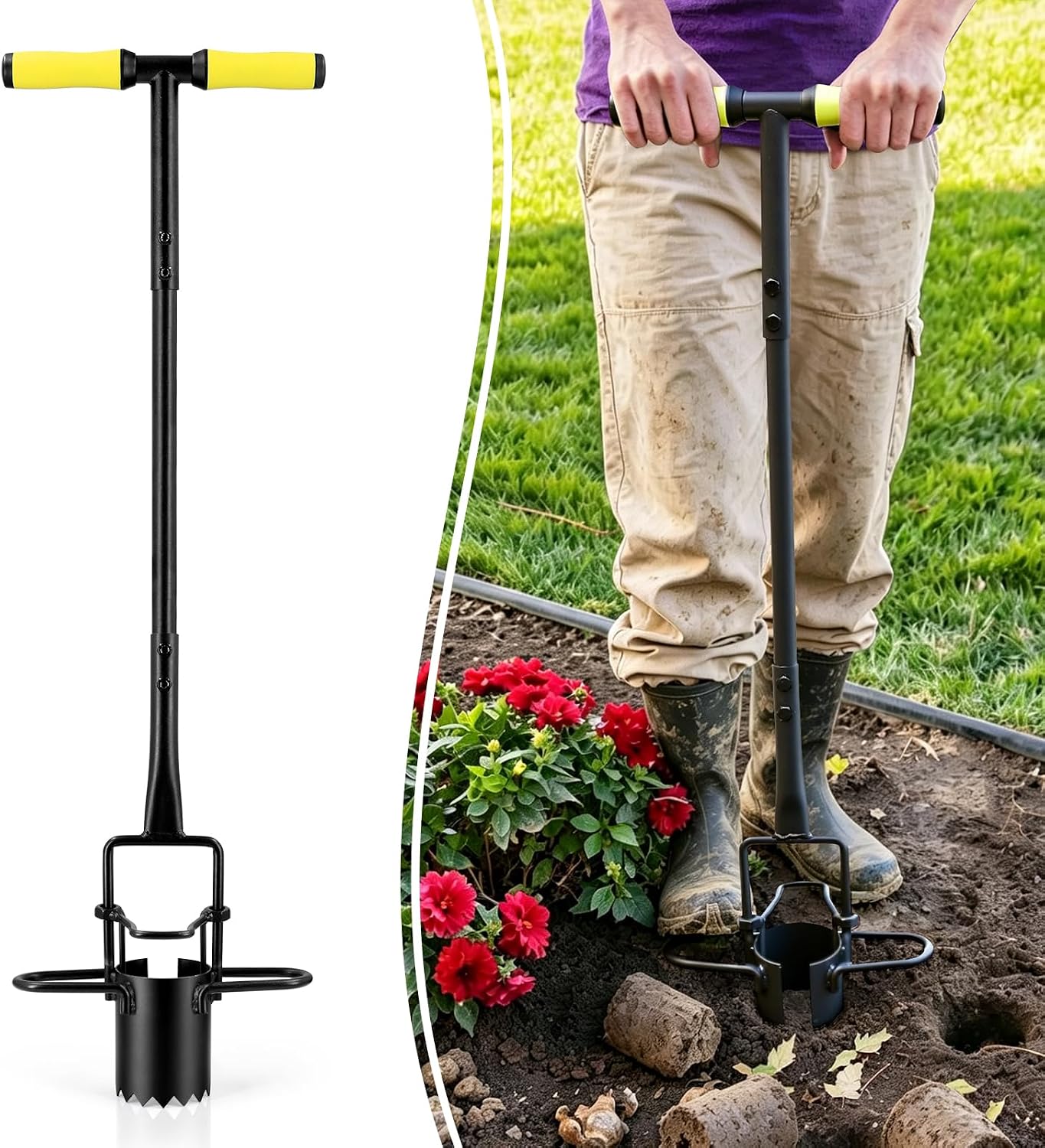
| Material | Solid Steel with Anti-Rust Coating |
|---|---|
| Overall Height | 37 in |
| Hole / Plug Diameter | 3.5 in |
| Key Features | Quick-Release Ejection Pedal & Dual Reinforced Foot Pedals |
This Colwelt long-handle bulb planter turns repetitive trowel work into a standing, one-step operation. You plant by stepping on the reinforced dual pedals to drive the serrated 3.5-inch cutter into the ground, twisting to loosen the plug, then using the ejection pedal to release soil without touching it. The 37-inch handle and T-grip keep you upright to protect your back and knees, and the solid steel construction with anti-rust coating makes it feel robust in normal garden conditions. It is best used in moist, well-conditioned soil; for dense clay or rock-hard ground you will need to water first to get clean plugs. Assembly is straightforward and the quick-release mechanism speeds up large jobs such as mass-bulb planting or lawn repair. Expect a sharp serrated base that cuts effectively but requires careful handling and proper storage to avoid corrosion and preserve the finish.
Best for: Buyers who prioritize a durable, low-effort tool for repeated bulb or lawn-plug planting and want a solution that minimizes bending and speeds large planting tasks.
Less Ideal for: People who mainly work in very compacted, rocky ground or need a tool for extremely small or shallow planting tasks should consider other options.
- Long 37-inch handle lets you plant upright to reduce back and knee strain.
- Dual reinforced foot pedals provide stable, balanced downward force for cleaner penetration.
- Quick-release ejection pedal removes soil plugs hands-free for faster, cleaner planting.
- Thickened carbon steel construction with anti-rust coating improves durability and weather resistance.
- Performs poorly in dry, compacted or very rocky soil without pre-watering or soil preparation.
- Serrated cutting edge is sharp and requires careful handling and protective storage to avoid injury or corrosion.
Verdict: If you want a sturdy, hands-free planter that lets you dig consistent plugs while standing and speeds up mass planting, this Colwelt long-handle bulb planter delivers.
Edward Tools Bulb Planter with Depth Marker

| Manufacturer | Edward Tools |
|---|---|
| Item model number | RMG1000 |
| Item Weight | 10.6 ounces |
The Edward Tools Bulb Planter is a compact, reinforced-steel hand tool designed to speed up planting bulbs like tulips, daffodils, and dahlias. You press the serrated cup into the soil, pull out a plug, set bulbs at the marked depths and use the quick-release handle to drop the soil back in place. The steel construction resists bending in firmer ground and the built-in depth markers help maintain consistent planting depth across many holes. The automatic soil release saves time versus digging and scooping by hand, and the tool is small enough to work in tight beds or between shrubs. Its limitation is that it is a manual tool best suited for loose to moderately compacted soil and for planting individual bulbs or short rows rather than very large areas. In very rocky ground or heavy clay you may still need a spade or powered auger to break soil before using this planter.
Best for: Gardeners who want a simple, durable hand tool to plant bulbs accurately and faster than digging by hand, especially for small to medium-sized flower beds.
Less Ideal for: Landscapers or gardeners planning to plant hundreds of bulbs over a large area or who regularly work in very rocky or compacted clay soils.
- Reinforced steel construction reduces bending in tougher soils
- Marked depth indicators for consistent planting depth
- Quick-release handle ejects soil plug for faster planting
- Compact size works well in tight beds and around established plants
- Manual operation is slow for very large planting jobs
- Less effective in heavy clay or extremely rocky soil without prior soil loosening
Verdict: Buy this if you want a sturdy, easy-to-use hand planter that speeds up accurate bulb planting in small to medium beds.
Choosing the Right Bulb Planter: Key Factors to Consider
Digging Depth and Stop Adjustability
Bulbs require specific planting depths to bloom reliably and avoid rot. A planter with clear depth markings or an adjustable stop lets you set the exact hole depth needed for different bulb sizes, from small crocus to large tulips. Consistent depth makes spacing, irrigation, and frost protection more predictable across a bed.
If you often plant mixed bulb sizes in the same area, easy adjustability saves time and reduces mistakes. Tools that lock securely at set depths prevent the planter from sinking too deep in softer soils or leaving holes too shallow in compacted ground.
Soil Removal and Ejection
Efficient soil ejection is essential when planting many bulbs. A planter that releases the soil cleanly lets you make consecutive holes without manually digging out compacted plugs between each dig, speeding the entire process.
Good ejection also reduces disturbance to surrounding soil and roots. If you reuse collected plugs to refill holes, look for a design that keeps the soil intact rather than shredding it, which helps maintain bed structure and reduces the need to topdress after planting.
Durability and Construction
Bulb planting can stress a tool with repeated twisting and leverage, especially in heavy or rocky soils. Sturdy construction from corrosion-resistant metals or reinforced composites resists bending and keeps moving parts functioning season after season.
Pay attention to welded joints, rivets, and the connection between handle and shaft. Lightweight tools are easier to carry but may sacrifice longevity. For gardeners planting larger areas, a balance of durability and manageable weight is important to avoid frequent replacements.
Handle Ergonomics and Reach
Comfortable grips and an appropriate shaft length reduce back strain and wrist fatigue during long planting sessions. A T-handle or cushioned grip improves leverage for pushing and twisting, while a longer shaft lets you work from a more upright position to protect your lower back.
Consider how often you will kneel versus stand while planting. Some handle shapes are better for two-handed pushing, others for twisting motions. Non-slip materials help when working in damp or muddy conditions.
Performance in Different Soil Types
Soil texture and the presence of stones change how a bulb planter performs. In light, sandy soils a narrower shaft may work fine, while clay or compacted soils benefit from a sturdier, wider-diameter cutter that can break through more resistance without bending.
If your soil has many rocks, a design that minimizes trapped stones and allows easy cleaning will save time. Some planters struggle in peaty or very loose soils because plugs crumble; in those cases a different cutting profile or a coreless planting approach may be preferable.
Maintenance and Storage
Tools that are easy to clean and resistant to rust last longer and perform predictably. Smooth metal surfaces, simple joints, and coatings that repel soil help keep the planter ready each season. Regular rinsing and drying after use prevents corrosion.
Compact or foldable designs are easier to store in small sheds, but moving parts should lock securely to avoid damage in transit. Consider whether spare parts or replacement components are readily available for the construction type you choose.
When a Long-Handled Planter Matters
Long-handled bulb planters let you stand while making holes, which is a big advantage if you are planting many bulbs or have back issues. They reduce the need to kneel repeatedly and speed up larger jobs by allowing a more upright working posture.
Long shafts also change leverage. A longer reach can make it easier to press and twist the cutter into compacted beds, but the tradeoff is slightly more weight and the need for a stronger connection where the handle meets the shaft.
- Better for planting large areas from a standing position
- Requires secure shaft-to-handle construction
- May be heavier to lift repeatedly
Short Handled Tools for Small Beds and Containers
Short-handled bulb planters are nimble for tight borders, raised beds, and container planting. They give you more control for precise spacing near other plants and are easier to maneuver around existing stems and roots.
Because they are lighter, short tools are also easier to store and carry. They do require more kneeling, which can be a consideration for gardeners with limited mobility.
- Ideal for containers and narrow borders
- Lightweight and easy to control
- Require more kneeling or using a garden seat
Techniques for Planting in Rocky or Compact Soils
In stony or compacted ground start by loosening the top layer with a fork or spade before using a bulb planter. If stones are deep, consider pre-clearing planting lines or using a planter with a robust cutting edge that resists bending.
Work in short bursts rather than forcing the tool. If a plug becomes jammed, twist gently to free it rather than levering hard, which can damage the blades or shaft. After planting, firm the soil gently around bulbs to remove air pockets without compacting too much.
- Pre-loosen very compacted areas
- Avoid forcing the tool against large buried stones
- Use plugs to refill holes when possible to preserve soil structure
Refilling Holes and Protecting Planted Bulbs
How you refill holes affects drainage and bulb health. Replacing the original soil plug maintains the local soil profile and drainage characteristics. If using fresh compost or amended soil, avoid piling it on top; mix sparingly into the plug to retain consistent depth.
Mark planted spots when working quickly so you can avoid digging into the same bulb later. Mulching after planting helps moderate soil temperature and moisture, which benefits root establishment as bulbs prepare for dormancy or spring growth.
- Use original plugs to maintain soil layering
- Lightly mix amendments into plugs if needed
- Mark positions and apply mulch to moderate moisture
Storing and Caring for Your Bulb Planter
After each use, knock excess soil from the shaft and wash off remaining dirt to prevent rust and sticking. Dry the tool thoroughly before storing in a dry place. For metal surfaces, a light coat of oil on moving parts prevents corrosion between seasons.
Inspect the handle attachment and any fasteners each season. Tighten or replace worn rivets and check for cracks in composite handles. Proper care extends the life of the tool and keeps it performing reliably year after year.
- Clean and dry after use
- Oil moving parts lightly
- Check fasteners and handle integrity annually
How We Chose the Best Bulb Planter
We focused on attributes that matter in routine bulb planting rather than flashy extras. Key evaluation criteria were digging depth control, overall durability and construction, soil ejection and cleanup, handle ergonomics and ease of use, and suitability for different soil types. We tested how reliably depth stops and markings worked, how well each tool shed soil for quick repeated holes, and whether construction materials resisted bending and wear. We excluded specialty powered or motorized diggers and any tools designed only for very large commercial operations. Also excluded were single-use or disposable devices. The shortlisted items had to offer consistent depth control, durable materials for repeated backyard use, practical soil-release mechanics, and ergonomic features that reduce strain during a planting session. These filters ensured the list emphasizes utility for typical home gardeners planting bulbs across small beds, borders, and larger garden areas.
FAQ
What depth should I plant different types of bulbs?
Depth depends on bulb size. Small bulbs like crocus often need shallow planting, while larger bulbs such as tulips require deeper holes. A general rule is about two to three times the bulb height. Use a planter with clear markings or an adjustable stop to get consistent depths.
Can I use a bulb planter in clay or heavy soil?
You can, but clay and compacted soils are tougher on tools. Pre-loosening the soil with a fork helps, and a sturdier planter with a stronger cutting edge or wider diameter is less likely to bend. Work in short intervals to avoid over-stressing the tool.
How do I clean and maintain a bulb planter?
Remove soil plugs and rinse the shaft after use, then dry thoroughly to prevent rust. Lightly oil moving parts or metal surfaces before storing. Check handles and fasteners each season and address any looseness or corrosion promptly.
Are long-handled planters better than short ones?
Long-handled planters reduce bending and speed up larger jobs, making them a good choice for planting many bulbs. Short-handled tools offer greater control in tight spaces and containers. Choose based on how much standing planting you will do versus precision work close to plants.
What if my soil plugs keep crumbling when I remove them?
Crumbly plugs are common in very loose or sandy soils. Try moistening the area lightly before digging to help plugs hold together, or switch to a different cutting profile that captures less soil. In some cases recovering the original soil is less important than ensuring correct depth and spacing.
Final Verdict
Choose a bulb planter that matches the scale of your planting and the conditions in your garden. Prioritize clear depth control and reliable soil ejection if you plant many bulbs, and favor stronger construction if your soil is compacted or rocky. Handle shape and shaft length should reflect how much standing work you plan to do and whether tight maneuvering is necessary. Weigh these tradeoffs and select the tool that reduces strain while producing consistent, correctly placed holes. Focusing on depth control, durability, and clean ejection will deliver the most dependable results season after season.
