

Note: This article contains affiliate links. If you click on these links and make a purchase, I may earn a small commission at no extra cost to you. This helps support my research and content. Read my full affiliate disclosure here.
A proper drip irrigation kit changes how a large garden looks and performs through the season. With more beds, deeper-rooted shrubs, and longer runs between water sources, you need components sized for flow, robust tubing that resists sun and rodents, and layout options that match varied planting zones. This guide covers seven top shortlisted drip irrigation kits suited for a large garden and explains the practical reasons each element matters. We'll evaluate coverage capability, tubing and emitter durability, installation flexibility, and how easy systems are to maintain and expand. Read on for clear, gardener-focused guidance to match a kit to your garden layout and watering goals.
Top Picks at a Glance
| Best Overall The best all-around choice for most situations | POCKET PANDA 250FT Drip Irrigation Kit (Quick-Connect, Adjustable Flow) |  |
| Best Value The sweet spot between price and what you get | MIXC Drip Irrigation System Kit, 230 ft with Quick-Connect Tubing and Adjustable Emitters |  |
| Best Budget The cheapest option that still gets the job done reliably | MQJIAZHI 246 ft Drip Irrigation System with 1/2" Main Tube and 1/4" Branch Tubing |  |
| Highest Rated A top-rated pick with lots of positive feedback | MIXC 320 ft Drip Irrigation Kit with Brass 2-Way Splitters and Stake-Mounted Tees |  |
| Most Popular A crowd favorite that many people choose with confidence | Maotong 240 ft Drip Irrigation Kit with 1/2" Main Line and 1/4" Distribution Tubing |  |
| Best Seller A high-volume bestseller chosen again and again | MIXC 200ft 1/4" Drip Irrigation Kit with 32 Adjustable Copper Nozzles |  |
POCKET PANDA 250FT Drip Irrigation Kit (Quick-Connect, Adjustable Flow)
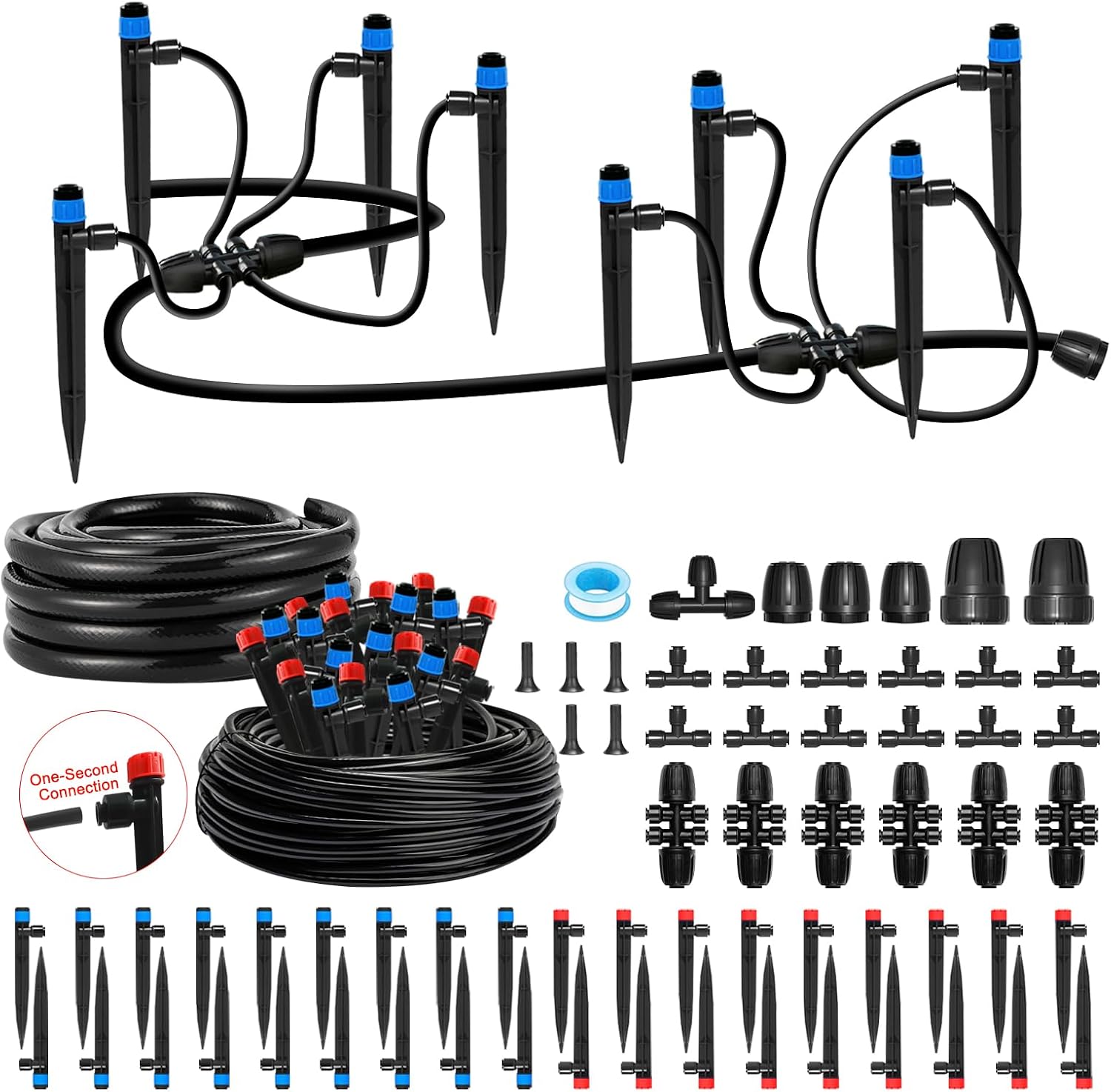
| Hose Length | 250 feet |
|---|---|
| Special Features | Misting |
| Fit Type | quick-connect |
| Control Type | Adjustable Flow |
| Material | Plastic, Rubber |
This POCKET PANDA kit is a full 250-foot drip irrigation system meant to cover a large garden without complicated tools. It uses quick-connect fittings and a 33 ft 1/2" supply hose plus extensive 1/4" distribution tubing so you can run multiple lines and keep water pressure steady to emitters. The set includes adjustable vortex and stream emitters for tailoring flow to different plants and a variety of tees, end plugs, faucet adapters and Teflon tape so you can assemble and adapt layouts on the fly. In practice the adjustable nozzles let you reduce overwatering of shallow-rooted plants while the larger 1/2" sections help maintain pressure across long runs. Components are plastic and rubber, which keeps cost low and makes installation straightforward, but that also means fittings will age faster than heavy-duty commercial parts and may need replacement after seasons of sun exposure. For a gardener who wants a ready-made, water-saving system for a large plot, this kit supplies most of what you need without custom fabrication.
Best for: Gardeners who want a ready-to-install, water-efficient system for a large backyard or multiple raised beds and value a balance of convenience, coverage, and adjustable watering.
Less Ideal for: People seeking heavy-duty, commercial-grade hardware or a fully pre-programmed irrigation solution with a built-in timer should look elsewhere.
- 250 ft total hose length covers large gardens and extended raised beds
- Quick-connect fittings enable fast, tool-free assembly
- Includes adjustable emitters for tuning water output to different plants
- Mixed 1/2" and 1/4" tubing helps maintain water pressure over long runs
- Comes with a wide set of connectors, faucet adapters, end plugs and Teflon tape
- Plastic and rubber components are less durable than commercial-grade materials
- Some users may need extra fittings or a timer for full automation
Verdict: A comprehensive, easy-to-install 250 ft drip kit that balances coverage and adjustable watering for large home gardens.
MIXC Drip Irrigation System Kit, 230 ft with Quick-Connect Tubing and Adjustable Emitters

| Hose Length | 230 feet |
|---|---|
| Size | 33FT main + 197FT 1/4" tube |
| Control Type | Automatic |
| Power Source | Water Pressure-driven |
| Special Features | Quick Connector Technology |
The MIXC 230 ft drip irrigation kit supplies a full DIY system for watering beds, containers, and small lawns by turning a garden faucet into a pressure-driven, automatic micro-irrigation network. It includes a 33 ft 1/2" mainline, 197 ft of 1/4" branch tubing, multiple emitter types, tees, barbed fittings and a faucet adapter so you can lay out a main hose and branch off to up to 32 emitters. The quick-connect technology and push-fit barbed parts make assembly straightforward and reduce leak points, and adjustable emitters let you change flow patterns from drips to sprays for different plants. Practical benefits include time savings versus hand-watering, flexible layouts for raised beds or potted plants, and the ability to fine-tune delivery to individual plants. Limitations to expect are the plastic construction, which will wear faster than premium materials in harsh sun or freezing conditions, and the need to plan pressure and emitter placement for even coverage rather than relying on a single layout to work everywhere.
Best for: Gardeners who want a practical, ready-to-install drip system to replace frequent hand-watering and who value components that make fast, adjustable layouts for beds and containers.
Less Ideal for: People seeking heavy-duty, long-lasting commercial-grade materials or systems sized for very large agricultural acreage.
- Complete kit that includes both 1/2" mainline and 1/4" distribution tubing plus fittings for a full layout
- Quick-connect fittings simplify assembly and reduce common leak points
- Adjustable emitters and three emitter styles let you tailor flow and spray pattern to different plants
- Designed to run automatically using water pressure so it eliminates frequent manual watering
- Plastic tubing and fittings may degrade faster under prolonged sun exposure or freezing temperatures
- Performance depends on correct pressure and layout planning to avoid uneven watering
Verdict: A practical, all-in-one drip kit that gets a small garden or group of planters on automatic watering quickly with easy-to-connect parts and adjustable emitters.
MQJIAZHI 246 ft Drip Irrigation System with 1/2" Main Tube and 1/4" Branch Tubing

| Hose Length | 33 feet (main) + 213 ft branch tubing |
|---|---|
| Number of Pieces | 152 |
| Power Source | Water Pressure-driven |
| Material | Polyethylene (PE) |
This MQJIAZHI kit provides a nearly complete DIY drip system for larger plots by combining a 33 ft 1/2‑inch main tube with 213 ft of 1/4‑inch branch tubing and 152 components. It is water pressure driven and includes three adjustable emitter types so you can switch between microdroplets, spray, and direct drip to suit flower beds, vegetable rows, or greenhouse benches. Quick‑plug fittings on the 1/4‑inch lines and locking couplers on the main tube make layout and repairs straightforward for a weekend install. The PE tubing is UV resistant for outdoor longevity and the kit is designed to concentrate water at the root zone to reduce evaporation and water use. Because it is a full kit rather than an automated controller, you will need a timer or manual valve to schedule watering and pressure at the tap affects range and uniformity, so longer runs may need pressure management. The system is a practical, low‑cost way to irrigate a large garden when you want a hands‑on setup that saves water without complex electronics.
Best for: Gardeners on a tight budget who need to irrigate multiple raised beds or a large backyard and are comfortable assembling and customizing a DIY drip layout.
Less Ideal for: People who want a plug‑and‑play electronic controller or who cannot add a pressure regulator or timer; small container gardeners who do not need extensive tubing.
- Very long combined tubing length suitable for large beds and multiple zones
- Three adjustable emitter types for flexible watering patterns
- Quick‑plug and locking connectors speed installation and repairs
- UV‑protected polyethylene tubing designed for outdoor durability
- No built‑in timer or pressure regulator included so buyer must add accessories for automated, uniform watering
- Performance depends on household water pressure which can reduce flow at far ends
Verdict: A cost‑effective, long‑reach drip kit that delivers adjustable, root‑targeted watering for large gardens when paired with a timer or pressure regulator.
MIXC 320 ft Drip Irrigation Kit with Brass 2-Way Splitters and Stake-Mounted Tees

| Hose Length | 320 feet |
|---|---|
| Included Components | 320ft tubing, 2 brass 2-way splitter, 40 nozzles, 20 tee, 20 tee-stake, ties, stakes, 8 end plugs |
| Special Features | Leak Resistant, Stake-mounted tees, Solid Brass 2-Way Splitter |
| Fit Type | Quick Connect |
| Material | brass, plastic |
This MIXC 320 ft kit supplies a complete drip system for large vegetable beds, raised planters, and landscape strips by providing two 160 ft tubing runs, brass 2-way splitters, and a mix of standard and stake-mounted tees. It uses quick-connect fittings and stake-integrated tees to speed installation and allow layout flexibility for scattered containers or rows. The solid brass splitters and copper adjustable nozzles improve outdoor durability and reduce the common failure point of plastic connectors, while the 360 degree nozzles let you switch between drip and fine mist for seedlings or established plants. Practical limits to note are pressure and spacing: the manufacturer recommends no more than about eight nozzles per 50 ft of tubing and modest spacing to avoid low downstream pressure, so very large or high-flow layouts may require an added main line or a second kit. Installation is tool-free but does require planning and careful push-in seating of tubing to avoid leaks.
Best for: Gardeners who need a robust, low-maintenance irrigation solution for large beds and value durable connectors and flexible emitter placement when reliability matters most.
Less Ideal for: Those with very small patios or a few potted plants who would be better served by a compact kit or single-line emitter system, and users who want an out-of-the-box automatic schedule without buying a timer.
- Large 320 ft coverage suitable for big gardens or multiple beds
- Solid brass 2-way splitters resist corrosion and reduce leaks compared with plastic fittings
- Stake-mounted quick tees let you place emitters directly in soil for flexible layouts
- Quick-connect system speeds installation and is tool-free
- Adjustable copper nozzles offer 360 degree spray control from drip to mist
- Performance depends on following pressure guidelines so very dense nozzle layouts can reduce downstream flow
- Does not include a timer so automated schedules require an additional controller
Verdict: Choose this kit if you need a large-coverage drip system built with durable brass fittings and flexible stake-mounted tees for reliable long-term irrigation.
Maotong 240 ft Drip Irrigation Kit with 1/2" Main Line and 1/4" Distribution Tubing

| Included Components | 40FT 1/2 inch main line +200FT 1/4 inch Tubing+136 accessory parts+ user manual |
|---|---|
| Material Type | Brass, Polyethylene (PE), Polypropylene (PP), Stainless Steel |
| Maximum Pressure | 45 psi |
| Unit Count | 1 Count |
This Maotong kit supplies a full set of tubing and fittings to set up drip irrigation for a large garden or split into two smaller systems. The 1/2" main line handles higher water pressure while the 1/4" distribution tubing and included emitters, vortex drippers, and mist nozzles let you tailor flow to beds, shrubs, or seedlings. Typical use is connecting the main line to a faucet, running the distribution tubing to plant zones, and placing emitters where each plant needs water. The package includes 136 parts and two faucet connectors so you can run one continuous 240 ft system or two independent networks. Practical benefits are significant coverage up to about 250 sq ft and a variety of nozzles for different plant water needs, which can cut watering time and water use. Limitations are that the kit is largely manual to assemble and may require additional pressure regulation or filters depending on your water source, and the plastic tubing will still wear over seasons in direct sun.
Best for: Gardeners setting up automatic watering for a large vegetable plot, perennial border, or multiple raised beds who want a ready-made kit they can configure themselves and value coverage and emitter variety.
Less Ideal for: People who want a truly plug-and-play, controller-driven system or those unwilling to do basic assembly and layout planning should consider alternatives.
- Large bundled length with 40 ft 1/2" main line plus 200 ft 1/4" distribution tubing to cover a big bed or split into two systems
- Includes multiple emitter types (drip stream, vortex, misting) for flexible watering needs
- Comes with two faucet connectors and 136 accessories so you can build a complete system without many extra purchases
- No built-in pressure regulator or filter included which some municipal or well systems may require
- Assembly is hands-on and requires planning of tubing runs and emitter placement
Verdict: This kit is a practical, all-in-one option for gardeners who need flexible coverage and emitter options to set up one long run or two separate drip systems for a large garden.
MIXC 200ft 1/4" Drip Irrigation Kit with 32 Adjustable Copper Nozzles

| Size | 200ft |
|---|---|
| Power Source | Water Pressure-driven |
| Fit Type | quick-connect |
| Maximum Pressure | 50 psi |
| Included Components | 200ft tubing, 32 nozzles, quick connectors, accessories |
This MIXC kit supplies 200 feet of 1/4" tubing plus connectors and 32 adjustable copper nozzles to build a flexible drip or mist system for raised beds, containers, and small lawns. It is assembled with quick-connect 2-way and 3-way fittings so you can lay runs, branch lines, and reposition emitters without special tools. The copper nozzles and aluminum-alloy wands allow a range of spray patterns and 360 degree adjustment, which is useful when irrigating mixed plantings or targeting root zones in raised beds. The manufacturer recommends no more than eight emitters per 50 feet of tubing to avoid pressure loss, so you may need a thicker main line or shorter runs for larger beds. The kit is water-pressure driven and rated to 50 psi, and it includes stakes, plugs, and ties to keep tubing neat. Practical limitations are that it lacks a timer and larger-diameter mains, so automatic scheduling and long low-pressure runs require adding a timer or 1/2" feed line. For gardeners who want an economical, modular way to water raised beds, this provides the core parts to get started quickly.
Best for: Gardeners setting up or expanding drip lines for raised beds who value a ready-to-install kit they can configure and adjust by hand and who prefer components that match common US tubing sizes.
Less Ideal for: Large acreage irrigation or gardeners who need a fully automated system out of the box with integrated timers and high-flow mains.
- Generous 200 ft of 1/4" tubing suitable for multiple raised bed runs
- Quick-connect fittings simplify assembly and reconfiguration without tools
- Durable copper nozzles and aluminum-alloy wands offer adjustable 360-degree spray patterns
- Includes stakes, plugs and cable ties to secure tubing and keep layout tidy
- No timer included so scheduling requires an added controller or manual operation
- Designed for 1/4" lateral runs so long runs may suffer pressure drop without a larger main line
Verdict: A hands-on, configurable 200 ft 1/4" kit that gives raised-bed gardeners durable adjustable nozzles and easy quick-connect plumbing to set up targeted drip or mist irrigation fast.
Choosing the Right Drip Irrigation Kit for Large Garden: Key Factors to Consider
Coverage and Flow Capacity
A large garden often has long lateral runs and multiple zones that need simultaneous watering. Flow capacity determines how many emitters or drip lines you can run off a single supply line before pressure drops reduce emitter output. Look at recommended GPH or LPH per emitter and calculate total demand against your water source and regulator capacity.
Hydraulic considerations also affect where you place filters, pressure regulators, and manifolds. Proper zoning reduces the need for oversized mains and makes scheduling simpler. For large gardens, prioritize kits designed for higher flow or those that provide clear guidance on how to split zones and run multiple parallel laterals.
Tubing Material and Durability
Tubing in a large garden sits exposed to sun, foot traffic, and sometimes wildlife. UV-stabilized polyethylene or thicker wall tubing resists cracking and sun degradation better than thin, non-stabilized lines. Tougher tubing also tolerates soil contact when buried and resists elongation under pressure.
Durable tubing reduces the frequency of repairs and simplifies long-term maintenance. Inspect expected wall thickness and whether the kit includes spare lengths or repair fittings. For long runs consider tubing rated for higher working pressures to avoid sagging and kinking that can interrupt flow.
Emitter Type and Performance
Emitters control how water is delivered to roots, so their behavior affects plant health and water use. Compensating emitters hold steady output across variable pressures and are useful for long runs and sloped gardens. Non-compensating emitters are simple and cheap but can underperform if pressure varies.
Also consider emitter clogging resistance and whether emitters are serviceable or replaceable. Grid gardens, row crops, and shrub borders benefit from inline drip tubing with integrated emitters, while specimen trees and deep-rooted beds may use adjustable point emitters for precise delivery.
Installation Flexibility
Large gardens evolve, so a kit that supports multiple layout options saves time and money. Flexible kits include a variety of fittings, tees, elbows, and adapters to run mains, branch lines, and risers. Look for clear instructions on routing, recommended tools, and whether components use push-fit connectors or require clamps.
Ease of installation also matters for staged builds. If you plan to expand beds over seasons, pick a system that allows adding zones without reworking the whole network. Compatibility with common controller and valve sizes makes future upgrades simpler.
Maintenance and Serviceability
Maintenance needs strongly influence operating costs and system longevity. Filters need regular cleaning in systems fed by well or surface water; kits that include accessible filter housings and spare screens make that routine easier. Consider whether emitters can be flushed in place or require removal for cleaning.
Also check how simple it is to isolate and replace damaged tubing or fittings. Winterizing is another seasonal task for many climates, so systems that permit easy drainage or disassembly reduce freeze damage risk.
Expandability and Compatibility
Large gardens often outgrow initial setups. Kits that support standard valve sizes, controller interfaces, and common filter and pressure regulator fittings let you add zones, timers, or pumps later. Compatibility reduces the need to buy proprietary adapters or scrap existing parts.
Evaluate whether the kit's connectors match typical irrigation hardware and whether replacement parts are commonly available. Systems that work with common dripline spacings and emitter densities make future planning straightforward.
Planning Zones and Water Budget
Map your garden by plant type, sun exposure, and root depth to create watering zones. Turf, annual beds, shrubs, and vegetables usually have different run times and emitter needs. Group plants with similar water requirements together to simplify scheduling.
Estimate the flow requirement per zone by totaling emitter output and adding a safety margin. This helps determine whether a single manifold with multiple valves or several smaller manifolds is the better option for your layout.
- Sketch permanent features and proposed beds before laying tubing
- Note water source location and any elevation changes
- Plan valves and manifolds near accessible points for maintenance
Choosing Between Point Emitters and Dripline
Point emitters are ideal for individual plants or containers where you need precise, adjustable delivery. They let you place water directly at the root ball or under mulch without saturating surrounding soil.
Dripline with built-in emitters suits linear plantings and vegetable rows because it lays flat and provides even distribution. For large beds, choose dripline with appropriate emitter spacing and pressure-compensating features if runs are long.
- Use point emitters for shrubs, trees, and container groupings
- Use dripline for rows, hedges, and groundcover strips
- Mix both types where planting types change across a zone
Installing Filters and Pressure Regulators
A filter and pressure regulator protect emitters and ensure consistent output. Even municipal water can carry fine particulates that clog small ports. Position filters where they are easy to access for cleaning.
Pressure regulators keep emitters operating at the pressure range they were designed for. On long runs or sloped sites, regulators prevent overpressure at low points and underperformance at the far end.
- Install a filter upstream of the first splitter or valve
- Add a pressure regulator if your household pressure exceeds emitter ratings
- Flush mains before attaching delicate emitters to remove debris
Managing Winterization and Seasonal Care
In climates with freezing winters, draining or blowing out lines prevents splits and fittings failures. Kits that allow quick disconnection of mains or provide accessible low points make winter prep faster.
During the growing season, periodically check emitters for clogged or misdirected output and inspect tubing for rodent or mower damage. Early detection of leaks conserves water and prevents dry spots in planting beds.
- Locate and label valves for easy shutoff
- Flush lines at the start and end of each season
- Inspect emitters monthly during peak use
Integrating Timers, Sensors, and Smart Controls
Controllers let you automate run times and stagger zones to match water pressure limits. Consider a timer with multiple programs if your garden has distinct plant types with different schedules.
Soil moisture sensors and rain sensors prevent unnecessary runs and reduce water waste. For large gardens, sensors placed in representative zones give more useful data than a single sensor controlling everything.
- Choose controllers sized to the number of valves you will operate
- Use sensors to avoid overwatering after rain events
- Stagger start times to reduce simultaneous flow demand
How We Chose the Best Drip Irrigation Kit for Large Garden
We focused on factors that matter in real large-garden use rather than marketing claims. Key evaluation criteria included delivered coverage and flow capacity to ensure long lateral runs and multiple zones can be supplied without pressure loss. Durability of tubing, fittings, and emitters was assessed for UV resistance, crush and rodent resistance, and corrosion-free connectors. Installation flexibility and layout options were evaluated to determine how easily systems adapt to mixed plantings, raised beds, and established shrubs. Maintenance and serviceability were considered, including whether emitters are cleanable or replaceable and how simple it is to winterize or flush the system. Expandability and compatibility with common controllers, filters, and backflow preventers were checked so systems can grow with the garden. We excluded hobby or micro-garden kits designed for patios, window boxes, or fewer than a dozen distinct outlets. We also excluded setups that require specialized tools or hard-to-find replacement parts. The final list favors systems that balance long-term reliability, straightforward installation, and the hydraulic capacity needed for large garden layouts.
FAQ
How much water does a drip irrigation system use compared with overhead watering?
Drip systems usually use less water because they apply water slowly at the root zone and reduce evaporation. Actual savings depend on run time and emitter flow rates but gardeners often see reduced water use when systems are sized and scheduled properly.
Can I run a drip system from a well or pump in a large garden?
Yes. Many large gardens use pumps or pressure tanks to meet higher flow needs. You may need a larger filter and a pressure regulator, and it is important to size the pump for the total flow required by all active emitters.
How often do emitters and filters need maintenance?
Filters generally need checking and cleaning every few weeks to months depending on water quality. Emitters can clog over time; regular flushing and occasional replacement or cleaning keeps output consistent. The schedule depends on local water conditions and system complexity.
Is it better to bury dripline or leave it on the surface in a large garden?
Both approaches work. Surface placement makes inspection and repairs easier and allows warming soil to dry faster, which can reduce root rot. Burying dripline below mulch protects it from UV and mechanical damage. In many large gardens a mix of both is practical.
Can I expand a small drip kit later if my garden grows?
Often you can expand if the kit uses standard fittings and valve sizes. Check whether the manifold supports additional valves and whether the tubing and connectors are common sizes. Compatibility with standard controllers and valves simplifies staged growth.
Final Verdict
For a large garden prioritize systems that handle higher flow and long lateral runs without pressure loss, and that use durable tubing and serviceable emitters. Balance zoning and controller capacity against your water source so each area gets the right run time. Accept tradeoffs between upfront install effort and long-term maintenance. A slightly more robust kit with accessible filters, pressure regulation, and common fittings will save time and repairs over seasons, making it easier to expand and adapt as the garden grows.
