

Note: This article contains affiliate links. If you click on these links and make a purchase, I may earn a small commission at no extra cost to you. This helps support my research and content. Read my full affiliate disclosure here.
If you tend a small lawn, patio containers, or raised beds, a compact fertilizer spreader saves time and reduces product waste. The right small fertilizer spreader delivers even granule distribution, simple control over application rate, and easy storage between seasonal uses. This guide looks at six shortlisted small fertilizer spreaders chosen for gardeners who need precise coverage without bulk. Each pick was evaluated on factors that matter in everyday garden work: spread accuracy, hopper capacity, durability, ease of use, and cleanup. Read on to match a compact spreader to your garden size and maintenance rhythm.
Top Picks at a Glance
| Best Overall The best all-around choice for most situations | Scotts Whirl Hand-Powered Spreader |  |
| Best Value The sweet spot between price and what you get | Snow Joe SJSPD1 Handheld Multipurpose Spreader (5 lb Capacity) |  |
| Best Budget The cheapest option that still gets the job done reliably | Garden Guru Handheld Seed Spreader Shaker (1L) |  |
| Highest Rated A top-rated pick with lots of positive feedback | ZXJ Handheld Seed Shaker Hand Spreader — 90 oz Capacity |  |
| Most Popular A crowd favorite that many people choose with confidence | Scotts Whirl Hand-Powered Handheld Spreader |  |
| Best Seller A high-volume bestseller chosen again and again | Scotts Turf Builder EdgeGuard Mini Broadcast Spreader |  |
Scotts Whirl Hand-Powered Spreader

| Material Type | Metal, Plastic |
|---|---|
| Handle Material | Rubber |
| Capacity Coverage | Up to 1,500 sq. ft. |
| Additional Features | Adjustable Arm Support, Smooth Even Coverage |
The Scotts Whirl is a compact, hand-powered spreader built for small lawns and spot treatments. It comes ready to use and is designed to distribute grass seed, granular fertilizer, ice melt, or salt with an agitator that promotes smooth, even coverage. Its adjustable arm support and light weight make it comfortable for short jobs like overseeding patches, treating narrow strips, or spreading ice melt on walkways. Because it is hand-held and intended for up to 1,500 square feet, it delivers control and reduced waste compared with tossing product by hand. The main limitation is capacity and speed: for larger lawns you will need a wheeled spreader or multiple refills, and fine-tuning the setting for very light seed rates can take a few test passes. Materials are basic metal and plastic with a rubber handle, so it is practical for seasonal use rather than heavy commercial work.
Best for: Homeowners with small lawns or those who need precise control for patch seeding, fertilizing, or winter ice-melting, who prioritize reliability and simplicity over high capacity.
Less Ideal for: Owners of medium to large lawns who need fast coverage or professional users who require higher durability and throughput.
- Compact handheld design ideal for small yards and spot treatments
- Engineered to deliver smooth, even product coverage across application area
- Adjustable arm support increases comfort during use
- Ready to use out of the box with simple hand-powered operation
- Limited capacity suitable only up to about 1,500 sq. ft., requiring frequent refills for larger lawns
- Not ideal for high-volume or commercial spreading tasks
Verdict: A simple, reliable handheld spreader that gives risk-averse homeowners controlled, even application for small lawns and spot jobs.
Snow Joe SJSPD1 Handheld Multipurpose Spreader (5 lb Capacity)

| Capacity | 84.5 oz (approx. 5 lb) |
|---|---|
| Adjustable settings | Coarse to fine dial |
| Use cases | Ice melt, grass seed, fertilizer, pool chemicals, pesticides |
| Handle | Ridged grip with twist-lock lid scoop |
The Snow Joe SJSPD1 is a lightweight handheld broadcast spreader designed for year-round use on driveways, walkways, and small lawn areas. It dispenses ice melt, grass seed, fertilizer, pool chemicals and similar granules from its 84.5 oz (about 5 lb) hopper using an adjustable dial that changes the opening from coarse to fine for more precise application. The twist-and-lock cap serves as a built-in scoop for faster, cleaner refills and the ridged grip handle keeps it comfortable to hold during short jobs. Practical benefits include fewer trips to refill thanks to the larger-than-average capacity for a handheld unit and better control of flow to reduce product waste and over-application. Limitations are inherent to handheld designs: it is best for small areas and spot treatments rather than large yards, and the plastic construction means it is less durable than heavy-duty broadcast spreaders designed for frequent commercial use. For routine home tasks it offers a simple, low-effort way to get even coverage without complex setup.
Best for: Homeowners who want a simple, low-risk tool to handle seasonal tasks like applying ice melt, patching grass seed, or spot-fertilizing small areas without complex equipment.
Less Ideal for: People who need to cover large properties frequently or professional users who require a heavy-duty wheeled spreader for continuous, high-volume work.
- Adjustable dial with coarse-to-fine settings for controlled, even spreading
- Built-in twist-lock lid that doubles as a scoop for quick, clean refills
- Generous 84.5 oz (approx. 5 lb) hopper reduces the number of refills
- Lightweight and ergonomic ridged handle for comfortable short-session use
- Plastic construction is less robust than metal commercial spreaders
- Not suitable for large lawns or continuous use where a wheeled spreader is faster
Verdict: A lightweight, easy-to-use handheld spreader that gives risk-averse homeowners precise control for small seasonal spreading tasks.
Garden Guru Handheld Seed Spreader Shaker (1L)

| Capacity | 1L |
|---|---|
| Use cases | Grass seed, fertilizer, salt, ice melt |
| Adjustability | Twist cap with multiple openings |
This compact Garden Guru handheld spreader is designed to make small-area seeding and fertilizer tasks faster and neater. You fill the wide top, set the twist cap to the desired opening, and shake or walk while dispensing for even coverage of grass seed, granular fertilizer, ice melt, or pool chemicals. The 1L capacity and ergonomic handle keep hand fatigue low and make it simple to use for quick touch-ups, patch repairs, or treating narrow strips like walkways and driveways. The adjustable openings let you switch between fine seed and coarser granules without changing tools, and the simple, durable construction means there are no complicated parts to break. Limits are its modest capacity and manual operation, so you will refill for larger lawns and it does not replace a broadcast or push spreader when covering big areas quickly.
Best for: Practical gardeners who want an inexpensive, no‑frills tool for spot seeding, lawn repairs, and small‑area fertilizing without the complexity of larger spreaders.
Less Ideal for: Homeowners who need to treat large lawns or want a hands‑free wheeled broadcast spreader for fast coverage should look elsewhere.
- Adjustable twist-cap with multiple opening sizes for fine to coarse granular materials.
- Lightweight ergonomic design reduces hand fatigue during short tasks.
- Wide top opening for quick refills and easy cleaning.
- Versatile for seed, fertilizer, ice melt and similar granular products.
- Small 1L capacity requires frequent refilling for medium to large lawns.
- Manual shake/handheld operation is slower than wheeled spreaders for large areas.
Verdict: A simple, budget-friendly handheld spreader that gives controlled, even application for small lawns and spot repairs.
ZXJ Handheld Seed Shaker Hand Spreader — 90 oz Capacity
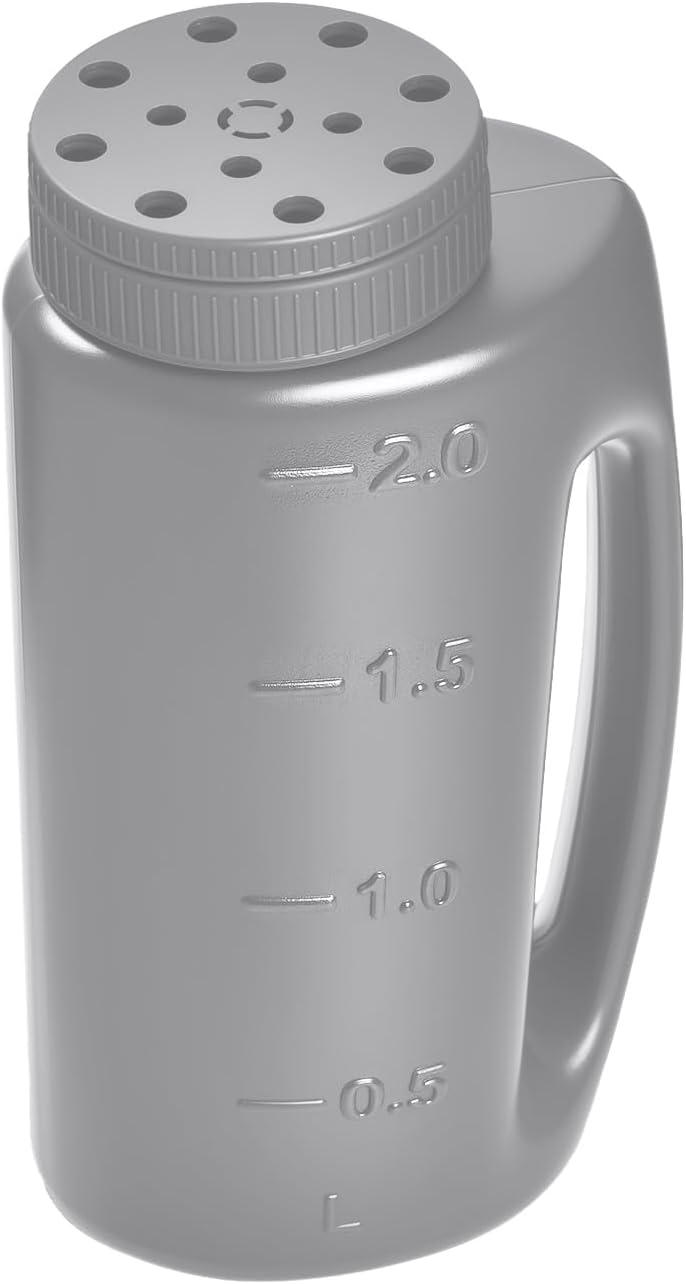
| Capacity | 90 oz |
|---|---|
| Included accessory | Garden gloves |
| Material | Weather-resistant plastic |
| Adjustable openings | Three settings |
The ZXJ Handheld Seed Shaker is a compact broadcast spreader aimed at small to medium yard tasks. It uses a front-facing diffuser and three adjustable openings to control flow so you can switch between fine grass seed and coarser materials like ice melt. The 90 oz capacity reduces refills compared with tiny hand spreaders, and the included garden gloves and ergonomic handle make longer passes more comfortable. Built from weather-resistant plastic, it is lightweight and easy to rinse after use. Expect good uniformity on lawns and walkways when cranked to the right setting, but it lacks a motorized or hopper-agitation system so very damp or clumpy products may need pre-breaking. The unit is straightforward to operate and store, making it a practical, no-frills choice for routine lawn seeding, fertilizing small plots, or spreading salt in winter.
Best for: Homeowners who want an affordable, easy-to-use spreader for routine lawn seeding, fertilizing, and occasional ice-melt tasks and who prioritize simplicity and low maintenance.
Less Ideal for: Commercial landscapers or users who need to treat very large areas quickly or handle consistently wet, clumpy materials should choose a heavier-duty or motorized spreader.
- Large 90 oz hopper reduces trips to refill during small to medium jobs
- Three adjustable openings provide flow control for seeds, fertilizer, or ice melt
- Ergonomic handle and included gloves improve comfort during extended use
- Weather-resistant plastic construction is easy to clean and store
- No mechanical agitation or motor makes it less effective with damp or clumpy materials
- Lightweight plastic may feel less durable under heavy professional use
Verdict: A budget-friendly, easy-to-use handheld spreader that delivers good control and reduced refills for small to medium seasonal lawn and ice-melt tasks.
Scotts Whirl Hand-Powered Handheld Spreader

| Material Type | Poly |
|---|---|
| Capacity coverage | Up to 1,500 sq. ft. |
| Included Components | Scotts – 71060 |
The Scotts Whirl is a simple, hand-powered spreader designed for small yards and spot treatments. It delivers smooth, even coverage of grass seed, fertilizer, salt, or ice melt by turning a small spreader wheel as you walk. Its ergonomic, adjustable arm support makes repeated passes more comfortable than basic handheld scoops, and the unit arrives fully assembled so you can use it right away. With a capacity rated up to 1,500 square feet it is best for modest lawns, beds, and patch repairs rather than large properties. Construction is lightweight poly, which keeps it easy to carry and maneuver but means it is not as rugged as metal commercial units. The straightforward mechanical design keeps maintenance trivial and there are no batteries or power hooks to worry about. If you want a low-cost, low-effort tool to improve distribution and avoid clumping during seeding or fertilizing, this does the job well, but those needing heavy-duty durability or very large coverage will want a larger tow-behind or broadcast spreader.
Best for: Buyers who want a practical, no-frills tool to improve distribution for routine lawn care on small to medium yards and value ease of use and low maintenance.
Less Ideal for: Homeowners with large lawns, commercial landscapers, or anyone needing a heavy-duty, high-capacity spreader should consider larger tow-behind or broadcast models.
- Provides smooth, even coverage for seed, fertilizer, salt, and ice melt
- Ergonomic adjustable arm support for more comfortable use during extended passes
- Lightweight poly construction makes it easy to carry and maneuver
- Comes fully assembled so it is ready to use out of the box
- Poly construction is less durable than metal alternatives for heavy or commercial use
- Capacity is limited to small lawns and spot treatments, not appropriate for large properties
Verdict: A lightweight, ready-to-use handheld spreader that delivers even coverage for small lawns and routine spot treatments.
Scotts Turf Builder EdgeGuard Mini Broadcast Spreader
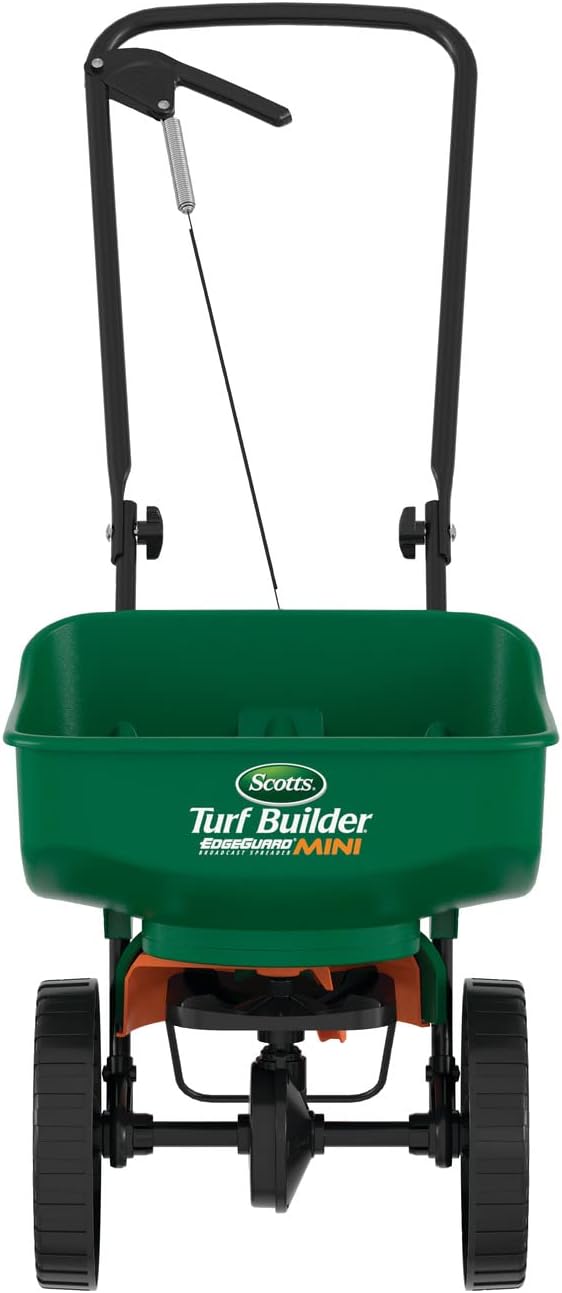
| Capacity | Up to 5,000 sq. ft. |
|---|---|
| Usage | Applies fertilizer, seed, granular weed control, salt, ice melt |
| Features | EdgeGuard side shield; dual-bladed agitator; fold-down handle |
The Scotts Turf Builder EdgeGuard Mini is a ready-to-use broadcast spreader aimed at smaller lawns and targeted spot work. It comes pre-calibrated so you set the dial to the recommended setting, pour in fertilizer, seed, ice melt, or granular weed control, and walk the lawn for even coverage. The hopper and dual-bladed agitator are redesigned to funnel product smoothly and reduce clogging, while open-spoke wheels and a fold-down handle make it easy to maneuver and store. Scotts' EdgeGuard feature blocks product on the right side of the pattern, which helps avoid deposits on sidewalks and landscape beds when edging. Capacity is geared to yards up to about 5,000 sq ft, so it handles typical small properties without being bulky. The main limitations are its smaller coverage area and basic mechanical design compared with larger, more precise spreaders, so it may require more passes on bigger lawns and offers fewer fine-control adjustments for professional users.
Best for: Buyers who want a simple, reliable spreader for small to medium yards and who prioritize ease of use and avoiding overspread onto hard surfaces.
Less Ideal for: Professional landscapers or owners of large properties who need higher capacity and finer control should consider larger commercial-style spreaders.
- Pre-calibrated and ready to use for quick setup
- EdgeGuard side shield reduces product on driveways and sidewalks
- Redesigned hopper and dual-blade agitator for consistent flow
- Fold-down handle and compact size for easy storage and maneuvering
- Smaller capacity suited for lawns up to about 5,000 sq ft so larger lawns need more refills or a larger spreader
- Limited fine adjustment compared with premium or professional models
Verdict: A user-friendly mini broadcast spreader that delivers even coverage for small lawns while keeping product off sidewalks and driveways.
Choosing the Right Small Fertilizer Spreader: Key Factors to Consider
Spread Accuracy and Calibration
Spread accuracy is the most important factor for small fertilizer spreaders because uneven distribution causes patchy growth or burned spots. Look for models with adjustable rate settings that let you dial in the grams or spread width. Clear, repeatable calibration markings help you apply the correct amount for your lawn or container mix.
In practice, test any new setting on a hard surface to see actual coverage before applying to plants. A spreader with a narrow, focused pattern works well in tight beds and between pots, while a wider pattern is useful on small lawns to cut application time.
Hopper Capacity and Refill Convenience
Hopper capacity should match the scale of your tasks. For small yards or frequent spot treatments, a compact hopper that holds enough product for one or two jobs is ideal; oversized hoppers add weight and take more space to store. Evaluate how easy the hopper is to open and pour; a wide mouth or removable lid speeds refills and reduces spills.
Consider whether the spreader allows partial fills and still meters reliably. Models with clear volume markings let you measure out product without extra containers. Also check how the hopper shape affects flow; narrow bottoms with agitators reduce clumping and keep material moving.
Build Durability and Materials
Durability affects how long a small spreader remains useful when exposed to fertilizer dust and outdoor storage. Look for corrosion-resistant metals or UV-stable plastics in the hopper and chassis. Weak plastic parts around the flow gate or handle are common failure points, so reinforced components or metal hardware improve lifespan.
Consider how the unit stores between seasons. Spreaders that disassemble or fold minimize space and reduce the chance of damage. Check seals and fasteners for rust-prone metals if you plan to store the spreader in a damp shed.
Control, Ergonomics, and Maneuverability
Ergonomics matter when you push or walk with a spreader across turf or between pots. Comfortable grips, reasonable handle height, and a smooth push action reduce fatigue. Controls for flow rate should be reachable without pausing, and clearly labeled settings reduce guesswork.
Wheels, axle smoothness, and overall weight determine maneuverability. Lightweight units are easier to handle but must still be stable when dispensing product. For spot treatments, hand-held or small broadcast types may be preferable; for running across a small lawn, a compact walk-behind gives more even coverage with less physical effort.
Ease of Cleaning and Maintenance
Fertilizer residues can corrode parts and clog outlets, so ease of cleaning directly affects longevity. Choose spreaders with removable hoppers, open access to the flow gate, and simple mechanisms that can be rinsed and dried after use. Avoid models with many small crevices where wet fertilizer can accumulate.
Regular maintenance tasks include rinsing the hopper, lubricating metal linkages, and checking seals for deterioration. A design that allows quick disassembly without tools makes seasonal storage routines faster and reduces the risk of long-term damage.
Storage Footprint and Portability
Small fertilizer spreaders should be easy to store in a shed, garage, or balcony closet. Evaluate how the unit breaks down or stands upright when empty. Collapsible handles, removable hoppers, or slim profiles are beneficial when storage space is tight.
Portability also includes weight when filled. If you plan to carry the spreader to multiple locations, choose a model light enough to lift comfortably but robust enough to resist flexing. Consider whether the spreader can be hung or nested with other garden tools to maximize space efficiency.
When a Small Spreader Is the Right Choice
Small fertilizer spreaders are designed for gardeners who need targeted coverage rather than treating large acreage. They suit compact lawns, apartment balconies with container gardens, raised beds, and spot treatments around shrubs and flower borders.
If your yard is under a few thousand square feet or you frequently do spot feeding, a compact unit reduces product waste and storage hassles compared with full-sized broadcast spreaders.
- Best for targeted applications and patch treatments
- Easier to store in small sheds or closets
- Lower product capacity reduces unnecessary weight
Types of Small Fertilizer Spreaders
There are several form factors to consider: handheld cyclone or rotary spreaders, small walk-behind broadcast spreaders, and hopper-style hand-crank or push models. Each type balances control, speed, and capacity differently.
Handheld units are very portable and good for spot work but require more passes for larger areas. Walk-behind compact spreaders provide more even coverage with less effort but take more storage space.
- Handheld spreaders: lightweight, great for containers and tight spots
- Push or walk-behind compact spreaders: better for small lawns and larger beds
- Crank-style or drop spreaders: offer precise placement along strips and paths
Matching Spreader to Fertilizer Type
Granule size and shape vary between fertilizer products and soil amendments. Check that a spreader's calibration range and gate opening accommodate the granules you use. Finer materials may require slower settings or narrower spread patterns to avoid wind drift.
Some spreaders include an agitator or vibration feature to prevent bridging with coarser or damp granules. If you use mixed amendments or seed along with fertilizer, choose a model that reliably meters mixed materials without clogging.
- Fine granules: use lower flow settings and test on a hard surface
- Coarse granules: ensure gate size and agitator prevent clogs
- Seed or amendment mixes: verify consistent metering before application
Maintaining Accuracy in Small Areas
In confined spaces accuracy matters more than speed. Walk at a steady, recommended pace and overlap passes minimally to prevent double application. Many compact spreaders allow you to narrow the spread pattern or reduce flow to better match small beds and container rows.
Marking a test swath and measuring spread width gives a practical baseline for future applications. Keep notes on settings for common tasks so you can repeat accurate rates without re-testing each season.
- Walk consistently and test settings on a driveway first
- Use flags or temporary guides to keep straight passes
- Record settings and coverage widths for repeatable results
Storing and Winterizing Your Spreader
After final seasonal use rinse the hopper and flow components to remove fertilizer residues. Let the unit dry fully before storage to prevent corrosion and clumping. Store indoors or under cover to protect plastic parts from UV degradation and metal parts from rust.
If the spreader disassembles, pack small parts in labeled bags to simplify spring reassembly. Periodically inspect seals, wheel bearings, and fasteners and replace any degraded parts before the next season.
- Rinse and dry thoroughly after each use
- Store in a cool, dry place away from direct sunlight
- Keep small hardware and spare parts organized for quick maintenance
How We Chose the Best Small Fertilizer Spreader
To assemble this list we focused on features that affect real-world use in small lawns, container plantings, and compact yard spaces. Key evaluation criteria were spread accuracy and calibration, because consistent granule distribution determines plant health and prevents waste. Hopper capacity and refill convenience were judged to ensure the spreader holds an appropriate amount for small tasks without being oversized. Build quality and materials were considered to predict longevity when exposed to fertilizer and outdoor storage. Controls and ergonomics were assessed for ease of application, including handle comfort and adjustable flow mechanisms. Finally, cleaning and maintenance needs were measured because fertilizer residues can corrode parts and clog outlets. We excluded heavy-duty and landscape-scale commercial spreaders that are clearly oversized for the intended scope. Also omitted were units lacking adjustable calibration or with fragile plastic parts that commonly fail in garden use. The remaining picks met the practical balance of compact size, measurable spread control, durable construction, and straightforward upkeep.
FAQ
How do I calibrate a small fertilizer spreader?
Calibration often involves measuring material applied over a set distance and adjusting the flow setting until the rate matches the product label. Test on pavement, collect the granules from a measured swath, weigh or volume-measure them, and adjust accordingly. Repeat until the output matches the recommended application rate.
Can I use a small spreader for seed as well as fertilizer?
Often yes, but it depends on seed size and spreader gate design. Small seeds may require a finer setting or a drop-style mechanism to avoid uneven distribution. Test a trial pass to confirm even delivery before sowing in planting beds.
How much area will a compact spreader cover on a single fill?
Coverage varies by hopper size and application rate. For light applications on a typical small lawn, many compact spreaders will cover several hundred square feet per fill. Check hopper volume and expected application rate to estimate actual coverage for your intended product.
What routine maintenance prevents corrosion?
Rinse the hopper and flow mechanism after each use, dry parts thoroughly, and lubricate metal linkages lightly. Store the spreader indoors or under cover and inspect fasteners and seals annually to replace any corroded components.
Is a handheld spreader accurate enough for small lawns?
Handheld spreaders can be accurate for small lawns and spot treatments when used carefully at the proper walking pace and setting. They require more passes and steadier motion than push models, but they are very portable and easy to store.
How do I avoid double application along edges and overlaps?
Use shallow overlap between passes and mark the edge of the previous pass with a visual cue. Reduce flow at the margins or slow your walking speed to avoid depositing extra material along borders.
Final Verdict
Choose a small fertilizer spreader based on the scale of your tasks, the granule types you use, and how often you will apply product. Prioritize spread accuracy and a hopper size that fits your typical job without adding unnecessary bulk. Durable materials, reachable controls, and easy cleaning will extend the tool's useful life. For compact yards and container gardens, favor models that offer precise calibration and manageable storage. With those tradeoffs in mind, you can pick a spreader that makes routine feeding faster, more consistent, and less wasteful.
