

Note: This article contains affiliate links. If you click on these links and make a purchase, I may earn a small commission at no extra cost to you. This helps support my research and content. Read my full affiliate disclosure here.
Choosing the right fertilizer spreader for your lawn tractor changes how quickly and evenly you can feed a medium to large yard. The wrong unit leaves streaks, wastes material, and costs extra time during seasonal applications. This guide focuses on spreaders built to attach to or be towed by a lawn tractor, and it highlights options that suit common garden sizes and maintenance routines. We shortlisted the best units that offer dependable hopper capacity, durable construction, and consistent distribution patterns. Read on to see the evaluation criteria and practical notes to help you pick the right spreader for your mowing and fertilizing workflow.
Top Picks at a Glance
| Best Overall The best all-around choice for most situations | Agri-Fab 130 lb Pull-Behind Broadcast Spreader (Model 45-0463) |  |
| Best Quality Built to a higher standard if you want something more solid | Yard Commander 125 lb Tow-Behind Broadcast Spreader |  |
| Best Budget The cheapest option that still gets the job done reliably | MAXSA Tow-Behind Broadcast Spreader, 110 lb Capacity |  |
| Highest Rated A top-rated pick with lots of positive feedback | John Deere 130-lb Tow-Behind Lawn Spreader |  |
| Most Popular A crowd favorite that many people choose with confidence | Agri-Fab Tow-Behind Broadcast Spreader, 85 lb Capacity (Model 45-0530) |  |
| Best Seller A high-volume bestseller chosen again and again | Agri-Fab 185 lb Tow-Behind ATV/UTV Broadcast Spreader |  |
Agri-Fab 130 lb Pull-Behind Broadcast Spreader (Model 45-0463)
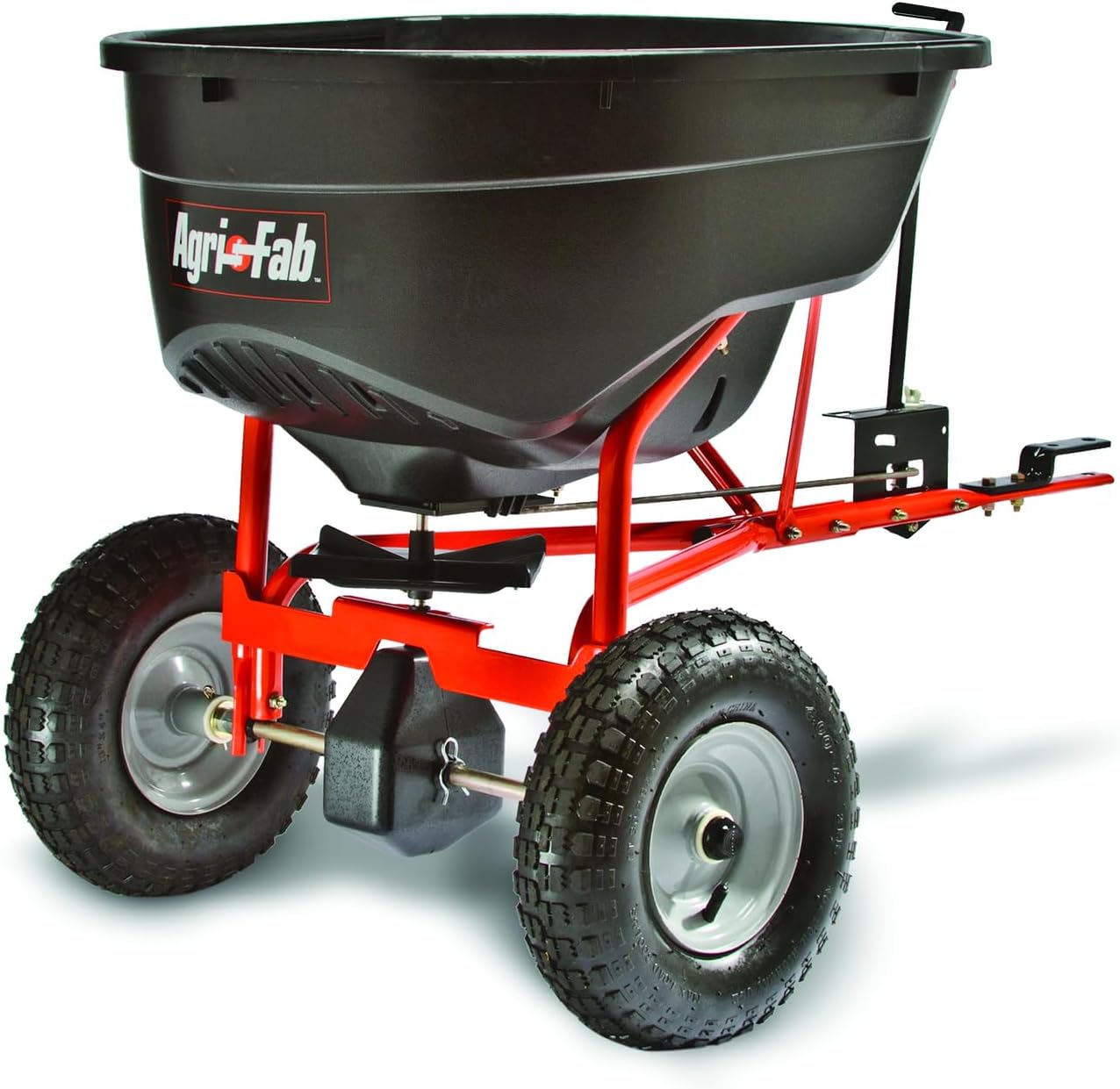
| Weight Capacity Maximum | 130 pounds |
|---|---|
| Spread Width | 10-12 ft |
| Tire Type | Pneumatic |
| Material Type | Alloy Steel, Polypropylene (PP), Rubber |
The Agri-Fab 130 lb pull-behind broadcast spreader is built for straightforward, dependable lawn care on larger yards. It mounts to most riding mowers with a universal hitch and holds up to 130 pounds, letting you cover roughly half an acre per fill to reduce interruptions. The wide 10 to 12 foot spread pattern and enclosed gear box promote more even dispersal and protect internal parts from dirt and moisture. A simple steel-rod flow control is reachable from the tractor seat so you can change application rates without stopping. The construction combines a poly hopper with alloy steel frame tubing and pneumatic tires for durability and smoother towing over uneven ground. Expect easy seasonal use for grass seed, fertilizer, granular lawn treatments, and salt. The main limitations are that it is a basic broadcast design, so very precise banding or ultra-fine calibration for specialty seed mixes may require additional passes or a different spreader type, and some assembly is required before first use.
Best for: Homeowners or property managers who want a reliable, no-nonsense tow-behind spreader to cover medium to large lawns efficiently and with minimal fuss.
Less Ideal for: Gardeners who need highly precise application patterns or small-plot users who prefer a handheld or walk-behind drop spreader for tight spaces.
- Large 130 lb hopper covers up to about 25,000 sq ft per fill to reduce refills on bigger lawns
- Universal hitch fits most riding mowers and lawn tractors for quick hookup
- Wide 10–12 ft spread width delivers even coverage with fewer passes
- Enclosed gear housing and steel frame improve durability and protect moving parts
- Seat-accessible steel-rod flow control lets you change settings without dismounting
- Broadcast design is less suited to precision banding or very narrow applications
- Requires assembly before first use
Verdict: A durable, easy-to-use tow-behind spreader that reliably covers larger lawns with fewer refills and minimal operator adjustments.
Yard Commander 125 lb Tow-Behind Broadcast Spreader

| Capacity | 125 lb |
|---|---|
| Spread radius | 10–12 ft |
| Tire type | 12-inch pneumatic tires |
| Hopper | Corrosion-resistant composite with cover |
| Gears | Cast aluminum |
The Yard Commander 125 lb tow-behind broadcast spreader is built to handle large lawns and heavier materials like fertilizer, seed, and ice melt. It mounts to tractors, riding mowers, ATVs, or UTVs via a universal hitch and uses premium cast aluminum gears to deliver a steady 10–12 foot spread radius. The corrosion-resistant composite hopper and included weather cover keep materials dry and prevent clumping during light precipitation. Large 12-inch pneumatic tires improve flotation and traction across uneven or soft turf so you can tow it over rough ground without frequent stoppages. Flow is controlled with a simple gate lever for dosing adjustments so you can tune application rate for different materials. Expect basic assembly and occasional maintenance on moving parts, and note capacity varies by material so very dense mixes may not reach the full 125 lb in practice. The unit is practical for large properties where tow-behind performance, corrosion resistance, and a wide spread pattern matter most.
Best for: Gardeners and property owners who prioritize performance and efficiency on large lawns and need a tow-behind spreader that handles varied terrain and heavier materials.
Less Ideal for: Small-lot homeowners who prefer a walk-behind unit or users who want a completely maintenance-free, plug-and-play spreader.
- Large 125 lb composite hopper resists corrosion and holds enough material to cover up to 25,000 sq ft in one fill
- Premium cast aluminum gear drive provides smoother, durable spreading and supports a 10–12 ft broadcast width
- Universal hitch fits most lawn tractors, riding mowers, ATVs, and UTVs for versatile tow-behind use
- 12-inch pneumatic tires improve flotation and traction on rough or soft terrain
- Included hopper cover reduces clumping and allows light-rain operation
- Requires assembly and periodic maintenance of moving parts
- Actual capacity and coverage depend on material density and may be less than rated with heavy mixes
Verdict: Choose this spreader if you need a durable, tow-behind broadcast unit that covers large lawns efficiently while handling rough terrain and damp conditions.
MAXSA Tow-Behind Broadcast Spreader, 110 lb Capacity

| Capacity | 110 lbs |
|---|---|
| Tire type | 10 inch pneumatic tires |
| Frame | Powder-coated steel |
| Hopper material | Rust-resistant poly |
This MAXSA tow-behind broadcast spreader is a straightforward option for homeowners who want a tractor-compatible spreader without extra bells. The 110 pound poly hopper sits on a powder-coated steel frame and pulls behind a lawn tractor, ATV, or UTV to distribute seed, fertilizer, salt, or ice melt over large yards. Large 10 inch pneumatic tires smooth towing over uneven turf and gravel, while a turn-handle flow control adjusts material output and spread width up to about 10 feet for broader, quicker coverage. A waterproof cover helps keep materials dry and makes loading easier. Because the design is simple and uses durable but economical materials, it provides reliable all-season use for routine spreading tasks, but it does not include sophisticated calibration markings or motorized delivery for precision applications. For buyers focused on basic performance and capacity for mid-to-large lawns, it offers good value; those needing fine control or commercial-grade construction should consider heavier-duty alternatives.
Best for: Homeowners with a lawn tractor or ATV who want an affordable, no-frills spreader to cover medium to large residential lawns quickly and reliably.
Less Ideal for: Professionals or users who need highly precise application rates, frequent heavy-duty use, or industrial-grade durability.
- 110 lb hopper capacity reduces refill frequency on larger lawns
- Polyethylene hopper and powder-coated steel frame resist rust and stand up to outdoor use
- 10 inch pneumatic tires provide smoother towing over uneven terrain
- Adjustable flow control and up to 10 ft spread width for fast coverage
- No motorized or precision calibration system for exact application rates
- Basic controls and construction are less suited to commercial or heavy daily use
Verdict: A cost-conscious tow-behind spreader that pairs with a lawn tractor or ATV to cover medium to large lawns efficiently with a 110 lb hopper and simple adjustable flow control.
John Deere 130-lb Tow-Behind Lawn Spreader

| Operation Mode | Manual |
|---|---|
| Number of Positions | 5 |
| Material Type | Polyethylene |
This John Deere tow-behind spreader is a straightforward, reliability-minded tool for homeowners who need to cover medium to large lawns without fuss. It mounts behind a lawn tractor and uses manual operation with five spreader positions to control application rate, so it is easy to set up and adjust while driving at a steady speed. The 130-pound polyethylene hopper resists corrosion and chemical damage better than metal, so it stands up well to repeated use with fertilizer and seed. Practical touches include a simple control linkage and a design that blends with typical tractor gear, which keeps operation predictable and low-maintenance. Limits are that it is manually adjusted rather than calibrated with a digital meter, and it lacks advanced features like variable-speed metering or an agitator for damp materials. For someone who values dependable, no-nonsense performance with durable construction, this spreader delivers consistent distribution without complicated electronics.
Best for: Homeowners who prioritize a durable, easy-to-use spreader that pairs with a lawn tractor and delivers consistent, low-maintenance performance across medium to large lawns.
Less Ideal for: Users who need laboratory-level application accuracy, automated rate control, or frequent use with wet, hard-to-flow materials should consider a professional or powered spreader instead.
- 130 lb polyethylene hopper resists rust and fertilizer corrosion
- Tow-behind design pairs with a lawn tractor for efficient coverage
- Five-position manual control lets you adjust application rate on the go
- Simple, low-maintenance mechanical operation reduces failure points
- No electronic calibration or variable-speed metering for precise rates
- Lacks an agitator so very damp materials may clump or require pre-drying
Verdict: Choose this spreader if you want a rugged, low-tech tow-behind that reliably covers large lawns with minimal maintenance.
Agri-Fab Tow-Behind Broadcast Spreader, 85 lb Capacity (Model 45-0530)

| Weight Capacity Maximum | 85 pounds |
|---|---|
| Number of Wheels | 2 |
| Tire Type | Tubeless |
| Additional Features | Heavy Duty |
The Agri-Fab tow-behind broadcast spreader is built to mount behind a lawn tractor and handle medium-sized residential jobs. It holds up to 85 pounds of granular fertilizer, seed, or ice melt and delivers a broadcast pattern up to about 10 feet wide, letting you cover lawn areas efficiently without repeated passes. Controls include an on/off gate reachable from the tractor seat so you can start and stop material flow while driving. The steel frame and pneumatic 10-inch tires give the unit durability and smoother rolling over uneven turf. Assembly is required but supported by video instructions. Important limitations are the simple mechanical flow control and lack of finer calibration features found on professional models, so achieving exact application rates may require testing and adjustment. Its size and tow design make it best for lawns roughly up to a quarter acre and for users who prefer a straightforward, robust spreader rather than a precision applicator.
Best for: Buyers who want a durable, easy-to-use tow-behind spreader for routine lawn fertilizer and seed applications and value straightforward operation over precision metering.
Less Ideal for: Not the best choice for commercial applicators or homeowners who need highly accurate calibrated rates for small or irregularly shaped lawns.
- 85 lb hopper lets you cover moderate lawns without constant refilling
- Tow-behind design with on/off gate operable from the tractor seat for convenient in-ride control
- 10-inch pneumatic tires roll smoothly over rough ground and improve stability
- Alloy steel frame and metal handle give a durable, heavy-duty build
- Flow control is basic and may need trial-and-error to dial in precise application rates
Verdict: A sturdy, no-nonsense tow-behind spreader that lets lawn tractor owners quickly cover moderate lawns without frequent refills.
Agri-Fab 185 lb Tow-Behind ATV/UTV Broadcast Spreader

| Weight Capacity Maximum | 185 pounds |
|---|---|
| Tire Type | Pneumatic Tires |
| Number of Wheels | 2 |
| Material Type | Metal, Polypropylene (PP) |
The Agri-Fab 185 lb tow-behind broadcast spreader is built to cover large yards and properties from the seat of an ATV, UTV, or small tractor. Its large polypropylene hopper holds enough material to cover roughly an acre on one fill, letting you finish jobs with fewer stops. Operation is straightforward: a raised on/off rod flow control is reachable from the vehicle seat, and a heat-treated steel gear drive with enclosed gearbox helps protect internals when spreading corrosive materials like salt or ice melt. The spread pattern reaches up to about 12 feet for fast, even coverage, and the pneumatic turf tires with ball bearings smooth transport over uneven ground. Durable alloy steel frame and rust-proof components make it suitable for year-round use. The unit is practical for homeowners and property managers who need efficient, repeatable distribution across larger areas. It is fairly large and requires a tow vehicle and storage space, and assembly and maintenance of the gearbox and tires add some upkeep compared with small hand spreaders.
Best for: Buyers who need a durable, vehicle-towed spreader to cover large lawns, acreage, or commercial properties efficiently without frequent refills.
Less Ideal for: Not a good fit for small urban yards, gardeners who prefer walk-behind or handheld tools, or anyone without a compatible tow vehicle.
- Large 185 lb hopper covers up to about 40,000 sq ft per fill to reduce downtime
- Raised flow-control rod usable from ATV/tractor seat for convenient operation
- Enclosed gearbox and rust-proof poly components resist corrosion from salt and fertilizer
- Wide spread pattern up to 12 ft speeds coverage and promotes even distribution
- Pneumatic turf tires with ball bearings improve transport over rough ground
- Requires a tow vehicle and significant storage space when not in use
- Heavier, larger unit that needs occasional gearbox and tire maintenance
Verdict: If you want a robust tow-behind spreader that handles large areas with fewer refills and seat-mounted control, this 185 lb Agri-Fab model is a practical choice.
Choosing the Right Fertilizer Spreader for Lawn Tractor: Key Factors to Consider
Hopper Capacity and Refilling Frequency
Hopper capacity determines how often you need to stop and refill while treating a lawn. Larger hoppers reduce interruptions during long runs and save time when you have several acres, but a bigger hopper adds weight and may require a sturdier hitch or mounting point on older tractors.
Think about the typical amount of fertilizer you apply per pass and how long your tractor runs comfortably with extra rear weight. If you fertilize frequently in small amounts, a mid-sized hopper can offer the right balance between convenience and handling.
Spread Pattern and Consistency
Uniform distribution is the most important factor for preventing over-application and patchy growth. Inspect how a spreader distributes material across its working width and whether the pattern remains even at common tractor speeds. Variations in flow rate, deflectors, or faulty agitators can create streaks that show up as uneven color or growth in the lawn.
Consider how the spreader handles different granule sizes and whether a cover or agitator helps prevent clumping. Consistency also affects how accurately you apply labeled fertilizer rates, which matters for plant health and environmental stewardship.
Mounting, Hitching, and Compatibility
A spreader that does not fit your tractor's hitch or cargo arrangement quickly becomes impractical. Some units mount to a three-point hitch, others bolt to a rear carrier or tow behind like a cart. Check the attachment style against your tractor's specifications and whether any adapters are needed.
Also consider how the added mass affects tractor handling and turning clearance. Ease of mounting and quick-release features make seasonal installation easier and reduce the likelihood of leaving a unit attached when it is not needed.
Flow Control and Application Rate Accuracy
Precise flow control matters for applying the right quantity per 1,000 square feet. Look for spreaders with adjustable gates, clear rate markings, and mechanisms that maintain a steady flow even at typical tractor speeds. Poor flow control increases waste and risks overfeeding delicate turf.
Flow adjustments should be simple to change from the seat or during a pause in work, and they should hold settings reliably across a full job. A logical indexing system and a readable chart for common fertilizers simplify setting rates.
Durability and Resistance to Corrosion
Fertilizers can be corrosive or moisture-attracting, so materials and finishes matter for longevity. Polyethylene hoppers resist rust but can be damaged by UV exposure; painted steel is strong but needs good coatings or galvanization to avoid rust.
Consider maintenance needs: how easy is it to rinse and dry the hopper, replace worn parts, or lubricate moving components? Durability influences long-term ownership cost and the consistency of spread patterns over multiple seasons.
How Tractor Speed and Pass Width Affect Application
Tractor speed and the working width you choose together determine how much product is laid down per pass. Going faster without adjusting the flow rate increases the rate per square foot and can lead to overapplication; going slower has the opposite effect. Match the spreader's recommended settings to a realistic cruising speed you can maintain while mowing or driving the field.
If you plan to use wider passes, look for spreaders with proven consistency across that width. Working wider can save time but requires confidence that the outer bands of the pattern are as even as the center to avoid missed strips.
- Test a small, measured swath before treating the whole lawn to confirm rate and pattern.
- Make multiple passes with overlapping edges only as recommended to avoid double-feeding.
- Adjust speed and gate settings together rather than changing one variable at a time.
Material Compatibility and Agitating Systems
Granule size and moisture content vary between lawn fertilizers, seed mixes, and ice melt. Some spreaders have active agitators or shaking plates to keep material flowing, while others rely on gravity and simple paddles. Consider what you commonly use and whether the spreader has a mechanism to prevent clogging and bridging at the gate.
If you will apply seed or mixes in addition to fertilizer, check that the spreader can handle both without damaging delicate seed or creating uneven distribution.
- Choose a model with a removable agitator if you need to clean or switch materials often.
- Look for smooth internal hopper walls to reduce bridging and make cleanup easier.
Storage, Winter Care, and Maintenance Tips
Proper storage after each season extends service life. Empty and thoroughly dry the hopper, rinse components that contacted fertilizer, and store the unit under cover to protect from UV and moisture. Small maintenance steps such as greasing pivot points and checking fasteners reduce wear.
Inspect the spreader before the season for cracked housings, worn gates, and damaged mounting hardware. Replace corroded bolts and tighten hitch connections to preserve safe operation.
- Always empty the hopper before long-term storage to avoid corrosion.
- Keep a small parts kit with spare pins and fasteners handy for field repairs.
Practical Setup Tips for a Smooth First Run
Before treating your whole lawn, set up a measured test area to confirm application rate settings and pattern. Use chalk, flags, or a measured tape to mark a known width and apply a single pass to see how the material lays. This helps you fine-tune gate settings and speed for consistent results.
Record the settings that worked for your fertilizer type and lawn conditions. A short log saved on your phone or in the tractor cab saves repeated recalibration in subsequent seasons.
- Calibrate with a small quantity of product and clear measurements.
- Adjust one variable at a time: speed, then gate setting, then overlap.
Safety Considerations when Spreading Fertilizer From a Tractor
Always follow label instructions for the fertilizer and personal protective measures. Keep children and pets away from the working area while applying and until dust or granules have settled. Be mindful of wind direction when broadcasting to avoid drifting onto sidewalks, driveways, or neighboring properties.
Securely fasten the spreader and check that the attachment does not obstruct lights or signals if you will transport the tractor on a driveway. Use appropriate eye and skin protection when loading and cleaning the hopper.
- Avoid turning sharply at full speed with a heavy rear-mounted hopper.
- Keep hands clear of moving agitators and gates while the tractor is running.
How We Chose the Best Fertilizer Spreader for Lawn Tractor
We evaluated candidates using criteria that matter to gardeners who use a lawn tractor for routine fertilizing. Key dimensions included hopper capacity for how much material a unit holds between refills; spread pattern and consistency because uniform coverage prevents burned spots and patchy growth; mounting and hookup options to match common tractor hitches and cargo beds; and construction durability against corrosion when used with granular fertilizers and salt. We also considered control features such as adjustable flow rates and gate mechanisms that let you dial application rates precisely. Ease of cleanup and compatibility with common fertilizer types were additional filters. Units were excluded if they were designed exclusively for handheld or push use, lacked basic mounting compatibility with tractors, or failed to provide clear flow-adjustment mechanisms. The final shortlist emphasizes spreaders that balance capacity, control, and long-term reliability for routine lawn feeding from a tractor platform.
FAQ
Can I tow a fertilizer spreader behind any lawn tractor?
Many spreaders are designed to be towed by common lawn tractors, but compatibility depends on hitch type and tow rating. Check your tractor's hitch and load capacity and verify the spreader's mounting options before purchase.
How often should I calibrate my spreader?
You should calibrate each season and whenever you change fertilizer type or working width. Calibration helps confirm that gate settings and tractor speed result in the labeled application rate under your specific conditions.
Is it better to use a large hopper or make more passes with a smaller one?
A larger hopper reduces refill stops and is helpful for bigger lawns, but it adds weight and may affect handling. For smaller yards, a mid-size hopper often balances convenience with easier maneuverability.
Can I spread seed with a fertilizer spreader designed for granules?
Some spreaders handle both seed and fertilizer, but seed sizes and fragility vary. Look for a spreader with an adjustable flow and gentle agitator, and always test on a small area to confirm the pattern and avoid seed damage.
How do I prevent corrosion from fertilizer residue?
Empty and rinse the hopper after use, dry components thoroughly, and store the unit under cover. Choosing corrosion-resistant materials and touching up protective coatings on metal parts also reduces long-term damage.
Final Verdict
When choosing a fertilizer spreader for lawn tractor use, prioritize even distribution and a hopper size that fits your lawn area and tractor capacity. Flow control precision and reliable mounting are the next most important aspects because they directly affect application accuracy and safety. Acceptable tradeoffs include choosing a slightly smaller hopper for easier handling or a heavier-duty frame if you need season-after-season durability. Focus on spread consistency, compatibility with your tractor, and maintenance needs to pick a spreader you will use confidently for years.
