

Note: This article contains affiliate links. If you click on these links and make a purchase, I may earn a small commission at no extra cost to you. This helps support my research and content. Read my full affiliate disclosure here.
When ants appear inside, you need a solution that stops colonies without creating new hazards for kids, pets, or houseplants. Choosing the right in home ant trap affects how quickly trails disappear, whether returning workers carry poison back to the nest, and how long control lasts. This guide covers seven shortlisted in home ant traps that suit typical household scenarios, from kitchens and utility rooms to basements and sunrooms. We evaluated each option on bait effectiveness, placement flexibility, and household safety so you can pick a trap that fits your layout and concerns. Read on for practical guidance on where and how to use traps, setup tips, and the decision factors that matter most when keeping ants out of living spaces.
Top Picks at a Glance
| Best Overall The best all-around choice for most situations | TERRO Liquid Ant Killer Bait Stations, 12-Pack (T300B) |  |
| Best Quality Built to a higher standard if you want something more solid | TERRO Liquid Ant Bait Stations, 18 Count (3 Pack) |  |
| Best Value The sweet spot between price and what you get | TERRO Liquid Ant Killer 3-Pack (T200-3SR) |  |
| Best Budget The cheapest option that still gets the job done reliably | HOT SHOT MaxAttrax Ant Bait Stations, 4 Count |  |
| Highest Rated A top-rated pick with lots of positive feedback | ROUTADE 48-Pack Slow-Acting Ant Gel Bait Stations |  |
| Most Popular A crowd favorite that many people choose with confidence | Raid Ant Killer Baits, 8 Count (Child-Resistant) |  |
| Best Seller A high-volume bestseller chosen again and again | TERRO Multi-Surface Liquid Ant Baits, 8-Count |  |
TERRO Liquid Ant Killer Bait Stations, 12-Pack (T300B)

| Unit Count | 12 Count |
|---|---|
| Item Form | Liquid |
| Target Species | Insects |
| Active Ingredients | Sodium Tetraborate Decahydrate (Borax), 5.40% |
Terro Liquid Ant Killer bait stations are prefilled, single-use traps designed for indoor control of common sugar-loving ants. You place the small stations along baseboards, in corners, under appliances, or on countertops where you see ant activity. Worker ants are drawn to the sweet liquid, feed on it, and take it back to the nest so the borax-based active ingredient can eliminate the colony over days to weeks. The product is easy to use with no mixing or setup and the 12-pack gives coverage for several rooms. Because the bait is contained inside a low-profile plastic station, it reduces incidental contact risk compared with loose sprays or powders and lasts for weeks while ants continue to visit. Limitations are that the formula targets sugar-preferring species so very protein- or grease-attracted ants may ignore it, and control can take 2 to 4 weeks for larger infestations. Also stations should be placed away from pets and children despite the contained design since the bait contains borax.
Best for: Homeowners who prioritize an easy, low-hassle indoor solution and want a bait that works at the colony level with minimal hands-on pest handling.
Less Ideal for: People who need immediate knockdown of ants or who have pets or children that frequently access treated areas and cannot reliably keep them away from placed stations.
- Ready-to-use stations require no mixing or setup
- Designed to be carried back to the nest for colony-level control
- Low-profile enclosed bait reduces messy exposure compared with loose liquids or sprays
- 12 stations provide coverage for multiple rooms or hotspots
- Formulation is sugar-based so less effective on ants that prefer protein or grease
- Control can take 2–4 weeks for large or established colonies
Verdict: A simple, low-contact indoor bait system that reliably reduces sugar-loving ant infestations by getting worker ants to carry borax back to the colony.
TERRO Liquid Ant Bait Stations, 18 Count (3 Pack)

| Unit Count | 18 Count |
|---|---|
| Item Form | Liquid |
| Target Species | Insects |
| Active Ingredients | Sodium Tetraborate Decahydrate (Borax) |
| Specification Met | EPA |
TERRO Liquid Ant Bait Stations are compact, ready-to-use traps that use a sweet liquid bait containing borax to attract foraging ants and carry the poison back to the colony. Typical use is placing the small stations along baseboards, in corners, behind appliances, or on counters where you see ant trails; no mixing or setup is required beyond opening the tab. The kit includes 18 bait stations (three packs of six) and the liquid formula is kept from drying by the sealed station design so it stays attractive for extended periods. Practical benefits include quick visible reduction in worker ants within a few days and the potential to eliminate the colony if placements are maintained until the bait is gone. Limitations: it is for indoor use only and works on ants that take sweet baits, so species that prefer greasy or protein foods may be less affected; results can take up to two to four weeks for full control and you should remove competing food sources for best results.
Best for: Homeowners or renters who want a low-effort, evidence-backed way to target kitchen ant trails and remove colonies without sprays, and who prefer products with a strong track record and social proof.
Less Ideal for: People needing immediate knockdown of visible ants or those dealing with species that avoid sweet baits should consider fast-acting sprays or alternative bait types instead.
- Ready-to-use stations require no mixing or tools
- Sealed liquid design resists drying so bait remains attractive over time
- Attracts worker ants that share bait, which can eliminate the colony
- Includes multiple stations for widespread placement around a kitchen
- Indoor-only product not formulated for outdoor use
- Relies on ants accepting a sweet bait so may be less effective on non-sugar-seeking species
Verdict: A ready-to-use, proven liquid bait kit that targets kitchen ant trails and can eliminate colonies with minimal effort.
TERRO Liquid Ant Killer 3-Pack (T200-3SR)

| Item Form | Liquid |
|---|---|
| Active Ingredients | Sodium Tetraborate Decahydrate (Borax) 5.40% |
| Target Species | Insects |
| Specification Met | EPA |
TERRO Liquid Ant Killer is a straightforward indoor bait system designed to eliminate common household ants by having workers feed on a borax-based liquid and transfer it to the colony. You apply drops of the bait onto the included cardboard tiles and place them along ant trails, baseboards, counters, and other activity hotspots. The 3-pack gives multiple bait stations for treating several rooms or repeated placements. The active ingredient, sodium tetraborate decahydrate, works slowly enough to be shared among nestmates so the queen and hidden workers are affected, which can produce visible reductions in a few days. Because the formulation is liquid and comes in drip bottles, placement and reapplication are simple and low-mess compared with granular or spray options. Limitations are that the product is intended for indoor use only and requires ants to find and feed on the bait, so heavily contaminated or outdoor nests may need additional measures. When used as directed it is a practical, low-effort solution for routine household infestations.
Best for: Homeowners wanting a low-effort, indoor-focused solution to eliminate sugar ants and other household species who prefer baiting over sprays.
Less Ideal for: People who need immediate knockdown of visible ants outdoors or who require a product for large external infestations should look at targeted outdoor nest treatments.
- Borax-based liquid attracts worker ants and allows transfer to the colony for more complete elimination
- Three 2 oz bottles provide multiple placements for whole-house coverage
- Simple drop application on included cardboard tiles makes setup and reapplication low-mess
- EPA specification met and formulated for common household ant species including sugar and ghost ants
- Only effective if ants discover and consume the bait, so results depend on placement and ant behavior
- Designed for indoor use and may not address outdoor nests feeding into the house
Verdict: A simple, effective indoor bait that uses borax to knock out sugar ant colonies by relying on worker-to-colony transfer.
HOT SHOT MaxAttrax Ant Bait Stations, 4 Count

| Brand | HOT SHOT |
|---|---|
| Unit Count | 4 Count |
| Item Type Name | Ant Bait |
| Active Ingredient | Indoxacarb (0.05%) |
| Use | Indoor and outdoor |
Hot Shot MaxAttrax Ant Bait Stations are small, child-resistant bait units preloaded with an indoxacarb-based attractant designed to be placed along ant trails indoors or just outside the home. In use you simply break the pack apart and set the stations in out-of-the-way locations such as along baseboards, under sinks, in cabinets or near exterior entry points. The bait is formulated to attract both sugar- and grease-feeding ants and begins killing visible ants within a day while the foraging workers carry poison back to the nest. The stations are low-maintenance and claim residual activity for up to three months indoors, with replacement guidance for continued control. Practical benefits include no-mess placement and a child-resistant housing that reduces accidental access. Limitations are that this is a short-term pack of four stations so heavy or widespread infestations may require multiple purchases and targeted placement for best effect, and the product contains an active insecticide so care is needed around pets and sensitive areas.
Best for: Buyers who want an affordable, ready-to-use indoor ant control option to place along known trails and in common ant hotspots without mess or complicated setup.
Less Ideal for: Homeowners dealing with extensive outdoor colonies or very large infestations who need broad perimeter treatment or professional-level solutions.
- Child-resistant bait stations reduce accidental access
- Attractant targets both sugar- and grease-feeding ants
- Begins killing ants quickly, often within 24 hours
- Long-lasting indoor protection claimed up to three months
- Only four stations per pack, may be insufficient for large or severe infestations
- Contains an active insecticide so placements must avoid pet and non-target exposure
Verdict: A simple, budget-friendly pack of child-resistant bait stations that provides quick, no-mess indoor ant control for small to moderate problems.
ROUTADE 48-Pack Slow-Acting Ant Gel Bait Stations

| Unit Count | 48 Count |
|---|---|
| Item Form | Gel |
| Target Species | Ants |
| Included Components | Ant gel bait |
This 48-pack of ROUTADE slow-acting ant gel bait stations is built for systematic, long-term ant control in and around the kitchen. Each station contains a gel formula that worker ants consume and carry back to the nest, which helps reduce the entire colony rather than only visible foragers. The product is supplied in ready-to-use stations with adhesive tape so you can place them along baseboards, in cabinets, near sinks, and on entry thresholds without messy sprays or frequent repositioning. The large pack lets you deploy multiple stations in high-traffic areas and replace them over time for continuous coverage. Because the formula is slow-acting, it is effective against a range of common household species including carpenter ants and sugar ants, but it requires several days to weeks to knock down a colony and will not give instant removal of visible ants. Also the stations are small and contain gel rather than a tamper-resistant hard block, so keep them away from children and pets. For someone wanting a low-maintenance, colony-focused approach to kitchen ant problems, this kit makes it easy to set and forget while the bait works.
Best for: Homeowners who prioritize reliable, long-term elimination of ant colonies in kitchens and want a low-maintenance bait they can deploy across multiple hotspots.
Less Ideal for: People who need an immediate knockdown of visible ants or who require childproof solid bait stations should consider alternatives.
- Slow-acting gel designed for worker ants to carry bait back to the nest for colony-level control
- Ready-to-use bait stations with adhesive for easy placement along baseboards and in cabinets
- 48-count pack provides broad coverage around a kitchen and enough replacements for extended use
- Versatile for indoor and outdoor placement to block entry points and high-traffic ant routes
- Slow-acting formula takes days to weeks to eliminate a colony so visible results are not immediate
- Gel in small stations may require careful placement to keep away from children and pets
Verdict: A practical, deploy-and-forget gel bait kit for reliable colony-level control of kitchen ant infestations.
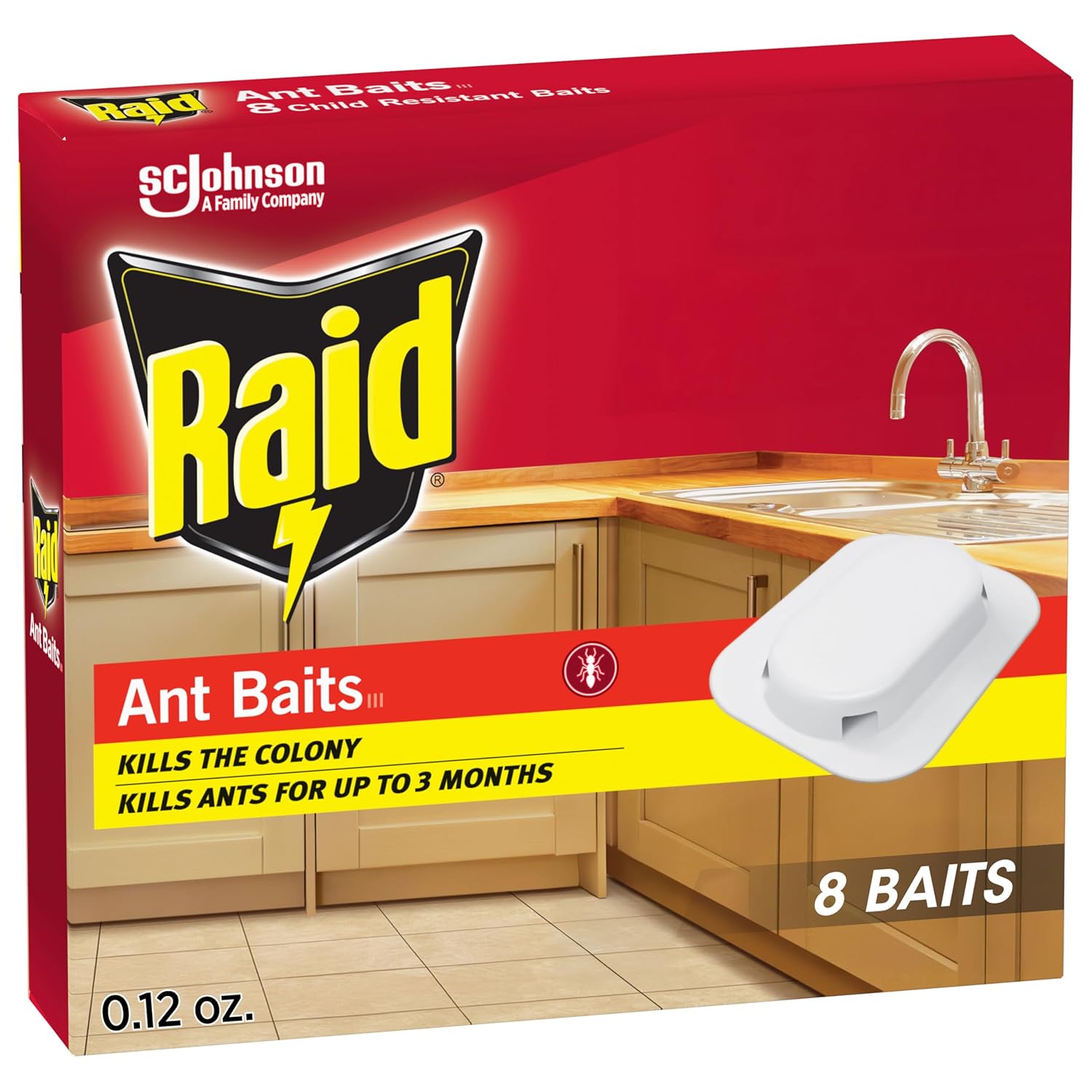
Raid Ant Killer Baits, 8 Count (Child-Resistant)
| Package quantity | 8 Count |
|---|---|
| Child safety | Child-resistant |
| Intended use | Indoor |
| Effect duration | Up to 3 months |
These Raid Ant Killer Baits are small, ready-to-use indoor stations that dispense an attractive liquid bait ants carry back to the colony, which can eliminate the nest over time. You place the bait along walls, in corners, and near entry points where small ants forage; after ants feed, the active ingredient is shared with other colony members, including the queen, and protection can last for weeks. The child-resistant design reduces accidental access in homes with children while the compact stations are low-profile and easy to position. Because they are prefilled and disposable, there is no mixing or measuring, which makes them convenient for quick treatment in kitchens, pantries, and baseboards. Limitations are that the product is for indoor use only and may be less effective if competing food sources are left available or if multiple heavy infestations require broader perimeter treatment. For someone looking for a simple, no-fuss bait to try first, these are a practical option.
Best for: Budget-minded homeowners or renters who want an easy, low-effort indoor solution to control small ant trails and try baiting before calling for broader treatments.
Less Ideal for: People needing immediate knockdown for very large or outdoor ant colonies or those who prefer non-chemical mechanical control methods.
- Ready-to-use prefilled bait stations that require no setup
- Child-resistant design reduces accidental access
- Bait formula is transferred through the colony to target the queen
- Compact, low-profile stations are easy to place along walls and entry points
- Intended for indoor use only, not suited for outdoor colony control
- May be less effective if other food sources are available or in very large infestations
Verdict: A low-cost, no-fuss indoor bait station that effectively targets small ant colonies by having foragers carry bait back to the nest.
TERRO Multi-Surface Liquid Ant Baits, 8-Count

| Unit Count | 8 Count |
|---|---|
| Target Species | Insects |
| Recommended Uses For Product | Indoor |
| Material Type | Plastic |
These TERRO Multi-Surface Liquid Ant Baits are ready-to-use stations that let you place bait nearly anywhere indoors to tackle small household ants. Each station contains a sweet borax-based liquid that lures worker ants, which then carry the slow-acting poison back to the nest to reach hidden members of the colony. The multi-surface design and included adhesive strips mean you can lay the stations flat or stick them to walls, under cabinets, and other discreet spots out of the way of people and pets. In practice you may see more ants at first as they discover the bait, but activity typically falls within days and complete control can take two to four weeks. The product is simple to deploy and monitor, with pre-filled, discreet stations that blend into home decor. Limitations are that it is an indoor bait only and relies on ants finding and feeding from the stations, so heavily infested homes or species that do not accept sweet baits may need additional measures.
Best for: Homeowners who want a low-effort, discreet indoor solution to control small household ants and prefer baiting over sprays or traps.
Less Ideal for: People needing outdoor or broad-spectrum pest control or those dealing with ant species that do not feed on sweet baits should look at other methods.
- Pre-filled, ready-to-use stations for quick deployment
- Multi-surface design with adhesive strips allows versatile, discreet placement
- Slow-acting borax formulation spreads through the colony for broader control
- Noticeable reduction in ant activity within days when ants accept the bait
- Indoor use only so not suitable for outdoor ant control
- Effectiveness depends on ants preferring the sweet liquid bait over other food sources
Verdict: A simple, versatile indoor bait option that quietly eliminates small household ant colonies by letting worker ants carry borax back to the nest.
Choosing the Right In Home Ant Trap: Key Factors to Consider
Bait Composition and Attractiveness
Bait formulation determines how likely worker ants are to accept and carry it back to the colony. Sugary baits work well on sugar-feeding species, while protein- or grease-based baits target omnivorous or grease-feeding ants. If the bait is rejected, you will see trails continue even after deployment.
Consider seasonal feeding patterns too: some ant species switch preferences depending on brood cycles. A trap with a clearly labeled bait type helps you match the product to the ants you observe, increasing the chance of colony-level control rather than just killing foragers at the bait station.
Delayed-Action Toxicity and Nest Transfer
For effective colony control, the active ingredient should act slowly enough that foragers have time to return to the nest and share the bait with other ants and brood. Fast-acting contact killers may remove visible workers but rarely stop the colony.
Look for traps formulated with delayed-action agents and delivery systems that encourage trophallaxis, the food-sharing behavior ants use. This increases the chance of reducing reproductive individuals and brood inside wall voids or nearby soil, leading to longer-lasting results.
Child and Pet Safety Features
Indoor ant control must balance effectiveness with minimizing exposure risks. Child-resistant housings, tamper-evident seals, and clear labeling about active ingredients reduce accidental contact. If you have crawling toddlers or curious pets, rigid enclosed stations are safer than open gels or loose granules.
Placement matters too. Even a child-safe trap can be risky if placed on the floor within reach. Consider traps that can be mounted or tucked behind appliances, and always follow product instructions regarding access and disposal.
Placement Flexibility and Form Factor
Ants travel along predictable trails, so traps that conform to narrow spaces or can be placed at right angles to baseboards are more useful in tight indoor environments. Slimline stations fit along cabinet edges, while knot-style bait placements may be better for cracks and crevices.
Consider whether you need waterproof housings for use near sinks, adhesive bases to prevent knock-overs, or discreet colors that blend with interiors. A trap that is easy to position and keep out of the way will be used more consistently, improving control outcomes.
Durability and Replacement Interval
Some traps hold bait for weeks, while others need frequent replacement. Longevity matters if you want low-maintenance protection, but overly old bait can dry out and lose attractiveness. Check how long a trap remains effective in real indoor conditions and whether refills are available.
Also consider storage life before opening and how easy it is to swap spent traps. Frequent replacement costs time and can lead to gaps in control if you miss changing stations, so choose a balance between long life and sustained bait attractiveness.
Visibility and Non-Target Contact Risk
Visibility affects whether household members will accidentally disturb stations and whether ants are drawn to the bait. Highly visible traps may alert curious children or pets; overly stealthy ones might be overlooked when monitoring progress.
Non-target contact risk includes spills, loose gels, and accidental ingestion. Prefer enclosed bait stations or sealed cartridges in busy homes. If you need to treat a high-traffic area, prioritize containment features and clear placement instructions to reduce accidental exposure.
Identifying the Ants and Their Trails
Start by watching when and where ants appear. Morning versus evening activity, whether they head for sugary spills or greasy residues, and the width of the trail help indicate species and feeding preferences. If trails converge at a wall crack or baseboard seam, that is a likely access point to target with a trap.
- Follow the line to find entry points near windows, doors, pipes, and appliance seals.
- Note what ants are feeding on before choosing a bait type.
Best Places to Place Indoor Traps
Place stations along active trails, near entry points, and tucked against walls where ants move in single-file. In kitchens, position traps inside cabinets near the baseboard or behind dishwashers rather than directly on countertops. Bathrooms, laundry rooms, and utility closets are common access corridors and often benefit from slimline stations.
- Avoid high-traffic floor areas where traps can be knocked over.
- Use multiple small stations for long trails rather than one large bait in a single spot.
Monitoring Progress and When to Replace
Check stations daily during the first week to confirm bait consumption and trail reduction. An uptick in activity around a trap usually means the bait is attractive. If no ants visit within three to five days, switch bait types or relocate the station closer to trails. Replace spent cartridges per manufacturer guidance or when bait is depleted or dried out. Keep a simple log of placement and replacement dates to spot patterns and measure control duration.
- Record bait uptake and trail changes over two weeks to assess effectiveness.
- Move stations gradually toward the suspected nest if trails shrink but activity continues further along the route.
Safe Use in Homes with Children and Pets
Use enclosed stations with child-resistant latches and mountable options to keep bait out of reach. Store unused refills in their original packaging, away from food and living areas. If you must use gels or open baits, apply them inside sealed corners or in tamper-proof holders designed for indoor use. Educate household members about bait locations and never place traps on surfaces where food is prepared or served.
- Mark trap locations with a small unobtrusive sticker so you can check them without moving furniture.
- Keep emergency contact info and ingredient labels stored with other household safety info.
Combining Traps with Sanitation and Exclusion
Baits work best alongside good sanitation and blocking entry points. Wipe up spills promptly, store food in sealed containers, and seal gaps around pipes and doors to reduce attractants. Traps reduce worker numbers, while exclusion prevents reinfestation from outside sources. Inspect exterior entry points and repair weatherstripping or mesh screens where ants might gain access. Reducing attractants lowers the number of stations needed and speeds control.
- Clean up pet food and fallen fruit promptly.
- Use door sweeps and caulk to block common tiny entry gaps.
How We Chose the Best In Home Ant Trap
We selected these in home ant traps by applying practical, garden-to-kitchen filters that reflect how people actually deal with indoor ant problems. Primary evaluation criteria included bait attractiveness and delayed-action potency to encourage workers to carry bait back to nest sites, physical trap design and placement flexibility for use along baseboards and inside cabinets, and safety features such as child-resistant housings and pet-safe formulations. We also tested longevity metrics reported by manufacturers and user reports for how often traps need replacing, plus the clarity of usage instructions and resistance to accidental spills. Exclusions included outdoor-only baits, DIY granular poisons not designed for indoor containment, and traps lacking clear safety labeling. The final list emphasizes measures that reduce active trails, minimize exposure risks in homes, and simplify placement and maintenance for typical household layouts.
FAQ
How long before I see results after placing an indoor ant trap?
Often you will notice reduced trail activity in a few days if the bait is attractive. Colony-level success can take one to three weeks depending on species and bait transfer. If there is no activity at the station after several days, try a different bait type or reposition it.
Are indoor ant traps safe around pets and children?
Many enclosed stations are designed to limit direct access and reduce risk, but safety depends on placement and product construction. Keep traps out of reach, use mounting options if available, and avoid open gels in homes with curious pets or toddlers.
Can I use indoor traps for outdoor ant problems near the house?
Indoor-formulated traps are optimized for enclosed spaces and may not withstand weather or attractants found outdoors. For perimeters and garden areas, choose products labeled for outdoor use. Placing indoor stations just inside entry points can help intercept ants entering the home.
What if ants ignore the trap bait?
Bait rejection is common with wrong bait types or aged, dried bait. Try a sugar-based option if ants are going after sweets, or a protein/grease bait for kitchen grease-feeding species. Relocate the station closer to the active trail and monitor for uptake.
How many traps should I deploy in a typical kitchen?
Deploy several small stations along observed trails and near likely entry points rather than one central station. Three to five stations spread along the route often achieves faster pickup and reduces the chance of ants missing the bait.
Can I reuse trap housings when the bait is spent?
Many housings are reusable if cleaned according to instructions, but avoid contaminating fresh bait with residue. Some designs accept sealed refills to minimize handling and maintain safety.
Final Verdict
For indoor ant control, prioritize bait attractiveness and safe containment. Match bait type to what ants are feeding on, place enclosed stations along active trails, and check them frequently during the first two weeks to confirm uptake. Balance longevity with the need to replace dried or depleted baits, and favor stations with mounting or child-resistant features in homes with children or pets. When you combine targeted traps with good sanitation and exclusion work, you get the most reliable interruption of ant activity without creating additional household risks. Choose traps that fit your floorplan and safety needs, and you will have a clear path back to ant-free living spaces.
