

Note: This article contains affiliate links. If you click on these links and make a purchase, I may earn a small commission at no extra cost to you. This helps support my research and content. Read my full affiliate disclosure here.
Choosing the right safe pre-emergent herbicide matters for maintaining a healthy lawn without harming nearby flowers, vegetables, or ornamentals. The wrong product or timing can stress turf or stunt desirable plants while failing to stop spring annual weeds. This guide looks at seven shortlisted, gardener-minded options selected for effective residual control and reduced non-target injury. Below we explain how these options behave in real lawns, what performance and safety features we evaluated, and which product traits fit different yard setups and timing strategies.
Top Picks at a Glance
| Best Overall The best all-around choice for most situations | The Andersons Barricade DG Pro Pre-Emergent Granules (50 lb) |  |
| Best Quality Built to a higher standard if you want something more solid | The Andersons Barricade Granular Pre-Emergent Weed Control (18 lb, covers 5,800 sq ft) |  |
| Best Value The sweet spot between price and what you get | Lawn Synergy Safeguard 0-0-7 Pre-Emergent Lawn Fertilizer (50 lb) |  |
| Best Budget The cheapest option that still gets the job done reliably | Preen Garden Weed Preventer, Pre-Emergent Granules, 16 lb (covers 2,560 sq. ft.) |  |
| Highest Rated A top-rated pick with lots of positive feedback | Quali-Pro Prodiamine Pre-Emergent Herbicide, 5 lb Granules |  |
| Most Popular A crowd favorite that many people choose with confidence | The Andersons Barricade Professional-Grade Granular Pre-Emergent Weed Control (40 lb) |  |
| Best Seller A high-volume bestseller chosen again and again | Preen Extended Control Weed Preventer, 13.75 lb. |  |
The Andersons Barricade DG Pro Pre-Emergent Granules (50 lb)

| Item Form | Granule |
|---|---|
| Coverage | 14,200 square feet |
| Active Ingredients | prodiamine |
Barricade DG Pro is a granular pre-emergent intended to prevent weed seed germination across established turf, landscape beds, and large turf installations. You apply it evenly over the target area in early spring or fall then water it in to activate the prodiamine, which forms a barrier at the soil surface to stop weed seedlings. The DG Pro granule formulation is designed to deliver more particles per square inch, improving coverage and consistency across the labeled 14,200 sq ft coverage. Practical benefits include long-lasting prevention of over 30 common grass and broadleaf weeds and a formulation trusted by turf professionals for large lawns, sports fields, and sod farms. Limitations are that it will not control weeds that are already established and it requires careful timing and follow-up watering to be effective; protective clothing is recommended during application because of the active ingredient. For homeowners focused on performance, it offers professional-level results when used as directed.
Best for: Buyers who prioritize turf performance and long-term weed prevention for large lawns, sports fields, or professional turf areas and who follow seasonal application schedules.
Less Ideal for: Not a good choice for gardeners seeking a quick fix for existing weed patches or for very small container or indoor plantings.
- Professional-grade active ingredient prodiamine for reliable pre-emergent control
- Granular DG formulation provides higher particle count for more uniform coverage
- Labeled coverage large enough for big lawns and turf areas (14,200 sq ft)
- Effective against over 30 common grassy and broadleaf weeds when applied correctly
- Does not kill existing weeds so requires pre-emptive timing and planning
- Requires watering after application to activate which adds a step to treatment
Verdict: Choose Barricade DG Pro when you want a professional-grade pre-emergent that delivers broad, long-lasting weed prevention across large turf areas.
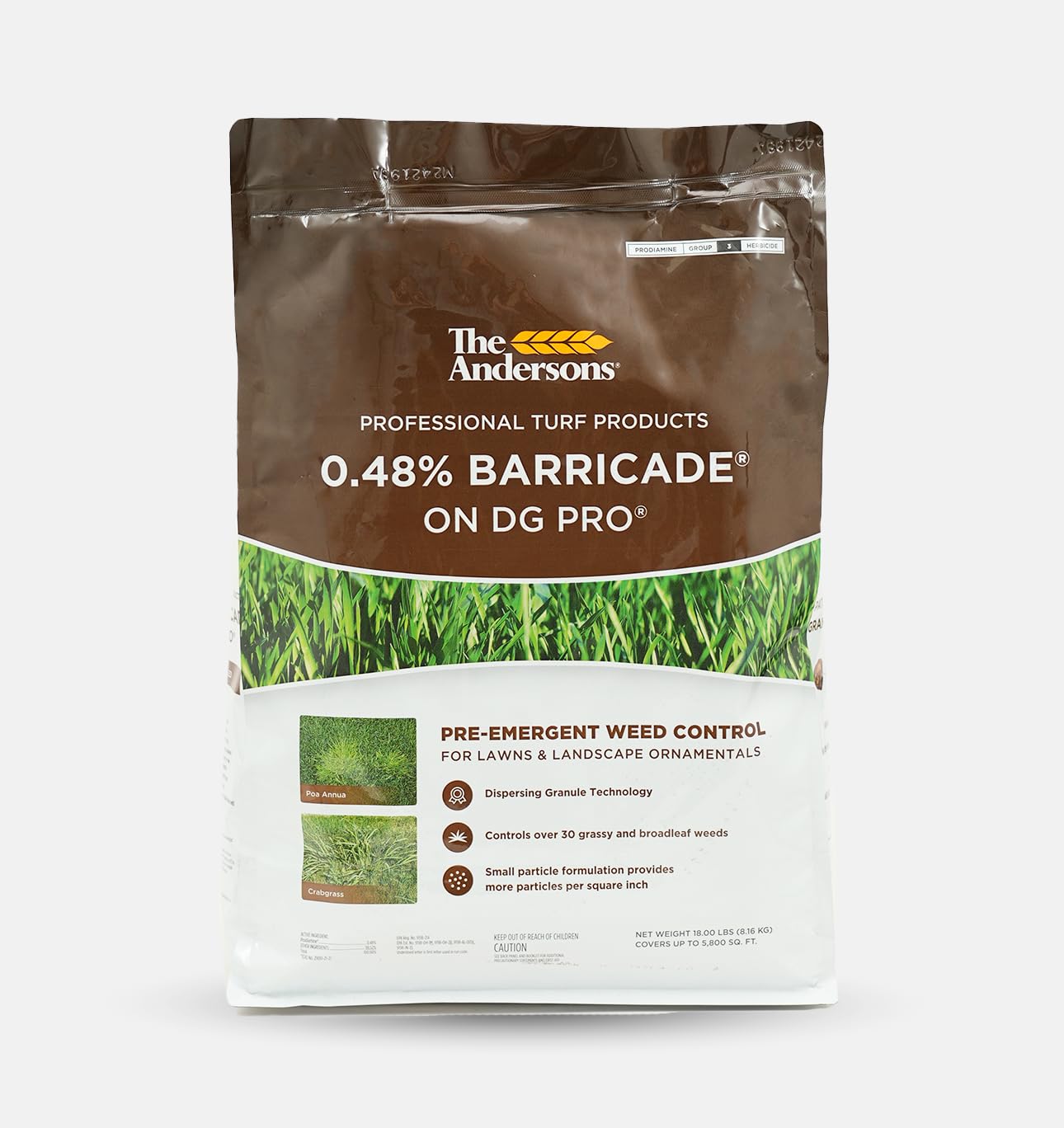
The Andersons Barricade Granular Pre-Emergent Weed Control (18 lb, covers 5,800 sq ft)
| Item Form | Granule |
|---|---|
| Coverage | 5800 square feet |
| Unit Count | 288 Ounce |
| Active Ingredients | Prodiamine 0.48% |
Barricade is a granular pre-emergent that stops common lawn weeds before they emerge, using 0.48% prodiamine in a dispersible granule formula. You apply it across the lawn in early spring or fall and water it in so the small DG Technology particles dissolve and move the active ingredient into the soil. That combination gives broader, more even coverage per square inch and is especially aimed at preventing crabgrass, poa annua and other annual grassy and broadleaf weeds across up to 5,800 square feet from a single 18 pound bag. The product is straightforward to use with a spreader and fits routine seasonal maintenance plans. Important limits are that it will not kill weeds already established and must be timed correctly for best effect. Also, because it is a professional-strength herbicide buyers should follow safety directions closely and keep pets and children off treated areas until safe.
Best for: Homeowners who plan seasonal lawn maintenance and want a single, high-coverage pre-emergent to prevent crabgrass and common annual weeds across medium to large yards.
Less Ideal for: People needing a post-emergent solution for existing weeds, or gardeners who prefer non-chemical weed control methods.
- Designed to prevent both grassy and broadleaf annual weeds including crabgrass and poa annua
- DG Technology dispersible granules dissolve quickly when watered for consistent soil incorporation
- Covers up to 5,800 square feet from a single 18 pound bag, suitable for typical residential lawns
- Contains professional-grade active ingredient prodiamine for season-long pre-emergent control
- Will not control weeds that are already established in the lawn
- Must be applied in the correct seasonal window (early spring or fall) to be effective
- Requires watering after application and careful safety handling around children and pets
Verdict: Pick Barricade when you want a professional-strength, high-coverage pre-emergent that reliably prevents crabgrass and other annual weeds across a typical residential lawn.
Lawn Synergy Safeguard 0-0-7 Pre-Emergent Lawn Fertilizer (50 lb)

| Item Form | Granules |
|---|---|
| Coverage | 12,500 |
| Specific Uses For Product | Weed Prevention, Lawn Maintenance, Landscape Bed Care |
| Target Species | lawn and landscape beds |
Safeguard 0-0-7 is a granular pre-emergent formulated with 0.37% prodiamine to stop weeds and crabgrass before they sprout. It is applied with a broadcast spreader at the recommended 3 to 5 lbs per 1,000 sq ft and should be watered in to activate the barrier. The 50 lb bag provides broad coverage and is aimed at both lawns and landscape beds, making it practical for larger yards or seasonal blanket protection in spring and fall. Key features are its professional-grade active ingredient, straightforward directions, and versatility for warm- and cool-season lawns. In use it simplifies regular turf maintenance by reducing the need for spot treatments later in the season. Important limitations are that it is a preventative product only and will not control established weeds, and proper timing and application rate are essential for effectiveness and to avoid wasted product. Users also need basic protective equipment during handling and a spreader for even coverage.
Best for: Homeowners who want a practical, preventative approach to weed control for medium to large yards and prefer a single seasonal application to reduce follow-up spot treatments.
Less Ideal for: Gardeners who need to remove existing weeds or want an immediate post-emergent solution should choose a different product.
- Contains 0.37% prodiamine, a proven pre-emergent active ingredient
- Large 50 lb bag covers up to 12,500 sq ft for fewer rebuys
- Granular form is easy to apply with a standard broadcast or drop spreader
- Works on both lawns and landscape beds and is labeled for warm- and cool-season use
- Prevents germination only and does not kill weeds that are already established
- Requires correct timing and watering after application for activation
Verdict: Buy this if you want a straightforward, large-coverage pre-emergent that prevents weeds and crabgrass before they germinate.
Preen Garden Weed Preventer, Pre-Emergent Granules, 16 lb (covers 2,560 sq. ft.)

| Item Form | Granule |
|---|---|
| Coverage | 2560 square_feet |
| Active Ingredients | Trifluralin |
| Unit Count | 256 Fluid Ounces |
Preen Garden Weed Preventer is a granular pre-emergent designed to prevent new weeds in flower beds, vegetable gardens, and around trees and shrubs rather than kill existing weeds. You apply it to prepared, weed-free soil or on top of mulch, water it in to activate the trifluralin-based barrier, and it blocks common broadleaf and grassy garden weeds for up to three months. The product includes an applicator scoop and can be broadcast with a hand spreader or fertilizer spreader for even coverage across the advertised 2,560 sq. ft. It is formulated for use around more than 200 established plants when directions are followed and is rain-resistant once activated. Important limitations are that it will not remove existing weeds, it should not be used on lawns or on very young seedlings, and repeated protection requires reapplication every 9 to 12 weeks. For gardeners prioritizing predictable season-long prevention, Preen reduces time spent hand-weeding but must be applied correctly and only around established plants.
Best for: Gardeners who want dependable, low-effort seasonal protection for planted beds and prioritize predictable prevention over reactive weed removal.
Less Ideal for: People needing an immediate solution for established or pervasive weeds, or those who want a product labeled for lawn use or for treating newly seeded beds.
- Pre-emergent action prevents weed seeds from germinating for up to 3 months
- Large 16 lb. granule container covers up to 2,560 sq. ft., suitable for medium to large beds
- Safe for use around many established flowers, vegetables, trees, and shrubs when used as directed
- Granular formula is rain-resistant once watered in and activates quickly with irrigation
- Does not kill or control existing weeds so beds must be cleared before use
- Contains trifluralin so it must be applied only as directed and kept away from children and pets
Verdict: Choose Preen when you want reliable, long-lasting pre-emergent weed protection for established garden beds so you can spend far less time hand-weeding.
Quali-Pro Prodiamine Pre-Emergent Herbicide, 5 lb Granules

| Item Form | Granule |
|---|---|
| Coverage | Pre-emergent grass and broadleaf weed control, season long crabgrass control |
| Active Ingredients | Prodiamine 65% |
Quali-Pro Prodiamine is a granular pre-emergent herbicide designed to prevent germination of common annual grassy and broadleaf weeds across lawns and landscape beds. You apply it before weed seeds germinate in spring or as a fall treatment to build residual control through the growing season. The product contains 65% prodiamine, which is widely used for reliable, long-lasting control of crabgrass, annual bluegrass and several broadleaf weeds, and it mixes readily when tank-mixed with fertilizers or iron. In real-world use it offers predictable, season-long suppression when applied at the labeled rate and incorporated by irrigation or rainfall. Important practical limits are that it is preventive only and will not kill established weeds, and proper timing and rate are essential to avoid reduced effectiveness. For larger areas the 5 lb package covers moderate lawn acreage but may require multiple bags for extensive turf.
Best for: Homeowners and lawn care professionals who prioritize a dependable, season-long preventive solution to keep crabgrass and annual weeds from establishing in turf.
Less Ideal for: Gardeners needing a post-emergent solution for existing weeds or those who prefer liquid ready-to-use products for spot treatments.
- High active ingredient concentration (Prodiamine 65%) for long residual control
- Granular form allows easy broadcast application and tank mixing with fertilizers
- Effective season-long crabgrass and annual weed suppression when applied correctly
- Suitable for spring or fall applications to build preventive control
- Pre-emergent only and will not control established weeds
- 5 lb bag may be insufficient for large lawns without purchasing additional quantity
Verdict: Choose this prodiamine granule when you want a proven, season-long preventive herbicide to reliably stop crabgrass and other annual weeds before they start.
The Andersons Barricade Professional-Grade Granular Pre-Emergent Weed Control (40 lb)

| Item Form | Granule |
|---|---|
| Coverage | 12880 square_feet |
| Active Ingredients | Herbicide (prodiamine 0.48%) |
| Unit Count | 640 Ounce |
The Andersons Barricade is a granular pre-emergent designed to stop common weeds before they emerge rather than kill existing plants. It contains 0.48% prodiamine and uses a dispersible granule formulation that dissolves quickly with watering so the active ingredient moves into the soil where seeds germinate. Typical use is a broadcast application across established turf and ornamental beds in early spring or fall following label rates to cover up to the listed square footage. Notable features include small particle granules for broader coverage and a professional-strength active ingredient used to prevent crabgrass, poa annua, goosegrass and many broadleaf weeds. The practical benefits are long-lasting prevention when timed correctly and efficient coverage for larger yards thanks to the 40 lb bag. Limitations to plan for are that it will not remove existing weeds, it requires precise application timing and watering to activate, and safety precautions are necessary because the product is harmful if ingested or contacts skin.
Best for: Buyers who prioritize proven, professional-strength prevention for medium to large lawns and want a product backed by many user reviews and established performance.
Less Ideal for: Gardeners who need to eliminate established weeds, have very small yards where large-volume packaging is impractical, or prefer non-chemical weed control methods.
- Dispersible granule formula that dissolves quickly with water to move the active ingredient into the soil
- Professional-grade active ingredient prodiamine effective against common grassy and broadleaf weeds
- Small particle size for broader coverage per square inch
- Large 40 lb bag intended to cover a wide area without frequent repurchasing
- Does not control or kill existing weeds, only prevents new ones
- Requires correct timing and follow-up watering to be effective
- Contains herbicide active ingredients that require careful handling and adherence to safety directions
Verdict: Choose Barricade when you need a reliable, professional-strength pre-emergent to prevent common lawn weeds across a large area.
Preen Extended Control Weed Preventer, 13.75 lb.

| Item Form | Granule |
|---|---|
| Coverage | 2,245 sq. ft |
| Active Ingredients | Isoxaben, trifluralin |
| Unit Count | 220 Ounce |
Preen Extended Control is a ready-to-use granular pre-emergent that prevents weed seeds from germinating so you spend less time hand-weeding. It is applied to the soil surface or on top of mulch, then watered in to activate an invisible barrier; a flip-top applicator helps distribute granules evenly. The formula lists isoxaben and trifluralin as active ingredients and is labelled safe to use around many established perennials, shrubs, groundcovers, and trees when directions are followed. One application covers a large area and can protect beds for up to six months, reducing the need for frequent reapplications. Important limitations are that it will not kill existing weeds, is not for use on lawns, vegetable gardens, flower seedings, or food-producing areas, and granules must be kept off foliage to avoid damage. For gardeners who prefer a conservative, low-maintenance approach, this product offers long-lasting, predictable prevention when used according to label instructions.
Best for: Gardeners who want a cautious, low-maintenance solution to prevent new weeds in established beds and who follow label directions carefully.
Less Ideal for: Growers who need post-emergent weed control, people planting seeds or vegetables, or those who prefer organic or non-chemical weed management.
- Long single-application protection up to six months over large areas
- Ready-to-use granules with a flip-top applicator for even distribution
- Works around many established ornamentals when label directions are followed
- Contains two active ingredients for broad-spectrum pre-emergent control
- Does not control or remove existing weeds, only prevents new seeds from germinating
- Not safe for lawns, vegetable gardens, flower seeds, or food-producing plants
Verdict: Choose Preen Extended Control when you want a long-lasting, easy-to-apply pre-emergent that reliably prevents new weeds in established garden beds.
Choosing the Right Safe Pre-Emergent Herbicide: Key Factors to Consider
Residual Control Duration
How long a pre-emergent remains active in the soil determines how long it prevents weed seedlings from establishing. Longer residual control can protect a lawn through the key germination period for crabgrass and other annuals, but very long persistence may interfere with fall seeding or late-season renovation.
Match residual length to your local weed emergence patterns. In climates with a prolonged germination season, an extended residual product reduces repeat applications. In yards where overseeding or establishing new turf is planned within months, choose a shorter residual or a product with clear label guidance for seeding intervals.
Turf Safety and Species Compatibility
Different turfgrass species tolerate pre-emergent active ingredients differently. A product rated safe on one grass type may injure another. Look for explicit turf safety ratings on the label for the species you grow, such as cool-season grasses or warm-season varieties.
Consider turf health at application time. Stressed or recently-divided turf is more vulnerable to chemical injury. Products with broader labeled turf compatibility offer more flexible timing and reduce the risk of scorch or growth suppression in mixed-species lawns.
Non-Target Plant Risk and Buffer Requirements
Pre-emergents applied in mulch beds, near ornamentals, or up against vegetable gardens can contact roots or be moved by irrigation and rainfall. Labels may require buffer distances or specific irrigation delays to limit movement into non-target root zones.
Understand how the active ingredient behaves in soil. Some bind tightly and stay put, lowering risk; others are more mobile. Choose products with clear instructions for protecting nearby plantings and note any explicit crop or species restrictions.
Application Ease and Distribution
Uniform soil coverage is essential for pre-emergent performance because these products act where seeds germinate. Granular formulations require even broadcasting and sometimes calibration of spreaders. Liquid or water-soluble products need careful mixing and consistent sprayer patterns.
Consider your typical application method and equipment. A product that suits your spreader or sprayer and includes clear calibration guidance reduces the chance of gaps in coverage or over-application that can harm turf or adjacent plants.
Compatibility With Seeding and Lawn Renovation
If you plan to overseed, renovate, or establish new turf, check the label for the recommended interval between application and seeding. Some pre-emergents permit seeding after a short waiting period or allow established seedbeds if incorporated appropriately; others require many weeks or months before safe seeding.
Plan project timing around these windows. For renovations, choose products that either have a short persistence or provide explicit instructions for mechanically removing treated soil or using seed-safe alternatives.
Environmental Persistence and Runoff Potential
How a product breaks down affects both longevity of weed control and environmental exposure. Compounds that persist may reduce the need to reapply but can move off-site with erosion or heavy irrigation, posing a risk to waterways and sensitive plants.
Review label guidance on irrigation after application, recommended buffer zones near storm drains or water features, and recommended practices to minimize runoff. Select options that balance effective control with responsible environmental behavior for your site.
When to Apply Safe Pre-Emergents in Your Region
Timing depends mainly on soil temperature and the target weed biology. For many temperate lawns, apply when soil temperatures at the 1 to 2 inch depth reach consistent daytime averages around 50 to 55 F. That timing targets early germinators before they emerge and is more reliable than calendar dates alone.
In warmer regions with earlier spring warming, watch for local phenological indicators such as the bloom of forsythia or the leafing of certain shrubs. In cooler climates delay application until the soil warms to avoid wasting product too early or affecting late-winter turf recovery.
- Measure soil temperature rather than relying only on the calendar.
- Stagger applications across microclimates within large properties to match local soil conditions.
- Avoid applying when heavy rain is expected within 24 hours unless the label allows immediate irrigation.
Preparing the Lawn Before Application
Mow to a normal height and remove clippings or thatch that could block contact between the pre-emergent and the soil. Light aeration can help in compacted soils, but avoid core aeration immediately before applying products with long residuals if the label warns against incorporation.
Ensure the turf is not drought-stressed or recently injured by other treatments. Watering patterns affect product movement; follow label irrigation guidance to activate granules or move liquid products into the upper soil layer without creating runoff.
- Repair bare or thin patches before applying long-residual products if you plan to seed soon.
- Check spreader settings and calibrate for even coverage.
- Keep pets and children off treated areas until the product has settled or the label-mandated reentry interval has passed.
Managing Treated Areas for Overseeding and Planting
If overseeding is part of your maintenance plan, choose a product with an acceptable seeding window or schedule seeding before applying a long-residual pre-emergent. When renovation must follow a pre-emergent, follow label instructions on waiting periods, soil removal, or techniques that reduce active ingredient concentration in the seedbed.
For planting ornamentals or vegetables near treated turf, maintain recommended buffer distances and delay planting until the product has sufficiently degraded, as specified on the label. If you need to work quickly, consider physical barriers or using seed-safe alternatives in localized areas.
- Plan renovation projects at least as far ahead as the product's seeding restriction.
- Use temporary physical barriers to protect soil in beds during lawn treatment.
- When in doubt, consult label seeding intervals rather than general rules of thumb.
Irrigation and Weather Considerations
Adequate moisture typically activates pre-emergent herbicides so they form a protective barrier at the soil surface. Labels will specify whether light irrigation is required soon after application or if natural rainfall suffices. Too much water risks moving the product deeper or into drainage pathways.
Avoid applying before heavy rain is forecasted unless the label explicitly allows it. High runoff conditions increase the chance of off-site movement and reduce on-site efficacy.
- Apply during calm weather to reduce drift for liquid products.
- Follow the recommended irrigation timing and amounts precisely to activate without causing runoff.
- Pause application when soil is saturated or frozen.
Combining Pre-Emergents With Other Lawn Inputs
Fertilizer timing, insecticide applications, and soil amendments can interact with pre-emergent performance or turf tolerance. Many labels allow compatible tank mixes for liquid formulations, but granular products applied simultaneously with heavy turf fertilizer can alter spread pattern and uptake.
Coordinate maintenance tasks so pre-emergent application does not coincide with stressful activities like dethatching or aggressive mechanical cultivation. Allow the turf to recover before layering additional chemical treatments.
- Space major mechanical lawn work and chemical treatments to reduce cumulative stress.
- Read label directions for tank-mix compatibility and avoid undocumented combinations.
- Consider split applications if you need both nutrient and weed prevention benefits during a narrow window.
How We Chose the Best Safe Pre-Emergent Herbicide
We focused on products that offer effective pre-emergent control of common annual grassy and broadleaf weeds while minimizing risk to established turf and non-target plants. Selection criteria emphasized residual activity length, turf safety ratings across common lawn species, active ingredient profile and mode of action, and label directions for application timing and site restrictions. We also considered formulation type and ease of even spread, because improper coverage reduces efficacy and increases the chance gardeners will reapply incorrectly. Excluded from consideration were post-emergent-only herbicides, products labeled for industrial or non-lawn uses only, and any formulations with label warnings that make them inappropriate for typical home garden or mixed-plant landscapes. We prioritized entries whose labels provide clear use windows, safety buffers around ornamentals, and instructions for overseeding or renovation so gardeners can plan feeding and seeding around pre-emergent protection.
FAQ
Will a pre-emergent herbicide harm my flower beds if applied on the lawn?
It depends on the product and how you apply it. Many safe pre-emergents have buffer recommendations to protect nearby beds. Avoid broadcast application across bed edges, follow label buffer distances, and use physical barriers or spot treatments when planting sensitive ornamentals.
Can I seed my lawn the same season I use a pre-emergent?
Often not. Many pre-emergents restrict seeding for several weeks to months. Some products have shorter seeding windows or specific instructions for incorporated seedbeds. Always follow the label's seeding interval to avoid poor germination.
How soon after application will I see fewer weeds?
Pre-emergents prevent weed seedlings from establishing rather than killing visible weeds. You should see reduced new emergence during the targeted germination season. Existing weeds present at application will generally need removal through mechanical or post-emergent methods.
Are granular or liquid pre-emergents better for home lawns?
Both can be effective. Granules are convenient for spreaders and have lower drift risk, but require even distribution. Liquids can provide uniform coverage with a proper sprayer and are often easier to calibrate for irregular areas. Choose based on your equipment and comfort with application techniques.
Do I need to adjust irrigation after applying a pre-emergent?
Yes. Many products require light irrigation shortly after application to move the active ingredient into the topsoil. Other products advise waiting to avoid runoff. Follow label instructions for recommended irrigation amount and timing to activate the product safely.
Will pet traffic affect the effectiveness of a pre-emergent?
Pet traffic can disturb granules or compact treated soil, potentially reducing uniform protection. Keep pets off treated areas until granules have been watered in or the product has settled according to the label. This also reduces the chance of pets contacting fresh application materials.
Final Verdict
Pick a Safe Pre-Emergent Herbicide that matches your turf species, timing needs, and renovation plans. Prioritize products with explicit turf safety ratings for your grass type, a residual length that fits your seeding schedule, and clear label guidance for protecting nearby ornamentals and water features. Tradeoffs are inevitable: longer residuals reduce reapplication but restrict seeding, while shorter residuals allow faster renovation but may require follow-up treatments. Use the criteria above to weigh those tradeoffs and choose the option that fits your lawn maintenance calendar and landscape layout.
