

Note: This article contains affiliate links. If you click on these links and make a purchase, I may earn a small commission at no extra cost to you. This helps support my research and content. Read my full affiliate disclosure here.
A pressure washer surface cleaner for driveways changes how you maintain concrete and paver surfaces by cutting cleaning time and reducing splash. The right unit makes broad, even passes, prevents etching or streaks, and connects cleanly to your existing washer setup. This guide covers seven shortlisted surface cleaners selected for their suitability for driveway work across common homeowner setups. Below we explain the practical differences that matter in the yard, from usable cleaning width and flow rate to brush and skirt design, so you can pick the tool that matches the size and condition of your driveway.
Top Picks at a Glance
| Best Overall The best all-around choice for most situations | MEKOH 20" Heavy-Duty Pressure Washer Surface Cleaner with Wheels |  |
| Best Quality Built to a higher standard if you want something more solid | WOJET 20" Commercial Pressure Washer Surface Cleaner with Wheels |  |
| Best Value The sweet spot between price and what you get | TOR 14" Stainless Steel Pressure Washer Surface Cleaner (4 Wheels) |  |
| Best Budget The cheapest option that still gets the job done reliably | JANZ 14" Pressure Washer Surface Cleaner |  |
| Highest Rated A top-rated pick with lots of positive feedback | Liyaxenug 24-Inch Stainless Steel Pressure Washer Surface Cleaner |  |
| Most Popular A crowd favorite that many people choose with confidence | Kärcher 15" Surface Cleaner for 2600–3200 PSI Pressure Washers |  |
| Best Seller A high-volume bestseller chosen again and again | Westinghouse 16.5" Stainless Steel Pressure Washer Surface Cleaner Attachment |  |
MEKOH 20" Heavy-Duty Pressure Washer Surface Cleaner with Wheels
| Maximum Pressure | 4500 psi |
|---|---|
| Maximum Flow Rate | 4 gpm |
| Power Source | manual |
| Hose Length | 63 inches |
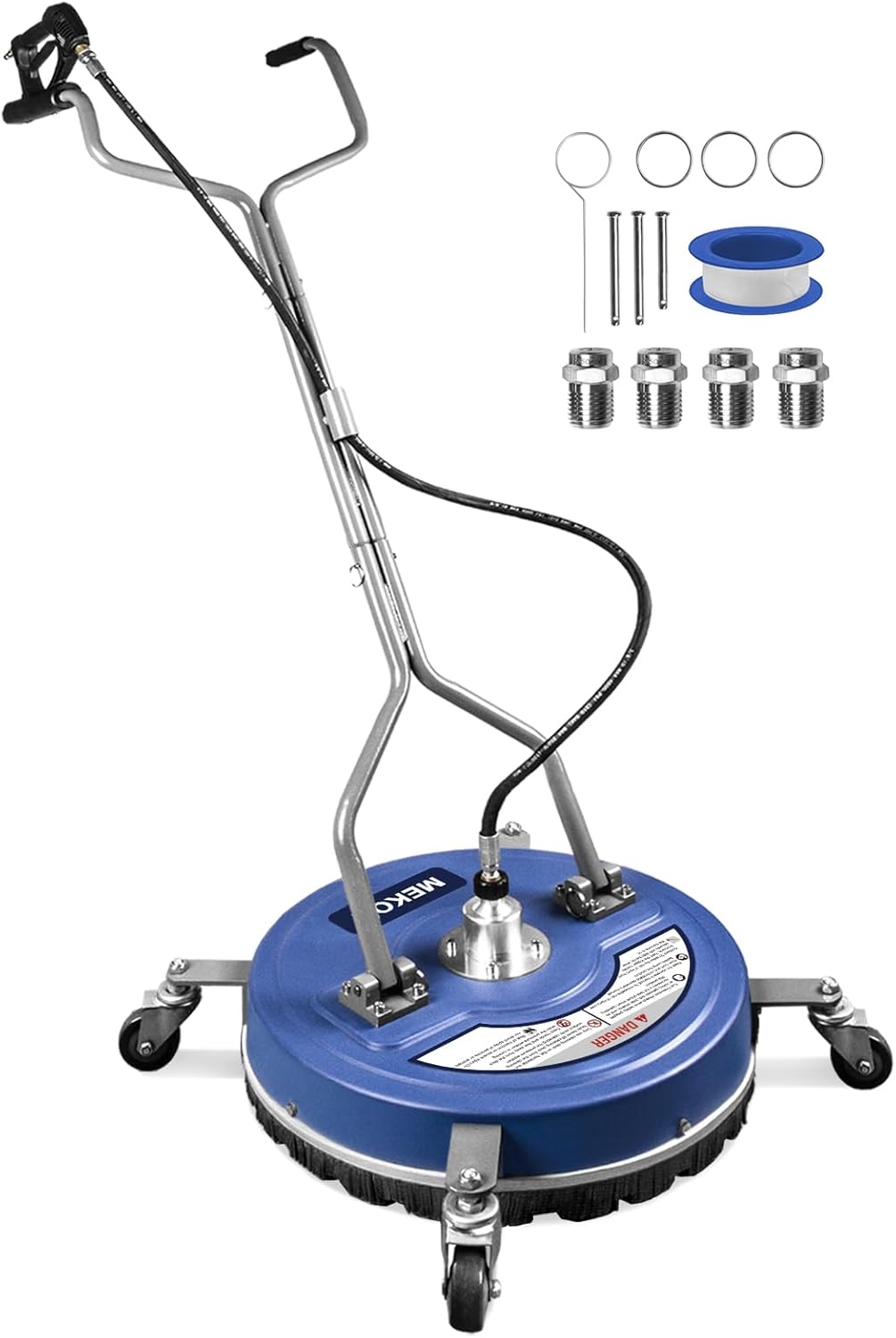
The MEKOH 20" surface cleaner is an attachment for pressure washers that turns concentrated nozzle spray into a wide, rotating cleaning path so you can clean driveways, sidewalks, patios, decks and similar flat surfaces much faster. It connects to standard pressure washer wands via a 3/8" quick-connect and is intended for machines that deliver at least 2000 PSI and 2.0 GPM, with best results above 3400 PSI. The unit uses two high-speed rotating nozzles inside a 20" housing, four casters and dual handles to keep the spray height consistent and make pushing and maneuvering easier. Construction mixes PP, stainless steel and brass with sealed bearings to resist leaking and allow hot or soapy water use. Practical benefits include large coverage per pass, reduced streaking compared with a single nozzle, and simpler, less tiring operation for big flat areas. Limitations are that it cannot be used without a compatible pressure washer and performance depends on your washer's pressure and flow, so smaller consumer machines may require slower passes to get a deep clean.
Best for: Homeowners or small-property caretakers who want a faster, less tiring way to clean long runs of sidewalk, driveway, patio or deck and already own or plan to use a medium to high-power pressure washer.
Less Ideal for: People who only need to clean small tight spots or those without access to a pressure washer; also not suited for intricate surfaces where a targeted nozzle or hand scrubbing is required.
- Large 20-inch cleaning path covers more surface per pass to cut cleaning time.
- Dual high-speed rotating nozzles produce consistent, low-streak cleaning compared with single-nozzle use.
- Four wheels and two handles keep the tool stable and make it easy to push across flat surfaces.
- Sealed bearings and mixed stainless/brass fittings allow use with hot or soapy water and help resist leaks.
- Requires a pressure washer with sufficient PSI and GPM to reach advertised performance.
- Not usable as a standalone hose attachment so you must own or rent compatible equipment.
Verdict: If you already have a pressure washer, this 20" wheeled surface cleaner will dramatically speed up streak-free cleaning of sidewalks and driveways.
WOJET 20" Commercial Pressure Washer Surface Cleaner with Wheels

| Maximum Pressure | 4500 psi |
|---|---|
| Maximum Flow Rate | 4 gpm |
| Power Source | manual |
| Max Temperature | 300 ℉ |
The WOJET 20" surface cleaner is a commercial-style pressure washer attachment made to clean large flat surfaces quickly and without striping. It connects via a 3/8" quick plug and uses two high-pressure jets behind a splash skirt to deliver consistent coverage across driveways, sidewalks, patios, decks and pool decks. Notable features for performance-focused users include a 304 stainless steel body for corrosion resistance, a pre-greased fully sealed swivel to reduce clogging and maintenance, dual handles and four larger wheels for stable, easy pushing, and two extra 25020 replacement nozzles included for higher-flow options. In real use it will remove dirt, weeds and grease more uniformly than a single nozzle wand and saves time by covering a 20" swath per pass. Important limitations: it requires a compatible pressure washer that delivers at least 2000 psi and 2 gpm to operate properly and you may need an adapter for some hose fittings. Also, the skirt is splash-reducing not abrasive, so stubborn stains may still need a separate brush or detergent pretreatment.
Best for: Buyers who prioritize fast, uniform cleaning of driveways and large flat outdoor surfaces and who already own or plan to use a high-pressure washer for heavy-duty cleaning.
Less Ideal for: People with only light-duty electric pressure washers below the required pressure or those who need built-in scrubbing for stubborn, deeply ingrained stains.
- Commercial-grade 304 stainless steel construction resists rust and improves durability
- Pre-greased fully sealed swivel reduces clogging and lowers maintenance needs
- Dual handles and four larger wheels improve control and make long runs easier
- Includes extra nozzles and a nozzle cleaner for quick maintenance and flow adjustments
- Requires a high-pressure washer (minimum ~2000 psi and 2 gpm) and possible adapter for some hoses
- Splash skirt protects from spray but does not scrub stubborn stains, which may need additional cleaning
Verdict: A heavy-duty 20" stainless steel surface cleaner that speeds up driveway and patio cleaning with commercial-level durability and a sealed swivel for low-maintenance, stripe-free results.
TOR 14" Stainless Steel Pressure Washer Surface Cleaner (4 Wheels)

| Power Source | Corded Electric |
|---|---|
| Maximum Pressure | 4000 psi |
The TOR 14" surface cleaner is an attachment that converts a pressure washer gun into a splash-reducing, streak-free surface cleaner for driveways, sidewalks, patios and decks. It connects via a 1/4" quick-connect plug and uses dual high-pressure rotating nozzles under a splash skirt to deliver a consistent cleaning path while the four caster wheels maintain a fixed nozzle height for even results and easy gliding. Built from stainless steel with heavy-duty bearings and a mesh inlet filter, it is designed to resist rust and reduce nozzle clogs during routine use. The kit includes two extension wands, replacement nozzles and basic accessories so you can reach farther without immediate extra purchases. Because it is rated for 2000–4000 PSI, it pairs with most residential and light-commercial washers but requires a compatible gun/wand connection and will not attach to a garden hose or units with a different outlet size without an adapter. Expect faster, more consistent cleaning of long sidewalks and driveways but plan for occasional maintenance of the nozzles and seals over time.
Best for: Homeowners or small contractors who want to clean sidewalks and driveways more efficiently and value durability and time savings over occasional setup steps.
Less Ideal for: People who only have a garden hose-pressure setup or pressure washers with nonstandard outlets and do not want to buy adapters or modify connectors.
- Stainless steel construction and heavy-duty bearings for durability and rust resistance.
- Dual rotating nozzles provide faster, streak-free cleaning across flat surfaces.
- Four caster wheels keep nozzle height consistent and reduce user fatigue.
- Included mesh inlet filter and spare nozzles help prevent clogs and extend run time.
- Requires a pressure washer gun/wand with a 1/4" quick-connect and will not work with a garden hose without adapters.
- No adapter for 3/8" outlets is included so some machines need an extra part to connect.
Verdict: If you want faster, streak-free cleaning for sidewalks and driveways, this heavy-duty 14" stainless steel surface cleaner delivers professional results with minimal effort.
JANZ 14" Pressure Washer Surface Cleaner
| Maximum Pressure | 4000 psi |
|---|---|
| Maximum Flow Rate | 3.7 gpm |
| Power Source | pressure washer |
| Connector | 1/4" Quick Plug |
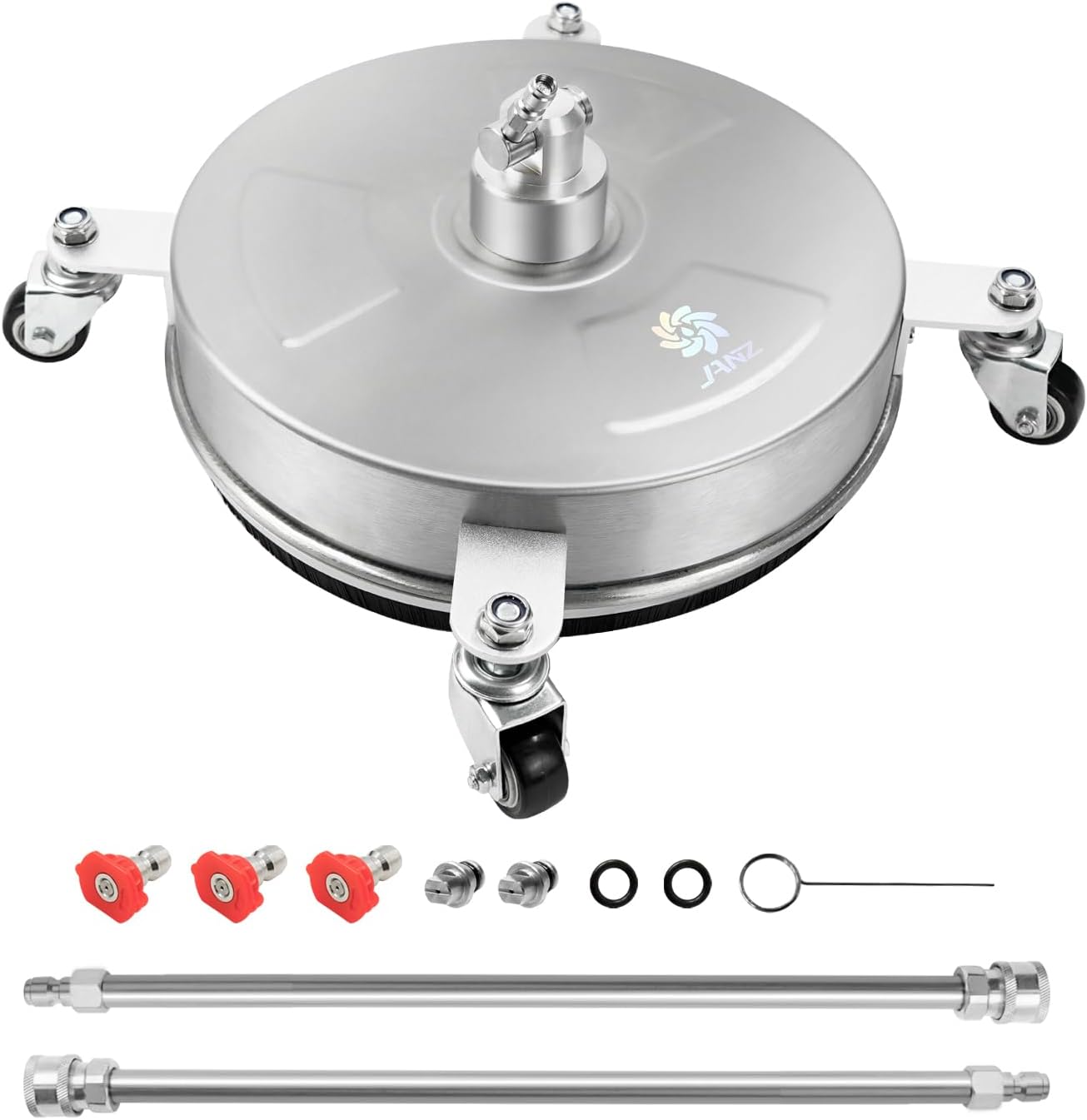
The JANZ 14" Pressure Washer Surface Cleaner is a stainless-steel attachment that converts a pressure washer into a splash-reducing, two-nozzle surface cleaner for large flat areas. It connects via a 1/4" quick plug and includes two extension wands and multiple nozzle tips so you can reach corners and extend your working radius. In use the dual high-pressure rotating jets clean faster and with less streaking than a single spray nozzle, and the four castors let the unit glide over concrete without constant lifting. Practical touches include a built-in inlet strainer and replaceable nozzles for easier maintenance, and the heavier housing helps keep the tool seated under high pressure. Limitations to note are that performance depends on your pressure washer meeting the stated PSI and GPM ranges and that the 14" cleaning path may require multiple passes for very large jobs. Also be mindful of the strong concentrated spray near the nozzle edges and follow safety guidance when operating.
Best for: Buyers who prioritize proven performance and want a durable, low-splash tool to speed up cleaning of driveways, patios, and decks while reducing streaking and overspray.
Less Ideal for: Customers needing a wider commercial-scale cleaning path or those without a pressure washer that meets the listed pressure and flow requirements should consider other options.
- Stainless steel housing and sealed bearing for durability and corrosion resistance.
- Dual rotating high-pressure jets provide faster, more consistent cleaning than a single nozzle.
- Includes extension wands and multiple nozzle tips for better reach and corner cleaning.
- Built-in inlet strainer and replaceable nozzles reduce clogging and simplify maintenance.
- Designed for a 14-inch cleaning path so larger areas may need more passes to finish.
- Requires a compatible pressure washer within the specified PSI and GPM range to reach peak performance.
Verdict: Choose this JANZ 14" surface cleaner if you want a durable, low-splash attachment that speeds up and evens out cleaning of driveways and patios when paired with a compatible pressure washer.
Liyaxenug 24-Inch Stainless Steel Pressure Washer Surface Cleaner

| Maximum Pressure | 4600 psi |
|---|---|
| Power Source | no |
This 24-inch stainless steel surface cleaner attaches to a compatible pressure washer to clean driveways, patios, sidewalks, and other flat outdoor surfaces much faster than a standard wand. It uses dual rotary nozzles and a 24-inch spray bar to cover a wide path in a single pass, which cuts cleaning time and reduces operator fatigue. The unit is built from heavy-duty 304 stainless steel with sealed bearings and four swivel caster wheels for smooth maneuvering over concrete, pavers, and rough asphalt. Setup is simple with a quick-connect style hose adapter and no electrical power required, and the downward-directed spray helps minimize splashback and streaking for a more uniform finish. Important limitations are that it requires a pressure washer capable of the recommended flow and pressure to perform optimally and its larger footprint makes it less useful for tight corners, steps, or intricate surfaces where a wand is still needed.
Best for: Buyers who prioritize dependable, long-lasting equipment for routine large-area cleaning and want a tool that reduces labor time on driveways and patios.
Less Ideal for: If you mainly clean narrow, detailed, or hard-to-reach areas or own a low-pressure/low-flow washer, a compact wand or smaller cleaner would be a better choice.
- Wide 24-inch cleaning path reduces time spent on large surfaces
- 304 stainless steel construction and sealed bearings resist rust and suit heavy use
- Four swivel caster wheels provide smooth, low-effort maneuvering over uneven surfaces
- Quick-connect setup works with standard pressure washers without tools or power
- Needs a high-flow, high-pressure washer to reach advertised performance
- Large size limits access to tight edges and steps
Verdict: Choose this stainless steel 24-inch surface cleaner when you need a durable, pro-grade attachment that reliably speeds up large-area outdoor cleaning.
Kärcher 15" Surface Cleaner for 2600–3200 PSI Pressure Washers

| Maximum Pressure | 3200 psi |
|---|---|
| Maximum Flow Rate | 2.7 gpm |
| Power Source | Pressure Washer Propelled |
| Item Type Name | 15" Surface Cleaner 2600-3200 PSI |
The Kärcher 15" Surface Cleaner is an accessory that turns a compatible pressure washer into a faster, streak-free surface cleaner. It connects via a standard 1/4" quick-connect fitting and runs off the pressure washer up to 3200 psi, using two counter-rotating nozzles to cover a 15" swath. In practice it significantly reduces cleaning time and water use compared with a single nozzle wand while the fixed-height nozzles help avoid streaks. The splash-free skirt and enclosed shroud keep overspray and debris contained for a drier, safer cleaning experience around cars or patio furniture. It is lightweight and straightforward to use for regular maintenance of concrete, stone, wood decks and even vertical siding. Limitations are compatibility and power needs: it requires a gas or electric pressure washer in the specified PSI range and will not perform well with lower-pressure machines, and the 15" width means multiple passes on very large surfaces or odd angles. For buyers who want reliable, no-fuss improvement over a spray wand, this delivers consistent, professional results.
Best for: Homeowners who prioritize reliable, low-mess cleaning and want a simple accessory to get faster, streak-free results on driveways, patios, decks and walkways without complicated setup.
Less Ideal for: Users who own low-pressure washers below the stated PSI range or who need an extra-wide commercial cleaner for very large surfaces should look at higher-capacity options.
- Two spinning nozzles cover a 15" swath for faster cleaning than a single wand
- Splash-free skirt and shroud reduce overspray and keep surrounding areas drier
- Fixed-height nozzles produce streak-free results on flat surfaces
- Quick-connect 1/4" fitting for easy attachment to compatible wands
- Only compatible with pressure washers rated between 2600 and 3200 psi
- 15" cleaning width may require extra passes on very large surfaces
Verdict: If you want quicker, streak-free cleaning of patios and driveways with minimal overspray, this 15" Kärcher surface cleaner reliably upgrades a compatible pressure washer.
Westinghouse 16.5" Stainless Steel Pressure Washer Surface Cleaner Attachment
| Power Source | manual |
|---|---|
| Maximum Pressure | 4400 psi |
| Hose Length | 35 feet |
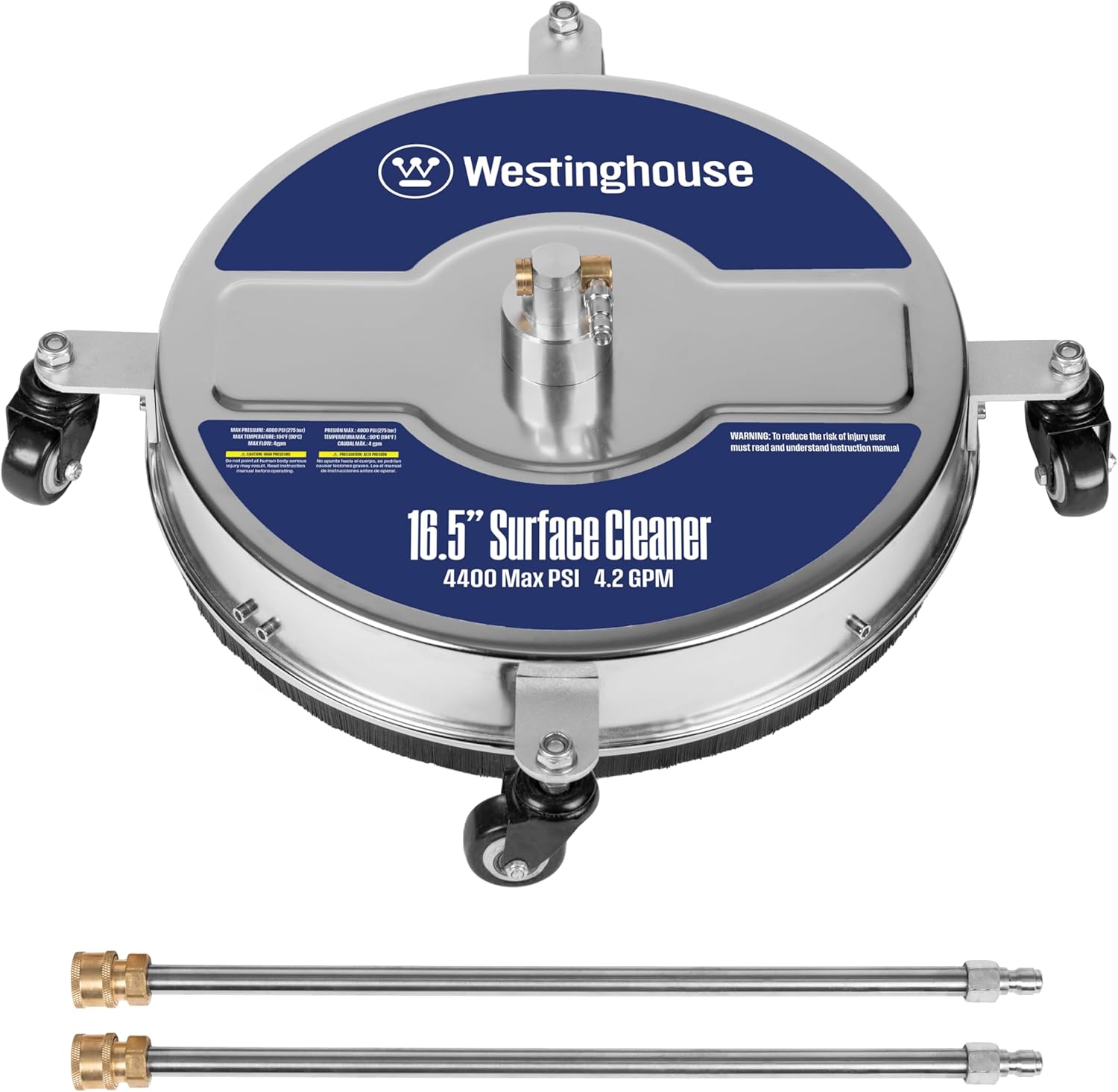
The Westinghouse 16.5" stainless steel surface cleaner is a heavy-duty attachment designed to convert a pressure washer into a fast, consistent surface-cleaning tool for decks, driveways, patios and vertical siding. It mounts via a 1/4" quick-connect fitting and is rated up to 4400 PSI, so it pairs well with most gas and higher-output electric washers. The wide 16.5" cleaning diameter and stainless construction let you cover large flat areas quickly while keeping spray contained under the housing, which reduces overspray and streaking compared with a single nozzle. Setup and use are straightforward: connect to your spray gun, feed water, and sweep the cleaner across the surface — the rotating inner bar evens out pressure for consistent results. Important limitations are compatibility and safety: you need a pressure washer with an appropriate outlet and sufficient flow to spin the internal arms properly, and high-pressure jets require protective gear and care around edges and soft materials. For performance-focused users this attachment significantly reduces cleaning time on large, flat surfaces.
Best for: Buyers who prioritize fast, uniform cleaning of large, flat outdoor surfaces and already own or plan to use a high-output pressure washer.
Less Ideal for: People who mostly clean small, detailed areas, delicate surfaces, or who rely on low-flow electric consumer models that cannot sustain the tool's required performance.
- Large 16.5" cleaning diameter covers more surface per pass to speed up jobs
- Stainless steel housing resists corrosion for outdoor use
- Rated to 4400 PSI, suitable for heavy-duty cleaning tasks
- 1/4" quick-connect fitting for simple attachment to compatible washers
- Requires sufficient flow from the pressure washer to operate optimally and avoid stalling the internal arms
- Not suitable for narrow or highly detailed areas where a focused nozzle is needed
Verdict: If you want to cut cleaning time across large patios, driveways and decks, this heavy-duty 16.5" stainless surface cleaner delivers professional-level, consistent results.
Choosing the Right Pressure Washer Surface Cleaner for Driveways: Key Factors to Consider
Cleaning Width and Coverage
Cleaning width directly affects how quickly you finish a driveway. A wider deck cuts passes and time, but excessively wide units can be hard to steer around parked cars, garage thresholds, and tight corners. Consider the typical width of your driveway and any narrow approaches when choosing a size.
Also think about transport and storage. Very wide cleaners may not fit in small sheds or the trunk of a car. For many homeowners, a mid-range width balances speed with control and storage convenience.
Flow Rate and Pressure Compatibility
Surface cleaners need the right combination of flow (GPM) and pressure (PSI) to spin the internal arms and deliver effective cleaning. If your pressure washer does not supply enough flow, the cleaner will not rotate properly and performance will suffer. Conversely, some high-flow cleaners are overkill for low-output electric washers.
Match the cleaner to the typical output of your machine and keep tolerance ranges in mind. This avoids weak cleaning, reduces wear on seals, and prevents the frustration of frequent rework.
Skirt Design and Splash Containment
A good skirt keeps water and debris off walls, driveways, and you. Skirts made of rubber or dense bristles contain spray better than flimsy materials, which reduces water waste and keeps nearby landscaping and siding cleaner. Proper splash control also makes the cleaning experience more comfortable and safer by limiting slippery runoff.
Inspect how skirts attach and whether replacement skirts are available. A replaceable skirt can extend the life of the unit if it wears from rubbing against rough concrete or curbing.
Brushes, Nozzles, and Surface Contact
Some cleaners use brushes or bristles inside the skirt to help agitate dirt while others rely solely on nozzle jets. Brushes can improve cleaning on textured concrete or pavers but may trap grit and require maintenance. Nozzle alignment and the quality of rotating arms determine whether the cleaner leaves even results or streaks.
Consider how the design manages grit pickup and how easy it is to access the rotating assembly for cleaning or replacement of nozzles and bearings.
Build Quality and Serviceability
Driveways expose surface cleaners to grit, stones, and knocks. Materials like aluminum or thick polymers resist damage better than thin stamped parts. Bearings, seals, and quick-connects should be accessible and replaceable. Units with common fittings are easier to repair with off-the-shelf parts.
Think about long-term ownership: a slightly heavier but sturdier unit can be cheaper over time than a lightweight model that needs repeated repairs.
Maneuverability and Ergonomics
How the cleaner moves across a driveway affects fatigue and result consistency. Lower-profile housings fit under car overhangs and close to thresholds; swivel handles or angled wand attachments improve reach around obstacles. Weight distribution matters when carrying the unit to the work area.
Test or visualize how the cleaner will move on slopes, around drains, and near steps. Ease of connection and disconnection from your pressure washer also contributes to overall convenience.
Matching a Surface Cleaner to Your Driveway Type
Driveways come in poured concrete, broom-finished concrete, pavers, and asphalt, and each surface responds differently to high-pressure cleaning. Smooth concrete cleans quickly with high-pressure jets, while textured or paver surfaces often benefit from a cleaner that combines jets with internal brushes to dislodge embedded dirt from joints.
Asphalt is softer and can be damaged by excessive pressure concentrated in a small area. For asphalt driveways choose units and pressure settings that provide broad, even coverage rather than aggressive point cleaning.
- Smooth concrete: prioritize high-pressure nozzle alignment and wider cleaning widths.
- Textured concrete and pavers: look for brush-assisted action or close nozzle spacing.
- Asphalt: use lower pressure ranges and gentler pass speeds to avoid gouging.
Installing and Using a Surface Cleaner Safely
Always check quick-connects and hose ratings before use. Secure attachments tightly and inspect seals for wear. Wear eye protection and non-slip footwear; even with a skirt, runoff can create slick surfaces.
Work from top to bottom on sloped driveways to control runoff direction, and avoid pointing the wand toward fragile plants or drainage grates. Test a small inconspicuous area first to confirm pressure settings and cleaning speed.
- Confirm hose and fitting pressure ratings match your washer.
- Start with a longer standoff and slower pass speed, then increase aggressiveness if safe.
- Keep bystanders and pets away from the work area.
Routine Maintenance to Extend Service Life
Rinse the internal arms and nozzles after use to remove grit that can wear bearings. Check nozzle spray patterns regularly; a distorted pattern usually indicates wear or clogging that reduces cleaning effectiveness. Replace worn skirts and brushes before they fail completely to avoid exposing the housing and internal parts to damage.
Store the cleaner in a dry place and protect any exposed seals from prolonged sun and cold, which can cause cracking. Periodic lubrication of rotating bearings, when accessible, helps maintain smooth operation.
- Flush with clean water after each heavy use.
- Inspect nozzles and replace if spray patterns are uneven.
- Keep replacement skirts and common nozzles on hand if you clean driveways frequently.
Adjusting Technique for Best Results
Cleaning speed and wand height change the outcome more than raw pressure alone. Move at a steady pace that allows the rotating arms to overlap slightly between passes to avoid striping. Keep the wand at a consistent distance so the jets maintain their intended impact angle.
If you see etching or surface damage, reduce pressure or increase your pass speed. For stubborn oil stains, pre-treat with an appropriate degreaser before using the surface cleaner to avoid repeated aggressive passes that wear the surface.
- Maintain consistent pass speed.
- Keep wand height steady for even coverage.
- Pre-treat tough stains to reduce need for aggressive cleaning.
When a Surface Cleaner Is the Wrong Tool
Surface cleaners excel at broad, flat areas. They are less effective in tight corners, steep steps, or heavily textured surfaces where targeted nozzle work or a rotary surface cleaner is preferable. If your driveway has many obstacles, you may still need a standard wand for edges and joints.
Also avoid using surface cleaners on delicate finishes or soft asphalt without confirming appropriate pressure and nozzle spacing to prevent damage.
- Use the wand for edges, joints, and steps.
- Avoid broad cleaners on very narrow or heavily broken-up driveways.
- Confirm suitability before using on soft or repaired asphalt patches.
How We Chose the Best Pressure Washer Surface Cleaner for Driveways
We evaluated surface cleaners using criteria that reflect real driveway use rather than laboratory numbers. Key considerations included usable cleaning width and maneuverability, because wider cleaners reduce passes but must still reach garage approaches and tight edges. Flow rate compatibility and pressure range were checked to ensure units operate effectively with common electric and gas washers. Skirt and brush design received attention for splash control and consistent contact with the surface. Build quality and serviceability were weighed to predict how well a unit stands up to abrasive grit and occasional knocks on rough concrete. Hose and quick-connect compatibility were included so installation is straightforward for typical garden setups. We excluded specialty products designed only for decks, soft surfaces, or industrial high-flow systems that require custom plumbing. We also omitted units with limited real-world durability or unclear parts availability. The final selections prioritize practical, durable designs that gardeners and homeowners can integrate into routine driveway maintenance.
FAQ
What pressure and flow do most driveway surface cleaners need to spin properly?
It depends on the cleaner design, but most driveway-grade surface cleaners require moderate flow to keep the arms spinning. Many work well in common gas washer ranges, while lower-flow electric washers may struggle with larger cleaners. Always check the cleaner's recommended GPM and PSI range against your machine.
Can a surface cleaner damage my driveway surface?
Damage is possible if pressure is too high or if you linger in one spot. Concrete is generally durable, but soft asphalt and thin sealcoatings can be gouged. Use appropriate pressure settings, keep the cleaner moving, and test in an inconspicuous spot first.
How do I handle edges and tight corners when using a surface cleaner?
Surface cleaners are best for broad passes. Use a standard wand or a smaller radius attachment for edges, corners, and around posts. Plan to do those areas after the main passes to ensure consistent coverage.
How often should I replace skirts, brushes, or nozzles on a surface cleaner?
Replacement frequency depends on use and surface grit. Heavy driveway use may wear skirts and nozzles within a season or two. Inspect them after each major cleaning and replace when you see uneven sealing, cracks, or distorted spray patterns.
Are brush-assisted surface cleaners better for pavers than nozzle-only designs?
Brush-assisted designs can help lift dirt and work in joints on pavers, but they may trap grit and need more maintenance. Nozzle-only designs rely on pressure and may require slower passes. The better choice depends on the surface texture and how much joint cleaning you need.
Final Verdict
For driveway work prioritize a surface cleaner that matches your washer's flow and pressure and offers the right cleaning width for your space. Pay attention to skirt design and build quality to limit splash and resist grit, and choose a unit that is serviceable so you can replace worn skirts or nozzles. Balancing coverage, compatibility, and durability will deliver the fastest, most consistent driveway cleaning. Select the cleaner that fits your machine and driveway layout, and plan to supplement it with wand work for edges and tight spots.
