

Note: This article contains affiliate links. If you click on these links and make a purchase, I may earn a small commission at no extra cost to you. This helps support my research and content. Read my full affiliate disclosure here.
If spider mites have started stippling or webbing on leaves, you need an insecticide that controls red spider mites without damaging foliage or helpful predators. Choosing the right product affects how quickly populations fall, whether plants show phytotoxic stress, and how long control lasts between sprays. This guide covers six shortlisted insecticides for red spider mites chosen for real garden use, from patios and houseplants to vegetable beds and ornamentals. We explain the criteria used to evaluate options and what to expect in the first few days after treatment. Read on to find the best match for your growing situation and pest pressure.
Top Picks at a Glance
| Best Overall The best all-around choice for most situations | Athena IPM Ready-to-Use Insecticide & Fungicide Spray, 32 fl oz |  |
| Best Quality Built to a higher standard if you want something more solid | Trifecta Crop Control Ready-to-Use Natural Insecticide, Fungicide & Miticide (32 fl oz) |  |
| Best Value The sweet spot between price and what you get | BioAdvanced 3-in-1 Insect, Disease & Mite Control Concentrate, 32 oz |  |
| Best Budget The cheapest option that still gets the job done reliably | Bonide Insecticidal Soap Ready-to-Use Spray, 32 oz |  |
| Highest Rated A top-rated pick with lots of positive feedback | Athena IPM Insecticide & Fungicide Concentrate, 1 Gallon |  |
| Most Popular A crowd favorite that many people choose with confidence | Bonide Captain Jack's Ready-to-Use Neem Oil Spray, 32 oz |  |
Athena IPM Ready-to-Use Insecticide & Fungicide Spray, 32 fl oz

| Brand | Athena |
|---|---|
| Unit Count | 32 Fluid Ounces |
| EPA Status | 25(b) minimum risk |
| Pest Targets | Spider mites, aphids, thrips |
| Use Type | Ready to use |
Athena IPM is a 32-ounce ready-to-use spray that combines botanical insecticidal and fungicidal action for routine plant protection. It is formulated to kill spider mites, aphids, thrips and contact-treat powdery mildew, so you use it by shaking the bottle and spraying affected leaves, stems, and surrounding foliage. Because it meets EPA 25(b) minimum risk criteria, it is positioned as an eco-friendlier option that can be used around people and pets when directions are followed. The product is versatile for outdoor beds, ornamental plants, vegetables, fruit trees and greenhouse use, and it requires no mixing or special equipment which simplifies regular preventive treatments. Practical limitations are that it is a contact-control product so it works best on visible infestations and vulnerable life stages rather than as a long-lasting residual solution, and repeated applications may be required for complete control of heavy infestations. Follow safety guidance for storage and keep away from children and pets while applying.
Best for: Gardeners and plant stewards who prioritize dependable, easy-to-use pest and mildew control and prefer lower-toxicity, ready-made solutions for routine outdoor plant care.
Less Ideal for: Anyone needing a long-lasting residual insecticide or rapid systemic control for severe, established infestations should consider professional or stronger systemic products.
- Ready-to-use formula requires no measuring or mixing
- Broad-spectrum action against common pests and powdery mildew on contact
- EPA 25(b) minimum risk ingredients for reduced chemical exposure when used as directed
- Suitable for a wide range of plant settings including gardens, greenhouses, and hydroponics
- Contact-only action provides limited residual control against re-infestation
- May require multiple applications for heavy or established pest problems
Verdict: A simple, lower-toxicity ready-to-use spray that reliably handles common outdoor plant pests and powdery mildew for gardeners who want straightforward, repeatable protection.
Trifecta Crop Control Ready-to-Use Natural Insecticide, Fungicide & Miticide (32 fl oz)

| Unit Count | 32 Fluid Ounces |
|---|---|
| Item Form | Spray |
| Strength | Maximum Strength (20:1) |
Trifecta Crop Control is a ready-to-use, plant-derived spray that combines insecticidal soap, miticide and fungicide action for vegetables, ornamentals and houseplants. It is typically applied with a trigger sprayer, atomizer or misting system until foliage is thoroughly wet, including leaf undersides, and can be used every other day during active infestations until control is achieved. Notable features include a maximum-strength formulation aimed at tough pests, a fast-drying no-residue finish suitable for edible crops when used as directed, and guidance for application at dusk to reduce foliage burn. In practice it performs well against spider mites, aphids, whiteflies, fungus gnats and powdery mildew and is biodegradable and generally safe around beneficial insects when used properly. Important limitations: it requires frequent reapplication for heavy infestations, may need careful coverage to reach crevices where pests hide, and users should wear eye protection and gloves during handling because of irritation risk.
Best for: Vegetable growers and serious home gardeners who prioritize strong, natural control of pests and fungal issues and are willing to follow a regular spray schedule to protect crops.
Less Ideal for: Growers seeking a single systemic treatment or those unwilling to perform repeat applications and close foliage inspection should consider alternative control methods.
- Plant-based formula safe for use on edible crops when label directions are followed
- Ready-to-use trigger-spray format for immediate application
- Broad-spectrum activity against common vegetable pests and powdery mildew
- Fast-drying, low-residue finish that reduces risk to harvestable produce
- Requires thorough, repeat coverage to be effective against heavy or hidden infestations
- Not a one-time systemic solution so ongoing maintenance sprays may be necessary
Verdict: Choose Trifecta Crop Control if you want a powerful, plant-based ready-to-use spray that reliably knocks down common vegetable pests and powdery mildew while leaving no harmful residues.
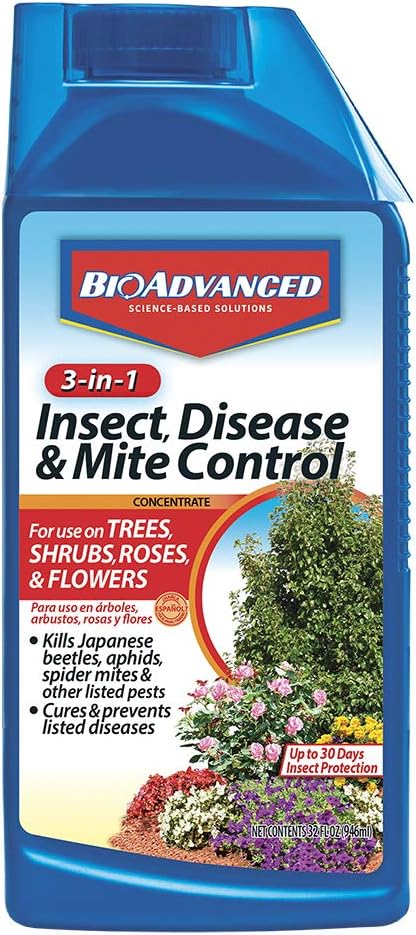
BioAdvanced 3-in-1 Insect, Disease & Mite Control Concentrate, 32 oz
| Unit Count | 32 Fluid Ounces |
|---|---|
| Item Type Name | Concentrate |
| Liquid Volume | 32 fluid ounces |
| Active Ingredients | Imidacloprid, Tau-fluvalinate, Tebuconazole |
| Specification Met | EPA |
This BioAdvanced concentrate is designed as an all-purpose plant treatment that kills listed insects on contact, controls common fungal diseases, and suppresses spider mites in one product. You mix the concentrate with water to make spray solution (it yields up to about 12 gallons), then apply to roses, flowers, shrubs, trees, and other ornamentals. Key active ingredients—imidacloprid, tau-fluvalinate, and tebuconazole—deliver systemic, rainproof protection that the label says can last up to 30 days. For mite control specifically, the miticide component gives both suppression and residual activity, so it is useful for follow-up sprays during an outbreak. Practical benefits include fewer separate products to buy and the convenience of treating multiple problems with one application. Important limitations are regulatory restrictions that make it unavailable in several states and the need to follow label safety precautions because it contains systemic insecticide active ingredients that can affect non-target insects if misused.
Best for: Gardeners who want a single, practical product to manage insect pests, fungal diseases, and spider mites on roses and ornamentals and who prefer a preventive residual treatment.
Less Ideal for: Organic gardeners or those managing pollinator-attractive plantings who avoid systemic insecticides should choose non-systemic or organic miticide and fungicide options instead.
- Combines insecticide, fungicide, and miticide in one concentrate for fewer products to store and apply
- Systemic formulation with rainproof protection that can last up to 30 days after application
- Makes up to 12 gallons of spray from a 32 fl oz bottle, suitable for treating multiple plants or repeat applications
- Active ingredients target a broad list of pests including aphids, spider mites, Japanese beetles and common foliar diseases
- Not available for sale in several U.S. states, limiting where it can be used
- Contains systemic insecticides that require careful adherence to label directions to avoid harming beneficial insects
Verdict: If you want one dependable product to both kill spider mites and prevent common foliar diseases across roses and ornamentals, this 3-in-1 concentrate simplifies treatment with a month-long systemic residual.
Bonide Insecticidal Soap Ready-to-Use Spray, 32 oz

| Unit Count | 32 Ounce |
|---|---|
| Item Form | Spray |
| Target Species | Insects |
| Active Ingredients | Potassium salt of fatty acids |
This ready-to-use insecticidal soap spray kills soft-bodied insects on contact using potassium salts of fatty acids derived from plants, making it suitable for organic vegetable beds and container vegetables. It is applied with the built-in spray nozzle directly to affected foliage to control aphids, mites, caterpillars, whiteflies and other listed pests; the label allows use up to the day of harvest on many food crops. Practical benefits include an easy spray application with no mixing, low residual toxicity compared with conventional insecticides, and a broad list of target species for small-scale home gardens and greenhouses. Important limitations are that it works by contact so complete coverage is required and it will not control pests hidden inside fruit or stems; repeated applications may be necessary for heavy infestations. Users should follow label safety directions and test on a few plants first since some sensitive foliage can show damage under hot conditions.
Best for: Gardeners who prioritize simple, low-residue organic solutions for vegetables and want a no-mix spray they can use quickly on affected plants.
Less Ideal for: Large-scale growers who need systemic or long‑residual control or anyone needing a product to reach pests hidden inside fruit or stems.
- Ready-to-use spray with an easy nozzle for immediate application
- Active ingredient is a plant-derived potassium salt suitable for organic gardening
- Labeled for use on a wide range of vegetables, herbs, ornamentals and houseplants
- Low residual toxicity compared with synthetic insecticides
- Kills only on contact so full coverage and repeat treatments are often required
- May cause phytotoxicity on some sensitive plants or under high heat if not spot-tested
Verdict: A convenient, ready-to-use organic spray that gives practical contact control of common vegetable garden pests with minimal residual impact.
Athena IPM Insecticide & Fungicide Concentrate, 1 Gallon

| Item Form | Liquid |
|---|---|
| Target Species | Fungus |
| Special Features | organic |
| Liquid Volume | 1 gallons |
| Active Ingredients | citric acid,potassium sorbate,sodium benzoate |
Athena IPM is a one-gallon liquid concentrate designed for reliable, broad-spectrum control of spider mites and common foliar pests while also treating powdery mildew. You dilute the concentrate with water and apply it with a standard pump sprayer or spray bottle, which makes it practical for home gardens, greenhouses and small commercial operations. The formula uses EPA 25(b) minimum-risk active ingredients such as citric acid and natural oils, so it provides contact knockdown without harsh synthetic pesticides and is labeled for use across ornamental plants, vegetables, fruit trees and hydroponic systems. Notable benefits include clear dilution instructions, versatile application scenarios, and an EPA specification that supports safe, repeatable treatments when label directions are followed. Important limitations are that it works on contact so thorough coverage is required and repeat applications may be needed for heavy infestations, and it should not be used on plants under stress or on edible crops within the specified pre-harvest interval. Protective gear and careful timing (no rain within 24 hours) are also necessary for safe use.
Best for: Gardeners and growers who prioritize consistent, low-toxicity pest control and want a dependable, professional-style concentrate they can rely on across different crops and growing spaces.
Less Ideal for: People seeking a systemic pesticide that provides long-term residual control or a ready-to-use spray for one-off spot treatments should consider other options.
- EPA 25(b) minimum-risk formula uses citric acid and natural oils for plant-safe contact control
- Ready-to-mix concentrate that works with common pump sprayers and bottles for flexible application
- Labeled for use on many plant types including ornamentals, vegetables, fruit trees and hydroponics
- Clear dilution and safety instructions reduce application errors and support consistent results
- Contact-only action requires thorough coverage and may need repeated treatments for severe infestations
- Not safe on stressed plants or for edible crops within the stated pre-harvest interval
Verdict: Choose this EPA-compliant, ready-to-mix concentrate when you need a reliable, low-toxicity contact treatment for spider mites and powdery mildew across varied growing setups.
Bonide Captain Jack's Ready-to-Use Neem Oil Spray, 32 oz

| Item Form | Liquid |
|---|---|
| Target Species | Insects |
| Liquid Volume | 32 fluid ounces |
| Active Ingredients | Clarified Hydrophobic Extract of Neem Oil |
This ready-to-use neem oil spray is a multipurpose garden treatment that kills insects at all life stages while also serving as a miticide and preventative fungicide. Packaged in a 32-ounce trigger bottle, it is applied by shaking and thoroughly spraying plant surfaces, including leaf undersides, at the first sign of pests or disease and reapplying every 7 to 14 days as needed. The active ingredient is a clarified hydrophobic extract of neem oil, which is approved for organic gardening and labeled safe to use on vegetables up to the day of harvest. Practical benefits include broad pest coverage (aphids, whiteflies, spider mites and others), disease suppression such as powdery mildew, and convenience from a ready-to-use sprayer. Important limitations are that results are slower than synthetic contact insecticides and application timing matters to avoid leaf burn in full sun; repeated applications may be needed for heavy infestations. Follow label safety directions and keep the product away from children and pets.
Best for: Gardeners who want a single, organic-approved product to manage common vegetable garden pests and fungal problems and who prefer products with strong user feedback.
Less Ideal for: Growers needing rapid knockdown of severe infestations or commercial producers who require fast-acting, high-throughput treatments.
- Kills multiple pest stages including eggs, larvae and adults for more complete control.
- Also acts as a fungicide and miticide so one product covers pests and common fungal issues.
- Ready-to-use trigger bottle requires no mixing and is easy to apply to leaves and undersides.
- Approved for organic gardening and can be used on vegetables up to day of harvest.
- Slower-acting than many synthetic contact insecticides, so it may take several applications to see control.
- Must avoid spraying in peak sunlight to reduce risk of leaf burn.
Verdict: A convenient, organic-approved all-in-one neem spray that controls common vegetable garden pests and fungal issues with minimal fuss.
Choosing the Right Insecticide for Red Spider Mites: Key Factors to Consider
Mode of Action and Targeting
Knowing how an insecticide works is important because red spider mites can be less susceptible to some modes of action. Contact sprays kill mites on contact but may miss hidden eggs or sheltered mites on leaf undersides. Systemic or translaminar products move into plant tissue and reach feeding mites, which can improve control when webbing or dense foliage prevents thorough coverage.
Rotation between modes of action is also crucial to delay resistance. If you rely on the same active ingredient repeatedly, mite populations can develop tolerance. Choose products with different action types when planning repeated treatments and follow label guidance on intervals and maximum applications.
Phytotoxicity Risk
Some insecticides, oils, or soaps can cause leaf burn, discoloration, or drop on sensitive plants, especially under heat stress. Phytotoxic effects vary by plant species, concentration, water quality, and environmental conditions such as temperature and sunlight.
Always check label restrictions for ornamentals and edibles and consider testing a small area or young plant before wide application. Timing matters: many contact materials are safer when applied in cooler parts of the day and avoiding direct midday sun.
Impact on Beneficial Arthropods
Beneficial predators and parasitoids help keep mite populations in check long term. Broad-spectrum insecticides can eliminate these allies, causing secondary pest outbreaks. Products labeled as low-toxicity to predatory mites or that break down quickly can preserve natural control agents.
When choosing an insecticide, consider its persistence and selectivity. Use targeted, lower-toxicity options where possible and apply spot treatments rather than blanket sprays to reduce non-target impacts.
Residual Activity and Reapplication Interval
Residual activity affects how often you need to re-treat. Short-residual contact sprays may require frequent reapplication to cover newly hatched mites, while products with longer residual suppression reduce labor but can affect non-target organisms for longer periods.
Plan treatments based on monitoring counts and label reapplication intervals. In heavy infestations, combine an initial knockdown with follow-up treatments timed to coincide with egg hatch to break the lifecycle.
Application Method and Practicality
How an insecticide is applied influences its effectiveness in a real garden. Fine sprays, thorough coverage of leaf undersides, and good nozzle choice matter for contact materials. Systemic or translaminar options may be applied as soil drenches or foliar sprays; each method has pros and cons relating to uptake speed and ease of use.
Consider tank-mix compatibility if you plan to combine products, and evaluate product packaging for measuring and mixing accuracy. Gardeners without sprayers might favor ready-to-use formulations or hose-end applicators for ease.
Crop and Site Restrictions
Different insecticides carry different label restrictions for food crops, ornamentals, and indoor plants. Some actives should not be used on certain vegetables, herbs, or young transplants. There are also limits on harvest intervals and allowed application sites such as greenhouses or outdoor landscapes.
Always read and follow label instructions closely. If you are treating edible plants, choose products specifically labeled for food crops and observe preharvest intervals to keep produce safe to eat.
When To Treat Versus When To Scout
Regular scouting helps catch spider mite outbreaks before heavy webbing and leaf damage occur. Treat when you see active stippling on many leaves, visible mites, or expanding webbing that interferes with photosynthesis.
If you only find a few mites or isolated spots, spot treatment combined with increased monitoring can be enough. In many cases, cultural changes such as improved watering and removing infested leaves reduce population growth without immediate chemical intervention.
- Check undersides of leaves and new growth for early signs.
- Look for fine webbing and yellow stippling as indicators of higher pressure.
- Increase humidity and reduce dust where possible because mites prefer hot, dry conditions.
Combining Cultural Controls With Chemical Treatment
Chemical control is most effective when paired with cultural practices that make the environment less favorable for mites. Regular irrigation to reduce plant stress, removing heavily infested leaves, and increasing humidity in greenhouse settings all slow mite reproduction.
After an initial insecticide application, continue cultural controls and monitor for re-infestation. Reducing plant stress improves the long-term success of any product you use.
- Prune and destroy heavily infested foliage rather than composting it on site.
- Use a strong water spray to dislodge populations on hardy plants before chemical application when feasible.
Safe Use and Timing Guidelines
Follow label temperature and timing recommendations to reduce phytotoxicity. Many contact products are safer when applied in the morning or evening and avoided during the hottest hours to prevent leaf scorch.
Rotate actives and respect reapplication intervals to avoid resistance buildup. If beneficial insects are present, consider spot-treating affected plants and avoiding broad blanket sprays.
- Wear appropriate protective equipment and avoid drift onto non-target plants.
- Wait the recommended interval before harvesting edible crops after treatment.
Monitoring Post-Treatment Results
Expect visible reduction in motile mites within a few days with a good knockdown product. However, eggs can hatch later, so plan follow-up inspections and possible repeat treatments timed to egg hatch intervals.
Record the timing and results of treatments so you can judge product effectiveness for your particular crop and conditions. That record helps you decide whether to change mode of action or adjust application technique.
- Use a white sheet or paper and tap foliage to count dislodged mites for a quick population check.
- Reassess in 7 to 10 days to catch emerging cohorts.
Managing Resistance Risks
Spider mites have a high potential for developing resistance when exposed to the same insecticide repeatedly. To manage this risk, rotate among products with different modes of action and incorporate non-chemical methods.
Keep records of which active ingredients you have used in a season and avoid more than the label-allowed number of applications of a single mode of action.
- Alternate contact and systemic approaches when rotation options are available.
- Use integrated pest management principles to reduce reliance on chemicals over time.
How We Chose the Best Insecticide for Red Spider Mites
We focused on practical, garden-relevant filters to narrow the field to insecticides that are effective against red spider mites while minimizing harm to plants and beneficial organisms. Key evaluation criteria included documented mite efficacy under typical garden conditions, measured by reported knockdown speed and residual suppression; phytotoxicity risk across common ornamental and edible plants; safety for beneficial predators such as predatory mites and lacewings when used as directed; application flexibility including spray, drench, or systemic use; and ease of use covering dilution, mixing stability, and re-entry intervals. We excluded products lacking credible efficacy data against spider mites, those with restrictions that prevent use on common garden plants, and poorly formulated products prone to clogging or inconsistent dosing. We also deprioritized materials that require specialized equipment or professional licensing. The final shortlist balances quick control, plant safety, and practical application for home gardeners and small-scale growers.
FAQ
How quickly should I see results after applying an insecticide for red spider mites?
Often you will see a drop in active, motile mites within a few days from a good knockdown spray. Complete control may take longer because eggs can survive contact sprays and hatch later, so follow-up inspections and treatments are usually needed.
Can I use the same insecticide on houseplants and outdoor ornamentals?
It depends on the product label. Some insecticides list restrictions for indoor use or specific plant types. Check the label for site and crop approvals and consider lower-concentration or gentler options for sensitive houseplants.
Will treating for spider mites harm beneficial insects in my garden?
Broad-spectrum contact insecticides can harm beneficial predators. Choosing selective products, applying spot treatments, and timing applications to avoid peak beneficial activity reduces non-target impacts.
Are horticultural oils and insecticidal soaps effective against red spider mites?
Horticultural oils and soaps can be effective when coverage is thorough and applications are repeated to catch newly hatched mites. They work best at lower pest densities and when environmental conditions reduce phytotoxic risk.
How should I time follow-up treatments to break the mite life cycle?
Plan reapplications based on the product label and the mite lifecycle for your climate. Often a second treatment is scheduled to coincide with egg hatch, commonly 7 to 10 days after the initial spray, but follow label guidance for intervals.
Is a systemic product better than a contact spray for heavy infestations?
Systemic or translaminar options can be helpful because they reach mites feeding inside leaf tissue and new growth. However, they are not always necessary and may have different label constraints. Consider crop type, infestation severity, and resistance management when deciding.
Final Verdict
Prioritize products that balance quick knockdown with low phytotoxic risk and minimal harm to beneficial predators. Match the mode of action to the infestation size and your crop type, and be prepared to follow up on eggs with additional monitoring and treatments. By combining an appropriate insecticide with cultural controls and rotation of active ingredients, you can control red spider mites effectively while protecting plants and garden ecology.
