

Note: This article contains affiliate links. If you click on these links and make a purchase, I may earn a small commission at no extra cost to you. This helps support my research and content. Read my full affiliate disclosure here.
Choosing the right fertilizer for a mustard crop affects plant vigor, oil content, and final yield. Mustard responds to specific nutrient ratios and sulfur availability more than many common vegetable crops, so a one-size-fits-all approach often leaves potential on the table. This guide covers seven shortlisted fertilizer options suited to mustard production across different soils and growing systems. We evaluate each choice for nutrient composition, ease of application, compatibility with soil tests, and how well it supports growth stages from vegetative leaf build-up to seed fill. Read on for practical notes that will help you match a fertilizer to your field conditions and management style.
Top Picks at a Glance
| Best Overall The best all-around choice for most situations | GEORGIC Mustard Oil Cake Powder Natural Fertilizer, 3 lb |  |
| Best Quality Built to a higher standard if you want something more solid | FoxFarm Happy Frog Tomato & Vegetable Fertilizer, 5-7-3 Blend, 4 lb |  |
| Best Value The sweet spot between price and what you get | Southern Ag All Purpose Granular Fertilizer 10-10-10 (5 lb) |  |
| Best Budget The cheapest option that still gets the job done reliably | RAINFLOW Slow-Release Granular Fertilizer 17-17-17 (11.28 oz) |  |
| Highest Rated A top-rated pick with lots of positive feedback | M.P. Mustard Cake Powder Organic Fertilizer, 1 kg |  |
| Most Popular A crowd favorite that many people choose with confidence | Dr. Earth Organic Tomato, Vegetable & Herb Fertilizer (64 oz) |  |
| Best Seller A high-volume bestseller chosen again and again | Cz Garden Supply Urea 46-0-0 Granular Fertilizer, 5 lb Resealable Pouch |  |
GEORGIC Mustard Oil Cake Powder Natural Fertilizer, 3 lb

| Item Form | Powder |
|---|---|
| Specific Uses For Product | Gardens, Flowerbeds, Lawns, Fruits, Golf Courses |
| Application Method | Top Dressing, Fluid Fertilizer, Potting Soil |
| Mixing Ratio | 1:50 |
| Nitrogen (N) | 5 % |
This mustard oil cake powder is a cold-pressed, all-natural fertilizer designed for slow nutrient release and improved soil health. Typically applied as a top dressing, mixed into potting soil, or brewed into a liquid slurry using the provided 1:50 mixing ratio, it supplies steady nitrogen and minor nutrients while feeding soil microbes. Notable features are its powdered form for easy mixing, suitability for both indoor and outdoor use, and versatility across vegetables, herbs, flowers and fruit trees. In practice it promotes root development, greener foliage and more consistent flowering by providing gentle, prolonged nutrition rather than a quick synthetic spike. Practical benefits include improved soil structure and water retention over time and reduced risk of burning young roots compared with concentrated chemical feeds. Limitations are that nutrient analysis is relatively low in NPK (Nitrogen 5%, Phosphate 0.41%, Potash 1.5%) so larger or nutrient-hungry crops will need higher application rates or complementary fertilizers, and results take longer to appear than with fast-release products.
Best for: Gardeners seeking a gentle, organic soil amendment that improves long-term soil health and supports consistent flowering and yield for small to medium mustard or mixed vegetable plots.
Less Ideal for: Growers who need rapid, high-concentration nutrient boosts for large-scale or high-demand commercial crops should choose a higher-N synthetic or blended fertilizer.
- 100% natural cold-pressed mustard cake suitable for organic gardening
- Powder form mixes easily for top dressing, potting mixes or liquid feed (1:50 ratio)
- Slow-release nutrition that supports soil microbes and improves structure
- Versatile for use on vegetables, herbs, flowers, lawns and fruit trees
- Relatively low NPK figures so may require higher application rates or supplementation for heavy-feeding crops
Verdict: Choose this product if you want an easy-to-use organic mustard cake fertilizer that builds soil health and delivers steady, slow-release nutrition for mustard and mixed garden crops.
FoxFarm Happy Frog Tomato & Vegetable Fertilizer, 5-7-3 Blend, 4 lb

| Item Form | Granules |
|---|---|
| Specific Uses For Product | Vegetables, Tomatoes, Soft Fruits, and Berries |
| Unit Count | 64 Ounce |
| Mixing Ratio | 5:7:3 |
| Target Species | Vegetables |
This granular FoxFarm Happy Frog fertilizer supplies a balanced 5-7-3 N-P-K blend designed to support leafy growth and plentiful fruit set, plus added calcium and mycorrhizal fungi to improve root uptake and reduce blossom end rot. It is applied to in-ground beds and containers following the package directions and is suitable across vegetable plantings. The OMRI listing means it fits organic-minded plots, and the inclusion of mycorrhizae can help young roots access nutrients and moisture more efficiently. For root crops such as turnips the moderate nitrogen level encourages healthy foliage without overly stimulating excessive top growth that can reduce root development when used at recommended rates. Practical limits are that it is a general vegetable formula rather than a turnip-specific mix, so tight control of nitrogen and timing is still needed for optimal root size, and application rates must be followed to avoid uneven root formation. The dry granules are easy to store and apply but require incorporation or watering in to activate nutrients.
Best for: Gardeners focused on reliable, performance-oriented nutrition for a variety of vegetable crops who want an organic-certified, all-purpose fertilizer that supports both roots and fruiting.
Less Ideal for: Growers seeking a specialized low-nitrogen or root-maximizing formula specifically for large-scale root vegetable production should consider a product formulated expressly for root crops.
- Balanced 5-7-3 N-P-K suited to vegetables that need both foliage and root development
- Contains calcium to help prevent blossom end rot and related fruiting issues
- Includes mycorrhizal fungi to improve root nutrient and water uptake
- OMRI listed, making it acceptable for organic gardens
- Granular form is simple to store, measure, and apply to containers or beds
- Not tailored specifically to root crops so growers may need to adjust application timing or rates for turnips
- Sold in a single size that may require multiple purchases for larger plots
Verdict: Choose this OMRI-listed 5-7-3 granular if you want a performance-oriented, organic-friendly fertilizer that supports healthy roots and reliable vegetable yields.
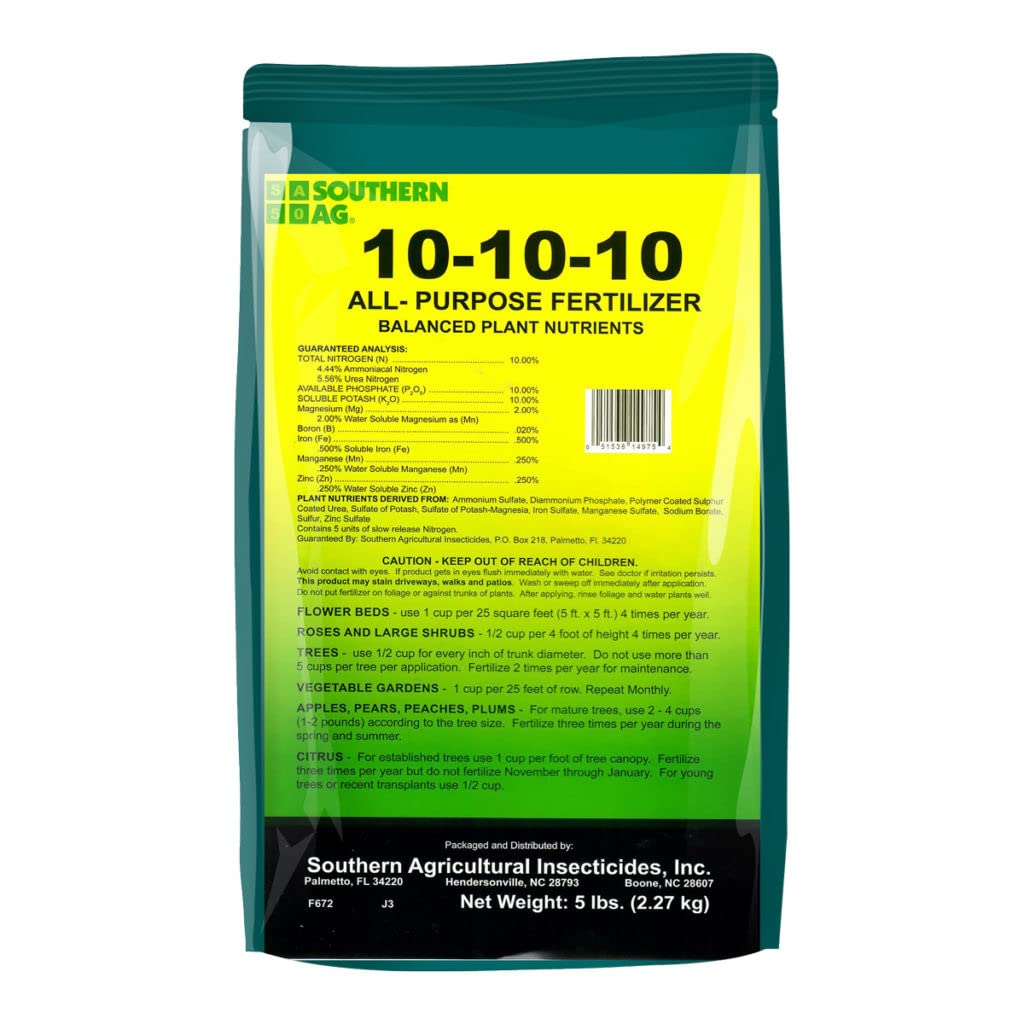
Southern Ag All Purpose Granular Fertilizer 10-10-10 (5 lb)
| Item Form | Granules |
|---|---|
| Specific Uses For Product | Citrus and Fruit Trees, Flowerbeds, Roses, and Large Shrubs, Vegetable Gardens |
| Application Method | Broadcast evenly over area and water in. |
| Mixing Ratio | 10:10:10 |
This 5 lb bag of Southern Ag 10-10-10 granular fertilizer is a straightforward, balanced all-purpose feed for vegetable beds, fruit trees, roses, and shrubs. You spread the granules uniformly over soil or beds and water them in; directions and recommended cup measurements are printed for common uses so dosing is easy. The formula supplies equal parts nitrogen, phosphorus, and potassium plus trace minerals like magnesium, iron, manganese, zinc, and boron, which supports steady vegetative growth and overall plant health. For asparagus specifically it can be used as a periodic maintenance feed during the growing season to support fern growth and energy storage in crowns. The product is simple to store and apply, and the small bag size is convenient for trialing on a single bed or patch. Limitations are that it is a general blend rather than a tailored asparagus formula, so heavy feeders or soils needing specific nutrient correction may require additional amendments, and granular broadcast feedings require careful placement to avoid contact with foliage or runoff risks described on the label.
Best for: Gardeners on a budget who want a simple, balanced fertilizer to maintain small asparagus patches and other mixed beds without buying specialty formulas.
Less Ideal for: Growers managing large asparagus plantings, or who need a targeted high-potassium or soil-specific amendment, should choose a crop-specific or soil-test-driven fertilizer.
- Balanced 10-10-10 N-P-K supports general growth and root development.
- Includes micronutrients (iron, manganese, zinc, boron) for broader plant nutrition.
- Clear application instructions and coverage rates for common garden uses.
- Small 5 lb size is convenient for testing on a single asparagus bed or small garden.
- Not formulated specifically for asparagus so may lack the higher potassium or phosphorus some heavy beds benefit from.
- Granular broadcast application can stain hard surfaces and requires watering after application to activate nutrients.
Verdict: A low-cost, easy-to-use balanced granular fertilizer that is a practical maintenance feed for small asparagus beds and mixed gardens.
RAINFLOW Slow-Release Granular Fertilizer 17-17-17 (11.28 oz)

| Item Form | Granules |
|---|---|
| Application Method | Spread and mix into the soil |
| Coverage | general-purpose, suitable for various plants and gardens |
| Mixing Ratio | 17:17:17 |
| Unit Count | 11.28 Ounce |
This RAINFLOW slow-release granular fertilizer delivers a balanced 17-17-17 NPK dose in a compact 11.28 ounce pack designed for indoor and outdoor use. It is applied by sprinkling or mixing into the soil and lightly covering, with the manufacturer recommending reapplication every 60 days. The granules make it simple to dose for small pots and container gardens using the provided rate guidance, and the slow-release formulation reduces how often you need to feed plants. Practical benefits include support for root development, foliage and stem growth across vegetables, flowers, herbs and potted plants, plus straightforward directions that suit beginner gardeners. Limitations are the small unit size, which means frequent repurchases for larger beds or multiple containers, and the product information does not list trace nutrients or organic certification beyond a generic "organic" claim. Users should measure carefully to avoid overapplication, especially in small pots where recommended grams are low.
Best for: Budget-minded gardeners who need an easy, general-purpose fertilizer for houseplants, small pots, or a few garden beds and prefer infrequent feeding schedules.
Less Ideal for: Large vegetable beds, commercial growers, or gardeners who need trace nutrient formulations or certified organic inputs should consider larger or specialty fertilizers instead.
- Balanced 17-17-17 NPK supports general plant growth across many species
- Slow-release granules feed plants for up to 60 days, reducing application frequency
- Granular form and clear dosing guidance make it easy to measure for pots and containers
- Small 11.28 ounce package requires repeated purchases for larger gardens
- No detailed listing of micronutrients or independent organic certification in the product information
Verdict: A simple, budget-friendly slow-release 17-17-17 granular fertilizer that makes feeding small pots and casual garden projects easy.
M.P. Mustard Cake Powder Organic Fertilizer, 1 kg

| Unit Count | 35.3 Ounce |
|---|---|
| Item Form | Liquid, Powder |
| Specific Uses For Product | Plant Growth |
| Coverage | Medium |
| Target Species | Home Garden |
This mustard cake powder is a simple organic fertilizer aimed at home gardens and small plots where mustard-based nutrient input is preferred. You can apply the dry powder directly into planting beds or pre-soak it and add the liquid the following day, which makes it versatile for both top-dressing and soil incorporation. The product is described as medium coverage and formulated to support general plant growth rather than crop-specific feeding programs. Practical benefits include organic nutrient content that can improve soil biology and a compact 1 kg package that is easy to store. Important limitations are that the label advises not to place the material too close to roots and to keep the powder cool and dry to avoid odors, so it requires some handling care and appropriate storage. Because nutrient analysis is not provided, growers aiming for precise N-P-K management or large-scale mustard production will need to supplement with tested fertilizers or soil tests to meet specific crop targets.
Best for: Gardeners who prioritize an organic, low-technology fertilizer for small plots or home garden mustard crops and who want a product that is easy to apply by hand.
Less Ideal for: Commercial growers or producers who need precise nutrient formulations, large coverage per application, or documented N-P-K values for crop planning.
- Organic mustard cake base supports soil biology and slow nutrient release
- Can be applied dry or pre-soaked for flexible use
- Compact 1 kg package is convenient for small gardens
- Instructions include simple application guidance for home use
- No nutrient analysis (N-P-K) or guaranteed composition provided
- Requires cool, dry storage to avoid developing unpleasant odor
Verdict: A straightforward organic mustard cake powder for small-scale growers who want a simple, soil-friendly fertilizer option.
Dr. Earth Organic Tomato, Vegetable & Herb Fertilizer (64 oz)

| Unit Count | 64 Ounce |
|---|---|
| Item Form | Granules |
| Specific Uses For Product | Organic |
| Target Species | Herb |
| Coverage | Medium |
This granular organic fertilizer is designed to boost vegetable and herb production by supplying balanced nutrients and soil biology support. It is typically broadcast into beds, mixed into potting mixes, or applied at planting and midseason for a nutritional lift; the manufacturer recommends reapplying every six weeks for containers. Notable features include a fully organic ingredient list, fast but sustained nutrient release, and a blend of probiotic microbes plus ecto and endo mycorrhizae intended to improve nutrient uptake and drought tolerance. In practice that means healthier root systems and potentially better yields and flavor in crops like cucumbers when used as part of an organic program. Limitations are that it is a medium coverage product in a 64 ounce bag so larger plots will need more frequent purchases, and it contains phosphorus so local runoff rules should be checked before use. Follow the directions for pH and application timing to avoid overapplication in small containers.
Best for: Gardeners who prioritize organic soil health and want a single, biology‑focused fertilizer to support vegetables like cucumbers in beds or containers.
Less Ideal for: Large‑scale growers seeking a bulk, high‑coverage fertilizer or those who must avoid phosphorus due to local regulations should consider other options.
- 100 percent organic formula suitable for certified organic gardens
- Contains beneficial microbes and eight strains of mycorrhizae to support root health and nutrient uptake
- Granular form releases nutrients quickly and continues feeding for several months
- Works for beds, raised planters and containers and can be used at planting, transplanting or midseason
- Bag is medium coverage so not economical for very large vegetable plots
- Includes phosphorus which may be restricted in some local jurisdictions
Verdict: Choose this product if you want an organic, microbe‑rich granular fertilizer that supports root health and steady feeding for cucumber and other vegetable plantings.
Cz Garden Supply Urea 46-0-0 Granular Fertilizer, 5 lb Resealable Pouch

| Item Form | Granules |
|---|---|
| Specific Uses For Product | gardening, lawn care, tie-dye projects |
| Coverage | Resealable |
| Mixing Ratio | 46:0:0 |
This Cz Garden Supply urea is a straightforward, high-concentration nitrogen fertilizer for gardeners who need a fast, cost-effective nitrogen boost. In practice it is spread or dissolved and applied to soil around established plants such as lawns, leafy vegetables and corn to encourage vigorous green growth and larger foliage. The product arrives as prilled granules in a heavy-duty resealable pouch that makes measuring and storage simple. Because it is nearly pure nitrogen (46-0-0) it delivers rapid greening and can be mixed for foliar or soil drench applications, but it offers no phosphorus or potassium so it is best used as a targeted topdress or sidedress rather than an all-purpose feed. Users should follow rate directions carefully and apply to wet or dry soil as recommended to avoid leaf burn or excess nitrogen runoff. Safety precautions for handling concentrated fertilizers apply. For gardeners focused on quick nitrogen response, this product is an effective, no-frills option.
Best for: Experienced home gardeners who want a fast, controllable nitrogen boost for established corn, lawns, and leafy crops and who follow application rates carefully.
Less Ideal for: Beginners wanting an all-in-one fertilizer or gardeners seeking balanced N-P-K feeds for flowering and fruiting without supplementing other nutrients.
- High 46-0-0 nitrogen concentration for rapid greening
- Resealable heavy-duty pouch for easier storage and measuring
- Versatile use for soil application or dissolving for foliar/soil drench
- Suitable for lawns, leafy vegetables and sidedressing corn
- Contains only nitrogen so additional fertilizers are needed for balanced nutrition
- Concentrated formula requires careful measuring to avoid burn
Verdict: Buy this if you need a powerful, easy-to-store nitrogen-only fertilizer to quickly green and boost corn after planting.
Choosing the Right Fertilizer for Mustard Crop: Key Factors to Consider
Nutrient Ratio and Stage-Specific Needs
Mustard needs a balanced supply of nitrogen, phosphorus, and potassium through the season, but the optimal ratio changes with growth stage. Early vegetative growth benefits from nitrogen to build leaf area, while phosphorus supports root development and potassium helps stress tolerance and seed quality. As plants move toward flowering and seed fill, maintaining adequate potassium and sulfur becomes more important for oil accumulation and flavor compounds.
Matching fertilizer ratios to these stages reduces the risk of excessive vegetative growth at the expense of yield or oil content. Use soil and tissue tests to time applications and choose products that let you alter NPK inputs across the season.
Sulfur Content and Form
Sulfur is critical for mustard because it is central to the plant's glucosinolate and oil synthesis pathways. Soils low in sulfur or with a history of intensive cropping will often show clear responses to sulfur-containing fertilizers. Sulfur can be supplied as sulfate salts, elemental sulfur, or as part of compound fertilizer mixtures; the form affects how quickly it becomes available.
Sulfate forms are plant-available immediately, while elemental sulfur requires microbial oxidation and is slower acting. Consider soil temperature, moisture, and biology when choosing the sulfur form so availability aligns with the crop's needs.
Seedbed and Starter Compatibility
Starter fertilizers applied at sowing can help establish uniform stands and early vigor, especially in cool or low-phosphorus soils. However, high salt-index starters placed too close to seed can reduce germination. Choose starter formulations with safe placement rates and ensure application equipment allows banding at the correct depth and lateral distance from seed.
For direct-seeded mustard, verify recommended rates for in-furrow or row-band use and prefer low-salt starters when soil moisture or seedbed conditions are marginal.
Application Method and Equipment Fit
Different fertilizers are designed for broadcast, banded, foliar, or fertigation application. Your choice should align with available equipment and labor. Granular blends are often suitable for broadcast or banding with standard spreaders or planters, while liquid fertilizers may be easier to apply through sprayers or irrigation systems for split applications.
Consider the ability to split nitrogen and sulfur applications to match crop uptake and reduce losses. Also factor in tank-mix compatibility and whether the fertilizer requires special handling during application.
Soil Test Interpretation and Adjustment
A soil test is the backbone of a fertilizer plan. Tests reveal existing nutrient pools, pH issues, and sulfur status, letting you choose products that correct deficiencies without over-applying nutrients that are already adequate. Proper interpretation converts test results into target rates and tells you whether liming or micronutrient amendments are needed.
Adjust fertilizer choice and rates based on test results rather than default recipes to avoid nutrient imbalances that can reduce yield or oil quality.
Environmental Loss Risk and Timing
Nitrogen and sulfur are mobile in the soil and can be lost to leaching or gaseous emissions if applied at the wrong time or in the wrong form. Time applications to coincide with active crop uptake, avoid applying before heavy rainfall, and consider stabilized nitrogen sources or split applications to reduce losses.
Managing application timing and fertilizer form not only protects yield but also reduces environmental impacts and the likelihood of regulatory issues related to nutrient runoff.
Soil pH and Mustard Nutrient Uptake
Soil pH influences nutrient availability and the effectiveness of many fertilizers. Mustard performs best in a near-neutral pH range where phosphorus and sulfur are more available. If pH is acidic, phosphorus can be tied up and some micronutrients can reach phytotoxic levels, while in very alkaline soils sulfur availability may be reduced.
- Test pH before planting and correct using lime or sulfur amendments as recommended by local extension.
- Remember that liming alters calcium and magnesium balance, which can change fertilizer recommendations.
Split Applications to Match Uptake
Splitting nitrogen and sulfur into multiple applications reduces loss and better matches crop demand. An initial dose at establishment supports leaf area development; subsequent side-dressings during stem elongation and early pod set sustain growth and seed filling. Split applications also let you respond to in-season tissue tests and weather conditions.
- Plan at least two to three nitrogen applications rather than a single large dose.
- Use quick-acting sulfate forms when a rapid sulfur correction is needed.
Foliar Feeding: When and How to Use It
Foliar feeding can be an efficient way to correct short-term deficiencies or supply micronutrients during key growth windows. For mustard, foliar sulfur sprays are sometimes used when immediate correction is needed, but foliar applications should supplement, not replace, a sound soil fertility program because foliar uptake quantities are limited.
Ensure sprays are applied at recommended concentrations to avoid leaf burn and time applications for cooler parts of the day to maximize uptake.
- Use foliar feeds for targeted micronutrient corrections detected via tissue tests.
- Avoid heavy foliar nitrogen doses late in the season that could delay maturation.
Organic Versus Conventional Sources
Organic fertilizers and amendments can supply sulfur and other nutrients, but they often release nutrients more slowly and in less predictable quantities than synthetic materials. If managing organically, plan for earlier or repeated applications to build nutrient availability before critical growth stages.
Conventional fertilizers provide precise nutrient ratios and known availability, which simplifies matching supply to crop demand when using soil tests.
- Combine composts and manures with testing to avoid over-application of phosphorus.
- Plan timing for organic sulfur sources that require microbial conversion.
Record-Keeping and In-Season Monitoring
Keep records of application rates, timing, weather, and crop response. These notes help refine fertility plans in subsequent seasons and identify patterns that affect yield and oil quality. Use tissue tests during vegetative growth and early flowering to confirm that the crop is accessing intended nutrients.
Regular monitoring lets you make corrective applications when necessary and avoid unnecessary inputs late in the season.
- Maintain a logbook or digital record for each field.
- Resample problematic fields more often to catch emerging deficiencies.
How We Chose the Best Fertilizer for Mustard Crop
Our selection focused on fertilizers that address the agronomic needs of mustard crop production across a range of soil types and farm scales. We prioritized formulations with clear nutrient analyses and reliable sulfur content because mustard requires both macronutrients and sulfur for proper oil synthesis and flavor development. Evaluation criteria included nutrient balance and ratio suitability for mustard growth stages, sulfur content and availability, application flexibility (ability to use as starter, side-dress, or foliar feed), and compatibility with common soil test recommendations. We also considered handling and storage safety for on-farm use and the practicality of applying the product with typical ground or aerial equipment. We excluded blends intended primarily for unrelated crops, experimental products lacking documented nutrient analysis, and materials that require specialized handling beyond standard farm equipment. The resulting shortlist reflects options likely to be effective when matched to soil test results and local fertility planning practices.
FAQ
How much sulfur does mustard typically require?
Mustard often needs more sulfur than many common crops because sulfur contributes to oil and flavor compounds. The exact rate depends on soil tests, but soils low in organic matter or with a history of heavy cropping usually respond to added sulfur. Use soil and tissue tests to set rates rather than a fixed blanket application.
Can I apply all nitrogen at planting for mustard?
Applying all nitrogen at planting increases the risk of leaching and may promote excessive vegetative growth early on. It is usually better to split nitrogen into multiple applications timed to match crop uptake and reduce losses, especially in sandy soils or regions with heavy rainfall.
Is elemental sulfur better than sulfate for mustard?
Elemental sulfur is slower to act because microbes must oxidize it first, which can be useful for long-term building of sulfur in soil. Sulfate forms supply sulfur immediately and are preferable when the crop needs a quick correction. Choose the form based on timing and soil biological activity.
Do I need a different fertilizer strategy for spring-planted versus fall-planted mustard?
Planting season affects temperature, moisture, and biological activity, which in turn affect nutrient availability. Cooler spring soils slow mineralization and sulfur oxidation, so available sulfur may be lower. Adjust fertilizer timing and possibly favor more available sulfate forms in cooler conditions.
Will foliar sulfur sprays fix a soil deficiency?
Foliar sulfur can quickly improve plant tissue levels and correct short-term deficiencies, but it does not replace soil-applied sulfur for sustained supply. Use foliar sprays as a short-term corrective measure while addressing the underlying soil deficiency.
Final Verdict
Choose a fertilizer for mustard crop by prioritizing proper nutrient ratios and ensuring adequate sulfur availability at the right times. Base product selection on soil and tissue test results, and favor application methods that match your equipment and the crop's uptake pattern. Balance split applications and quick-acting sulfur sources against slower-release options depending on timing and soil biology. With a test-driven plan and attention to application timing, you can make a practical fertilizer choice that supports yield, seed quality, and efficient use of inputs.
