

Note: This article contains affiliate links. If you click on these links and make a purchase, I may earn a small commission at no extra cost to you. This helps support my research and content. Read my full affiliate disclosure here.
If you grow African violets, feeding is one of the simplest steps that makes the biggest difference in bloom frequency and leaf health. The right plant food keeps compact growth, encourages repeat flowering, and avoids the leggy, sparse plants that come from underfeeding or using the wrong fertilizer balance. This guide shortlists the top options for African violet feeding and explains how we judged them on nutrient profile, application style, and reliability in home conditions. Read on to find the feeding approach that fits your pot size, watering routine, and whether you prefer liquid, granular, or water-soluble concentrates.
Top Picks at a Glance
| Best Overall The best all-around choice for most situations | Schultz African Violet Plus Liquid Plant Food, 4 oz (2-Pack) |  |
| Best Quality Built to a higher standard if you want something more solid | Espoma Organic Violet! Liquid Plant Food (8 fl oz) |  |
| Best Value The sweet spot between price and what you get | TPS Nutrients African Violet Liquid Fertilizer, 8 fl oz |  |
| Best Budget The cheapest option that still gets the job done reliably | Bonide 106 Liquid African Violet Plant Food, 8 oz |  |
| Highest Rated A top-rated pick with lots of positive feedback | Jack's Classic 12-36-14 African Violet Water-Soluble Fertilizer, 8 oz |  |
| Most Popular A crowd favorite that many people choose with confidence | TPS NUTRIENTS African Violet Liquid Fertilizer, 32 fl oz |  |
| Best Seller A high-volume bestseller chosen again and again | TPS NUTRIENTS African Violet Liquid Fertilizer, 1 Gallon |  |
Schultz African Violet Plus Liquid Plant Food, 4 oz (2-Pack)

| Item Form | Liquid |
|---|---|
| Application Method | Water |
| Target Species | African violets and other blooming plants |
| Mixing Ratio | 1:128 |
This Schultz African Violet Plus liquid plant food is a concentrated feed designed to encourage blooms and maintain healthy foliage on African violets and similar indoor flowering plants. It is used by mixing a small amount with water (mixing ratio 1:128 or seven drops per quart) and applying as part of regular watering. The formula provides an 8-14-9 NPK balance plus added micronutrients to support root strength and flower production, and the two 4 oz bottles give enough supply for repeated feedings. Practical benefits include straightforward dosing, a liquid form that disperses evenly in water, and a nutrient profile aimed at stimulating blooms rather than just leaf growth. Important limitations are the small bottle size if you care for many plants and the need to follow the dilution instructions closely to avoid overfeeding sensitive varieties. For growers who prefer granular slow-release feeds or who want larger-volume supplies, this concentrated liquid may be less convenient.
Best for: Ideal for home growers who want a simple, bloom-focused liquid feed for a moderate number of African violets or indoor flowering plants and who prefer precise, water-applied fertilization.
Less Ideal for: Not a great choice for gardeners managing large collections who prefer bulk or slow-release granular fertilizers or for those who dislike regular liquid dosing routines.
- Formulated specifically for African violets and other blooming houseplants
- Provides an 8-14-9 NPK ratio plus micronutrients to encourage flower production
- Liquid concentrate mixes easily into water for even application
- Two 4 oz bottles supply repeated feedings without immediate repurchase
- Small bottle size may require frequent replacement for larger collections
- Requires careful dilution to avoid overfeeding delicate plants
Verdict: A compact, easy-to-mix liquid fertilizer focused on boosting blooms in African violets and other indoor flowering plants.
Espoma Organic Violet! Liquid Plant Food (8 fl oz)

| Item Form | Liquid |
|---|---|
| Specific Uses For Product | Plant Growth and Flowering |
| Target Species | African violets, indoor flowering plants |
| Liquid Volume | 8 fluid ounces |
| Mixing Ratio | 1:2 |
Espoma Organic Violet! is a concentrated liquid plant food made specifically for African violets and similar indoor flowering plants. You mix half a cap per quart of water (mixing ratio 1:2 listed) and drench the potting soil every 2 to 4 weeks, so it fits easily into a regular watering routine. As an organic formula, it supplies essential plant nutrients intended to encourage fuller foliage and more frequent, vivid blooms without synthetic additives. The small 8 ounce bottle is easy to store and the dosing is simple, which helps avoid overfeeding sensitive violets. Because it is concentrated, a little goes a long way for individual houseplants, but the bottle size and medium coverage mean it is best suited to small collections rather than large-scale feeding. If you want a dedicated, organic fertilizer to keep potted violets blooming on a budget, this product is straightforward and effective, though heavy users with many plants may prefer larger or more economical concentrates.
Best for: A budget-minded houseplant owner who cares for a small collection of African violets and wants an easy organic fertilizer to encourage blooms without complicated dosing.
Less Ideal for: Collectors with many plants or commercial growers who need larger volumes or lower cost per treatment should consider bulk concentrates or larger packages.
- Formulated specifically for African violets and other indoor flowering plants
- Organic concentrated liquid that is easy to mix and apply
- Simple dosing instructions (1/2 cap per quart) reduce risk of overfeeding
- Small bottle stores easily and lasts for multiple treatments on a few plants
- 8 fl oz size limits cost-effectiveness for large collections or frequent use
- Coverage is described as medium so may require more product for many pots
Verdict: A simple, organic concentrated liquid fertilizer made for small collections of African violets to boost growth and blooms.
TPS Nutrients African Violet Liquid Fertilizer, 8 fl oz
| Item Form | Liquid |
|---|---|
| Specific Uses For Product | Plant Food |
| Coverage | Medium |
| Target Species | African Violet |
| Mixing Ratio | 1:128-1:256 |
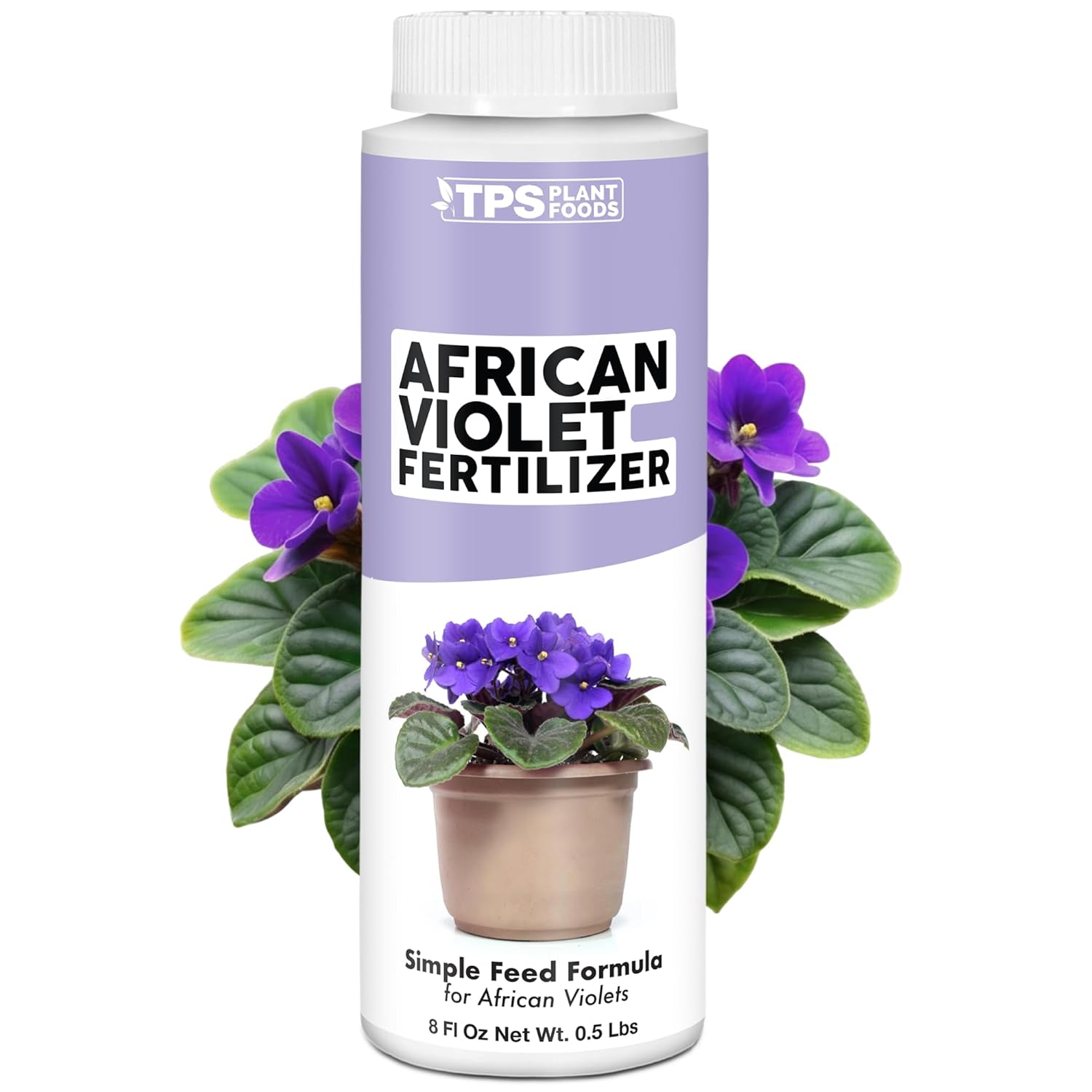
This 8 fl oz liquid fertilizer from TPS Nutrients is made for African violets and is designed to be diluted and applied regularly to support continuous flowering and healthy leaves. It is a low-concentration liquid formula with a recommended mixing ratio of 1:128 to 1:256 and directions to dilute 5 to 10 drops per quart of water and feed every two weeks or with every watering for best results. The product highlights gentle nutrition aimed at delicate roots, claims to reduce buildup and root stress, and specifically targets rebloom cycles and robust leaf color. Practical benefits include easy measuring for small indoor plants, even nutrient distribution when diluted, and a focused formulation that removes guesswork for violet owners. Limitations are the small bottle size for growers with many plants and the need for consistent dilution and schedule to see results; it is not a granular or slow-release option for hands-off users. Safety precautions and standard fertilizer warnings apply.
Best for: Violet owners who want a targeted, easy-to-dose nutrient solution and who follow a regular feeding routine to keep indoor plants blooming and healthy.
Less Ideal for: People who prefer low-maintenance slow-release or granular fertilizers or those who need a bulk supply for many plants at once.
- Formulated specifically for African violets to encourage reblooming and richer foliage
- Liquid concentrate allows precise dosing for small indoor plants
- Gentle, low-concentration formula intended to minimize root stress and buildup
- Clear mixing ratio and feeding instructions make routine use straightforward
- Small 8 fl oz bottle may require frequent replacement for multiple plants
Verdict: A small, easy-to-dose liquid fertilizer tailored to African violets that simplifies regular feeding to promote more blooms and healthier foliage.
Bonide 106 Liquid African Violet Plant Food, 8 oz

| Item Form | Liquid |
|---|---|
| Specific Uses For Product | Plant Food |
| Application Method | Water |
| Target Species | African Violet |
| Mixing Ratio | 1/8 tsp. per quart of water |
Bonide 106 is a concentrated liquid plant food specifically formulated for African violets and other flowering houseplants. You dilute 1/8 teaspoon per quart of water and feed the solution every time you water, which makes it simple to incorporate into a regular indoor watering routine. The 7-10-7 nutrient ratio with urea nitrogen is aimed at encouraging blooms and healthy foliage while using a low concentration to avoid overfeeding. The 8 ounce bottle is compact and easy to store, and the liquid form mixes quickly for even application. Because it is designed for frequent, low-dose feeding it helps maintain consistent bloom production without complex schedules. The main limitation is the small 8 ounce volume, which means frequent replacement if you care for many plants, and the formula is specialized for bloomers so it is not a general-purpose houseplant tonic for heavy feeders.
Best for: Buyers looking for an inexpensive, no-fuss fertilizer to keep African violets blooming regularly and who prefer feeding at each watering as part of routine care.
Less Ideal for: Collectors with large indoor collections or users who want an all-purpose fertilizer for diverse houseplant types should consider larger or more generalized products.
- Formulated specifically for African violets and other blooming houseplants to promote flowers
- Low dilution rate (1/8 tsp per quart) that makes it easy to feed at every watering
- Liquid form mixes quickly for even distribution and straightforward application
- Compact 8 oz bottle is easy to store and handle for small indoor collections
- Small 8 oz volume can run out quickly for gardeners with many plants
- Specialized bloom formula may not suit foliage-only or heavy-feeding houseplants
Verdict: A simple, budget-friendly liquid fertilizer that makes frequent low-dose feeding of African violets easy and reliable.
Jack's Classic 12-36-14 African Violet Water-Soluble Fertilizer, 8 oz
| Item Form | Powder |
|---|---|
| Specific Uses For Product | African Violet care |
| Application Method | Spray or pour |
| Mixing Ratio | 1/4 teaspoon per gallon |
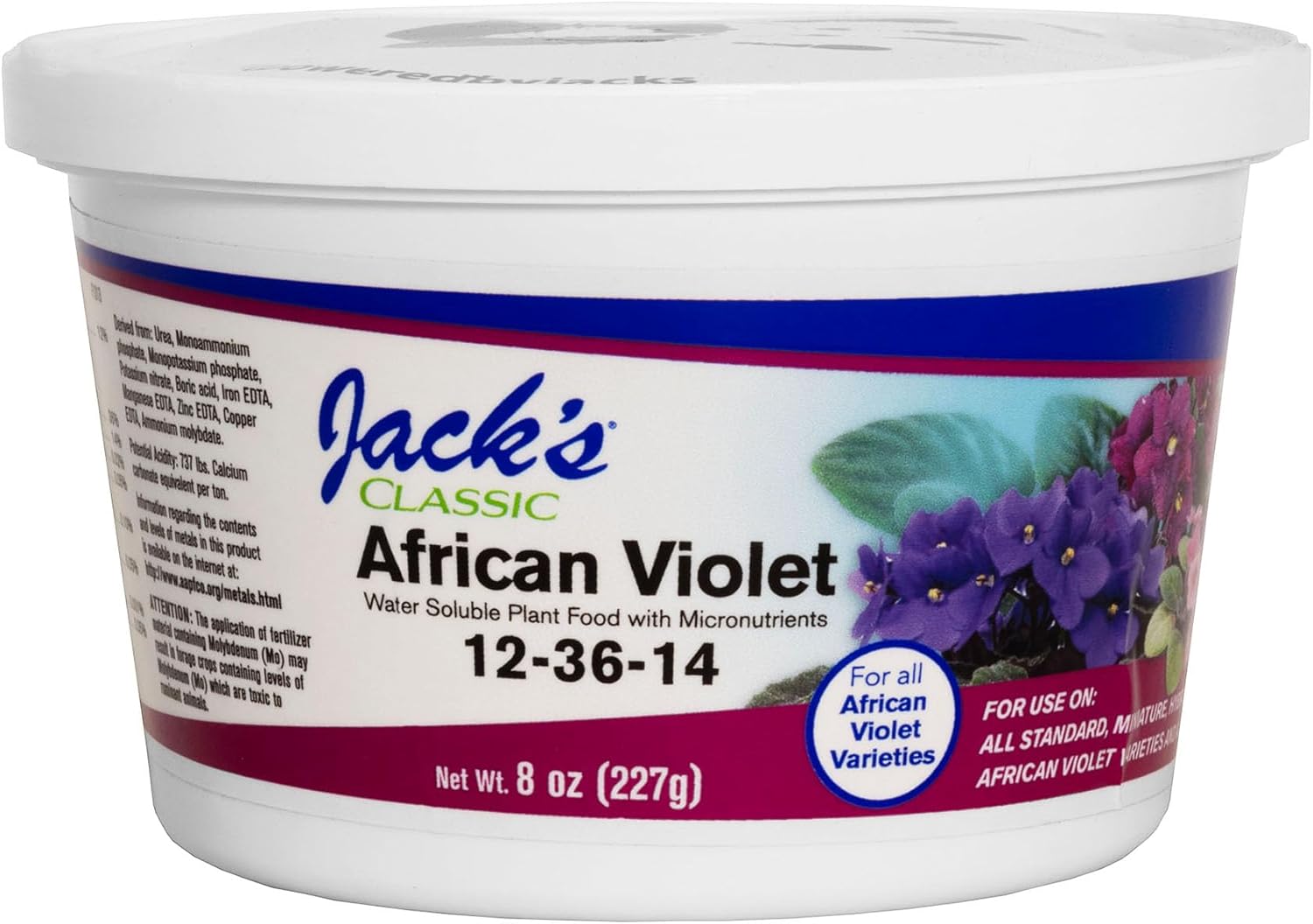
Jack's Classic 12-36-14 is a powder concentrate designed specifically for African violets and other houseplants, mixed at the recommended ratio to create a liquid feed. You can apply it as a foliar spray or pour it into the potting mix for root feeding, and a small 1/4 teaspoon per gallon mixing guideline makes it easy to dose repeatedly. The formula emphasizes bloom and bud development while supplying micronutrients for healthier foliage and stronger roots. Because it is concentrated powder, one 8 oz unit will make many gallons of feed, which is economical and convenient for steady, scheduled feeding. The product also includes a measuring spoon for precision dosing and claims a safety margin to reduce burn risk when used as directed. Limitations are that you need to mix it each time and follow the feeding schedule carefully, and it is tailored to African violets so it is not a one-size-fits-all houseplant fertilizer for radically different nutrient needs.
Best for: Buyers who prioritize consistent, proven results for African violets and prefer a professional-grade, easy-to-measure feed for regular scheduled feeding.
Less Ideal for: Casual plant owners who want ready-to-use liquid fertilizers or gardeners seeking a general-purpose houseplant feed for many different species.
- Formulated specifically for African violets to encourage blooms and strong foliage
- Water-soluble powder yields many gallons of feed from a small container, improving economy
- Includes micronutrients for balanced nutrition and a measuring spoon for accurate dosing
- Can be used as foliar spray or root drench for flexible application methods
- Requires mixing each use rather than being a ready-to-use product
- Nutrient ratio is specialized so may not suit all houseplant types
Verdict: A concentrated, professional-grade powder fertilizer that reliably boosts blooms and foliage on African violets when used as a regular feed.
TPS NUTRIENTS African Violet Liquid Fertilizer, 32 fl oz

| Item Form | Liquid |
|---|---|
| Specific Uses For Product | Plant Food |
| Coverage | Medium |
| Target Species | African Violet |
| Unit Count | 32 Fluid Ounces |
This TPS NUTRIENTS liquid fertilizer is formulated for indoor African violets and is intended to encourage repeat blooming, richer leaf color, and stronger roots. It is used by diluting and applying to the potting soil on a regular feeding schedule so plants receive consistent, gentle nutrition without salt buildup. Notable features include a liquid form that delivers even feeding and a formula described as gentle for delicate roots to reduce burn risk. In practice the product is convenient for hobbyists who want predictable rebloom cycles and fuller flowers because liquid feedings are easy to measure and absorb quickly. The bottle size suits several months of routine feeding for a small violet collection. Important limitations are that directions are basic and the label does not list detailed nutrient analysis on the provided summary, so precise NPK or application rates should be checked before regular use and users with many plants will need to plan refill or larger volumes.
Best for: Indoor plant owners who prioritize reliable reblooming and gentle, easy-to-apply nutrition for a small African violet collection and who prefer a liquid feed routine backed by popular use.
Less Ideal for: Gardeners managing a mixed collection of houseplants or large numbers of pots who need a universal or concentrated fertilizer designed for many species.
- Formulated specifically for African violets to support reblooming and leaf color
- Liquid form provides even feeding and easy measurement
- Marketed as gentle on roots to reduce risk of fertilizer burn
- 32 fl oz bottle provides multiple doses for a small indoor collection
- Label information in the summary does not include a full nutrient breakdown or explicit application rates
- Not intended for general houseplants or outdoor use beyond the listed target species
Verdict: A convenient, gentle liquid fertilizer made to help indoor African violets rebloom and maintain rich leaves.
TPS NUTRIENTS African Violet Liquid Fertilizer, 1 Gallon

| Item Form | Liquid |
|---|---|
| Specific Uses For Product | Plant Food |
| Coverage | Medium |
| Target Species | African Violet |
| Unit Count | 128 Fluid Ounces |
This 1 gallon liquid fertilizer is formulated for African violets and is intended to deliver gentle, regular nutrition to indoor plants. It is typically diluted and mixed into potting mix or applied as part of a routine feeding schedule to support rebloom cycles, stronger roots, and richer leaf color. Notable features include a liquid form that reduces salt buildup compared with granular feeds and a nutrient blend containing nitrates, potassium phosphate and trace micronutrients for balanced growth. Practical benefits are consistent bloom encouragement and easier dosing for multiple pots thanks to the large 1 gallon supply. Important limitations are that directions are general and users should follow dilution guidance carefully to avoid overfeeding, and the product is targeted at African violets so it may not be optimized for other houseplants. Also, the concentrated size means storage and handling precautions are necessary to keep it away from children and pets.
Best for: A cautious indoor gardener who grows African violets and wants an easy-to-dose, purpose-made fertilizer to encourage regular blooms without complex mixing routines.
Less Ideal for: Growers who need a universal houseplant fertilizer for many plant types or who prefer single-use packets and minimal handling should consider alternatives.
- Formulated specifically for African violets to encourage rebloom and vibrant foliage
- Liquid form allows even feeding and lower risk of salt buildup compared with granular fertilizers
- Large 1 gallon volume supports multiple plants and frequent feedings without frequent repurchase
- Includes macronutrients and trace elements such as calcium, magnesium and micronutrient sulfates
- Concentrated size requires careful storage and precise dilution to avoid accidental overfeeding
- Label directions are generalized and may require adjustment for different potting mixes or pot sizes
Verdict: Buy this if you want a purpose-made, liquid fertilizer that reliably encourages African violets to rebloom and maintain healthy foliage.
Choosing the Right African Violet Plant Food: Key Factors to Consider
Nutrient Ratio and Micronutrient Balance
African violets generally respond best to balanced fertilizer ratios with slightly higher phosphorus to encourage flowering. A formulation specifically labeled for blooming houseplants or violets often lists an N-P-K ratio that supports both foliage and flowers. Micronutrients such as magnesium, iron, and boron matter because potted plants have a limited root zone and can run short of trace elements between repottings.
Too much nitrogen will produce lush leaves at the expense of blooms, while low phosphorus can reduce flowering. Look for formulas that include chelated micronutrients or explicitly note suitability for acid-loving or indoor flowering plants. That helps prevent common deficiencies and maintains compact, healthy growth.
Formulation and Ease of Dosing
Fertilizers come as liquids, water-soluble powders, and slow-release granules. For African violets, small, precise doses are important because pots are small and roots are sensitive to overfeeding. Liquid concentrates and water-soluble products let you mix mild feedings on a regular schedule, which is often safer for violets than occasional heavy feedings.
Consider how easy it is to measure the recommended dose and whether the product includes a measuring cap or spoon. Concentrates that list ppm or clear dilution ratios are more user-friendly for indoor growers who prefer consistent results.
Solubility, Absorption, and Watering Style
How a product dissolves and how you water plants interact strongly. If you use bottom-watering or trays, you need a fertilizer that dissolves fully and moves readily into the root zone. Granules or slow-release beads may not be ideal for bottom-watering methods because uptake can be uneven.
Water-soluble salts are ideal when you water from the top and allow runoff. Also consider whether the product leaves residue on leaves or soil surface; for small rosettes, foliar contact can cause spotting, so fully soluble mixes are preferable.
Salt Buildup and Flushing Needs
Potted African violets are prone to salt accumulation because they are fed regularly in a small volume of soil. High-salt fertilizers or heavy application schedules increase the risk of root damage and brown leaf tips. Opt for low-salt or mild-strength feeding recommendations to reduce the need for frequent flushing.
Plan for periodic leaching with plain water if you feed often. Choose products that document safe feeding frequency or include guidance on when to water through to flush excess salts to protect sensitive roots.
Bloom Promotion and Growth Habit
Some formulations emphasize bloom boosters with higher phosphorus or bloom-specific micronutrients. These can increase flower production but may also affect leaf size and plant compactness. For table-top African violets, maintaining a compact rosette while encouraging frequent bloom is usually the priority.
Evaluate whether the fertilizer promotes many small blooms or fewer larger ones, and whether it supports reblooming schedules. Matching the feed to your preferred flowering style helps you hit the balance between dense foliage and abundant flowers.
Packaging Size and Instruction Clarity
Because African violets are small, you do not need large containers of fertilizer, and a small, clearly labeled package reduces waste and keeps dosing accurate. Look for products that include exact dilution guidelines for small pots and instructions for alternate watering methods like tray or bottom feeding.
Clear labeling also helps prevent accidental overfeeding. Packaging that stores well in a kitchen or closet and is resealable is a practical advantage for hobby growers who feed a few pots at a time.
Feeding Schedules That Work for Violets
Most growers use a regular low-strength feeding schedule rather than intermittent heavy feedings. A common approach is to apply a weak solution with every second or third watering during the growing and blooming season to provide steady nutrients without overwhelming roots.
Adjust frequency in winter when growth slows; reduce feeding or switch to maintenance strength. If you practice bottom-watering, apply diluted feed until the soil is evenly moist and allow excess to drain so salts do not concentrate at the surface.
- Regular low-strength feedings reduce the risk of leaf burn
- Cut back feeding in cooler, low-light months
- Flush the pot with plain water occasionally to remove salts
Liquid Vs Water-Soluble Vs Slow-Release
Liquid and water-soluble fertilizers give the most control for small pots because you can measure a mild dose for each application. They mix quickly and are suitable for both top-watering and tray methods, provided the mix fully dissolves.
Slow-release granules need less frequent attention but can be harder to dose for tiny containers and may not distribute evenly in the small root ball. For growers who prefer a set-and-forget approach, low-release options formulated for indoor plants can work, but expect less flexibility in adjusting strength during bloom cycles.
- Liquids: precise control, immediate availability
- Water-soluble: good for routine feeding, mixes easily
- Slow-release: lower maintenance, less dosing precision
Preventing Leaf Spotting and Burn
Direct contact between concentrated fertilizer and foliage can cause burning or spotting on the delicate leaves of African violets. Always avoid splashing undiluted concentrate on leaves and wipe any accidental spills immediately.
Apply fertilizer to moist soil rather than dry media to minimize root shock. If you notice leaf edge browning or black spots after feeding, reduce concentration and flush the pot with plain water to remove excess salts.
- Mix feed to recommended strength before application
- Avoid foliar contact with concentrated solutions
- Flush pots if signs of salt damage appear
Feeding for Reblooming Cycles
To encourage repeat blooming, use a fertilizer that supports both flower development and carbohydrate reserves in the plant. Regular, mild feedings during active growth keep plants healthy and ready to put energy into new flower spikes.
Timing also matters: slightly increased feeding during bud formation can support larger flushes of blooms, but do not overdo nitrogen levels that might delay or reduce flower set.
- Increase feeding modestly when you see developing buds
- Reduce nitrogen relative to phosphorus during heavy bloom
Storage and Shelf Life for Hobby Growers
Small packages are convenient for occasional feeding and help maintain potency. Store fertilizers in a cool, dry place away from direct sunlight and humidity to keep soluble ingredients stable.
If you buy concentrates, follow dilution instructions and discard mixed solutions after the recommended time. Powdered or crystal formulations often retain potency longer if kept sealed and dry.
- Keep products sealed and dry
- Discard mixed solutions if left standing beyond guidelines
- Choose package sizes that match your usage rate
How We Chose the Best African Violet Plant Food
We selected products that match the needs of typical African violet growers and the specific demands of small houseplants. Key evaluation criteria included nutrient ratio and micronutrient content to support continuous blooming, formulation type and ease of measuring for accurate dosing, solubility and suitability for common watering methods, and potential for salt buildup or leaf tip burn. We also considered packaging sizes appropriate for hobbyists and whether directions cover both active growth and bloom maintenance. Exclusions included general-purpose garden fertilizers that lack guidance for indoor potted plants, high-salt formulations unsuitable for frequent use, and products without clear dilution instructions. The result is a list of options that are well suited to potted African violets across different care styles and watering frequencies.
FAQ
How often should I feed African violets?
Often a low-strength feeding every second or third watering during active growth is effective. Frequency depends on light and growth rate; reduce feedings in winter when plants slow down.
Can I use general houseplant fertilizer on African violets?
It depends on the formulation. Many general houseplant feeds work if diluted appropriately, but products designed for blooming indoor plants or violets better support flower production and often include suitable micronutrients.
Is bottom-watering compatible with liquid fertilizers?
Yes. Ensure the fertilizer fully dissolves and the solution reaches the root ball when bottom-watering. Monitor for uneven uptake and use occasional top-water feedings if distribution seems poor.
What signs indicate overfeeding?
Symptoms include brown leaf tips, leaf burn, reduced flowering, and a crust of salts on the soil surface. If you see these signs, flush the pot with plain water and reduce concentration or frequency.
Should I change fertilizer when repotting?
Repotting into fresh media often resets nutrient levels, so reduce or skip feeding for a few weeks while roots establish. Resume a mild feeding schedule once new growth appears.
Do African violets need micronutrients?
Usually yes. Micronutrients like magnesium and iron prevent subtle deficiencies in small pots. Look for formulations that include trace elements or consider supplementing if you observe pale new growth.
Final Verdict
Choose a feeding approach that matches your watering method, pot size, and flowering goals. For most hobby growers, a water-soluble or liquid fertilizer with a bloom-friendly nutrient balance and clear dilution instructions delivers steady results without stressing roots. Prioritize products with low salt potential, clear dosing, and micronutrients so you can maintain compact, repeat-flowering plants with minimal fuss.
