

Note: This article contains affiliate links. If you click on these links and make a purchase, I may earn a small commission at no extra cost to you. This helps support my research and content. Read my full affiliate disclosure here.
If Japanese beetle grubs are leaving brown patches or spongy turf in your yard, choosing the right grub killer makes a big difference in recovery and prevention. You want a treatment that targets root-feeding grubs without harming beneficial soil life, is straightforward to apply over typical lawns, and gives reliable residual control through the season. This guide presents seven shortlisted Japanese beetle grub killers selected for effectiveness in common lawn situations. We evaluate each option by how well it controls grub populations, how easy it is to apply on a schedule, and what kind of residual protection you can expect. Read on for practical guidance to match a treatment to your lawn size, timing window, and long-term turf health goals.
Top Picks at a Glance
| Best Overall The best all-around choice for most situations | Atticus Mineiro 2F Flex Systemic Insecticide (32 oz) |  |
| Best Quality Built to a higher standard if you want something more solid | St. Gabriel Organics Milky Spore Granular Grub Control, 15 lb |  |
| Best Value The sweet spot between price and what you get | BioAdvanced Complete Insect Killer Granules for Soil & Turf, 10 lb |  |
| Best Budget The cheapest option that still gets the job done reliably | Ortho BugClear Lawn Insect Killer, 10 lb granules |  |
| Highest Rated A top-rated pick with lots of positive feedback | Merit 0.5% Insecticide Granules (30 lb) |  |
| Most Popular A crowd favorite that many people choose with confidence | Scotts GrubEx1 Season-Long Grub Killer (covers 5,000 sq. ft.) |  |
| Best Seller A high-volume bestseller chosen again and again | BioAdvanced Season Long Grub Control Granules, 10 lb |  |
Atticus Mineiro 2F Flex Systemic Insecticide (32 oz)

| Active ingredient | Imidacloprid 21.4% |
|---|---|
| Formulation | Liquid concentrate |
| Primary use | Preventive grub and insect control |
Mineiro 2F Flex is a liquid concentrate containing 21.4% imidacloprid designed for preventive grub control and broader insect management in lawns and landscapes. You mix and spray it over turf, ornamentals, and certain fruit and pecan trees during the recommended application window to build a residual that kills hatching grubs and a range of root- and leaf-feeding pests. Its key benefits are a long-lasting residual and a flexible mid-June through late-July application window that fits different schedules while catching summer-hatching grubs before they mature. The product is also labeled for use on parks, sports fields, and sod farms so it suits larger areas as well as home lawns. Important limitations are legal restrictions in many states and the need to follow label directions closely for safe, appropriate use; it is a preventive systemic treatment rather than an instant knockdown for established, heavy infestations. Users should plan applications around label timing and targeted pests for best results.
Best for: Gardeners and property managers who want a preventive, long-residual grub and insect treatment they can apply on a predictable schedule to protect lawns and landscape plants.
Less Ideal for: People looking for a fast contact knockdown for active, heavy infestations or those who cannot use products restricted in certain states should consider alternative control methods.
- High concentration of imidacloprid (21.4%) provides long residual activity against grubs
- Flexible application window (mid-June through late-July) for preventive control
- Label allows use on lawns, trees, shrubs, flowers, groundcovers and certain fruit and pecan trees
- Suitable for larger turf areas such as parks, sports fields, and sod farms
- Not registered for sale or use in a number of states, restricting availability
- Acts as a preventive systemic treatment and is less effective as an immediate fix for heavy, established infestations
Verdict: Choose Mineiro 2F Flex if you need a preventive, long-lasting systemic treatment to protect lawns and landscape plants from Japanese beetle grubs and similar pests.
St. Gabriel Organics Milky Spore Granular Grub Control, 15 lb
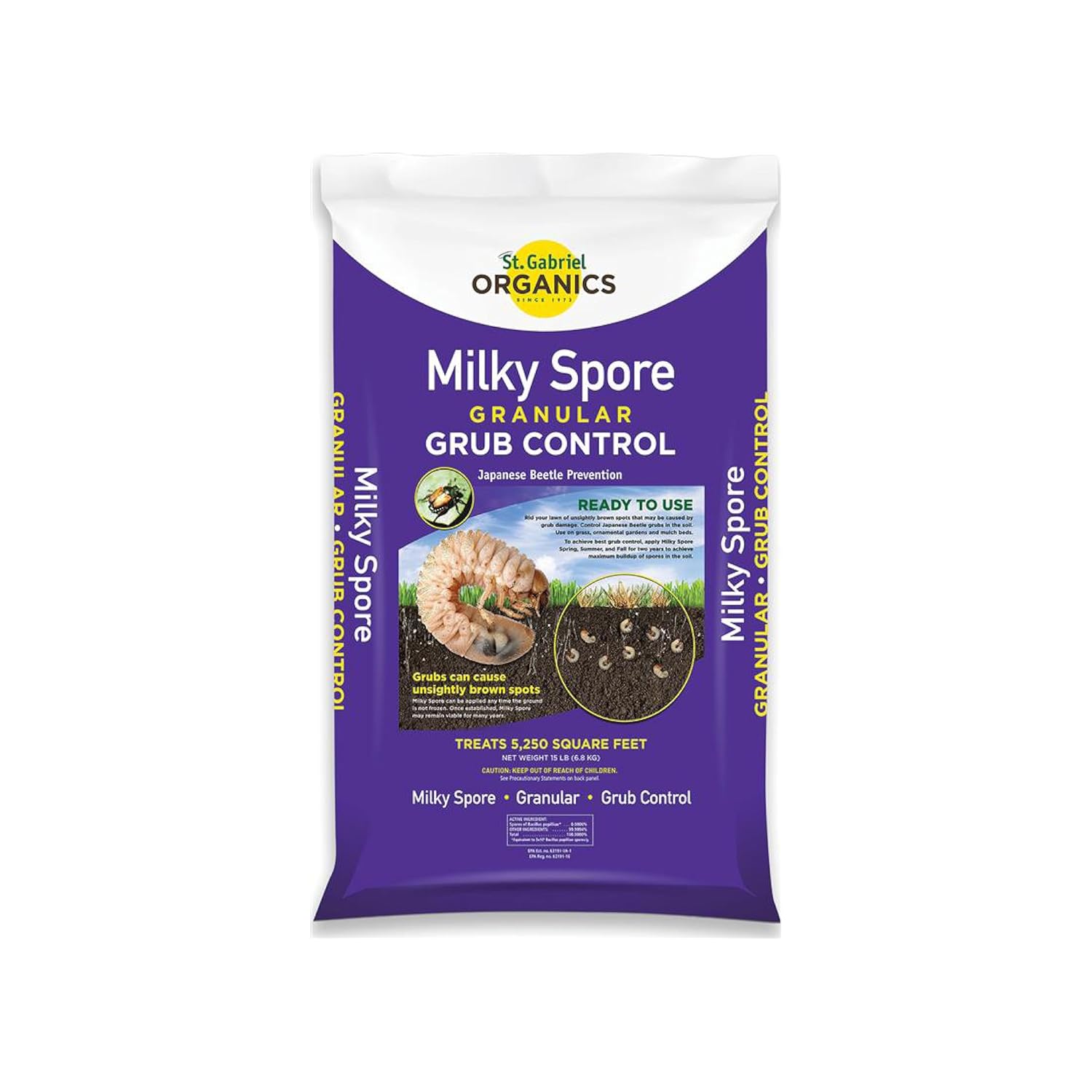
| Unit Count | 240 Ounce |
|---|---|
| Included Components | 15lb bag |
| Item Form | Granules |
| Target Species | Japanese Beetle |
| Active Ingredients | Bacillus Popilliae |
St. Gabriel Organics Milky Spore Granular is a 15 lb ready-to-use granular treatment that delivers a biological control for Japanese beetle grubs. You apply it with a spreader or by hand to unfrozen soil in spring, summer, and fall; the spores are picked up by feeding grubs, multiply inside them, and spread back into the soil. The product is USDA-organic, non-toxic to people and pets, and safe around vegetable beds when used as directed. Notable features are its long-lasting activity over multiple years and a simple application schedule that covers large areas per bag. Expect gradual population reduction rather than immediate disappearance because the spores establish in the soil and require repeat applications over two years for best results. It works specifically on Japanese beetle grubs and will not control other soil pests, so you may need complementary measures for different invaders. For gardeners seeking an eco-conscious, low-toxicity approach to grub control this product integrates easily into an organic vegetable garden program.
Best for: Home gardeners who prioritize an organic, low-toxicity approach and want a biological, long-term solution for Japanese beetle grubs in vegetable garden soil.
Less Ideal for: Gardeners who need fast knockdown of a variety of soil pests or immediate visible results should consider faster-acting chemical options or targeted treatments for other grub species.
- Uses Bacillus popilliae for biological control of Japanese beetle grubs, safe for people and pets
- Ready-to-use granules that can be applied with a spreader or by hand
- USDA-organic formulation suitable for use near food crops when directions are followed
- Provides long-term suppression as spores establish and recycle in soil
- Requires multiple applications over two years and time for the soil population to build, so results are gradual
- Effective only against Japanese beetle grubs and not other turf or garden soil pests
Verdict: A safe, USDA-organic granular Milky Spore treatment for gardeners who want a long-term, biological solution to Japanese beetle grubs in vegetable beds.
BioAdvanced Complete Insect Killer Granules for Soil & Turf, 10 lb

| Unit Count | 160 Ounce |
|---|---|
| Item Form | Granules |
| Target Species | Insects |
| Active Ingredients | Imidacloprid, B-Cyfluthrin |
BioAdvanced Complete Insect Killer is a two-way granular insecticide designed for lawn and landscape use. You spread it with a broadcast or drop spreader to treat turf, soil around plants, and ornamental beds; the formula kills listed surface insects within 24 hours and provides residual control of soil pests for up to three months. Notable features are the dual active ingredients, Imidacloprid and beta-cyfluthrin, the ready-to-spread granule form, and coverage claimed up to 10,000 square feet from a 10 lb bag. In practice this makes it convenient for homeowners who want a single seasonal application to reduce grubs, ants, ticks and mosquitoes while protecting root zones. Important limitations are regulatory restrictions in several states and that effectiveness applies only to the listed pests; it is not labeled for all insect species and must be applied according to label directions to avoid harm to pollinators and nearby plants. Users should follow spreader settings and safety precautions when applying near gardens or water features.
Best for: Homeowners who want a single, practical seasonal treatment to reduce grubs and other listed lawn pests across turf and planting beds and who follow label directions for safe application.
Less Ideal for: Gardeners who rely on organic or pollinator-safe methods, or those needing treatment for unlisted or specialized pests should consider other approaches.
- Two-way formula targets both surface and soil insects for broader control
- Ready-to-spread granules work with common broadcast or drop spreaders for easy application
- Provides up to three months of subsurface protection against listed soil pests
- 10 lb bag claims coverage up to 10,000 square feet, suitable for average yards
- Not labeled for use in several states, limiting availability and legal use in those areas
- Only controls listed insects so identification and adherence to label are required for expected results
Verdict: A convenient, dual-action granular treatment for homeowners wanting broad seasonal control of listed turf and soil insects, including Japanese beetle grubs.
Ortho BugClear Lawn Insect Killer, 10 lb granules

| Unit Count | 160 Ounce |
|---|---|
| Item Form | Granules |
| Target Species | Insects |
| Coverage | Up to 16,500 sq ft |
Ortho BugClear Lawn Insect Killer is a ready-to-use granular treatment for lawns and landscape beds that targets ants, ticks, fleas, grubs, armyworms and other common outdoor insects. You apply it with a broadcast spreader over turf, ornamental beds or around a home perimeter, then water it in to activate the product. The formula starts killing quickly on contact for most pests and claims up to six months residual control against many ant species and three months against other listed insects. Practical benefits include wide coverage from a single 10 lb bag—listed as treating up to about 16,500 sq ft—and compatibility with standard spreaders, which makes it straightforward to dose evenly across a yard. Limitations to note are the exclusions named on the label for certain ants and that some pests such as fire ants are not controlled rapidly, so local follow-up may be needed. As with any lawn insecticide you should follow label directions closely for application timing, watering-in, and approved uses on ornamentals and listed vegetable plants to avoid off-target damage.
Best for: Gardeners and homeowners who want a straightforward, no-frills granular treatment to reduce common lawn pests across medium to large yards and who prioritize ease of application and multi-month protection.
Less Ideal for: People seeking an organic or non-chemical solution, or those needing rapid eradication of fire ant mounds or pests excluded on the product label should consider alternative products or targeted treatments.
- Broad pest list that includes ants, ticks, fleas, grubs and armyworms
- Fast knockdown on contact for most listed insects
- Long residual control for many ants (up to 6 months) and several months for other pests
- Designed for use with common broadcast spreaders for even coverage
- Does not control all ant species and is less effective against fire ants for quick elimination
- Contains active ingredients that require careful adherence to label restrictions for edible plants and landscaping use
Verdict: A practical, easy-to-apply granular insecticide that delivers broad, fast knockdown and multi-month residual control for typical lawn pests.
Merit 0.5% Insecticide Granules (30 lb)

| Item Form | Granules |
|---|---|
| Target Species | Insects |
Merit 0.5 insecticide granules are a professional-style grub and soil insect control product formulated to provide long residual activity against turf pests such as Japanese beetle grubs. Applied to lawns or ornamental beds and watered in, the granules dissolve into the soil where the active ingredient is taken up by feeding insects, disrupting nerve impulses and stopping feeding and reproduction. The 30 pound bag supplies enough product for treating medium to large lawns in a few applications and is straightforward to apply with a broadcast or drop spreader. Notable features are its granule form for soil incorporation and a formulation intended for extended residual control rather than instant knockdown. Limitations are that it is a chemical insecticide requiring careful application, proper timing, and adherence to label directions for safety around people, pets, and desirable insects, and it is not a multi-mode solution for all garden pests.
Best for: Homeowners and lawn-care-minded buyers who prioritize dependable, long-lasting grub and soil insect control for turf and ornamentals and who are willing to follow label instructions for safe chemical use.
Less Ideal for: Those who prefer organic, non-chemical pest management or who need quick contact kill of a wide variety of above-ground garden pests.
- Granule formulation designed for soil incorporation and long residual control against grubs
- Large 30 lb bag suitable for treating medium to large lawns
- Professional-grade formulation intended for effective control of turf-damaging insects
- Requires careful timing, watering-in, and strict adherence to label directions for safe use
- Chemical treatment that can affect non-target insects and requires precautions around pets and people
Verdict: Choose Merit granular insecticide when you need dependable, long-residual grub control for lawns and ornamentals and are prepared to apply a professional chemical treatment safely.
Scotts GrubEx1 Season-Long Grub Killer (covers 5,000 sq. ft.)

| Item Form | Granules |
|---|---|
| Target Species | Insects |
| Active Ingredients | Chlorantraniliprole |
| Unit Count | 229.6 Ounce |
Scotts GrubEx1 is a granular, season-long insecticide intended to protect turf by killing grubs and other soil-feeding larvae before they damage roots. It is applied to a dry lawn in spring or early summer using a broadcast or drop spreader and then watered in to carry the active ingredient into the root zone. The product lists chlorantraniliprole as the active ingredient and claims up to four months of control after one application, which makes it a low-maintenance option for routine lawn care. It also controls caterpillars, May/June beetle larvae, billbugs, and suppresses chinchbugs, so it addresses multiple common pests in one treatment. Practical benefits include one-year application limits and clear spreader settings recommended by the manufacturer, which simplify dosing. Limitations are that it must be watered in after application to activate, it is for an annual application only, and it targets soil-dwelling larvae rather than surface-feeding insects, so additional products may be needed for other pest problems.
Best for: Homeowners who prioritize predictable, low-effort grub prevention and want a reliable, season-long solution they can apply as part of routine lawn maintenance.
Less Ideal for: People needing immediate knockdown of active surface pests or those who prefer treatments that can be applied multiple times per season should consider alternate products.
- Single application provides up to four months of grub control
- Covers 5,000 sq. ft. per 14.35 lb. bag, suitable for typical residential lawns
- Targets multiple turf pests beyond grubs, including caterpillars and billbugs
- Manufacturer gives specific spreader settings to simplify correct application
- Requires watering in after application to activate protection
- Designed for one application per year so it is not a quick fix for active heavy infestations
Verdict: Choose this product if you want a straightforward, single-application granular treatment that prevents grubs and several other lawn larvae for an entire season.
BioAdvanced Season Long Grub Control Granules, 10 lb

| Unit Count | 160 Ounce |
|---|---|
| Item Form | Granules |
| Target Species | Insects |
| Active Ingredients | Lambda-cyhalothrin |
BioAdvanced Season Long Grub Control is a granule-form insecticide designed to create a protective zone in turf that kills grubs and more than 40 listed lawn pests. You apply it with a rotary or drop spreader across the lawn, lightly water it in, and a single application is intended to last through the season. The product lists lambda-cyhalothrin as the active ingredient and specifically names pests such as mole crickets, chinch bugs, ants, ticks, and European crane fly larvae in addition to grubs, so it serves as a broad preventive treatment rather than a spot fix. For homeowners who want a low-effort approach the once-per-season application is convenient and the granular format is easy to broadcast. Important limitations are that it is a chemical insecticide, so users should follow label safety directions and avoid use on flowering plants where pollinators may forage; it does not distinguish between pest and beneficial soil insects. If you need targeted, organic, or pet-sensitive options you will want to consider alternatives, but for straightforward, season-long grub and turf pest control this product delivers a simple preventive option.
Best for: Homeowners who want a straightforward, low-effort prevention plan for grubs and common lawn pests and are comfortable using conventional chemical treatments.
Less Ideal for: Gardners seeking organic, pollinator-friendly, or pet-sensitive grub control methods should choose an alternative approach.
- One application is formulated to provide season-long control of grubs and other listed lawn pests
- Granular form works with standard rotary or drop spreaders for easy broadcast application
- Broad-spectrum activity targets multiple turf pests above and below the surface
- Contains a recognized active ingredient (lambda-cyhalothrin) used in professional turf products
- Chemical insecticide that can affect non-target and beneficial soil insects
- Requires careful adherence to label safety and watering instructions to be effective and safe
Verdict: A convenient once-per-season granular treatment for homeowners who want broad, season-long protection against grubs and other lawn-damaging insects.
Choosing the Right Japanese Beetle Grub Killer: Key Factors to Consider
Active Ingredient and Mode of Action
Knowing the active ingredient is essential because different chemistries target grubs in different ways. Some products act quickly to kill existing larvae, while others work as preventive agents that stop newly hatched grubs from feeding. Understanding mode of action helps set expectations for how soon you will see turf recovery and whether retreatment is likely.
Active ingredients also determine restrictions and application timing. Some require incorporation into the soil via irrigation or rainfall to be effective, while others provide contact activity when applied directly. For sustainable lawn care, gardeners should weigh whether an ingredient has known non-target impacts and follow label guidance to reduce exposure to beneficial insects.
Residual Duration in Soil
Residual duration describes how long the active ingredient remains effective in the root zone where grubs feed. Longer residual activity can protect turf through vulnerable periods without frequent reapplications, which is useful for larger lawns or when timing the application precisely is difficult.
However, longer persistence can also increase exposure risk to non-target organisms and may affect planting or overseeding schedules. Choose a product whose residual window matches your pest pressure and management philosophy, and plan cultural tasks like aeration or reseeding around labeled intervals.
Timing and Life Stage Targeting
Successful control depends heavily on timing. Grubs are most vulnerable when newly hatched, so preventive treatments timed before or during egg hatch often perform better than late-season attempts. Conversely, curative treatments intended to knock down established larvae require different active ingredients and may need repeated applications or follow-up cultural care to restore turf.
Assess your local beetle lifecycle and typical timing for egg-laying in your region. That will guide whether you need a preventive product applied in late spring or early summer, or a curative option for midsummer grub outbreaks.
Application Method and Lawn Size
Application method affects how well the product reaches the grub zone. Granular spreads are common for lawns and pair with rotary spreaders, while liquid or hose-end formulations can be easier to apply evenly on uneven terrain. Some products require watering in to move the active ingredient into the root zone, which influences scheduling around irrigation or expected rainfall.
Consider the size and complexity of your lawn, access to a spreader or hose, and the effort you are willing to invest. For large properties, low-effort, spreader-friendly options with longer residual control can be more practical. For small urban lawns or patch treatments, precision liquid applications may be preferable.
Turf Health and Compatibility
Treatments should be compatible with your grass type and any recent lawn work. Some grub controls can stress turf if applied during drought or immediately after aeration or overseeding. Read label directions regarding safe application windows relative to mowing, fertilizing, and irrigation schedules.
If you have newly seeded or highly sensitive turf, select products with clear guidance for use around establishment activities. Protecting the root zone and avoiding additional turf stress will speed recovery after grub damage.
Environmental and Pollinator Considerations
Because lawn treatments can move through soil and runoff, it is important to consider environmental effects. Look for products that provide label instructions for minimizing runoff, avoiding direct exposure to ornamental flower beds, and protecting water features. Guidance on pollinator protection and timing applications to avoid bloom periods or reduce exposure is also important for preserving beneficial insect populations.
Gardeners should follow buffer zone recommendations and handle, store, and dispose of treatments per label instructions to limit unintended impacts on wildlife and water quality.
When to Treat Your Lawn
Timing depends on local beetle life cycles and the grub stage present in your lawn. Preventive applications are most effective when applied before or during egg hatch, which in many regions is late spring to early summer. Curative approaches aimed at larger larvae are typically used in mid to late summer but may require different active ingredients and follow-up care.
Monitor your lawn for early signs like small brown patches, spongy turf, or increased bird and skunk activity digging for grubs. A simple soil check with a shovel in suspected areas can confirm the presence and size of grubs and inform whether preventive or curative treatment is appropriate.
- Check soil for grubs by removing a square foot of turf and counting larvae.
- Time preventive products before consistent egg hatch in your area.
- For curative control, target treatments when grubs are still small to mid-size for best results.
Preparing the Lawn Before Application
Mow and remove excessive clippings before treatment to ensure even coverage and better soil contact for granular products. If using a liquid product that requires watering in, plan the application so you can irrigate soon after treatment to move the active ingredient into the root zone.
Avoid treatment during drought stress or immediately after heavy fertilization or aeration unless the label explicitly allows it. Mark irrigation or rainfall windows to ensure the product performs as intended and to reduce the chance of runoff.
- Mow to a normal height and clear debris for uniform spread.
- Water in according to label directions, usually within 24 hours if required.
- Delay aeration or overseeding until labeled intervals after treatment.
Spot Treatments and Small Patch Strategy
If grub damage is limited to small patches, spot treatment saves time and product. Use a carefully measured application to the affected area and water in as directed. Inspect nearby healthy turf to determine if the infestation is spreading before committing to whole-lawn treatment.
Combine spot treatment with cultural repairs such as topdressing, overseeding, and consistent watering to encourage turf recovery after grub mortality reduces feeding pressure.
- Treat a slightly larger buffer area than the visible damage to catch nearby larvae.
- Follow up spot treatments with turf repair steps within the same season.
Integrating Cultural Controls
Cultural practices reduce grub habitat and improve turf resilience. Maintain a dense, healthy lawn through proper mowing height, adequate but not excessive fertilization, and routine aeration. Proper irrigation scheduling discourages drought stress that magnifies grub damage.
Encourage predators like birds by avoiding night-time lighting and minimizing chemical exposure that harms beneficial organisms. Cultural controls do not replace chemical treatment when grub pressure is high, but they reduce the need for repeated interventions over time.
- Maintain recommended mowing heights for your grass species.
- Fertilize according to soil test results rather than on a fixed schedule.
- Aerate compacted soils to promote deeper rooting and reduce grub impact.
Managing Expectations and Follow-Up
Most grub treatments reduce further feeding pressure, but turf recovery takes time. You may not see green-up until the following growth flush once roots begin to recover. Plan follow-up inspections and avoid reseeding or major turf renovations until label intervals permit.
If grubs persist or damage returns, re-evaluate timing and application technique before repeating treatment. In severe cases, combining a recommended chemical approach with aggressive cultural repair yields the fastest restoration.
- Inspect treated areas regularly to assess grub mortality and turf recovery.
- Wait for labeled intervals before reseeding or aerating after treatment.
How We Chose the Best Japanese Beetle Grub Killer
We selected treatments that address the core gardener concerns when managing Japanese beetle grubs in lawns: proven grub mortality, residual soil activity, application practicality, and safety for turf and nearby plants. Our evaluation favored products with documented efficacy against common grub species at application rates suitable for residential lawns and that integrate with standard watering and mowing routines. Concrete evaluation criteria included the active ingredient efficacy against white grubs, length of residual control in turf soil, ease and flexibility of application (spreaders, sprayers, or hose-end), compatibility with turf and landscape plants, and clear label instructions for timing and water incorporation. We also considered environmental exposure risks and whether the product has guidance for protecting pollinators and beneficial organisms. We excluded items lacking clear label directions for grub control in lawns, treatments intended solely for ornamentals or agricultural use, and products with unclear active ingredient concentrations. The resulting list focuses on options that balance reliable grub control with gardener-friendly application and acceptable safety practices.
FAQ
When is the best time to apply a grub killer for Japanese beetles?
Timing often depends on your region, but preventive applications are typically most effective when made before or during egg hatch in late spring to early summer. Curative products used against established larvae are usually applied in mid to late summer when grubs are actively feeding.
Can I treat only the damaged patches instead of the whole lawn?
Yes. Spot treatments work well for localized infestations. Treat a slightly larger area than the visible damage to catch nearby larvae and follow label directions for application and watering in. Monitor surrounding turf for spread before treating the entire lawn.
Will grub treatment harm my lawn or beneficial insects?
Some active ingredients can stress turf if applied during drought or around aeration. Labels also include guidance to reduce exposure to pollinators and beneficial organisms. Choose a product with clear environmental instructions and follow application timing and buffer recommendations to minimize non-target impacts.
How soon will I see results after applying a grub killer?
Quick-acting curative products may reduce grub activity within days, but visible turf recovery can take weeks as roots regrow. Preventive products reduce future feeding rather than produce immediate turf green-up, so expect a delayed improvement in lawn appearance.
Do I need to water in granular or liquid applications?
Many formulations require watering in to move the active ingredient into the root zone where grubs feed. Follow label instructions for the recommended amount and timing of irrigation, typically within 24 hours after application, to ensure effectiveness.
Can I overseed after treating for grubs?
It depends on the product and label directions. Some treatments advise waiting a specified interval before overseeding or performing major soil disturbance. Check the label and plan reseeding to occur outside restricted timeframes to avoid reduced seedling success.
Final Verdict
Choosing the right Japanese beetle grub killer hinges on timing, the active ingredient, and how the product fits your lawn care routine. Prioritize products whose residual window and application method match your property size and your tolerance for reapplication. Balance effectiveness with turf safety and follow label guidance to protect non-target organisms. With proper timing and complementary cultural practices, you can reduce grub pressure and help your lawn recover confidently.
