

Note: This article contains affiliate links. If you click on these links and make a purchase, I may earn a small commission at no extra cost to you. This helps support my research and content. Read my full affiliate disclosure here.
If grub damage is turning green lawns into brown patches, choosing the right natural grub killer matters for recovery and long-term turf health. You want something that targets larvae without harming beneficial insects, pets, or soil life. This guide shortlists six top-rated natural grub killers suited for residential lawns and explains the practical tradeoffs you will face. We evaluated products for larval knockdown, safety around people and pets, ease of application, and how they affect turf recovery. Read on to understand how each approach behaves in real lawn conditions and which product traits matter most for your yard.
Top Picks at a Glance
| Best Overall The best all-around choice for most situations | ST. Gabriel Organics Milky Spore Granular Grub Control, 20 lb |  |
| Best Quality Built to a higher standard if you want something more solid | St. Gabriel Organics Milky Spore Powder Grub Control, 40 oz |  |
| Best Budget The cheapest option that still gets the job done reliably | NaturesGoodGuys Triple Blend Beneficial Nematodes (HB + SC + SF), 50 Million |  |
| Highest Rated A top-rated pick with lots of positive feedback | St. Gabriel Organics Milky Spore Granular Grub Control, 15 lb |  |
| Most Popular A crowd favorite that many people choose with confidence | ST. GABRIEL Milky Spore Japanese Beetle and Beetle Killer |  |
| Best Seller A high-volume bestseller chosen again and again | NaturesGoodGuys Triple Blend Beneficial Nematodes, 15 Million | |
ST. Gabriel Organics Milky Spore Granular Grub Control, 20 lb

| Unit Count | 1 Count |
|---|---|
| Included Components | St. Gabriel Organics Milky Spore Granular Natural Bacteria |
| Item Type Name | Insect Control |
| Manufacturer | St. Gabriel Organics |
ST. Gabriel Organics Milky Spore is a granular, bacteria-based treatment formulated to reduce Japanese beetle grub populations in lawns and garden beds. Applied with a broadcast spreader from spring through fall, the granules introduce Paenibacillus popilliae into the soil where it infects and kills grubs over time. Notable features include long residual control reported to last many years after establishment and a formulation that is safe around people, pets, wildlife, and beneficial insects. Practical benefits are reduced root feeding, less patchy turf, and a hands-off maintenance approach once the spore becomes established. Important limitations are that it works specifically on Japanese beetle grubs so it will not control other soil pests, and it can take one or more seasons of establishment before strong population suppression is evident. Coverage claims are substantial so plan applications by lawn area and use a spreader for even distribution.
Best for: Homeowners who want a low-maintenance, organic option to reduce Japanese beetle grub damage and are willing to plan for multi-season control.
Less Ideal for: People needing fast knockdown of multiple soil pests or immediate repair of heavily damaged turf should consider faster-acting chemical or alternative controls.
- Uses Milky Spore bacteria for an organic, targeted approach against Japanese beetle grubs
- Long-lasting control that can persist for multiple years after establishment
- Safe around people, pets, wildlife, and beneficial insects when used as directed
- Granular form is easy to apply with a standard lawn spreader and covers a large area
- Targets only Japanese beetle grubs and will not control other turf-damaging pests
- May require one or more seasons to build up effective spore levels in the soil
Verdict: Choose this product if you want a long-lasting, organic Milky Spore solution specifically to reduce Japanese beetle grub damage with minimal ongoing effort.
St. Gabriel Organics Milky Spore Powder Grub Control, 40 oz

| Unit Count | 40 Ounce |
|---|---|
| Item Form | Granules |
| Target Species | Japanese Beetle Grubs |
| Special Features | Ready to Use |
| Active Ingredients | Bacillus Popilliae |
St. Gabriel Milky Spore is a targeted, biological granulare product designed to reduce Japanese beetle grub populations by introducing Bacillus popilliae into the soil. It is applied by broadcasting small amounts across the lawn (hand-spread or with a dispenser tube) and then lightly watering so spores reach the root zone. The key benefit is persistence: once established, the spores amplify in infected grubs and replenish the soil, offering season-after-season suppression across large areas—one 40 oz bag covers up to about 10,000 sq ft. It is labeled safe for people, pets, pollinators, and earthworms, so it fits into organic lawn care routines. Expect results to build over time rather than produce immediate, complete elimination; effective reduction requires correct timing during grub activity and adequate initial coverage. Also note it targets only Japanese beetle grubs and will not control other turf pests. For gardeners who prioritize an effective, low‑impact long-term solution, Milky Spore is a practical performance-oriented choice.
Best for: Gardeners and lawn-care minded homeowners who want an effective, low-impact solution to reduce Japanese beetle grub pressure across an entire lawn and prefer a long-term performance approach.
Less Ideal for: People needing rapid elimination of multiple turf pests or an immediate cosmetic fix should consider fast-acting insecticides or other targeted treatments instead.
- Long-lasting biological control that can persist in soil for years after application
- Large coverage per bag—advertised up to about 10,000 sq ft, suitable for whole-yard treatments
- Safe for people, pets, pollinators and earthworms, fitting organic lawn care practices
- Easy application by hand or with a dispenser and compatible with normal watering and maintenance
- Works specifically on Japanese beetle grubs only and will not affect other turf pests
- Builds protection over seasons so it is not an immediate knockdown solution
Verdict: Use Milky Spore when you want a proven, low‑impact biological treatment that builds long‑lasting grub control across large lawns.
NaturesGoodGuys Triple Blend Beneficial Nematodes (HB + SC + SF), 50 Million

| Active Ingredients | Heterohabditis bacteriophora; Steinernema carpocapsae; Steinernema feltiae |
|---|---|
| Target Species | Insects |
This triple blend packs three nematode species—Heterohabditis bacteriophora, Steinernema carpocapsae, and Steinernema feltiae—into a single 50 million-unit dose intended to suppress common soil-dwelling insect pests. You apply the product to soil or potting mixes following the package timing and moisture instructions so the nematodes move into pest larvae and reduce infestations without chemical pesticides. The notable benefit is broad-spectrum cover because the three strains have overlapping but different pest preferences, which reduces the need to pick a single species. It arrives as live organisms, so storage and application windows matter and performance depends on correct handling, adequate soil moisture, and appropriate target pest presence. For gardeners who want a biological option, this blend simplifies selection and can fit into integrated pest management, but it is not an instant fix and works best as part of repeated seasonal applications rather than a one-time cure.
Best for: Gardeners who prefer biological pest control and want a single product that covers multiple soil pests, and who are willing to follow handling and application steps for best results.
Less Ideal for: Someone needing an immediate, one-time knockdown of visible pests or who prefers low-maintenance, shelf-stable chemical treatments.
- Three complementary nematode species included to broaden the range of target soil pests
- Designed for biological control, avoiding chemical pesticide use
- Sold as live, guaranteed organisms which can be effective when applied correctly
- Effectiveness depends on correct storage, timing, and soil moisture so handling is more demanding than granular pesticides
- Not a quick knockdown solution and typically requires repeat applications for sustained control
Verdict: Choose this triple-strain nematode mix if you want a ready-made biological solution that covers a broad range of soil insect pests.
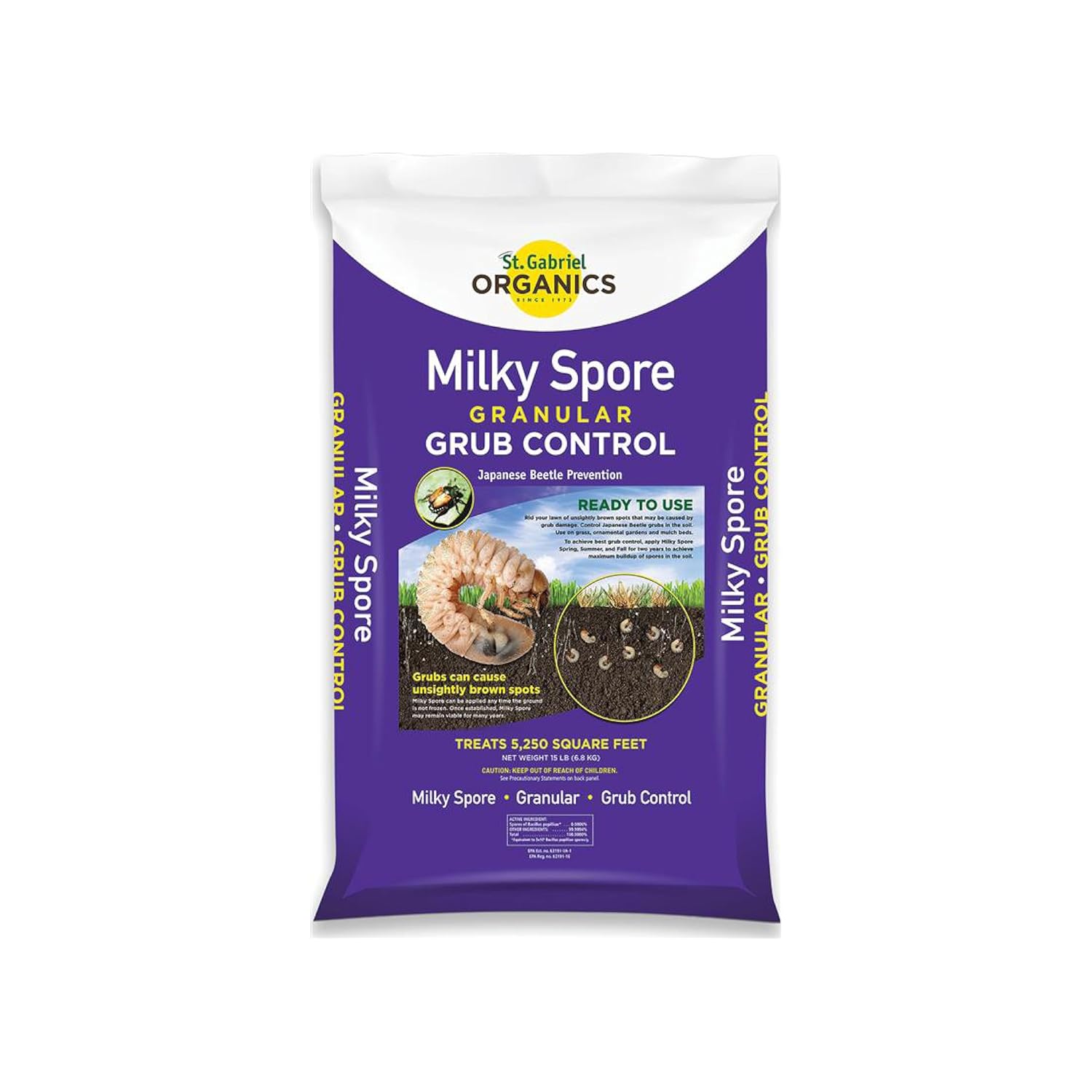
St. Gabriel Organics Milky Spore Granular Grub Control, 15 lb
| Unit Count | 240 Ounce |
|---|---|
| Included Components | 15lb bag |
| Item Form | Granules |
| Target Species | Japanese Beetle |
| Active Ingredients | Bacillus Popilliae |
St. Gabriel Organics Milky Spore Granular is a 15 lb ready-to-use granular treatment that delivers a biological control for Japanese beetle grubs. You apply it with a spreader or by hand to unfrozen soil in spring, summer, and fall; the spores are picked up by feeding grubs, multiply inside them, and spread back into the soil. The product is USDA-organic, non-toxic to people and pets, and safe around vegetable beds when used as directed. Notable features are its long-lasting activity over multiple years and a simple application schedule that covers large areas per bag. Expect gradual population reduction rather than immediate disappearance because the spores establish in the soil and require repeat applications over two years for best results. It works specifically on Japanese beetle grubs and will not control other soil pests, so you may need complementary measures for different invaders. For gardeners seeking an eco-conscious, low-toxicity approach to grub control this product integrates easily into an organic vegetable garden program.
Best for: Home gardeners who prioritize an organic, low-toxicity approach and want a biological, long-term solution for Japanese beetle grubs in vegetable garden soil.
Less Ideal for: Gardeners who need fast knockdown of a variety of soil pests or immediate visible results should consider faster-acting chemical options or targeted treatments for other grub species.
- Uses Bacillus popilliae for biological control of Japanese beetle grubs, safe for people and pets
- Ready-to-use granules that can be applied with a spreader or by hand
- USDA-organic formulation suitable for use near food crops when directions are followed
- Provides long-term suppression as spores establish and recycle in soil
- Requires multiple applications over two years and time for the soil population to build, so results are gradual
- Effective only against Japanese beetle grubs and not other turf or garden soil pests
Verdict: A safe, USDA-organic granular Milky Spore treatment for gardeners who want a long-term, biological solution to Japanese beetle grubs in vegetable beds.
ST. GABRIEL Milky Spore Japanese Beetle and Beetle Killer

| Brand | ST. GABRIEL |
|---|---|
| Target Species | Insects |
| Unit Count | 1 Count |
This Milky Spore product supplies Bacillus popilliae spores in a granular format to target Japanese beetle larvae in soil and reduce future adult infestations. It is applied to turf or infested areas and requires incorporation into the soil where grubs feed; once established the spores infect grubs and can provide multi-year biological control as they persist in the soil. The product is made in the United States and packaged for homeowner use, so application is straightforward for lawn-care routines. Practical benefits include a species-specific, nonchemical approach that is safe around people, pets, and beneficial insects when used as directed, and potential long-term reduction of grub pressure after the bacterium becomes established. Important limitations are that results are gradual rather than immediate, effectiveness is specific to Japanese beetle larvae and closely related species, and it performs best when applied proactively or in areas with existing grub problems rather than as an emergency fix.
Best for: Homeowners who prefer a natural, long-term approach to reducing Japanese beetle grub populations and who are comfortable waiting for biological control to establish.
Less Ideal for: People needing immediate grub knockdown, those with infestations caused by non-target grub species, or gardeners who require a broad-spectrum, fast-acting solution.
- Biological control agent that targets Japanese beetle grubs without synthetic pesticides
- Designed to persist in soil and potentially provide multi-year protection after establishment
- Simple granular application suitable for homeowner lawn care routines
- Made in the United States with documented product labeling
- Works slowly and may take a season or more to noticeably reduce beetle populations
- Effective mainly against Japanese beetle larvae and not a broad-spectrum grub control
Verdict: Choose this if you want a species-specific, nonchemical milky spore option that can establish in soil and reduce Japanese beetle problems over multiple seasons.
NaturesGoodGuys Triple Blend Beneficial Nematodes, 15 Million
| Unit Count | 15 Count |
|---|---|
| Target Species | Insects |
| Active Ingredients | Heterohabditis bacteriophora; Steinernema carpocapsae; Steinernema feltiae |
This product supplies three species of beneficial nematodes—Heterohabditis bacteriophora, Steinernema carpocapsae, and Steinernema feltiae—packaged as 15 million infective juveniles for soil application. It is designed to be activated with water and released with a watering can or hose-end applicator onto moist soil where grubs, root-feeding larvae, and other target insects live. The included storage instructions let you refrigerate the unactivated nematodes for up to 30 days, and once mixed they must be applied within six hours, which encourages planning applications on cool, overcast days or early morning. In practical use the mix is safe around people, pets, and plants and fits into an integrated organic pest program, reducing reliance on chemical insecticides. Important limitations are the short window after activation and the need to maintain soil moisture and cool temperatures for best results, so timing and proper storage are essential to achieve the expected control.
Best for: Gardeners who prefer biological, low-toxicity solutions for grub and root-feeding pests and who plan applications carefully to meet storage and activation timing.
Less Ideal for: Those who need immediate, one-time rapid knockdown regardless of temperature or moisture or who cannot apply treatments shortly after activation.
- Contains three complementary nematode species to target a broad range of soil insect pests
- Safe to use around people, pets, and garden plants
- Can be stored unactivated in the refrigerator for up to 30 days
- Simple activation and application with watering can or hose-end sprayer
- Once activated the nematodes must be applied within six hours, limiting application flexibility
- Performance depends on soil moisture and cool conditions, so reduced efficacy in hot dry weather
Verdict: Use this triple-species beneficial nematode mix when you want an organic, pet-safe biological control for soil grubs and root-feeding pests and can apply it within the product's storage and activation constraints.
Choosing the Right Natural Grub Killer: Key Factors to Consider
Mode of Action and Target Timing
How a natural grub treatment works determines when you should apply it and what results to expect. Biological agents and microbial products typically infect or consume grubs over days to weeks, so they are most effective when applied as larvae are active and before they reach late instars. Products that rely on desiccation or repellency need direct contact and often perform best under warm, moist soil conditions.
Matching the product mode of action to grub life stage and local soil temperature is critical. Applying a biological product too late in the season often yields poor results because older larvae are harder to control and the turf is already stressed. Knowing the timing window for the chosen approach improves success more than repeating applications at random intervals.
Safety Around Pets, Children, and Beneficials
One main reason gardeners choose natural grub controls is to reduce risk to pets, kids, and pollinators. Safety is not absolute; different natural agents have different exposure profiles. Some microbial products have a strong safety record for mammals but can still affect soil invertebrates. Physical or mechanical treatments may be inherently safer for pets but can be less reliable for large or deep infestations.
Read labels for re-entry intervals and pet access recommendations. Consider whether treated areas overlap flower beds or pollinator habitat. Even with natural treatments, plan to keep pets and children off freshly treated areas until the product has been watered in or settled according to instructions.
Application Method and Lawn Size
How you apply a natural grub killer affects convenience and coverage. Granular products spread quickly with a broadcast spreader and are often easier for large lawns, while liquid or spray-applied biologicals may give more uniform contact in small to medium yards. Some products require incorporation with irrigation or light watering after application; others work with ambient moisture.
For large lawns, choose formats compatible with your existing spreader or sprayer to save time. For spot treatments or small patches, a hose-end or hand-sprayer option can reduce waste. Application method also influences how evenly the active ingredient reaches soil where grubs live.
Environmental Persistence and Residual Effects
Natural does not always mean short-lived. Some biological agents persist in the soil for a time and can continue to suppress grubs, while other natural approaches break down quickly and require repeated applications. Persistence affects how long your lawn is protected and whether follow-up treatments will be needed the following season.
Consider whether you want a treatment that provides rapid knockdown with little residual activity or a product that offers longer suppression of subsequent generations. Also think about how persistence may influence earthworms and beneficial soil microbes; low persistence is generally kinder to soil ecology but may demand more frequent maintenance.
Impact on Turf Recovery and Stress
A successful grub treatment should minimize additional stress to the lawn and support recovery. Some natural products suppress grubs without harming grass roots, allowing quick regrowth and reseeding if necessary. Others reduce grub numbers slowly, which can delay visible turf recovery and require overseeding or topdressing.
Plan turf care around treatment timing. If you expect a slower kill, schedule aeration, fertilization, or overseeding after the product has completed its active period. If a product requires heavy irrigation to activate, offset that with appropriate mowing and soil management to avoid compaction or runoff.
How Natural Treatments Compare to Mechanical Control
Mechanical options like hand-collecting grubs or using soil cultivation can reduce localized infestations but are often impractical for larger yards. Natural biological treatments operate at a soil microbiology level and can reach grubs in deeper root zones where digging cannot.
Use mechanical control for small, visible patches where you can pull damaged turf and remove exposed larvae. For broader infestations, natural treatments or integrated approaches deliver more consistent results across the lawn without repeated physical disruption.
- Mechanical control is immediate but labor intensive and localized.
- Biological natural options work across the root zone and require less ongoing disturbance.
When to Treat: Seasonal Timing and Soil Conditions
Timing is crucial. Most grubs hatch in late spring to early summer and are easiest to control when young. Monitor soil temperature and local pest forecasts to determine the optimal application window. Treatments applied after mid-to-late summer may be less effective because larvae are larger and more resilient.
Soil moisture affects many natural products. Warm, moist soil improves activity for microbial agents and helps granules dissolve and move into the root zone. Avoid treating during drought or when heavy rain is imminent, as both conditions can reduce effectiveness.
- Apply during the peak early larval stage for best results.
- Water in as recommended to move active ingredients into the soil.
Combining Natural Treatments With Cultural Lawn Care
An integrated plan combines natural grub control with good lawn management. Practices like proper mowing height, balanced fertilization, aeration, and organic matter management strengthen roots so the turf tolerates some grub feeding while treatments take effect.
Cultural care also minimizes conditions that favor heavy grub outbreaks. Healthy, dense turf shades soil and reduces egg-laying sites for adult beetles. After treatment, prioritize recovery practices such as light topdressing and overseeding where root damage was severe.
- Use natural grub control as one part of a broader lawn health plan.
- Schedule recovery tasks after the biological agent has had time to act.
Spot Treatment Vs Whole-Lawn Programs
Decide between targeting localized damage and treating the whole lawn. Spot treatments save product and time when damage is concentrated, but they require careful detection of all affected areas. Whole-lawn programs give uniform protection and are simpler for preventive applications.
If you opt for spot treatments, mark affected areas and expand the treatment zone slightly beyond visible damage because grubs can feed outward from the initial point. Whole-lawn preventive applications are better when adult beetle activity is high or when previous seasons saw widespread infestations.
- Spot treat visible damage for efficiency.
- Choose whole-lawn programs for prevention or when infestations are widespread.
Practical Safety Tips for Application
Follow label instructions for keeping pets and children off treated areas. Even natural products often recommend limiting access until the product is watered in or has settled. Use gloves when spreading granules or mixing liquids to avoid skin irritation from concentrated materials.
Store products in a cool, dry place away from pets and food. Dispose of empty bags or containers per local guidance. When applying near flower beds, protect pollinator habitat by treating turf only and avoiding drift onto blooms.
- Keep pets off treated areas until the product is fully settled or watered in.
- Avoid treating flowering plants to protect pollinators.
How We Chose the Best Natural Grub Killer
We selected natural grub control options by focusing on practical, gardener-relevant performance and safety measures. Primary evaluation criteria included biological effectiveness against white grubs and other turf larvae, safety profile for pets and non-target wildlife, and impact on soil and beneficial organisms. We also weighed application ease and timing, since many natural solutions require specific watering or temperature windows to work well. Finally, we considered how treatments influence lawn recovery speed and turf stress after grub control. We excluded conventional chemical pesticides and synthetic neonicotinoids, as well as products that lack clear usage instructions or independent efficacy data. We did not include homemade home remedies that lack evidence of consistent grub control. The result is a shortlist of options that balance visible grub reduction with minimal harm to pets, pollinators, and soil biology.
FAQ
How quickly will I see results after applying a natural grub control?
Results vary by product and grub stage. Microbial treatments often take several days to a few weeks to reduce larval populations. Expect slower visible turf recovery if the product kills grubs gradually rather than instantly.
Are natural grub killers safe for dogs and cats?
Many natural options have favorable safety profiles for pets but not all are identical. Some microbial agents are low risk to mammals when used as directed, while physical or irritant-based products may require restricted access until they are watered in. Always follow label precautions for pet exposure.
Can I use natural grub treatments preventively?
Yes. Preventive applications timed for early larval activity can reduce future damage. Preventive use is most effective when timed to coincide with egg hatch and when soil conditions favor product activity.
Will natural treatments harm earthworms or beneficial soil organisms?
Impact varies. Some biological agents are targeted and leave larger soil fauna largely unaffected, while broader-spectrum biologicals or mechanical treatments can disturb soil life. Select low-persistence options if preserving earthworms and microbes is a priority.
Do I need to water in a natural grub treatment?
Many natural products require light irrigation to move the active ingredient into the root zone where grubs live. The label will specify timing and amount. Avoid heavy watering that causes runoff, which reduces effectiveness.
How often should I reapply a natural grub killer?
Reapplication depends on the product's persistence and the level of infestation. Some options require a single seasonal application, while others may need follow-ups if grub pressure is high or if persistence is short. Follow manufacturer guidance and monitor grub activity.
Final Verdict
Choose a natural grub control based on how quickly you need results, your tolerance for lawn disruption, and the presence of pets or pollinator habitat. Biological agents are often the best balance between effectiveness and safety when applied at the correct larval stage, while mechanical or spot treatments can complement larger programs. Prioritize timing and correct application method to maximize success. Combine treatment with cultural practices that strengthen turf so your lawn recovers faster and resists future outbreaks. With the right approach, natural grub control can restore healthy green turf while protecting people, pets, and beneficials.
