

Note: This article contains affiliate links. If you click on these links and make a purchase, I may earn a small commission at no extra cost to you. This helps support my research and content. Read my full affiliate disclosure here.
Picking the right lawn fertilizer for weeds changes how fast your turf recovers and how well it competes against dandelions, clover, and crabgrass. Whether you manage a sunny front yard, a shaded lawn, or a high-traffic turf, the fertilizer you use affects color, density, and how long weeds stay suppressed. This guide shortlists the top options suited for weed-prone lawns and explains the characteristics that matter in real garden use. We focus on nutrient formulas, feeding timing, and application practicality so you can choose the product that fits your lawn care routine. Read on for the picks and the evaluation criteria used to compare them.
Top Picks at a Glance
| Best Overall The best all-around choice for most situations | Scotts Turf Builder Triple Action 14.1 lb |  |
| Best Quality Built to a higher standard if you want something more solid | The Andersons Surge Weed & Feed 16-0-9 Granular Lawn Fertilizer (40 lb) |  |
| Best Value The sweet spot between price and what you get | BioAdvanced 5-in-1 Weed and Feed Granules (9.6 lb) |  |
| Best Budget The cheapest option that still gets the job done reliably | Jonathan Green Corn Gluten Lawn Fertilizer 10-0-2 (5,000 sq. ft.) |  |
| Highest Rated A top-rated pick with lots of positive feedback | Scotts Turf Builder WinterGuard Fall Weed & Feed, 11.43 lb |  |
| Most Popular A crowd favorite that many people choose with confidence | Scotts Turf Builder Weed & Feed5 Granular Lawn Fertilizer (33.95 lb) |  |
| Best Seller A high-volume bestseller chosen again and again | Scotts Turf Builder Weed & Feed (42.87 lb) |  |
Scotts Turf Builder Triple Action 14.1 lb

| Item Form | Granule |
|---|---|
| Coverage | 5,000 sq. ft. |
| Active Ingredients | Pendimethalin 1.22%, 2,4-D 1.22%, Dicamba 0.081% |
Scotts Turf Builder Triple Action combines weed control, crabgrass prevention, and fertilizer in one granular bag to simplify spring lawn care. You apply it with a broadcast spreader when dandelions are actively growing and the grass is wet so granules stick to weed leaves, then water 24 hours later to move the preventative ingredient into the soil. The formula lists active herbicides (pendimethalin, 2,4-D, and dicamba) plus nutrients, so it both removes many common broadleaf weeds and establishes a barrier against new grassy weeds like crabgrass for up to four months while feeding the grass. In practice this reduces the number of separate products and applications needed across a 5,000 sq. ft. lawn. Important limitations are the restricted application window and safety precautions: follow label directions, avoid use on sensitive grass types or newly seeded lawns, and keep people and pets off treated areas until dust settles. Also it will not kill existing crabgrass, only prevent future germination.
Best for: Homeowners who prioritize strong seasonal performance and want a single product to reduce application steps while improving lawn density and weed suppression.
Less Ideal for: Those with newly seeded or very young lawns, people who prefer organic-only products, or gardeners treating areas near ponds or sensitive aquatic life.
- Three-in-one formula combines fertilizer, broadleaf weed control, and crabgrass prevention
- Covers up to 5,000 sq. ft. from a single 14.1 lb bag
- Designed for use with a Scotts spreader for even application
- Provides up to four months of crabgrass prevention when applied correctly
- Contains herbicides that require careful handling and re-entry restrictions
- Does not kill existing crabgrass, only prevents new germination
Verdict: If you want a performance-focused, all-in-one spring treatment to feed your lawn while preventing crabgrass and controlling common broadleaf weeds, this product delivers in a single application.
The Andersons Surge Weed & Feed 16-0-9 Granular Lawn Fertilizer (40 lb)

| Item Form | Granule |
|---|---|
| Coverage | 16000 square_feet |
| Unit Count | 640 Ounce |
| Active Ingredients | Herbicide |
The Andersons Surge Weed and Feed is a professional four‑way granular treatment that combines herbicide action with a 16-0-9 fertilizer to feed lawns while eliminating broadleaf weeds. It is applied with a broadcast spreader to established turf when broadleaf weeds are actively growing; best results come from mowing 1–2 days before application, applying to a damp lawn so granules adhere, and avoiding irrigation for at least 24 hours afterward. The product claims control of more than 250 common weeds and uses relatively small granules for wider coverage per square inch. In practice this means you can treat a large yard quickly and expect both greening and weed suppression over the season, including cooler spring and fall windows. Important limitations are that it is not suitable for certain turf types such as Floratam St. Augustine, dichondra, carpetgrass, creeping bentgrass, or lawns with desirable clovers, and you must follow timing and watering instructions to avoid reduced effectiveness or damage to new grass. For a homeowner focused on strong seasonal performance, this delivers broad control and fertilizer in one application.
Best for: Buyers who prioritize strong, season‑long weed control and want a professional‑grade product that also feeds established lawns and can treat a large area efficiently.
Less Ideal for: People with sensitive or excluded turf species, newly seeded/sodded lawns, or those who prefer spot treatments rather than whole‑lawn broadcast applications.
- Combines broadleaf weed control with fertilizer (16-0-9) for two functions in one application
- Covers up to 16,000 square feet, suitable for medium to large lawns
- Small granule size increases coverage per square inch for more uniform application
- Formulated to work through a wide part of the growing season, including cooler spring and fall conditions
- Not safe for specific turf types including Floratam St. Augustine, dichondra, carpetgrass, and creeping bentgrass
- Requires careful timing and withholding irrigation for at least 24 hours to be effective
- Not recommended for newly seeded or recently sodded lawns without reduced rates and waiting periods
Verdict: Choose this if you want a professional, large‑area weed‑and‑feed that delivers broadleaf control plus fertilizer in a single application.
BioAdvanced 5-in-1 Weed and Feed Granules (9.6 lb)

| Item Form | Granule |
|---|---|
| Coverage | 4000 square_feet |
| Active Ingredients | Dicamba, Quinclorac |
BioAdvanced 5-in-1 Weed and Feed is a granular lawn treatment that combines multiple herbicides with fertilizer so you can kill existing weeds and feed turf in a single application. You apply it with a broadcast or drop spreader to an established, dry lawn, then water in and avoid mowing for at least a day. The formula targets over 200 broadleaf weeds and large crabgrass and creates a soil barrier that helps prevent new listed weeds for up to six months while feeding and greening the lawn for about three months. Practical features include granular form for easy even coverage and instructions for follow-up watering and safety precautions. Important limitations are usual for combined herbicide-fertilizers: it is intended for established turf rather than newly seeded lawns, and precautions are needed around children, pets, and windy applications. It is not labeled for sale in all states and requires following label directions closely for best results.
Best for: Homeowners who want a low-effort, maintenance-friendly product to reduce separate purchases and applications and keep an established lawn greener while controlling common weeds.
Less Ideal for: People establishing a new lawn from seed, managing sensitive ornamentals near turf, or those who prefer non-chemical weed control methods.
- Combines weed control and fertilizer in one application for convenience
- Controls both broadleaf weeds and large crabgrass and helps prevent new weeds for up to six months
- Granular formula spreads evenly with a broadcast or drop spreader for uniform coverage
- Feeds and greens turf for up to three months after application
- Not suitable for newly seeded or delicate lawns where herbicides can inhibit germination
- Requires careful handling and exclusion of children and pets until treated areas are dry
Verdict: Use this product when you want one granular application to both kill common and crabgrass weeds and feed an established lawn for months of reduced maintenance.
Jonathan Green Corn Gluten Lawn Fertilizer 10-0-2 (5,000 sq. ft.)

| Item Form | Granules |
|---|---|
| Specific Uses For Product | Lawn Fertilizer |
| Coverage | 5,000 sq. ft |
| Target Species | Lawns |
This Jonathan Green corn gluten fertilizer is a granular lawn product intended for seasonal application to established lawns where mild feeding and pre-emergent weed suppression are desired. It supplies nitrogen in a 10-0-2 formula and is commonly broadcast across a lawn with a spreader; directions are provided for timing and application rates. The product is labeled safe to use around children and pets and can also be applied in planting beds and flower gardens when used as directed. Practical benefits include easy storage and spreading from a 15 lb bag that covers about 5,000 square feet and the combination of gentle feeding with inhibitory properties against certain weed seeds. Limitations are that it is a preventive control rather than a post-emergent herbicide so it will not kill established weeds, and results depend on correct timing and lawn conditions. Budget-conscious buyers will find it straightforward to apply, but expect modest, preventive results rather than an immediate weed kill.
Best for: Homeowners who want an affordable, do-it-yourself seasonal product that combines light feeding with preventive weed control across a medium-sized lawn.
Less Ideal for: People needing a fast-acting solution for large infestations or those seeking a product that kills established broadleaf weeds should look at targeted post-emergent herbicides instead.
- Combines mild fertilization with pre-emergent weed suppression in one granular product
- Covers approximately 5,000 sq. ft. from a single 15 lb bag, reducing trips to the store
- Labeled safe for use around children and pets when used according to directions
- Granular form is easy to store and apply with a standard broadcast spreader
- Does not control existing broadleaf or mature weeds because it works primarily as a pre-emergent
- Effectiveness depends on precise timing and lawn conditions, so inconsistent results are possible
Verdict: A cost-conscious option that combines light feeding with preventive weed suppression for homeowners maintaining a 5,000 sq. ft. lawn.
Scotts Turf Builder WinterGuard Fall Weed & Feed, 11.43 lb

| Item Form | Granule |
|---|---|
| Coverage | 4000 square feet |
Scotts Turf Builder WinterGuard is a fall granular weed-and-feed formulated to kill common broadleaf weeds such as clover and dandelion while feeding cool- and warm-season grasses. It is applied with a broadcast or drop spreader to a moist lawn on a calm day when temperatures are between 60°F and 90°F. Notable features include WeedGrip Technology to improve granule adhesion to weed leaves, instructions tuned for Scotts spreaders, and coverage sized for about 4,000 square feet per 11.43 lb bag. In practice it simplifies a seasonal task by combining weed control and fertilization in one application, which helps build root strength and recover summer stress heading into winter. Important limitations are that it is labeled for specific grass types only and must not be used on St. Augustinegrass, bentgrass, or several groundcover species, and you must avoid watering for 24 hours after application for best effect. For homeowners who want a dependable, single-step fall treatment for typical lawn weeds, this performs as advertised; those with unsupported grass types or very large lawns will need a different product or multiple bags.
Best for: Homeowners who prioritize a reliable, low-effort fall solution to eliminate clover and other broadleaf weeds while feeding their lawn for winter hardiness.
Less Ideal for: Properties planted with unsupported turf species or buyers who need coverage for very large lawns without buying multiple bags.
- Kills over 50 listed lawn weeds including clover and dandelion
- Combined fertilizer and weed control saves an extra application
- WeedGrip Technology helps granules stick to moist weed leaves for better uptake
- Clear application guidance for use with Scotts spreaders and recommended timing
- Labeled for specific grass types only and should not be used on St. Augustinegrass, bentgrass, or certain groundcovers
Verdict: Choose this product if you want a dependable one-step fall treatment that both kills clover and feeds your lawn to build stronger roots for spring.
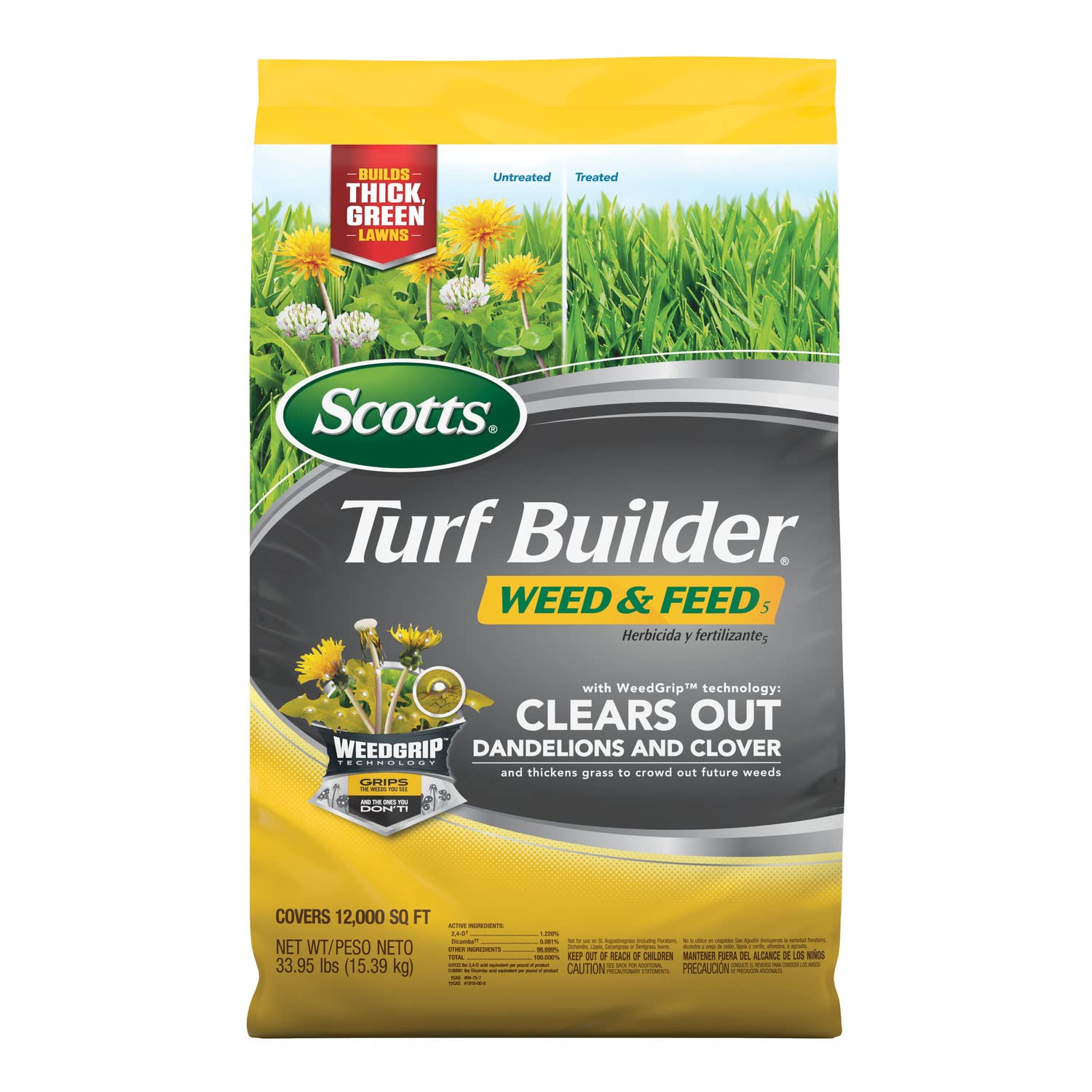
Scotts Turf Builder Weed & Feed5 Granular Lawn Fertilizer (33.95 lb)
| Item Form | Granule |
|---|---|
| Coverage | 12000 square feet |
| Active Ingredients | 2.4‑D and Dicamba |
| Unit Count | 1 Count |
Scotts Turf Builder Weed & Feed5 is a combined granular weed killer and lawn fertilizer intended for use when broadleaf weeds are actively growing and daytime temperatures are between 60°F and 90°F. You apply it to a wet lawn with a broadcast, drop, or hand spreader (Scotts publishes spreader settings) and then avoid watering for 24 hours to let granules stick to weed leaves. The formula uses WeedGrip technology and active ingredients 2,4‑D and dicamba to target common lawn weeds such as clover and dandelion while the fertilizer portion delivers nitrogen and potassium to thicken turf. A single 33.95 lb. bag is sized to cover about 12,000 square feet, making it convenient for medium to large yards. Important limits: do not use on St. Augustine, bentgrass, dichondra, carpetgrass, or lippia and do not apply if rain is expected within 24 hours; the product can also require keeping people and pets off treated turf until dust settles. For homeowners seeking a combined weed control plus feeding step, this simplifies late‑spring applications, but those with excluded grass types or who need precise spot treatments should consider alternatives.
Best for: Homeowners with warm‑season Bahia and other listed grass types who want a single late‑spring application to control broadleaf weeds while feeding the lawn and prefer products with established brand usage guidance.
Less Ideal for: Anyone growing St. Augustine, bentgrass, dichondra, carpetgrass, or lippia or gardeners who need spot treatments, organic options, or year‑round fertilization plans.
- Kills a wide range of listed broadleaf lawn weeds including clover and dandelion using WeedGrip technology
- Feeds lawn while treating weeds so it both reduces weeds and promotes thicker turf
- Large 33.95 lb. bag covers up to 12,000 sq ft, suitable for medium to large lawns
- Published application guidance and spreader settings make it straightforward to apply evenly
- Not safe for use on several turf types including St. Augustine and bentgrass
- Requires dry window after application and restriction on people and pets until dust settles
- Contains synthetic herbicides that require careful handling and label compliance
Verdict: A convenient, proven weed‑and‑feed option for Bahia and other compatible lawns that combines broadleaf weed control with feeding in one late‑spring application.
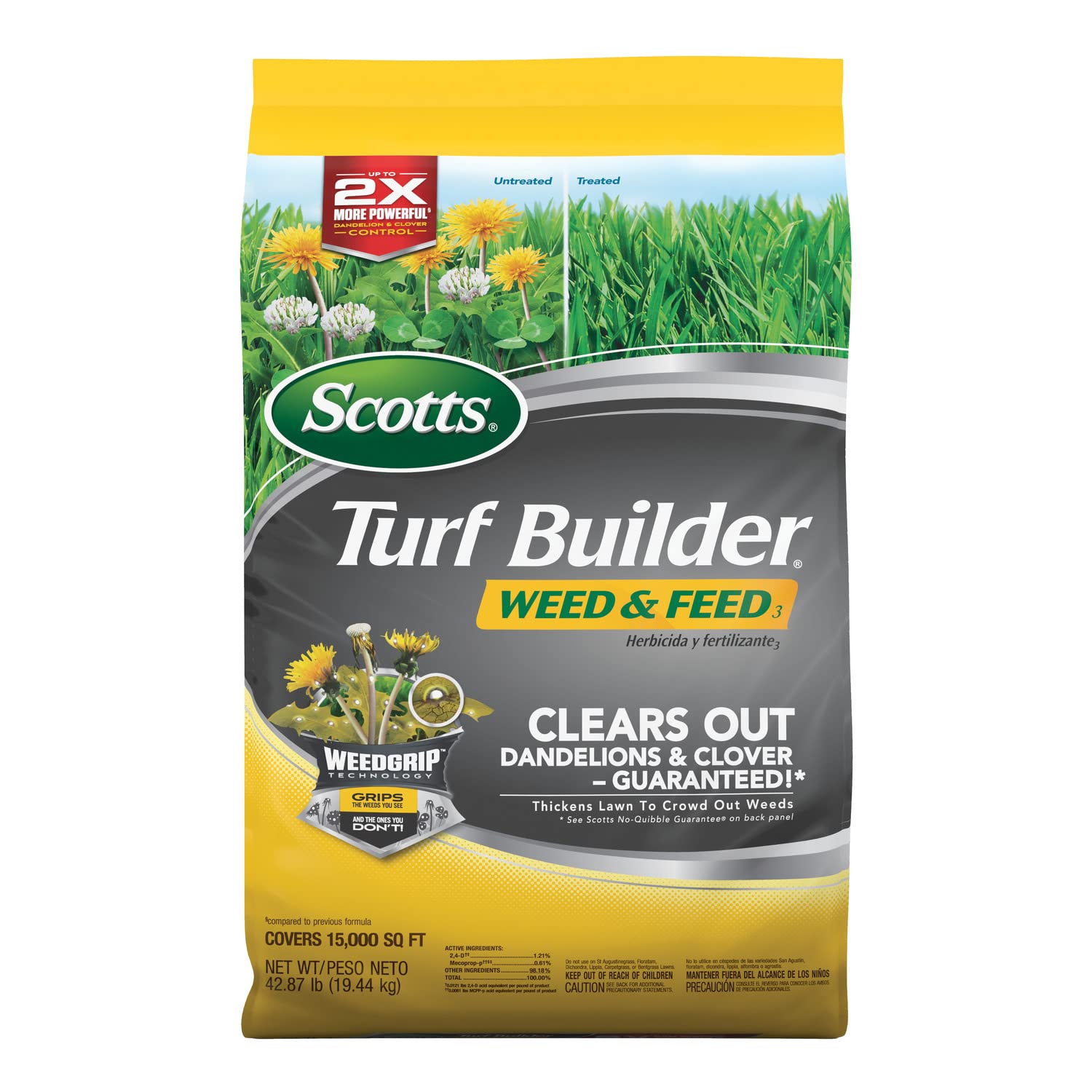
Scotts Turf Builder Weed & Feed (42.87 lb)
| Item Form | Granule |
|---|---|
| Coverage | 15000 square_feet |
| Active Ingredients | 24-D Mecoprop-p |
Scotts Turf Builder Weed & Feed is a granular lawn treatment that kills broadleaf weeds while feeding grass to encourage thicker turf. It is applied with a spreader when weeds are actively growing and temperatures are between 60°F and 90°F; the label recommends applying to a wet lawn so granules stick to weed leaves and waiting 24 hours before watering. The formula uses WeedGrip technology and lists active ingredients including 2,4-D and Mecoprop-p, and the 42.87 lb bag covers about 15,000 square feet. In practice this product is straightforward to broadcast across medium to large lawns and gives visible reduction of common weeds like dandelions and clover while supplying nutrients to help crowd out future weeds. Important limitations are application timing and grass restrictions: do not use on St. Augustinegrass, bentgrass, carpetgrass, dichondra, or lippia, and do not apply if rain is expected within 24 hours. Also keep people and pets off treated turf until dust settles. For homeowners who follow label directions, it is an efficient one-step option for late spring weed control and feeding.
Best for: Homeowners who want a single product to both reduce common broadleaf weeds and feed a cool- or warm-season lawn and who prefer a proven brand with clear label instructions and wide user adoption.
Less Ideal for: People with lawns made of excluded grass types or those needing immediate spot treatment for individual weeds should consider alternatives designed for those specific situations.
- Combines selective broadleaf weed control and fertilizer in one application
- Large bag covers up to 15,000 sq. ft., suitable for medium to large lawns
- WeedGrip technology helps granules adhere to weed leaves for better control
- Granular form is compatible with common broadcast or drop spreaders
- Not safe for several grass types including St. Augustine and bentgrass
- Requires specific temperature and moisture conditions for best results
Verdict: A convenient, proven one-step weed-and-feed for homeowners who want broadleaf weed control plus lawn feeding across large yards.
Choosing the Right Lawn Fertilizer for Weeds: Key Factors to Consider
Nutrient Ratio and Release Profile
The balance of nitrogen, phosphorus, and potassium and how nitrogen is released determine how quickly turf greens up and how long the feeding lasts. A product with a controlled-release nitrogen source provides steady growth and reduces quick flushes that can stress grass, while a fast-release boost is useful for quick green-up when overseeding or after spot-treating weeds.
Consider seasonal needs: spring and fall feedings often benefit from different nitrogen forms than midsummer applications. Pay attention to the label for suggested timing and whether the formula is safe for warm-season versus cool-season turf grasses.
Weed Suppression Support
Some lawn fertilizers are formulated to complement weed-control programs rather than act as herbicides. Thick, healthy turf created by proper fertilization outcompetes weeds, so look for products that promote density and root vigor. Labels may also describe compatibility with preemergent or postemergent herbicides or provide timing suggestions to pair fertilizer applications with weed treatments.
Avoid expecting a fertilizer alone to eliminate established broadleaf or grassy weeds. Instead, treat fertilizer selection as part of an integrated approach that includes mowing height, watering, and targeted weed control.
Application Method and Ease
How a fertilizer is applied affects results and the time you spend on lawn care. Granular spreaders and liquid sprayers each have tradeoffs: granules are convenient for even broadcast application and are easy to store, while liquids can offer precise, uniform coverage for smaller yards or spot treatments.
Check whether the granules are free-flowing, whether the product requires calibration for your spreader, and whether it produces dust. Clear label instructions for spreader settings and re-entry intervals reduce guesswork and can prevent over-application.
Coverage Rate and Consistency
Coverage information tells you how much area a bag or container will treat and how evenly nutrients will be distributed. Inconsistent coverage leads to patchy growth and uneven weed pressure. Look for instructions that include pounds per 1,000 square feet and guidance on overlapping passes to avoid stripes.
For large lawns, higher coverage efficiency reduces handling and time. For small or irregularly shaped yards, choose formats that are easy to apply precisely to avoid runoff or treating non-lawn areas.
Turf Type Compatibility
Different turf species respond differently to nutrient profiles and application timing. Cool-season grasses have peak growth windows in spring and fall and may need different formulations than warm-season grasses that thrive with summer feedings. Choosing a product matched to your turf type reduces stress and improves weed competition.
If your lawn is a mix of grasses, favor formulations with balanced release profiles and follow label guidance for the most sensitive species present.
Safety, Storage, and Handling
Fertilizers can be dusty or have strong odors, and some formulations require precautions when storing or applying. Check label safety directions for protective equipment, child and pet re-entry intervals, and storage recommendations to avoid moisture exposure that can cause caking.
Good packaging and clear mixing or calibration instructions reduce waste and the risk of accidental over-application. Consider environmental precautions for runoff near water features or vegetable beds.
Timing Your Applications for Best Weed Control
When weeds are the main concern, timing fertilizer applications to turf growth cycles reduces openings where weeds can establish. Early spring feedings help cool-season lawns recover from winter and fill in thin spots before summer weeds emerge. For warm-season grasses, a late spring to early summer schedule supports vigorous growth that competes with grassy weeds.
Coordinate fertilizer timing with any preemergent or postemergent herbicide plans. Applying a fertilizer with a steady-release nitrogen at the same time as a preemergent can maintain turf vigor without encouraging excessive top growth that undermines root development.
- Apply heavier, controlled-release feeds ahead of peak growth to build density.
- Use light, fast-release touch-ups for visible yellowing or quick color correction.
- Avoid high-nitrogen rushes before hot, dry spells to reduce stress and disease risk.
Calibrating Spreaders and Measuring Coverage
Proper calibration is essential for even coverage. Follow the product label for spreader settings and test on a small area to confirm rate and pattern. Walk at a steady pace and overlap passes slightly to avoid gaps.
For irregular lawns, break the area into sections and apply in a systematic pattern. Use a handheld spreader for small patches and a broadcast spreader for larger, open lawns to maintain consistent application intensity.
- Mark out 1,000-square-foot test areas to confirm coverage rate.
- Keep records of settings used so future applications are repeatable.
- Rinse spreaders after use to prevent clumping and cross-contamination.
Pairing Fertilizer with Mowing and Watering
Mowing height and watering frequency directly affect how fertilizer benefits turf and suppresses weeds. Taller mowing heights help shade soil and reduce germination of many weed species. Mow at the recommended height for your grass type and avoid removing more than one-third of blade length at a time.
Light, frequent watering after applying a product designed for incorporation into the soil helps nutrients reach roots without creating runoff. Follow label instructions on irrigation timing to ensure proper activation of controlled-release formulations and any co-applied herbicides.
- Keep mower blades sharp to reduce stress and disease vectoring.
- Water gently after granular applications if label recommends it.
- Adjust mowing schedule to encourage lateral spread and denser turf.
Managing Thin Areas and Spot Treatments
Thin or bare patches invite weeds. Address these areas with focused fertility and, if needed, overseeding or patching. Use a fertilizer formulation that supports root development before overseeding so young grass has the nutrients needed for establishment.
For persistent weed spots, use spot treatments that combine targeted weed control with nutrient support. Apply smaller, measured doses to avoid overlapping into healthy turf and creating nutrient imbalances.
- Prepare soil in patches with light raking and amend lightly if compacted.
- Match the fertilizer release profile to seed or sod instructions when repairing.
- Limit spot fertilizer applications to labeled rates for small areas.
Environmental Considerations and Runoff Prevention
Fertilizer runoff can harm waterways and plants in adjacent beds. Choose application rates and timing that minimize runoff risk, such as avoiding heavy applications before heavy rain and using slow-release formulas that reduce soluble nutrient loss. Keep fertilizer off driveways and sidewalks to prevent waste and pollution.
Consider buffer zones near ponds, streams, or storm drains and sweep any granules off hard surfaces back onto the lawn or into a container for reuse. Good practices reduce environmental impact and help keep nutrients where they benefit turf.
- Avoid fertilizing before forecasts of heavy rain.
- Use slow-release formulations to reduce immediate solubility.
- Store unused product securely to prevent accidental spills.
How We Chose the Best Lawn Fertilizer for Weeds
We prioritized products formulated to address both turf nutrition and common weeds found in home lawns. Selection began by filtering for fertilizers that specify enhanced nitrogen timing, include components that support turf density, or are intended to be used alongside or in combination with weed-control programs. We excluded general-purpose garden fertilizers and mixes intended only for new sod or seed establishment. Our evaluation emphasized turf-focused metrics gardeners can verify: nutrient ratio and release profile, compatibility with common spreaders and sprayers, recommended timing and frequency for season-long control, and label guidance for use with herbicides. We also considered physical form and handling for backyard use, such as granule uniformity and dust, because these affect even application and safety. Finally, we gave weight to manufacturer instructions that address typical lawn scenarios like shaded vs sunny areas and high-traffic wear. The result is a shortlist that balances practical application, turf nutrition, and weed suppression guidance.
FAQ
Can a fertilizer eliminate existing weeds on its own?
No. Fertilizer supports turf vigor and helps grass outcompete weeds, but it does not act as a herbicide. Established weeds typically require targeted control measures in addition to proper fertilization.
How soon after applying fertilizer will I see results?
It depends on the release profile. Fast-release formulas can produce visible green-up within days, while controlled-release products improve color and density over several weeks. Environmental conditions and turf health also affect response time.
Is it safe to apply fertilizer near flower beds or vegetable gardens?
Exercise caution. Keep granules and sprays off non-target areas and follow label guidance for buffer zones. Rinsing any granules from hard surfaces back onto the lawn helps avoid accidental transfer to edible gardens.
How often should I fertilize a weed-prone lawn?
Frequency depends on the product and turf type. Many weed-focused programs use multiple applications timed to growth cycles, combining controlled-release feeds for steady nutrition with occasional quick-release touch-ups. Always follow label intervals to avoid over-application.
Can I mix fertilizer and herbicide in the same application?
Sometimes, but only if the product labels explicitly allow tank-mixing or simultaneous application. Read both product instructions carefully for compatibility, application timing, and safety notes to avoid phytotoxicity or reduced effectiveness.
Final Verdict
Prioritize a fertilizer that matches your turf type and the timing needs of your lawn care calendar. Focus on balanced nutrient ratios and a release profile that builds density without causing stress. Pair proper fertilization with correct mowing, watering, and targeted weed control to minimize weed pressure over the season. The right choice depends on whether you need quick green-up, long-term slow feeding, or easy application. Use the evaluation criteria and practical considerations above to match a product to your yard and routine so you get healthier turf and fewer weeds with predictable effort.
