

Note: This article contains affiliate links. If you click on these links and make a purchase, I may earn a small commission at no extra cost to you. This helps support my research and content. Read my full affiliate disclosure here.
Indoor plants respond differently to fertilizers than outdoor beds. A true all-purpose 20 20 20 fertilizer supplies equal parts nitrogen, phosphorus, and potassium, which can support leafy growth, flower set, and general vigor when used at the right rate for pots and containers. Choosing the right formula and application method matters because overfeeding or salt buildup quickly harms confined root systems. This guide covers six shortlisted 20 20 20 fertilizer options suited for houseplants. We evaluated each pick against practical gardener concerns like nutrient balance, dilution and application ease, and salt management so you can pick a product that fits your watering routine and plant mix.
Top Picks at a Glance
| Best Overall The best all-around choice for most situations | Grow More 20-20-20 Water Soluble All-Purpose Fertilizer, 25 lb |  |
| Best Quality Built to a higher standard if you want something more solid | GS Plant Foods All Purpose Water Soluble 20-20-20 Fertilizer (3 lb) |  |
| Best Value The sweet spot between price and what you get | Southern Ag PowerPak 20-20-20 Water Soluble Fertilizer (1 lb) |  |
| Best Budget The cheapest option that still gets the job done reliably | ferti-lome All Purpose Water Soluble Plant Food 20-20-20 (8 oz) |  |
| Highest Rated A top-rated pick with lots of positive feedback | Jack's Classic 20-20-20 All Purpose Water-Soluble Fertilizer (8 oz) |  |
| Most Popular A crowd favorite that many people choose with confidence | Jack's Classic 20-20-20 All Purpose Water-Soluble Fertilizer (24 oz) | 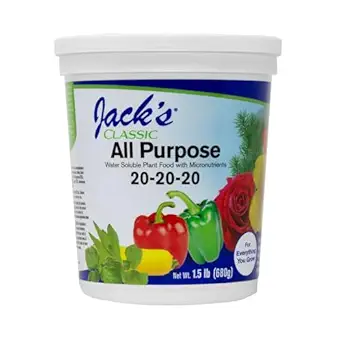 |
Grow More 20-20-20 Water Soluble All-Purpose Fertilizer, 25 lb

| Item Form | Powder |
|---|---|
| Application Method | foliar or soil-feeding |
| Unit Count | 400 Ounce |
| Mixing Ratio | 1 tablespoon/gallon |
| Target Species | All-purpose |
Grow More 20-20-20 is a concentrated, water-soluble powder fertilizer intended as an all-purpose feed for vegetables, flowers, shrubs, trees and houseplants. You mix the powder at the recommended rate (manufacturer lists 1 tablespoon per gallon as a guideline) and apply by soil drench or foliar spray; the product is also suitable for injection into sprinkler or fertigation systems for larger plantings. Its even 20-20-20 NPK profile with chelated micronutrients makes it useful during general growth stages when plants need balanced nitrogen, phosphorus and potassium rather than a bloom- or root-specific formula. The 25 lb bag supplies a lot of feed for multiple seasons and reduces the need to buy multiple specialty fertilizers. Trade-offs are that this is a generic balanced formula so growers seeking targeted bloom boosters or low-salt mixes for sensitive houseplants may prefer a specialized product, and dosing requires care to avoid overfeeding since it is fully soluble and concentrated.
Best for: A practical home grower or hobby gardener wanting a single, balanced fertilizer to simplify feeding routines for mixed houseplants and outdoor plantings. Best for buyers who prioritize convenience and broad compatibility over stage-specific formulations.
Less Ideal for: Not ideal for growers who need low-salt mixes for very sensitive indoor plants or who want a fertilizer formulated specifically for flowering or rooting phases.
- Balanced 20-20-20 NPK suitable for general growth across many plant types
- Water-soluble powder that dissolves in cold water for foliar or soil feeding
- Contains chelated micronutrients to support overall plant health
- Large 25 lb bag provides long-term supply for multiple uses and systems
- Not a specialized bloom or rooting formula for growers who need stage-specific nutrition
- Concentrated soluble form requires careful measuring to avoid overfeeding
Verdict: A versatile, concentrated 20-20-20 water-soluble fertilizer that simplifies feeding for mixed houseplants and general garden use.
GS Plant Foods All Purpose Water Soluble 20-20-20 Fertilizer (3 lb)

| Item Form | dry |
|---|---|
| Specific Uses For Product | Plant Food |
| Application Method | watering can, hose-end sprayer, backpack sprayer |
| Mixing Ratio | 1:1:1 |
This GS Plant Foods 20-20-20 is a concentrated, water-soluble fertilizer intended for frequent feeding of a wide range of plants. It dissolves in water and is applied with a watering can, hose-end sprayer, or backpack sprayer at the recommended mixing ratio of 1 oz per gallon. The formula delivers equal parts nitrogen, phosphate, and potash plus trace elements such as iron, manganese, zinc, copper, boron, and molybdenum, and includes kelp for additional growth-supporting compounds. For houseplant growers seeking reliable, performance-focused feeding, the even NPK balance supports steady vegetative growth and general vigor without needing separate bloom or root formulas. Practical benefits include versatile application methods, a dry powder that stores compactly, and a coverage claim suitable for turf and larger areas when diluted. Limitations are that it is a generic balanced fertilizer rather than a specialized houseplant or bloom-boosting formula, and users must follow dilution and frequency guidelines to avoid overfeeding sensitive species.
Best for: Houseplant owners and growers focused on consistent, measurable performance who want a single balanced feed for foliage and general maintenance.
Less Ideal for: Growers aiming for specialized bloom enhancement, root stimulation, or those who prefer organic-only liquid extracts for delicate or fertilizer-sensitive plants.
- Balanced 20-20-20 NPK supports steady, general-purpose growth
- Includes essential micronutrients for more complete nutrition
- Water-soluble dry formula works with watering cans and sprayers for even application
- Contains kelp to provide natural growth-supporting compounds
- Not specialized for flowering or high-phosphorus feeding needs
Verdict: Choose this product when you want a dependable, performance-oriented balanced 20-20-20 water-soluble fertilizer for regular feeding of houseplants and containers.
Southern Ag PowerPak 20-20-20 Water Soluble Fertilizer (1 lb)

| Item Form | Soluble Fertilizer |
|---|---|
| Specific Uses For Product | Lawns |
| Application Method | Water Soluble |
| Mixing Ratio | 1:128 |
Southern Ag PowerPak 20-20-20 is a straightforward, water-soluble complete fertilizer designed to feed flowers, vegetables, shrubs, trees, lawns and houseplants. Mixed at the label rate (about 2 teaspoons per gallon or 1 lb per 1,000 sq ft for lawns), it delivers equal parts nitrogen, phosphorus and potassium plus chelated minor elements for general growth, root development and overall plant vigor. In practice it is easy to dissolve and apply through a watering can or hose-end applicator, making it convenient for routine liquid feedings of potted plants and mixed beds. The inclusion of chelated micronutrients helps prevent common deficiencies in container plants. Limitations are that it is a general-purpose formula rather than a specialty houseplant blend tailored for specific stages like bloom boost or low-nitrogen maintenance, and frequent liquid feeding still requires careful measurement to avoid overfertilizing sensitive species. For most indoor gardeners who want a reliable, all-purpose soluble feed, this product is a practical, no-frills option.
Best for: Indoor gardeners who want a single, reliable soluble feed to maintain steady growth across a wide range of houseplants and mixed containers.
Less Ideal for: Growers seeking a specialized fertilizer for bloom enhancement, succulents with low nutrient needs, or precise stage-specific feeding programs should look elsewhere.
- Balanced 20-20-20 N-P-K formula supports general growth, root development, and vigor
- Water-soluble form is easy to mix and apply through watering cans or hose applicators
- Contains chelated micronutrients to reduce common trace-element deficiencies
- Clear mixing instructions provided for both potted plants and lawn applications
- General-purpose formula not tailored to specific houseplant stages like flowering or low-nitrogen rest
- Requires regular measurement and application which can lead to overfeeding if not monitored
Verdict: A dependable, easy-to-mix 20-20-20 soluble fertilizer that provides balanced nutrition and chelated micronutrients for straightforward houseplant maintenance.
ferti-lome All Purpose Water Soluble Plant Food 20-20-20 (8 oz)

| Item Form | Liquid |
|---|---|
| Application Method | soil drench and foliar spray |
| Target Species | Geraniums, Pansies, Petunias, Impatiens, annuals, perennials, hanging baskets |
| Mixing Ratio | 1:64 (soil), 1:256 (foliar) |
This 8 oz bottle of ferti-lome 20-20-20 is a straightforward, balanced water‑soluble fertilizer for flowering annuals like zinnias. It mixes easily—directions call for 1–2 teaspoons per gallon for soil applications and a much weaker foliar spray—so you can feed plants either through the potting mix or by spraying leaves. The even N-P-K ratio supports steady vegetative growth while supplying phosphorus and potassium for blooms and overall vigor. Because it is liquid and concentrated, small amounts treat many plants and you can apply it every watering or every few days for continuous bloom production. Limitations are the small 8 oz size if you maintain a large planting area and the lack of granular slow‑release option for low‑maintenance schedules. Also it is a general purpose formula rather than a zinnia-specific bloom booster, so some growers may prefer a higher-phosphorus feed when pushing heavy flower set.
Best for: Gardeners who want an affordable, easy-to-mix liquid fertilizer to keep zinnias and other bedding annuals blooming regularly without complicated feeding schedules.
Less Ideal for: Large-scale or low-maintenance gardeners who prefer slow‑release granules or a high‑phosphorus bloom formula tailored specifically for heavy flowering.
- Balanced 20-20-20 formula suitable for foliage and flowering needs
- Water‑soluble concentrate that mixes quickly for soil or foliar feeding
- Concentrated dosing means small bottle treats many plants when mixed correctly
- Small 8 oz bottle may require frequent repurchase for larger beds or repeated use
- Not a high-phosphorus bloom booster if you want to force extra-heavy flowering
Verdict: A compact, easy-to-use 20-20-20 liquid fertilizer that delivers frequent, balanced feeding to keep zinnias blooming without complicated mixing.
Jack's Classic 20-20-20 All Purpose Water-Soluble Fertilizer (8 oz)

| Analysis | 20-20-20 |
|---|---|
| Item Form | Powder |
| Application Method | Spray or Water |
| Unit Count | 8 Ounce |
| Mixing Ratio | 1 tablespoon/1/2 teaspoon : 1 gallon |
Jack's Classic 20-20-20 is a powdered, water-soluble fertilizer intended for regular feeding of houseplants and other container-grown plants. Mix the powder into water using the included scoop and apply as a root drench or foliar spray; the product lists a clear mixing ratio for convenient, repeatable use. Its balanced 20-20-20 NPK plus added micronutrients supports rapid leaf expansion and general green-up, which makes it useful when plants show slow growth or pale foliage. Because it is a concentrated powder, a single 8-ounce package produces multiple gallons of solution, so it is economical for regular feeding schedules and adaptable to both watering cans and continuous-feed systems. Limitations are that it is a general-purpose formula rather than a crop-specific blend, so growers seeking targeted flower or fruit boosters may prefer a specialty feed. Also follow label safety guidance to avoid contact with skin and eyes and keep it away from children and pets.
Best for: Home growers who prioritize consistent, professional-grade nutrition for houseplants and want a dependable, easy-to-mix fertilizer for routine feeding.
Less Ideal for: Gardeners seeking a specialized bloom booster or fertilizer formulated specifically for acid-loving or fruiting crops should choose a targeted formula instead.
- Balanced 20-20-20 NPK with micronutrients for general growth and green-up
- Water-soluble powder stretches a single container into many gallons of feed solution
- Includes measuring spoon and clear mixing ratio for consistent, repeatable dosing
- Suitable for foliar spray or root feeding and compatible with continuous feed systems
- General all-purpose formula not tailored for flowering or fruiting specialists
Verdict: A reliable, professional-grade 20-20-20 water-soluble powder that delivers consistent, easy-to-mix feedings for healthy, green houseplants.
Jack's Classic 20-20-20 All Purpose Water-Soluble Fertilizer (24 oz)

| Item Form | Powder |
|---|---|
| Specific Uses For Product | Plant Growth |
| Coverage | All |
| Mixing Ratio | 0.22 |
Jack's Classic 20-20-20 is a professional‑grade, water‑soluble powder fertilizer intended for general feeding of indoor and outdoor plants. You dissolve the measured spoonfuls in water and apply as a root drench or foliar spray every 7 to 14 days, or use weaker mixes for seedlings and cuttings. The even 20-20-20 NPK formula promotes quick green‑up and leaf expansion, while included micronutrients support overall plant health. Because it is a powder concentrate, a small tub makes multiple gallons of feed, which is convenient for regular maintenance across beds, containers, and ornamentals. The product ships with a measuring spoon and clear directions, so it is easy to dose consistently. Limitations to note are that it is a generalist formula rather than crop‑specific booster, so plants with specialized needs may do better with targeted blends, and it requires careful handling and dilution to avoid overfeeding. Protective handling is recommended since the powder can irritate skin and eyes.
Best for: Gardeners who want a reliable, easy-to-use all‑around fertilizer for regular maintenance of outdoor beds, containers, and ornamentals and who value predictable, balanced nutrition.
Less Ideal for: Growers seeking a specialized bloom booster or a fertilizer tailored to a single crop should choose a targeted formula instead.
- Balanced 20-20-20 NPK supports fast green-up and leaf growth across many plant types
- Water‑soluble powder stretches farther than comparable liquid feeds so one tub makes multiple gallons
- Usable as both foliar spray and root feed for flexible application
- Includes measuring spoon and clear mixing directions for consistent dosing
- Added micronutrients reduce need for separate supplements
- General all-purpose formula is not optimized for bloom or fruit boosting
- Requires accurate measuring and dilution to avoid fertilizer burn
Verdict: A straightforward, professional‑grade balanced fertilizer that delivers reliable, easy-to-dose nutrition for maintaining healthy outdoor plants.
Choosing the Right 20 20 20 Fertilizer for Houseplants: Key Factors to Consider
Nutrient Ratio and Label Transparency
Knowing the exact N-P-K ratio and the presence of secondary nutrients matters because houseplants live in limited soil volumes. Equal parts nitrogen, phosphorus, and potassium are useful for general feeding, but trace elements like iron, magnesium, and micronutrients influence long-term leaf color and resilience.
Clear labeling tells you how much to add per quart or liter of water and whether the fertilizer is a full-spectrum mix or a simple macronutrient blend. For indoor use, prefer formulas with explicit soluble weight and parts-per-million guidance so you can avoid accidental overdosing when diluting small batches.
Formulation Type and Solubility
Water-soluble concentrates dissolve fully and allow precise dosing for small pots, reducing the chance of salt pockets forming in the container. Dry soluble powders can be fine if fully dissolved, but granules or slow-release pellets behave differently and may release nutrients unevenly in restricted root balls.
Solubility also affects how quickly a plant can access nutrients after feeding. Fast-soluble mixes give predictable short-term response, which is helpful when correcting deficiencies, while slower-release forms may be harder to monitor indoors and can complicate repotting schedules.
Salt Buildup and Leaching Requirements
Houseplants are more sensitive to salt accumulation because you seldom flush large soil volumes. A fertilizer with a higher salt index will require more frequent leaching with plain water to prevent root burn and leaf tip browning.
Consider whether you are willing to perform runoff watering and repot occasionally. Low-salt or mild formulations reduce the maintenance burden, especially for hanging baskets and plants in shallow containers where flushing is harder.
Ease of Dosing for Small Volumes
Measuring tiny amounts accurately matters when you are mixing a few ounces of feed for several small pots. Bottles with graduated caps, pre-measured sachets, or clearly labeled teaspoons and milliliter markings make routine feeding simpler and reduce dosing errors.
If your watering routine is irregular, choose a formulation that tolerates light variation in concentration or that provides a low-dose maintenance recommendation to avoid surprise damage.
Container Size and Root Volume Compatibility
The same dose that works for a 10-inch nursery pot may be too strong in a 4-inch propagation tray. Consider how root volume affects nutrient uptake and how often you repot. Smaller pots need lower or less frequent feeding to prevent salt stress.
Pick formulations that include maintenance-rate instructions for small containers or give clear guidance for young plants and seedlings to avoid stunting or root dehydration from overfeeding.
Application Methods and Flexibility
Some gardeners prefer a weekly dilute feed, others feed every time they water at low strength, and some use periodic stronger feeds when plants are actively growing. A fertilizer that supports multiple approaches-foliar sprays, soil drench, and occasional root soak-offers flexibility.
Also evaluate whether the product works safely with existing watering habits, such as bottom-watering or capillary mats, and whether it requires special mixing equipment for accurate concentration control.
When to Use a Balanced 20 20 20 Feed
A balanced 20 20 20 fertilizer is best used during active growth periods when plants need steady, even access to all three macronutrients. It is particularly useful for mixed collections where you have leafy foliage plants and flowering specimens and want a single maintenance feed that supports both.
Using this fertilizer as a routine maintenance feed avoids extremes that favor only leaf growth or only root development. For sensitive species, reduce frequency and concentration, then observe leaf tips and new growth for any signs of stress.
- Apply at a lower strength for seedlings and recently repotted plants
- Increase frequency slightly during a warm, high-light growth surge
- Flush pots with plain water monthly if you feed regularly to reduce salt build up
Mixing and Measuring Tips for Indoor Watering
Measure carefully when preparing small batches. Use a syringe or graduated cap for milliliter accuracy rather than guessing with teaspoons. Dissolve powders fully in warm water before adding to a watering can to ensure even distribution.
Label a dedicated bottle of mixed solution with concentration and date if you prepare more than a single watering. Most soluble 20 20 20 formulas remain stable for a short period once mixed, but avoid storing mixed feed for long stretches.
- Follow low-strength starter rates for the first application after repotting
- Always mix in a clean container to avoid contamination
- Rinse measuring tools after use to prevent salt crusting
Safe Feeding Schedule for Common Houseplants
A practical approach is to feed at one-quarter to one-half the label rate every one to two weeks during active growth, and to cut back to once a month or stop entirely in seasonal low-light periods. Adjust frequency based on plant response rather than a fixed calendar.
For plants with known sensitivity to salts, such as succulents or some begonias, reduce strength and increase leaching. Keep records of how plants respond so you can refine concentration and timing over a season.
- Use lower concentrations for small pots and seedlings
- Observe leaf tips and root health after several feedings to set a routine
- Water thoroughly until runoff on a schedule for active feeders to prevent salt accumulation
Troubleshooting Common Indoor Feeding Problems
Yellowing leaf margins, tip burn, and slow growth can result from either underfeeding or salt stress. If you suspect salt buildup, flush the pot with several times the container volume of plain water and reduce feed strength going forward.
If growth remains weak after adjusting feeding, check root health and potting mix. Compacted or depleted media will not transmit nutrients effectively and can look like a feeding problem even when nutrients are present.
- Flush pots if you see white crust on the soil surface
- Reduce dose and frequency if new leaf tips brown after feeding
- Repot into fresh, well-draining mix if roots are crowded or soil is degraded
How We Chose the Best 20 20 20 Fertilizer for Houseplants
We focused on attributes that affect houseplant health in pots and small containers. Key evaluation criteria included nutrient profile clarity and labeling so gardeners know exact N-P-K ratios and trace element content; ease of dilution and application for common indoor watering schedules; formulation type and how it affects salt buildup and repotting intervals; and packaging sizes and dispensing options that suit small-scale use. We tested selection logic against durability in typical indoor conditions, such as infrequent watering, lower light, and restricted root volume. Exclusions included outdoor-only formulations, products lacking clear N-P-K labeling, and fertilizers designed primarily for lawns or large-scale agriculture. We excluded slow-release granules that cannot be safely monitored in pots without repotting and products with unclear mixing instructions. The final list favors soluble, clearly labeled formulas that are straightforward to dose and that reduce the risk of overconcentration in container soils.
FAQ
How often should I feed houseplants with a 20 20 20 fertilizer?
It depends on plant type and light levels. Many indoor gardeners use a low-strength feed every one to two weeks during active growth and reduce or stop in low-light seasons. Watch plant response and adjust frequency accordingly.
Can I use a 20 20 20 fertilizer on seedlings and young plants?
You can, but use a much lower concentration for seedlings and recently rooted cuttings. Young roots are sensitive to salts, so start at one-quarter label strength and increase slowly if growth appears healthy.
How do I avoid salt buildup when using a soluble fertilizer indoors?
Leach pots periodically by watering thoroughly until runoff, reduce concentration, and use a well-draining potting mix. If buildup appears as white crust or leaf tip burn, flush the pot and hold off feeding until plants recover.
Is foliar feeding with a 20 20 20 mix safe for houseplants?
Foliar feeding can provide quick correction for deficiencies but should be dilute and used sparingly. Avoid spraying in direct sun or on already wet foliage to reduce leaf spotting and limit foliar applications to mild, short-term use.
Will a balanced 20 20 20 feed promote flowering?
A balanced feed supports both foliage and flowers, but flowering often responds to light, pruning, and specific phosphorus needs. If blooms are sparse, evaluate light and consider targeted bloom-boost feeds at appropriate intervals.
Can I mix a 20 20 20 fertilizer with other houseplant treatments?
Mixing with other liquid products depends on their chemistry. Avoid combining with strong acids, undiluted concentrates, or products with unclear compatibility. When in doubt, test a small volume and observe for precipitation or color changes before treating plants.
Final Verdict
For indoor growers, the right 20 20 20 fertilizer is one that balances clear labeling, low salt impact, and easy dosing for small volumes. Prioritize soluble formulas with straightforward dilution instructions if you manage a mixed collection in pots and want predictable, even feeding. Balance tradeoffs between growth stimulation and maintenance tasks like leaching and repotting. Use lower concentrations for small pots and seedlings and increase only when plants show healthy, vigorous response. That approach will help you maintain steady growth without risking salt stress or root damage.
