

Note: This article contains affiliate links. If you click on these links and make a purchase, I may earn a small commission at no extra cost to you. This helps support my research and content. Read my full affiliate disclosure here.
June is a pivotal month for warm- and cool-season lawns because growth rates and stress factors change as temperatures rise. Choosing the right fertilizer for grass in June affects color, root depth, and how well the lawn copes with summer heat or drought. This guide shortlists six top options suited to June feeding and evaluates them by nutrient profile, release rate, and application ease. Read on to see how we judged their timing, longevity, and turf health impact before the product list.
Top Picks at a Glance
| Best Overall The best all-around choice for most situations | Scotts Green Max Lawn Food (16.67 lb) |  |
| Best Quality Built to a higher standard if you want something more solid | The Andersons Professional PGF Complete 16-4-8 Granular Lawn Fertilizer (covers 5,000 sq ft) |  |
| Best Value The sweet spot between price and what you get | GreenView Lawn Food 22-0-4, 16 lb bag |  |
| Highest Rated A top-rated pick with lots of positive feedback | GreenView Multi-Purpose Fertilizer 10-10-10, 33 lb |  |
| Most Popular A crowd favorite that many people choose with confidence | Scotts Turf Builder Weed & Feed5 Granular Lawn Fertilizer (33.95 lb) |  |
| Best Seller A high-volume bestseller chosen again and again | Scotts Turf Builder Lawn Food, 12.5 lb |  |
Scotts Green Max Lawn Food (16.67 lb)

| Item Form | Granules |
|---|---|
| Coverage | 5000 square feet |
| Specific Uses For Product | Lawn |
| Target Species | lawn grass |
Scotts Green Max Lawn Food is a granular, all-purpose lawn fertilizer formulated to deliver fast greening with a 2-in-1 feed plus 5% iron supplement. It is applied with a broadcast or drop spreader to any grass type and is recommended for routine spring, summer, or fall applications. Notable features include a guaranteed nonstaining formula when used as directed and settings provided for Scotts spreaders to help get an even application across the advertised 5,000 sq ft coverage. The iron content speeds visible greening in as little as three days and the granules are ready to water in for faster uptake. For a risk-averse homeowner growing fescue in spring, the product is straightforward to use and safe to re-enter the lawn immediately after application. Limitations are that proper spreader settings and sweeping up excess product are important to avoid runoff and that it is a general lawn food rather than a specialized product for nutrient-deficient soils, so a soil test is still useful for targeted corrections.
Best for: Homeowners who want a low-risk, easy-to-apply lawn food that produces quick green results on fescue lawns in spring and prefer established brand guidance for application.
Less Ideal for: Gardeners seeking a product to correct a specific nutrient imbalance or those who prefer liquid or organic-only fertilizing approaches.
- Includes 5% iron for faster, deeper greening visible in about three days
- Premeasured granular form covers up to 5,000 sq ft from one bag
- Manufacturer provides spreader settings to simplify even application
- Formulated not to stain concrete or driveways when used as directed
- Not a tailored corrective fertilizer for specific soil deficiencies
- Requires correct spreader settings and cleanup to prevent runoff
Verdict: A simple, fast-acting granular lawn food with added iron that reliably greens fescue lawns when applied with a spreader.
The Andersons Professional PGF Complete 16-4-8 Granular Lawn Fertilizer (covers 5,000 sq ft)

| Item Form | Granules |
|---|---|
| Specific Uses For Product | Soil Conditioning |
| Target Species | lawn grasses |
| Unit Count | 288 Ounce |
| Mixing Ratio | 4-1-2 ratio |
This granular fertilizer is built to boost turf performance with a 16-4-8 N-P-K ratio that delivers both immediate and extended nitrogen release for up to eight weeks. It is typically applied with a broadcast spreader at the recommended rate on dry foliage, then lightly watered to activate the Humic DG technology that helps nutrients move into the root zone. Notable features include super-fine particles for even coverage, added iron and micronutrients for richer color, and a mix of quick and slow-release nitrogen for steady growth without frequent reapplication. Practical benefits for a performance-focused buyer are visibly greener turf, reduced application frequency, and improved soil conditioning from humic acids. Important limitations are that it is a granular product so precise spreader calibration and steady walking are required for uniform results, and it is not labeled for sale in California which restricts availability in that state.
Best for: Gardeners focused on high-performance, visibly greener lawns who want a single application product that delivers both immediate and extended feeding and supports soil health.
Less Ideal for: Small container gardeners or people who prefer liquid or organic-only fertilizer programs should consider other formats or formulations.
- Balanced 16-4-8 N-P-K with both quick- and slow-release nitrogen for immediate color and sustained feeding
- Super-fine particles designed for even distribution across the lawn
- Includes iron and multiple micronutrients to improve turf color and overall plant nutrition
- Humic DG additive to help move nutrients into the soil and support soil conditioning
- Requires correct spreader settings and consistent walking speed to avoid streaking
- Not available for sale in California
Verdict: Choose this fertilizer when you want a performance-focused granular formula that delivers quick color boost plus up to eight weeks of sustained feeding for greener grass.
GreenView Lawn Food 22-0-4, 16 lb bag

| NPK | 22-0-4 |
|---|---|
| Form | Granules |
| Coverage | 5,000 sq. ft. |
| Application | Broadcast or drop spreader |
GreenView Lawn Food is a granular, broadcast-applied lawn fertilizer designed to boost root development, speed spring green-up, and maintain deeper green color through an eight-week controlled-release formula. You apply it with a broadcast or drop spreader over up to 5,000 sq. ft., and the MESA controlled-release nitrogen delivers both immediate and slow-release nutrition so you get quicker green-up without a surge of excessive top growth. The zero-phosphate 22-0-4 blend focuses on nitrogen and potassium to improve drought resistance and nutrient uptake in established turf. Practical benefits for summer care include longer feeding intervals, better water retention from improved root vigor, and fewer repeat applications compared with quick-release products. Limitations are that it is not a starter fertilizer for new seed because it contains no phosphorus and it requires a spreader for even coverage; hand spreading is discouraged. Also the 16 lb bag suits small to medium lawns rather than large properties where multiple bags would be needed.
Best for: Homeowners who want a low-maintenance summer feed that reduces how often you need to reapply and prioritizes steady green-up and root health.
Less Ideal for: Those establishing new lawns from seed or managing large commercial turf areas who need phosphorus or high-coverage bulk quantities.
- Controlled-release MESA nitrogen gives up to 8 weeks of feeding for fewer applications
- Applicable with common broadcast or drop spreaders for even coverage
- Zero-phosphate formula aligns with lawn-use restrictions and protects waterways
- 22-0-4 NPK focuses on root development and drought resilience
- Not suitable as a phosphorus-containing starter fertilizer for new seed
- 16 lb bag covers about 5,000 sq. ft. so larger lawns will need multiple bags
Verdict: A convenient, controlled-release summer lawn food that keeps small to mid-size lawns greener longer with fewer applications.
GreenView Multi-Purpose Fertilizer 10-10-10, 33 lb

| Item Form | Granules |
|---|---|
| Application Method | broadcast or drop spreader |
| Specific Uses For Product | Plant Growth, Root Development, Seed Development, Soil Conditioning |
| Target Species | Trees, Shrubs, Vegetables, Flowers, Ornamental Gardens |
GreenView 10-10-10 is a granular, balanced fertilizer designed for routine feeding across mixed garden beds. It is applied with a broadcast or drop spreader and can be used when planting or as a general feed to support plant growth, root development, and seed establishment. The product's NPK 10-10-10 formulation supplies nitrogen, phosphorus, and potassium in equal measure, which makes it a safe choice when you need broad-spectrum nutrition without strengthening one growth phase excessively. The bag covers a large area so it is convenient for medium to large beds and mixed plantings. Important practical notes are that it is intended to be distributed with a spreader rather than hand spread and that label directions differ by plant type, so following coverage and timing guidance is important. For gardeners that prefer tailored, soil-test-based fertilization or slow-release formulations targeted to a single crop, this general-purpose granular will be less specific than specialty blends.
Best for: Gardeners who want a single, straightforward fertilizer to maintain mixed garden beds and prefer a practical, easy-to-apply solution that covers multiple plant types.
Less Ideal for: Growers seeking a slow-release feed, highly targeted nutrient program, or formulas tuned to a specific crop or diagnosed soil deficiency.
- Balanced 10-10-10 NPK suitable for a wide range of vegetables, flowers, shrubs, and trees
- Granular form works with broadcast or drop spreaders for fast, even coverage
- Large coverage per bag makes it practical for multiple garden beds
- Supports plant growth, root development, and seed establishment
- Not a crop-specific or soil-test tailored formula for addressing particular nutrient deficiencies
Verdict: A single balanced granular fertilizer that delivers broad-spectrum nutrition and easy spreader application for maintaining mixed garden beds.
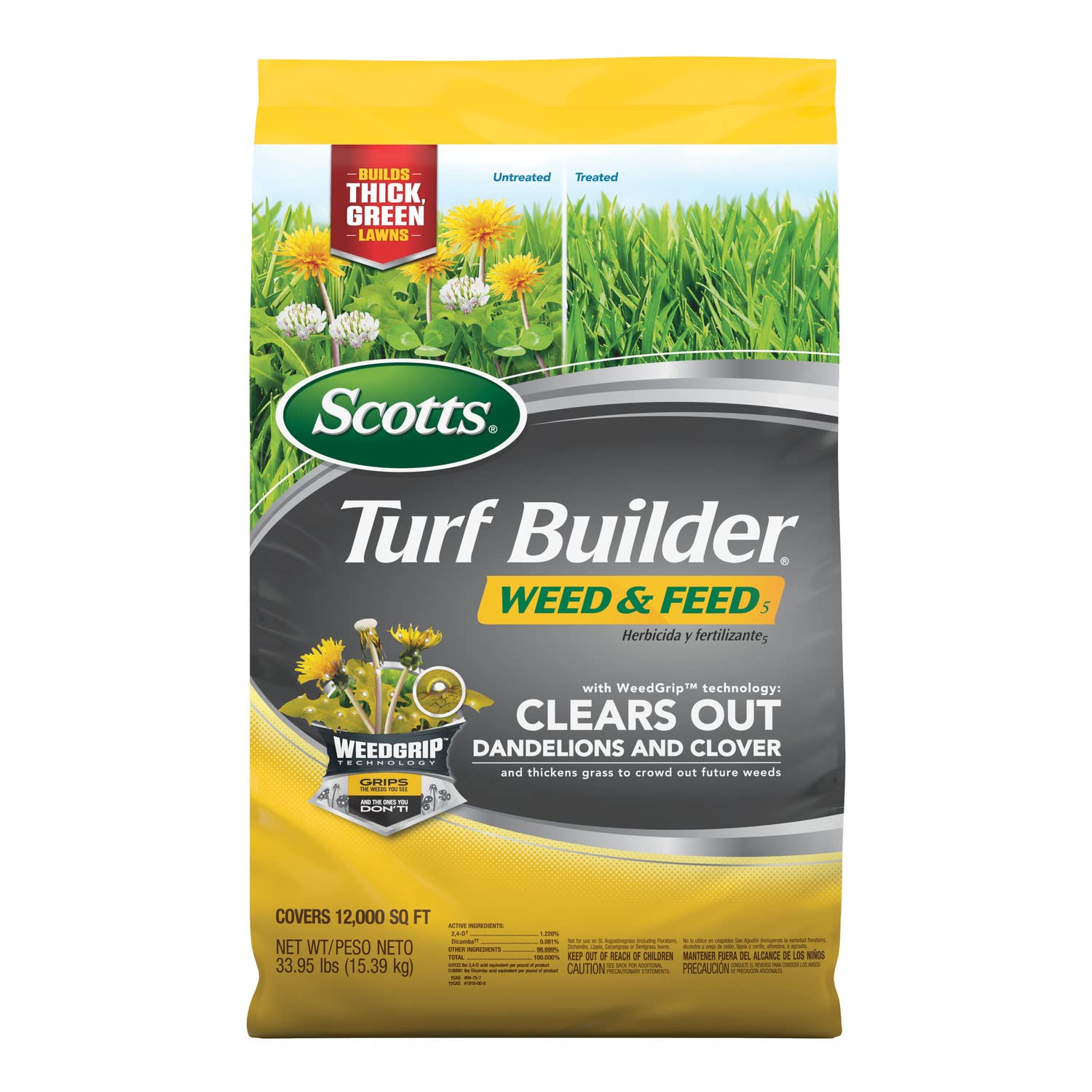
Scotts Turf Builder Weed & Feed5 Granular Lawn Fertilizer (33.95 lb)
| Item Form | Granule |
|---|---|
| Coverage | 12000 square feet |
| Active Ingredients | 2.4‑D and Dicamba |
| Unit Count | 1 Count |
Scotts Turf Builder Weed & Feed5 is a combined granular weed killer and lawn fertilizer intended for use when broadleaf weeds are actively growing and daytime temperatures are between 60°F and 90°F. You apply it to a wet lawn with a broadcast, drop, or hand spreader (Scotts publishes spreader settings) and then avoid watering for 24 hours to let granules stick to weed leaves. The formula uses WeedGrip technology and active ingredients 2,4‑D and dicamba to target common lawn weeds such as clover and dandelion while the fertilizer portion delivers nitrogen and potassium to thicken turf. A single 33.95 lb. bag is sized to cover about 12,000 square feet, making it convenient for medium to large yards. Important limits: do not use on St. Augustine, bentgrass, dichondra, carpetgrass, or lippia and do not apply if rain is expected within 24 hours; the product can also require keeping people and pets off treated turf until dust settles. For homeowners seeking a combined weed control plus feeding step, this simplifies late‑spring applications, but those with excluded grass types or who need precise spot treatments should consider alternatives.
Best for: Homeowners with warm‑season Bahia and other listed grass types who want a single late‑spring application to control broadleaf weeds while feeding the lawn and prefer products with established brand usage guidance.
Less Ideal for: Anyone growing St. Augustine, bentgrass, dichondra, carpetgrass, or lippia or gardeners who need spot treatments, organic options, or year‑round fertilization plans.
- Kills a wide range of listed broadleaf lawn weeds including clover and dandelion using WeedGrip technology
- Feeds lawn while treating weeds so it both reduces weeds and promotes thicker turf
- Large 33.95 lb. bag covers up to 12,000 sq ft, suitable for medium to large lawns
- Published application guidance and spreader settings make it straightforward to apply evenly
- Not safe for use on several turf types including St. Augustine and bentgrass
- Requires dry window after application and restriction on people and pets until dust settles
- Contains synthetic herbicides that require careful handling and label compliance
Verdict: A convenient, proven weed‑and‑feed option for Bahia and other compatible lawns that combines broadleaf weed control with feeding in one late‑spring application.
Scotts Turf Builder Lawn Food, 12.5 lb

| Item Form | Powder |
|---|---|
| Specific Uses For Product | Lawn |
| Coverage | 5,000 sq. ft. |
| Mixing Ratio | 32:0:4 |
Scotts Turf Builder Lawn Food is a general-purpose granular fertilizer formulated for use on any grass type to thicken turf and improve root strength. You spread it with a broadcast or drop spreader (Scotts provides recommended settings) and can apply it to wet or dry lawns in spring, summer, or fall. The formula is pesticide-free and emphasizes building deeper roots so the lawn better absorbs water and nutrients, which helps turf resist stress over the season. One 12.5 lb bag covers about 5,000 sq. ft., making it a simple option for small to medium yards or spot treatments. Practical benefits include clear application guidance, compatibility with common spreaders, and the option to water in for faster greening. Limitations are that this single bag covers a modest area compared with larger homeowner bags and it does not include weed control or insect protection, so you may need additional products for comprehensive lawn care.
Best for: Buyers who want a reliable, easy-to-apply granular fertilizer to strengthen and green a small to medium lawn and prefer products with widespread user approval and clear instructions.
Less Ideal for: Homeowners needing one-step weed or pest control, or those with large properties who want a single bag to cover many thousands of square feet.
- Works on all common grass types so one product fits mixed lawns
- Builds stronger, deeper roots to improve water and nutrient uptake
- Clear spreader settings and can be applied to wet or dry turf for flexibility
- Pesticide-free formula suitable when you only want fertilization
- Covers only about 5,000 sq. ft. per bag, requiring multiple bags for larger yards
- Does not include weed or insect control so additional products may be needed
Verdict: A reliable, easy-to-use granular lawn food that builds stronger roots and is a solid choice for feeding small to medium lawns.
Choosing the Right Fertilizer for Grass in June: Key Factors to Consider
Nutrient Ratio and Nitrogen Source
The fertilizer's N-P-K ratio and the form of nitrogen determine how the lawn responds in June. A moderate nitrogen level helps maintain green color without driving excessive top growth that increases water demand. Ammonium-based or fast-release nitrogen produces quick green-up but raises burn risk during hot spells. Slow-release or stabilized nitrogen provides steady feeding that supports consistent growth through summer.
Knowing the nitrogen source helps you choose a product that matches your watering schedule and tolerance for mowing frequency. For lawns prone to stress, lean toward more controlled-release nitrogen to avoid a sudden flush of tender growth.
Release Rate and Longevity
Release rate defines how quickly nutrients become available and how often you must reapply. In June, weather can swing between cool mornings and hot afternoons, so a balanced release reduces the chance of scorching and limits fertilizer runoff during heavy rain.
Longer-lasting formulas cut down on application frequency, which is helpful if you prefer fewer lawn tasks over the summer. Shorter-release options are useful when you need a fast cosmetic green-up before an event, but they may require more vigilance around watering and mowing.
Turf Safety and Burn Risk
Fertilizer salt content and particle size affect how likely a product is to burn grass under heat or drought. High-salt, high-solubility products can desiccate leaf tissue if not watered in properly. Particle uniformity also affects how evenly granules spread, influencing local concentrations that cause burn spots.
Consider the lawn's recent moisture history before applying. If conditions are dry or a heat wave is expected, choose a gentler formula or plan to irrigate after application to reduce surface salt buildup and protect the turf.
Compatibility With Grass Type
Warm-season and cool-season grasses have different growth cycles in June. Cool-season species may still be active and benefit from moderate feeding, whereas warm-season grasses are often entering peak growth. A June fertilizer should match the physiology of your turf to avoid overfeeding or underfeeding.
Selecting a product labeled for your grass type or one with flexible ratios helps ensure the treatment supports root growth and plant health instead of promoting weak, succulent shoots that are vulnerable to heat stress.
Application Method and Equipment
How you apply fertilizer affects coverage and results. Granular spreaders offer convenience but require calibration for even distribution. Liquid applications can give faster uptake but need mixing and sometimes specific equipment. Some granules are formulated for drop spreaders or broadcast spreaders differently.
Think about the tools you already own, how comfortable you are with calibration, and whether you prefer a one-time application or scheduled treatments. Ease of cleanup and storage are also practical considerations for homeowner users.
Environmental Considerations and Timing
Applying fertilizer at the wrong time or in the wrong quantity increases the risk of nutrient runoff into nearby soil and water. June can bring heavy rains in some regions, so timing applications before light rain is fine, but avoid feeding right before heavy storms.
Choose products with lower soluble phosphorus if local regulations or soil tests indicate it is unnecessary. Also consider slow-release options to reduce nutrient spikes that contribute to runoff and to provide more consistent feeding for the lawn.
When to Apply Fertilizer in June
Aim to fertilize in the early part of June when soil temperatures and growth rates are stabilizing. Morning application followed by light irrigation helps move nutrients into the root zone without wetting leaf surfaces for long periods.
Avoid applying during predicted heat waves or right before heavy rainfall. If the lawn is stressed from drought, delay feeding until you have watered and allowed recovery.
- Apply in the morning to reduce leaf scorch
- Water lightly after spreading to incorporate granules
- Skip application if turf is drought-stressed
How to Match Feedings to Your Mowing Schedule
Coordinate fertilizer timing with mowing so you do not remove treated leaf tissue immediately after application. Mow a day or two before feeding to reduce clumping of clippings on freshly applied granules.
Consider the expected growth boost from the product's nitrogen source. Fast-release formulas may require more frequent mowing, while slow-release types moderate growth and reduce clipping frequency.
- Mow before applying to improve coverage
- Adjust mower height to help shade roots during hot periods
- Expect quicker regrowth with soluble nitrogen
Irrigation and Fertilizer Interaction
Proper irrigation is key after a June application. Watering helps activate granules, reduce salt buildup, and carry nutrients to roots. Avoid overwatering, which can leach nutrients below the root zone.
Set irrigation to deliver a light to moderate soak immediately after application, then return to normal watering cycles. For slow-release formulas, standard irrigation schedules are usually sufficient.
- Water in granules within 24 hours
- Avoid heavy irrigation that causes runoff
- Monitor soil moisture to prevent leaching
Adjusting Rates Based on Soil Tests
A recent soil test gives the best guidance on how much and what type of fertilizer you need in June. Soil tests reveal existing nutrient levels and pH, which influence nutrient availability and the appropriate N-P-K ratio.
If a test shows adequate phosphorus or potassium, select a product with lower levels of those nutrients and focus on nitrogen and micronutrients to meet turf needs without overloading the soil.
- Base nitrogen rates on grass type and test results
- Use lime or sulfur if pH adjustments are indicated before heavy feeding
- Retest every few years to track nutrient trends
Addressing Common Summer Turf Problems
June can bring issues like increased thatch, insect activity, and early-season disease pressure. A June fertilizer should strengthen roots and avoid excessive top growth that encourages pest problems.
Integrate cultural practices such as aeration, dethatching, and proper irrigation to complement fertilization. A balanced feeding plan supports recovery from early stress and helps the lawn tolerate mid- and late-summer challenges.
- Use moderate nitrogen to avoid thatch buildup
- Combine fertilization with aeration when compacted
- Monitor for signs of pests and disease after feeding
How We Chose the Best Fertilizer for Grass in June
We focused on factors that matter for midseason lawn care and excluded specialty formulas meant only for spring green-up or winter hardening. Selection prioritized fertilizer mixes that deliver an appropriate nutrient balance for June conditions, clear release characteristics, and predictable application results. We considered nitrogen source and ratio because June feeding should balance quick color without causing excessive top growth. Longevity and release type were important to reduce the risk of scorch and to match maintenance schedules. Application simplicity and compatibility with common spreaders and sprinklers were evaluated to reflect typical homeowner tools. We also reviewed turf safety data such as salt index and burn risk, plus suitability for both cool-season and warm-season grass types where possible. Products were excluded if they were formulated exclusively for new seed establishment, contained high herbicide mixes, or required professional application methods beyond homeowner reach.
FAQ
Can I apply fertilizer in June if my lawn is already green?
Often yes. If the lawn is actively growing, a moderate June feeding can maintain color and root health. Reduce application rates if the grass is lush to avoid excessive, tender growth during heat.
Should I use a slow-release or fast-release product in June?
It depends on your priorities. Slow-release supplies steady nutrition and lowers burn and runoff risk, while fast-release gives quick green-up but may increase watering and mowing needs.
How long should I wait to water after applying granular fertilizer?
Water lightly within 24 hours to move nutrients into the soil and reduce surface salt concentration. Avoid heavy watering that causes runoff.
Is it safe to fertilize during a dry spell in June?
Usually not. If the lawn is drought-stressed, postpone feeding until after it has recovered and you can irrigate. Fertilizing dry turf increases burn risk and stress.
Do warm-season and cool-season grasses need different June feeding approaches?
Yes. Warm-season grasses often benefit from stronger June feeding as they enter peak growth, while cool-season grasses need more conservative rates to avoid heat stress. Match fertilizer type and rate to your grass species.
Final Verdict
For June feeding, prioritize nutrient balance, controlled-release nitrogen, and turf safety over aggressive quick-green formulas. Match application timing to weather and your irrigation capacity, and use soil test results to set appropriate rates. By focusing on steady root support and minimizing burn or runoff risk, you will keep the lawn resilient through the summer months.
